REVIEW 4 major objections 5 minor 32 references
Two scalarizations of magnetically charged black holes
T0 review · 4 major / 5 minor · reviewed 2026-08-06 · deepseek-v4-flash
Pith's one-line read The paper claims that a single magnetically charged black hole admits two scalarization mechanisms: a Gauss-Bonnet channel with a narrow instability window and a single branch, and a nonlinear-electrodynamics channel with infinitely many…
desk verdict Useful new onset numbers for a magnetically charged qOS-like black hole, but the infinite-branches claim is inferred from linearized WKB analysis rather than demonstrated. read the letter →
The pith
A machine-rendered reading of the paper's core claim, the machinery that carries it, and where it could break.
The reading
What carries the argument
The machinery is the linearized scalar perturbation theory around the bald metric of Eq. (12). For each coupling the scalar equation reduces to a one-dimensional Schr\"odinger-type problem with effective potential (30) or (45); the GB$^-$ critical onset follows from the resonance condition $r_c(M,\alpha,P)=0$ (Eq. 34), which encodes the degenerate binding well at $\lambda\to-\infty$, while the NED$^+$ branch count follows from the WKB quantization condition (Eq. 49), whose large-$\lambda$ form yields $\lambda_{\mathrm{in},n}$ (Eq. 53). The Smarr formula $m=2TS+4W_\alpha\alpha$ with $\alpha$ as thermodynamic variable is what connects the bald black hole thermodynamics to the scalarization-onset questions.
What would settle it
Solve the full field equations (4) and (10) numerically for the fundamental NED+ branch at $M=1$, $\alpha=1$, $P=0.6$ with $\lambda$ just above $\lambda_{\mathrm{in},0}=119$ and check whether a regular, asymptotically flat scalarized black hole exists; the WKB prediction of infinite branches is only as strong as the existence of that first nonlinear solution.
Extended reading notes
Core claim
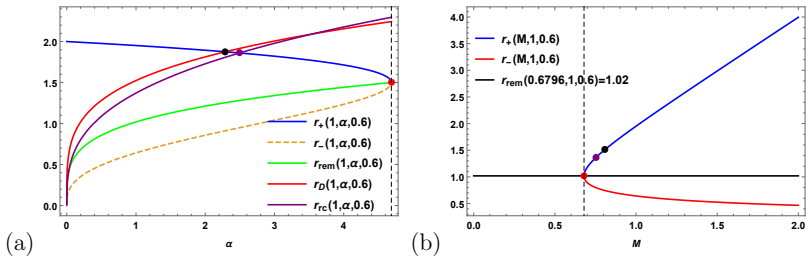
The central claim is that the same magnetically charged black hole described by Eq. (12) scalarizes in two inequivalent ways depending on which coupling is switched on. For the $f_1$ coupling (GB$^-$ scalarization with $\lambda<0$), the critical onset parameters are $\alpha_c=2.4948$ at $M=1$, $P=0.6$ and $M_c=0.7556$ at $\alpha=1$, $P=0.6$, with a narrow instability window $\alpha_c\le\alpha\le\alpha_e$ and $M_{\mathrm{rem}}\le M\le M_c$, and the Davies points of the heat capacity do not mark this onset. For the $f_2$ coupling (NED$^+$ scalarization with $\lambda>0$), the instability window is wide, $\alpha\in[0,\alpha_e]$ and $M\in[M_{\mathrm{rem}},\infty)$, and the WKB bound-state condition $\int dr\sqrt{-V_2}/g=(n-1/4)\pi$ gives discrete starting couplings $\lambda_{\mathrm{in},n}=\pi^2(n+3/4)^2/I_n^2$, hence infinitely many branches of scalarized charged black holes. The paper also establishes a Smarr formula $m=2TS+4W_\alpha\alpha$ with the action parameter as the thermodynamic variable, and shows that observed shadow-radius data do not constrain $\alpha$ but do constrain $M$.
Load-bearing premise
The load-bearing premise is that the onset and multiplicity of scalarization are fully captured by threshold conditions on the linearized scalar perturbation (the resonance condition $r_c=0$ and the WKB quantization of the effective potential), because the paper never solves the full nonlinear equations for the scalarized solutions.
Editorial extensions
If this is right
- If the resonance-condition analysis is right, GB$^-$ scalarized charged black holes exist only in the window $\alpha_c\le\alpha\le\alpha_e$ for $M=1$ and $M_{\mathrm{rem}}\le M\le M_c$ for $\alpha=1$; outside this window the bald hole is stable against this channel.
- The mismatch between Davies points and critical onset means that, for this model, a heat-capacity phase transition is not a signal that scalarization is about to begin, in contrast to the quantum Oppenheimer-Snyder case.
- If the WKB quantization is right, the NED$^+$ channel predicts an infinite tower of scalarized branches labeled $n=0,1,2,\ldots$, with each branch turning on at its own coupling $\lambda_{\mathrm{in},n}$; the fundamental branch starts at $\lambda_{\mathrm{in},0}=119$ for $M=1$, $\alpha=1$, $P=0.6$.
- The shadow-radius comparison yields no constraint on $\alpha$ but restricts the mass to $0.886\lesssim M\lesssim1.011$ at $1\sigma$ and $0.823\lesssim M\lesssim1.076$ at $2\sigma$ for $\alpha=1$, $P=0.6$.
- The Smarr formula makes $\alpha$ a genuine thermodynamic variable with chemical potential $W_\alpha=P^2/r_+^3$, so first-law consistency holds with $\alpha$, not the magnetic charge $P$, as the work term.
Reading between the lines
- If the WKB threshold quantization is taken literally, the infinite-branch structure is a prediction that can be checked only by constructing the nonlinear solutions, which the paper leaves as a numerical step; a natural test is to solve Eqs. (4) and (10) just above $\lambda_{\mathrm{in},0}$ and see whether exactly one fundamental branch emerges.
- The unexplained point where Davies and critical-onset curves intersect suggests some hidden thermodynamic condition; deriving the algebraic condition $r_D=r_{rc}$ and identifying its physical meaning could either restore a partial Davies-onset connection or expose the intersection as accidental.
- Because the magnetic charge enters mostly through the combinations $\alpha P^2$ and $\alpha P$, the same onset curves may hold for other fixed $P$ after rescaling $\alpha$; checking this would turn the $P=0.6$ results into a general statement about the model.
- The shadow bounds are computed on the bald background, so if NED$^+$ scalarized branches carry hair, their shadows should be recomputed before using the observed mass bounds for the scalarized objects.
Editorial analysis
A structured set of objections, weighed in public.
Referee Report
Summary. This manuscript studies magnetically charged black holes in Einstein-Gauss-Bonnet-scalar theory with a nonlinear electrodynamics (NED) term, with two scalar coupling functions f1(φ) and f2(φ). The bald solution is the four-parameter family (12) involving mass M, action parameter α, and magnetic charge P (mostly fixed to P=0.6). The paper computes the thermodynamics of this family, presents a Smarr formula, identifies Davies points, performs a shadow-radius analysis with EHT constraints, and then studies two scalarization mechanisms: GB− scalarization via f1(φ)=2λφ² with λ<0, giving critical onset parameters αc=2.4948 and Mc=0.7556; and NED+ scalarization via f2(φ)=1−λφ²/3 with λ>0, for which WKB quantization (Eqs. 48–53) yields a sequence λ_in,n that the paper interprets as the onset of infinitely many branches of scalarized charged black holes. The main structural claims are that the Davies points do not coincide with the GB− onset curve (except at one unexplained point) and that the NED+ mechanism has a much wider instability window than GB−.
Significance. If the central claims were fully established, the model would offer an interesting two-mechanism scalarization setup in a single theory, with a concrete link to a candidate quantum Oppenheimer-Snyder black hole and with testable shadow-radius predictions. The analytic thermodynamic expressions, the explicit critical onset parameters, and the use of the Hod resonance condition and the Dotti-Gleiser integral are clear and reproducible strengths; the computations are internally consistent enough to be checked numerically. However, the paper's most striking conclusion—infinitely many scalarized charged black-hole branches for NED+ scalarization—rests on linearized WKB thresholds and is not supported by any nonlinear solution, a gap that the paper itself acknowledges in Section 7.
major comments (4)
- [Section 2, Eqs. (7) and (9)] The NED energy-momentum tensor and its explicit magnetic-field form contain f1(φ), but in the action (1) the NED Lagrangian is coupled through f2(φ). Since f1(0)=0, the printed stress tensor cannot produce the charged bald solution (11); the correct factor must be f2(φ), with f2(0)=1. This is not a purely cosmetic typo, because the full Einstein equation (4) would be wrong for nonzero scalar profiles.
- [Section 3, Eqs. (18)-(19)] With the entropy fixed, r+ is fixed, so Wα=∂m/∂α equals P²/(2r+³), not P²/r+³ as printed in Eq. (18). With the printed Wα, the Smarr formula m=2TS+4Wαα in Eq. (19) fails by an additive term 2αP²/r+³. Either Eq. (18) or the coefficient in Eq. (19) must be corrected before the claim of a correct thermodynamic Smarr relation is supported.
- [Section 6, Eqs. (48)-(53), and Section 7] The infinite-branches conclusion is inferred solely from WKB eigenvalues of the linearized scalar equation on the bald background. No nonlinear solutions of the full field equations (4) and (10) are constructed, and Section 7 explicitly defers such a construction to future work. A linearized zero mode is necessary but not sufficient for the existence of a regular scalarized branch, for its connection to the bald family, or for its multiplicity. In addition, Eq. (52) is an asymptotic large-λ approximation with the upper limit taken to infinity, so the λ_in,n of Eq. (53) are approximate linear thresholds, not exact onset couplings. The abstract's statement of infinite branches of scalarized charged black holes should be either substantiated by nonlinear solutions or replaced by a statement about WKB-approximate linear thresholds.
- [Section 5, text after Eq. (41)] The statement that the narrow unstable region implies a 'single branch of scalarized charged black holes' is also an inference from linearized thresholds, not a result about the nonlinear equations. Since no scalarized solution is exhibited for the GB− mechanism, the claim of a single branch should be weakened or accompanied by a nonlinear construction, consistent with the treatment requested for the NED+ mechanism.
minor comments (5)
- [Section 5, shaded-region sentence] The text lists αe=4.4875 as the upper bound of the allowed region, but the extremal value used everywhere else is αe=4.6875; this appears to be a typo.
- [Section 5, paragraph after Fig. 5] The sentence 'As is depicted in Fig. 4, we find that αsc...' refers to Fig. 5, not Fig. 4; please correct the cross-reference.
- [Section 7, Discussion] The Discussion refers to the NED term as '(F²)' while the action (2) uses L_NED=−2ξ(F)^{3/2}; the notation should be unified.
- [Section 6, Eqs. (48) and (52)] Eq. (48) uses n=1,2,... with phase (n−1/4)π, while Eq. (52) uses n=0,1,... with phase (n+3/4)π; these are equivalent after relabeling, but the correspondence should be stated explicitly to avoid confusion.
- [Section 6, Eqs. (54)-(57)] The inequalities refer to 'λ <34', 'λ >34', 'λ <35', and 'λ >35'; please clarify whether these are meant as 3/4, 34, or specific numerical thresholds, and ensure the notation is unambiguous.
Circularity Check
No significant circularity: the scalarization thresholds are computed from the stated linearized equations, not fitted to reproduce the conclusions.
full rationale
I walked the derivation chain and found no step in which an output reduces to an input by construction. The bald metric (12) is obtained by solving the field equations with zero scalar field; the thermodynamic quantities (15)-(18), Davies conditions (20)-(21), and shadow radii (22)-(24) are direct algebraic functions of that metric and are compared to EHT data. The GB- scalarization thresholds in Section 5 come from the linearized scalar equation (27)-(31), the resonance condition (34), and the integral condition (39)-(41); they are evaluated numerically, not fitted. The NED+ thresholds in Section 6 follow from the linearized equation (42)-(46), the WKB quantization condition (48)-(52), and the resulting formula (53). The self-citations (Refs. 8, 9, 18, 19, 20, 25) are contextual or contrastive rather than load-bearing; in particular, Ref. [25] is used to highlight that the Davies-critical equality found there does not hold here. The one epistemically weak point is the claim of infinite branches of scalarized charged black holes, which is inferred from the infinite discrete set of WKB eigenvalues in Eq. (53). The paper itself, in Section 7, states that solving the full equations (4) and (10) 'would be a further step', so branch existence and multiplicity are not demonstrated. That is an evidentiary gap or correctness risk, not a circular reduction: no parameter was fitted to force the infinite-branch conclusion, and the WKB eigenvalues are independent inputs to the claim.
Assumptions & free parameters
free parameters (3)
- Magnetic charge P =
0.6
- Coupling constant lambda =
varies; large |lambda| limits used
- Action parameter alpha =
scanned over [0,4.6875] and extended to 7.91 for shadows
assumptions (5)
- domain assumption The action (1) with NED term L_NED = -2 xi F^(3/2) and couplings f1 = 2 lambda phi^2, f2 = 1 - lambda phi^2/3 describes the relevant theory.
- domain assumption The metric (12) is the bald charged black hole solution sourced by the NED term.
- standard math Standard area law entropy S = pi r_+^2 and surface-gravity temperature hold for this theory.
- domain assumption Hod's resonance condition in the large -lambda limit gives the critical onset parameters for GB- scalarization.
- domain assumption EHT shadow-radius constraints from Ref. [30] can be applied to this black hole model.
Cite this review
Pith. "Pith review of Two scalarizations of magnetically charged black holes." pith.science (2026). https://pith.science/paper/ZQ3CYJSN
@misc{pith2026250717086,
  author       = {Pith},
  title        = {Pith review of: Two scalarizations of magnetically charged black holes},
  year         = {2026},
  howpublished = {\url{https://pith.science/paper/ZQ3CYJSN}},
  note         = {Machine review of arXiv:2507.17086}
}
abstract
We study two scalarizations of magnetically charged black holes in the Einstein-Gauss-Bonnet-scalar theory with the nonlinear electrodynamics (NED) term. For this purpose, two scalar coupling functions $f_1(\phi)$ and $f_2(\phi)$ are introduced to couple to Gauss-Bonnet (GB) and NED terms. The bald black hole is described by mass ($M$) and action parameter ($\alpha$) with magnetic charge ($P$), which becomes the quantum Oppenheimer-Snyder black hole for $P=M$ whose action is still unknown. We derive Smarr formula which describes a correct thermodynamics for the charged black hole. Two Davies points of heat capacity are not identified with two critical onset mass and action parameter for GB$^-$ scalarization with $f_1(\phi)$. Furthermore, the shadow radius analysis of charged black hole is performed to include naked singularities and it is compared to the EHT observation. There is no constraints on the action parameter, whereas new mass constraints are found. Finally, the NED$^+$ spontaneous scalarization with $f_2(\phi)$ leads to infinite branches of scalarized charged black holes.
Figures


Figures from the paper (4 more)


Reference graph
Works this paper leans on
-
[1]
B. Carter, Phys. Rev. Lett. 26 (1971), 331-333 doi:10.1103/PhysRevLett.26.331
-
[2]
R. Ruffini and J. A. Wheeler, Phys. Today 24 (1971) no.1, 30 doi:10.1063/1.3022513
-
[3]
C. A. R. Herdeiro and E. Radu, Int. J. Mod. Phys. D 24 (2015) no.09, 1542014 doi:10.1142/S0218271815420146 [arXiv:1504.08209 [gr-qc]]
arXiv 2015
-
[4]
G. Antoniou, A. Bakopoulos and P. Kanti, Phys. Rev. Lett. 120 (2018) no.13, 131102 doi:10.1103/PhysRevLett.120.131102 [arXiv:1711.03390 [hep-th]]
arXiv 2018
-
[5]
D. D. Doneva and S. S. Yazadjiev, Phys. Rev. Lett. 120 (2018) no.13, 131103 doi:10.1103/PhysRevLett.120.131103 [arXiv:1711.01187 [gr-qc]]
arXiv 2018
-
[6]
H. O. Silva, J. Sakstein, L. Gualtieri, T. P. Sotiriou and E. Berti, Phys. Rev. Lett. 120 (2018) no.13, 131104 doi:10.1103/PhysRevLett.120.131104 [arXiv:1711.02080 [gr-qc]]
arXiv 2018
-
[7]
C. A. R. Herdeiro, E. Radu, N. Sanchis-Gual and J. A. Font, Phys. Rev. Lett. 121 (2018) no.10, 101102 doi:10.1103/PhysRevLett.121.101102 [arXiv:1806.05190 [gr-qc]]
arXiv 2018
-
[8]
Y. S. Myung and D. C. Zou, Eur. Phys. J. C 79 (2019) no.3, 273 doi:10.1140/epjc/s10052-019-6792-6 [arXiv:1808.02609 [gr-qc]]
arXiv 2019
Show all 32 references
-
[9]
Y. S. Myung and D. C. Zou, Phys. Lett. B 790 (2019), 400-407 doi:10.1016/j.physletb.2019.01.046 [arXiv:1812.03604 [gr-qc]]
2019 arXiv
-
[10]
Cunha, V.P., C
P. Cunha, V.P., C. A. R. Herdeiro and E. Radu, Phys. Rev. Lett. 123 (2019) no.1, 011101 doi:10.1103/PhysRevLett.123.011101 [arXiv:1904.09997 [gr-qc]]
2019 arXiv
-
[11]
L. G. Collodel, B. Kleihaus, J. Kunz and E. Berti, Class. Quant. Grav. 37 (2020) no.7, 075018 doi:10.1088/1361-6382/ab74f9 [arXiv:1912.05382 [gr-qc]]
2020 arXiv
-
[12]
A. Dima, E. Barausse, N. Franchini and T. P. Sotiriou, Phys. Rev. Lett. 125 (2020) no.23, 231101 doi:10.1103/PhysRevLett.125.231101 [arXiv:2006.03095 [gr-qc]]
2020 arXiv
-
[13]
Hod, Phys
S. Hod, Phys. Rev. D 102 (2020) no.8, 084060 doi:10.1103/PhysRevD.102.084060 [arXiv:2006.09399 [gr-qc]]. 19
2020 arXiv
-
[14]
S. J. Zhang, B. Wang, A. Wang and J. F. Saavedra, Phys. Rev. D 102 (2020) no.12, 124056 doi:10.1103/PhysRevD.102.124056 [arXiv:2010.05092 [gr-qc]]
2020 arXiv
-
[15]
D. D. Doneva, L. G. Collodel, C. J. Kr¨ uger and S. S. Yazadjiev, Phys. Rev. D 102 (2020) no.10, 104027 doi:10.1103/PhysRevD.102.104027 [arXiv:2008.07391 [gr-qc]]
2020 arXiv
-
[16]
C. A. R. Herdeiro, E. Radu, H. O. Silva, T. P. Sotiriou and N. Yunes, Phys. Rev. Lett. 126 (2021) no.1, 011103 doi:10.1103/PhysRevLett.126.011103 [arXiv:2009.03904 [gr-qc]]
2021 arXiv
-
[17]
Berti, L
E. Berti, L. G. Collodel, B. Kleihaus and J. Kunz, Phys. Rev. Lett. 126 (2021) no.1, 011104 doi:10.1103/PhysRevLett.126.011104 [arXiv:2009.03905 [gr-qc]]
2021 arXiv
-
[18]
M. Y. Lai, Y. S. Myung, R. H. Yue and D. C. Zou, Phys. Rev. D 106 (2022) no.4, 044045 doi:10.1103/PhysRevD.106.044045 [arXiv:2206.11587 [gr-qc]]
2022 arXiv
-
[19]
M. Y. Lai, Y. S. Myung, R. H. Yue and D. C. Zou, Phys. Rev. D 106 (2022) no.8, 084043 doi:10.1103/PhysRevD.106.084043 [arXiv:2208.11849 [gr-qc]]
2022 arXiv
-
[20]
Y. S. Myung and D. C. Zou, Phys. Lett. B 814 (2021), 136081 doi:10.1016/j.physletb.2021.136081 [arXiv:2012.02375 [gr-qc]]
2021
-
[21]
Lewandowski, Y
J. Lewandowski, Y. Ma, J. Yang and C. Zhang, Phys. Rev. Lett. 130 (2023) no.10, 101501 doi:10.1103/PhysRevLett.130.101501 [arXiv:2210.02253 [gr-qc]]
2023 arXiv
-
[22]
S. H. Dong, F. Hosseinifar, F. Studniˇ cka and H. Hassanabadi, Phys. Lett. B 860 (2025), 139182 doi:10.1016/j.physletb.2024.139182
2025
-
[23]
J. P. Ye, Z. Q. He, A. X. Zhou, Z. Y. Huang and J. H. Huang, Phys. Lett. B 851 (2024), 138566 doi:10.1016/j.physletb.2024.138566 [arXiv:2312.17724 [gr-qc]]
2024
-
[24]
Chen and S
L. Chen and S. Jiang, Phys. Lett. B 866 (2025), 139522 doi:10.1016/j.physletb.2025.139522
2025
-
[25]
Y. S. Myung, Eur. Phys. J. C 85 (2025) no.7, 745 doi:10.1140/epjc/s10052-025-14472-8 [arXiv:2505.19450 [gr-qc]]
2025 arXiv
-
[26]
S. H. Mazharimousavi, Eur. Phys. J. C 85 (2025) no.6, 667 doi:10.1140/epjc/s10052- 025-14410-8 [arXiv:2502.10457 [gr-qc]]. 20
2025 arXiv
-
[27]
Akiyama et al.[Event Horizon Telescope], Astrophys
K. Akiyama et al.[Event Horizon Telescope], Astrophys. J. Lett.930, no.2, L12 (2022) doi:10.3847/2041-8213/ac6674 [arXiv:2311.08680 [astro-ph.HE]]
2022 arXiv
-
[28]
Akiyama et al.[Event Horizon Telescope], Astrophys
K. Akiyama et al.[Event Horizon Telescope], Astrophys. J. Lett.930, no.2, L14 (2022) doi:10.3847/2041-8213/ac6429 [arXiv:2311.09479 [astro-ph.HE]]
2022 arXiv
-
[29]
Akiyama et al.[Event Horizon Telescope], Astrophys
K. Akiyama et al.[Event Horizon Telescope], Astrophys. J. Lett.930, no.2, L17 (2022) doi:10.3847/2041-8213/ac6756 [arXiv:2311.09484 [astro-ph.HE]]
2022 arXiv
-
[30]
Vagnozzi, R
S. Vagnozzi, R. Roy, Y. D. Tsai, L. Visinelli, M. Afrin, A. Allahyari, P. Bambhaniya, D. Dey, S. G. Ghosh and P. S. Joshi, et al. Class. Quant. Grav. 40, no.16, 165007 (2023) doi:10.1088/1361-6382/acd97b [arXiv:2205.07787 [gr-qc]]
2023 arXiv
-
[31]
Dotti and R
G. Dotti and R. J. Gleiser, Class. Quant. Grav. 22 (2005), L1 doi:10.1088/0264- 9381/22/1/L01 [arXiv:gr-qc/0409005 [gr-qc]]
2005 arXiv
-
[32]
Hod, Phys
S. Hod, Phys. Lett. B 798 (2019), 135025 doi:10.1016/j.physletb.2019.135025 [arXiv:2002.01948 [gr-qc]]. 21
2019
Reviewed August 6, 2026 · model on record in the stance chip above.
Discussion (0). Sign in to comment.