REVIEW 4 major objections 5 minor 73 references
Topological Zero Modes in Non-Hermitian Topolectrical Systems: Size and Impedance Control
T0 review · 4 major / 5 minor · reviewed 2026-08-06 · deepseek-v4-flash
Pith's one-line read A finite non-Hermitian SSH chain has a critical length at which its edge modes sit at exactly zero admittance, and in a topolectrical circuit this appears as a large impedance peak.
desk verdict The circuit design and qualitative picture are useful, but the central analytic formulas (Eqs. 5–7) contain internal contradictions and are numerically wrong, so the paper is not publishable as-is. read the letter →
The pith
A machine-rendered reading of the paper's core claim, the machinery that carries it, and where it could break.
The reading
What carries the argument
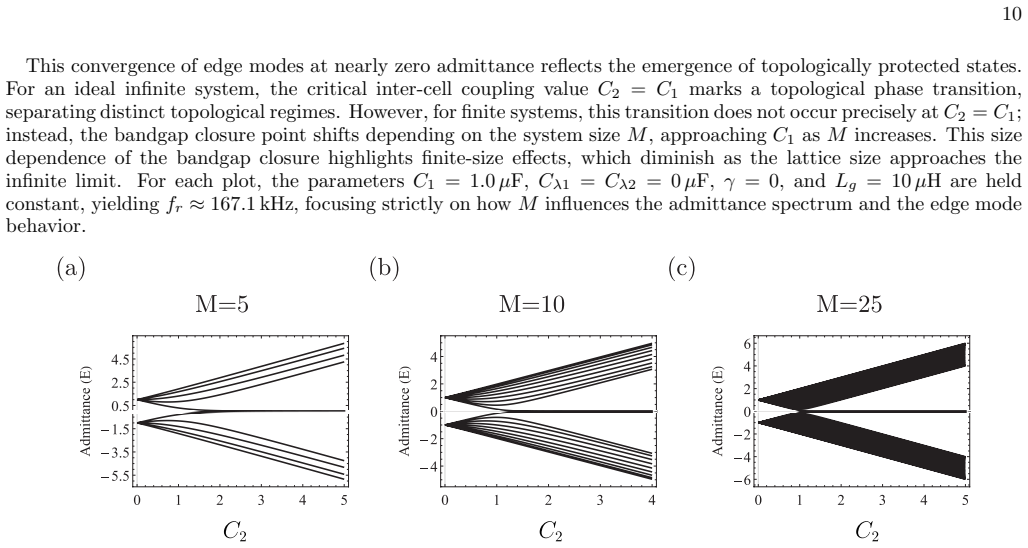
The argument is carried by an Ansatz for edge eigenstates as superpositions of $\beta^j$ modes, with $\beta_1 = r e^{i\theta}$ and $\beta_2 = r e^{-i\theta}$; for the topological edge states one takes $\theta = \pi + i\phi$, where $\phi$ is the decay parameter of the localized mode. Imposing the open-boundary conditions turns the secular problem into $\sinh((M+1)\phi)/\sinh(M\phi)=\xi$, whose solution feeds into the edge eigenvalue through $\cosh\phi$. The critical size $M_c$ is the value of $M$ at which $\phi = \cosh^{-1}\sigma$ makes the eigenvalue square root vanish, which is exactly where the two edge modes collapse to zero energy and the end-to-end impedance becomes very large.
What would settle it
Numerically diagonalize the open-boundary Hamiltonian of Eq. (8) with the paper's parameter set, scan $M$ across the predicted $M_c$, and test whether the minimum edge-state energy reaches zero exactly and at the predicted integer. In a physical circuit, sweep the number of unit cells while holding all other parameters fixed and look for the impedance peak at $M_c$; if the peak appears at a different size or remains finite at the predicted size, the central claim is falsified.
Extended reading notes
Core claim
The central claim is that non-Hermiticity enables exact zero-energy topological zero modes in finite systems, not only in the thermodynamic limit. For the generalized non-Hermitian SSH model, the edge-state admittance eigenvalues are $E_{\pm} = \pm\sqrt{-2\sqrt{(C_1^2-C_{\lambda1}^2)(C_2^2-C_{\lambda2}^2)}\cosh\phi + (C_1^2-C_{\lambda1}^2)+(C_2^2-C_{\lambda2}^2)-\gamma^2}$, with $\phi$ a size-dependent decay parameter fixed by the equation $\sinh((M+1)\phi)/\sinh(M\phi)=\xi$. Setting the square root to zero gives the condition that the edge-state gap vanishes, and solving for $M$ yields the critical size $M_c$ at which the two edge modes become degenerate at exactly zero admittance. In the topolectrical circuit this zero eigenvalue is read out as a large impedance peak between the chain ends, giving a direct measurement signature.
Load-bearing premise
The formula for $M_c$ rests on an approximate solution of the transcendental equation $\sinh((M+1)\phi)/\sinh(M\phi)=\xi$ in which terms like $(\xi+\Delta\phi)^{2M}$ are replaced by $(\Delta\phi)^{2M}$; if that approximation fails, the predicted critical size at which zero energy is reached is not guaranteed.
Editorial extensions
If this is right
- If the critical-size claim is correct, a finite non-Hermitian SSH chain of length $M_c$ supports edge modes at exactly zero energy, so measurements along a chain of increasing length will show the edge-state gap closing precisely at $M_c$.
- In a topolectrical circuit, the impedance between the two end nodes will show a pronounced peak at $M_c$, giving an electrical rather than spectroscopic signature of the zero mode.
- Tuning the gain/loss parameter $\gamma$ moves $M_c$ toward shorter chains, so the same circuit can be reconfigured by changing the resistor rather than by adding unit cells.
- Adding the grounding capacitor $-C_2$ fixes the resonance frequency independently of $C_2$, so adjusting $C_2$ shifts the edge-state energies without retuning the drive.
Reading between the lines
- Editorial: if the effect is generic, similar size-tuning should appear in higher-order non-Hermitian topological circuits, where finite-size corner-mode splitting could be cancelled at a critical footprint.
- Editorial: the impedance peak at $M_c$ could serve as a calibration observable, since measuring the peak position across lengths gives a direct estimate of the non-Hermitian parameters $\gamma$ and $C_{\lambda1}$.
- Editorial: because $M_c$ comes from an approximate solution of the transcendental equation, checking the exact secular equation for large $M$, where the replacement $(\xi+\Delta\phi)^{2M}\approx(\Delta\phi)^{2M}$ becomes increasingly poor, would bound where the formula remains predictive.
Editorial analysis
A structured set of objections, weighed in public.
Referee Report
Summary. The paper studies a finite non-Hermitian Su-Schrieffer-Heeger (SSH) chain realized as a topolectrical circuit, with asymmetric (non-reciprocal) couplings and staggered gain/loss. It claims exact analytical expressions for the finite-size edge-state admittance eigenvalues (Eq. 5) and for a critical system size Mc (Eq. 7) at which the topological zero modes (TZMs) recover exactly zero energy, with the effect observable as a large impedance peak. The Methods section derives these results from a boundary-condition determinant, a transcendental equation for the decay parameter, and an asymptotic inversion. The paper also proposes a grounding-capacitor scheme to tune edge-state energies at fixed resonance frequency, and discusses experimental feasibility and component tolerances.
Significance. The subject is timely: finite-size and non-Hermitian effects in topological circuits are of active interest, and an impedance-based signature of exactly zero-energy edge modes would be experimentally valuable. If the central analytical result were correct, the paper would provide a useful closed-form description of size-dependent TZM recovery. However, the derivation contains a mathematically invalid approximation in the central step, the main-text formulas are inconsistent with the Methods derivation, and the numerical validation in Fig. 5 does not actually compare the claimed critical sizes. The paper ships no code or machine-checkable proofs, and the central quantitative claim is currently unsupported.
major comments (4)
- [Section II (Eqs. 5-6)] The main-text edge-state energy, Eq. (5), is written with cos(phi), where phi is defined as the real positive number ln(xi + (xi - xi^3)/(1 + xi^{2M+2})). The Methods derivation, Eq. (29), gives the same quantity with cosh(phi), which follows from Eq. (23) after substituting theta = pi + i phi (since cos(theta) = -cosh(phi)). Because phi is real, cos(phi) oscillates and cannot describe the exponentially decaying edge-state energy. This is not a harmless typo, since Eq. (6) sets the zero-gap condition using cos(phi), whereas the Methods condition, Eq. (31), uses cosh(phi) = sigma.
- [Methods Section III.A (Eqs. 26-28)] The step labeled exact in the solution of the transcendental equation is algebraically invalid. Equation (26) is correct, but the approximation (xi + Delta_phi)^{2M} approx (Delta_phi)^{2M} in Eq. (27) is not valid for xi > 1 and small |Delta_phi|; the leading behavior is (xi + Delta_phi)^{2M} approx xi^{2M}, not Delta_phi^{2M}. Consequently Eq. (27) for Delta_phi and Eq. (28) for phi do not follow, and the critical-size formula Eq. (7) (and Eq. (33)) is not an exact result. A concrete check for the Fig. 4 parameters (C1 = 0.9, C_lambda1 = 0.1, C2 = 1.0, C_lambda2 = 0, gamma = 0.1) shows that the exact condition sinh((M+1)phi)/sinh(M phi) = xi with cosh(phi) = sigma has a solution near M ~ 8.8, while Eq. (7) gives Mc ~ 3.0.
- [Methods (text near Eq. 25)] The claim that a solution to Eq. (25) exists only when the denominator e^phi - xi is close to zero is an asymptotic large-M condition, not a general property. For finite M the denominator need not be small, and the paper's advertised effect is precisely the shift of the critical size to smaller M with increasing gamma. This makes the 'exact' solution internally inconsistent with the parameter regime in which the claimed phenomenon occurs.
- [Section II (Fig. 5)] The numerical validation does not support the stated conclusion. The gray dots in Fig. 5 are numerical edge-state energies as functions of M and gamma, not numerically extracted critical sizes Mc, so the claimed 'close agreement between the analytical predictions and numerical results' is not actually demonstrated by the figure. Moreover, for the stated parameters with gamma = 0.2, sigma = 0.984 < 1, so cosh^{-1}(sigma) is not real and Eq. (7) does not yield a real critical size, which contradicts the monotonic trend asserted in the text and in the figure caption.
minor comments (5)
- [Section II (Eq. 4)] In Eq. (4), the summation index is inconsistent: the numerator reads |psi_{l,p} - psi_{k,q}|^2, but the second wavefunction should be psi_{l,q} to correspond to the l-th eigenmode.
- [Section II (Eq. 3)] The relation defining phi in Eq. (3) is typeset incorrectly ('1+xi2M +2' should likely be '1+xi^{2M+2}'), and the condition xi > 1 that is needed for the subsequent formulae is not stated.
- [Figure 2 caption] The caption refers to 'a = 1 and b = M' for the impedance measurement, while the main text and Fig. 3 use p = 1 and q = 30; the notation should be made consistent.
- [Appendix D] There is a typographical error in Appendix D: 'C_lambda1 != 0,,' contains a double comma.
- [Abstract and Introduction] The paper repeatedly describes the formulas as 'exact analytical solutions,' but Eq. (28) is explicitly derived using an approximation; the terminology should be corrected throughout once the derivation is fixed.
Circularity Check
No circularity: the edge-state eigenvalues and critical size are derived from the lattice Hamiltonian and checked against independent numerics; heavy self-citation is contextual, not load-bearing.
full rationale
The paper's central objects (E_edge and Mc) are not fitted inputs renamed as predictions. The finite-size eigenvalue formula Eq. 29 is obtained by solving the open-boundary eigenvalue problem of the Hamiltonian in Eq. 8: recurrence relations in Eqs. 9-12, the ansatz in Eq. 15, the boundary-condition determinant in Eq. 21, and the transcendental equation in Eq. 24 are all derived within the paper. Setting the derived band gap to zero (Eqs. 30-31) yields the critical-size formula Eq. 33, and Fig. 5 compares this formula with numerical diagonalization. The paper's approximation in Eqs. 26-27 may be mathematically questionable, but that is an accuracy/correctness concern, not a circular input-output identity. The self-citations (e.g., Refs. [38], [54], [73]) describe topolectrical-circuit implementations, prior size-dependent TZMs, and the non-Hermitian skin effect; they are contextual and do not supply the central Mc formula or forbid alternatives. No uniqueness theorem from the authors is imported, and the cosh/phi structure is derived explicitly rather than adopted by citation. Therefore no significant circularity is present.
Assumptions & free parameters
assumptions (4)
- domain assumption The circuit admittance matrix at resonance maps exactly to the tight-binding Hamiltonian H(kx) of Eq. 2, including the i-gamma gain/loss term.
- domain assumption The finite-chain eigenstates satisfy the open boundary conditions psi(0)_B = 0 and psi(M+1)_A = 0, and can be expanded as a sum of two components beta^j with a common modulus r.
- ad hoc to paper The determinant of the 2x2 boundary-condition matrix reduces to sin(M theta)(xi + cos theta) + cos(M theta) sin theta = 0.
- ad hoc to paper The transcendental equation 2M phi = ln((e^{-phi} - xi)/(e^{phi} - xi)) can be solved by writing e^{phi} = xi + Delta phi with Delta phi small, and approximating (xi + Delta phi)^{2M} approximately (Delta phi)^{2M}.
Cite this review
Pith. "Pith review of Topological Zero Modes in Non-Hermitian Topolectrical Systems: Size and Impedance Control." pith.science (2026). https://pith.science/paper/2Q4M3IFJ
@misc{pith2026250717227,
  author       = {Pith},
  title        = {Pith review of: Topological Zero Modes in Non-Hermitian Topolectrical Systems: Size and Impedance Control},
  year         = {2026},
  howpublished = {\url{https://pith.science/paper/2Q4M3IFJ}},
  note         = {Machine review of arXiv:2507.17227}
}
read the original abstract
We investigate the size-dependent behavior of topological zero modes (TZMs) in finite non-Hermitian Su-Schrieffer-Heeger (SSH) chains implemented on a topolectrical circuit platform. By deriving exact analytical solutions for the eigenenergies and band gaps of TZMs, we reveal their sensitivity to system size and non-Hermitian parameters, such as asymmetric coupling and onsite gain or loss. Our results show that non-Hermiticity enables the recovery of exactly zero-energy TZMs at a critical system size, unlike Hermitian systems where finite-size effects cause energy splitting. These zero-energy modes produce pronounced impedance peaks in the circuit's admittance spectrum, providing a measurable signature of topological states. Additionally, a tunable grounding capacitor enables precise control of TZM energies at a fixed resonance frequency, enhancing practical tunability. Our findings offer insights into finite-size effects in non-Hermitian topological systems and guide the design of robust, reconfigurable topolectrical circuits for sensing and energy transfer applications.
Figures


Figures from the paper (6 more)




Reference graph
Works this paper leans on
-
[1]
J. Wang and S.-C. Zhang, Topological states of condensed matter, Nat. Mater. 16, 1062 (2017)
work page 2017
-
[2]
Zhang, Topological states of quantum matter, Phys ics 1, 6 (2008)
S.-c. Zhang, Topological states of quantum matter, Phys ics 1, 6 (2008)
work page 2008
- [3]
-
[4]
S. Rafi-Ul-Islam, Z. B. Siu, C. Sun, and M. B. Jalil, Strain -controlled current switching in weyl semimetals, Phys. Re v. Appl. 14, 034007 (2020)
work page 2020
- [5]
-
[6]
S. Rafi-Ul-Islam, Z. Bin Siu, and M. B. Jalil, Topoelectri cal circuit realization of a weyl semimetal heterojunction , Commun. Phys. 3, 72 (2020)
work page 2020
-
[7]
F. D. M. Haldane, Nobel lecture: Topological quantum mat ter, Rev. Mod. Phys. 89, 040502 (2017)
work page 2017
-
[8]
S. Rafi-Ul-Islam, Z. B. Siu, H. Sahin, and M. B. Jalil, Vall ey hall effect and kink states in topolectrical circuits, Phy s. Rev. Res. 5, 013107 (2023)
work page 2023
Show all 73 references
-
[9]
Rafi-Ul-Islam, Z
S. Rafi-Ul-Islam, Z. B. Siu, C. Sun, and M. B. Jalil, Realiz ation of weyl semimetal phases in topoelectrical circuits, New J. Phys. 22, 023025 (2020)
2020
-
[10]
Trebin, The topology of non-uniform media in cond ensed matter physics, Adv
H.-R. Trebin, The topology of non-uniform media in cond ensed matter physics, Adv. Phys. 31, 195 (1982). 14
1982
-
[11]
C. Sun, S. Rafi-Ul-Islam, H. Yang, and M. B. Jalil, Spin ne rnst and anomalous nernst effects and their signature output s in ferromagnet/nonmagnet heterostructures, Phys. Rev. B 102, 214419 (2020)
2020
-
[12]
Rafi-Ul-Islam, Z
S. Rafi-Ul-Islam, Z. B. Siu, H. Sahin, and M. B. Jalil, Con ductance modulation and spin/valley polarized transmissi on in silicene coupled with ferroelectric layer, J. Magn. Magn. M ater 571, 170559 (2023)
2023
-
[13]
Laflorencie, Quantum entanglement in condensed matt er systems, Phys
N. Laflorencie, Quantum entanglement in condensed matt er systems, Phys. Rep. 646, 1 (2016)
2016
-
[14]
C. Sun, J. Deng, S. Rafi-Ul-Islam, G. Liang, H. Yang, and M . B. Jalil, Field-free switching of perpendicular magnetiz ation through spin hall and anomalous hall effects in ferromagnet– heavy-metal–ferromagnet structures, Phys. Rev. Appl. 12, 034022 (2019)
2019
-
[15]
V. Y. Irkhin and Y. N. Skryabin, Modern physics of the con densed state: Strong correlations and quantum topology, Ph ys. Met. Metallogr. 120, 513 (2019)
2019
-
[16]
Gr¨ oning, S
O. Gr¨ oning, S. Wang, X. Yao, C. A. Pignedoli, G. Borin Ba rin, C. Daniels, A. Cupo, V. Meunier, X. Feng, A. Narita, et al. , Engineering of robust topological quantum phases in graph ene nanoribbons, Nature 560, 209 (2018)
2018
-
[17]
Rafi-Ul-Islam, Z
S. Rafi-Ul-Islam, Z. B. Siu, and M. Jalil, Anti-klein tun neling in topoelectrical weyl semimetal circuits, Appl. Ph ys. Lett. 116 (2020)
2020
-
[18]
C. Chen, S. He, H. Weng, W. Zhang, L. Zhao, H. Liu, X. Jia, D . Mou, S. Liu, J. He, et al. , Robustness of topological order and formation of quantum well states in topological in sulators exposed to ambient environment, Proc. Natl. Acad. Sci. 109, 3694 (2012)
2012
-
[19]
C. L. Kane and T. C. Lubensky, Topological boundary mode s in isostatic lattices, Nat. Phys. 10, 39 (2014)
2014
-
[20]
A. K. Nayak, A. Steinbok, Y. Roet, J. Koo, G. Margalit, I. Feldman, A. Almoalem, A. Kanigel, G. A. Fiete, B. Yan, et al. , Evidence of topological boundary modes with topological no dal-point superconductivity, Nat. phys. 17, 1413 (2021)
2021
-
[21]
D. S. Borgnia, A. J. Kruchkov, and R.-J. Slager, Non-her mitian boundary modes and topology, Phys. Rev. Lett. 124, 056802 (2020)
2020
-
[22]
Obana, F
D. Obana, F. Liu, and K. Wakabayashi, Topological edge s tates in the su-schrieffer-heeger model, Phys. Rev. B 100, 075437 (2019)
2019
-
[23]
Rafi-Ul-Islam, Z
S. Rafi-Ul-Islam, Z. B. Siu, H. Sahin, and M. B. Jalil, Val ley and spin quantum hall conductance of silicene coupled to a ferroelectric layer, Front. Phys. 10, 1021192 (2022)
2022
-
[24]
Nakada, M
K. Nakada, M. Fujita, G. Dresselhaus, and M. S. Dresselh aus, Edge state in graphene ribbons: Nanometer size effect an d edge shape dependence, Phys. Rev. B 54, 17954 (1996)
1996
-
[25]
Hafezi, S
M. Hafezi, S. Mittal, J. Fan, A. Migdall, and J. Taylor, I maging topological edge states in silicon photonics, Nat. P hotonics 7, 1001 (2013)
2013
-
[26]
S. Z. Butler, S. M. Hollen, L. Cao, Y. Cui, J. A. Gupta, H. R . Guti´ errez, T. F. Heinz, S. S. Hong, J. Huang, A. F. Ismach, et al. , Progress, challenges, and opportunities in two-dimensio nal materials beyond graphene, ACS nano 7, 2898 (2013)
2013
-
[27]
L. Kou, Y. Ma, Z. Sun, T. Heine, and C. Chen, Two-dimensio nal topological insulators: Progress and prospects, J. Phy s. Chem. Lett 8, 1905 (2017)
2017
-
[28]
R. Xie, T. Zhang, H. Weng, and G.-L. Chai, Progress, adva ntages, and challenges of topological material catalysts, Small Science 2, 2100106 (2022)
2022
-
[29]
T. Yang, Y. Yang, X. Wang, G. Zhang, and Z. Cheng, Topolog ical thermoelectrics: New opportunities and challenges, Mater. Today Chemi. 30, 101488 (2023)
2023
-
[30]
Ashida, Z
Y. Ashida, Z. Gong, and M. Ueda, Non-hermitian physics, Adv. Phys. 69, 249 (2020)
2020
-
[31]
E. J. Bergholtz, J. C. Budich, and F. K. Kunst, Exception al topology of non-hermitian systems, Rev. Mod. Phys. 93, 015005 (2021)
2021
-
[32]
Rafi-Ul-Islam, Z
S. Rafi-Ul-Islam, Z. B. Siu, M. S. H. Razo, H. Sahin, and M. B. Jalil, From knots to exceptional points: Emergence of topological features in non-hermitian systems with long-r ange coupling, Phys. Rev. B 110, 045444 (2024)
2024
-
[33]
Kawabata, K
K. Kawabata, K. Shiozaki, M. Ueda, and M. Sato, Symmetry and topology in non-hermitian physics, Phys. Rev. X 9, 041015 (2019)
2019
-
[34]
Rafi-Ul-Islam, Z
S. Rafi-Ul-Islam, Z. B. Siu, H. Sahin, M. S. H. Razo, and M. B. Jalil, Twisted topology of non-hermitian systems induce d by long-range coupling, Phys. Rev. B 109, 045410 (2024)
2024
-
[35]
Z. B. Siu, S. Rafi-Ul-Islam, and M. B. Jalil, Terminal-co upling induced critical eigenspectrum transition in close d non- hermitian loops, Sci. Rep. 13, 22770 (2023)
2023
-
[36]
Z. Gong, Y. Ashida, K. Kawabata, K. Takasan, S. Higashik awa, and M. Ueda, Topological phases of non-hermitian syste ms, Physical Review X 8, 031079 (2018)
2018
-
[37]
Koshino, T
M. Koshino, T. Morimoto, and M. Sato, Topological zero m odes and dirac points protected by spatial symmetry and chir al symmetry, Phys. Rev. B 90, 115207 (2014)
2014
-
[38]
Rafi-Ul-Islam, Z
S. Rafi-Ul-Islam, Z. B. Siu, H. Sahin, C. H. Lee, and M. B. J alil, System size dependent topological zero modes in coupl ed topolectrical chains, Phys. Rev. B 106, 075158 (2022)
2022
-
[39]
W. Song, W. Sun, C. Chen, Q. Song, S. Xiao, S. Zhu, and T. Li , Breakup and recovery of topological zero modes in finite non-hermitian optical lattices, Phys. Rev. Lett. 123, 165701 (2019)
2019
-
[40]
J. Noh, T. Schuster, T. Iadecola, S. Huang, M. Wang, K. P. Chen, C. Chamon, and M. C. Rechtsman, Braiding photonic topological zero modes, Nat. Phys. 16, 989 (2020)
2020
-
[41]
Imhof, C
S. Imhof, C. Berger, F. Bayer, J. Brehm, L. W. Molenkamp, T. Kiessling, F. Schindler, C. H. Lee, M. Greiter, T. Neupert , et al. , Topolectrical-circuit realization of topological corne r modes, Nat. Phys. 14, 925 (2018)
2018
-
[42]
Zhu and G
W. Zhu and G. Ma, Distinguishing topological corner mod es in higher-order topological insulators of finite size, Ph ys. Rev. B 101, 161301 (2020). 15
2020
-
[43]
Proctor, P
M. Proctor, P. A. Huidobro, B. Bradlyn, M. B. De Paz, M. G. Vergniory, D. Bercioux, and A. Garc ´ ıa-Etxarri, Robustness of topological corner modes in photonic crystals, Phys. Rev . Res. 2, 042038 (2020)
2020
-
[44]
Rafi-Ul-Islam, Z
S. Rafi-Ul-Islam, Z. B. Siu, H. Sahin, and M. B. Jalil, Typ e-ii corner modes in topolectrical circuits, Phys. Rev. B 106, 245128 (2022)
2022
-
[45]
S. A. A. Ghorashi, X. Hu, T. L. Hughes, and E. Rossi, Secon d-order dirac superconductors and magnetic field induced majorana hinge modes, Phys. Rev. B 100, 020509 (2019)
2019
-
[46]
Fu, Z.-A
B. Fu, Z.-A. Hu, C.-A. Li, J. Li, and S.-Q. Shen, Chiral ma jorana hinge modes in superconducting dirac materials, Phy s. Rev. B 103, L180504 (2021)
2021
-
[47]
Rafi-Ul-Islam, Z
S. Rafi-Ul-Islam, Z. B. Siu, H. Sahin, and M. B. Jalil, Chi ral surface and hinge states in higher-order weyl semimetal lic circuits, Phys. Rev. B 109, 085430 (2024)
2024
-
[48]
Helbig, T
T. Helbig, T. Hofmann, S. Imhof, M. Abdelghany, T. Kiess ling, L. Molenkamp, C. Lee, A. Szameit, M. Greiter, and R. Thomale, Generalized bulk–boundary correspondence in n on-hermitian topolectrical circuits, Nat. Phys. 16, 747 (2020)
2020
-
[49]
Zhang, B
X. Zhang, B. Zhang, H. Sahin, Z. B. Siu, S. Rafi-Ul-Islam, J. F. Kong, B. Shen, M. B. Jalil, R. Thomale, and C. H. Lee, Anomalous fractal scaling in two-dimensional electric net works, Commun. Phys. 6, 151 (2023)
2023
-
[50]
D. Zou, T. Chen, W. He, J. Bao, C. H. Lee, H. Sun, and X. Zhan g, Observation of hybrid higher-order skin-topological effect in non-hermitian topolectrical circuits, Nat. Commu n. 12, 1 (2021)
2021
-
[51]
Rafi-Ul-Islam, Z
S. Rafi-Ul-Islam, Z. B. Siu, and M. B. Jalil, Non-hermiti an topological phases and exceptional lines in topolectric al circuits, New J. Phys. 23, 033014 (2021)
2021
-
[52]
Sahin, Z
H. Sahin, Z. B. Siu, S. Rafi-Ul-Islam, J. F. Kong, M. B. Jal il, and C. H. Lee, Impedance responses and size-dependent resonances in topolectrical circuits via the method of imag es, Phys. Rev. B 107, 245114 (2023)
2023
-
[53]
Hofmann, T
T. Hofmann, T. Helbig, F. Schindler, N. Salgo, M. Brzezi ´ nska, M. Greiter, T. Kiessling, D. Wolf, A. Vollhardt, A. Ka baˇ si, et al. , Reciprocal skin effect and its realization in a topolectric al circuit, Phys. Rev. Res. 2, 023265 (2020)
2020
-
[54]
Rafi-Ul-Islam, Z
S. Rafi-Ul-Islam, Z. B. Siu, and M. B. Jalil, Topological phases with higher winding numbers in nonreciprocal one- dimensional topolectrical circuits, Phys. Rev. B 103, 035420 (2021)
2021
-
[55]
L. Lu, J. D. Joannopoulos, and M. Soljaˇ ci´ c, Topological photonics, Nat. Photonics 8, 821 (2014)
2014
-
[56]
Barik, A
S. Barik, A. Karasahin, C. Flower, T. Cai, H. Miyake, W. D eGottardi, M. Hafezi, and E. Waks, A topological quantum optics interface, Science 359, 666 (2018)
2018
-
[57]
Soskin, S
M. Soskin, S. V. Boriskina, Y. Chong, M. R. Dennis, and A. Desyatnikov, Singular optics and topological photonics, Journal of Optics 19, 010401 (2016)
2016
-
[58]
Qi and S.-C
X.-L. Qi and S.-C. Zhang, Topological insulators and su perconductors, Rev. Mod. Phys. 83, 1057 (2011)
2011
-
[59]
Zhang, Z
P. Zhang, Z. Wang, X. Wu, K. Yaji, Y. Ishida, Y. Kohama, G. Dai, Y. Sun, C. Bareille, K. Kuroda, et al. , Multiple topological states in iron-based superconductors, Nat. Ph ys. 15, 41 (2019)
2019
-
[60]
H. N. Krishnamoorthy, Z. Jacob, E. Narimanov, I. Kretzs chmar, and V. M. Menon, Topological transitions in metamate - rials, Science 336, 205 (2012)
2012
-
[61]
C. Liu, W. Gao, B. Yang, and S. Zhang, Disorder-induced t opological state transition in photonic metamaterials, Ph ys. Rev. Lett. 119, 183901 (2017)
2017
-
[62]
S. M. Rafi-Ul-Islam, Z. B. Siu, H. Sahin, C. H. Lee, and M. B . A. Jalil, Critical hybridization of skin modes in coupled non-hermitian chains, Phys. Rev. Res. 4, 013243 (2022)
2022
-
[63]
S. M. Rafi-Ul-Islam, Z. B. Siu, M. S. H. Razo, and M. B. A. Ja lil, Frequency-controlled critical non-hermitian skin eff ect in a topolectrical circuit, Phys. Rev. B 112, 045402 (2025)
2025
-
[64]
Rafi-Ul-Islam, Z
S. Rafi-Ul-Islam, Z. B. Siu, M. S. H. Razo, and M. B. Jalil, Critical non-hermitian skin effect in a cross-coupled hermi tian chain, Phys. Rev. B 111, 115415 (2025)
2025
-
[65]
Rafi-Ul-Islam, H
S. Rafi-Ul-Islam, H. Sahin, Z. B. Siu, and M. B. Jalil, Int erfacial skin modes at a non-hermitian heterojunction, Phy s. Rev. Res. 4, 043021 (2022)
2022
-
[66]
S. D. Sarma, M. Freedman, and C. Nayak, Majorana zero mod es and topological quantum computation, npj Quantum Information 1, 1 (2015)
2015
-
[67]
R. W. Bomantara and J. Gong, Quantum computation via floq uet topological edge modes, Phys. Rev. B 98, 165421 (2018)
2018
-
[68]
Wang et al
J. Wang et al. , 1d photonic topological insulators composed of split ring resonators: a mini review, Adv. Phys. Res. 3, 2300125 (2024)
2024
-
[69]
Z. Guo, Y. Wang, S. Ke, X. Su, J. Ren, and H. Chen, 1d photon ic topological insulators composed of split ring resonator s: a mini review, Adv. Phys. Res. 3, 2300125 (2024)
2024
-
[70]
Z. Guo, T. Zhang, J. Song, H. Jiang, and H. Chen, Sensitiv ity of topological edge states in a non-hermitian dimer chai n, Photonics Res. 9, 574 (2021)
2021
-
[71]
H. Groß, J. M. Hamm, T. Tufarelli, O. Hess, and B. Hecht, N ear-field strong coupling of single quantum dots, Sci. Adv. 4, eaar4906 (2018)
2018
-
[72]
Z. Guo, J. Jiang, H. Jiang, J. Ren, and H. Chen, Observati on of topological bound states in a double su-schrieffer-hee ger chain composed of split ring resonators, Phys. Rev. Res. 3, 013122 (2021)
2021
-
[73]
S. M. Rafi-Ul-Islam, Z. B. Siu, H. Sahin, C. H. Lee, and M. B . A. Jalil, Unconventional skin modes in generalized topolectrical circuits with multiple asymmetric coupling s, Phys. Rev. Res. 4, 043108 (2022)
2022
Reviewed August 6, 2026 · model on record in the stance chip above.
Discussion (0). Continue with ORCID to comment.