REVIEW 4 major objections 5 minor 29 references
TransLPRNet: Lite Vision-Language Network for Single/Dual-line Chinese License Plate Recognition
T0 review · 4 major / 5 minor · reviewed 2026-08-06 · deepseek-v4-flash
Pith's one-line read A lightweight vision-language Transformer can recognize single- and double-line Chinese license plates at around 99% accuracy, with a weakly supervised perspective-correction network handling tilted images.
desk verdict A solid engineering paper with a genuine weak-supervision idea for perspective correction, but the double-line results are synthetic-only and the abstract numbers diverge from the body, so the practical claims need tightening. read the letter →
The pith
A machine-rendered reading of the paper's core claim, the machinery that carries it, and where it could break.
The reading
What carries the argument
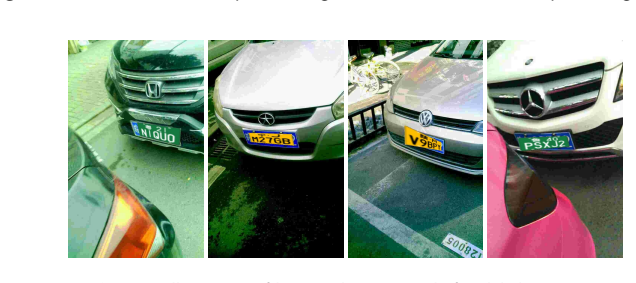
The load-bearing machinery is the encoder-adapter-decoder pipeline plus two supporting mechanisms. The encoder stacks inverted residual blocks and MobileViTv3 blocks: inverted residuals extract local character detail cheaply, while MobileViT blocks apply windowed self-attention to local windows, giving global layout modeling within a small computational budget; the adapter reduces the 7×7×320 feature map to 49 tokens of width 128, and a four-layer transformer text decoder with masked self-attention and cross-attention generates the character sequence autoregressively. The second mechanism, PTN, replaces direct regression of a perspective matrix with regression of four plate-corner coordinates, then computes the 3×3 perspective transform by solving the standard 8-parameter linear system; supervision comes from a MobileNetV3 binary classifier that decides whether an image is a frontal view, so corner labels themselves are not needed for PTN training. The third mechanism is data: program-generated yellow and green double-line plate images are blurred, pasted onto redundant real CCPD backgrounds via perspective transform, and cropped with perturbed boxes, producing a mixed single/double-line dataset while redundancy compression keeps total dataset size unchanged.
What would settle it
Train and evaluate the described pipeline on a held-out set of real double-line Chinese plates photographed from trucks and buses, with no overlap with the synthetic generation templates; if accuracy falls materially below the reported ~99% Base-d figure, the synthetic-data representativeness assumption is falsified.
Extended reading notes
Core claim
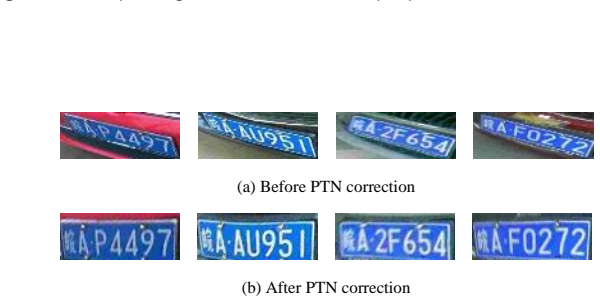
On its own terms, the paper's central claim is that a single lightweight encoder-decoder can unify single- and double-line Chinese license plate recognition. The visual encoder, built from MobileViTv3's inverted residual blocks and windowed self-attention, turns a 224×224 image into 49 tokens, and a four-layer transformer decoder autoregressively predicts the plate string until [EOS], so both lines of a double-line plate are read as one spatial token layout rather than a flattened sequence. Trained on the corrected, extended mixed CCPD-derived test set, TransLPRNet reports 98.75% average accuracy under coarse bounding-box perturbations and 99.03% under fine four-vertex perturbations, beating Eulpr, PaddleOCRv3, Lpr-transformer, and TrOCR-without-pretraining on most subsets at 46 FPS with 5.94M parameters. PTN regresses the four corner coordinates, solves the 8-parameter perspective matrix, and is supervised by a frozen front-view classifier, improving coarse-perturbation accuracy from 98.60% to 98.91% and lifting the Challenge subset from 93.25% to 94.54%.
Load-bearing premise
The load-bearing premise is that the synthetic double-line plates used for training and testing faithfully represent real double-line plates in font, wear, distortion, and layout, and that the manual re-annotation of CCPD labels is accurate; if either fails, the reported recognition rates will not transfer to real plates.
Editorial extensions
If this is right
- One model can recognize both single- and double-line Chinese plates without line segmentation or a two-stage pipeline; the decoder simply reads both lines as one token sequence.
- PTN's weak-supervised corner regression is a stable alternative to STN-based perspective correction: under coarse localization perturbations, the paper reports average accuracy rising from 98.60% to 98.91%, with the hardest Challenge subset rising from 93.25% to 94.54%.
- At 46 FPS and 5.94M parameters (batch size 1), the reported accuracy does not come at the cost of real-time deployment; the paper's comparison with TrOCR shows 12 FPS and 34.6M parameters.
- Redundancy compression of the CCPD Base subset allows double-line plate images to be added without enlarging the dataset or sacrificing single-line information, so the same data budget supports both plate types.
Reading between the lines
- A decisive test of the central transfer claim would be to evaluate the pipeline on a corpus of real (non-synthesized) double-line plates from truck or bus surveillance; if accuracy drops materially below the reported ~99% Base-d figure, the synthetic dataset's fidelity is the binding constraint.
- The same weak-supervision recipe—a cheap binary 'is this a frontal view?' classifier driving a geometric rectifier—could be applied to ID cards, documents, or industrial markings where corner labels are scarce.
- Since the model is a generic image-to-sequence network, fine-tuning it for other multi-line plate formats or for two-row document text is a natural extension; the bottleneck is likely data, not architecture.
- The paper's error analysis points to two cheap improvements it does not test: a language or plate-format prior to disambiguate 8/B, 2/Z, 0/D, and 5/S confusions, and rebalancing the provincial distribution to reduce over-prediction of 'wan' from Anhui-dominant CCPD data.
Editorial analysis
A structured set of objections, weighed in public.
Referee Report
Summary. The paper proposes TransLPRNet, a lightweight Chinese license plate recognition network combining a MobileViTv3-based visual encoder with a transformer text decoder, a Perspective Transformation Network (PTN) trained via weak supervision from a frontal-view classifier, and a dataset-construction pipeline that overlays program-generated double-line plates onto redundant CCPD images. The authors report averages of 98.75% and 99.03% recognition accuracy on a mixed single/double-line test set under coarse and fine localization perturbations, respectively, with 46 FPS and 5.94M parameters, outperforming LPRNet, Eulpr, PaddleOCRv3, TrOCR, and Lpr-transformer on most subsets.
Significance. If the results hold, the work is a useful engineering contribution: it demonstrates that a compact encoder-decoder can handle both single- and double-line Chinese plates and that viewpoint-classification supervision can train a perspective-correction module at low annotation cost. The body's tables are internally consistent, and the main comparisons are run under one protocol with reported speed and parameter counts. However, the central double-line claim is validated only on synthetic test images generated by the same pipeline used for training; the paper also contains a direct contradiction about whether TransLPRNet uses pre-trained weights; and the abstract in the metadata reports different headline numbers from the body. These issues prevent the evidence from supporting the paper's strongest claims as currently presented.
major comments (4)
- [Section 3.3.2, Tables 6/7] The double-line recognition claim rests entirely on synthetic test images: the Base-d test set is built by pasting program-generated double-line plates onto redundant CCPD backgrounds, using the same generator that produced the double-line training images. The reported 99.97% and 99.99% Base-d accuracies are therefore within-distribution scores on synthetic plates, not evidence of generalization to real double-line plates, which differ in font rendering, embossing, wear, dirt, and layout. The paper should add a real double-line test set or an independent dataset, or clearly re-scope the claim away from 'strong practical applicability' in the abstract.
- [Section 3.1.1 vs. Section 4.3.1] The paper contradicts itself on pre-training. Section 3.1.1 states that the visual encoder 'leveraged the pre-trained weights of this backbone on the ImageNet-1k dataset,' while Section 4.3.1 claims that TransLPRNet is 'trained entirely from scratch without using any external pre-trained data.' The comparison against TrOCR is explicitly framed as showing superiority without pre-training, so this contradiction is load-bearing for the fairness argument and must be resolved with a precise statement of which weights are initialized from ImageNet-1k and what is trained from scratch.
- [Abstract (metadata vs. body)] The abstract in the submission metadata reports 99.34% average recognition accuracy under coarse localization, 99.58% under fine localization, and 167 FPS, whereas the body abstract and Tables 6/7 report 98.75% and 99.03% accuracy and 46 FPS. These are inconsistent headline results for the same claimed system, and the discrepancy is not explained anywhere in the manuscript. The authors must reconcile or clearly label which numbers correspond to which configuration.
- [Section 3.3.1] The test labels are corrected using a model-based filtering step followed by manual re-annotation, and the corrected dataset is not released. Since all test accuracies depend on these modified labels, the paper should report the reliability of the correction process (e.g., inter-annotator agreement on a sample) and make the corrected labels available, otherwise independent verification of the headline accuracy is impossible.
minor comments (5)
- [Section 3.2.2, Eq. (1)] The unknown parameter vector is ordered as [theta1, theta4, theta7, theta2, theta5, theta8, theta3, theta6], which does not match the row-by-row ordering implied by the coefficient matrix; please clarify or re-order the entries to avoid an apparent typographical inconsistency.
- [Tables 4 and 5] The column header 'Parameter Name' is used for values such as Learning Rate, Optimizer, and Batch Size; rename it to 'Value' or 'Setting' for clarity.
- [Tables 6 and 7] The 'Avg' column is not defined; please state whether it is a weighted average over subset sizes or an unweighted mean.
- [Figure 18 and Section 3.3.2] The pie chart labels (e.g., 60k blue single-line, 10k green double-line, 10k yellow double-line) are difficult to reconcile with the text describing 25,000 double-line images added to the training set and 25,000 used in Base-d; clarify the exact dataset composition and the fate of the replaced single-line images.
- [Throughout] There are numerous typographical issues, including 'Toaddress' in the abstract, 'Inversted' in Figure captions, inconsistent capitalization of 'transLPRNet' vs. 'TransLPRNet', and an unclear explanation in the Table 7 note about TrOCR's performance under fine localization; these should be corrected in a final revision.
Circularity Check
No formal circularity: single-line CCPD results are externally benchmarked, and no fitted parameter is renamed a prediction. One circularity-adjacent step remains: the synthetic Base-d test set is generated by the same Section 3.3.2 pipeline as the double-line training data, so the headline 99.97% Base-d accuracy measures intra-generator fit, not real double-line generalization.
-
other
[Section 3.3.2 (Double/Single-Line Dataset Construction via Image Overlay); Tables 6-7; Abstract.]
"First, the program-generated double-line license plate images are blurred ... these synthesized double-line license plate images are overlaid onto redundant license plate samples via perspective transformation ... Among these, 25,000 double-line plates were added to the training set ... The remaining 25,000 double-line license plates were used as the Base-d subset within the test set to evaluate the model's recognition performance on double-line license plate images."
The double-line training and Base-d test plates are all rendered by the same Section 3.3.2 generator: program-made templates, blur, and perspective pasting onto RPNet-selected 'redundant' CCPD backgrounds. The Base-d test distribution is therefore the same distribution the model was trained on, so the headline double-line accuracies (99.97% coarse / 99.99% fine, Tables 6/7) certify intra-generator fit, not transfer to real double-line plates, of which the paper presents no evaluation; the abstract's 'strong practical applicability' overreaches this evidence.
full rationale
Formal derivation chain is self-contained. TransLPRNet (MobileViTv3 encoder + transformer decoder) is trained on the mixed CCPD/synthetic dataset; the PTN rectifier is trained under a frozen frontal-view classifier that itself was trained on labeled frontal/non-frontal plate images, so the PTN supervision signal is independent of the recognition target. Recognition is evaluated against external open-source baselines (LPRNet, Eulpr, PaddleOCRv3, TrOCR, Lpr-transformer) on identical test sets with identical Gaussian perturbations, so the single-line comparisons do not reduce to the paper's own outputs, and no fitted parameter is renamed as a prediction. There are no load-bearing author self-citations and no imported uniqueness theorems; architecture choices are cited from external works (MobileViTv3, TrOCR). The single circularity-adjacent issue is the double-line evaluation circularity in Section 3.3.2 described in the step above: because the Base-d test set comes from the same generator as the double-line training data, the double-line accuracy claims (99.97%/99.99%) validate fit to the generator, and the paper supplies no real double-line validation, which weakens the 'strong practical applicability' claim for its central dual-style contribution; this supports score 3 rather than 0. Flagged separately as correctness/consistency risks, not circular steps: (i) the arXiv abstract reports 99.34%/99.58% on CCPD, 98.70% on double-line, and 167 FPS, none matching Tables 6/7 (98.75%/99.03%, Base-d 99.97%/99.99%, 46 FPS); (ii) Section 3.1.1 states ImageNet-1k pre-trained encoder weights are leveraged, while Section 4.3.1 states TransLPRNet is 'trained entirely from scratch without using any external pre-trained data'; (iii) Base-s is enriched with RPNet-correctly-recognized 'redundant' samples, and the assertion that 'difficult-to-recognize samples share common characteristics across different models' is assumed, not demonstrated; (iv) no code, data, or corrected CCPD labels are released, so the corrected test set and synthetic pipeline cannot be independently verified.
Assumptions & free parameters
free parameters (4)
- Gaussian perturbation std =
4 pixels
- Target rectified image size =
94x24
- Redundant-sample selection count =
50,000 (25k train, 25k test)
- Max decoding length N =
10
assumptions (4)
- domain assumption Synthetic double-line plates are representative of real double-line plates
- domain assumption The manually corrected CCPD labels are accurate
- domain assumption Front-view classification provides sufficient supervision for perspective rectification
- standard math Standard deep learning assumptions (SGD/Adam, loss gradients, i.i.d. data) hold
Cite this review
Pith. "Pith review of TransLPRNet: Lite Vision-Language Network for Single/Dual-line Chinese License Plate Recognition." pith.science (2026). https://pith.science/paper/GLLQVNWS
@misc{pith2026250717335,
  author       = {Pith},
  title        = {Pith review of: TransLPRNet: Lite Vision-Language Network for Single/Dual-line Chinese License Plate Recognition},
  year         = {2026},
  howpublished = {\url{https://pith.science/paper/GLLQVNWS}},
  note         = {Machine review of arXiv:2507.17335}
}
read the original abstract
License plate recognition in open environments is widely applicable across various domains; however, the diversity of license plate types and imaging conditions presents significant challenges. To address the limitations encountered by CNN and CRNN-based approaches in license plate recognition, this paper proposes a unified solution that integrates a lightweight visual encoder with a text decoder, within a pre-training framework tailored for single and double-line Chinese license plates. To mitigate the scarcity of double-line license plate datasets, we constructed a single/double-line license plate dataset by synthesizing images, applying texture mapping onto real scenes, and blending them with authentic license plate images. Furthermore, to enhance the system's recognition accuracy, we introduce a perspective correction network (PTN) that employs license plate corner coordinate regression as an implicit variable, supervised by license plate view classification information. This network offers improved stability, interpretability, and low annotation costs. The proposed algorithm achieves an average recognition accuracy of 99.34% on the corrected CCPD test set under coarse localization disturbance. When evaluated under fine localization disturbance, the accuracy further improves to 99.58%. On the double-line license plate test set, it achieves an average recognition accuracy of 98.70%, with processing speeds reaching up to 167 frames per second, indicating strong practical applicability.
Figures


Figures from the paper (26 more)






Reference graph
Works this paper leans on
-
[1]
License plate recognition system based on improved yolov5 and gru
Shi, H., Zhao, D., 2023. License plate recognition system based on improved yolov5 and gru. Ieee Access 11, 10429–10439
work page 2023
-
[2]
Improving robustness of license plates automatic recognition in natural scenes
Fan, X., Zhao, W., 2022. Improving robustness of license plates automatic recognition in natural scenes. IEEE Transactions on Intelligent Transportation Systems 23, 18845–18854
work page 2022
-
[3]
Vehicle license plate recognition method based on deep convolution network in complex road scene
Liu, Z., Cai, Y., Chen, L., Wang, H., He, Y., 2019. Vehicle license plate recognition method based on deep convolution network in complex road scene. Proceedings of the Institution of Mechanical Engineers, Part D: Journal of Automobile Engineering 233, 2284–2292
work page 2019
-
[4]
A new approach for character recognition of multi-style vehicle license plates
Huang, Q., Cai, Z., Lan, T., 2020. A new approach for character recognition of multi-style vehicle license plates. IEEE Transactions on multimedia 23, 3768–3777
work page 2020
-
[5]
Robust automatic recognition of chinese license plates in natural scenes
He, M.X., Hao, P., 2020. Robust automatic recognition of chinese license plates in natural scenes. Ieee Access 8, 173804–173814
work page 2020
-
[6]
License plate detection and recognition based on yolov3 and ilprnet
Zou, Y., Zhang, Y., Yan, J., Jiang, X., Huang, T., Fan, H., Cui, Z., 2022. License plate detection and recognition based on yolov3 and ilprnet. Signal, image and video processing 16, 473–480
work page 2022
-
[7]
A robust license plate recognition model based on bi-lstm
Zou, Y., Zhang, Y., Yan, J., Jiang, X., Huang, T., Fan, H., Cui, Z., 2020. A robust license plate recognition model based on bi-lstm. IEEE Access 8, 211630–211641
work page 2020
-
[8]
Lprnet: License plate recognition via deep neural networks
Zherzdev, S., Gruzdev, A., . Lprnet: License plate recognition via deep neural networks. arxiv 2018. arXiv preprint arXiv:1806.10447
arXiv 2018
Show all 29 references
-
[9]
Recognitionofvehiclelicenseplatesinhighwaysceneswithdeepfusionnetwork and connectionist temporal classification
Hua,L.,Ma,X.,Zhao,C.,Zhang,B.,Su,Z.,Wu,Y.,2024. Recognitionofvehiclelicenseplatesinhighwaysceneswithdeepfusionnetwork and connectionist temporal classification. IET Image Processing 18, 4066–4080
2024
-
[10]
License plate recognition system using yolov5 and cnn, in: 2022 8th International Conference on Advanced Computing and Communication Systems (ICACCS), IEEE
Raj, S., Gupta, Y., Malhotra, R., 2022. License plate recognition system using yolov5 and cnn, in: 2022 8th International Conference on Advanced Computing and Communication Systems (ICACCS), IEEE. pp. 372–377
2022
-
[11]
Automatic number plate recognition (anpr) with yolov3-cnn
Adak, R., Kumbhar, A., Pathare, R., Gowda, S., 2022. Automatic number plate recognition (anpr) with yolov3-cnn. arXiv preprint arXiv:2211.05229
2022 arXiv
-
[12]
Spatial transformer networks
Jaderberg, M., Simonyan, K., Zisserman, A., et al., 2015. Spatial transformer networks. Advances in neural information processing systems 28
2015
-
[13]
Collaborativelicenseplaterecognitionviaassociationenhancementnetwork with auxiliary learning and a unified benchmark
Deng,Y.,Wang,G.,Li,C.,Wang,W.,Zhang,C.,Tang,J.,2024. Collaborativelicenseplaterecognitionviaassociationenhancementnetwork with auxiliary learning and a unified benchmark. IEEE Transactions on Multimedia
2024
-
[14]
A deep learning-based framework for vehicle license plate detection
Yang, D., Yang, L., 2024. A deep learning-based framework for vehicle license plate detection. International Journal of Advanced Computer Science & Applications 15
2024
-
[15]
Trocr:Transformer-basedopticalcharacterrecognition with pre-trained models, in: Proceedings of the AAAI conference on artificial intelligence, pp
Li,M.,Lv,T.,Chen,J.,Cui,L.,Lu,Y.,Florencio,D.,Zhang,C.,Li,Z.,Wei,F.,2023. Trocr:Transformer-basedopticalcharacterrecognition with pre-trained models, in: Proceedings of the AAAI conference on artificial intelligence, pp. 13094–13102
2023
-
[16]
Mobilevitv3: Mobile-friendly vision transformer with simple and effective fusion of local, global and input features
Wadekar, S.N., Chaurasia, A., 2022. Mobilevitv3: Mobile-friendly vision transformer with simple and effective fusion of local, global and input features. arXiv preprint arXiv:2209.15159
2022 arXiv
-
[17]
Towards end-to-end license plate detection and recognition: A large dataset and baseline, in: Proceedings of the European conference on computer vision (ECCV), pp
Xu, Z., Yang, W., Meng, A., Lu, N., Huang, H., Ying, C., Huang, L., 2018. Towards end-to-end license plate detection and recognition: A large dataset and baseline, in: Proceedings of the European conference on computer vision (ECCV), pp. 255–271
2018
-
[18]
Qin,S.,Liu,S.,2020.Efficientandunifiedlicenseplaterecognitionvialightweightdeepneuralnetwork.IETImageProcessing14,4102–4109
2020
-
[19]
Pp-ocr: A practical ultra lightweight ocr system
Du, Y., Li, C., Guo, R., Yin, X., Liu, W., Zhou, J., Bai, Y., Yu, Z., Yang, Y., Dang, Q., et al., 2020. Pp-ocr: A practical ultra lightweight ocr system. arXiv preprint arXiv:2009.09941
2020 arXiv
-
[20]
Pp-ocrv3:Moreattemptsfortheimprovement of ultra lightweight ocr system
Li,C.,Liu,W.,Guo,R.,Yin,X.,Jiang,K.,Du,Y.,Du,Y.,Zhu,L.,Lai,B.,Hu,X.,etal.,2022. Pp-ocrv3:Moreattemptsfortheimprovement of ultra lightweight ocr system. arXiv preprint arXiv:2206.03001
2022 arXiv
-
[21]
Mobilevit: light-weight, general-purpose, and mobile-friendly vision transformer
Mehta, S., Rastegari, M., 2021. Mobilevit: light-weight, general-purpose, and mobile-friendly vision transformer. arXiv preprint arXiv:2110.02178
2021 arXiv
-
[22]
Integrating yolov8 and cspbottleneck based cnn for enhanced license plate character recognition
Khokhar, S., Kedia, D., 2024. Integrating yolov8 and cspbottleneck based cnn for enhanced license plate character recognition. Journal of Real-Time Image Processing 21, 168
2024
-
[23]
Robust license plate detection and recognition with automatic rectification
Xiao, D., Zhang, L., Li, J., Li, J., 2021. Robust license plate detection and recognition with automatic rectification. Journal of Electronic Imaging 30, 013002–013002
2021
-
[24]
Bakshi, A., Gulhane, S., Sawant, T., Sambhe, V., Udmale, S.S., 2023. Alpr-an intelligent approach towards detection and recognition of licenseplatesinuncontrolledenvironments,in:InternationalConferenceonDistributedComputingandIntelligentTechnology,Springer.pp. 253–269
2023
-
[25]
A robust attentional framework for license plate recognition in the wild
Zhang, L., Wang, P., Li, H., Li, Z., Shen, C., Zhang, Y., 2020. A robust attentional framework for license plate recognition in the wild. IEEE Transactions on Intelligent Transportation Systems 22, 6967–6976
2020
-
[26]
Wang,Q.,Lu,X.,Zhang,C.,Yuan,Y.,Li,X.,2022.Lsv-lp:Large-scalevideo-basedlicenseplatedetectionandrecognition.IEEETransactions on Pattern Analysis and Machine Intelligence 45, 752–767
2022
-
[27]
Searching for mobilenetv3, in: Proceedings of the IEEE/CVF international conference on computer vision, pp
Howard, A., Sandler, M., Chu, G., Chen, L.C., Chen, B., Tan, M., Wang, W., Zhu, Y., Pang, R., Vasudevan, V., et al., 2019. Searching for mobilenetv3, in: Proceedings of the IEEE/CVF international conference on computer vision, pp. 1314–1324
2019
-
[28]
Flexiblecameracalibrationbyviewingaplanefromunknownorientations,in:Proceedingsoftheseventhieeeinternational conference on computer vision, Ieee
Zhang,Z.,1999. Flexiblecameracalibrationbyviewingaplanefromunknownorientations,in:Proceedingsoftheseventhieeeinternational conference on computer vision, Ieee. pp. 666–673
1999
-
[29]
chinese-lpr-transformer
sosopop, 2024. chinese-lpr-transformer. GitHub. URL:https://github.com/sosopop/chinese-lpr-transformer. Guangzhu Xu et al.:Preprint submitted to ElsevierPage 26 of 26
2024
Reviewed August 6, 2026 · model on record in the stance chip above.
Discussion (0). Sign in to comment.