REVIEW 2 major objections 7 minor 3 cited by
Reasoning-Driven Retrosynthesis Prediction with Large Language Models via Reinforcement Learning
T0 review · 2 major / 7 minor · reviewed 2026-08-06 · deepseek-v4-flash
Pith's one-line read A chemical LLM trained with reasoning and verifiable-reward RL reaches 65.0% top-1 retrosynthesis accuracy, surpassing the prior best method by 4.2 points while explaining its logic.
desk verdict 65.0% top-1 on USPTO-50K is a credible SOTA claim if the base model's pretraining is clean; the missing inference budget and an un-audited base corpus are the two things to resolve in review. read the letter →
The pith
A machine-rendered reading of the paper's core claim, the machinery that carries it, and where it could break.
The reading
What carries the argument
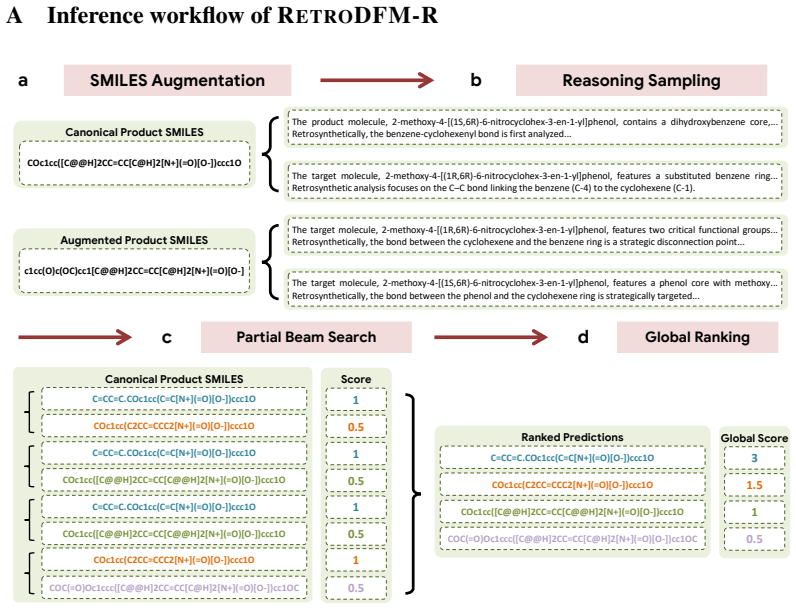
The load-bearing mechanism is the three-stage training pipeline, driven by an explicit reinforcement-learning reward. For an output $o$ and ground-truth reactants $a$, the reward is $R(o,a)=R_{\mathrm{correct}}(o,a)+\lambda R_{\mathrm{format}}(o)$: the correctness term is 1 if RDKit-canonicalized predicted SMILES match the ground truth, and the format term checks the $\langle\mathrm{think}\rangle \ldots \langle\mathrm{answer}\rangle$ structure. Optimization uses DAPO, a policy-gradient algorithm whose asymmetric clipping encourages low-probability tokens and whose prompt filtering skips groups where all samples earn identical rewards. Two auxiliary mechanisms carry much of the chemical knowledge: SMILES-IUPAC conversion transfers the structural and functional-group information encoded in IUPAC names into SMILES, and the inference scheme samples diverse reasoning paths, then runs partial beam search from each answer tag and aggregates candidate ranks with a decay-weighted score.
What would settle it
Retrain the full three-stage pipeline starting from a chemical LLM whose pretraining corpus is provably disjoint from the USPTO-50K test products; if top-1 exact-match accuracy falls substantially below 65.0%, the reported gain was inflated by memorized test reactions.
Extended reading notes
Core claim
The paper's discovery, stated on its own terms, is that the gap between general chemical LLMs and specialized retrosynthesis models can be closed by a three-stage training design: continual pretraining on SMILES-to-IUPAC conversion and retrosynthesis data, cold-start distillation of answer-conditioned chain-of-thought rationales from a strong general reasoning model, and large-scale reinforcement learning under a rule-based reward that checks both canonical SMILES correctness and output format. The resulting model, RetroDFM-R, achieves 65.0% top-1 exact-match accuracy on USPTO-50K (compared with 60.8% for EditRetro) and state-of-the-art top-3, top-5, and top-10 results, with a competitive 50.5% top-1 on the noisier USPTO-FULL benchmark. It also reaches 88.3% top-1 round-trip accuracy when predicted reactants are tested by a forward-reaction model, and in double-blind AB tests experts prefer or tie its predictions over ground truth in 64% of USPTO-50K samples and 75% of USPTO-FULL samples. The paper itself flags that the reasoning can hallucinate—one example invokes a chlorine atom that is not in the product—so the interpretability claim is real but not a guarantee of correctness.
Load-bearing premise
The paper's leakage cleaning excludes test-set products from its own continual pretraining and reinforcement-learning data, but the headline accuracy also assumes the base chemical LLM's earlier pretraining never contained USPTO-50K test reactions; if it did, the gain could be memorization rather than the proposed pipeline.
Editorial extensions
If this is right
- Chemical LLMs can surpass specialized small models on the standard single-step retrosynthesis benchmark, closing a gap that previously left the best chemical LLM at 17.9% top-1 accuracy.
- Every prediction comes with a step-by-step rationale identifying bond disconnections, reaction types, and sometimes reagents and conditions, so a chemist can audit the model's logic.
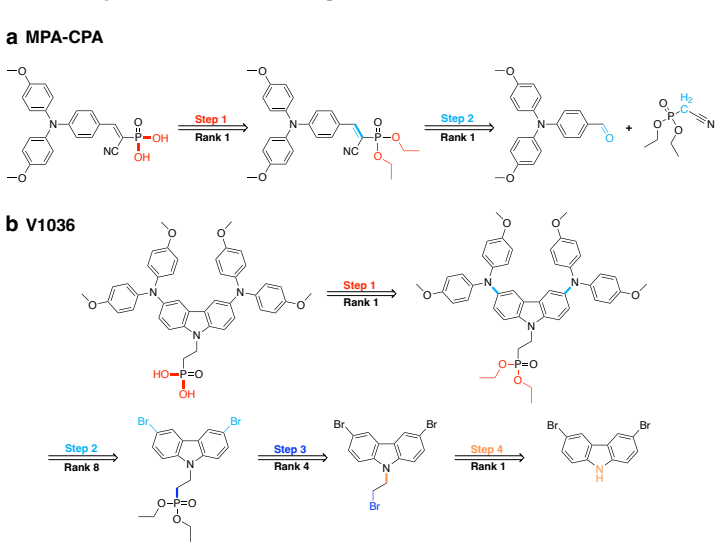
- A single-step model can be applied iteratively to reproduce published multistep routes for drug molecules and perovskite materials, with most steps ranked first or second.
- Templates and reaction class labels are not needed; verifiable-reward RL plus root-aligned SMILES augmentation supplies the training signal.
- Round-trip and MaxFrag evaluations indicate the predictions are chemically plausible alternatives, not merely string matches to dataset answers.
Reading between the lines
- If the headline result survives a clean audit of the base model's pretraining data, the same three-stage recipe should transfer to other chemistry tasks with verifiable string-level rewards, such as forward reaction prediction or condition recommendation.
- The exact-match reward pushes the model toward dataset answers, but retrosynthesis is one-to-many; using round-trip validity or forward-reaction plausibility as an additional reward could yield better chemistry than the paper reports.
- The reported 59.0% without test-time augmentation versus 65.0% with it shows that a meaningful share of the headline advantage comes from the sampling-plus-beam-search aggregation, not from reasoning or RL alone.
- The two-stage inference scheme—sample reasoning paths, then beam-search the answer only—is a reusable pattern for any chain-of-thought model whose final answer is cleanly separated from its reasoning.
Editorial analysis
A structured set of objections, weighed in public.
Referee Report
Summary. The manuscript introduces RetroDFM-R, an 8B-parameter LLM for single-step retrosynthesis initialized from ChemDFM-v1.5 and trained in three stages: continual pretraining on SMILES-IUPAC conversion and retrosynthesis data, cold-start reasoning distillation from DeepSeek-R1, and reinforcement learning with DAPO using exact-match and format rewards. On USPTO-50K the model reports 59.0% top-1 exact match without augmentation and 65.0% with test-time augmentation, exceeding EditRetro by 4.2%; on USPTO-FULL it reports 50.5% top-1 (below EditRetro's 52.2%) but higher top-3/5/10. The paper also presents round-trip and MaxFrag metrics, human AB preferences, per-class breakdowns, and multistep case studies.
Significance. If the 65.0% result is robust, it is a meaningful advance: it would be the first LLM-based retrosynthesis model to surpass specialized graph- and sequence-based methods on USPTO-50K, and the explicit chain-of-thought outputs plus double-blind human evaluation are valuable contributions. The paper is commendably transparent in several respects: it uses external benchmarks and standard splits, reports a no-augmentation number alongside the augmented result, provides code and evaluation data links, and includes an honest discussion of reasoning hallucination. The two main weaknesses are that the base model's pretraining corpus is not audited for test-set overlap and that the inference augmentation parameters ka, ks, and kb are never reported; both are directly relevant to the headline claim.
major comments (2)
- [Sections 1.2, 3.1, 3.3] The leakage cleaning described in Sections 1.2 and 3.1 removes test-set products from the data the authors control, but the model is initialized from ChemDFM-v1.5 (Section 3.3), and the ChemDFM-v1.5 pretraining corpus is never audited for overlap with the USPTO-50K or USPTO-FULL test reactions. The 17.9% ChemDFM-v1.5 baseline in Table 1 does not rule out memorization, because that baseline is measured without the task-specific <think>/<answer> formatting and exact-match reward training introduced by this paper. Before the state-of-the-art claim can be accepted, the authors should either audit the base model's pretraining data for these test reactions, retrain from a checkpoint with verified disjoint pretraining, or provide a quantitative overlap analysis (e.g., reaction or substructure retrieval rates).
- [Section 3.4, Tables 1-2] Section 3.4 defines the inference augmentation counts ka, ks, and kb but never reports their numerical values; Table 8 and Appendix G also omit them. The headline 65.0% in Table 2 is obtained with this augmentation (Table 1 shows 59.0% without it), so without these values the result cannot be reproduced and cannot be compared with EditRetro or R-SMILES under a matched inference budget. Please report the exact ka, ks, and kb (and, if relevant, the beam size) used for each reported row, and clarify whether they were chosen on the validation set.
minor comments (7)
- [Abstract and Section 1.4] The abstract's statement that RetroDFM-R 'significantly outperforms state-of-the-art methods' is too strong for USPTO-FULL, where Table 3 reports a top-1 accuracy of 50.5% versus EditRetro's 52.2%; please qualify the claim to USPTO-50K or to the top-3/5/10 results on USPTO-FULL.
- [Section 3.2] The reward in Equation (1) is an exact canonical-SMILES match plus a format check; calling it 'chemically verifiable' is somewhat overstated, since the Molecular Transformer round-trip verification is used only as an evaluation metric in Table 4 and not as a training reward.
- [Section 1.11 and Figure 6] The description of the AB test as 'double-blind' is unclear, because the experimenters must know which candidate is the model output in order to assign A and B; please clarify the blinding procedure and what exactly was hidden from the experimenters.
- [Section 1.8 and Figure 3] The diversity cluster analysis reports Tanimoto similarities for RetroDFM-R only; a comparison with EditRetro and R-SMILES using the same protocol would be needed to support the claim that RetroDFM-R generates more diverse predictions.
- [Appendix B, Table 5] The statement that 78.3% accuracy on the 23-sample FGA class reflects 'genuine understanding' is underpowered; with 23 samples the uncertainty is large, and no per-class baseline comparison is provided.
- [Section 1.10] The multistep retrosynthesis results are sequential rollouts of the single-step model; please state explicitly that these are illustrative case studies without a search algorithm, and clarify how the stopping criterion and intermediate selections were determined.
- [Appendix C] The prompt for chemical LLMs refers to 'ChemDMF-v1.5'; the correct name used elsewhere is 'ChemDFM-v1.5'.
Circularity Check
The headline 65.0% accuracy is externally benchmarked and not circular; the only mild circularity is the answer-conditioned rationale used to support the explainability claim.
-
self definitional
[Section 1.1 (Overview; also Section 3.1 pipeline)]
"We employ an answer-conditioned distillation strategy, wherein the model is provided with both the input question and the correct answer, along with explicit instructions to generate a coherent, stepwise reasoning chain leading from problem to solution. In doing so, the model generates a reasoning process as if independently deriving the answer reactants, thereby emulating the analytical thinking of a human expert."
The reasoning traces that ground the explainability claim are manufactured by conditioning the teacher on the ground-truth reactants, so the rationale is by construction a post-hoc narrative matching the known answer. The paper then presents this reasoning as if it were the model's independent derivation ('as if independently deriving the answer reactants'), and Section 1.7 uses it as evidence of human-interpretable insight. This makes the interpretability advantage reduce to answer-conditioned rationalization rather than evidence about how predictions are actually reached. The paper itself concedes that the model 'may produce reasoning steps that are irrelevant or disconnected from the final predicted reactants' (Section 2).
full rationale
The central SOTA claim is externally grounded and not circular: RETRO DFM-R's top-1 accuracy of 65.0% on USPTO-50K (Table 2) and its USPTO-FULL performance (Table 3) are measured against standard public test splits using exact-match canonical SMILES scoring, with comparisons to published template-based, graph-based, and sequence-based baselines. No fitted parameter or self-defined benchmark enters the accuracy computation. Using ChemDFM-v1.5 as the backbone and as a baseline is legitimate reuse of the authors' prior model, not a load-bearing self-citation. The one mild circular step is confined to the explainability claim: the cold-start reasoning data are produced by answer-conditioned distillation, i.e., DeepSeek-R1 is given the correct reactants and asked to write a reasoning chain leading to them. Thus the rationales are generated from the label, so presenting them as independent 'insights' is a self-definitional artifact. This does not affect the external accuracy result, which stands on its own benchmark evaluation.
Assumptions & free parameters
free parameters (4)
- lambda (reward weight in Eq. 1) =
0.5
- alpha (ranking decay in Eq. 5) =
1.0
- ka, ks, kb (inference augmentation counts) =
not reported
- rollout temperature in RL inference =
1.0
assumptions (6)
- domain assumption USPTO-50K and USPTO-FULL test labels are correct and complete enough to serve as ground truth for exact-match reward.
- domain assumption ChemDFM-v1.5's pretraining corpus did not contain USPTO-50K test reactions.
- domain assumption DeepSeek-R1 answer-conditioned rationales are chemically sound enough to serve as training targets for reasoning.
- domain assumption Canonical SMILES exact match after RDKit is an adequate and fair correctness measure.
- domain assumption The hand-selected multistep case studies are representative of practical route planning.
- standard math DAPO and OpenRLHF behave as described in their source references.
Cite this review
Pith. "Pith review of Reasoning-Driven Retrosynthesis Prediction with Large Language Models via Reinforcement Learning." pith.science (2026). https://pith.science/paper/HJ7MAJKS
@misc{pith2026250717448,
  author       = {Pith},
  title        = {Pith review of: Reasoning-Driven Retrosynthesis Prediction with Large Language Models via Reinforcement Learning},
  year         = {2026},
  howpublished = {\url{https://pith.science/paper/HJ7MAJKS}},
  note         = {Machine review of arXiv:2507.17448}
}
read the original abstract
Retrosynthesis planning, essential in organic synthesis and drug discovery, has greatly benefited from recent AI-driven advancements. Nevertheless, existing methods frequently face limitations in both applicability and explainability. Traditional graph-based and sequence-to-sequence models often lack generalized chemical knowledge, leading to predictions that are neither consistently accurate nor easily explainable. To address these challenges, we introduce RetroDFM-R, a reasoning-based large language model (LLM) designed specifically for chemical retrosynthesis. Leveraging large-scale reinforcement learning guided by chemically verifiable rewards, RetroDFM-R significantly enhances prediction accuracy and explainability. Comprehensive evaluations demonstrate that RetroDFM-R significantly outperforms state-of-the-art methods, achieving a top-1 accuracy of 65.0% on the USPTO-50K benchmark. Double-blind human assessments further validate the chemical plausibility and practical utility of RetroDFM-R's predictions. RetroDFM-R also accurately predicts multistep retrosynthetic routes reported in the literature for both real-world drug molecules and perovskite materials. Crucially, the model's explicit reasoning process provides human-interpretable insights, thereby enhancing trust and practical value in real-world retrosynthesis applications.
Figures


Figures from the paper (11 more)






Forward citations
Cited by 3 Pith papers
-
Augmenting Molecular Language Models with Local $n$-gram Memory
MolGram integrates a conditional n-gram memory module into molecular language models to address locality gaps in SMILES tokenization, improving performance on generation, forward prediction, and retrosynthesis while o...
-
Large Language Models in Process Systems Engineering: Opportunities, Architectures, and Industrial Deployment Challenges
A systematic review of LLM applications in process systems engineering finds genuine utility for natural-language tasks but persistent challenges for real-time execution, constraint satisfaction, and safety guarantees.
-
RETROSPECT: RETROsynthesis via Sequential Prediction, and Chemically Transformed-ranking
RETROSPECT reports 55.00% top-1 and 86.18% top-10 accuracy on USPTO-50K with a ChemAlign Transformer plus LambdaMART reranker reaching 59.4% top-1 on candidate pools using proposal scores and template statistics.
Reference graph
Works this paper leans on
-
[1]
Corey, E. J. The logic of chemical synthesis: multistep synthesis of complex carbogenic molecules (nobel lecture). Angewandte Chemie International Edition in English 30, 455–465 (1991)
work page 1991
-
[2]
Corey, E. J., Long, A. K. & Rubenstein, S. D. Computer-assisted analysis in organic synthesis. Science 228, 408–418 (1985)
work page 1985
-
[3]
Coley, C. W., Rogers, L., Green, W. H. & Jensen, K. F. Computer-assisted retrosynthesis based on molecular similarity. ACS central science 3, 1237–1245 (2017)
work page 2017
-
[4]
Todd, M. H. Computer-aided organic synthesis. Chemical Society Reviews 34, 247–266 (2005)
work page 2005
- [5]
-
[6]
Sacha, M. et al. Molecule edit graph attention network: modeling chemical reactions as sequences of graph edits. Journal of Chemical Information and Modeling 61, 3273–3284 (2021)
work page 2021
- [7]
-
[8]
Chen, Z., Ayinde, O. R., Fuchs, J. R., Sun, H. & Ning, X. G 2 retro as a two-step graph generative models for retrosynthesis prediction. Communications Chemistry 6, 102 (2023)
work page 2023
Show all 75 references
-
[9]
Zhu, J. et al. Beyond homophily in graph neural networks: Current limitations and effective designs. Advances in neural information processing systems 33, 7793–7804 (2020)
2020
-
[10]
& Koltun, V
Li, G., Müller, M., Ghanem, B. & Koltun, V . Training graph neural networks with 1000 layers. In International conference on machine learning, 6437–6449 (PMLR, 2021)
2021
-
[11]
Jin, D. et al. Graph neural network for higher-order dependency networks. In Proceedings of the ACM Web Conference 2022, 1622–1630 (2022)
2022
-
[12]
& Jung, Y
Chen, S. & Jung, Y . Deep retrosynthetic reaction prediction using local reactivity and global attention. JACS Au 1, 1612–1620 (2021)
2021
-
[13]
Liu, B. et al. Retrosynthetic reaction prediction using neural sequence-to-sequence models. ACS central science 3, 1103–1113 (2017)
2017
-
[14]
& Tetko, I
Karpov, P., Godin, G. & Tetko, I. V . A transformer model for retrosynthesis. InInternational conference on artificial neural networks, 817–830 (Springer, 2019)
2019
-
[15]
& Yang, Y
Zheng, S., Rao, J., Zhang, Z., Xu, J. & Yang, Y . Predicting retrosynthetic reactions using self-corrected transformer neural networks. Journal of chemical information and modeling 60, 47–55 (2019)
2019
-
[16]
V ., Karpov, P., Van Deursen, R
Tetko, I. V ., Karpov, P., Van Deursen, R. & Godin, G. State-of-the-art augmented nlp transformer models for direct and single-step retrosynthesis. Nature communications 11, 5575 (2020)
2020
-
[17]
& Lai, L
Lin, K., Xu, Y ., Pei, J. & Lai, L. Automatic retrosynthetic route planning using template-free models. Chemical science 11, 3355–3364 (2020)
2020
-
[18]
Kim, E., Lee, D., Kwon, Y ., Park, M. S. & Choi, Y .-S. Valid, plausible, and diverse retrosynthesis using tied two-way transformers with latent variables. Journal of Chemical Information and Modeling 61, 123–133 (2021)
2021
-
[19]
Zhong, Z. et al. Root-aligned smiles: a tight representation for chemical reaction prediction. Chemical Science 13, 9023–9034 (2022)
2022
-
[20]
Retrosynthesis prediction with an iterative string editing model
Han, Y .et al. Retrosynthesis prediction with an iterative string editing model. Nature Commu- nications 15, 6404 (2024)
2024
-
[21]
Smiles, a chemical language and information system
Weininger, D. Smiles, a chemical language and information system. 1. introduction to method- ology and encoding rules. Journal of chemical information and computer sciences 28, 31–36 (1988)
1988
-
[22]
& Schmidhuber, J
Hochreiter, S. & Schmidhuber, J. Long short-term memory. Neural computation 9, 1735–1780 (1997)
1997
-
[23]
Attention is all you need
Vaswani, A.et al. Attention is all you need. Advances in neural information processing systems 30 (2017)
2017
-
[24]
Brown, T. et al. Language models are few-shot learners. Advances in neural information processing systems 33, 1877–1901 (2020)
2020
-
[25]
Achiam, J. et al. Gpt-4 technical report. arXiv preprint arXiv:2303.08774 (2023)
2023 arXiv
-
[26]
Jaech, A. et al. Openai o1 system card. arXiv preprint arXiv:2412.16720 (2024). 18
2024 arXiv
-
[27]
Chen, Z. et al. Dfm: Dialogue foundation model for universal large-scale dialogue-oriented task learning. arXiv preprint arXiv:2205.12662 (2022)
2022 arXiv
-
[28]
Guo, D. et al. Deepseek-r1: Incentivizing reasoning capability in llms via reinforcement learning. arXiv preprint arXiv:2501.12948 (2025)
2025 arXiv
-
[29]
Zhao, Z. et al. Developing chemdfm as a large language foundation model for chemistry. Cell Reports Physical Science 6 (2025)
2025
-
[30]
Zhao, Z. et al. Chemdfm-x: towards large multimodal model for chemistry. Science China Information Sciences 67, 1–2 (2024)
2024
-
[31]
Zhang, D. et al. Chemllm: A chemical large language model. arXiv preprint arXiv:2402.06852 (2024)
2024 arXiv
-
[32]
N., Chen, Z., Ning, X
Yu, B., Baker, F. N., Chen, Z., Ning, X. & Sun, H. LlaSMol: Advancing large language models for chemistry with a large-scale, comprehensive, high-quality instruction tuning dataset. In First Conference on Language Modeling (2024)
2024
-
[33]
Tan, Q. et al. Chemmllm: Chemical multimodal large language model. arXiv preprint arXiv:2505.16326 (2025)
2025 arXiv
-
[34]
Yu, Q. et al. Dapo: An open-source llm reinforcement learning system at scale. arXiv preprint arXiv:2503.14476 (2025)
2025 arXiv
-
[35]
Chen, Z. et al. An empirical study on eliciting and improving r1-like reasoning models. arXiv preprint arXiv:2503.04548 (2025)
2025 arXiv
-
[36]
Kim, S. et al. Pubchem 2025 update. Nucleic Acids Research 53, D1516–D1525 (2024)
2024
-
[37]
& Landrum, G
Schneider, N., Stiefl, N. & Landrum, G. A. What’s what: The (nearly) definitive guide to reaction role assignment. Journal of chemical information and modeling 56, 2336–2346 (2016)
2016
-
[38]
& Jaakkola, T
Jin, W., Coley, C., Barzilay, R. & Jaakkola, T. Predicting organic reaction outcomes with weisfeiler-lehman network. Advances in neural information processing systems 30 (2017)
2017
-
[39]
Hurst, A. et al. Gpt-4o system card. arXiv preprint arXiv:2410.21276 (2024)
2024 arXiv
-
[40]
Introducing gpt-4.1 in the api (2025)
OpenAI. Introducing gpt-4.1 in the api (2025). URL https://openai.com/index/gpt-4-1
2025
-
[41]
Liu, A. et al. Deepseek-v3 technical report. arXiv preprint arXiv:2412.19437 (2024)
2024 arXiv
-
[42]
Introducing openai o3 and o4-mini (2025)
OpenAI. Introducing openai o3 and o4-mini (2025). URL https://openai.com/index/ introducing-o3-and-o4-mini
2025
-
[43]
Segler, M. H. & Waller, M. P. Neural-symbolic machine learning for retrosynthesis and reaction prediction. Chemistry–A European Journal 23, 5966–5971 (2017)
2017
-
[44]
& Tang, J
Shi, C., Xu, M., Guo, H., Zhang, M. & Tang, J. A graph to graphs framework for retrosynthesis prediction. In International conference on machine learning, 8818–8827 (PMLR, 2020)
2020
-
[45]
Yan, C. et al. Retroxpert: Decompose retrosynthesis prediction like a chemist. Advances in Neural Information Processing Systems 33, 11248–11258 (2020)
2020
-
[46]
R., Bunne, C., Coley, C., Krause, A
Somnath, V . R., Bunne, C., Coley, C., Krause, A. & Barzilay, R. Learning graph models for retrosynthesis prediction. Advances in Neural Information Processing Systems 34, 9405–9415 (2021)
2021
-
[47]
Wang, X. et al. Retroprime: A diverse, plausible and transformer-based method for single-step retrosynthesis predictions. Chemical Engineering Journal 420, 129845 (2021)
2021
-
[48]
Seo, S.-W. et al. Gta: Graph truncated attention for retrosynthesis. In Proceedings of the AAAI Conference on Artificial Intelligence, vol. 35, 531–539 (2021). 19
2021
-
[49]
& Zhang, S
Wan, Y ., Hsieh, C.-Y ., Liao, B. & Zhang, S. Retroformer: Pushing the limits of end-to-end retrosynthesis transformer. In International Conference on Machine Learning, 22475–22490 (PMLR, 2022)
2022
-
[50]
& Coley, C
Tu, Z. & Coley, C. W. Permutation invariant graph-to-sequence model for template-free retrosynthesis and reaction prediction. Journal of chemical information and modeling 62, 3503–3513 (2022)
2022
-
[51]
Molecular transformer: a model for uncertainty-calibrated chemical reaction prediction
Schwaller, P.et al. Molecular transformer: a model for uncertainty-calibrated chemical reaction prediction. ACS central science 5, 1572–1583 (2019)
2019
-
[52]
Finlay, M. R. V .et al. Discovery of a potent and selective egfr inhibitor (azd9291) of both sensitizing and t790m resistance mutations that spares the wild type form of the receptor. Journal of Medicinal Chemistry 57, 8249–8267 (2014)
2014
-
[53]
Guo, Z.-L., Deng, Y .-Q., Zhong, S. & Lu, G. Enantioselective synthesis of (r)-salmeterol employing an asymmetric henry reaction as the key step. Tetrahedron: Asymmetry 22, 1395– 1399 (2011)
2011
-
[54]
Hou, S. et al. Design, synthesis, and biological evaluation of selective sting synergists that enhance cgamp-sting pathway activation without inherent agonist activity. Journal of Medicinal Chemistry 68, 9407–9430 (2025)
2025
-
[55]
Xu, H. et al. Design and synthesis of seh/hdac6 dual-targeting inhibitors for the treatment of inflammatory pain. Journal of Medicinal Chemistry 67, 12887–12911 (2024)
2024
-
[56]
Rdkit: Open-source cheminformatics software (2016)
Landrum, G. Rdkit: Open-source cheminformatics software (2016)
2016
-
[57]
Shao, Z. et al. Deepseekmath: Pushing the limits of mathematical reasoning in open language models. arXiv preprint arXiv:2402.03300 (2024)
2024 arXiv
-
[58]
& Klimov, O
Schulman, J., Wolski, F., Dhariwal, P., Radford, A. & Klimov, O. Proximal policy optimization algorithms. arXiv preprint arXiv:1707.06347 (2017)
2017 arXiv
-
[59]
Grattafiori, A. et al. The llama 3 herd of models. arXiv preprint arXiv:2407.21783 (2024)
2024 arXiv
-
[60]
Ainslie, J. et al. GQA: Training generalized multi-query transformer models from multi-head checkpoints. In Bouamor, H., Pino, J. & Bali, K. (eds.) Proceedings of the 2023 Conference on Empirical Methods in Natural Language Processing, 4895–4901 (Association for Computational ...
2023
-
[61]
Hu, J. et al. Openrlhf: An easy-to-use, scalable and high-performance rlhf framework. arXiv preprint arXiv:2405.11143 (2024)
2024 arXiv
-
[62]
& Liubimov, N
Tkachenko, M., Malyuk, M., Holmanyuk, A. & Liubimov, N. Label Studio: Data labeling software (2020-2025). URL https://github.com/HumanSignal/label-studio
2020
-
[63]
Zhang, S. et al. Minimizing buried interfacial defects for efficient inverted perovskite solar cells. Science 380, 404–409 (2023)
2023
-
[64]
Self-assembled hole transporting monolayer for highly efficient perovskite solar cells
Magomedov, A.et al. Self-assembled hole transporting monolayer for highly efficient perovskite solar cells. Advanced energy materials 8, 1801892 (2018)
2018
-
[65]
Kingma, D. P. Adam: A method for stochastic optimization. arXiv preprint arXiv:1412.6980 (2014)
2014 arXiv
-
[66]
Rasley, J., Rajbhandari, S., Ruwase, O. & He, Y . Deepspeed: System optimizations enable training deep learning models with over 100 billion parameters. In Proceedings of the 26th ACM SIGKDD international conference on knowledge discovery & data mining, 3505–3506 (2020)
2020
-
[67]
FlashAttention-2: Faster attention with better parallelism and work partitioning
Dao, T. FlashAttention-2: Faster attention with better parallelism and work partitioning. In International Conference on Learning Representations (ICLR) (2024). 20 A Inference workflow of R ETRO DFM-R SMILES Augmentationa Reasoning Samplingb Partial Beam Searchc Global Ranking...
2024
-
[68]
- Highlight any reactive sites, electron-withdrawing/electron-donating groups, and resonance or steric effects that may influence its reactivity
Product Structure Analysis: - Clearly identify and describe key functional groups within the provided molecule. - Highlight any reactive sites, electron-withdrawing/electron-donating groups, and resonance or steric effects that may influence its reactivity
-
[69]
- Propose reactants that are chemically feasible, stable, and commercially available or readily synthesized
Retrosynthetic Analysis: - Break down the molecule into simpler precursors using retrosynthetic analysis, clearly indicating the bonds targeted for disconnection. - Propose reactants that are chemically feasible, stable, and commercially available or readily synthesized. - Pro...
-
[70]
A is better
Final Response Template: <reason> [Provide your reasoning in logically coherent paragraphs, clearly analyzing the product’s structure, functional groups, and reactive sites. Reflect thoughtfully on strategic bond disconnections and justify the selection of reactants without us...
-
[71]
The correctness and rationality of the retrosynthetic analysis
-
[72]
A constructive retrosynthetic design, in which a complex molecule is transformed into two relatively simple molecules, is preferred
-
[73]
A synthetic plan with high potential yield and fewer side reactions is preferable
-
[74]
Mild reaction conditions and the use of commonly available reagents are advanta- geous
-
[75]
Figure 10: Evaluation criteria provided to annotators for the AB test
Preference for greener and safer chemical solutions. Figure 10: Evaluation criteria provided to annotators for the AB test. O N NC P O OH OH O O N O O OP O H2 C NO O N NC P O O O O Step 1 Rank 1 Step 2 Rank 1 + O N O N O O N POHO OH O PO N Br Br O O N O N O O N POO O Step 1 Ra...
Reviewed August 6, 2026 · model on record in the stance chip above.
Discussion (0). Sign in to comment.