REVIEW 4 major objections 6 minor 28 references
BGM-HAN: A Hierarchical Attention Network for Accurate and Fair Decision Assessment on Semi-Structured Profiles
T0 review · 4 major / 6 minor · reviewed 2026-08-06 · deepseek-v4-flash
Pith's one-line read BGM-HAN reports 85.06% accuracy and beats GPT-4o on semi-structured admissions profiles.
desk verdict A clearly written architecture paper whose headline claim of significant superiority is not backed by any significance testing on a 154-sample test set; the idea is worth reviewing, but the evidence needs major reinforcement. read the letter →
The pith
A machine-rendered reading of the paper's core claim, the machinery that carries it, and where it could break.
The reading
What carries the argument
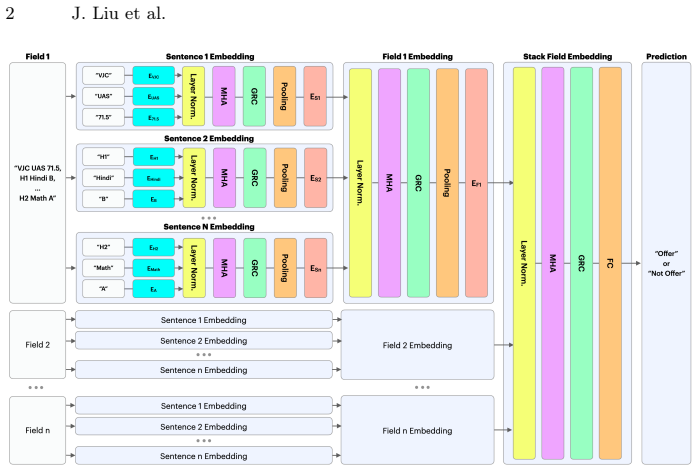
The load-bearing object is the three-level hierarchy token → sentence → field, implemented in the BGM-HAN network. Each level applies layer normalization, multi-head self-attention, a gated residual connection, and mean pooling, so local word information is composed into sentence embeddings and then field embeddings before a final binary classifier. Byte-pair encoding supplies a 5,000-token subword vocabulary that keeps rare and out-of-vocabulary terms representable; the gated residual term $\gamma \odot \mathrm{FFN}(X) + X$ lets the network decide how much nonlinear transformation to pass forward; and a class-weighted binary cross-entropy loss counteracts the imbalance between offers and rejections.
What would settle it
Resample the 3,083 profiles repeatedly (e.g., bootstrap or repeated stratified 90/5/5 splits), retrain or refit the strongest baselines, and compute confidence intervals for accuracy and F1; if the interval for BGM-HAN's margin over BiLSTM-Concat and XGBoost frequently includes zero, the reported superiority is not established.
Extended reading notes
Core claim
On the paper's own terms, the discovery is that the multi-level structure of an admissions profile is learnable and predictive. BGM-HAN scores each applicant by first tokenizing every text field with a learned BPE subword vocabulary, then composing word-level representations into sentence-level and field-level representations with layer normalization, multi-head self-attention, gated residual connections, and mean pooling. Applied to 3,083 real applicant profiles, this architecture reaches a macro-averaged F1-score of 0.8453 and an accuracy of 0.8506, the highest values in the paper's table, ahead of XGBoost (F1 0.7878), BiLSTM-Concat (F1 0.8176), and GPT-4o-RA (F1 0.7352). The paper concludes that hierarchical modeling of semi-structured profiles beats both traditional discriminative models and out-of-the-box LLMs for this decision task.
Load-bearing premise
The performance claim depends on a single stratified 5% test split — roughly 154 profiles from one admission year — with no confidence intervals or significance tests, so a few percentage points of separation between models could be sampling noise.
Editorial extensions
If this is right
- A comparatively small trained classifier can beat zero-shot and five-shot GPT-4o on this admissions task, weakening the case for using general-purpose LLMs without domain adaptation.
- The hierarchy itself contributes: plain HAN trails BGM-HAN by 7.4 F1 points and 9.6 accuracy points in the paper's reported results.
- Each added mechanism improves the base model in the ablation, with multi-head attention listed as the largest single gain.
- The model's field-level attention could be shown to reviewers as evidence behind an admission decision, supporting the paper's interpretability goal.
Reading between the lines
- Editorial inference: the 2.8-point F1 margin over BiLSTM-Concat and the 5.8-point margin over XGBoost come from one test split; a bootstrap analysis would tell whether the hierarchy is actually buying the stated gains.
- Editorial inference: the fairness framing is not backed by outcome metrics; group-wise error rates, calibration, or counterfactual tests would be needed before calling the model fair.
- Editorial inference: if the hierarchy generalizes, the same token-to-sentence-to-field pattern could transfer to other semi-structured evaluation tasks such as resume screening and loan applications, but that transfer requires separate validation on each new domain.
- Editorial inference: attention weights are presented as interpretability, yet the paper does not test whether the attended sentences are the ones that actually drive the prediction; an attention-faithfulness perturbation test would settle that.
Editorial analysis
A structured set of objections, weighed in public.
Referee Report
Summary. The paper proposes BGM-HAN, a hierarchical attention network with byte-pair encoding, gated residual connections, and multi-head attention, for binary admission decisions on semi-structured applicant profiles. The model is evaluated on a proprietary dataset of 3,083 profiles against traditional ML, neural, and zero-/few-shot GPT-4o baselines, reporting the best accuracy (0.8506) and macro-F1 (0.8453). The authors claim significant superiority over all baselines, interpretability, and fairness, and they release source code. The architecture and training details are clearly specified, but the central empirical claims are undermined by the small test set, the absence of any statistical uncertainty quantification, and the lack of a fairness evaluation.
Significance. If the empirical claims were established, BGM-HAN would be a useful contribution to modeling hierarchical semi-structured data in high-stakes decision settings, and the code release would support follow-up work. The paper's strengths include a clearly specified architecture with algorithmic descriptions, a real-world admissions dataset, a broad baseline suite spanning traditional ML to LLMs, and the use of a class-weighted loss to address imbalance. However, the significance is currently limited by three major gaps: (1) the claim of significant superiority is not supported by any confidence intervals, significance tests, or repeated-seed variance; (2) the fairness promised in the title and introduction is never measured; and (3) the ablation study's component-wise gains are asserted without reporting the intermediate model results. These gaps are load-bearing for the paper's main claims, so the contribution remains promising but not yet established.
major comments (4)
- [Abstract; §4.4; Table 2] The central claim that BGM-HAN 'significantly outperforms' all baselines is not supported by the reported statistics. The test split is 5% of 3,083 profiles, i.e., approximately 154 samples. The margin over BiLSTM-Concat is 0.0230 in accuracy and 0.0277 in macro-F1, which corresponds to only a handful of test-set predictions. No confidence intervals, significance tests, or repeated-seed variance are reported anywhere in Section 4, so the observed margins are within typical sampling noise for this test size. Please provide uncertainty quantification (e.g., bootstrap confidence intervals, paired significance tests, or multiple-seed runs) and revise the wording 'significantly' in the abstract and Section 4.6 to match the statistical evidence.
- [§3.5; §4.6; Title] The fairness claim is unevaluated. The weighted binary cross-entropy loss in Section 3.5 compensates for class imbalance, but it does not by itself ensure or measure fairness. No protected attributes, fairness metrics (e.g., demographic parity or equalized odds), or fairness audits are presented in Section 4, yet the title and contribution 3 promise a 'fair' decision assessment. The manuscript should either add a concrete fairness evaluation or explicitly reframe the fairness contribution as a design aspiration rather than an empirically supported property.
- [§4.7; Table 2] The ablation study reports component-wise gains (BPE +1.8%, multi-head attention +5.2%, gated residual connections +2.6%) and a total F1 gain of 7.4% over the base HAN, but Table 2 contains only the base HAN and the full BGM-HAN rows. The intermediate configurations with each enhancement added are never reported, making the claimed component contributions unverifiable and preventing readers from checking whether the gains are additive or interact. Please provide a complete ablation table with all component combinations, including uncertainty estimates, or remove the component-wise percentages.
- [§1, Contribution 3; §4.6] The introduction claims that BGM-HAN outperforms 'human evaluators,' but no human evaluation results are presented in Table 2 or anywhere in Section 4. This unsupported claim should be either substantiated with data or removed. The text around Table 2 also refers to results 'across proposed models, human evaluation, and different categories of baseline models,' yet no human row exists in the table; please reconcile the text and the table.
minor comments (6)
- [§4.2; §4.5] Section 4.2 reports that BGM-HAN was trained with the AdamW optimizer, while Section 4.5 states that 'neural models' use Adam; please clarify which optimizer applies to BGM-HAN and to each neural baseline to avoid ambiguity.
- [§3.3] There is a typo in Section 3.3: 'attend to different different positions' should read 'attend to different positions.'
- [References] References [24] and [25] both cite Vaswani et al., and references [27] and [28] both cite Yang et al. with overlapping titles; please consolidate the duplicates.
- [§4.4] The phrase 'missing values in text fields are replaced with NaN tokens' should be made more precise, for example by specifying a dedicated '[PAD]' or '[MASK]' token and describing how the model treats it.
- [§2] The mapping in Section 2 is written as D : P → 0, 1; it should be D : P → {0, 1} to denote the binary label set.
- [§4.5; Table 2] The GPT-4o baselines are zero-shot and retrieval-augmented few-shot without fine-tuning; the text should consistently say so when claiming superiority over 'large language models,' since a fine-tuned LLM would be a stronger comparison point.
Circularity Check
No significant circularity: BGM-HAN's performance claim rests on a standard train/validation/test evaluation, and the self-citations in related work are not load-bearing.
full rationale
The paper's central claim is an empirical performance comparison: BGM-HAN is trained on a 90% split and evaluated on a held-out 5% test split. Section 4.4 states: 'We split the dataset into training (90%), validation (5%), and test (5%) subsets using stratified sampling to preserve the class distribution across splits.' The reported F1-score and accuracy in Table 2 are therefore genuine held-out predictions, not quantities defined in terms of the target result. Hyperparameters were selected on validation accuracy (Section 4.2), not on test labels, so the test numbers are not fitted inputs renamed as predictions. The ablation discussion compares BGM-HAN to the base HAN empirically; no component is claimed to derive from the final metric by construction. The only self-citations are [16] and [17], which appear in related-work and baseline contexts and do not justify the central performance claim. There is no uniqueness theorem imported from the authors, no ansatz smuggled in via self-citation, and no renaming of a known result as a new contribution. The main weakness is statistical: with roughly 154 test profiles and no significance tests or confidence intervals, the word 'significantly' in the Abstract is not established. That is a statistical-inference concern, not a circularity concern. Accordingly, no circular step is identified.
Assumptions & free parameters
free parameters (8)
- hidden dimension =
1024
- number of attention heads =
8
- dropout rate =
0.6
- learning rate =
1e-5
- batch size =
32
- BPE vocabulary size =
5000
- hierarchical dimensions (s,w,d) =
(10, 50, 768)
- L2 regularization weight decay lambda
assumptions (5)
- domain assumption The four profile components (GCE A-Level results, GCE O-Level results, leadership records, PIQ responses) and the binary admission label are sufficient to model the admission decision.
- domain assumption The 3,083 profiles from a single year at one engineering university are representative of the admissions decision task in general.
- standard math Standard neural network training, including backpropagation and AdamW optimization, converges to a model whose performance generalizes to the held-out test set.
- ad hoc to paper Class-weighted binary cross-entropy loss is an adequate mechanism for achieving fairness.
- domain assumption The BPE vocabulary learned on the corpus does not leak test-set information, even though the train/test split for vocabulary learning is not specified.
Cite this review
Pith. "Pith review of BGM-HAN: A Hierarchical Attention Network for Accurate and Fair Decision Assessment on Semi-Structured Profiles." pith.science (2026). https://pith.science/paper/YSGS5W5P
@misc{pith2026250717472,
  author       = {Pith},
  title        = {Pith review of: BGM-HAN: A Hierarchical Attention Network for Accurate and Fair Decision Assessment on Semi-Structured Profiles},
  year         = {2026},
  howpublished = {\url{https://pith.science/paper/YSGS5W5P}},
  note         = {Machine review of arXiv:2507.17472}
}
read the original abstract
Human decision-making in high-stakes domains often relies on expertise and heuristics, but is vulnerable to hard-to-detect cognitive biases that threaten fairness and long-term outcomes. This work presents a novel approach to enhancing complex decision-making workflows through the integration of hierarchical learning alongside various enhancements. Focusing on university admissions as a representative high-stakes domain, we propose BGM-HAN, an enhanced Byte-Pair Encoded, Gated Multi-head Hierarchical Attention Network, designed to effectively model semi-structured applicant data. BGM-HAN captures multi-level representations that are crucial for nuanced assessment, improving both interpretability and predictive performance. Experimental results on real admissions data demonstrate that our proposed model significantly outperforms both state-of-the-art baselines from traditional machine learning to large language models, offering a promising framework for augmenting decision-making in domains where structure, context, and fairness matter. Source code is available at: https://github.com/junhua/bgm-han.
Figures
Reference graph
Works this paper leans on
-
[1]
Advances in Neural Information Processing Systems36 (2024)
Alur, R., Laine, L., Li, D., Raghavan, M., Shah, D., Shung, D.: Auditing for human expertise. Advances in Neural Information Processing Systems36 (2024)
work page 2024
-
[2]
and it’s bi- ased against blacks
Angwin, J., Larson, J., Mattu, S., Kirchner, L.: Machine bias: There’s software used across the country to predict future criminals. and it’s bi- ased against blacks. ProPublica (2016), https://www.propublica.org/article/ machine-bias-risk-assessments-in-criminal-sentencing
work page 2016
-
[3]
Anthropic: The claude 3 model family: Opus, sonnet, haiku (2024), https://www-cdn.anthropic.com/de8ba9b01c9ab7cbabf5c33b80b7bbc618857627/ Model_Card_Claude_3.pdf
work page 2024
-
[4]
In: Proceedings of the 40th International Conference on Machine Learning
Basu, S., Rawat, A.S., Zaheer, M.: A statistical perspective on retrieval-based models. In: Proceedings of the 40th International Conference on Machine Learning. pp. 1852–1886 (2023)
work page 2023
-
[5]
In: Proceedings of the 2014 Conference on Empirical Methods in Natural Language Processing (EMNLP)
Cho, K., van Merrienboer, B., Gulcehre, C., Bahdanau, D., Bougares, F., Schwenk, H., Bengio, Y.: Learning phrase representations using rnn encoder–decoder for sta- tistical machine translation. In: Proceedings of the 2014 Conference on Empirical Methods in Natural Language Processing (EMNLP). pp. 1724–1734 (2014)
work page 2014
-
[6]
Devlin, J., Chang, M.W., Lee, K., Toutanova, K.: Bert: Pre-training of deep bidi- rectional transformers for language understanding. In: Proceedings of the 2019 Conference of the North American Chapter of the Association for Computational Linguistics: Human Language Technologies. pp. 4171–4186 (2019)
work page 2019
-
[7]
Science Advances 4(1), eaao5580 (2018)
Dressel, J., Farid, H.: The accuracy, fairness, and limits of predicting recidivism. Science Advances 4(1), eaao5580 (2018). https://doi.org/10.1126/sciadv.aao5580, https://www.science.org/doi/10.1126/sciadv.aao5580
-
[8]
arXiv preprint arXiv:2407.21783 (2024)
Dubey, A., Jauhri, A., Pandey, A., Kadian, A., Al-Dahle, A., Letman, A., Mathur, A., Schelten, A., Yang, A., Fan, A., et al.: The llama 3 herd of models. arXiv preprint arXiv:2407.21783 (2024)
arXiv 2024
Show all 28 references
-
[9]
arXiv preprint arXiv:2403.00811 (2024), https://arxiv.org/abs/2403.00811
Echterhoff, J., et al.: Cognitive bias in high-stakes decision-making with llms. arXiv preprint arXiv:2403.00811 (2024), https://arxiv.org/abs/2403.00811
2024 arXiv
-
[10]
arXiv preprint arXiv:2208.05126 (2022), https://arxiv
Ghai, B., Mueller, K.: D-bias: A causality-based human-in-the-loop system for tackling algorithmic bias. arXiv preprint arXiv:2208.05126 (2022), https://arxiv. org/abs/2208.05126
2022 arXiv
-
[11]
Haag, F., Stingl, C., Zerfass, K., Hopf, K., Staake, T.: Overcoming anchoring bias: Thepotentialofaiandxai-baseddecisionsupport.arXivpreprintarXiv:2405.04972 (2024), https://arxiv.org/abs/2405.04972
2024 arXiv
-
[12]
Neural Computation 9(8), 1735–1780 (1997) Byte-Pair Encoded, Gated Multi-head Hierarchical Attention Network 15
Hochreiter, S., Schmidhuber, J.: Long short-term memory. Neural Computation 9(8), 1735–1780 (1997) Byte-Pair Encoded, Gated Multi-head Hierarchical Attention Network 15
1997
-
[13]
In: 2021 IEEE International Conference on Data Mining (ICDM)
Iyer, R.G., Wang, W., Sun, Y.: Bi-level attention graph neural networks. In: 2021 IEEE International Conference on Data Mining (ICDM). pp. 1126–1131 (2021)
2021
-
[14]
Frontiers in Psychology14, 10071311 (2023), https://pmc.ncbi.nlm.nih
Kahneman,D.,Tversky,A.:Cognitivebiasandhowtoimprovesustainabledecision making. Frontiers in Psychology14, 10071311 (2023), https://pmc.ncbi.nlm.nih. gov/articles/PMC10071311/
2023
-
[15]
In: Advances in Neural Information Processing Systems
Lample, G., Conneau, A.: Cross-lingual language model pretraining. In: Advances in Neural Information Processing Systems. vol. 32 (2019)
2019
-
[16]
Liu, J., Lee, R.K.W., Lim, K.H.: Understanding fairness-accuracy trade-offs in ma- chine learning models: Does promoting fairness undermine performance? In: Pro- ceedings of the International Conference on Advances in Social Networks Analysis and Mining (ASONAM’25) (2025)
2025
-
[17]
Journal of Big Data9(1), 1–16 (2022)
Liu, J., Ng, Y.C., Gui, Z., Singhal, T., Blessing, L.T.M., Wood, K.L., Lim, K.H.: Title2vec: a contextual job title embedding for occupational named entity recog- nition and other applications. Journal of Big Data9(1), 1–16 (2022)
2022
-
[18]
arXiv preprint arXiv:1907.11692 (2019)
Liu, Y., Ott, M., Goyal, N., Du, J., Joshi, M., Chen, D., Levy, O., Lewis, M., Zettlemoyer, L., Stoyanov, V.: Roberta: A robustly optimized bert pretraining approach. arXiv preprint arXiv:1907.11692 (2019)
2019 arXiv
-
[19]
OpenAI: Gpt-4 technical report (2024)
2024
-
[20]
Decision Support Systems63, 63–66 (2019)
Phillips-Wren, G., Power, D.J., Mora, M.: Cognitive bias, decision styles, and risk attitudes in decision making and dss. Decision Support Systems63, 63–66 (2019)
2019
-
[21]
arXiv preprint arXiv:2004.04343 (2020), https: //arxiv.org/abs/2004.04343
Ribeiro, J.G., Felisberto, F.S., Neto, I.C.: Pruning and sparsemax methods for hierarchical attention networks. arXiv preprint arXiv:2004.04343 (2020), https: //arxiv.org/abs/2004.04343
2020 arXiv
-
[22]
arXiv preprint arXiv:1611.01260 (2016)
Savarese, P.H., Mazza, L.O., Figueiredo, D.R.: Learning identity mappings with residual gates. arXiv preprint arXiv:1611.01260 (2016)
2016 arXiv
-
[23]
Ethics and Information Technology 26, 85–102 (2024)
Smith, J., Doe, J., Lee, A.: Bias and fairness in high-stakes ai: Challenges of data sensitivity and access. Ethics and Information Technology 26, 85–102 (2024). https://doi.org/10.1007/s10676-024-09746-w, https://link.springer.com/ article/10.1007/s10676-024-09746-w
2024 doi
-
[24]
Advances in Neural Information Processing Systems (2017)
Vaswani, A.: Attention is all you need. Advances in Neural Information Processing Systems (2017)
2017
-
[25]
In: Advances in Neural Information Processing Systems
Vaswani,A.,Shazeer,N.,Parmar,N.,Uszkoreit,J.,Jones,L.,Gomez,A.N.,Kaiser, Ł., Polosukhin, I.: Attention is all you need. In: Advances in Neural Information Processing Systems. vol. 30 (2017)
2017
-
[26]
arXiv preprint arXiv:2404.05228 (2024), https://arxiv.org/abs/2404.05228
Yang, M., et al.: Fair machine guidance to enhance fair decision making in biased people. arXiv preprint arXiv:2404.05228 (2024), https://arxiv.org/abs/2404.05228
2024 arXiv
-
[27]
In: Proceedings of the 2016 Conference of the North American Chapter of the Association for Computational Linguistics: Human Language Technologies
Yang, Z., Yang, D., Dyer, C., He, X., Smola, A., Hovy, E.: Hierarchical attention networks for document classification. In: Proceedings of the 2016 Conference of the North American Chapter of the Association for Computational Linguistics: Human Language Technologies. pp. 1480–...
2016
-
[28]
In: Proceedings of the 2016 conference of the North American chapter of the association for computational linguistics: human language technologies
Yang, Z., Yang, D., Dyer, C., He, X., Smola, A., Hovy, E.: Hierarchical attention networks for document classification. In: Proceedings of the 2016 conference of the North American chapter of the association for computational linguistics: human language technologies. pp. 1480–...
2016
Reviewed August 6, 2026 · model on record in the stance chip above.
Discussion (0). Sign in to comment.