REVIEW 5 major objections 6 minor 12 references
Molecular Properties in Quantum-Classical Auxiliary-Field Quantum Monte Carlo: Correlated Sampling with Application to Accurate Nuclear Forces
T0 review · 5 major / 6 minor · reviewed 2026-08-06 · deepseek-v4-flash
Pith's one-line read Correlated sampling is extended to quantum-classical AFQMC to make finite-difference nuclear forces accurate in strongly correlated molecules.
desk verdict First correlated-sampling QC-AFQMC force paper, with correct variance-reduction math and good benchmarks, but the shadow-reuse resource claim is unsupported and likely wrong for finite shadows. read the letter →
The pith
A machine-rendered reading of the paper's core claim, the machinery that carries it, and where it could break.
The reading
What carries the argument
The load-bearing identity is the finite-difference variance formula $\sigma_{F_i}^2 \approx \sigma_E^2(1-\rho)/(2\delta^2)$, which converts the force problem into the problem of driving the correlation coefficient $\rho$ between energy estimates at displaced geometries toward one. Four synchronization mechanisms do that work: identical random number sequences for corresponding walkers; an orbital alignment protocol that maximizes overlap between reference and target orbitals, handling degenerate subspaces with SVD and phase corrections; a deterministic modified Cholesky decomposition whose pivot sequence is fixed at the reference geometry so auxiliary-field representations match across geometries; and one matchgate-shadow measurement ensemble generated at the reference geometry and reused for every displacement. The virtual-correlation-energy overlap formula, Eq. (34), is also load-bearing: it reduces a full-space trial-walker overlap to an active-space overlap times classical determinant factors, allowing the quantum device to stay in a small active space while correlation outside it is recovered classically.
What would settle it
Run the correlated-sampling force calculation on a molecule where, at some displacement $R+\delta$, the fixed Cholesky pivot sequence produces a non-positive residual diagonal $D_{pq}$ in Eq. (24), which the paper's own flow diagram handles with a 'Reset reference state' path. If at that displacement the force variance no longer follows $\sigma_E^2(1-\rho)/(2\delta^2)$ and the correlation coefficient $\rho$ drops sharply, the method's central claim fails exactly where the paper anticipates it might need resetting.
Extended reading notes
Core claim
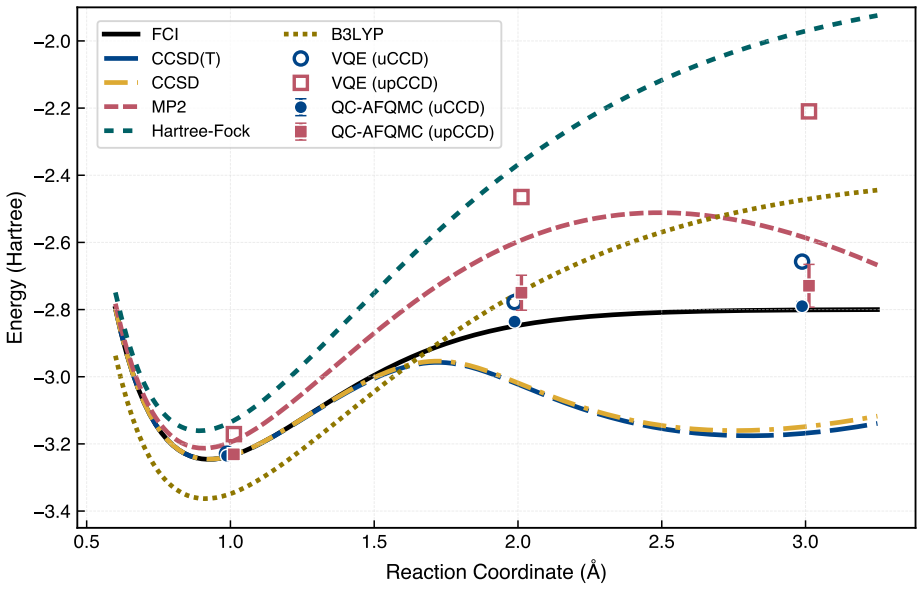
The central claim, on the paper's own terms, is that correlated sampling can be implemented inside QC-AFQMC without additional quantum cost: one synchronizes random number streams, aligns molecular orbitals between geometries by SVD-based rotations within near-degenerate subspaces, enforces the same Cholesky pivot sequence from the reference geometry for the two-electron integral decomposition, and reuses a single classical shadow ensemble defined at the reference geometry for all displaced geometries. Reusing this reference-defined shadow ensemble is what removes the need for extra quantum measurements at displaced geometries and locks in correlations from finite shadow sampling. With these controls, energy estimators at displaced geometries become strongly positively correlated, and Eq. (14) shows the force variance is proportional to $\sigma_E^2(1-\rho)/(2\delta^2)$, approaching zero as $\rho\to 1$. The paper demonstrates force errors near 0.01 Hartree/Å or better for N$_2$ in a $(6e^-,6o)$ active space with an upCCD trial state plus virtual correlation energy, and shows that orbital-optimized upCCD trials maintain accurate energetics for stretched CO$_2$ where CCSD and CCSD(T) fail to converge.
Load-bearing premise
The reference-geometry Cholesky pivots and shadow ensemble stay valid and representative when the molecule is displaced, so that walker ensembles at $R\pm\delta$ remain correlated; if a residual diagonal turns non-positive or the shadow overlap degrades after orbital rotation, the variance reduction in Eq. (14) collapses.
Editorial extensions
If this is right
- Finite-difference nuclear forces from QC-AFQMC become practical in strongly correlated molecules, with demonstrated N$_2$ force errors around 0.01 Ha/Å near equilibrium and qualitatively correct forces through dissociation.
- The same four synchronization mechanisms transfer directly to any energy-difference property, including ionization potentials, electron affinities, proton affinities, and reaction barriers, as the paper states.
- Orbital-optimized pair coupled cluster trial states improve accuracy for demanding cases like stretched CO$_2$ without increasing quantum resource requirements, because the orbital rotation is applied classically to the integrals before circuit construction.
- Since the shadow ensemble is defined once at the reference geometry, the quantum measurement budget for a gradient is the same as for a single energy calculation rather than scaling with the number of nuclear displacements.
Reading between the lines
- An implicit consequence is that the quantum hardware cost of computing forces is decoupled from molecular size in the number of force components: all geometric displacements share one shadow ensemble, so adding atoms may add classical propagation cost but not quantum measurements.
- The same correlation-locking logic should apply to other parametric perturbations, such as external electric or magnetic field strengths, making correlated sampling a general way to compute polarizabilities, hyperpolarizabilities, and magnetic response properties in QC-AFQMC.
- A direct test of the method's mechanism would be to compare force variance with deterministic Cholesky pivots against variance with freshly chosen pivots at each geometry; the paper's reasoning predicts a large increase in variance in the latter case.
- The reported statistical error generally grows with bond length, suggesting that the achievable correlation coefficient degrades as the electronic structure changes more strongly with displacement; quantifying $\rho(\delta)$ would set practical limits on the finite-difference step size.
Signed reviews
Editorial analysis
A structured set of objections, weighed in public.
Referee Report
Summary. The manuscript extends correlated sampling from classical auxiliary-field quantum Monte Carlo to the hybrid quantum-classical QC-AFQMC framework for computing nuclear forces by finite differences. The authors identify four consistency mechanisms: synchronized random number streams, orbital alignment across geometries, deterministic Cholesky decomposition with fixed pivots, and a consistent classical-shadow measurement ensemble fixed at a reference geometry. They present force benchmarks for N2, H4, and MEA-CO2 against FCI or CCSD, energy surfaces for H6 and CO2, and an application to MEA-CO2 using DMRG-based active-space selection and matchgate shadows. The formal variance analysis in Eqs. (11)-(14) is standard and sound, and the numerical tables show that QC-AFQMC with correlated sampling often outperforms ph-AFQMC and CCSD in strongly correlated regimes. Most force benchmarks, however, use statevector overlaps (the infinite-shadow limit), and the single finite-shadow force row lacks a control with independent shadow ensembles.
Significance. If the central correlated-sampling claim holds, the paper provides a practical route to forces in strongly correlated molecules within QC-AFQMC, with potential applications to geometry optimization and reaction-path exploration. The strengths include the use of external FCI and CCSD references, the absence of fitted parameters in the reported force results, the systematic treatment of active-space selection via quantum information metrics, and a concrete application to an industrially relevant carbon-capture reaction. The main weakness is that the shadow-reuse pillar is not validated with finite shadow samples: the principal force tables use statevector overlaps, and the single finite-shadow row does not isolate the variance-reduction mechanism. In addition, the abstract's claim that no additional quantum measurements are needed at displaced geometries is problematic as stated. These issues are fixable but require additional benchmarks and a corrected protocol description.
major comments (5)
- [Abstract; §2.2.2 item 4] The sentence in the Abstract and item 4 of §2.2.2 claim that reusing the reference-defined shadow ensemble 'eliminates the need for additional quantum measurements at displaced geometries.' In the matchgate-shadow estimator (Eq. 9), the unitaries U_i are applied to the trial state and the computational-basis outcomes are collected; if the trial state at R±δ is a different state, it must still be prepared and measured under the shared U_i. Reusing the unitary list correlates the shot noise but does not recycle measurement outcomes. If the reference measurement outcomes were literally reused, the estimator would target overlaps with the reference trial state rather than the displaced-geometry trial state and would be biased. This conflation should be corrected, or the resource claim should be restated as 'no additional shadow unitary generation,' not 'no additional quantum measurements.'
- [§3.2; Table 2] The finite-shadow component of the correlated-sampling claim is not validated. Section 3.2 states that the H6, N2, and CO2 benchmarks use statevector overlaps, i.e., the N_s→∞ limit with zero overlap-shot noise, and Section 4 states that the matchgate-shadow examples use a noise-free emulator. The only finite-shadow force result is the H4 matchgate row in Table 2, which has no control run with independently drawn shadow ensembles at R±δ and no decomposition of σ_F into AFQMC sampling noise versus overlap-shot noise. Eq. (14) makes the variance reduction depend on the correlation coefficient ρ; without a correlated-versus-independent finite-N_s comparison, the specific contribution of the shadow-reuse pillar to Eq. (14) is untested.
- [§2.2.2, Eq. (18)] The orthonormalization formula in Eq. (18) appears to have the wrong power of the overlap matrix. For MO coefficient matrices satisfying C† S C = I, the coefficients in a Löwdin-orthonormalized basis are S^{1/2}C, not S^{-1/2}C. As written, \tilde C^† \tilde C = C^† S^{-1} C ≠ I, so the subspace overlap matrix O_k in Eq. (20) is not the MO overlap and the SVD alignment in Eqs. (21)-(22) is not correctly defined. Since orbital alignment is one of the four synchronization pillars, this needs correction and a check that the numerical implementation uses the correct expression.
- [Table 1, N2 at 2.0 Å] The QC-AFQMC force error at R=2.0 Å is 0.094 Ha/Å relative to FCI, which is about six times the error at 1.2 Å and much larger than the 0.011 Ha/Å error at 2.5 Å, while the energy error is 0.028 Ha. This nonmonotonic pattern is not discussed, and the text's 'reasonable quantitative accuracy' does not address the outlier. Please provide an explanation (e.g., trial-state phase-problem behavior at that geometry) or additional data, such as convergence with respect to walker number or an improved trial, to support the claim that the method yields accurate forces across the dissociation curve.
- [§2.2.2 item 3; Fig. 8] The deterministic-Cholesky pillar assumes that the pivot sequence fixed at the reference geometry remains valid at R±δ. The flow chart in Fig. 8 includes a 'Reset reference state' path when the decomposition is invalid, and Eq. (24) shows that a non-positive residual diagonal D_pq would break the reference-fixed pivot rule. The paper does not state the conditions under which the fixed pivot sequence remains valid for the displacements δ=10^{-5} or 10^{-6} used in Tables 1, 2, and 4, nor whether any resets occurred. Please quantify this or argue that the displacement is small enough that the failure mode cannot occur for the tested systems.
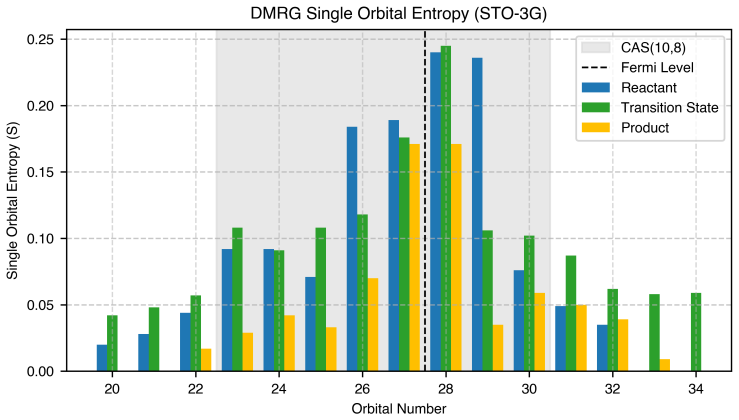
minor comments (6)
- [§3.2] The phrase 'infinite shadow limit (N_s → ∞)' is slightly imprecise; the statevector evaluation gives exact overlaps with zero shot noise, not just a limit of the classical-shadow estimator. Clarify to avoid conflating the two.
- [Eq. (10); §3.1] Eq. (10) uses M for the number of walkers while Section 3.1 uses M for the DMRG bond dimension; rename one of them to avoid ambiguity.
- [Eqs. (28)-(33)] The block-matrix expressions in Eqs. (28)-(33) lack explicit dimensions; adding them would make the determinant reduction easier to verify.
- [§4.4; Fig. 6] The claim that B3LYP underestimates the barrier 'by more than 50%' is not quantified in the text; give the actual barrier values visible in Fig. 6 or state the numbers explicitly.
- [References] Several references are formatted inconsistently, e.g., Ref. 7 lacks a journal or archive identifier beyond 'arXiv [cond-mat.str-el] 2018', and Ref. 90 has an incomplete page range.
- [Table 2] The caption reports '21,080 shadows' but does not specify how this number was chosen; state the criterion (e.g., the bound in Eq. (10)) used to set N_s.
Circularity Check
No significant circularity: forces are benchmarked against external FCI/CCSD references with no parameter fitted to the reported values; minor self-citations (Refs 13 and 84) are not load-bearing, and the flagged finite-shadow validation gap is a correctness concern rather than a circular reduction.
full rationale
The derivation chain is not circular. The force values in Tables 1-4 are genuine computations of the finite-difference estimator (Eq. 11) using energies that depend on the Hamiltonian at each displaced geometry, benchmarked against external FCI and CCSD references; no parameter is fitted to any reported force, and the variance reduction quantified in Eqs. 12-17 is standard statistical error propagation whose effectiveness is evidenced empirically by the error bars in Tables 1-2. The four synchronization mechanisms (seeded random streams, SVD-based orbital alignment, fixed Cholesky pivots, reference-defined shadow unitaries) are procedural choices, not fitted parameters renamed as predictions: none constrains the computed energy difference to equal a fitted value, and the H4 matchgate row (Table 2) provides an in-paper finite-shadow result consistent with FCI within 2-3 sigma. The paper cites the authors' own prior work, but not load-bearingly: the matchgate shadow framework rests on the external theory of Wan et al. (Ref 10), the oo-upCCD ansatz is documented in external Refs 83 and 85, and accuracy claims are adjudicated by in-paper comparisons to FCI and CCSD rather than by the citations themselves. Two limitations are weighed here but do not constitute circularity. First, Section 3.2 admits that the H6, N2, and CO2 benchmarks use statevector overlaps (the infinite-shadow limit, Ns to infinity), leaving only the single H4 matchgate row to validate finite-shadow behavior. Second, Section 2.2.2 item 4's claim that shadow reuse 'eliminates additional quantum shot budgets' is not supported by the matchgate-shadow procedure as written: reusing the unitary ensemble still requires preparing and measuring displaced-geometry trial states, while literally reusing reference measurement outcomes would bias the overlap estimator toward the reference trial state. These are validation and resource-accounting concerns rather than reductions of a predicted quantity to its input, so they do not raise the circularity score above 1.
Assumptions & free parameters
free parameters (6)
- Finite difference displacement delta =
10^-5 or 10^-6 Ha (tables)
- Active space sizes =
(6e-,6o), (10e-,8o)
- Orbital degeneracy threshold delta_thresh =
not specified
- Entropy threshold for active space =
0.1*ln(4) approximately 0.14
- AFQMC timestep =
0.01 to 0.02 Ha^-1
- Matchgate shadow sample count =
21,080 for H4 matchgate; infinite (statevector) otherwise
assumptions (7)
- domain assumption Hubbard-Stratonovich transformation and phaseless AFQMC importance sampling control the phase problem and converge to the ground state.
- domain assumption The mixed estimator, Eq. (6), with the chosen trial wavefunction gives an acceptable projection estimate.
- standard math The matchgate shadow estimator is unbiased and achieves the polynomial sample complexity in Eq. (10).
- domain assumption The Cholesky pivot sequence fixed at the reference geometry remains a valid decomposition at displaced geometries.
- domain assumption Orbital alignment via SVD in Eq. (22) preserves the character of near-degenerate orbitals and keeps trial-walker overlaps continuous under displacement.
- standard math Reusing a single shadow ensemble from the reference geometry does not bias overlap estimates at displaced geometries.
- domain assumption For MEA-CO2, CCSD is an adequate reference since FCI is intractable.
Cite this review
Pith. "Pith review of Molecular Properties in Quantum-Classical Auxiliary-Field Quantum Monte Carlo: Correlated Sampling with Application to Accurate Nuclear Forces." pith.science (2026). https://pith.science/paper/BBCND5JF
@misc{pith2026250717992,
  author       = {Pith},
  title        = {Pith review of: Molecular Properties in Quantum-Classical Auxiliary-Field Quantum Monte Carlo: Correlated Sampling with Application to Accurate Nuclear Forces},
  year         = {2026},
  howpublished = {\url{https://pith.science/paper/BBCND5JF}},
  note         = {Machine review of arXiv:2507.17992}
}
abstract
We extend correlated sampling from classical auxiliary-field quantum Monte Carlo to the quantum-classical (QC-AFQMC) framework, enabling accurate nuclear force computations crucial for geometry optimization and reaction dynamics. Stochastic electronic structure methods typically encounter prohibitive statistical noise when computing gradients via finite differences. To address this, our approach maximizes correlation between nearby geometries by synchronizing random number streams, aligning orbitals, using deterministic integral decompositions, and employing a consistent set of classical shadow measurements defined at a single reference geometry. Crucially, reusing this single, reference-defined shadow ensemble eliminates the need for additional quantum measurements at displaced geometries. Together, these methodological choices substantially reduce statistical variance in computed forces. We validate the method across hydrogen chains, confirming accuracy throughout varying correlation regimes, and demonstrate significant improvements over single-reference methods in force evaluations for N$_2$ and stretched linear H$_4$, particularly in strongly correlated regions where conventional coupled cluster approaches qualitatively fail. Orbital-optimized trial wave functions further boost accuracy for demanding cases such as stretched CO$_2$, without increasing quantum resource requirements. Finally, we apply our methodology to the MEA-CO$_2$ carbon capture reaction, employing quantum information metrics for active space selection and matchgate shadows for efficient overlap evaluations, establishing QC-AFQMC as a robust framework for exploring complex reaction pathways.
Figures


Figures from the paper (6 more)


Reference graph
Works this paper leans on
-
[1]
(1) Bartlett, R. J.; Musiał, M. Coupled-cluster theory in quantum chemistry.Reviews of modern physics 2007, 291–352. (2) Park, J. W.; Al-Saadon, R.; MacLeod, M. K.; Shiozaki, T.; Vlaisavljevich, B. Multiref- erenceelectroncorrelationmethods: Journeysalongpotentialenergysurfaces. Chemical reviews 2020, 5878–5909. (3) Roos, B. O.; Lindh, R.; Malmqvist, P. A...
work page 2007
-
[207]
(63) Leininger, M. L.; Nielsen, I. M. B.; Crawford, T. D.; Janssen, C. L. A new diagnostic for open-shell coupled-cluster theory.Chemical physics letters2000, 431–436. (64) Lee, T. J. Comparison of the T1 and D1 diagnostics for electronic structure theory: a new definition for the open-shell D1 diagnostic.Chemical physics letters2003, 362–367. (65) Cramer...
work page 1991
-
[340]
Ab initiocalculation of force constants and equilibrium geometries in poly- atomic molecules: I
(54) Pulay, P. Ab initiocalculation of force constants and equilibrium geometries in poly- atomic molecules: I. Theory.Molecular physics 1969, 197–204. (55) Takeshita, T.; Rubin, N. C.; Jiang, Z.; Lee, E.; Babbush, R.; McClean, J. R. Increas- ing the representation accuracy of quantum simulations of chemistry without extra quantum resources.Physical revie...
work page 1969
-
[416]
Calculation of partition functions.Physical review letters1959, 77–78
(46) Hubbard, J. Calculation of partition functions.Physical review letters1959, 77–78. (47) Xu, X.; Li, Y. Quantum-assisted Monte Carlo algorithms for fermions.Quantum 2022,
work page 2022
-
[1072]
(48) Amsler, M.; Deglmann, P.; Degroote, M.; Kaicher, M. P.; Kiser, M.; Kühn, M.; Ku- mar, C.; Maier, A.; Samsonidze, G.; Schroeder, A.; Streif, M.; Vodola, D.; Wever, C. Quantum-enhanced quantum Monte Carlo: an industrial view.arXiv [quant-ph] 2023, (49) Kiser, M.; Beuerle, M.; Šimkovic, F., 4th Contextual subspace auxiliary-field quantum Monte Carlo: Im...
work page 2023
-
[1279]
(75) Oliveira, V. P.; Kraka, E.; Machado, F. B. C. Pushing 3c-4e bonds to the limit: A coupled cluster study of stepwise fluorination of first-row atoms.Inorganic chemistry 2019, 14777–14789. 55 (76) Jiang, W.; DeYonker, N. J.; Wilson, A. K. Multireference character for 3d transition- metal-containing molecules. Journal of chemical theory and computation2...
work page 2019
-
[1291]
(78) Karton, A.; Rabinovich, E.; Martin, J. M. L.; Ruscic, B. W4 theory for computa- tional thermochemistry: In pursuit of confident sub-kJ/mol predictions.The Journal of chemical physics2006, 144108. (79) Beran, G. J. O.; Head-Gordon, M. Extracting dominant pair correlations from many- body wave functions.The Journal of chemical physics2004, 78–88. (80) ...
work page 2024
-
[1994]
48 (16) Handy, N. C.; Schaefer, H. F., III On the evaluation of analytic energy derivatives for correlated wave functions.The Journal of chemical physics1984, 5031–5033. (17) Salter, E. A.; Trucks, G. W.; Bartlett, R. J. Analytic energy derivatives in many-body methods. I. First derivatives.The Journal of chemical physics1989, 1752–1766. (18) Salter, E. A...
work page 1988
Show all 12 references
-
[2010]
Predicting many properties of a quantum system from very few measurements.Nature physics 2020, 1050–1057
(51) Huang, H.-Y.; Kueng, R.; Preskill, J. Predicting many properties of a quantum system from very few measurements.Nature physics 2020, 1050–1057. (52) Huang, H.-Y.; Kueng, R.; Torlai, G.; Albert, V. V.; Preskill, J. Provably efficient 52 machine learning for quantum many-bo...
2020
-
[2014]
R.; Friesner, R
(27) Shee, J.; Zhang, S.; Reichman, D. R.; Friesner, R. A. Chemical transformations ap- proaching chemical accuracy via correlated sampling in auxiliary-field quantum Monte Carlo. Journal of chemical theory and computation2017, 2667–2680. (28) Chen, S.; Yang, Y.; Morales, M.; ...
2017
-
[2016]
K.-L.; Sharma, S
(4) Chan, G. K.-L.; Sharma, S. The density matrix renormalization group in quantum chemistry. Annual review of physical chemistry2011, 465–481. (5) Lee, J.; Pham, H. Q.; Reichman, D. R. Twenty years of auxiliary-field quantum Monte Carlo in quantum chemistry: An overview and a...
2018
-
[3418]
(87) Xie, H.-B.; Zhou, Y.; Zhang, Y.; Johnson, J. K. Reaction mechanism of mo- noethanolamine with CO2 in aqueous solution from molecular modeling.The journal of physical chemistry. A2010, 11844–11852. (88) Rochelle, G. T. Thermal degradation of amines for CO2 capture.Current ...
2012
Reviewed August 6, 2026 · model on record in the stance chip above.
Discussion (0). Continue with ORCID to comment.