REVIEW 5 major objections 5 minor 17 references
Distributional Uncertainty for Out-of-Distribution Detection
T0 review · 5 major / 5 minor · reviewed 2026-08-06 · deepseek-v4-flash
Pith's one-line read This paper claims that replacing RPL's fixed free-energy target with a variance map from a Beta posterior network improves out-of-distribution detection in semantic segmentation.
desk verdict The paper's central mechanism — the variance-based loss that supposedly replaces RPL's free-energy target — is identically zero by Eq. 12, so the claimed contribution is not supported by the paper's own math. read the letter →
The pith
A machine-rendered reading of the paper's core claim, the machinery that carries it, and where it could break.
The reading
What carries the argument
The operative object is the Beta posterior variance map. A flow-based network transforms per-pixel latent features into log-probability scores $z_{\mathrm{in}}, z_{\mathrm{out}}$, which are converted to Beta parameters by $\alpha = 1 + \log(1 + e^{z_{\mathrm{in}}})$ and $\beta = 1 + \log(1 + e^{z_{\mathrm{out}}})$; the variance $\mathrm{Var}(p) = \alpha\beta/((\alpha+\beta)^2(\alpha+\beta+1))$ then becomes both the uncertainty estimate and the training target. The key property is that variance is largest when $\alpha \approx \beta$ with small values, so minimizing the outlier loss corresponds to reducing the sharpness of the predictive distribution on OoD pixels. The paper integrates this variance into RPL's energy loss and adds a Beta Uncertainty Cross Entropy (BUCE) loss that combines standard cross-entropy, a digamma-based uncertainty term, and binary cross-entropy between the variance map and the OoD mask.
What would settle it
Run the same RPL-plus-flow pipeline but replace the Beta variance in the loss with the raw free-energy score while keeping the identical binary OoD-mask supervision; if FPR and AuPRC do not worsen, the Beta posterior variance is not the operative component. A second check is to recompute the flow log-likelihood with the full change-of-variables Jacobian determinant and see whether the free-energy ranking of OoD pixels in Eq. (5) is preserved.
Extended reading notes
Core claim
The paper's central claim is that distributional uncertainty, quantified as the variance of a per-pixel Beta posterior fitted by a normalizing-flow density estimator, can serve as a principled supervision signal for OoD detection in semantic segmentation. The method computes flow-based energy representations, converts them into Beta parameters $\alpha(\omega) = 1 + \log(1 + e^{z_{\mathrm{in}}(\omega)})$ and $\beta(\omega) = 1 + \log(1 + e^{z_{\mathrm{out}}(\omega)})$, and injects the variance $\mathrm{Var}(p(\omega)) = \frac{\alpha(\omega)\beta(\omega)}{(\alpha(\omega)+\beta(\omega))^2(\alpha(\omega)+\beta(\omega)+1)}$ into RPL's energy-based loss. Because Beta variance is maximized when $\alpha \approx \beta$ and both are small, the loss pushes the flow network to flatten the predictive distribution exactly where the OoD mask is active, while the proposed BUCE loss keeps inlier predictions confident. The claimed result is a semantically meaningful, sampling-free uncertainty map that outperforms MC Dropout, Shannon entropy, and plain free-energy baselines on real-world anomaly-segmentation benchmarks.
Load-bearing premise
The load-bearing assumption is that the variance of the Beta posterior, trained with a binary cross-entropy loss against OoD labels, truly captures distributional uncertainty for unseen pixels and is a better training target than the original fixed free-energy score; if the variance is merely fitting the outlier labels, the claimed mechanism collapses.
Editorial extensions
If this is right
- OoD-aware segmentation can be trained with a single forward pass, eliminating the computational overhead of MC Dropout-style sampling and the need for post-hoc energy thresholding.
- The Beta variance map provides dense pixel-level supervision, so the network can learn OoD regions during training rather than only at inference, which is what the reported FPR and AuPRC gains reflect.
- The same uncertainty signal transfers across different anomaly types, since the paper reports consistent gains on Fishyscapes-Static, Fishyscapes-L&F, SMIYC-Anomaly, SMIYC-Obstacle, and RoadAnomaly.
- Because the segmentation backbone is frozen and only the flow posterior and loss terms are trained, the added cost is localized to the uncertainty branch, making the approach more scalable than sampling-based alternatives.
- The variance-maximizing condition ties OoD behavior to a concrete property of the Beta distribution, giving practitioners a diagnostic: anomalous pixels should be those where the posterior is flat and low-evidence.
Reading between the lines
- The same Beta-variance supervision could be plugged into other energy-based OoD detectors beyond RPL; the paper's closing remark gestures at this, but the mechanism itself is not specific to RPL.
- Part of the reported gain may come from the binary cross-entropy term that directly supervises variance with OoD labels, so an ablation that trains the same BCE on raw energy scores would reveal how much of the improvement is due to the Beta parametrization rather than to outlier exposure.
- If Beta variance is a genuine distributional-uncertainty signal, it should also improve misclassification detection and calibration on in-distribution inputs; the paper does not report those checks, but they are testable extensions.
- The condition $\alpha \approx \beta$ with small values is the evidential reading of 'conflicting and weak evidence,' which suggests the method could be unified with evidential deep-learning losses that penalize high uncertainty without explicit OoD labels.
Editorial analysis
A structured set of objections, weighed in public.
Referee Report
Summary. The paper proposes a Free-Energy Posterior Network that combines a Beta-posterior flow module with the RPL framework for out-of-distribution detection in semantic segmentation. It claims that using the variance of the Beta posterior as a supervisory signal, instead of RPL's fixed free-energy targets, improves uncertainty estimation and OoD detection. Experiments are reported on Fishyscapes, RoadAnomaly, and Segment-Me-If-You-Can.
Significance. The topic is relevant and the paper attempts a novel combination of posterior-network uncertainty and energy-based flow models. However, the central mechanism as written is non-functional: the proposed OoD variance loss in Eq. (12) is identically zero, and the displayed gradient in Eq. (13) is inconsistent with that loss. The empirical section also misreports a table and omits the most relevant baseline. As a result, the claimed contribution is not established by the evidence presented.
major comments (5)
- [§3.1, Eqs. (11-13)] Eq. (12) defines Lout = sum_omega max(-m(omega)*Var(p(omega)), 0), with m(omega) in {0,1} and Var(p(omega)) > 0 for alpha,beta > 0. Every summand is therefore zero: for an OoD pixel the argument is negative and max(.,0) returns 0, while for an inlier pixel the argument is 0. Thus Lout is identically zero and injects no gradient into the flow parameters. The gradient in Eq. (13) is the derivative of -Var, not of max(-m*Var,0), whose gradient is zero on the whole domain. This invalidates the paper's central claim that the Beta variance map replaces RPL's fixed free-energy target as a supervisory signal; any observed difference between RPL and RPL+DE would have to be attributed to other terms, such as Eq. (18), not to Eq. (12).
- [§3.2, Eq. (18); §4.2] The only operational supervision of the Beta variance is the binary cross-entropy loss Lvar = BCE(Var(i), y(i)), which directly fits the variance to binary OoD labels. The paper claims that the method estimates distributional uncertainty without relying on handcrafted thresholds, but Eq. (18) uses OoD labels as supervision. Consequently, reporting improved OoD detection does not establish that Beta variance captures intrinsic distributional uncertainty; it may simply reflect that the estimator is trained to predict the target labels. An ablation omitting Lvar or a held-out analysis would be needed to support the interpretation.
- [§4.2, Table 3] The text in Section 4.2 misreports Table 3. For SMIYC-Anomaly, Table 3 shows RPL+DE with FPR 6.87 and AUPRC 89.48 versus RPL with FPR 7.18 and AUPRC 88.55, not AP 89.48 vs. 57.99. For SMIYC-Obstacle, Table 3 shows RPL+DE with FPR 0.11 and AUPRC 96.29 versus RPL with FPR 0.09 and AUPRC 96.91, not AUPRC 96.29 vs. 22.10. The numbers 57.99 and 22.10 do not appear in the table. Moreover, the Obstacle row shows that RPL+DE is worse than RPL on both FPR and AUPRC, contradicting the claim that RPL+DE consistently improves both AP and AUPRC.
- [§4.1, Table 1; §4.2] Table 1 omits the RPL baseline even though the paper's contribution is an integration with RPL and Section 4.2 claims that the method outperforms all baselines. Without RPL numbers in Table 1, the comparison is incomplete, especially because Table 3 indicates that the gain over RPL is small or negative on some benchmarks. The claim should be restricted to the baselines actually listed in the table.
- [§2.2, Eq. (5)] Eq. (5) is presented as the log-likelihood in a flow-based framework, but it appears to be only the log-density of the latent Gaussian. A normalizing-flow density for the input requires the log-absolute-determinant of the Jacobian of the transformation. If Eq. (5) is intended only as the latent density, the text should say so explicitly. Since the free-energy interpretation of the flow output is central to the proposed framework, this needs clarification.
minor comments (5)
- [§3.1, Eqs. (7) and (10)] The definitions of alpha and beta are inconsistent: Eq. (7) uses log(1 + exp(z_in)) and log(1 + exp(z_out)), while Eq. (10) uses log P(z|c) and log Q(z|c). The relationship between these notations should be made explicit.
- [§3.1, Eq. (9)] The threshold tau in Eq. (9) is not specified; if it is a hyperparameter, its value and sensitivity should be reported.
- [§3.2, Eq. (15)] The variable y_i in Eq. (15) is used as a class indicator, but its exact meaning relative to Eq. (9) is unclear for the multi-class segmentation setting. Please clarify whether it is a pixel-wise binary OoD indicator or a class label.
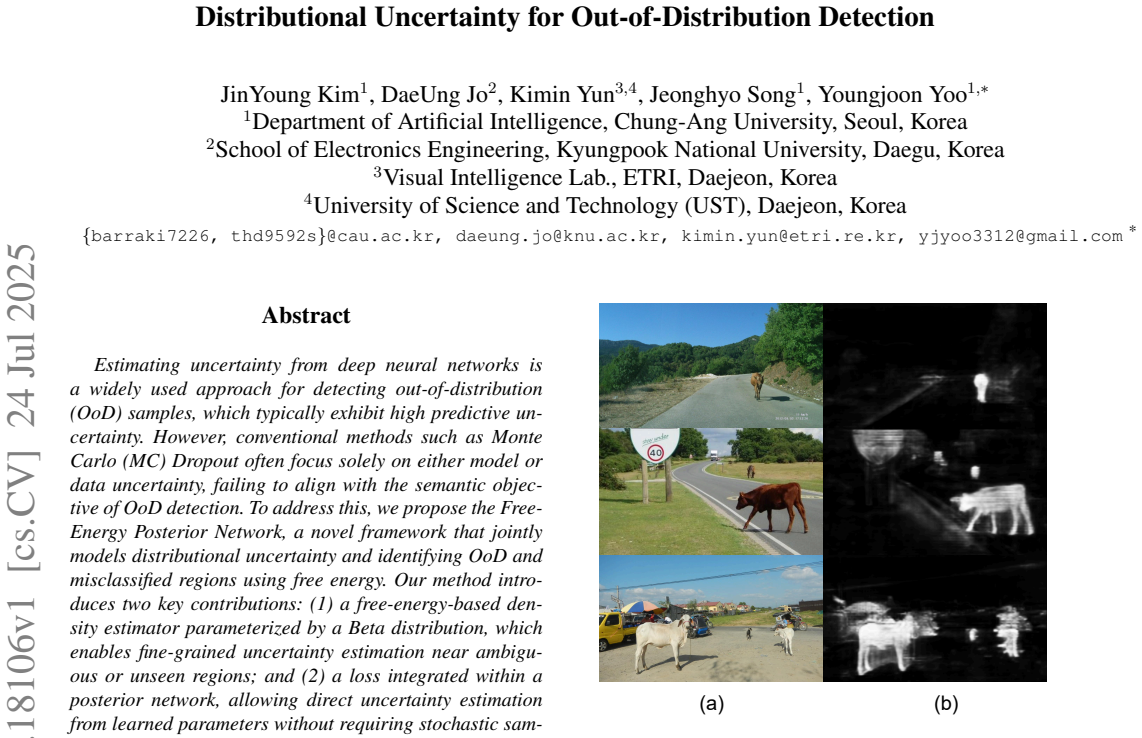
- [Figure 2 caption] The caption says that the differential entropy map replaces the free energy term in RPL's l_in loss, whereas Section 3.1 defines L_out for the OoD term. The notation should be reconciled.
- [§4.3 and Figure 3] Section 4.3 refers to the Fishyscapes dataset, but the Figure 3 caption says Road Anomaly. Please correct the caption or the text.
Circularity Check
Eq. 12's variance loss is identically zero under the paper's own positivity of α,β, so the central variance-based supervision mechanism reduces to a constant; Eq. 13's gradient is inconsistent with Eq. 12.
-
self definitional
[Section 3.1, Eqs. (11)–(13)]
"Lout = Σ_{ω∈Ω} max(−m(ω) · Var(p(ω)), 0), where m(ω) ∈ {0,1} is a binary mask indicating OoD pixels. ... ∇θflowLout = − ∂Var(p)/∂α · ∂α/∂θflow − ∂Var(p)/∂β · ∂β/∂θflow."
Since α=1+log(1+e^{z_in})>1 and β=1+log(1+e^{z_out})>1 by Eq. (7), Var(p)>0 for every pixel. Hence −m(ω)·Var(p(ω)) is non-positive for both m=0 and m=1, so each max(·,0) term is identically zero and Lout≡0 regardless of the flow parameters. The gradient in Eq. 13 is the derivative of −Var, not of max(−m·Var,0), which is zero on the whole domain. Thus the paper's central claim that this loss 'encourages the flow network to produce Beta parameters with higher variance for OoD regions' cannot operate: the variance-based supervision reduces by construction to a null signal. Any improvement must come from the separately supervised Lvar term, not from Eq. 12.
full rationale
The derivation chain for the paper's central claim—that Beta variance replaces RPL's fixed free-energy target as a supervision signal—breaks at Eq. 12. Because α=1+log(1+e^{z_in}) and β=1+log(1+e^{z_out}) are always >1, Var(p)>0, so max(−m·Var,0)=0 for both m=0 and m=1. Thus Lout is identically zero and the gradient shown in Eq. 13 is not the gradient of Eq. 12. This is a self-definitional reduction: the proposed loss term cannot produce the 'higher variance for OoD regions' behavior described in Sec. 3.1. The other uncertainty terms (LUCE, Lvar) are standard supervised losses trained on outlier-exposure labels and evaluated on held-out benchmarks, so they are not circular. There are no load-bearing self-citations: RPL and FlowEneDet are external prior works. The omitted Jacobian log-determinant in Eq. 5 is a correctness concern, not a circularity. Score reflects one central mechanism that reduces by construction to zero, while the empirical comparison remains externally benchmarked.
Assumptions & free parameters
free parameters (5)
- lambda_1
- lambda_2
- tau
- UCE scale factor =
1e-7
- N
assumptions (3)
- domain assumption Beta/Dirichlet posterior parameters encode distributional uncertainty.
- domain assumption Free energy computed from a normalizing flow is a valid OoD surrogate.
- domain assumption The flow network trained on frozen backbone features captures the semantic structure needed for OoD detection.
Cite this review
Pith. "Pith review of Distributional Uncertainty for Out-of-Distribution Detection." pith.science (2026). https://pith.science/paper/QATANDWG
@misc{pith2026250718106,
  author       = {Pith},
  title        = {Pith review of: Distributional Uncertainty for Out-of-Distribution Detection},
  year         = {2026},
  howpublished = {\url{https://pith.science/paper/QATANDWG}},
  note         = {Machine review of arXiv:2507.18106}
}
read the original abstract
Estimating uncertainty from deep neural networks is a widely used approach for detecting out-of-distribution (OoD) samples, which typically exhibit high predictive uncertainty. However, conventional methods such as Monte Carlo (MC) Dropout often focus solely on either model or data uncertainty, failing to align with the semantic objective of OoD detection. To address this, we propose the Free-Energy Posterior Network, a novel framework that jointly models distributional uncertainty and identifying OoD and misclassified regions using free energy. Our method introduces two key contributions: (1) a free-energy-based density estimator parameterized by a Beta distribution, which enables fine-grained uncertainty estimation near ambiguous or unseen regions; and (2) a loss integrated within a posterior network, allowing direct uncertainty estimation from learned parameters without requiring stochastic sampling. By integrating our approach with the residual prediction branch (RPL) framework, the proposed method goes beyond post-hoc energy thresholding and enables the network to learn OoD regions by leveraging the variance of the Beta distribution, resulting in a semantically meaningful and computationally efficient solution for uncertainty-aware segmentation. We validate the effectiveness of our method on challenging real-world benchmarks, including Fishyscapes, RoadAnomaly, and Segment-Me-If-You-Can.
Figures


Reference graph
Works this paper leans on
- [1]
-
[2]
The Fishyscapes Benchmark: Measuring Blind Spots in Semantic Segmentation
H. Blum, P.-E. Sarlin, J. Nieto, R. Siegwart, and C. Ca- dena. The fishyscapes benchmark: Measuring blind spots in semantic segmentation. arXiv preprint arXiv:1904.03215, 2019
work page Pith review arXiv 1904
-
[3]
R. Chan, K. Lis, S. Uhlemeyer, H. Blum, S. Honari, R. Sieg- wart, P. Fua, M. Salzmann, and M. Rottmann. Segment- meifyoucan: A benchmark for anomaly segmentation. In Thirty-fifth Conference on Neural Information Processing Systems Datasets and Benchmarks Track, 2021
work page 2021
-
[4]
B. Charpentier, D. Z ¨ugner, and S. G ¨unnemann. Posterior network: Uncertainty estimation without ood samples via density-based pseudo-counts. Advances in neural informa- tion processing systems, 33:1356–1367, 2020
work page 2020
-
[5]
L.-C. Chen, Y . Zhu, G. Papandreou, F. Schroff, and H. Adam. Encoder-decoder with atrous separable convolution for se- mantic image segmentation. In Proceedings of the Euro- pean conference on computer vision (ECCV) , pages 801– 818, 2018
work page 2018
-
[6]
Cordts, M
M. Cordts, M. Omran, S. Ramos, T. Rehfeld, M. Enzweiler, R. Benenson, U. Franke, S. Roth, and B. Schiele. The cityscapes dataset for semantic urban scene understanding. In Proceedings of the IEEE conference on computer vision and pattern recognition, pages 3213–3223, 2016
2016
- [7]
-
[8]
D. Gudovskiy, T. Okuno, and Y . Nakata. Concurrent misclas- sification and out-of-distribution detection for semantic seg- mentation via energy-based normalizing flow. InUncertainty in Artificial Intelligence, pages 745–755. PMLR, 2023
work page 2023
Show all 17 references
-
[9]
Kendall and Y
A. Kendall and Y . Gal. What uncertainties do we need in bayesian deep learning for computer vision? In NeurIPS, 2017
2017
-
[10]
Landgraf, M
S. Landgraf, M. Hillemann, K. Wursthorn, and M. Ulrich. U- ce: Uncertainty-aware cross-entropy for semantic segmenta- tion. arXiv preprint arXiv:2307.09947, 2023
2023 arXiv
-
[11]
T. Y . Lin, M. Maire, S. Belongie, J. Hays, P. Perona, D. Ra- manan, P. Dollar, and C. L. Zitnick. Microsoft COCO: Com- mon objects in context. In ECCV, 2014
2014
-
[12]
K. Lis, K. Nakka, P. Fua, and M. Salzmann. Detecting the unexpected via image resynthesis. In Proceedings of the IEEE/CVF International Conference on Computer Vision , pages 2152–2161, 2019
2019
-
[13]
Y . Liu, C. Ding, Y . Tian, G. Pang, V . Belagiannis, I. Reid, and G. Carneiro. Residual pattern learning for pixel-wise out-of-distribution detection in semantic segmentation. In Proceedings of the IEEE/CVF International Conference on Computer Vision, pages 1151–1161, 2023
2023
-
[14]
Malinin and M
A. Malinin and M. Gales. Predictive uncertainty estimation via prior networks. Advances in neural information process- ing systems, 31, 2018
2018
-
[15]
Mukhoti and Y
J. Mukhoti and Y . Gal. Evaluating bayesian deep learn- ing methods for semantic segmentation. arXiv preprint arXiv:1811.12709, 2018
2018 arXiv
-
[16]
Sensoy, L
M. Sensoy, L. Kaplan, and M. Kandemir. Evidential deep learning to quantify classification uncertainty. Advances in neural information processing systems, 31, 2018
2018
-
[17]
W. Zhao, J. Li, X. Dong, Y . Xiang, and Y . Guo. Seg- ment every out-of-distribution object. In Proceedings of the IEEE/CVF Conference on Computer Vision and Pattern Recognition, pages 3910–3920, 2024
2024
Reviewed August 6, 2026 · model on record in the stance chip above.
Discussion (0). Continue with ORCID to comment.