REVIEW 4 major objections 6 minor 2 cited by
GenAI for Automotive Software Development: From Requirements to Wheels
T0 review · 4 major / 6 minor · reviewed 2026-08-06 · deepseek-v4-flash
Pith's one-line read The authors claim that an LLM-driven, model-checked pipeline can generate, validate, and deploy automotive ADAS software end to end, cutting typical development cycles from days and hours to about a minute.
desk verdict A coherent end-to-end LLM/MDE workflow paper that overclaims its only quantitative result — the 'minutes' claim has no data behind it. read the letter →
The pith
A machine-rendered reading of the paper's core claim, the machinery that carries it, and where it could break.
The reading
What carries the argument
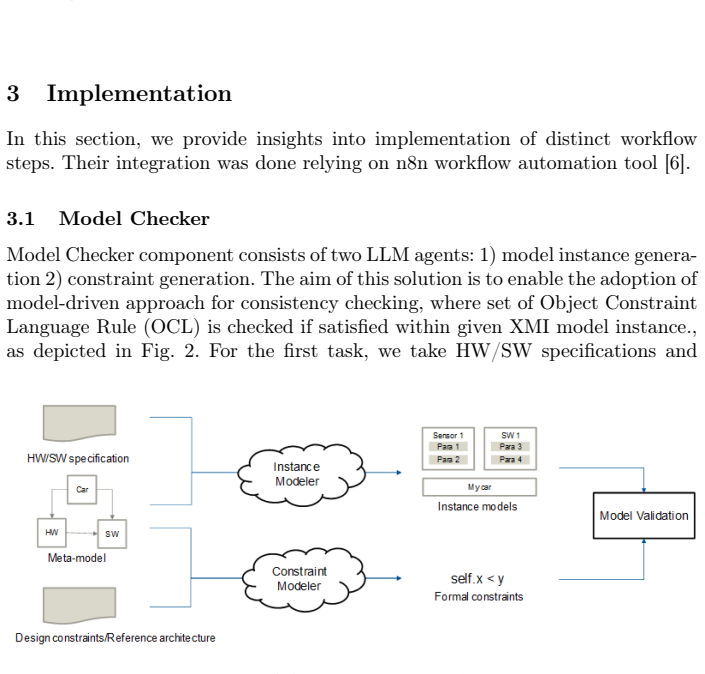
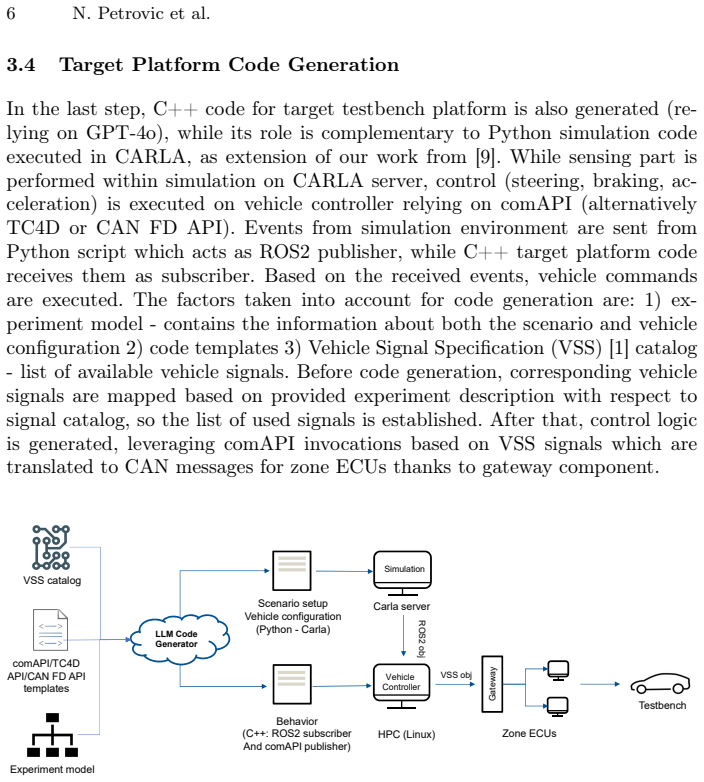
The machinery is a staged pipeline whose hinge is a formal model stack: LLMs turn requirements into a simple UML-like sketch notation (PlantUML), which is transformed into an Ecore metamodel, an XMI instance model, and Object Constraint Language (OCL) rules; those artifacts are checked for consistency before code generation. Around that hinge, a two-stage retrieval-augmented generation system with smart chunking and reranking extracts regulation-compliant scenarios from documents such as UN R152, LLM pipelines generate simulation configuration code, and a C++ generator maps Vehicle Signal Specification signals to controller API calls for the testbench. The role of these pieces is to make generated artifacts verifiable in principle, which is the paper's answer to LLM hallucination risk.
What would settle it
Run the full pipeline on a second, unseen ADAS requirement set, measure the fraction of generated XMI/OCL artifacts that pass the model checker without human edits and the fraction of generated Python/C++ code that compiles and executes a valid braking event, and record total wall-clock time including all human corrections. If the pass rates are low enough that human rewriting dominates, or total time stays in the hours range, the central time-saving claim fails.
Extended reading notes
Core claim
The paper's central claim is that a single generative workflow can take automotive requirements and regulation documents and produce the formal models, test scenarios, simulation code, and target-platform control code for an ADAS function without hand-coding. Concretely, for automated emergency braking under UN Regulation No. 152, the workflow generates an Ecore metamodel with an XMI instance and Object Constraint Language (OCL) constraints as a consistency-checked formal representation, then uses that representation to emit Python configuration code for a simulation environment and C++ controller code for a vehicle on a testbench. The authors report that early results suggest cycle times for innovation and testing falling from days and hours to the order of a minute, a claim framed as potential rather than measured throughput.
Load-bearing premise
The load-bearing premise is that LLM-generated models, constraints, test scenarios, and code are correct enough for automated model-driven checks to replace most human review, yet the paper gives no data on how often those artifacts need correction; if they often fail, the promised minute-scale cycle collapses.
Editorial extensions
If this is right
- If the claim holds, a changed ADAS requirement re-triggers model, test, and code generation, turning a re-engineering cycle from days of manual work into a single automated pass.
- If the claim holds, generated test scenarios are traceable to regulatory documents such as UN R152, because RAG retrieval grounds each scenario in source text.
- If the claim holds, OCL consistency checks catch a class of LLM hallucinations before code generation, providing a concrete trust layer for AI-written automotive artifacts.
- If the claim holds, local deployment of the model and OCL generation steps lets carmakers keep proprietary requirements off external servers.
Reading between the lines
- The paper does not test it, but the same requirements-to-model-to-code pattern should transfer to other ADAS functions such as lane keeping or pedestrian detection; a next experiment is measuring pass rates on a second regulation.
- The minute-scale cycle is an aspiration from one initial result, not a measured throughput; the human reviewer still in the loop is not charged to the clock.
- The reported ability of a small fine-tuned local model to match a frontier model on OCL generation, if it holds, strengthens the case for small specialized models where data sovereignty matters.
- The architecture implies that final controller-code quality is capped by formal-model quality, so quantifying how often OCL checks catch real requirement errors would measure how much trust the check layer can carry.
Editorial analysis
A structured set of objections, weighed in public.
Referee Report
Summary. The manuscript proposes a GenAI-empowered workflow for automotive ADAS software development. The workflow chains RAG-based extraction from regulations and requirements, LLM-based generation of an Ecore metamodel, XMI model instances, OCL constraints, CARLA simulation configuration code, and C++ target testbench code, with MDE consistency checks interleaved as a mitigation for LLM hallucination. The paper describes the architecture of each component (Sections 2–3) and concludes in Section 4 that, based on 'initial results' for automated emergency braking, the approach reduces development and testing time from days/hours to the order of a minute. No measurements, quantitative results, or end-to-end evaluation are reported.
Significance. If placed on a solid empirical footing, the proposed pipeline would be a meaningful contribution to automotive software engineering practice: it is one of the few end-to-end proposals that combine MDE-based validation with LLM generation for the complete chain from regulatory text to executable testbench code. The emphasis on locally deployable models and RAG for standards is also timely, and the individual components are grounded in a series of prior works by the authors, several of which are available as preprints. However, the paper's significance cannot be assessed from the manuscript alone, because the central claim of drastic time reduction is stated without presenting the underlying 'initial results' or any reproducibility artifact. The paper is therefore best viewed as a high-level architecture description rather than a validated approach.
major comments (4)
- [Section 4, Conclusion] The sentence "Based on the initial results for automated emergency braking, the proposed approach ... exhibits strong potential for reducing the time needed for innovation and testing - from days and hours to order of magnitude of a minute" makes a quantitative claim that is never backed by data anywhere in the manuscript; no wall-clock times, artifacts, or comparisons appear in Sections 2 or 3. Without a reported end-to-end run (or at least precisely described and cited measurements), this claim is unverifiable and should be removed or replaced with a testable hypothesis.
- [Sections 3.1 and 3.4] The workflow relies on the assumptions that LLM-generated XMI/OCL artifacts and the subsequently generated Python/C++ code are correct enough that MDE checks alone constitute sufficient validation; the paper provides no evidence on the error rates of these generated artifacts, no compilation or execution logs, and no statement about which generated outputs were actually used on the testbench. Because the stated time savings depend on reducing human review, the absence of evidence on generated-code quality is load-bearing.
- [Sections 2 and 3.1] The workflow includes mandatory or recommended human review steps ("it is still recommended to include human reviewer in a loop" in Section 2; "Once human reviewer is satisfied, model-to-model transformation will be executed ..." in Section 3.1). The paper does not clarify whether the time estimate in Section 4 includes this human effort; if it does not, the estimate is misleading, and if it does, the 'order of a minute' claim is implausible. The workflow description should specify which steps are automatic versus human-gated and how the time claim treats those steps.
- [Section 3.1] Claims about the performance of specific components (e.g., "Llama 3.1-70B based solution that achieves a comparable semantic score to GPT-4o," citing [8], and the fine-tuned OCL model, citing [7]) are made by reference to the authors' own prior works; because those references are preprints or workshop papers that are not summarized in this manuscript, the reviewer cannot assess whether the components satisfy the accuracy requirements of the end-to-end workflow. Please at least state the relevant metrics and conditions (dataset, baseline, evaluation protocol) for each cited result, or mark them explicitly as unpublished.
minor comments (6)
- [Section 3.1] The phrase "set of Object Constraint Language Rule (OCL)" should be "set of Object Constraint Language (OCL) rules."
- [Figures 1 and 4] Figures 1 and 4 have identical captions ("GenAI-empowered automotive software development workflow"), but Figure 4 appears to illustrate the RAG pipeline for regulation-compliant scenario generation; please correct the caption.
- [Section 3.1] The cross-reference "as shown in Fig. 6" for the model-to-model transformation (Ecore from PlantUML) points to a figure that in the manuscript shows target platform code generation (Section 3.4); the figure numbering or reference is likely wrong.
- [Section 2] The phrase "potential constrains" should be "potential constraints."
- [Section 3.3] The section heading "Simulation T est Scenario Generation" contains a spurious space.
- [References] The reference list is inconsistently formatted: some entries include DOI, arXiv identifiers, or access dates with different conventions; please unify (e.g., [3], [7], [13] vs. [15]).
Circularity Check
No significant circularity: the paper presents a workflow composition, not a derivation, and its self-citations are supporting evidence rather than forced conclusions.
full rationale
The manuscript is a workflow proposal rather than a formal derivation: the claimed outcome is not obtained by equations or by inference from the same data it purports to predict. The only quantitative claim, the 'order of magnitude of a minute' reduction in Section 4, is attributed to 'initial results for automated emergency braking' that are not reported or cited with data; this is an evidence gap, not circularity. The self-citations (Section 3.1 references [7] and [8], Section 3.3 reference [3], Section 3.4 reference [9], and Section 2 references [10] and [11]) point to prior component implementations and evaluations. None is invoked as a uniqueness theorem, none forbids alternative designs, and none is used to define the target result in terms of itself. The MDE consistency check in Section 3.1 checks generated OCL constraints against a generated XMI instance, but the paper does not claim this check alone proves safety; it is presented as a design-time consistency step. No fitted parameter is later renamed as a prediction, and no result is defined by the very quantity it claims to derive. Under the rule that self-citation is not circularity when it functions as supporting evidence, no specific reduction can be exhibited, so the score is 0. Concerns about missing experimental support belong to correctness risk, not circularity.
Assumptions & free parameters
assumptions (4)
- domain assumption LLMs can generate syntactically and semantically correct XMI model instances, OCL constraints, test scenario configurations, and C++ target code.
- domain assumption RAG with SmartChunking retrieves all relevant regulatory information and produces accurate test scenarios from UN Regulation No. 152.
- domain assumption MDE consistency checking can detect hallucinations and ensure the correctness of generated models.
- domain assumption The simulation environment (CARLA) and target testbench are accurate representations of real vehicle behavior.
Cite this review
Pith. "Pith review of GenAI for Automotive Software Development: From Requirements to Wheels." pith.science (2026). https://pith.science/paper/KWW7YTMD
@misc{pith2026250718223,
  author       = {Pith},
  title        = {Pith review of: GenAI for Automotive Software Development: From Requirements to Wheels},
  year         = {2026},
  howpublished = {\url{https://pith.science/paper/KWW7YTMD}},
  note         = {Machine review of arXiv:2507.18223}
}
read the original abstract
This paper introduces a GenAI-empowered approach to automated development of automotive software, with emphasis on autonomous and Advanced Driver Assistance Systems (ADAS) capabilities. The process starts with requirements as input, while the main generated outputs are test scenario code for simulation environment, together with implementation of desired ADAS capabilities targeting hardware platform of the vehicle connected to testbench. Moreover, we introduce additional steps for requirements consistency checking leveraging Model-Driven Engineering (MDE). In the proposed workflow, Large Language Models (LLMs) are used for model-based summarization of requirements (Ecore metamodel, XMI model instance and OCL constraint creation), test scenario generation, simulation code (Python) and target platform code generation (C++). Additionally, Retrieval Augmented Generation (RAG) is adopted to enhance test scenario generation from autonomous driving regulations-related documents. Our approach aims shorter compliance and re-engineering cycles, as well as reduced development and testing time when it comes to ADAS-related capabilities.
Figures


Figures from the paper (3 more)


Forward citations
Cited by 2 Pith papers
-
LLM-Driven Approach to Modeling Tool Interoperability in Automotive Domain
An LLM workflow with automated validation maps and merges Ecore and SysML v2 models, hitting 100% semantic matching on four small automotive cases while struggling with SysML syntax.
-
A Unified Perception-Language-Action Framework for Adaptive Autonomous Driving
A GPT-4.1-powered perception-language-action framework for autonomous driving is evaluated on a single intersection scenario without baselines or public artifacts.
Reference graph
Works this paper leans on
-
[8]
LLM-enabled Instance Model Generation
Pan, F., Petrovic, N., Zolfaghari, V., Wen, L., Knoll, A.: Llm-enabled instance model generation. arXiv preprint arXiv:2503.22587 (Mar 2025), accessed: 2025-07- 09
work page Pith review arXiv 2025
-
[7]
In: 2024 IEEE International Symposium on Systems Engineering (ISSE)
Pan, F., Zolfaghari, V., Wen, L., Petrovic, N., Lin, J., Knoll, A.: Generative ai for ocl constraint generation: Dataset collection and llm fine-tuning. In: 2024 IEEE International Symposium on Systems Engineering (ISSE). pp. 1–8. Perugia, Italy (2024). https://doi.org/10.1109/ISSE63315.2024.10741141
-
[1]
COVESA website (2025), https://covesa.global/vehicle-signal-specification/, accessed: 2025-07-10
COVESA: Vehicle signal specification (vss). COVESA website (2025), https://covesa.global/vehicle-signal-specification/, accessed: 2025-07-10
work page 2025
-
[2]
DeepSeek: deepseek-ai/deepseek-llm-7b-chat. Hugging Face model reposi- tory (2024), https://huggingface.co/deepseek-ai/deepseek-llm-7b-chat, accessed: 2025-07-11
work page 2024
-
[3]
Lebioda, K., Petrovic, N., Pan, F., Zolfaghari, V., Schamschurko, A., Knoll, A.: Are requirements really all you need? a case study of llm-driven configuration code generation for automotive simulations. arXiv preprint arXiv:2505.13263 (May 2025), submitted May 19, 2025; DOI: 10.48550/arXiv.2505.13263
work page Pith review arXiv doi:10.48550/arxiv.2505.13263 2025
-
[4]
Optimizing Retrieval Augmented Generation for Object Constraint Language
Li, K.C., Zolfaghari, V., Petrovic, N., Pan, F., Knoll, A.: Optimizing re- trieval augmented generation for object constraint language. arXiv preprint arXiv:2505.13129 (May 2025). https://doi.org/10.48550/arXiv.2505.13129, https://arxiv.org/abs/2505.13129, presented at the First Large Language Models for Software Engineering Workshop (LLM4SE 2025), part o...
work page Pith review arXiv doi:10.48550/arxiv.2505.13129 2025
-
[5]
McKinsey & Company: The case for an end-to-end automotive- software platform. McKinsey & Company Insight (Jan 2020), https://www.mckinsey.com/industries/automotive-and-assembly/our- insights/the-case-for-an-end-to-end-automotive-software-platform
work page 2020
-
[6]
n8n.io (2025), https://n8n.io/, accessed: 2025-07-09
n8n: Powerful workflow automation software & tools – n8n. n8n.io (2025), https://n8n.io/, accessed: 2025-07-09
work page 2025
Show all 16 references
-
[9]
arXiv preprint arXiv:2505.02500 (May 2025), submitted May 2025
Pan, F., Song, Y., Wen, L., Petrovic, N., Lebioda, K., Knoll, A.: Automating automotive software development: A synergy of generative ai and formal methods. arXiv preprint arXiv:2505.02500 (May 2025), submitted May 2025
2025
-
[10]
Technical report, Technical University of Munich (2024), https://mediatum.ub.tum.de/doc/1738462/1738462.pdf
Petrovic, N., et al.: Synergy of large language model and model driven engineering for automated development of centralized vehicu- lar systems. Technical report, Technical University of Munich (2024), https://mediatum.ub.tum.de/doc/1738462/1738462.pdf
2024
-
[11]
arXiv preprint arXiv:2503.04506 (Mar 2025), https://arxiv.org/abs/2503.04506, accepted for IntelliSys2025
Petrovic, N., Zhang, Y., Maaroufi, M., Chao, K.Y., Mazur, L., Pan, F., Zolfaghari, V., Knoll, A.: Multi-modal summarization in model-based engineering: Automotive software development case study. arXiv preprint arXiv:2503.04506 (Mar 2025), https://arxiv.org/abs/2503.04506, acc...
2025 arXiv
-
[12]
In: Journal of Artificial Intelligence & Cloud Computing, vol
Phatale, A., Kaushik, A.: Generative ai adoption in automotive vehicle technology: Case study of custom gpt. In: Journal of Artificial Intelligence & Cloud Computing, vol. 3, pp. 1–5 (November 2024). https://doi.org/10.47363/JAICC/2024(3)400
2024 doi
-
[13]
https://doi.org/10.48550/arXiv.2503.12108, https://arxiv.org/abs/2503.12108, conference paper accepted for IntelliSys2025
Schamschurko, A., Petrovic, N., Knoll, A.C.: RECSIP: RE- peated Clustering of Scores Improving the Precision (2025). https://doi.org/10.48550/arXiv.2503.12108, https://arxiv.org/abs/2503.12108, conference paper accepted for IntelliSys2025
-
[14]
In: IEEE Software, vol
Staron, M., Abrahão, S.: Exploring generative ai in automated soft- ware engineering. In: IEEE Software, vol. 42, pp. 142–145 (2025). https://doi.org/10.1109/MS.2025.3533754 8 N. Petrovic et al
2025
-
[15]
Publications Office of the European Union (Oct 2020), uN-ECE Reg
United Nations Economic Commission for Europe: Un regulation no 152 – uniform provisions concerning the approval of motor vehicles with regard to the advanced emergency braking system (aebs) for m1 and n1 vehicles. Publications Office of the European Union (Oct 2020), uN-ECE R...
2020
-
[16]
In: 2024 2nd International Conference on Foundation and Large Language Models (FLLM)
Zolfaghari, V., Petrovic, N., Pan, F., Lebioda, K., Knoll, A.: Adopting rag for llm- aided future vehicle design. In: 2024 2nd International Conference on Foundation and Large Language Models (FLLM). pp. 437–442. Dubai, United Arab Emirates (2024). https://doi.org/10.1109/FLLM...
2024
Reviewed August 6, 2026 · model on record in the stance chip above.
Discussion (0). Sign in to comment.