REVIEW 3 major objections 6 minor 1 cited by
Correlation and Data-Analysis Distinctiveness of Time-Delay Interferometry Configurations
T0 review · 3 major / 6 minor · reviewed 2026-08-06 · deepseek-v4-flash
Pith's one-line read The paper claims that the choice of time-delay interferometry configuration matters mainly at high frequencies: short-span schemes like PD4L give more accurate frequency-domain parameter recovery than long-span Michelson-style schemes…
desk verdict Useful TDI comparison, but the PD4L recommendation rests on a confounded inference run that never tests the 'shorter span' mechanism directly. read the letter →
The pith
A machine-rendered reading of the paper's core claim, the machinery that carries it, and where it could break.
The reading
What carries the argument
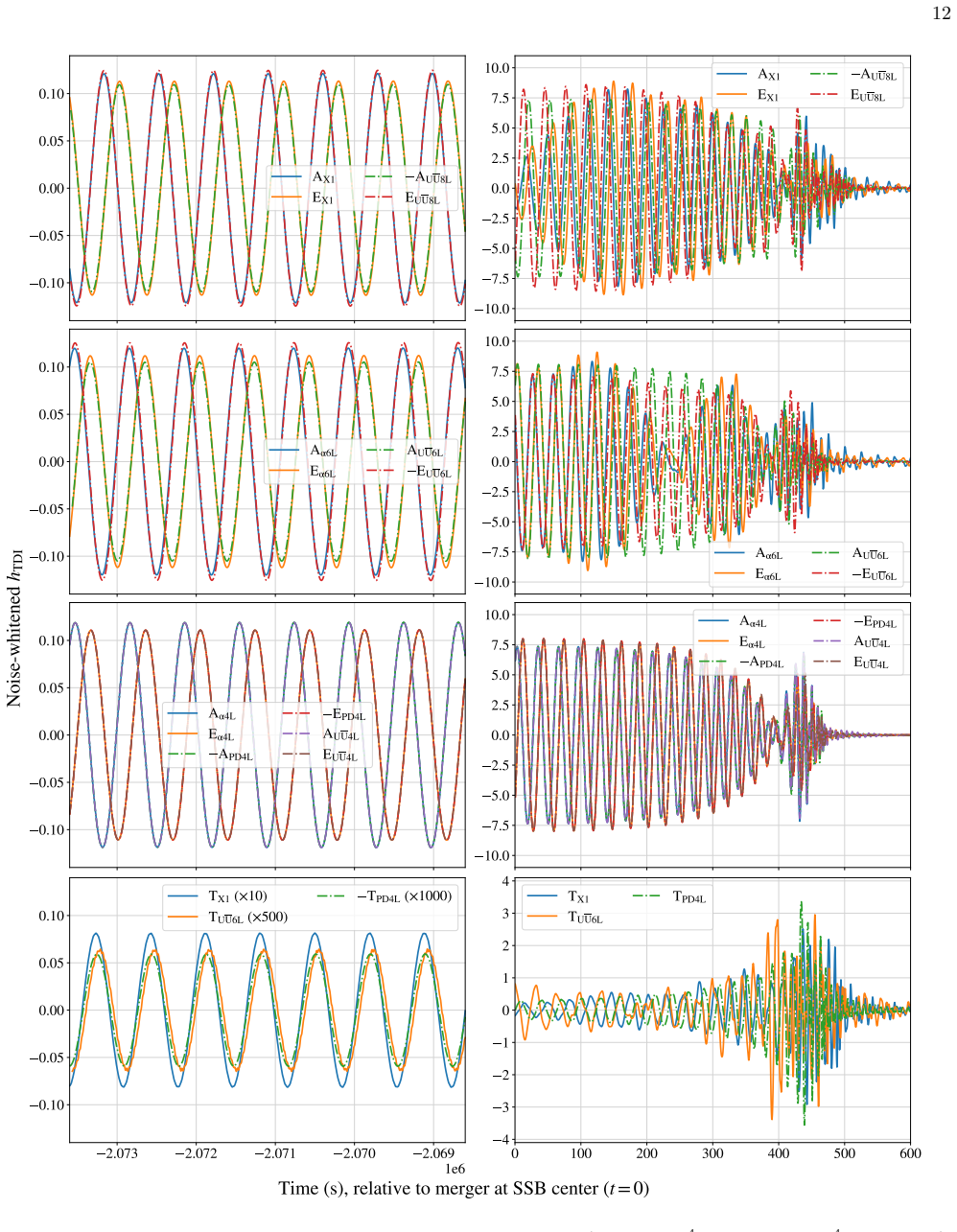
The central object is the TDI delay structure: the ordered sequence of forward and backward light-travel delays through the three spacecraft that defines a synthetic interferometer. Two derived quantities carry the argument: the effective time span $\tau$ (in units of the arm light-travel time $L$) and the null frequencies $f_{\mathrm{null}}=m/(nL)$ where the channel's transfer function vanishes. The argument runs through the standard frequency-domain approximation $h_{\mathrm{TDI}}(f,t)=R_{\mathrm{TDI}}(f,t)h(f)$, which treats the TDI response as a frequency-dependent multiplicative factor; when a gravitational wave's frequency changes appreciably over $\tau$, the approximation leaks power across frequency bins, and longer $\tau$ with more nulls worsens the leakage and adds amplitude modulation. PD4L's $\tau=4L$ and nulls at $u=m$ minimize both effects, which is why it wins the frequency-domain comparison.
What would settle it
Run the same parameter-inference comparison between PD4L and hybrid Relay 8L on the same simulated binary, but replace the factorized response $h_{\mathrm{TDI}}(f,t)=R_{\mathrm{TDI}}(f,t)h(f)$ with a complete frequency-domain model that accounts for the time dependence of the delays; if the two configurations' posteriors become statistically indistinguishable, the short-span advantage is an artifact of the factorized approximation rather than an intrinsic feature of the geometry.
Extended reading notes
Core claim
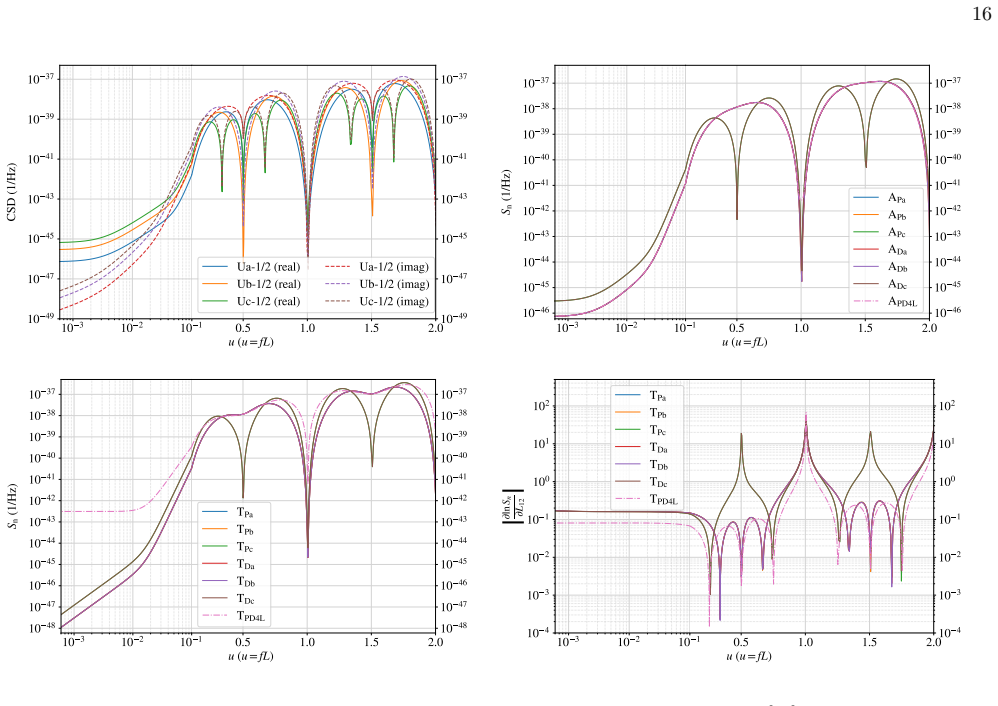
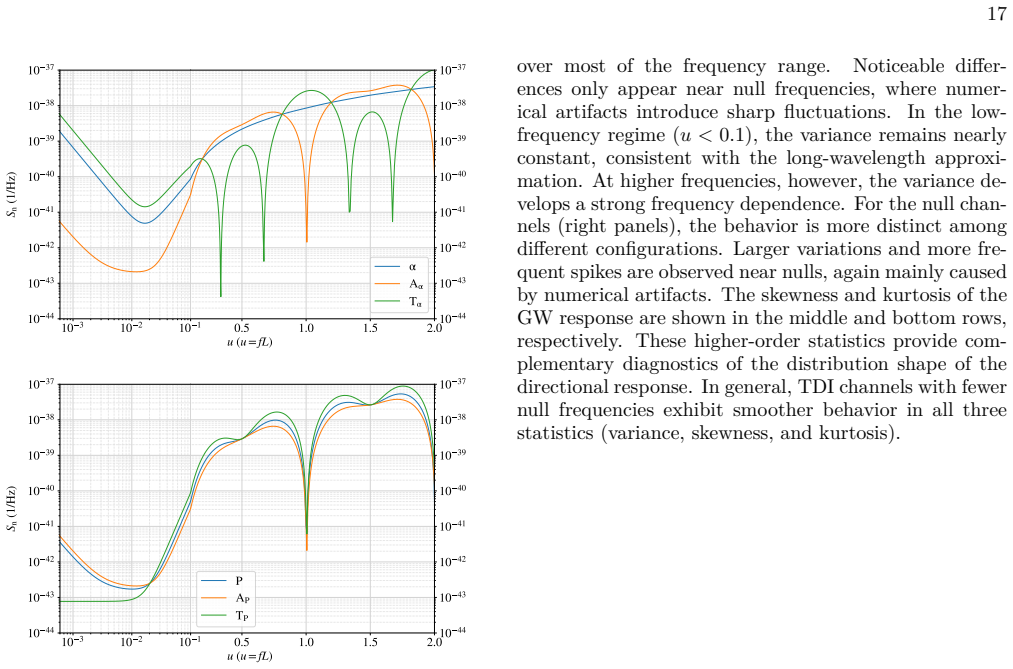
Correctly understood, the paper's discovery is that 'equivalent' TDI configurations are equivalent only in the long-wavelength limit. Using numerically simulated orbits with realistically unequal arms, the paper shows that the orthogonal science channels A and E of Michelson, Sagnac 6L, hybrid Relay 8L/6L/4L, $\alpha$4L, and PD4L are highly correlated in gravitational-wave response and instrument noise for dimensionless frequency $u=fL<0.1$, and their single-channel sky-averaged sensitivities are nearly identical. For $u>0.1$ the configurations part ways: Michelson's nulls at $u=m/4$ and its 8L span make its noise spectra most sensitive to arm-length variation, whereas PD4L has nulls only at $u=m$ and exhibits smoother spectra and sensitivity curves. In a parameter-inference test on a simulated massive black hole binary with component masses $3\times10^4$ and $10^4$ solar masses at redshift $0.2$, frequency-domain inference using the factorized response model $h_{\mathrm{TDI}}(f,t)=R_{\mathrm{TDI}}(f,t)h(f)$ places PD4L's posteriors closer to the injected values than hybrid Relay 8L's, with the bias traced to aliasing and leakage over the delay span. The same inference performed in the time domain finds both configurations equivalent and recovers the injected values, showing that the configuration dependence comes from the modeling approximation rather than lost information.
Load-bearing premise
The load-bearing premise is that a TDI configuration should be judged by how accurately it works with the simple frequency-domain model that multiplies the waveform by a transfer function; the paper itself concedes that with a more complete time-dependent frequency-domain model, the short-span advantage could disappear.
Editorial extensions
If this is right
- At low frequencies ($u<0.1$), results from any of the compared second-generation TDI configurations can be treated as interchangeable, since the science channels are highly correlated and single-channel sensitivities are nearly identical.
- High-frequency gravitational wave searches that rely on frequency-domain pipelines should prefer compact configurations such as PD4L to reduce aliasing, waveform modulation, and edge effects from long delay spans.
- Time-domain TDI inference recovers the same parameters from long-span and short-span configurations, so it can serve as a robust cross-check when the factorized frequency-domain model breaks down.
- The Michelson configuration's dense nulls at $u=m/4$ make its noise spectra most unstable against arm-length variations, which complicates noise characterization at high frequencies.
- Because the paper shows the advantage is not fundamental, adopting more complete frequency-domain response models could make the choice of TDI configuration less important for frequency-domain analysis.
Reading between the lines
- Editorial inference: if the factorized-model explanation is correct, the PD4L advantage should grow with the signal's chirp rate and with frequency; this could be tested by repeating the inference with heavier binaries, lower frequency cutoffs, or louder signals.
- Editorial inference: the paper's own caveat implies that no single TDI configuration is optimal in absolute terms; the ranking depends on the analysis pipeline, so mission design should treat 'best TDI' as pipeline-dependent.
- Editorial inference: the time-domain equivalence suggests a practical division of labor: compact TDI for fast frequency-domain searches and time-domain or complete-response models for final parameter estimation of rapidly evolving massive binaries.
- Editorial inference: the link-failure discussion hints that short-span schemes may also be useful building blocks for resilient partial-link TDI designs, since they keep the effective delay footprint small when combining surviving links.
Editorial analysis
A structured set of objections, weighed in public.
Referee Report
Summary. The paper compares a set of second-generation time-delay interferometry (TDI) configurations—Michelson (X1), Sagnac-type (α6L), hybrid Relay variants (UU8L, UU6L, UU4L), α4L, and PD4L—with respect to the correlations of their sky-averaged gravitational-wave responses and noise spectra, the stability of their noise power spectral densities, and their behavior in parameter inference for a massive black hole binary signal. The central claim is that, although the optimal A/E science channels of different configurations are highly correlated at low frequencies, high-frequency performance differs: configurations with shorter TDI time spans and fewer null frequencies, especially PD4L, allow more accurate frequency-domain waveform modeling and parameter recovery, while longer-span configurations such as Michelson and UU8L suffer from aliasing, amplitude modulation, and signal tails. In the time domain, the paper argues, the optimal channels of different configurations give consistent parameter inference. The manuscript is careful in places, explicitly acknowledging that the advantage is not fundamental and that more complete frequency-domain models could mitigate the effects for any TDI scheme.
Significance. If the claimed high-frequency distinction among TDI configurations is robust, the paper would be useful for data-analysis planning and TDI design for LISA-like missions, where frequency-domain pipelines are still the workhorse. The manuscript contains substantial quantitative material: numerical orbits, sky-averaged response functions, noise correlation computations, analytic sensitivity comparisons, and public software (SATDI, LISA-Like-Orbit) are used throughout, and the derivations of PSDs and response functions are standard. The paper's own limitations, however, are also substantive: the central inference comparison uses a single injected signal with artificially boosted SNR and a frequency-domain model whose breakdown is the very mechanism under study. The strength of the conclusion is therefore smaller than the abstract suggests, and the comparison is not controlled for the time-span variable in isolation. Because the main claim is plausible but not yet cleanly established, the paper needs additional work rather than acceptance as is.
major comments (3)
- [§IV B, Fig. 9, Eq. (6)] The parameter-inference comparison is made only between UU8L (8L hybrid Relay) and PD4L (4L Monitor/Beacon combination). These two configurations differ simultaneously in effective time span and in path construction, so the abstract's conclusion that 'shorter TDI time spans' are preferable is not isolated. The paper defines UU4L in Eq. (6), a hybrid Relay with 4L span and the same minimal null frequencies, and shows its whitened waveforms in Fig. 8, but it never runs the Fig. 9 inference for UU4L or α4L. A same-family span comparison (UU8L vs UU6L vs UU4L) is required to separate the time-span effect from PD4L-specific geometry; without it, the observed improvement could be a property of PD4L's particular path geometry or noise robustness rather than of shorter delay.
- [§IV B, Fig. 9, Eq. (25)] The evidence for the PD4L advantage rests on a single injected massive black hole binary (m1 = 3e4, m2 = 1e4 solar masses, z = 0.2) with the noise PSD artificially reduced by a factor of 10 and a low-frequency cutoff of 22 mHz. Both frequency-domain runs show biases in mass and luminosity distance, and no quantitative comparison metric (posterior bias, credible-interval coverage, Bayes factor, or statistical significance of the contour difference) is reported. Since the paper itself states in §IV B that the advantage 'is not fundamental' and that more complete frequency-domain models can mitigate aliasing for any TDI scheme, the headline conclusion is currently contingent on the approximate factorized model of Eq. (25). The authors should either add robustness tests over multiple sources, SNRs, and model assumptions, or explicitly restrict the claim to the factorized-model framework.
- [§IV A, Eq. (24)] The frequency-domain analysis whitens the signal with an analytic noise PSD evaluated at fixed instantaneous arm lengths (the midpoint of the observation), while the signal itself is generated with time-dependent varying delays; the text acknowledges that this approximate whitening can leave residual modulations near null frequencies. Because the Fig. 9 inference is performed after this whitening, the observed difference between PD4L and UU8L could partly reflect artifacts of the whitening/PSD-estimation procedure rather than intrinsic TDI modeling error. The manuscript should demonstrate that the reported difference survives a more faithful whitening (e.g., segmented PSD estimation or time-dependent noise model), or state why such an effect cannot account for the result.
minor comments (6)
- [Abstract] The phrase 'suppresses laser frequency noise and achieve the required sensitivity' has a subject-verb agreement error; 'achieve' should be 'achieves'.
- [§II A] There are several typographical errors in the text: 'Saganc' should be 'Sagnac', 'suffix' should be 'suffix', 'overmuch' is not standard usage, and 'efficient' should be 'efficient'.
- [§IV B, Fig. 9] The text says PD4L yields posteriors 'closer to the injected values' than hybrid Relay 8L, but no numerical values or error bars are given for the contours. Please report quantitative measures, such as posterior means and standard deviations or credible-interval intervals, for the key parameters.
- [§IV B, last paragraph] The statement that 'similar conclusions are expected to apply to other schemes' is presented without supporting evidence; either provide additional runs (e.g., for UU4L or α4L) or soften the statement to an explicit conjecture.
- [§III B, Figs. 4 and 5] The figures are labeled 'Results partially reproduced from [22]'; please clarify which panels are new to this paper and which are reproduced, so that the novel contribution is unambiguous.
- [Reproducibility] The manuscript cites public repositories for SATDI and LISA-Like-Orbit but does not give version numbers or commit identifiers; adding these would improve reproducibility of the numerical results.
Circularity Check
No circular reduction found: the PD4L comparison is empirical, externally benchmarked, and its self-citations are contextual rather than load-bearing.
full rationale
I walked the derivation chain and found no step in which a claimed prediction or first-principles result reduces by construction to a fitted input, a self-cited theorem, or a definitional identity. The central numerical claims are generated in this paper: sky-averaged GW responses and noise PSDs are computed from a specified numerical orbit and the LISA noise model; the high-frequency waveform comparison uses the external SEOBNRv5HM waveform model; and the parameter-inference comparisons use MultiNest on separately constructed frequency-domain and time-domain TDI responses. The self-citations to [12,13,19,22] for designing PD4L and to [34] for the SATDI code are real, but they are not the load-bearing evidence for the paper's conclusions; the paper reproduces and extends the relevant results in its own figures and Appendices A-C, and the inference in Fig. 9 is a new empirical computation. The statements 'As analyzed in our previous work [22], the PD4L configuration demonstrates excellent performance' and 'Results partially reproduced from [22]' are contextual self-citations that are corroborated, not assumed, by the present analysis. The paper also explicitly disclaims that the short-span advantage is fundamental, stating that more complete frequency-domain models 'can mitigate aliasing and leakage effects for any TDI scheme.' One genuine limitation is that Fig. 9 compares PD4L (4L) only with hybrid Relay 8L and not with the same-family UU4L, so the headline attribution of the improvement to time span is not fully controlled; however, an uncontrolled comparison is a robustness or correctness concern, not a circular identification. Under the stated hard rules, the lack of any exhibited Eq.-to-Eq. or fit-to-prediction reduction means the appropriate verdict is no significant circularity, with a minor allowance for the paper's repeated self-citations.
Assumptions & free parameters
assumptions (3)
- domain assumption The LISA noise model with acceleration noise Sacc = 3 fm/s^2/sqrt(Hz) * sqrt(1+(0.4mHz/f)^2) * sqrt(1+(f/8mHz)^4) and OMS noise Soms = 15 pm/sqrt(Hz) * sqrt(1+(2mHz/f)^4).
- domain assumption The equal-arm approximation for the orthogonal transformation in Eq. (9) is valid because real parts of CSDs dominate imaginary parts.
- domain assumption The factorized frequency-domain response model h_TDI(f,t) = R_TDI(f,t) h(f) is used for parameter inference.
Cite this review
Pith. "Pith review of Correlation and Data-Analysis Distinctiveness of Time-Delay Interferometry Configurations." pith.science (2026). https://pith.science/paper/RYC3KRSH
@misc{pith2026250718397,
  author       = {Pith},
  title        = {Pith review of: Correlation and Data-Analysis Distinctiveness of Time-Delay Interferometry Configurations},
  year         = {2026},
  howpublished = {\url{https://pith.science/paper/RYC3KRSH}},
  note         = {Machine review of arXiv:2507.18397}
}
read the original abstract
Time-Delay Interferometry (TDI) is essential for space-based gravitational wave (GW) missions, as it suppresses laser frequency noise and achieve the required sensitivity. Beyond the standard Michelson configuration, a variety of second-generation TDI schemes have been proposed, each utilizing different combinations of inter-spacecraft laser links. In this work, we conduct a comparative study of several representative TDI configurations with different time spans, and show that while their (quasi-)orthogonal channels are highly correlated, their performance in data analysis can differ among these schemes. In the low-frequency regime, the performance of different TDI configurations are nearly identical. Their distinctions emerge primarily at high frequencies, where the GW wavelength becomes comparable to the arm length. In this regime, shorter TDI time spans with minimal null frequencies facilitate more accurate waveform modeling and parameter recovery in frequency domain. In contrast, configurations with longer time spans and more null frequencies, such as the Michelson, are more susceptible to frequency aliasing and waveform modulation effects, which degrade inference accuracy. However, if signal modeling and analysis are performed in the time domain, the optimal science channels of these TDI configurations exhibit consistent performance in parameter inference. Considering the usability in both frequency and time domain, the short-span PD4L scheme, which exhibits minimal nulls and superior performance in high frequencies, emerges as a promising candidate for future space-based GW mission designs.
Figures


Figures from the paper (10 more)





Forward citations
Cited by 1 Pith paper
-
Detectability to extreme mass ratio inspirals with alternative space-based detector networks
Multi-detector networks of LISA-TAIJI-TianQin reduce EMRI sky localization uncertainty by up to 100x and achieve comparable parameter constraints to longer single-mission observations via Fisher analysis.
Reference graph
Works this paper leans on
-
[1]
W.-T. Ni, J.-T. Shy, S.-M. Tseng, X. Xu, H.-C. Yeh, W.-Y. Hsu, W.-L. Liu, S.-D. Tzeng, P. Fridelance, E. Samain, D. Lee, Z.-Y. Su, and A.-M. Wu, Progress in mission concept study and laboratory development for the ASTROD (Astrodynamical Space Test of Relativity using Optical Devices), in Small Spacecraft, Space Envi- ronments, and Instrumentation Technolo...
work page 1997
-
[2]
J. W. Armstrong, F. B. Estabrook, and M. Tinto, Time-Delay Interferometry for Space-based Gravita- tional Wave Searches, Astrophys. J. 527, 814 (1999)
work page 1999
-
[3]
F. B. Estabrook, M. Tinto, and J. W. Armstrong, Time- delay analysis of LISA gravitational wave data: Elim- ination of spacecraft motion effects, Phys. Rev. D 62, 042002 (2000)
work page 2000
-
[4]
P. Amaro-Seoane et al. (LISA), Laser Interferometer Space Antenna, (2017), arXiv:1702.00786 [astro-ph.IM]
arXiv 2017
-
[5]
M. Colpi et al. , LISA Definition Study Report, (2024), arXiv:2402.07571 [astro-ph.CO]
arXiv 2024
-
[6]
Hu and Y.-L
W.-R. Hu and Y.-L. Wu, The Taiji Program in Space for gravitational wave physics and the nature of gravity, Natl. Sci. Rev. 4, 685 (2017)
2017
- [7]
-
[8]
Ni, ASTROD-GW: Overview and Progress, Int
W.-T. Ni, ASTROD-GW: Overview and Progress, Int. J. Mod. Phys. D 22, 1341004 (2013) , arXiv:1212.2816 [astro-ph.IM]
arXiv 2013
Show all 54 references
-
[9]
Tinto, F
M. Tinto, F. B. Estabrook, and J. Armstrong, Time delay interferometry with moving spacecraft arrays, Phys. Rev. D 69, 082001 (2004) , arXiv:gr-qc/0310017
2004 arXiv
-
[10]
D. A. Shaddock, M. Tinto, F. B. Estabrook, and J. Arm- strong, Data combinations accounting for LISA space- craft motion, Phys. Rev. D 68, 061303 (2003) , arXiv:gr- qc/0307080
2003
-
[11]
Vallisneri, Geometric time delay interferometry, Phys
M. Vallisneri, Geometric time delay interferometry, Phys. Rev. D 72, 042003 (2005) , [Erratum: Phys. Rev. D 76, 109903(2007)], arXiv:gr-qc/0504145 [gr-qc]
2005 arXiv
-
[12]
Wang, Time-delay Interferometry for ASTROD-GW , Master’s thesis, Purple Mountain Observatory, CAS (2011), arXiv:2406.14173 [gr-qc]
G. Wang, Time-delay Interferometry for ASTROD-GW , Master’s thesis, Purple Mountain Observatory, CAS (2011), arXiv:2406.14173 [gr-qc]
2011 arXiv
-
[13]
Wang and W.-T
G. Wang and W.-T. Ni, Time-delay Interferometry for ASTROD-GW, Chin. Astron. Astrophys. 36, 211 (2012)
2012
-
[14]
Wang, W.-T
G. Wang, W.-T. Ni, W.-B. Han, and C.-F. Qiao, Algo- rithm for time-delay interferometry numerical simulation and sensitivity investigation, Phys. Rev. D 103, 122006 (2021), arXiv:2010.15544 [gr-qc]
2021 arXiv
-
[15]
Hartwig and M
O. Hartwig and M. Muratore, Characterization of time 18 FIG. 12. Mollweide sky maps (ecliptic coordinates) of the instantaneous GW response of PD4L configuration at three dimen- sionless frequencies, u = f L ∈ {0.10, 0.75, 1.25}. The left column shows the combined science chan...
2022 arXiv
-
[16]
Tinto, S
M. Tinto, S. Dhurandhar, and D. Malakar, Second- generation time-delay interferometry, Phys. Rev. D 107, 082001 (2023) , arXiv:2212.05967 [gr-qc]
2023 arXiv
-
[17]
T. A. Prince, M. Tinto, S. L. Larson, and J. W. Arm- strong, The LISA optimal sensitivity, Phys. Rev. D 66, 122002 (2002) , arXiv:gr-qc/0209039 [gr-qc]
2002 arXiv
-
[18]
Vallisneri, J
M. Vallisneri, J. Crowder, and M. Tinto, Sensitivity and parameter-estimation precision for alternate LISA configurations, Class. Quant. Grav. 25, 065005 (2008) , arXiv:0710.4369 [gr-qc]
2008 arXiv
-
[19]
Wang, Time delay interferometry with minimal null frequencies, Phys
G. Wang, Time delay interferometry with minimal null frequencies, Phys. Rev. D 110, 042005 (2024) , arXiv:2403.01490 [gr-qc]
2024 arXiv
-
[20]
Wang, Enhancing noise characterization with robust time delay interferometry combination, Phys
G. Wang, Enhancing noise characterization with robust time delay interferometry combination, Phys. Rev. D 110, 064085 (2024) , arXiv:2406.11305 [gr-qc]
2024 arXiv
-
[21]
P. Wu, M. Du, and P. Xu, Suppressing data anomalies of gravitational reference sensors with time delay inter- ferometry combinations, Opt. Express 32, 43249 (2024) , arXiv:2206.10664 [gr-qc]
2024 arXiv
-
[22]
Wang, Time delay interferometry with minimal null frequencies and shortened time span, Sci
G. Wang, Time delay interferometry with minimal null frequencies and shortened time span, Sci. China Phys. Mech. Astron. 69, 220411 (2026) , arXiv:2502.03983 [gr- qc]
2026
-
[23]
Https://github.com/gw4gw/LISA-Like-Orbit
-
[24]
Wang and W.-T
G. Wang and W.-T. Ni, Numerical simulation of time delay interferometry for TAIJI and new LISA, Res. As- 19 10 3 10 2 10 1 0.0 0.1 0.2 0.3 0.4 0.5 0.6 variance AX1+EX1 AUU8L+EUU8L AUU6L+EUU6L APD4L+EPD4L 0.5 1.0 1.5 2.0 u (u = fL) 0.0 0.1 0.2 0.3 0.4 0.5 0.6 10 3 10 2 10 1 0.0...
2019 arXiv
-
[25]
Freise, S
A. Freise, S. Chelkowski, S. Hild, W. Del Pozzo, A. Per- reca, and A. Vecchio, Triple Michelson Interferometer for a Third-Generation Gravitational Wave Detector, Class. Quant. Grav. 26, 085012 (2009) , arXiv:0804.1036 [gr-qc]
2009 arXiv
-
[26]
Wang and W.-T
G. Wang and W.-T. Ni, Revisiting time delay interfer- ometry for unequal-arm LISA and TAIJI, Phys. Scripta 98, 075005 (2023) , arXiv:2008.05812 [gr-qc]
2023 arXiv
-
[27]
J. D. Romano and N. J. Cornish, Detection meth- ods for stochastic gravitational-wave backgrounds: a unified treatment, Living Rev. Rel. 20, 2 (2017) , arXiv:1608.06889 [gr-qc]
2017 arXiv
-
[28]
J. D. E. Creighton and W. G. Anderson, Gravitational- wave physics and astronomy: An introduction to theory, experiment and data analysis (2011)
2011
-
[29]
M. R. Adams and N. J. Cornish, Discriminating be- tween a Stochastic Gravitational Wave Background and Instrument Noise, Phys. Rev. D 82, 022002 (2010) , arXiv:1002.1291 [gr-qc]
2010 arXiv
-
[30]
Hartwig, M
O. Hartwig, M. Lilley, M. Muratore, and M. Pieroni, Stochastic gravitational wave background reconstruction for a nonequilateral and unequal-noise LISA constella- tion, Phys. Rev. D 107, 123531 (2023) , arXiv:2303.15929 [gr-qc]
2023 arXiv
-
[31]
D. A. Shaddock, B. Ware, R. E. Spero, and M. Vallisneri, 20 Post-processed time-delay interferometry for LISA, Phys. Rev. D 70, 081101 (2004) , arXiv:gr-qc/0406106
2004 arXiv
-
[32]
J.-B. Bayle, Simulation and Data Analysis for LISA : In- strumental Modeling, Time-Delay Interferometry, Noise- Reduction Permormance Study, and Discrimination of Transient Gravitational Signals , Ph.D. thesis, Paris U. VII, APC (2019)
2019
-
[33]
Pompili et al
L. Pompili et al. , Laying the foundation of the effective- one-body waveform models SEOBNRv5: Improved ac- curacy and efficiency for spinning nonprecessing bi- nary black holes, Phys. Rev. D 108, 124035 (2023) , arXiv:2303.18039 [gr-qc]
2023 arXiv
-
[34]
Wang, SATDI: Simulation and Analysis for Time- Delay Interferometry, (2024), arXiv:2403.01726 [gr-qc]
G. Wang, SATDI: Simulation and Analysis for Time- Delay Interferometry, (2024), arXiv:2403.01726 [gr-qc]
2024 arXiv
-
[35]
Aghanim et al
N. Aghanim et al. (Planck), Planck 2018 results. VI. Cosmological parameters, Astron. Astrophys. 641, A6 (2020), [Erratum: Astron.Astrophys. 652, C4 (2021)], arXiv:1807.06209 [astro-ph.CO]
2020 arXiv
-
[36]
T. P. Robitaille et al. (Astropy), Astropy: A Community Python Package for Astronomy, Astron. Astrophys. 558, A33 (2013) , arXiv:1307.6212 [astro-ph.IM]
2013 arXiv
-
[37]
Vallisneri and C
M. Vallisneri and C. R. Galley, Non-sky-averaged sen- sitivity curves for space-based gravitational-wave ob- servatories, Class. Quant. Grav. 29, 124015 (2012) , arXiv:1201.3684 [gr-qc]
2012 arXiv
-
[38]
M. L. Katz, S. Marsat, A. J. K. Chua, S. Babak, and S. L. Larson, GPU-accelerated massive black hole binary pa- rameter estimation with LISA, Phys. Rev. D 102, 023033 (2020), arXiv:2005.01827 [gr-qc]
2020 arXiv
-
[39]
Feroz, M
F. Feroz, M. P. Hobson, and M. Bridges, MultiNest: an efficient and robust Bayesian inference tool for cosmology and particle physics, Mon. Not. Roy. Astron. Soc. 398, 1601 (2009) , arXiv:0809.3437 [astro-ph]
2009 arXiv
-
[40]
Buchner, A
J. Buchner, A. Georgakakis, K. Nandra, L. Hsu, C. Rangel, M. Brightman, A. Merloni, M. Salvato, J. Donley, and D. Kocevski, X-ray spectral modelling of the AGN obscuring region in the CDFS: Bayesian model selection and catalogue, Astron. Astrophys. 564, A125 (2014), arXiv:1402...
2014 arXiv
-
[41]
Marsat, J
S. Marsat, J. G. Baker, and T. Dal Canton, Explor- ing the Bayesian parameter estimation of binary black holes with LISA, Phys. Rev. D 103, 083011 (2021) , arXiv:2003.00357 [gr-qc]
2021 arXiv
-
[42]
may provide more efficient and robust solutions. V. CONCLUSION AND DISCUSSION In this study, we revisit the correlations among orthog- onal channels in representative second-generation TDI configurations. While generator-based decompositions suggest that different TDI observabl...
-
[43]
García-Quirós, S
C. García-Quirós, S. Tiwari, and S. Babak, GPU- accelerated LISA parameter estimation with full time do- main response, (2025), arXiv:2501.08261 [gr-qc]
2025 arXiv
-
[44]
C. R. Harris, K. J. Millman, S. J. van der Walt, R. Gom- mers, P. Virtanen, D. Cournapeau, E. Wieser, J. Tay- lor, S. Berg, N. J. Smith, R. Kern, M. Picus, S. Hoyer, M. H. van Kerkwijk, M. Brett, A. Haldane, J. F. del Río, M. Wiebe, P. Peterson, P. Gérard-Marchant, K. Shep- pa...
2020
-
[45]
Virtanen, R
P. Virtanen, R. Gommers, T. E. Oliphant, M. Haberland, T. Reddy, D. Cournapeau, E. Burovski, P. Peterson, W. Weckesser, J. Bright, S. J. van der Walt, M. Brett, J. Wilson, K. J. Millman, N. Mayorov, A. R. J. Nel- son, E. Jones, R. Kern, E. Larson, C. J. Carey, İ. Po- lat, Y. F...
2020
-
[46]
pandas development team, pandas-dev/pandas: Pan- das (2020)
T. pandas development team, pandas-dev/pandas: Pan- das (2020)
2020
-
[47]
J. D. Hunter, Matplotlib: A 2D Graphics Environment, Comput. Sci. Eng. 9, 90 (2007)
2007
-
[48]
Lewis, GetDist: a Python package for analysing Monte Carlo samples, (2019), arXiv:1910.13970 [astro- ph.IM]
A. Lewis, GetDist: a Python package for analysing Monte Carlo samples, (2019), arXiv:1910.13970 [astro- ph.IM]
2019 arXiv
-
[49]
K. M. Górski, E. Hivon, A. J. Banday, B. D. Wan- delt, F. K. Hansen, M. Reinecke, and M. Bartelmann, HEALPix: A Framework for High-Resolution Discretiza- tion and Fast Analysis of Data Distributed on the Sphere, Astrophys. J. 622, 759 (2005) , arXiv:astro-ph/0409513
2005 arXiv
-
[50]
Zonca, L
A. Zonca, L. Singer, D. Lenz, M. Reinecke, C. Rosset, E. Hivon, and K. Gorski, healpy: equal area pixeliza- tion and spherical harmonics transforms for data on the sphere in python, Journal of Open Source Software 4, 1298 (2019)
2019
-
[51]
LIGO Scientific Collaboration, Virgo Collaboration, and KAGRA Collaboration, L VK Algorithm Library - LAL- Suite, Free software (GPL) (2018)
2018
-
[52]
Wette, SWIGLAL: Python and Octave interfaces to the LALSuite gravitational-wave data analysis libraries, SoftwareX 12, 100634 (2020)
K. Wette, SWIGLAL: Python and Octave interfaces to the LALSuite gravitational-wave data analysis libraries, SoftwareX 12, 100634 (2020)
2020
-
[53]
A. Nitz, I. Harry, D. Brown, C. M. Biwer, J. Willis, T. D. Canton, C. Capano, T. Dent, L. Pekowsky, G. S. C. Davies, S. De, M. Cabero, S. Wu, A. R. Williamson, B. Machenschalk, D. Macleod, F. Pannarale, P. Kumar, S. Reyes, dfinstad, S. Kumar, M. Tápai, L. Singer, P. Ku- mar, v...
2024
-
[54]
Tinto and S
M. Tinto and S. V. Dhurandhar, Time-delay interferom- etry, Living Rev. Rel. 24, 1 (2021)
2021
Reviewed August 6, 2026 · model on record in the stance chip above.
Discussion (0). Sign in to comment.