REVIEW 3 major objections 4 minor 75 references
PosterMate: Audience-driven Collaborative Persona Agents for Poster Design
T0 review · 3 major / 4 minor · reviewed 2026-08-15 · deepseek-v4-flash
Pith's one-line read PosterMate turns marketing briefs into audience personas that critique poster designs.
desk verdict A well-built system paper whose central claim—that LLM-generated personas reflect real target audiences—is tested only for internal consistency, not against actual audience responses; still worth serious review. read the letter →
The pith
A machine-rendered reading of the paper's core claim, the machinery that carries it, and where it could break.
The reading
What carries the argument
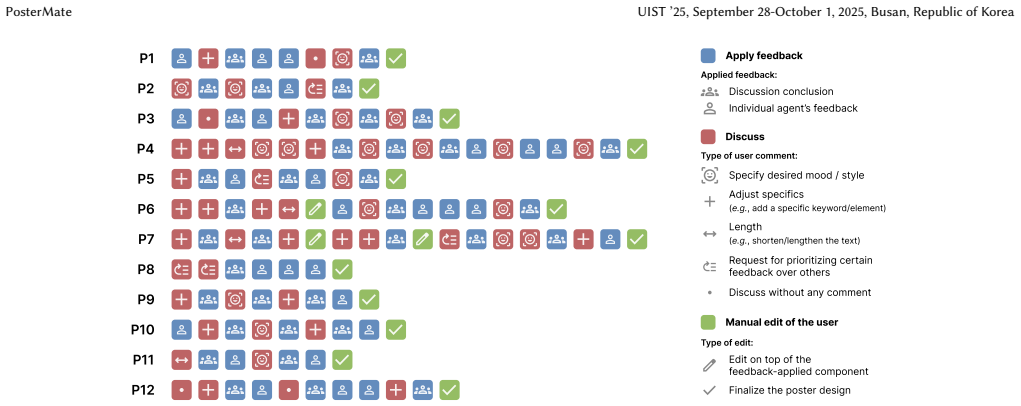
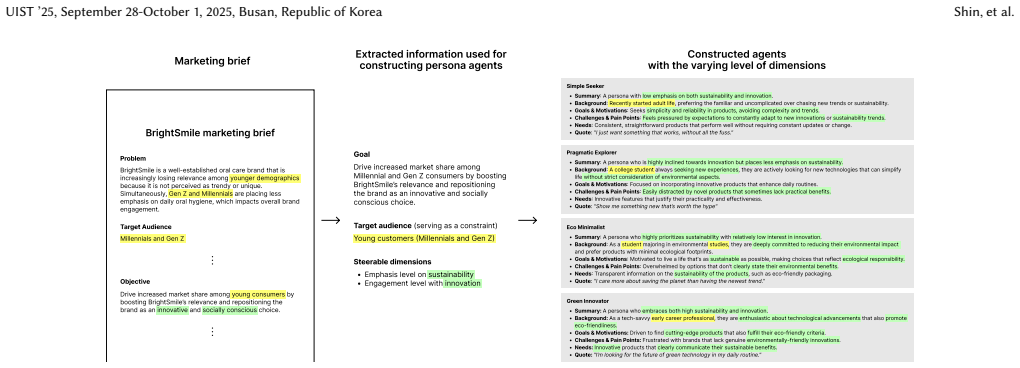
The load-bearing mechanism is the persona-agent pipeline: a multimodal LLM reads the marketing brief, chooses two steerable dimensions, forms a 2x2 matrix of four persona descriptions, and then generates feedback conditioned on the persona details, the brief's goal, and the poster's JSON representation together with its rendered pixel image. A moderator agent then resolves disagreements by asking each persona agent a thought-provoking question, collecting open-ended responses, and drawing a conclusion that may selectively compromise or omit parts of individual viewpoints. The same JSON structure lets accepted edits be written back to the canvas, which is what keeps the designer in control while the agents contribute.
What would settle it
Recruit people who actually match each generated persona (for example, frequent versus occasional shoppers in the brief's demographic), show them the same poster, and compare their stated preferences and critiques against the persona agent's feedback; if the match is near chance or systematically divergent, the premise of audience fidelity fails.
Extended reading notes
Core claim
The paper's central claim is that audience-driven persona agents constructed from marketing documents can act as design collaborators: they produce component-level feedback that matches their persona, and moderated discussion among them yields conclusions that synthesize the persona viewpoints better than any single agent's feedback. PosterMate operationalizes this by extracting two steerable audience dimensions from the brief, generating four persona agents at the dimension extremes, prompting each to critique text, image, and theme with both a high-level opinion and a concrete preview, and running a moderator-led discussion that resolves conflicts into an actionable conclusion. The user study supports the system's usefulness and its preservation of designer agency, while the controlled evaluation shows that text feedback is attributed to the correct persona by 52.1% of evaluators and image feedback by 64.3%, both well above the 25% chance level, and that conclusions are preferred over individual feedback for satisfying the majority of personas across all three component types.
Load-bearing premise
An LLM prompted with a marketing brief and generated persona descriptions produces feedback that genuinely represents what the real target audience would say.
Editorial extensions
If this is right
- A designer with only a marketing brief can generate diverse audience perspectives in seconds and iterate on them in real time, without recruiting a review panel.
- Previews attached to each piece of feedback lower the cost of comparing alternatives, which makes the tool useful for early prototyping.
- Moderated multi-agent discussion produces conclusions that evaluators rate as satisfying the majority of personas more often than any individual persona's feedback, across text, image, and theme.
- Text and image feedback are attributable to the correct persona well above chance, so designers can trace a critique back to a specific viewpoint; theme feedback is not reliably attributable, which limits provenance for theme suggestions.
- Because accepted edits flow directly into the canvas, the system can support rapid iteration without forcing the designer to leave the design tool.
Reading between the lines
- The persona agents are only as faithful as the LLM's model of real audiences, and the paper never checks them against actual members of the target audience; a natural extension is to validate persona feedback against a real sample drawn from the brief's audience segments.
- The same construction could plausibly generalize beyond posters to other goal-directed design artifacts, such as UI mockups or infographics, whenever the design can be serialized into a structured representation.
- The weak theme results suggest that retrieval from a fixed template library is the bottleneck; generating candidate themes on demand, rather than matching tone and color to existing templates, would be a testable fix.
- If persona feedback is later shown to diverge from real audience preferences, the system could be repositioned honestly as a creativity-stimulation device rather than an audience-simulation device, since the user study's main benefit was noticing overlooked perspectives.
Signed reviews
Editorial analysis
A structured set of objections, weighed in public.
Referee Report
Summary. PosterMate is a poster-design assistant that constructs four persona agents from a marketing brief via an LLM, has each agent give text/image/theme feedback on a designer's draft, and runs moderator-led discussions to synthesize conclusions. The paper reports a formative interview study (N=8), a user study (N=12), and a controlled online evaluation (N=100). The user study indicates perceived usefulness and perceived broadening of perspectives, and the controlled evaluation shows that crowd workers can often match text and image feedback to the persona that produced it (52.1% and 64.3% vs. 25% chance) and rate moderated conclusions as more satisfactory than individual agents' feedback.
Significance. If the central claim were fully established, PosterMate would be a useful addition to creativity-support tools: it operationalizes a concrete pipeline from marketing briefs to persona agents to design feedback, and the two evaluations provide a template for assessing agent role fidelity. The paper is also commendably transparent: Section 8 explicitly acknowledges the absence of non-AI baselines, the need for causal validation of persona attributes, and the below-chance theme matching. However, as it stands the evidence primarily demonstrates internal consistency of an LLM prompting pipeline, not that the agents faithfully represent real target audiences; the externally valid claim in the abstract ('capture the needs of the target audiences') is under-supported.
major comments (3)
- [Section 6.1.2 and 6.3.2] Study 2 evaluates whether crowd workers can match each feedback to the persona description that the same LLM generated earlier in the pipeline. Because personas and feedback are both outputs of the same prompt chain, high match rates (52.1% text, 64.3% image) largely verify prompt adherence and reliance on stereotypical cues, rather than establishing that the persona agents reflect the actual target audience. The paper's central motivation (Section 1) is to help designers 'capture the needs of the target audiences'; Section 8 acknowledges the need for further causal validation, but the current evaluation contains no comparison against responses from real members of the target audience segments. At minimum, the abstract and Section 7 should be rephrased to claim internal persona-consistency, or a small ground-truth study (e.g., having members of the described audience rate whether the agents' feedback matches their own preferences) should be added.
- [Section 5] All user-study claims about effectiveness are based on a single condition in which participants use PosterMate; there is no baseline such as static persona cards, a single non-persona LLM feedback, or no feedback. The observed benefits (e.g., Section 5.3.3, 'participants mentioned that the multiple persona agents... allowed them to step outside of their initial assumptions') could be produced by any additional feedback source rather than by the persona-agent discussion mechanism. Section 8 states that comparative studies with non-AI baselines were not run; for the causal framing in the paper ('helped them consider perspectives'), this is a load-bearing limitation rather than a routine future-work item. Adding a between-subjects baseline condition, or explicitly reframing the contribution as an exploratory feasibility demonstration, is needed.
- [Section 6.3.2] The theme-matching result (21.9%, below the 25% chance level) is reported and discussed in Section 7, which is honest, but the design implication is under-developed. If themes cannot be attributed to persona identities, it is unclear that the theme feedback pathway contributes to the audience-capture claim; the discussion attributes the problem to template retrieval, yet no diagnostic evaluation isolates whether the issue is persona construction, feedback generation, or template matching. The paper should either report an analysis of why theme feedback fails to carry persona-specific signal (e.g., measuring inter-persona overlap in tone/color descriptors) or narrow the scope of the claim regarding theme feedback.
minor comments (4)
- [Section 4.4.4] There is a duplicated phrase in the paragraph about applying themes: 'In this process, During this process, the system temporarily stores...'.
- [Section 6.3.1] The chi-square tests treat the repeated observations from the same 100 evaluators as independent; a mixed-effects model or evaluator-level clustering would be more appropriate, though the large effect sizes make it unlikely to change the qualitative conclusions.
- [Section 4.5.3] The statement that the moderator 'may selectively omit certain portion of some individual agents' perspectives' seems to sit uneasily with the claim that the conclusion 'maximizes satisfaction among all agents'; a brief justification or limitation note would help.
- [Figure 10] The caption's phrase 'slanting downward from left to right' is redundant and slightly confusing; consider simplifying to 'the diagonal'.
Circularity Check
Audience-validity claim reduces to self-consistency: feedback is generated from the very persona descriptions that the matching study asks evaluators to recover, so 'persona-appropriate' is a prompt-conditioning check; usefulness retains independent qualitative support.
-
self definitional
[Section 4.4 / Section 6.1.2 / Section 6.3.2]
"Given this input, the goal of the poster design, and the persona details, the model provides feedback from each persona agent ... [Study 2] they reviewed four outputs (each of which was from each persona agent) and were asked to identify which persona had provided the feedback leading to each output. The correct answer was the persona whose feedback corresponds to the presented output."
The 'persona identity' being tested is the persona description that was used as the LLM prompt input to generate the feedback. Study 2's 'correct answer' is therefore the generation input itself, and the high text/image match rates (52.1%, 64.3%) verify that the LLM conditions on its own persona descriptions and that the descriptions are discriminable, not that the personas represent real target-audience members. The abstract's claim that feedback is 'appropriate given its persona identity' is thus a self-consistency statement: the target property is built into the generation prompt, so the evaluation reduces to checking prompt adherence. No comparison to actual target-audience members is made.
-
self definitional
[Section 4.3 / Section 5.3.1, Figure 6b]
"To elicit dimensions from the marketing brief, an LLM is first prompted to return two dimensions that could be varied given the marketing brief, without contradicting audience characteristics defined in the marketing brief ... Then, the model generates four personas based on the combination of two extremes of these axes ... [Section 5.3.1] the participants reported that the generated personas aligned well with the marketing brief (see Figure 6b), demonstrating the reliability of constructing persona agents based on the briefs."
The personas are generated by an LLM explicitly instructed to stay consistent with the marketing brief ('without contradicting audience characteristics defined in the marketing brief'). User ratings that the personas 'aligned well with the marketing brief' therefore restate the generation constraint rather than independently validating the persona-construction step. The alignment is an input requirement, not an empirically discovered output property, so presenting it as evidence of reliability is circular, though this is a secondary claim.
full rationale
The paper contains no mathematical derivation, no fitted parameters, and no load-bearing self-citation chain; the main circularity concern is the operationalization of the audience-validity claim. In Section 4.4, each persona agent's feedback is generated by prompting the LLM with the goal of the poster design and the persona details that were themselves produced in Section 4.3 from the marketing brief. Study 2 then asks crowd-workers to match each feedback output back to the persona description that was used as the generation input, defining the 'correct answer' as that same description. High text/image match rates (52.1%, 64.3%) therefore demonstrate that the LLM conditions on its own personas and that those personas are discriminable, not that the personas reflect real target-audience members; the abstract's 'appropriate given its persona identity' is a self-consistency result. The same structure appears in the user-study claim that 'generated personas aligned well with the marketing brief': the LLM is explicitly instructed to avoid contradicting the brief, so this alignment is an input constraint, not an independent finding. The paper's Section 8 concedes that 'further causal validation is necessary to confirm that detailed persona attributes specifically shape the feedback' and that no non-AI baseline comparison was run, corroborating the internal-consistency reading. At the same time, the qualitative user study (N=12) independently documents that designers found the multi-agent discussion useful and that it helped them notice overlooked brief details, and Study 1's human preferences for the moderator's conclusion are genuinely elicited judgments, so the system-usefulness claim is not fully circular. The theme-matching failure (21.9%, below the 25% chance level) also shows the internal-consistency effect is not universal. Net: the central audience-reflection claim reduces by construction to prompt conditioning, while the usefulness claim retains independent qualitative content; partial circularity, score 6.
Assumptions & free parameters
free parameters (1)
- Number of persona dimensions =
2
assumptions (4)
- domain assumption LLMs can simulate human behavior and persona perspectives accurately enough for design feedback.
- domain assumption Marketing briefs contain sufficient information to construct meaningful target audience personas.
- domain assumption The 2x2 matrix of two steerable dimensions covers the diversity of the target audience.
- domain assumption Crowd evaluators' judgments of persona-feedback matching and conclusion quality are a valid proxy for design feedback effectiveness.
invented entities (1)
-
Audience persona agents
Cite this review
Pith. "Pith review of PosterMate: Audience-driven Collaborative Persona Agents for Poster Design." pith.science (2026). https://pith.science/paper/FB3BRI3F
@misc{pith2026250718572,
  author       = {Pith},
  title        = {Pith review of: PosterMate: Audience-driven Collaborative Persona Agents for Poster Design},
  year         = {2026},
  howpublished = {\url{https://pith.science/paper/FB3BRI3F}},
  note         = {Machine review of arXiv:2507.18572}
}
read the original abstract
Poster designing can benefit from synchronous feedback from target audiences. However, gathering audiences with diverse perspectives and reconciling them on design edits can be challenging. Recent generative AI models present opportunities to simulate human-like interactions, but it is unclear how they may be used for feedback processes in design. We introduce PosterMate, a poster design assistant that facilitates collaboration by creating audience-driven persona agents constructed from marketing documents. PosterMate gathers feedback from each persona agent regarding poster components, and stimulates discussion with the help of a moderator to reach a conclusion. These agreed-upon edits can then be directly integrated into the poster design. Through our user study (N=12), we identified the potential of PosterMate to capture overlooked viewpoints, while serving as an effective prototyping tool. Additionally, our controlled online evaluation (N=100) revealed that the feedback from an individual persona agent is appropriate given its persona identity, and the discussion effectively synthesizes the different persona agents' perspectives.
Figures


Figures from the paper (10 more)



Reference graph
Works this paper leans on
-
[1]
Josh Achiam, Steven Adler, Sandhini Agarwal, Lama Ahmad, Ilge Akkaya, Floren- cia Leoni Aleman, Diogo Almeida, Janko Altenschmidt, Sam Altman, Shyamal Anadkat, et al. 2023. GPT-4 Technical Report. arXiv preprint arXiv:2303.08774 (2023). https://arxiv.org/abs/2303.08774
arXiv 2023
-
[2]
Adobe. 2023. Adobe Firefly. https://www.adobe.com/products/firefly.html
work page 2023
-
[3]
Adobe. 2024. Unlock value faster with Use Case Playbooks for Adobe Real-Time CDP and Journey Optimizer. https://business.adobe.com/blog/the-latest/unlock- value-faster-with-use-case-playbooks-for-adobe-real-time-cdp-and-journey- optimizer PosterMate UIST ’25, September 28-October 1, 2025, Busan, Republic of Korea
work page 2024
-
[4]
Ernesto Arias, Hal Eden, Gerhard Fischer, Andrew Gorman, and Eric Scharff. 2000. Transcending the Individual Human Mind — Creating Shared Understanding through Collaborative Design. ACM Transactions on Computer-Human Interaction (TOCHI) 7, 1 (2000), 84–113. https://doi.org/10.1145/344949.345015
-
[5]
Michael S Bernstein, Joel Brandt, Robert C Miller, and David R Karger. 2011. Crowds in Two Seconds: Enabling Realtime Crowd-Powered Interfaces. In Pro- ceedings of the 24th Annual ACM Symposium on User Interface Software and Technology. 33–42. https://doi.org/10.1145/2047196.2047201
arXiv 2011
-
[6]
Virginia Braun and Victoria Clarke. 2006. Using thematic analysis in psychology. Qualitative Research in Psychology 3, 2 (2006), 77–101. https://doi.org/10.1191/ 1478088706QP063OA
2006
-
[7]
Noah Brier. 2023. The 2x2 Edition: On consulting, presentations, and the enduring power of the four-box. https://whyisthisinteresting.substack.com/p/the-2x2- edition
work page 2023
-
[8]
Canva. 2024. Canva: Visual Suite for Everyone . https://www.canva.com/
work page 2024
Show all 75 references
-
[9]
Shang Chai, Liansheng Zhuang, Fengying Yan, and Zihan Zhou. 2023. Two-stage Content-Aware Layout Generation for Poster Designs. In Proceedings of the 31st ACM International Conference on Multimedia. 8415–8423. https://doi.org/10.1145/ 3581783.3612275
2023
-
[10]
Beenish Moalla Chaudhry. 2024. Concerns and Challenges of AI Tools in the UI/UX Design Process: A Cross-Sectional Survey. In Extended Abstracts of the CHI Conference on Human Factors in Computing Systems . 1–6. https://doi.org/10. 1145/3613905.3650878
2024
-
[11]
John Joon Young Chung, Wooseok Kim, Kang Min Yoo, Hwaran Lee, Eytan Adar, and Minsuk Chang. 2022. TaleBrush: Sketching Stories with Generative Pretrained Language Models. In Proceedings of the 2022 CHI Conference on Human Factors in Computing Systems . 1–19. https://doi.org/10...
2022
-
[12]
Patrick A Crain and Brian P Bailey. 2017. Share Once or Share Often?: Exploring How Designers Approach Iteration in a Large Online Community. In Proceedings of the 2017 ACM SIGCHI Conference on Creativity and Cognition . 80–92. https: //doi.org/10.1145/3059454.3059476
2017
-
[13]
Jim DeLash. 2022. The Isosceles Project: Reframing the marketing brief.Journal of Brand Strategy 11, 2 (2022), 110–119. https://www.ingentaconnect.com/content/ hsp/jbs/2022/00000011/00000002/art00002
2022
-
[14]
Alexey Dosovitskiy, Lucas Beyer, Alexander Kolesnikov, Dirk Weissenborn, Xi- aohua Zhai, Thomas Unterthiner, Mostafa Dehghani, Matthias Minderer, Georg Heigold, Sylvain Gelly, Jakob Uszkoreit, and Neil Houlsby. 2021. An Image is Worth 16x16 Words: Transformers for Image Recogn...
2021 arXiv
-
[15]
KJ Kevin Feng, Tony W Li, and Amy X Zhang. 2023. Understanding Collaborative Practices and Tools of Professional UX Practitioners in Software Organizations. In Proceedings of the 2023 CHI Conference on Human Factors in Computing Systems . 1–20. https://doi.org/10.1145/3544548.3581273
2023
-
[16]
Figma. 2024. Figma: The Collaborative Interface Design Tool . https://www.figma. com/
2024
-
[17]
Figma, Inc. 2024. FigJam - The Online Collaborative Whiteboard for Teams . https: //www.figma.com/figjam/
2024
-
[18]
Fabio Antonio Figoli, Lucia Rampino, Francesca Mattioli, et al . 2022. AI in design idea development: A workshop on creativity and human-AI collaboration. Proceedings of DRS (2022), 1–17. https://doi.org/10.21606/drs.2022.414
2022 doi
-
[19]
Laura Forlano and Stephanie Smith. 2018. Critique as Collaboration in Design Anthropology. Journal of Business Anthropology 7, 2 (2018), 279–300. https: //doi.org/10.22439/jba.v7i2.5607
2018 doi
-
[20]
Jonas Frich, Lindsay MacDonald Vermeulen, Christian Remy, Michael Mose Biskjaer, and Peter Dalsgaard. 2019. Mapping the Landscape of Creativity Support Tools in HCI. In Proceedings of the 2019 CHI Conference on Human Factors in Computing Systems. 1–18. https://doi.org/10.1145/...
2019
-
[21]
Gabriel Enrique Gonzalez, Dario Andres Silva Moran, Stephanie Houde, Jessica He, Steven I Ross, Michael J Muller, Siya Kunde, and Justin D Weisz. 2024. Col- laborative Canvas: A Tool for Exploring LLM Use in Group Ideation Tasks. InIUI Workshops. https://hai-gen.github.io/2024...
2024
-
[22]
Michael D Greenberg, Matthew W Easterday, and Elizabeth M Gerber. 2015. Critiki: A Scaffolded Approach to Gathering Design Feedback from Paid Crowd- workers. In Proceedings of the 2015 ACM SIGCHI Conference on Creativity and Cognition. 235–244. https://doi.org/10.1145/2757226.2757249
2015
-
[23]
Shunan Guo, Zhuochen Jin, Fuling Sun, Jingwen Li, Zhaorui Li, Yang Shi, and Nan Cao. 2021. Vinci: An Intelligent Graphic Design System for Generating Advertising Posters. In Proceedings of the 2021 CHI Conference on Human Factors in Computing Systems. 1–17. https://doi.org/10....
2021
-
[25]
Angel Hsing-Chi Hwang. 2022. Too Late to be Creative? AI-Empowered Tools in Creative Processes. In CHI Conference on Human Factors in Computing Systems Extended Abstracts. 1–9. https://doi.org/10.1145/3491101.3503549
2022
-
[26]
Angel Hsing-Chi Hwang and Andrea Stevenson Won. 2021. IdeaBot: Investigating Social Facilitation in Human-Machine Team Creativity. In Proceedings of the 2021 CHI Conference on Human Factors in Computing Systems . 1–16. https: //doi.org/10.1145/3411764.3445270
2021
-
[27]
Hiroshi Ishii and Minoru Kobayashi. 1992. ClearBoard: A Seamless Medium for Shared Drawing and Conversation with Eye Contact. In Proceedings of the SIGCHI Conference on Human Factors in Computing Systems . 525–532. https: //doi.org/10.1145/142750.142977
1992
-
[28]
Youngseung Jeon, Seungwan Jin, Patrick C Shih, and Kyungsik Han. 2021. Fash- ionQ: An AI-Driven Creativity Support Tool for Facilitating Ideation in Fashion Design. In Proceedings of the 2021 CHI Conference on Human Factors in Computing Systems. 1–18. https://doi.org/10.1145/3...
2021
-
[30]
Tae Soo Kim, DaEun Choi, Yoonseo Choi, and Juho Kim. 2022. Stylette: Styling the Web with Natural Language. In Proceedings of the 2022 CHI Conference on Human Factors in Computing Systems . 1–17. https://doi.org/10.1145/3491102.3501931
2022
-
[31]
Scott R Klemmer, Michael Thomsen, Ethan Phelps-Goodman, Robert Lee, and James A Landay. 2002. Where Do Web Sites Come From? Capturing and Inter- acting with Design History. In Proceedings of the SIGCHI Conference on Human Factors in Computing Systems . 1–8. https://doi.org/10....
2002
-
[32]
Tiffany Knearem, Mohammed Khwaja, Yuling Gao, Frank Bentley, and Clara E Kliman-Silver. 2023. Exploring the Future of Design Tooling: The Role of Artificial Intelligence in Tools for User Experience Professionals. In Extended Abstracts of the 2023 CHI Conference on Human Facto...
2023
-
[33]
Hyung-Kwon Ko, Gwanmo Park, Hyeon Jeon, Jaemin Jo, Juho Kim, and Jinwook Seo. 2023. Large-scale Text-to-Image Generation Models for Visual Artists’ Creative Works. In Proceedings of the 28th International Conference on Intelligent User Interfaces. 919–933. https://doi.org/10.1...
2023
-
[34]
Mina Lee, Percy Liang, and Qian Yang. 2022. CoAuthor: Designing a Human-AI Collaborative Writing Dataset for Exploring Language Model Capabilities. In Proceedings of the 2022 CHI Conference on Human Factors in Computing Systems . 1–19. https://doi.org/10.1145/3491102.3502030
2022
-
[35]
Fengheng Li, An Liu, Wei Feng, Honghe Zhu, Yaoyu Li, Zheng Zhang, Jingjing Lv, Xin Zhu, Junjie Shen, Zhangang Lin, et al. 2023. Relation-Aware Diffusion Model for Controllable Poster Layout Generation. InProceedings of the 32nd ACM International Conference on Information and K...
2023
-
[36]
Jianan Li, Jimei Yang, Jianming Zhang, Chang Liu, Christina Wang, and Tingfa Xu
-
[37]
Xingxuan Li, Weiwen Xu, Ruochen Zhao, Fangkai Jiao, Shafiq Joty, and Lidong Bing. 2024. Can We Further Elicit Reasoning in LLMs? Critic-Guided Planning with Retrieval-Augmentation for Solving Challenging Tasks. arXiv preprint arXiv:2410.01428 (2024). https://arxiv.org/abs/2410.01428
2024 arXiv
-
[38]
Jinpeng Lin, Min Zhou, Ye Ma, Yifan Gao, Chenxi Fei, Yangjian Chen, Zhang Yu, and Tiezheng Ge. 2023. AutoPoster: A Highly Automatic and Content-aware Design System for Advertising Poster Generation. In Proceedings of the 31st ACM International Conference on Multimedia . 1250–1...
2023
-
[39]
Tatiana Losev, Sarah Storteboom, Sheelagh Carpendale, and Søren Knudsen
-
[40]
2010.The Power of the 2 x 2 Matrix: Using 2 x 2 Thinking to Solve Business Problems and Make Better Decisions
Alex Lowy and Phil Hood. 2010.The Power of the 2 x 2 Matrix: Using 2 x 2 Thinking to Solve Business Problems and Make Better Decisions . John Wiley & Sons
2010
-
[41]
In 2020 IEEE Workshop on Evaluation and Beyond-Methodological Approaches to Visualization (BELIV)
Distributed Synchronous Visualization Design: Challenges and Strategies. In 2020 IEEE Workshop on Evaluation and Beyond-Methodological Approaches to Visualization (BELIV). IEEE, 1–10. https://doi.org/10.1109/BELIV51497.2020. 00008
2020
-
[42]
Julia M Markel, Steven G Opferman, James A Landay, and Chris Piech. 2023. GPTeach: Interactive TA Training with GPT-based Students. InProceedings of the Tenth ACM Conference on Learning @ Scale . 226–236. https://doi.org/10.1145/ 3573051.3593393
2023
-
[43]
Kurt Luther, Amy Pavel, Wei Wu, Jari-lee Tolentino, Maneesh Agrawala, Björn Hartmann, and Steven P Dow. 2014. CrowdCrit: Crowdsourcing and Aggregating Visual Design Critique. In Proceedings of the Companion Publication of the 17th ACM Conference on Computer Supported Cooperati...
2014
-
[44]
Damien Masson, Sylvain Malacria, Géry Casiez, and Daniel Vogel. 2024. Direct- GPT: A Direct Manipulation Interface to Interact with Large Language Models. In Proceedings of the 2024 CHI Conference on Human Factors in Computing Systems . 1–16. https://doi.org/10.1145/3613904.36...
2024
-
[45]
Jennifer Marlow, Scott Carter, Nathaniel Good, and Jung-Wei Chen. 2016. Beyond Talking Heads: Multimedia Artifact Creation, Use, and Sharing in Distributed Meetings. In Proceedings of the 19th ACM Conference on Computer-Supported Co- operative Work & Social Computing . 1703–17...
2016 doi
-
[46]
Jon McCormack, Patrick Hutchings, Toby Gifford, Matthew Yee-King, Maria Teresa Llano, and Mark D’inverno. 2020. Design Considerations for Real- Time Collaboration with Creative Artificial Intelligence. Organised Sound 25, 1 (2020), 41–52. https://doi.org/10.1017/S1355771819000451
2020 doi
-
[47]
Tara Matthews, Tejinder Judge, and Steve Whittaker. 2012. How Do Design- ers and User Experience Professionals Actually Perceive and Use Personas?. In Proceedings of the SIGCHI Conference on Human Factors in Computing Systems . 1219–1228. https://doi.org/10.1145/2207676.2208573
2012
-
[48]
Lora Oehlberg, Kyu Simm, Jasmine Jones, Alice Agogino, and Björn Hartmann
-
[49]
Miro. 2024. Miro | workspace for innovation . https://miro.com/
2024
-
[50]
OpenAI. 2023. DALL-E 3. https://openai.com/dalle-3
2023
-
[51]
OpenAI. 2024. GPT-4o. https://openai.com/index/hello-gpt-4o/
2024
-
[52]
Jasper O’Leary, Holger Winnemöller, Wilmot Li, Mira Dontcheva, and Morgan Dixon. 2018. Charrette: Supporting In-Person Discussions around Iterations in User Interface Design. In Proceedings of the 2018 CHI Conference on Human Factors in Computing Systems . 1–11. https://doi.or...
2018
-
[53]
Joon Sung Park, Joseph O’Brien, Carrie Jun Cai, Meredith Ringel Morris, Percy Liang, and Michael S Bernstein. 2023. Generative Agents: Interactive Simulacra of Human Behavior. In Proceedings of the 36th Annual ACM Symposium on User Interface Software and Technology. 1–22. http...
2023
-
[54]
Joon Sung Park, Lindsay Popowski, Carrie Cai, Meredith Ringel Morris, Percy Liang, and Michael S Bernstein. 2022. Social Simulacra: Creating Populated Prototypes for Social Computing Systems. In Proceedings of the 35th Annual ACM Symposium on User Interface Software and Techno...
2022
-
[55]
Peter O’Donovan, Aseem Agarwala, and Aaron Hertzmann. 2014. Learning Layouts for Single-Page Graphic Designs. IEEE Transactions on Visualization and Computer Graphics 20, 8 (2014), 1200–1213. https://doi.org/10.1109/TVCG.2014.48
2014 doi
-
[56]
Polotno. 2024. Polotno. https://polotno.com/
2024
-
[57]
Chen Qian, Wei Liu, Hongzhang Liu, Nuo Chen, Yufan Dang, Jiahao Li, Cheng Yang, Weize Chen, Yusheng Su, Xin Cong, et al. 2024. ChatDev: Communicative Agents for Software Development. In Proceedings of the 62nd Annual Meeting of the Association for Computational Linguistics (Vo...
2024 doi
-
[58]
Neil Pollock and Luciana D’Adderio. 2012. Give me a two-by-two matrix and I will create the market: Rankings, graphic visualisations and sociomateriality. Accounting, Organizations and Society 37, 8 (2012), 565–586. https://doi.org/10. 1016/j.aos.2012.06.004
2012
-
[59]
Seen. 2024. A Comprehensive Guide To Poster Advertising. https://seenoutdoor. co.uk/the-benefits-of-poster-advertising/
2024
-
[60]
Jingzhe Shi, Jialuo Li, Qinwei Ma, Zaiwen Yang, Huan Ma, and Lei Li. 2024. CHOPS: CHat with custOmer Profile Systems for Customer Service with LLMs. arXiv preprint arXiv:2404.01343 (2024). https://doi.org/abs/2404.01343
2024 arXiv
-
[61]
Nina Ryd. 2004. The design brief as carrier of client information during the construction process. Design Studies 25, 3 (2004), 231–249. https://doi.org/10. 1016/j.destud.2003.10.003
2004
-
[62]
Wina Smeenk, Janienke Sturm, and Berry Eggen. 2019. A Comparison of Ex- isting Frameworks Leading to an Empathic Formation Compass for Co-design. International Journal of Design 13, 3 (2019), 53–68. https://www.ijdesign.org/ index.php/IJDesign/article/view/3406
2019
-
[63]
Svelte. 2024. SvelteKit. https://kit.svelte.dev/
2024
-
[64]
Donghoon Shin, Lucy Lu Wang, and Gary Hsieh. 2024. From Paper to Card: Transforming Design Implications with Generative AI. In Proceedings of the CHI Conference on Human Factors in Computing Systems . 1–15. https://doi.org/10. 1145/3613904.3642266
2024
-
[65]
Praneetha Vaddamanu, Vinay Aggarwal, Bhanu Prakash Reddy Guda, Bal- aji Vasan Srinivasan, and Niyati Chhaya. 2022. Harmonized Banner Creation from Multimodal Design Assets. In CHI Conference on Human Factors in Computing Systems Extended Abstracts. 1–7. https://doi.org/10.1145...
2022
-
[66]
Viswanath Venkatesh and Hillol Bala. 2008. Technology Acceptance Model 3 and a Research Agenda on Interventions. Decision Sciences 39, 2 (2008), 273–315. https://doi.org/10.1111/j.1540-5915.2008.00192.x
2008
-
[67]
Alicia Y Tsai, Adam Kraft, Long Jin, Chenwei Cai, Anahita Hosseini, Taibai Xu, Zemin Zhang, Lichan Hong, Ed H Chi, and Xinyang Yi. 2024. Leveraging LLM Reasoning Enhances Personalized Recommender Systems. arXiv preprint arXiv:2408.00802 (2024). https://arxiv.org/abs/2408.00802
2024 arXiv
-
[68]
Shaodong Wang, Yunyang Ge, Liuhan Chen, Haiyang Zhou, Qian Wang, Xin- hua Cheng, and Li Yuan. 2024. Prompt2Poster: Automatically Artistic Chinese Poster Creation from Prompt Only. In Proceedings of the 32nd ACM International Conference on Multimedia. https://doi.org/10.1145/36...
2024
-
[69]
Jason Wei, Xuezhi Wang, Dale Schuurmans, Maarten Bosma, Fei Xia, Ed Chi, Quoc V Le, Denny Zhou, et al. 2022. Chain-of-Thought Prompting Elicits Rea- soning in Large Language Models. Advances in Neural Information Processing Systems 35 (2022), 24824–24837. https://doi.org/10.55...
2022
-
[70]
Samangi Wadinambiarachchi, Ryan M Kelly, Saumya Pareek, Qiushi Zhou, and Eduardo Velloso. 2024. The Effects of Generative AI on Design Fixation and Divergent Thinking. In Proceedings of the 2024 CHI Conference on Human Factors in Computing Systems. 1–18. https://doi.org/10.114...
2024
-
[71]
Zhuohao Wu, Danwen Ji, Kaiwen Yu, Xianxu Zeng, Dingming Wu, and Moham- mad Shidujaman. 2021. AI Creativity and the Human-AI Co-creation Model. In Human-Computer Interaction. Theory, Methods and Tools . Springer, 171–190. https://doi.org/10.1007/978-3-030-78462-1_13
2021 doi
-
[72]
Anbang Xu, Shih-Wen Huang, and Brian Bailey. 2014. Voyant: Generating Struc- tured Feedback on Visual Designs Using a Crowd of Non-Experts. In Proceedings of the 17th ACM Conference on Computer Supported Cooperative Work & Social Computing. 1433–1444. https://doi.org/10.1145/2...
2014
-
[73]
Wei Wu, Kurt Luther, Amy Pavel, Björn Hartmann, Steven Dow, and Maneesh Agrawala. 2013. CrowdCritter: Strategies for Crowdsourcing Visual Design Critique. http://www2.eecs.berkeley.edu/Pubs/TechRpts/2013/EECS-2013-95. pdf
2013
-
[75]
#$%&#'(%)**+$,-./$ 0-&1#2345$%&3#.$ 0*2
Tongyu Zhou, Jeff Huang, and Gromit Yeuk-Yin Chan. 2024. Epigraphics: Message- Driven Infographics Authoring. In Proceedings of the CHI Conference on Human Factors in Computing Systems . https://doi.org/10.1145/3613904.3642172 PosterMate UIST ’25, September 28-October 1, 2025,...
2024
-
[76]
Alvin Yuan, Kurt Luther, Markus Krause, Sophie Isabel Vennix, Steven P Dow, and Bjorn Hartmann. 2016. Almost an Expert: The Effects of Rubrics and Expertise on Perceived Value of Crowdsourced Design Critiques. In Proceedings of the 19th ACM Conference on Computer-Supported Coo...
2016
-
[2012]
In Proceedings of the Designing Interactive Systems Conference
Showing is Sharing: Building Shared Understanding in Human-Centered Design Teams with Dazzle. In Proceedings of the Designing Interactive Systems Conference. 669–678. https://doi.org/10.1145/2317956.2318057
-
[2020]
IEEE Transactions on Visualization and Computer Graphics 27, 10 (2020), 4039–4048
Attribute-Conditioned Layout GAN for Automatic Graphic Design. IEEE Transactions on Visualization and Computer Graphics 27, 10 (2020), 4039–4048. https://doi.org/10.1109/TVCG.2020.2999335
2020
Reviewed August 15, 2026 · model on record in the stance chip above.
Discussion (0). Continue with ORCID to comment.