REVIEW 4 major objections 5 minor 1 cited by
TRPrompt: Bootstrapping Query-Aware Prompt Optimization from Textual Rewards
T0 review · 4 major / 5 minor · reviewed 2026-08-06 · deepseek-v4-flash
Pith's one-line read This paper claims that natural-language critiques can serve as the direct training signal for a query-specific prompt generator, yielding state-of-the-art prompt accuracy on the GSMHard and MATH benchmarks.
desk verdict First to train a prompt model on textual rewards directly, but the current evidence doesn't yet isolate that claim from numerical-reward conditioning. read the letter →
The pith
A machine-rendered reading of the paper's core claim, the machinery that carries it, and where it could break.
The reading
What carries the argument
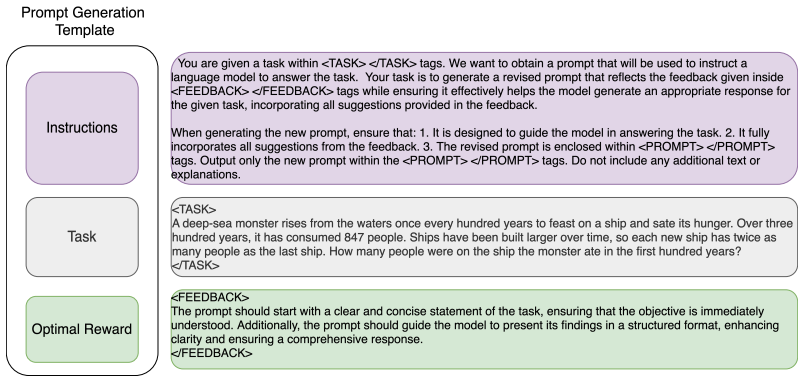
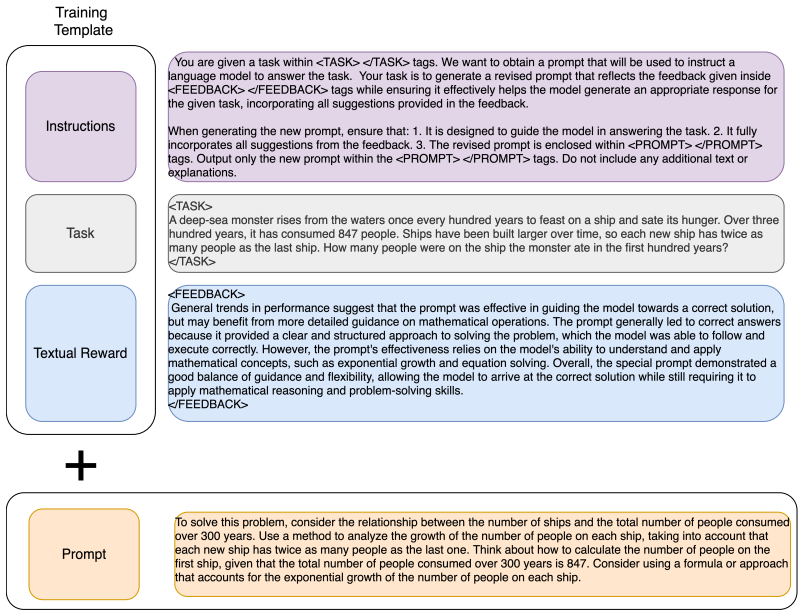
The load-bearing mechanism is the iterative three-step loop. A textual reward is a free-form natural-language critique $t=R_{\text{textual}}(q, p, \hat{y}, y^*)$ produced by a reward model from the question, the prompt, the target model's answer, and the ground truth; the prompt model is trained by supervised fine-tuning to maximize the log-likelihood of a generated prompt given the question and the reward text. The third ingredient is the optimal-textual-reward search: after each fine-tuning round, a train-free text-based optimizer rewrites the conditioning critique so that it tracks the current prompt model's failure modes, preventing overfitting to stale feedback. The work these pieces do together is to convert a flat 0/1 outcome into a content-bearing training distribution that separates one failed prompt from another.
What would settle it
Look inside the training pairs: measure how much of the critique text is predictable from the binary correctness label. If a probe trained only on the 0/1 outcome can reproduce the critiques at near-ceiling accuracy—or if two prompts that both produce wrong answers routinely receive identical critiques—then the textual reward is not higher-resolution than a numerical one, and the central claim fails. A complementary check is to strip the correctness information from the critiques and retrain; if accuracy on GSMHard and MATH drops to the numerical-reward baseline, the signal was mostly the binary echo.
Extended reading notes
Core claim
On the paper's own terms, the central discovery is that textual rewards are not just an inference-time prompt-refinement tool but can be a direct supervision signal for training a prompt generator. The paper formalizes the query-dependent prompting problem as a dual objective: maximize the target model's accuracy by choosing a prompt model, and simultaneously choose the 'optimal textual reward'—the critique that, when fed to the prompt model, yields the most accurate prompts. The experiments support the claim that with this dual loop, a single 8-billion-parameter instruction-tuned model can serve as target, reward model, and prompt model, and the resulting query-level prompts outperform numerical-reward prompt optimizers on GSMHard (31.76%) and MATH (41.37%). The key observation in the motivating example is that two different prompts can both yield a wrong answer—same numerical reward of zero—yet receive different textual critiques, and that difference is what makes the learned signal higher-resolution.
Load-bearing premise
The load-bearing premise is that the free-text critiques actually describe how the prompt led the target model astray, rather than merely echoing whether the answer was right or wrong; if they only paraphrase the correctness label, the textual reward adds no information over a binary score and the claimed advantage collapses.
Editorial extensions
If this is right
- Prompt optimization for math reasoning can be bootstrapped from scratch: no expert-written seed prompts or manually designed prompt pools are needed to reach competitive query-level accuracy.
- The same model family can serve as target, reward generator, and prompt generator, so the pipeline supports a form of self-improvement that does not require a separate stronger model for supervision.
- Because the training data is synthesized on the fly, adapting TRPrompt to a new dataset reduces to supplying questions with ground-truth answers and running the three-step loop.
- The gains concentrate where the target model fails often; on easier benchmarks the text signal is mostly redundant with the binary label, so the method's advantage is diagnostic of task difficulty.
- The iterative reward search is necessary: without re-optimizing the conditioning critique, the prompt model overfits to stale feedback and accuracy declines across rounds.
Reading between the lines
- Editorial inference: the same recipe should transfer to any domain where scalar rewards are flat—code repair, creative writing, or safety judgments—where many bad outputs share the same score but differ in why they fail.
- Editorial inference: if the advantage really comes from the critique's information content, then a controlled probe should show that the textual rewards carry information about the prompt that is not contained in the binary correctness label; a simpler test is to compare TRPrompt against SFT on the same prompt–question pairs conditioned on a one-word proxy for the critique.
- Editorial inference: the paper's same-family design leaves open whether a stronger or weaker reward model changes the gain; a testable extension is to vary the reward model independently of the target model and measure whether the textual signal's usefulness scales with critique quality.
- Editorial inference: replacing the expensive non-parallel reward search with a cheaper, parallelizable critique sampler would test whether the boost comes from searching the reward space or merely from conditioning on language feedback at all.
Editorial analysis
A structured set of objections, weighed in public.
Referee Report
Summary. The paper introduces TRPrompt, an iterative framework for query-dependent prompt optimization in which a prompt model (Llama-3-8B-Instruct) is fine-tuned by supervised learning on synthetic examples that pair a query-dependent prompt with a textual reward (a natural-language critique) generated by a reward model from the same model family. The optimal textual reward is periodically updated with Textgrad (using GPT-4o-mini), and the loop repeats for four iterations. The authors report that TRPrompt outperforms previous query-dependent prompt optimizers (QPO, Prompt-OIRL) and the CoT baseline on GSMHard and MATH, and analyze the contribution of the SFT and reward-search steps through ablations.
Significance. If the central claim is supported, TRPrompt would be a useful step toward using natural-language feedback as a training signal for prompt models, reducing reliance on handcrafted initial prompts and on numerical rewards. The framework is fully automated, does not require prior manual prompt sets, and the paper provides a clear algorithmic description plus detailed appendices on the synthetic data construction and training setup. The main weakness is that the experiments do not isolate the claimed advantage of textual rewards over numerical rewards, because the closest train-free textual-reward baselines are absent from the main comparison and no ablation replaces the textual reward with a binary label under otherwise identical conditions. The reported margins are small and are not accompanied by variance estimates or a statement that baseline numbers were produced under the same target model and evaluation protocol, so the state-of-the-art claim is conditional on additional evidence.
major comments (4)
- [Table 3 and Section 5] The main comparison omits the two most relevant textual-reward baselines, Textgrad and APO. Since the paper's claimed novelty is using textual rewards inside training rather than in a train-free loop, the absence of same-protocol Textgrad and APO results makes it impossible to tell whether the reported gains come from the training mechanism or simply from using a different optimizer on the same reward signal. The authors should report Textgrad and APO run under the same target model (Llama-3-8B-Instruct), same temperature, and same evaluation protocol, or clearly justify why these baselines are not applicable.
- [Algorithm 1 and Eq. (3)] The SFT objective in Eq. (3) trains the prompt model to reproduce its own previously generated prompts, conditioned on the critique of those same prompts. This is essentially self-imitation with relabeling, and the only new information entering the loop across iterations is the Textgrad-updated optimal reward and the critique text. The ablation in Figure 7 shows that removing the Textgrad step degrades performance, but it does not isolate the role of the textual reward versus a numerical reward. A load-bearing control is missing: keep everything identical but replace the textual reward ti with the binary label (correct/incorrect), and compare accuracies. Without this control, the claim that textual rewards provide a higher-resolution training signal than numerical rewards is not demonstrated.
- [Table 3 and Appendix A.2] The reported comparisons against QPO and Prompt-OIRL appear to use published numbers that may come from different target models, decoding settings, and evaluation splits. The paper states the temperature (0.001) and evaluation split for TRPrompt, but it does not state whether the baseline accuracies were produced under the same conditions, nor does it provide error bars or multiple seeds. The margins over the strongest baselines are about +1% on GSMHard and +2% on MATH, which are within the range of typical protocol differences; without matched-protocol baselines and variance estimates, the state-of-the-art claim is not yet supported.
- [Section 5 and Appendix A.1] The effectiveness of the textual reward signal depends on the critiques being contentful and reliable, but the paper provides no quantitative analysis of critique quality. Because the reward model is the same Llama-3-8B-Instruct family as the target model, it is possible that many critiques are hallucinated or mostly echo the binary correctness label; in that case Eq. (3) is effectively a re-labeling of a binary outcome. The authors should include an analysis or a sanity check showing that the textual rewards contain information beyond the correctness label and that this information changes as the prompt model improves.
minor comments (5)
- [Author affiliations] The affiliation for Saibo Geng is spelled 'EFPL' rather than 'EPFL'; this should be corrected.
- [Section 2] The notation 'P=∈ V∞' appears to contain a typo; it should likely be 'P ⊂ V∞'.
- [Abstract and Section 1] The phrase 'is being iteratively improved' in the abstract is grammatically awkward; consider rewriting to 'is iteratively improved'.
- [Throughout] The paper uses both 'Textgrad' and 'TextGrad' in different places; the spelling should be made consistent.
- [Section 5.1 and Appendix A.2] The paper reports only final accuracies and does not report the number of seeds or standard deviations for any of the TRPrompt results; figures such as Figures 4 and 6 would be more informative with error bars or at least a statement about the number of runs.
Circularity Check
No significant circularity: the main evaluation is external and the reward search is validation-based; the self-imitative SFT loop is a methodological concern, not a circular reduction.
full rationale
TRPrompt's central result is evaluated on held-out test sets (appendix A.2: 'All the final results we report in the paper are on the dedicated test set for each dataset'), with the optimal textual reward and the best checkpoint selected on a validation split. The dual objective in Eqs. 1–2 is an alternating optimization over the prompt model and the reward, not a definitional identity. Algorithm 1's SFT step (Eq. 3) does train the prompt model to reproduce its own previously generated prompts conditioned on critiques of those prompts, which is a self-bootstrapping loop and a legitimate experimental limitation: the paper does not ablate a binary-correctness conditioning string, so the specific advantage of textual rewards over numerical rewards is not isolated. However, this is not a circular reduction by construction: test-time prompts are generated for unseen questions, and the reported accuracies are not equal to any fitted training quantity. The paper contains no load-bearing self-citation, no imported uniqueness theorem, and no ansatz smuggled via citation; Textgrad is external prior work used as a component. The acknowledged limitations (reduced gains on easier datasets, high computational cost) also do not indicate circularity. Therefore the derivation is self-contained against external benchmarks, and the main weaknesses are experimental controls rather than circular reasoning.
Assumptions & free parameters
free parameters (7)
- Iteration count K =
4
- Synthetic dataset size per iteration =
800 questions
- SFT epochs =
2
- Learning rate =
2e-5
- LoRA rank and alpha =
r=256, alpha=256
- Generation temperatures =
0.9 prompt generation, 0.001 evaluation and reward generation
- Textgrad iterations =
10
assumptions (5)
- domain assumption Textual rewards are more informative than binary numerical rewards for query-level prompt optimization.
- domain assumption The hand-written reward-model meta-instruction yields accurate critiques from the same-family Llama-3-8B-Instruct model.
- domain assumption Textgrad with GPT-4o-mini on the validation set finds an optimal textual reward that transfers to held-out test questions.
- domain assumption Using the prompt model's own previous prompts as SFT labels in Eq. 3 is a useful training distribution for learning better prompts.
- standard math Answer equality r(y*, yhat)=1{yhat=y*} is a sufficient measure of reasoning correctness.
Cite this review
Pith. "Pith review of TRPrompt: Bootstrapping Query-Aware Prompt Optimization from Textual Rewards." pith.science (2026). https://pith.science/paper/XUPCXYLY
@misc{pith2026250718618,
  author       = {Pith},
  title        = {Pith review of: TRPrompt: Bootstrapping Query-Aware Prompt Optimization from Textual Rewards},
  year         = {2026},
  howpublished = {\url{https://pith.science/paper/XUPCXYLY}},
  note         = {Machine review of arXiv:2507.18618}
}
read the original abstract
Prompt optimization improves the reasoning abilities of large language models (LLMs) without requiring parameter updates to the target model. Following heuristic-based "Think step by step" approaches, the field has evolved in two main directions: while one group of methods uses textual feedback to elicit improved prompts from general-purpose LLMs in a training-free way, a concurrent line of research relies on numerical rewards to train a special prompt model, tailored for providing optimal prompts to the target model. In this paper, we introduce the Textual Reward Prompt framework (TRPrompt), which unifies these approaches by directly incorporating textual feedback into training of the prompt model. Our framework does not require prior dataset collection and is being iteratively improved with the feedback on the generated prompts. When coupled with the capacity of an LLM to internalize the notion of what a "good" prompt is, the high-resolution signal provided by the textual rewards allows us to train a prompt model yielding state-of-the-art query-specific prompts for the problems from the challenging math datasets GSMHard and MATH.
Figures


Figures from the paper (5 more)



Forward citations
Cited by 1 Pith paper
-
Prompt-R1: Collaborative Automatic Prompting Framework via End-to-end Reinforcement Learning
Prompt-R1 is an end-to-end RL framework where a small-scale LLM collaborates with large-scale LLMs by generating prompts, using a dual-constrained reward to optimize correctness and quality, and outperforms baselines ...
Reference graph
Works this paper leans on
-
[1]
Llama 3 model card
AI@Meta. Llama 3 model card. 2024
2024
-
[2]
Training verifiers to solve math word problems
Karl Cobbe, Vineet Kosaraju, Mohammad Bavarian, Mark Chen, Heewoo Jun, Lukasz Kaiser, Matthias Plappert, Jerry Tworek, Jacob Hilton, Reiichiro Nakano, et al. Training verifiers to solve math word problems. arXiv preprint arXiv:2110.14168, 2021
-
[3]
Rlprompt: Optimizing discrete text prompts with reinforce- ment learning
Mingkai Deng, Jianyu Wang, Cheng-Ping Hsieh, Yihan Wang, Han Guo, Tianmin Shu, Meng Song, Eric P Xing, and Zhiting Hu. Rlprompt: Optimizing discrete text prompts with reinforce- ment learning. arXiv preprint arXiv:2205.12548, 2022
arXiv 2022
-
[4]
Pal: Program-aided language models
Luyu Gao, Aman Madaan, Shuyan Zhou, Uri Alon, Pengfei Liu, Yiming Yang, Jamie Callan, and Graham Neubig. Pal: Program-aided language models. arXiv preprint arXiv:2211.10435, 2022
arXiv 2022
-
[5]
Measuring mathematical problem solving with the math dataset
Dan Hendrycks, Collin Burns, Saurav Kadavath, Akul Arora, Steven Basart, Eric Tang, Dawn Song, and Jacob Steinhardt. Measuring mathematical problem solving with the math dataset. NeurIPS, 2021
2021
-
[6]
Large language models are zero-shot reasoners
Takeshi Kojima, Shixiang Shane Gu, Machel Reid, Yutaka Matsuo, and Yusuke Iwasawa. Large language models are zero-shot reasoners. Advances in neural information processing systems , 35:22199–22213, 2022
2022
-
[7]
Qpo: Query-dependent prompt optimization via multi-loop offline reinforcement learning
Yilun Kong, Hangyu Mao, Qi Zhao, Bin Zhang, Jingqing Ruan, Li Shen, Yongzhe Chang, Xueqian Wang, Rui Zhao, and Dacheng Tao. Qpo: Query-dependent prompt optimization via multi-loop offline reinforcement learning. arXiv preprint arXiv:2408.10504, 2024
arXiv 2024
-
[8]
Qintong Li, Leyang Cui, Xueliang Zhao, Lingpeng Kong, and Wei Bi. Gsm-plus: A comprehen- sive benchmark for evaluating the robustness of llms as mathematical problem solvers. arXiv preprint arXiv:2402.19255, 2024
arXiv 2024
Show all 22 references
-
[9]
Test-time preference optimization: On-the-fly alignment via iterative textual feedback
Yafu Li, Xuyang Hu, Xiaoye Qu, Linjie Li, and Yu Cheng. Test-time preference optimization: On-the-fly alignment via iterative textual feedback. arXiv preprint arXiv:2501.12895, 2025
2025 arXiv
-
[10]
Guiding large language models via directional stimulus prompting
Zekun Li, Baolin Peng, Pengcheng He, Michel Galley, Jianfeng Gao, and Xifeng Yan. Guiding large language models via directional stimulus prompting. Advances in Neural Information Processing Systems, 36, 2024
2024
-
[11]
Large language models as evolutionary optimizers
Shengcai Liu, Caishun Chen, Xinghua Qu, Ke Tang, and Yew-Soon Ong. Large language models as evolutionary optimizers. In 2024 IEEE Congress on Evolutionary Computation (CEC), pages 1–8. IEEE, 2024
2024
-
[12]
Gpt-4 technical report
Josh OpenAI, Achiam, Steven Adler, Sandhini Agarwal, Lama Ahmad, Ilge Akkaya, Floren- cia Leoni Aleman, Diogo Almeida, Janko Altenschmidt, Sam Altman, Shyamal Anadkat, et al. Gpt-4 technical report. arXiv preprint arXiv:2303.08774, 2023. 10
2023 arXiv
-
[13]
Training language models to follow instructions with human feedback
Long Ouyang, Jeffrey Wu, Xu Jiang, Diogo Almeida, Carroll Wainwright, Pamela Mishkin, Chong Zhang, Sandhini Agarwal, Katarina Slama, Alex Ray, et al. Training language models to follow instructions with human feedback. Advances in neural information processing systems , 35:277...
2022
-
[14]
gradient descent
Reid Pryzant, Dan Iter, Jerry Li, Yin Tat Lee, Chenguang Zhu, and Michael Zeng. Automatic prompt optimization with" gradient descent" and beam search.arXiv preprint arXiv:2305.03495, 2023
2023 arXiv
-
[15]
Learning performance-improving code edits
Alexander Shypula, Aman Madaan, Yimeng Zeng, Uri Alon, Jacob Gardner, Milad Hashemi, Graham Neubig, Parthasarathy Ranganathan, Osbert Bastani, and Amir Yazdanbakhsh. Learning performance-improving code edits. arXiv preprint arXiv:2302.07867, 2023
2023 arXiv
-
[16]
Query-dependent prompt evaluation and optimization with offline inverse rl
Hao Sun, Alihan Hüyük, and Mihaela van der Schaar. Query-dependent prompt evaluation and optimization with offline inverse rl. In The Twelfth International Conference on Learning Representations, 2023
2023
-
[17]
Chain-of-thought prompting elicits reasoning in large language models
Jason Wei, Xuezhi Wang, Dale Schuurmans, Maarten Bosma, Fei Xia, Ed Chi, Quoc V Le, Denny Zhou, et al. Chain-of-thought prompting elicits reasoning in large language models. Advances in neural information processing systems , 35:24824–24837, 2022
2022
-
[18]
Improving reward models with synthetic critiques
Zihuiwen Ye, Fraser Greenlee-Scott, Max Bartolo, Phil Blunsom, Jon Ander Campos, and Matthias Gallé. Improving reward models with synthetic critiques. arXiv preprint arXiv:2405.20850, 2024
2024 arXiv
-
[19]
differentiation
Mert Yuksekgonul, Federico Bianchi, Joseph Boen, Sheng Liu, Zhi Huang, Carlos Guestrin, and James Zou. Textgrad: Automatic" differentiation" via text. arXiv preprint arXiv:2406.07496, 2024
2024 arXiv
-
[20]
Gonzalez
Tianjun Zhang, Fangchen Liu, Justin Wong, Pieter Abbeel, and Joseph E. Gonzalez. The wisdom of hindsight makes language models better instruction followers. In Proceedings of the 40th International Conference on Machine Learning , ICML’23. JMLR.org, 2023
2023
-
[21]
Tempera: Test-time prompting via reinforcement learning
Tianjun Zhang, Xuezhi Wang, Denny Zhou, Dale Schuurmans, and Joseph E Gonzalez. Tempera: Test-time prompting via reinforcement learning. arXiv preprint arXiv:2211.11890, 2022
2022 arXiv
-
[22]
Large language models are human-level prompt engineers
Yongchao Zhou, Andrei Ioan Muresanu, Ziwen Han, Keiran Paster, Silviu Pitis, Harris Chan, and Jimmy Ba. Large language models are human-level prompt engineers. arXiv preprint arXiv:2211.01910, 2022. A Technical Appendices and Supplementary Material A.1 Synthetic Dataset Creati...
2022 arXiv
Reviewed August 6, 2026 · model on record in the stance chip above.
Discussion (0). Sign in to comment.