REVIEW 3 major objections 5 minor 12 references
Bayesian Deep Gaussian Processes for Correlated Functional Data: A Case Study in Cosmological Matter Power Spectra
T0 review · 3 major / 5 minor · reviewed 2026-08-15 · deepseek-v4-flash
Pith's one-line read A Bayesian deep Gaussian process combines perturbation theory and simulation outputs to estimate the universe's matter power spectrum with quantified uncertainty, and its emulator matches the leading Cosmic Emu benchmark.
desk verdict Solid DGP extension for correlated functional outputs with a credible CAMB validation, but the headline Mira-Titan comparison with Cosmic Emu is undermined by tuning α on the held-out cosmologies and comparing against method-specific in-sample means. read the letter →
The pith
A machine-rendered reading of the paper's core claim, the machinery that carries it, and where it could break.
The reading
What carries the argument
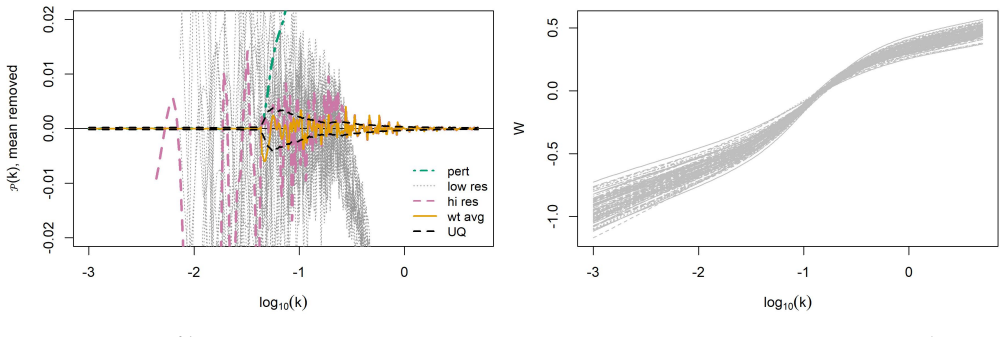
The central object is the dense correlated-noise covariance $\Sigma_\varepsilon = (\Lambda_p + \Sigma_\ell^{-1} + \Lambda_h)^{-1}$, where $\Lambda_p$ and $\Lambda_h$ are diagonal precision matrices encoding which wavenumbers each data source can be trusted and $\Sigma_\ell$ is a Matérn covariance estimated from the low-resolution runs. This matrix lets the model treat the sixteen low-resolution curves and the high-resolution curve as smooth correlated functional realizations rather than independent points. It is combined with a deep Gaussian process prior on the spectrum: a latent monotonic warp layer $W$ warps the wavenumber inputs, so the outer Matérn covariance $\Sigma_S(W)$ is evaluated at warped locations and can stretch or compress correlation structure across $k$. The closing identity is the integrated likelihood $\bar{Y}|W \sim \mathcal{GP}(0,\Sigma_S(W)+\Sigma_\varepsilon)$, which permits elliptical slice sampling for $W$ and yields a closed-form conditional posterior for $S$.
What would settle it
Take a cosmology where an independent, larger simulation gives the true infinite-volume spectrum, generate many independent batches of the low- and high-resolution runs at that cosmology, and count how often the DGP.FCO 95% credible intervals contain the truth at each wavenumber; if the rate is far from 95%, the assumed error structure is wrong.
Extended reading notes
Core claim
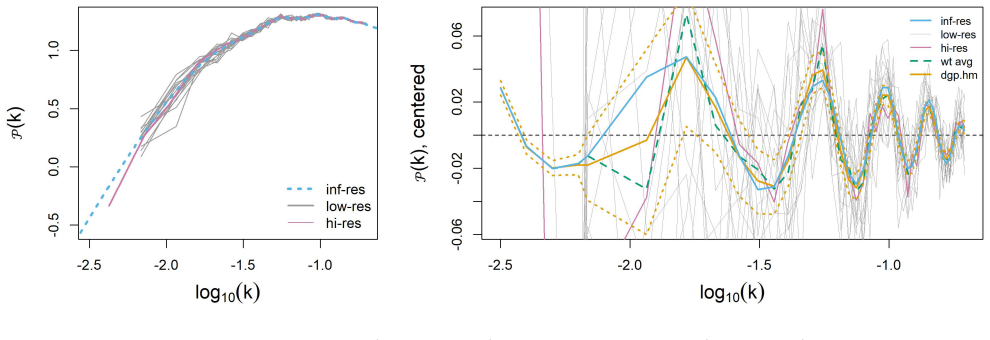
For each cosmology, the paper models the precision-weighted average of the 18 spectra as a Gaussian process centered on the unknown infinite-volume spectrum $S$. The noise covariance is dense: it inverts the sum of a Matérn covariance estimated from the low-resolution runs and diagonal precisions encoding which wavenumbers perturbation theory and the high-resolution run can be trusted. $S$ itself is given a deep Gaussian process prior through a latent monotonic warp, letting the reconstructed spectrum be smooth where dynamics are linear and more variable where baryonic acoustic oscillations appear. Conditioning on the data yields a Gaussian posterior for $S$ in closed form, so posterior means and 95% credible intervals are obtained by direct sampling. On CAMB data, where the truth is known, this posterior mean cuts MSE roughly in half relative to the weighted average and adds a further 30% reduction over a shallow GP; on Mira-Titan held-out cosmologies, the principal-component emulator built on these posterior means has lower MSE than Cosmic Emu at 88% of wavenumbers.
Load-bearing premise
The whole calculation rests on treating one combined average of the 18 simulation curves, together with a pre-chosen model of how errors in those curves relate to one another, as containing all the useful information about the true spectrum; if that combination discards information or gets the error relationships wrong, the uncertainty intervals will not mean what they claim.
Editorial extensions
If this is right
- With the dense correlated-noise covariance, the posterior mean of the spectrum outperforms the weighted average and a shallow GP on CAMB truth, so both the smoothing step and the deep layer earn their place in the pipeline.
- The PC-GP emulator trained on DGP.FCO posterior means predicts held-out Mira-Titan cosmologies with lower MSE than Cosmic Emu at 88% of wavenumbers, and matches it elsewhere.
- The same fitted spectra can be reused as training data for any emulator that maps cosmological parameters to functional outputs, not only this paper's principal-component model.
- Within each cosmology the model produces a closed-form Gaussian posterior for the spectrum, so credible intervals and posterior draws are cheap to obtain after the MCMC for the warp is done.
- Nonstationarity is handled by a latent monotonic warp rather than by changing the kernel family, which generalizes to other smooth functional responses with scale-dependent variability.
Reading between the lines
- A direct testable extension would be to run DGP.FCO on many independent simulation seeds at a single cosmology and check empirical coverage of the credible intervals; the paper's validation is mostly against synthetic and CAMB truth, not repeated Mira-Titan runs.
- Because the covariance $\Sigma_\varepsilon$ is fixed before sampling rather than learned jointly, there may be room to estimate its Matérn parameters inside the MCMC, which would fold uncertainty about the correlation structure into the final intervals.
- The per-cosmology fitting strategy ignores borrowing of strength across cosmologies at the spectrum-estimation stage; a hierarchical version that shares warp parameters or covariance parameters across cosmologies could improve predictions at held-out points with few neighbors.
- The PC emulator uses only the posterior means, discarding the posterior covariance of each fitted spectrum; feeding posterior draws through the PC decomposition would produce a full predictive distribution for unobserved cosmologies rather than a point prediction.
Signed reviews
Editorial analysis
A structured set of objections, weighed in public.
Referee Report
Summary. The paper proposes a Bayesian deep Gaussian process model for correlated functional data, called DGP.FCO, and applies it to cosmological matter power spectra. For a given cosmology, the model synthesizes perturbation-theory spectra, sixteen low-resolution simulations, and one high-resolution simulation into an estimate of the infinite-volume power spectrum P∞(k) with quantified uncertainty. The estimation is validated on synthetic data and on CAMB, where a true infinite-resolution spectrum is available. The paper then uses the estimated posterior means for training cosmologies to build a principal-component Gaussian process emulator that predicts spectra at unobserved cosmologies, comparing its Mira-Titan predictions with the Cosmic Emu emulator. The paper claims improved estimation and uncertainty quantification over a weighted average and a standard GP, and states that DGP.FCO competes favorably with Cosmic Emu on held-out cosmologies.
Significance. If the central claims hold, the paper makes a useful contribution to nonstationary functional emulation with uncertainty quantification for multi-fidelity cosmological outputs. The manuscript has notable strengths: the closed-form posterior derivations in Appendices A and B are sound; the code, data, and R package are publicly available; and the CAMB experiment provides an external ground truth, showing that DGP.FCO reduces mean MSE from 6.7e-5 (weighted average) to 4.3e-5 (standard GP with correlated functional outputs) to 3.0e-5 (DGP.FCO) across 32 cosmologies. However, the headline comparative claim against Cosmic Emu is not supported as presented because the comparison in Section 4.3 uses test-data leakage in the tuning of the kernel exponent and scores predictions against method-specific in-sample means rather than a common target. The core estimation contribution, validated on CAMB, is not affected by these concerns.
major comments (3)
- [Section 4.1] The kernel exponent α=1.95 is selected by minimizing MSE across the six held-out Mira-Titan cosmologies, and those same six cosmologies are used in Section 4.3 to claim favorable comparison with Cosmic Emu. Since Cosmic Emu's kernel settings are not re-tuned on these hold-outs, this leaks test information into DGP.FCO+PC and biases the comparison in its favor. This directly undermines the claim that DGP.FCO 'competes favorably with the state-of-the-art Cosmic Emu model' (Section 4.3, final paragraph). The comparison should be rerun with α chosen without touching the hold-outs, for example by cross-validation within the 111 training cosmologies or by fixing α to a standard value such as 2.
- [Section 4.3, Figures 12-13] The Mira-Titan out-of-sample predictions are evaluated against each method's own in-sample posterior mean: DGP.FCO+PC predictions are centered by the in-sample DGP.FCO posterior mean, and Cosmic Emu predictions by the in-sample DPC posterior mean. MSE relative to two different, method-specific references does not measure accuracy for the common target P∞(k), and a smoother in-sample estimate will automatically appear closer to a smooth out-of-sample prediction. The paper itself acknowledges in this section that these in-sample spectra 'are not formal truths.' Consequently, the '88% of k values' statistic in Figure 13 does not establish that DGP.FCO predicts the infinite-volume spectrum better than Cosmic Emu. To support the comparative claim, both methods should be scored against a common target, such as the high-resolution run on the wavenumber range where it is unbiased, or the CAMB external-validation protocol should be used as the primary evidence.
- [Section 3.5] The Mira-Titan uncertainty quantification relies on Σε = (Λp + Σℓ^{-1} + Λh)^{-1}, where Σℓ is a Matérn covariance estimated separately from the low-resolution runs and referenced to the Walsh (2023) thesis. Unlike the CAMB experiment in Section 3.4, where Σε is diagonal and an external truth exists, the correlated-noise case in Mira-Titan has no ground truth to check calibration, and the hyperparameters of Σε are fixed rather than inferred within the Bayesian model. Section 5 itself lists estimation of Σε hyperparameters within the sampling scheme as 'an area for further investigation.' The credible intervals for Mira-Titan should therefore be described as conditional on an externally estimated Σε, and the UQ claims for the dense-covariance setting should not be stated as validated by the CAMB experiment, which uses a different (diagonal) noise structure.
minor comments (5)
- [Appendix A] In the integrated-likelihood derivation, the displayed exponential contains 'YT i Σ−1 ε Y' and 'Σ−1 ε Y' where the subscript i on Y is missing in two places; this should be corrected to Yi for clarity.
- [Reference list] The reference for Higdon et al. (2010) includes a stray leading number '749' in the title field; it should be removed.
- [Figure 13 caption] The caption reads 'MSE across each of the 6 hold out cosmologies'; it should be 'hold-out cosmologies'.
- [Section 3.5] The choice of Σℓ and the statement that a Matérn covariance trained on low-resolution runs 'performs the best' is delegated to Walsh (2023); since this choice is load-bearing for the Mira-Titan estimation, the manuscript should at least summarize the candidate set and selection criterion used to reach that conclusion.
- [Section 4.1] The phrase 'with theGPfitR-package' should be formatted as 'with the GPfit R package' for readability.
Circularity Check
The Mira-Titan emulator comparison is partially circular: the kernel exponent is tuned on the six held-out cosmologies, and each method is scored against its own in-sample posterior mean, so the 'competes favorably with Cosmic Emu' claim is not an independent out-of-sample result.
-
fitted input called prediction
[Section 4.1 (kernel exponent selection for the Mira-Titan PC emulator), then used as the out-of-sample benchmark in Section 4.3]
"We fix α = 1.95, selected by minimizing MSE across the six held-out Mira-Titan cosmologies over a grid of candidate values."
The same six 'held-out' Mira-Titan cosmologies are the N = 6 test cosmologies on which Section 4.3 reports the out-of-sample MSE comparison with Cosmic Emu, including the '88% of k values' statistic. Thus α, a smoothness hyperparameter of the power-exponential kernel used for the PC-weight GPs, is fitted to the test set before the test-set error is reported. The reported 'out-of-sample' MSE for DGP.FCO + PC is therefore partly an in-sample training error with respect to α, while Cosmic Emu is not given the same test-set tuning. The headline claim that DGP.FCO 'competes favorably with the state-of-the-art Cosmic Emu model' is consequently derived from a comparison in which one competitor's hyperparameter was selected to minimize exactly the error metric being reported.
-
self definitional
[Section 4.3, Mira-Titan prediction benchmark and Figure 13]
"Although these estimated “in-sample” spectra for each method are not formal “truths,” we find them to be useful benchmarks for our “out-of-sample” predictions. ... For each method, predictions are centered by their respective in-sample posterior means: DGP.FCO + PC predictions are centered by the in-sample DGP.FCO posterior mean, and Cosmic Emu predictions are centered by the in-sample DPC posterior mean."
Accuracy is measured against a target that is defined by each method's own posterior mean, rather than against the shared infinite-volume spectrum P∞(k) or any common observable. Since the error metric is 'distance from my own smoother,' the comparison in Figure 13 does not compare predictive accuracy across methods; it compares each prediction to a method-specific benchmark. A smoother in-sample estimate will automatically appear closer to smooth out-of-sample predictions, so 'MSE is lower at 88% of k values' does not establish that DGP.FCO predicts the infinite-volume spectrum better than Cosmic Emu. The claimed favorable comparison reduces, by construction, to agreement with a self-defined reference.
full rationale
The core estimation contribution of the paper is not circular: Section 3.3 uses a simulation study with known truth, and Section 3.4 validates DGP.FCO against the CAMB infinite-resolution spectrum y_c, an external ground truth that is not an input to the model. Those sections support the claim that the Bayesian deep GP with functional correlated outputs recovers a smooth spectrum with sensible UQ. The circularity is confined to the Mira-Titan emulator comparison in Sections 4.1 and 4.3, which supports the headline 'competes favorably with Cosmic Emu.' Two protocol choices make that comparison partially circular by construction: (1) the kernel exponent α is selected by minimizing MSE on the same six held-out cosmologies later used for evaluation, so the reported out-of-sample error is partly in-sample for DGP.FCO + PC while Cosmic Emu is not re-tuned; and (2) both methods are scored against their own in-sample posterior means, so the MSE comparison has no common target and rewards each method for matching its own smoother. The paper itself acknowledges these in-sample spectra 'are not formal truths,' yet the comparative headline is drawn from that exercise. The Walsh (2023) self-citation for the Σ_ℓ covariance choice is a minor modeling deference but is not a uniqueness theorem and does not force the main result; I do not count it as load-bearing circularity. Overall, the central estimation method is independently validated, but the headline comparative claim rests on partially circular evaluation, giving a score of 6 rather than higher.
Assumptions & free parameters
free parameters (9)
- Precision multiplier c between low- and high-resolution spectra =
3.73
- Wavenumber-specific precisions p_1,...,p_n =
Estimated
- Kernel exponent α in PC emulator =
1.95
- Number of principal components p_η =
10
- Matérn smoothness ν for ΣS and ΣW =
2.5
- Scale parameters of ΣS and ΣW =
1
- Lengthscales θS, θW =
Estimated by MCMC
- Parameters of low-resolution noise covariance Σℓ =
Estimated from low-res runs
- Anchor precision Λ_p =
10^8
assumptions (9)
- domain assumption Ȳ|S ~ GP(S, Σε)
- domain assumption S|W ~ GP(0, ΣS(W)) with Matérn kernel
- domain assumption W ~ monoGP(0, ΣW(X))
- domain assumption Perturbation theory spectrum is unbiased for k<0.04 and enforced to ~3 decimal places via Λ_p=10^8
- domain assumption Low-resolution spectra are unbiased for 0.04≤k≤0.25 and high-resolution for 0.04≤k≤5
- domain assumption The weighted average Ȳ is a sufficient summary of the 18 spectra for inference on S
- domain assumption Matérn covariance for Σε captures spatial dependence across wavenumbers
- domain assumption Independence of measurement errors across data types after precision weighting
- domain assumption PCA truncation at p_η=10 adequately represents the functional output space
Cite this review
Pith. "Pith review of Bayesian Deep Gaussian Processes for Correlated Functional Data: A Case Study in Cosmological Matter Power Spectra." pith.science (2026). https://pith.science/paper/A5TJXTRG
@misc{pith2026250718683,
  author       = {Pith},
  title        = {Pith review of: Bayesian Deep Gaussian Processes for Correlated Functional Data: A Case Study in Cosmological Matter Power Spectra},
  year         = {2026},
  howpublished = {\url{https://pith.science/paper/A5TJXTRG}},
  note         = {Machine review of arXiv:2507.18683}
}
read the original abstract
Understanding the structure of our universe and the distribution of matter is an area of active research. As cosmological surveys grow in complexity, the development of emulators to efficiently and effectively predict matter power spectra is essential. We are particularly motivated by the Mira-Titan Universe simulation suite that, for a specified cosmological parameterization (termed a "cosmology"), provides multiple response curves of various fidelities, including correlated functional realizations. Our objective is two-fold. First, we estimate the underlying matter power spectra, with appropriate uncertainty quantification (UQ), from all of the provided curves. To this end, we propose a novel Bayesian deep Gaussian process (DGP) hierarchical model which synthesizes all the simulation information to estimate the underlying matter power spectra while providing effective UQ. Our model extends previous work on Bayesian DGPs from scalar responses to correlated functional outputs. Second, we leverage our predicted power spectra from various cosmologies in order to accurately predict the entire matter power spectra for an unobserved cosmology. For this task, we use basis function representations of the functional spectra to train a separate Gaussian process emulator. Our method performs well in synthetic exercises and against the benchmark cosmological emulator (Cosmic Emu).
Figures


Figures from the paper (11 more)





Reference graph
Works this paper leans on
-
[1]
Agarwal, S., Abdalla, F. B., Feldman, H. A., Lahav, O., and Thomas, S. A. (2014). “pkann – II. A non- linear matter power spectrum interpolator developed using artificial neural networks.”Monthly Notices of the Royal Astronomical Society, 439, 2, 2102–2121. Aghanim, N., Akrami, Y., Ashdown, M., Aumont, J., Baccigalupi, C., Ballardini, M., Banday, A. J., B...
work page 2014
-
[12]
Vecchia-approximated deep Gaussian processes for computer experiments
Springer. Sauer, A., Cooper, A., and Gramacy, R. B. (2023a). “Vecchia-approximated deep Gaussian processes for computer experiments.”Journal of Computational and Graphical Statistics, 32, 3, 824–837. Sauer, A., Gramacy, R. B., and Higdon, D. (2023b). “Active learning for deep Gaussian process surrogates.” Technometrics, 65, 1, 4–18. Schabenberger, O. and ...
work page 2023
-
[15]
Gattiker, J., Klein, N., Hutchings, G., and Lawrence, E. (2020). “lanl/SEPIA: v1.1.” Gneiting, T. and Raftery, A. E. (2007). “Strictly Proper Scoring Rules, Prediction, and Estimation.” Journal of the American Statistical Association, 102, 477, 359–378. Gramacy, R. B. (2020).Surrogates: Gaussian process modeling, design, and optimization for the applied s...
work page 2020
-
[17]
Bayesian "Deep" Process Convolutions: An Application in Cosmology
21 Lewis, A. and Challinor, A. (2011). “CAMB: Code for Anisotropies in the Microwave Background.” Astrophysics Source Code Library, record ascl:1102.026. MacDonald, B., Ranjan, P., and Chipman, H. (2015). “GPfit: An R Package for Fitting a Gaussian Process Model to Deterministic Simulator Outputs.”Journal of Statistical Software, 64, 12, 1–23. Micka¨ el B...
work page Pith review arXiv 2011
-
[26]
Lawrence, E., Heitmann, K., White, M., Higdon, D., Wagner, C., Habib, S., and Williams, B. (2010). “The coyote universe. III. Simulation suite and precision emulator for the nonlinear matter power spectrum.” The Astrophysical Journal, 713, 2,
work page 2010
-
[29]
Flowing with time: a new approach to non-linear cosmological perturbations
Pietroni, M. (2008). “Flowing with time: a new approach to non-linear cosmological perturbations.” Journal of Cosmology and Astroparticle Physics, 2008, 10,
work page 2008
-
[36]
Santner, T. J., Williams, B. J., Notz, W. I., and Williams, B. J. (2003).The design and analysis of computer experiments, vol
work page 2003
-
[65]
hetGP: Heteroskedastic Gaussian Process Modeling and Sequential Design in R
Binois, M. and Gramacy, R. B. (2021). “hetGP: Heteroskedastic Gaussian Process Modeling and Sequential Design in R.”Journal of Statistical Software, 98, 13, 1–44. Booth, A. S. (2024).deepgp: Bayesian Deep Gaussian Processes using MCMC. R package version 1.1.3. Damianou, A. and Lawrence, N. D. (2013). “Deep gaussian processes.” InArtificial intelligence an...
work page 2021
Show all 12 references
-
[69]
How deep are deep Gaussian processes?
Dodelson, S. and Schmidt, F. (2020).Modern cosmology. Academic press. Dunlop, M. M., Girolami, M. A., Stuart, A. M., and Teckentrup, A. L. (2018). “How deep are deep Gaussian processes?”Journal of Machine Learning Research, 19, 54, 1–46. 20 Euclid Collaboration, Knabenhans, M....
2020
-
[108]
The coyote universe. I. Precision determination of the nonlinear matter power spectrum
Heitmann, K., White, M., Wagner, C., Habib, S., and Higdon, D. (2010). “The coyote universe. I. Precision determination of the nonlinear matter power spectrum.”The Astrophysical Journal, 715, 1, 104–121. Higdon, D., Gattiker, J., Williams, B., and Rightley, M. (2008). “Compute...
2010
-
[580]
CosmoDC2: A synthetic sky catalog for dark energy science with LSST
Springer. Korytov, D., Hearin, A., Kovacs, E., Larsen, P., Rangel, E., Hollowed, J., Benson, A. J., Heitmann, K., Mao, Y.-Y., Bahmanyar, A., et al. (2019). “CosmoDC2: A synthetic sky catalog for dark energy science with LSST.”The Astrophysical Journal Supplement Series, 245, 2,
2019
-
[1322]
Non-linear power spectrum including massive neutrinos: the time-RG flow approach
Lesgourgues, J., Matarrese, S., Pietroni, M., and Riotto, A. (2009). “Non-linear power spectrum including massive neutrinos: the time-RG flow approach.”Journal of Cosmology and Astroparticle Physics, 2009, 06,
2009
Reviewed August 15, 2026 · model on record in the stance chip above.
Discussion (0). Continue with ORCID to comment.