REVIEW 4 major objections 6 minor 41 references
Observation of Magnetic Devil's Staircase-Like Behavior in Quasiperiodic Qubit Lattices
T0 review · 4 major / 6 minor · reviewed 2026-08-06 · deepseek-v4-flash
Pith's one-line read The paper claims that devil's staircase-like magnetization steps, previously tied to periodic magnetic order, emerge in quasiperiodic qubit lattices with only short-range antiferromagnetic couplings, as observed on a quantum annealing…
desk verdict Honest and clean QA-on-quasicrystal experiment, but the devil's staircase claim rests on a generic property of finite Ising models, not on anything quasiperiodicity-specific. read the letter →
The pith
A machine-rendered reading of the paper's core claim, the machinery that carries it, and where it could break.
The reading
What carries the argument
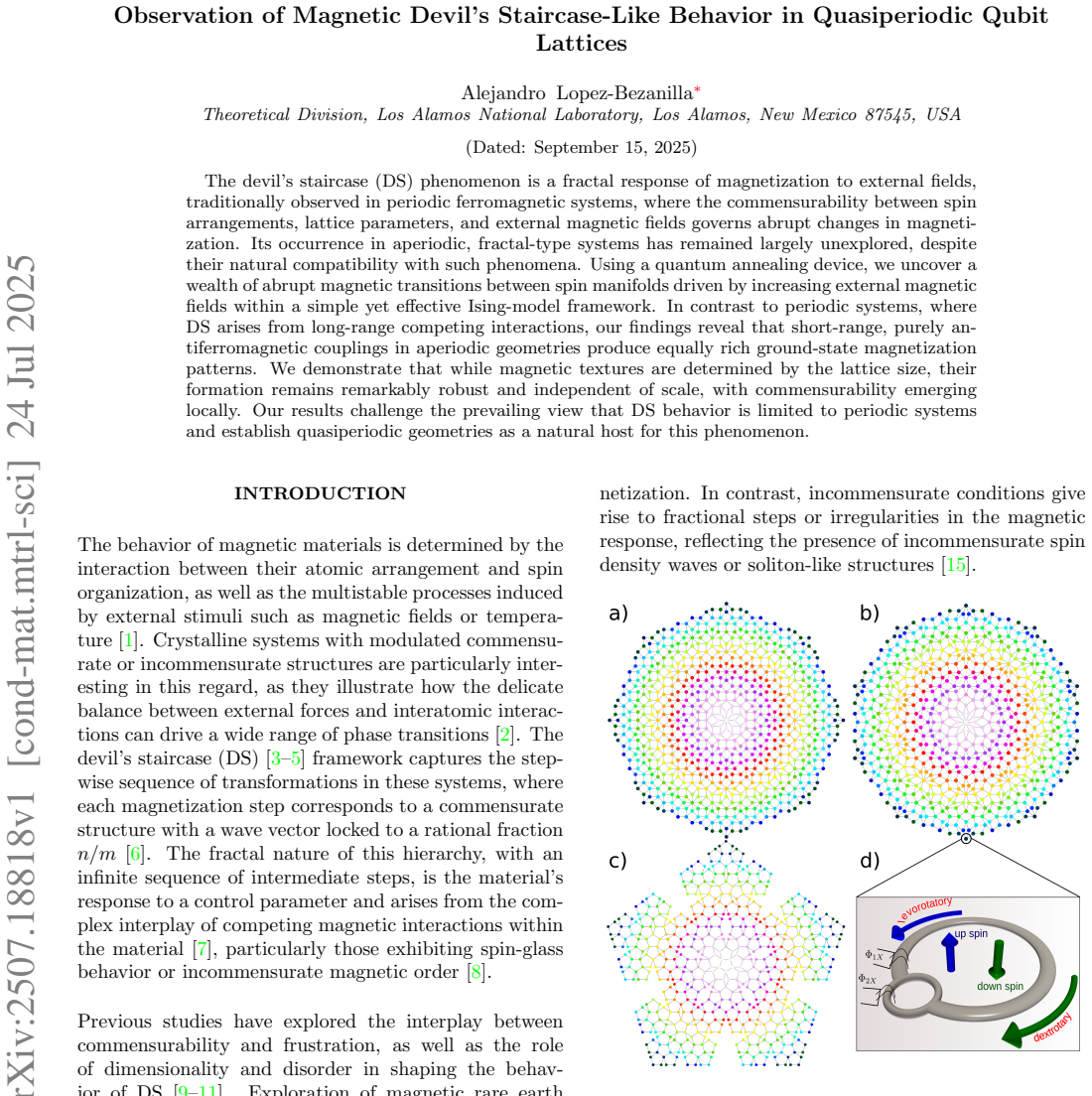
The central objects are finite realizations of three quasiperiodic lattices—two Ammann-Beenker tilings (labeled AB17 and AB16) and a pentaplexity tiling (PPL)—with nodes representing Ising spins $\sigma_i^z = \pm 1$ coupled by nearest-neighbor antiferromagnetic interactions $J_{ij}$ and subject to a uniform external field $h$. The argument is carried by the magnetization curve $\langle m\rangle(h)$ obtained from ensemble averages over spin configurations sampled by a quantum annealer, along with its derivative, the susceptibility $\chi(h)$. Peaks in $\chi$ are taken as signatures of abrupt transitions between discrete spin manifolds, and the persistence of step features under lattice growth is taken as evidence of scale-free, self-similar behavior. The paper also uses graph automorphism groups to identify equivalent nodes and refine the annealing parameters, which allows reproducible sampling.
What would settle it
Perform exhaustive ground-state enumeration or exact diagonalization on the smallest AB17, AB16, and PPL lattices at the same field values and compare the resulting magnetization curves to the annealer output; any mismatch in step positions or heights would show the staircase to be a sampling artifact. Alternatively, run the same protocol on a random lattice with identical degree distribution and antiferromagnetic couplings; if equally sharp steps appear, quasiperiodic order is not the cause.
Extended reading notes
Core claim
Using a quantum annealing device to sample low-energy configurations of a short-range antiferromagnetic Ising model, the paper finds that the average magnetization of the quasiperiodic lattices rises monotonically but in discrete steps as the external field $h$ increases, with peaks in the susceptibility $\chi = d\langle m\rangle/dh$ marking rapid spin rearrangements. The stepwise structure persists when the lattice is enlarged, with new steps appearing at different field values, which the paper interprets as finite-size evidence of a self-similar, fractal-like hierarchy. Detailed qubit-resolved maps show regions where local magnetization jumps sharply between field values, including frustrated zones of near-zero magnetization that act as boundaries between spin manifolds. The paper argues that the plateaus are not tied to rational fractions of saturation magnetization, as in classical devil's staircases, but arise from local commensurability conditions imposed by the aperiodic geometry, frustration, and boundary effects.
Load-bearing premise
The central premise is that the measured magnetization steps are the true ground-state responses of the Ising model, not annealing artifacts, and that their pattern reflects an emergent fractal hierarchy rather than a generic finite-size staircase.
Editorial extensions
If this is right
- Quasiperiodic magnetic materials, not just periodic crystals, can host devil's staircase-like responses, broadening the search space for materials with tunable stepwise magnetization.
- Short-range nearest-neighbor antiferromagnetic couplings suffice to produce staircases; long-range competing interactions are not required when the lattice geometry is aperiodic.
- The step positions and spin textures depend on lattice size, but the qualitative staircase structure persists as the lattice grows, suggesting that finite quasiperiodic systems capture a partial, truncated version of an infinite fractal hierarchy.
- The plateaus in these systems do not correspond to rational fractions of saturation magnetization, so the staircase signature must be identified by its discrete transitions and self-similarity rather than by fractional step heights.
- Field-tunable transitions between distinct spin manifolds in quasiperiodic geometries could be exploited for magnetic memory or sensing elements where different magnetization plateaus encode information.
Reading between the lines
- If the staircase is robust, one testable extension is to compute the scaling of the number of steps with lattice size; a true devil's staircase would show step count growing without bound, whereas a merely finite-size effect would saturate.
- The same mechanism might be checked on other aperiodic tilings (for instance Penrose-like or random substitution tilings) to see whether quasiperiodic order is essential or any highly frustrated finite graph produces similar stepwise magnetization.
- The near-zero-magnetization regions the paper identifies as boundaries between spin manifolds resemble the degenerate configurations of spin ice; a direct comparison of local correlation functions could reveal whether the two families share an underlying ice-rule-like constraint.
- A classical simulated-annealing baseline at the same lattice sizes and field steps would separate quantum-annealing sampling artifacts from genuine ground-state physics; the paper does not provide such a comparison.
Editorial analysis
A structured set of objections, weighed in public.
Referee Report
Summary. The paper reports stepwise magnetization curves obtained on a D-Wave quantum annealer for Ising antiferromagnets defined on quasiperiodic graphs (Ammann-Beenker and pentaplexity tilings). The authors interpret these steps as 'devil's staircase-like' behavior, claim robustness across system sizes, and argue that short-range antiferromagnetic couplings on aperiodic geometries suffice to produce such behavior, thereby challenging the view that devil's staircases require periodic systems with long-range competing interactions. The central evidence is the average magnetization as a function of applied field for three lattice geometries, plus real-space magnetization maps and a size-dependence study.
Significance. If the central claim were established, the paper would offer an interesting experimental platform—a quantum annealer implementing frustration on quasiperiodic graphs—and would broaden the notion of devil's-staircase phenomena. The work leverages a sizable programmable quantum processor (up to 705 logical qubits), uses automorphism-based shimming, and reports a qualitative link between aperiodic geometry and complex magnetization responses. However, the significance is contingent on showing that the observed stepwise response is genuinely special to quasiperiodicity, rather than a generic feature of any finite Ising model with a linear field term. The paper does not provide such a demonstration, and its own qualifications (no rational fractions, finite-size-limited steps, no structural commensurability) undercut the 'devil's staircase' label.
major comments (4)
- [Results and Discussion, Fig. 2 and Eq. (1)] The stepwise structure of the magnetization curves is not evidence of quasiperiodicity-specific behavior. For any finite Ising Hamiltonian with a linear field term, the ground-state energy is the lower envelope of finitely many linear functions of h, so the ground-state magnetization is piecewise constant. The paper provides no null-model comparison (e.g., random graphs with the same degree distribution, periodic lattices of comparable size, or diluted lattices) and no quantitative characterization of the step widths or step positions. Consequently, the observation of plateaus in Fig. 2 cannot distinguish quasiperiodic geometry from generic finite-system effects.
- [Results and Discussion, Fig. 2] The magnetization curves are presented as exact ground-state responses, but the manuscript reports no error bars, no number of annealer samples M per field value, no convergence metrics, and no comparison with exact low-energy states for small lattices. Because the quantum annealer returns samples that may include excited states, the steps in ⟨m⟩ could be artifacts of incomplete sampling or annealing dynamics rather than true ground-state transitions. The paper should at least validate the annealer by comparing against brute-force solutions for a subset of small lattice patches or by reporting the fraction of samples in the lowest found energy band.
- [Figure 4 and the paragraph beginning 'Furthermore, the finite size imposes a natural limit'] The self-similarity claim is based on visual inspection of magnetization curves for different lattice patches, but no quantitative scaling analysis is provided. There is no plateau-width distribution, no step-count versus system-size scaling, no comparison of nested generations of the same tiling, and no collapse of the susceptibility. Since the system sizes differ (705, 641, 560 nodes) and the 'larger portions' are not necessarily nested, the assertion that 'fractal-like, self-similar structures persists' is unsupported. Without a quantitative measure, the claim of scale-invariance cannot be evaluated.
- [Paragraph 'The use of the term “DS-like behavior” is justified'] The paper explicitly concedes that the plateaus 'do not exhibit an obvious correspondence to such fractional values,' that 'commensurability here does not strictly arise from intrinsic structural locking,' and that finite size limits the number of steps. These are precisely the features that define a devil's staircase in the classical literature. Calling the observed stepwise curves 'DS-like' on the basis of 'stepwise structure, discrete transitions, and sensitivity to control parameters' reduces the term to a generic property of any finite Ising model. The opening and concluding claims that quasiperiodic geometries are a 'natural host' for devil's-staircase behavior are therefore not supported by the evidence presented.
minor comments (6)
- [Eq. (1) and Fig. 2] The relation between the longitudinal field hi in the Hamiltonian and the plotted external field h is never defined; the paper should state whether hi = h for all i and how the field is swept, including the field step size and range.
- [Results and Discussion] The number of samples M used to compute ⟨mi⟩ is not specified anywhere; this is essential for assessing the statistical error of the magnetization and susceptibility curves.
- [Quasiperiodic Geometries and Materials] The phrase 'automorphism groups with a total number of 55, 42, and 60' is ambiguous—whether these are the number of equivalence classes, the sizes of the automorphism groups, or something else should be clarified.
- [Fig. 2 caption] The caption contains a stray 'd d' before the panel labels; the notation for identifying the four panels in each subfigure should be corrected.
- [Results and Discussion, Fig. 3] The text states 'At h = −2.21, the spins exhibit a well-defined orientation; for a slightly different h = −2.34 (Figure 3),' but the insets in Fig. 3 show different field values (e.g., −2.40, −2.54); the consistency between the text and the figure should be checked.
- [Quantum Annealing] The manuscript should specify the embedding strategy for the quasiperiodic graphs onto the Zephyr topology, including whether any graph edges were dropped or additional qubits were used for chains, because this affects the physical validity of the implemented Hamiltonian.
Circularity Check
No significant circularity: the magnetization curves are experimental readouts of a stated classical Ising Hamiltonian; no fitted parameter or author self-citation forces the conclusion.
full rationale
The paper's chain is an observation, not a derivation: it fixes a classical nearest-neighbor antiferromagnetic Ising Hamiltonian (Eq. 1), embeds finite quasiperiodic graphs on a quantum annealer, and reports the measured average magnetization <m> versus field h. There is no parameter fitted to a target dataset, no 'prediction' that is statistically forced by its input, and no uniqueness theorem imported from the author's prior work. The reference list contains no self-citations by the sole author, and the calibration citation is not load-bearing. The stepwise character of ground-state magnetization curves is indeed generic for finite Ising models, and the paper itself concedes this limitation by calling the behavior 'DS-like' and noting that the plateaus exhibit no obvious rational fractional values and that finite size limits the number of steps. That concession shows the label is not presented as an exact equivalence to classical devil's-staircase systems. Concerns about whether the annealer returned true ground states, absence of error bars, and lack of a null-model comparison are validation and interpretation risks, not circularity: the observation would be either correct or incorrect independently of the model's construction. The self-similarity claim from Figure 4 is visual and under-quantified, but that is a lack of evidence, not a reduction of the conclusion to its inputs. Accordingly, no circular step meets the required standard of a quoted equation or definition that equates the output to the input.
Assumptions & free parameters
assumptions (3)
- domain assumption The quantum annealer returns the true ground state of the Ising Hamiltonian at each field value.
- domain assumption The finite quasiperiodic graphs capture the behavior of the infinite aperiodic lattice, with steps representing a fractal-like hierarchy.
- domain assumption Short-range antiferromagnetic Ising couplings capture the essential physics of magnetic quasicrystals.
Cite this review
Pith. "Pith review of Observation of Magnetic Devil's Staircase-Like Behavior in Quasiperiodic Qubit Lattices." pith.science (2026). https://pith.science/paper/DU5KX25S
@misc{pith2026250718818,
  author       = {Pith},
  title        = {Pith review of: Observation of Magnetic Devil's Staircase-Like Behavior in Quasiperiodic Qubit Lattices},
  year         = {2026},
  howpublished = {\url{https://pith.science/paper/DU5KX25S}},
  note         = {Machine review of arXiv:2507.18818}
}
read the original abstract
The devil's staircase (DS) phenomenon is a fractal response of magnetization to external fields, traditionally observed in periodic ferromagnetic systems, where the commensurability between spin arrangements, lattice parameters, and external magnetic fields governs abrupt changes in magnetization. Its occurrence in aperiodic, fractal-type systems has remained largely unexplored, despite their natural compatibility with such phenomena. Using a quantum annealing device, we uncover a wealth of abrupt magnetic transitions between spin manifolds driven by increasing external magnetic fields within a simple yet effective Ising-model framework. In contrast to periodic systems, where DS arises from long-range competing interactions, our findings reveal that short-range, purely antiferromagnetic couplings in aperiodic geometries produce equally rich ground-state magnetization patterns. We demonstrate that while magnetic textures are determined by the lattice size, their formation remains remarkably robust and independent of scale, with commensurability emerging locally. Our results challenge the prevailing view that DS behavior is limited to periodic systems and establish quasiperiodic geometries as a natural host for this phenomenon.
Figures


Figures from the paper (1 more)

Reference graph
Works this paper leans on
-
[1]
Hardy, V., Flahaut, D., Lees, M. R. & Petrenko, O. A. Magnetic quantum tunneling in ca 3co2o6 studied by ac susceptibility: Temperature and magnetic-field depen- dence of the spin-relaxation time. Phys. Rev. B 70, 214439 (2004). https://link.aps.org/doi/10.1103/ PhysRevB.70.214439
work page 2004
-
[2]
Kim, J. W., Mun, E. D., Ding, X., Hansen, A., Jaime, M., Harrison, N., Yi, H. T., Chai, Y., Sun, Y., Cheong, S. W., Zapf, V. S. Metastable states in the frustrated tri- angular compounds ca 3co2−xmnxo6 and ca3co2o6. Phys. Rev. B 98, 024407 (2018). https://link.aps.org/doi/ 10.1103/PhysRevB.98.024407
-
[3]
Bak, P. Chaotic behavior and incommensurate phases in the anisotropic Ising model with competing interactions. Phys. Rev. Lett.46, 791–794 (1981). https://link.aps. org/doi/10.1103/PhysRevLett.46.791
-
[4]
Bak, P. & Bruinsma, R. One-dimensional ising model and the complete devil’s staircase. Phys. Rev. Lett.49, 249–251 (1982). https://link.aps.org/doi/10.1103/ PhysRevLett.49.249
work page 1982
-
[5]
Villain, J. & Bak, P. Two-dimensional ising model with competing interactions : floating phase, walls and dis- locations. J. Phys. France42, 657–668 (1981). https: //doi.org/10.1051/jphys:01981004205065700
-
[6]
Phase dia- gram and magnetic structures of cesb
Rossat-Mignod, J., Burlet, P., Villain, J., Bartholin, H., Tcheng-Si, W., Florence, D., Vogt, O. Phase dia- gram and magnetic structures of cesb. Phys. Rev. B16, 440–461 (1977). https://link.aps.org/doi/10.1103/ PhysRevB.16.440
work page 1977
-
[7]
Spin glass with non-random interactions
Villain, J. Spin glass with non-random interactions. Jour- nal of Physics C: Solid State Physics10, 1717 (1977). https://dx.doi.org/10.1088/0022-3719/10/10/014
-
[8]
Edwards, S. F. & Anderson, P. W. Theory of spin glasses. Journal of Physics F: Metal Physics 5, 965 (1975). https://dx.doi.org/10.1088/0305-4608/5/5/017
Show all 41 references
-
[9]
N., Broto, J
Baibich, M. N., Broto, J. M., Fert, A., Van Dau, F. N., Petroff, F., Etienne, P., Creuzet, G., Friederich, A., Chazelas, J. Giant magnetoresistance of (001)fe/(001)cr magnetic superlattices. Phys. Rev. Lett. 61, 2472– 2475 (1988). https://link.aps.org/doi/10.1103/ PhysRevLett....
1988
-
[10]
& Zinn, W
Binasch, G., Gr¨ unberg, P., Saurenbach, F. & Zinn, W. Enhanced magnetoresistance in layered magnetic struc- tures with antiferromagnetic interlayer exchange. Phys. Rev. B 39, 4828–4830 (1989). https://link.aps.org/ doi/10.1103/PhysRevB.39.4828
1989 doi
-
[11]
Observation of a devil’s staircase in the novel spin-valve system srco 6o11
Matsuda, T., Partzsch, S., Tsuyama, T., Schierle, E., Weschke, E., Geck, J., Saito, T., Ishiwata, S., Tokura, Y., Wadati, H. Observation of a devil’s staircase in the novel spin-valve system srco 6o11. Phys. Rev. Lett.114, 236403 (2015). https://link.aps.org/doi/10.1103/ PhysR...
2015
-
[12]
Elliott, R. J. Phenomenological discussion of magnetic ordering in the heavy rare-earth metals. Phys. Rev.124, 346–353 (1961). https://link.aps.org/doi/10.1103/ PhysRev.124.346
1961
-
[13]
Two-staged mag- netoresistance driven by the ising-like spin sublattice in srco6o11
Ishiwata, S., Terasaki, I., Ishii, F., Nagaosa, N., Mukuda, H., Kitaoka, Y., Saito, T., Takano, M. Two-staged mag- netoresistance driven by the ising-like spin sublattice in srco6o11. Phys. Rev. Lett.98, 217201 (2007). https:// link.aps.org/doi/10.1103/PhysRevLett.98.217201
2007 doi
-
[14]
C., Daoud-Aladine, A., Schefer, J., Gukasov, A., Mazzoli, C., Lees, M
Agrestini, S., Chapon, L. C., Daoud-Aladine, A., Schefer, J., Gukasov, A., Mazzoli, C., Lees, M. R., Petrenko, O. A. Nature of the magnetic order in ca 3co2o6. Phys. Rev. Lett. 101, 097207 (2008). https://link.aps.org/doi/ 10.1103/PhysRevLett.101.097207
2008 doi
-
[15]
Incommensurate magnetic structures in two-dimensional itinerant systems with and without per- pendicular fields
Machida, K. Incommensurate magnetic structures in two-dimensional itinerant systems with and without per- pendicular fields. In Iye, Y. & Yasuoka, H. (eds.) The Physics and Chemistry of Oxide Superconductors, 433–435 (Springer Berlin Heidelberg, Berlin, Heidelberg, 1992)
1992
-
[16]
D., Batista, C
King, A. D., Batista, C. D., Raymond, J., Lanting, T., Ozfidan, I., Poulin-Lamarre, G., Zhang, H., Amin, M. H. Quantum annealing simulation of out-of-equilibrium magnetization in a spin-chain compound. PRX Quantum 2, 030317 (2021). https://link.aps.org/doi/10.1103/ PRXQuantum.2.030317
2021
-
[17]
Kairys, P. et al. Simulating the shastry-sutherland ising model using quantum annealing. PRX Quantum 1, 020320 (2020). https://link.aps.org/doi/10.1103/ PRXQuantum.1.020320
2020
-
[18]
D., Suzuki, S., Raymond, J., Zucca, A., Lanting, T., Altomare, F., Berkley, A
King, A. D., Suzuki, S., Raymond, J., Zucca, A., Lanting, T., Altomare, F., Berkley, A. J., Ejtemaee, S., Hoskin- son, E., Huang, S., et al. Coherent quantum anneal- ing in a programmable 2,000 qubit ising chain. Nature Physics 18, 1324–1328 (2022). https://doi.org/10. 1038/s4...
2022
-
[19]
D., Raymond, J., Lanting, T., Harris, R., Zucca, A., Altomare, F., Berkley, A
King, A. D., Raymond, J., Lanting, T., Harris, R., Zucca, A., Altomare, F., Berkley, A. J., Boothby, K., Ejtemaee, S., Enderud, C., et al. Quantum critical dy- namics in a 5,000-qubit programmable spin glass. Na- ture 617, 61–66 (2023). https://doi.org/10.1038/ s41586-023-05867-2
2023
-
[20]
D., Coraux, J., Canals, B
King, A. D., Coraux, J., Canals, B. & Rougemaille, N. Magnetic arctic circle in a square ice qubit lattice. Phys. Rev. Lett.131, 166701 (2023). https://link.aps.org/ doi/10.1103/PhysRevLett.131.166701
2023 doi
-
[21]
& Shephard, G
Gr¨ unbaum, B. & Shephard, G. C. G. C. Tilings and Patterns (W. H. Freeman, New York, 1987)
1987
-
[22]
Pentaplexity a class of non-periodic tilings of the plane
Penrose, R. Pentaplexity a class of non-periodic tilings of the plane. The Mathematical Intelligencer 2, 32–37 (1979). https://doi.org/10.1007/BF03024384
1979 doi
-
[23]
& Kuo, K
Wang, N., Chen, H. & Kuo, K. H. Two-dimensional quasicrystal with eightfold rotational symmetry. Phys. Rev. Lett. 59, 1010–1013 (1987). https://link.aps. org/doi/10.1103/PhysRevLett.59.1010
1987 doi
-
[24]
Wang, N., Fung, K. K. & Kuo, K. H. Symmetry study of the Mn-Si-Al octagonal quasicrystal by convergent beam electron diffraction. Applied Physics Letters 52, 2120– 2121 (1988). https://doi.org/10.1063/1.99754
1988 doi
-
[25]
& Schiffer, P
Nisoli, C., Moessner, R. & Schiffer, P. Colloquium: Ar- tificial spin ice: Designing and imaging magnetic frus- tration. Rev. Mod. Phys.85, 1473–1490 (2013). https: //link.aps.org/doi/10.1103/RevModPhys.85.1473
2013 doi
-
[26]
C., Witte, T
Collins, L. C., Witte, T. G., Silverman, R., Green, D. B. & Gomes, K. K. Imaging quasiperiodic electronic states in a synthetic penrose tiling. Nature Communications8, 15961 (2017). https://doi.org/10.1038/ncomms15961
2017 doi
-
[27]
S., Sklenar, J., Farmer, B., Woods, J., Hast- ings, J
Bhat, V. S., Sklenar, J., Farmer, B., Woods, J., Hast- ings, J. T., Lee, S. J., Ketterson, J. B., De Long, L. E. Controlled magnetic reversal in permalloy films patterned into artificial quasicrystals. Phys. Rev. Lett. 111, 077201 (2013). https://link.aps.org/doi/10. 1103/Phys...
2013
-
[28]
G., Wong, C
Noya, E. G., Wong, C. K., Llombart, P. & Doye, J. P. K. How to design an icosahedral quasicrystal through direc- tional bonding. Nature 596, 367–371 (2021). https: //doi.org/10.1038/s41586-021-03700-2
2021 doi
-
[29]
P., Mudring, A.-V
Smetana, V., Kelley, S. P., Mudring, A.-V. & Rogers, R. D. A fivefold uo22+ node is a path to dodecago- nal quasicrystal approximants in coordination polymers. Science Advances 6, eaay7685 (2020). https://www. science.org/doi/pdf/10.1126/sciadv.aay7685
2020 doi
-
[30]
Disorder-enhanced transport in photonic quasicrystals
Levi, L., Rechtsman, M., Freedman, B., Schwartz, T., Manela, O., Segev, M. Disorder-enhanced transport in photonic quasicrystals. Science 332, 1541–1544 (2011). https://www.science.org/doi/pdf/10.1126/ science.1202977
2011
-
[31]
V., Nahata, A
Vardeny, Z. V., Nahata, A. & Agrawal, A. Optics of pho- tonic quasicrystals. Nature Photonics 7, 177–187 (2013). https://doi.org/10.1038/nphoton.2012.343
2013 doi
-
[32]
S., Baumgaertl, K., Hamdi, M
Watanabe, S., Bhat, V. S., Baumgaertl, K., Hamdi, M. & Grundler, D. Direct observation of multiband trans- port in magnonic penrose quasicrystals via broadband and phase-resolved spectroscopy. Science Advances 7, eabg3771 (2021). https://www.science.org/doi/abs/ 10.1126/sciadv.abg3771
2021 doi
-
[33]
I., ´Ecija, D., Lyu, G., Zhang, R., Palma, C.- A., Auw¨ arter, W
Urgel, J. I., ´Ecija, D., Lyu, G., Zhang, R., Palma, C.- A., Auw¨ arter, W. Lin, N. Quasicrystallinity expressed in two-dimensional coordination networks. Nature Chem- istry 8, 657–662 (2016). https://doi.org/10.1038/ nchem.2507
2016
-
[34]
Ahn, S. J. Moon, P. Kim, T.-H. Kim, H.-W. Shin, H.-C. Kim, E. H. Cha, H. W. Kahng, S.-J. Kim, P. Koshino, M. Son, Y.-W. Yang, C.-W. et al.Dirac electrons in a do- decagonal graphene quasicrystal. Science 361, 782–786 (2018). https://www.science.org/doi/pdf/10.1126/ science.aar8412
2018
-
[35]
& King, A
Chern, K., Boothby, K., Raymond, J., Farr´ e, P. & King, A. D. Tutorial: calibration refine- ment in quantum annealing. Frontiers in Com- puter Science V olume 5 - 2023 (2023). https: //www.frontiersin.org/journals/computer-science/ articles/10.3389/fcomp.2023.1238988
2023
-
[36]
Chiorescu, I., Nakamura, Y., Harmans, C. J. P. M. & Mooij, J. E. Josephson persistent-current qubit. Science 285, 1036–1039 (1999). 8
1999
-
[37]
J., Johansson, J., Johnson, M
Harris, R., Lanting, T., Berkley, A. J., Johansson, J., Johnson, M. W., Bunyk, P., Ladizinsky, E., Ladizinsky, N., Oh, T. Han, S. Compound josephson-junction cou- pler for flux qubits with minimal crosstalk. Phys. Rev. B 80, 052506 (2009). https://link.aps.org/doi/10. 1103/Phy...
2009
-
[38]
& Roy, A
Boothby, K., Bunyk, P., Raymond, J. & Roy, A. Next-generation topology of d-wave quantum pro- cessors (2020). https://arxiv.org/abs/2003.00133. 2003.00133
2020 arXiv
-
[39]
D., Hoskinson, E., Lanting, T., Andriyash, E
King, A. D., Hoskinson, E., Lanting, T., Andriyash, E. & Amin, M. H. Degeneracy, degree, and heavy tails in quan- tum annealing. Phys. Rev. A93, 052320 (2016). https: //link.aps.org/doi/10.1103/PhysRevA.93.052320
2016 doi
-
[40]
Ortiz-Ambriz, A., Nisoli, C., Reichhardt, C., Reichhardt, C. J. O. & Tierno, P. Colloquium: Ice rule and emer- gent frustration in particle ice and beyond. Rev. Mod. Phys. 91, 041003 (2019). https://link.aps.org/doi/ 10.1103/RevModPhys.91.041003
2019 doi
-
[41]
& Sondhi, S
Castelnovo, C., Moessner, R. & Sondhi, S. L. Magnetic monopoles in spin ice. Nature 451, 42–45 (2008). https: //doi.org/10.1038/nature06433
2008 doi
Reviewed August 6, 2026 · model on record in the stance chip above.
Discussion (0). Continue with ORCID to comment.