REVIEW 4 major objections 5 minor 51 references
Fine-Grained Traffic Inference from Road to Lane via Spatio-Temporal Graph Node Generation
T0 review · 4 major / 5 minor · reviewed 2026-08-15 · deepseek-v4-flash
Pith's one-line read RoadDiff infers lane-level traffic states from road-level data, cutting speed inference error by about 40%.
desk verdict RoadDiff proposes a useful new lane-inference task with strong speed results, but its diffusion module does not mathematically invert the stated forward process and the flow gains are modest. read the letter →
The pith
A machine-rendered reading of the paper's core claim, the machinery that carries it, and where it could break.
The reading
What carries the argument
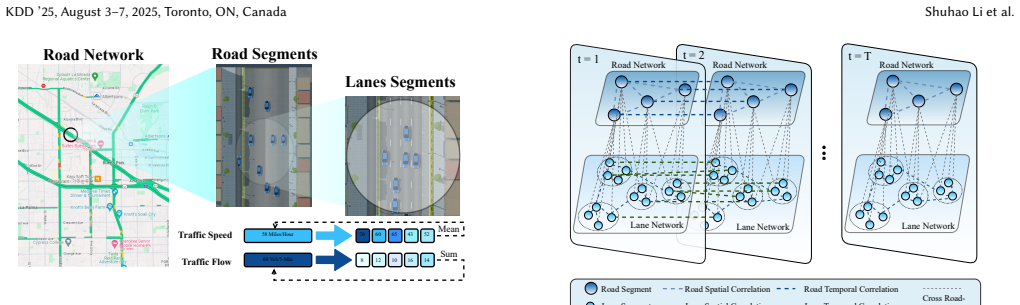
The load-bearing object is the two-stage RoadDiff architecture. The first stage, the Road-Lane Correlation Autoencoder-Decoder, uses a road-level encoder with static and attention-based graph convolutions and temporal MLPs to produce intermediate features, then a lane-level decoder maps those features onto lane nodes using lane topology and road-lane correspondence, yielding an initial lane estimate. The second stage, the Lane Diffusion Module, runs forward noise addition and reverse denoising conditioned on road information, then applies a constraint-loss gradient step that enforces the two identities $x_{r_i}^t = \frac{1}{J_i}\sum_{j=1}^{J_i} x_{l_{i,j}}^t$ for speed and $x_{r_i}^t = \sum_{j=1}^{J_i} x_{l_{i,j}}^t$ for flow. The diffusion stage is what absorbs the uncertainty in mapping coarse road measurements to finer lane states and iteratively pushes the generated lanes toward traffic-consistent values.
What would settle it
Compare per-lane detector speeds with the road-level detector speed on the same segment over many intervals; if the reported road speed consistently differs from the arithmetic mean of lane speeds by more than the model's reported error margins, the hard speed constraint is violated and would penalize correct lane estimates.
Extended reading notes
Core claim
The paper's central claim is that lane-level traffic speed and flow can be accurately generated from road-level data by formulating the task as a spatio-temporal graph node generation problem rather than as a prediction or reconstruction problem. RoadDiff solves this with a Road-Lane Correlation Autoencoder-Decoder, which maps road graph features to initial lane features using graph convolutions, attention, and temporal MLPs, followed by a Lane Diffusion Module that adds and removes noise while enforcing two physical constraints: road speed equals the arithmetic mean of its lane speeds, and road flow equals the sum of its lane flows. The authors report that RoadDiff outperforms all adapted baselines on six real speed and flow datasets and that the speed inference error is approximately 40% lower than the best-performing baseline.
Load-bearing premise
The speed constraint treats a road's reported speed as the arithmetic mean of its lanes' speeds, but real detectors often compute speed as a flow-weighted or zone-based quantity, so the hard constraint can bias lane estimates when that identity fails.
Editorial extensions
If this is right
- A city with only road-level loop detectors could generate lane-level speed and flow maps for lane-change guidance and signal control without installing per-lane cameras.
- The FRTI formulation gives future work a shared task definition, evaluation metrics, and adapted baselines for spatio-temporal graph node generation.
- The diffusion-plus-constraint refinement recipe could be reused for other disaggregation problems where coarse observations must respect conservation identities.
- On speed inference, errors are roughly 40 percent lower than the best adapted baseline; on flow inference, the improvement is smaller but consistent across datasets.
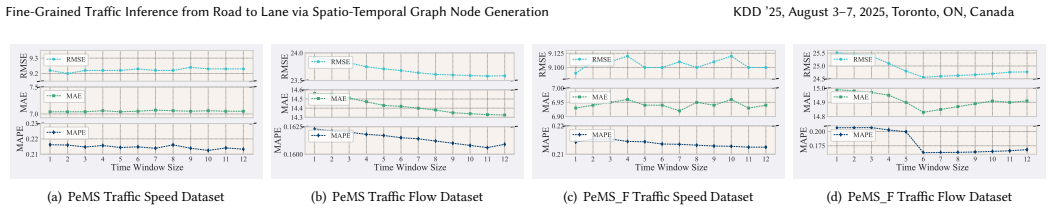
- Longer time windows matter more for flow inference than for speed inference, where performance stays stable across window sizes.
Reading between the lines
- Because the speed constraint is enforced as a hard loss, the method's real-world accuracy likely depends on how closely detector-reported road speed matches the arithmetic mean of lane speeds; on roads where flow-weighted speed is reported, a learned or soft aggregation could be a natural adaptation.
- The same spatio-temporal node-generation formulation could transfer to other granularity mismatches, such as inferring neighborhood-level flows from district-level counts or producing high-resolution air-quality maps from sparse monitors.
- The ablations suggest that the diffusion module carries much of the accuracy gain; a cheaper refinement network that only enforces the constraints could test whether the full diffusion machinery is necessary.
- If the reported 40 percent improvement holds on independently collected road-lane pairs, the practical case for replacing dedicated lane sensors with inference from existing road detectors is strengthened.
Signed reviews
Editorial analysis
A structured set of objections, weighed in public.
Referee Report
Summary. The paper introduces the Fine-grained Road Traffic Inference (FRTI) task: inferring lane-level speed and flow from road-level measurements using road and lane graph topologies. The proposed RoadDiff framework has two stages: a Road-Lane Correlation Autoencoder-Decoder that produces initial lane estimates from road spatio-temporal features, and a Lane Diffusion Module that iteratively refines these estimates while enforcing speed and flow constraints. Experiments on PeMS, PeMS_F, and HuaNan datasets compare against 17 adapted baselines, reporting substantially lower MAE/RMSE/MAPE for traffic speed and smaller but consistent gains for traffic flow. The authors release datasets and code.
Significance. If the results hold, the paper makes a useful contribution: it formalizes a new spatio-temporal graph node generation task, provides a practical method that could reduce reliance on dedicated lane-level sensors, and reports strong speed-inference improvements over strong baselines across three real datasets. The manuscript also includes several well-chosen baselines adapted from urban inference and traffic forecasting, and it makes code and data available, which strengthens reproducibility. The flow improvements, however, are modest, and the diffusion-module derivation has a load-bearing correctness problem that needs to be resolved before the methodological claims can be accepted.
major comments (4)
- [Section 3.2, Eqs. (14)-(16)] The reverse diffusion update in Eq. (16) is not the inverse of the forward process in Eq. (14). Solving Eq. (14) for x^(n-1) gives x^(n-1) = (x^(n) - gamma_n * road - sqrt(beta_n) * epsilon) / sqrt(1 - beta_n), whereas Eq. (16) uses (x^(n) - beta_n/sqrt(1 - beta_n) * epsilon_theta)/sqrt(1 - beta_n) + gamma_n * road + Sigma: the noise coefficient differs and the road term has the opposite sign. Additionally, the forward process conditions on x_R^(n-1) in Eq. (13), while the reverse conditions on x_R^(n) in Eq. (15), and the KL loss in Eq. (20) drops the road conditioning entirely. The Lane Diffusion Module is therefore a heuristic denoiser rather than a valid denoising diffusion probabilistic model, and the claim in Section 3.2 that it learns constraints through a diffusion process is not supported. The authors should either derive a consistent forward/reverse pair or reframe the module as an iterative denoising refinement and remove the diffusion-modeling claims.
- [Section 2, Constraint 1 and Appendix A.2] Constraint 1 asserts that road speed equals the arithmetic mean of lane speeds, and Appendix A.2 calls this the 'Traffic Speed Consistency Law.' In real loop-detector data, road speed is commonly a flow-weighted average over lanes or is computed over a detector zone, so the arithmetic-mean equality need not hold. Because Eq. (18) enforces this equality as a hard training loss, a systematically incorrect constraint would penalize correct lane-level estimates and bias inference. The authors should validate the constraint empirically (e.g., by comparing arithmetic-mean, flow-weighted, and detector-zone speed aggregations on the PeMS/HuaNan data) or test model sensitivity to replacing or removing this loss.
- [Section 4.4, Tables 2-5] No error bars, multiple seeds, or significance tests are reported, which matters because the flow improvements are small: from Table 2, RoadDiff MAE is 14.56 versus best FUFI baseline CUFAR's 15.09 (about 3.5%); from Table 3, 14.99 versus 15.78 (about 5%); from Table 5, 4.88 versus 5.08 (about 4%). The Section 4.4 claim of 'approximately 40%' error reduction is also not uniformly supported by the tables: the speed MAE reductions versus the best baseline are 35.7% on PeMS (7.04 vs. 10.95), 28.7% on PeMS_F (6.93 vs. 9.72), and 39.0% on HuaNan (3.11 vs. 5.10). Please clarify which datasets the 40% figure refers to and add seed variance and significance reporting.
- [Section 4.6, Figure 5] The text states that the Lane Diffusion Module 'could not be directly removed' because of the shape requirement, yet the ablation reports a 'w/o D' variant with the diffusion module removed. The procedure for obtaining this variant is undefined, which undermines the conclusion that removing the Lane Diffusion Module causes the largest error increase. The authors should specify exactly what the w/o D model is (e.g., initial lane information passed through the constraint update only) and report how its outputs are obtained.
minor comments (5)
- [Abstract] The abstract repeats the phrase 'solve the FRTI task' twice; one occurrence should be removed.
- [Section 3.3, Eq. (19)] The term L_recon is called 'Reconstruction Error,' but Eq. (19) is the standard noise-prediction loss used in diffusion training; the name should be changed to avoid confusion.
- [Algorithm 1, lines 19-21] The algorithm uses inconsistent notation, writing b_X_L^(n) on the left of the forward step but e_X_L^(n) inside the reverse update; the variables should be made uniform and aligned with Eqs. (14)-(16).
- [Figures 6-8] The figure text contains unicode artifact tokens (e.g., '/uni00000030/uni00000024/...'), making axis labels and legends unreadable; the figures need to be regenerated.
- [Section 4.1 and Abstract] The paper refers to 'six datasets,' but the experiments describe three sensor collections (PeMS, PeMS_F, HuaNan) with speed and flow as two traffic states; the wording should clarify whether these count as six datasets.
Circularity Check
No significant circularity: RoadDiff is supervised against external lane-level sensor data, and its constraints are assumptions, not derived predictions.
full rationale
The paper's central claim is that RoadDiff infers lane-level speed and flow from road-level inputs, and it is evaluated against real lane-level sensor labels (PeMS and HuaNan datasets). This is a standard supervised learning setup: the lane labels are external data, not fitted parameters of the model, and the reported MAE/RMSE/MAPE are computed on held-out lane data. No equation in the paper reduces a predicted lane value to a fitted input; the road-lane constraints (arithmetic-mean speed, summed flow) are imposed as auxiliary losses (Eq. 18) and are stated as physical assumptions (Appendix A), not derived from the model outputs. The observation that a physics-only baseline, which already satisfies these constraints, performs much worse on speed inference (e.g., MAE 11.47 vs. RoadDiff 7.04 on PeMS) confirms that the constraints do not by themselves determine the lane-level predictions. The authors' self-citations ([5], [21], [22]) appear in related-work and baseline contexts and are not used to justify the diffusion module or any uniqueness claim. The reverse diffusion update in Eq. (16) is not the algebraic inverse of the forward process in Eq. (14), which is a substantive correctness or validity concern about the Lane Diffusion Module, but it is not a circularity: the reverse step is inconsistent rather than equivalent to its inputs by construction. Overall, the derivation chain is self-contained with respect to the empirical evaluation, and no prediction reduces to its own input.
Assumptions & free parameters
free parameters (5)
- Diffusion step count N =
10 (main), tuned from {5,10,20,30}
- Constraint loss weight lambda =
not reported
- Balancing parameters beta and gamma =
not reported
- Constraint-update learning rate eta =
not reported
- Noise schedule beta_n and road-influence weights gamma_n =
not reported
assumptions (4)
- domain assumption Road speed equals the arithmetic mean of its lane speeds (Constraint 1).
- domain assumption Road flow equals the sum of lane flows (Constraint 2).
- domain assumption Lane topology is captured by a static four-direction adjacency graph.
- standard math Standard DDPM theory applies to the initial lane estimates.
Cite this review
Pith. "Pith review of Fine-Grained Traffic Inference from Road to Lane via Spatio-Temporal Graph Node Generation." pith.science (2026). https://pith.science/paper/WCOLYKDO
@misc{pith2026250719089,
  author       = {Pith},
  title        = {Pith review of: Fine-Grained Traffic Inference from Road to Lane via Spatio-Temporal Graph Node Generation},
  year         = {2026},
  howpublished = {\url{https://pith.science/paper/WCOLYKDO}},
  note         = {Machine review of arXiv:2507.19089}
}
read the original abstract
Fine-grained traffic management and prediction are fundamental to key applications such as autonomous driving, lane change guidance, and traffic signal control. However, obtaining lane-level traffic data has become a critical bottleneck for data-driven models due to limitations in the types and number of sensors and issues with the accuracy of tracking algorithms. To address this, we propose the Fine-grained Road Traffic Inference (FRTI) task, which aims to generate more detailed lane-level traffic information using limited road data, providing a more energy-efficient and cost-effective solution for precise traffic management. This task is abstracted as the first scene of the spatio-temporal graph node generation problem. We designed a two-stage framework--RoadDiff--to solve the FRTI task. solve the FRTI task. This framework leverages the Road-Lane Correlation Autoencoder-Decoder and the Lane Diffusion Module to fully utilize the limited spatio-temporal dependencies and distribution relationships of road data to accurately infer fine-grained lane traffic states. Based on existing research, we designed several baseline models with the potential to solve the FRTI task and conducted extensive experiments on six datasets representing different road conditions to validate the effectiveness of the RoadDiff model in addressing the FRTI task. The relevant datasets and code are available at https://github.com/ShuhaoLii/RoadDiff.
Figures


Figures from the paper (3 more)


Reference graph
Works this paper leans on
-
[1]
Lei Bai, Lina Yao, Can Li, Xianzhi Wang, and Can Wang. 2020. Adaptive graph convolutional recurrent network for traffic forecasting. Advances in neural information processing systems 33 (2020), 17804–17815
2020
-
[2]
Marc Brockschmidt, Miltiadis Allamanis, Alexander L Gaunt, and Oleksandr Polo- zov. 2018. Generative code modeling with graphs. arXiv preprint arXiv:1805.08490 (2018)
arXiv 2018
-
[3]
Joan Bruna, Wojciech Zaremba, Arthur Szlam, and Yann Lecun. 2014. Spectral networks and locally connected networks on graphs. In International Conference on Learning Representations (ICLR2014), CBLS, April 2014 . http–openreview
work page 2014
-
[4]
Changlu Chen, Yanbin Liu, Ling Chen, and Chengqi Zhang. 2022. Bidirectional spatial-temporal adaptive transformer for urban traffic flow forecasting. IEEE Transactions on Neural Networks and Learning Systems 34, 10 (2022), 6913–6925
work page 2022
-
[5]
Yue Cui, Shuhao Li, Wenjin Deng, Zhaokun Zhang, Jing Zhao, Kai Zheng, and Xiaofang Zhou. 2023. ROI-demand Traffic Prediction: A Pre-train, Query and Fine- tune Framework. In 2023 IEEE 39th International Conference on Data Engineering (ICDE). IEEE, 1340–1352
work page 2023
-
[6]
Yue Cui, Kai Zheng, Dingshan Cui, Jiandong Xie, Liwei Deng, Feiteng Huang, and Xiaofang Zhou. 2021. METRO: a generic graph neural network framework for multivariate time series forecasting. Proceedings of the VLDB Endowment 15, 2 (2021), 224–236
2021
-
[7]
Carlos F Daganzo. 1997. Fundamentals of transportation and traffic operations . Emerald Group Publishing Limited
work page 1997
-
[8]
H Dai, Y Tian, B Dai, S Skiena, and L Song. 2018. Syntax-directed variational autoencoder for structured data. arXiv. arXiv preprint arXiv:1802.08786 (2018)
arXiv 2018
Show all 51 references
-
[9]
Zheng Fang, Qingqing Long, Guojie Song, and Kunqing Xie. 2021. Spatial- temporal graph ode networks for traffic flow forecasting. In Proceedings of the 27th ACM SIGKDD conference on knowledge discovery & data mining . 364–373
2021
-
[10]
Zeying Gong, Yujin Tang, and Junwei Liang. 2023. Patchmixer: A patch-mixing architecture for long-term time series forecasting.arXiv preprint arXiv:2310.00655 (2023)
2023 arXiv
-
[11]
Bruce D Greenshields, J Rowland Bibbins, WS Channing, and Harvey H Miller
-
[12]
Shengnan Guo, Youfang Lin, Ning Feng, Chao Song, and Huaiyu Wan. 2019. Attention based spatial-temporal graph convolutional networks for traffic flow forecasting. In Proceedings of the AAAI conference on artificial intelligence , Vol. 33. 922–929
2019
-
[13]
Xiaojie Guo, Yuanqi Du, Sivani Tadepalli, Liang Zhao, and Amarda Shehu. 2021. Generating tertiary protein structures via interpretable graph variational autoen- coders. Bioinformatics Advances 1, 1 (2021), vbab036
2021
-
[14]
Jonathan Ho, Ajay Jain, and Pieter Abbeel. 2020. Denoising diffusion probabilistic models. Advances in neural information processing systems 33 (2020), 6840–6851
2020
-
[15]
Shion Honda, Hirotaka Akita, Katsuhiko Ishiguro, Toshiki Nakanishi, and Kenta Oono. 2019. Graph residual flow for molecular graph generation. arXiv preprint arXiv:1909.13521 (2019)
2019 arXiv
-
[16]
Junfeng Hu, Xu Liu, Zhencheng Fan, Yuxuan Liang, and Roger Zimmermann
-
[17]
Renhe Jiang, Zhaonan Wang, Jiawei Yong, Puneet Jeph, Quanjun Chen, Ya- sumasa Kobayashi, Xuan Song, Shintaro Fukushima, and Toyotaro Suzumura
-
[18]
Wengong Jin, Jeremy Wohlwend, Regina Barzilay, and Tommi S Jaakkola. [n. d.]. Iterative Refinement Graph Neural Network for Antibody Sequence-Structure Co-design. In International Conference on Learning Representations
-
[19]
Cheng Li, Yali Qi, Qingtao Zeng, and Likun Lu. 2023. Comparison of image gen- eration methods based on diffusion models. In 2023 4th International Conference on Computer Vision, Image and Deep Learning (CVIDL) . IEEE, 1–4
2023
-
[20]
In Proceedings of the AAAI conference on artificial intelligence , Vol
Spatio-temporal meta-graph learning for traffic forecasting. In Proceedings of the AAAI conference on artificial intelligence , Vol. 37. 8078–8086
-
[21]
Shuhao Li, Yue Cui, Libin Li, Weidong Yang, Fan Zhang, and Xiaofang Zhou. 2024. ST-ABC: Spatio-Temporal Attention-Based Convolutional Network for Multi- Scale Lane-Level Traffic Prediction. In 2024 IEEE 40th International Conference on Data Engineering (ICDE). IEEE, 1185–1198
2024
-
[22]
Shuhao Li, Yue Cui, Jingyi Xu, Libin Li, Lingkai Meng, Weidong Yang, Fan Zhang, and Xiaofang Zhou. 2024. Unifying Lane-Level Traffic Prediction from a Graph Structural Perspective: Benchmark and Baseline. arXiv preprint arXiv:2403.14941 (2024)
2024 arXiv
-
[23]
Jiyue Li, Senzhang Wang, Jiaqiang Zhang, Hao Miao, Junbo Zhang, and S Yu Philip. 2022. Fine-grained urban flow inference with incomplete data. IEEE Transactions on Knowledge and Data Engineering 35, 6 (2022), 5851–5864
2022
-
[24]
Yuxuan Liang, Kun Ouyang, Lin Jing, Sijie Ruan, Ye Liu, Junbo Zhang, David S Rosenblum, and Yu Zheng. 2019. Urbanfm: Inferring fine-grained urban flows. In Proceedings of the 25th ACM SIGKDD international conference on knowledge discovery & data mining . 3132–3142
2019
-
[25]
Yuxuan Liang, Kun Ouyang, Yiwei Wang, Ye Liu, Junbo Zhang, Yu Zheng, and David S Rosenblum. 2021. Revisiting convolutional neural networks for citywide crowd flow analytics. In Machine Learning and Knowledge Discovery in Databases: European Conference, ECML PKDD 2020, Ghent, B...
2021
-
[26]
Yaguang Li, Rose Yu, Cyrus Shahabi, and Yan Liu. 2017. Diffusion convolu- tional recurrent neural network: Data-driven traffic forecasting. arXiv preprint arXiv:1707.01926 (2017)
2017 arXiv
-
[27]
Kaushalya Madhawa, Katsuhiko Ishiguro, Kosuke Nakago, and Motoki Abe. 2019. GraphNVP: An Invertible Flow-Based Model for Generating Molecular Graphs. (2019)
2019
-
[28]
Kun Ouyang, Yuxuan Liang, Ye Liu, Zekun Tong, Sijie Ruan, Yu Zheng, and David S Rosenblum. 2020. Fine-grained urban flow inference. IEEE transactions on knowledge and data engineering 34, 6 (2020), 2755–2770
2020
-
[29]
Wenqi Lu, Yikang Rui, and Bin Ran. 2020. Lane-level traffic speed forecasting: A novel mixed deep learning model. IEEE Transactions on Intelligent Transportation Systems 23, 4 (2020), 3601–3612
2020
-
[30]
Chao Song, Youfang Lin, Shengnan Guo, and Huaiyu Wan. 2020. Spatial- temporal synchronous graph convolutional networks: A new framework for spatial-temporal network data forecasting. In Proceedings of the AAAI conference on artificial intelligence, Vol. 34. 914–921
2020
-
[31]
Ashish Vaswani, Noam Shazeer, Niki Parmar, Jakob Uszkoreit, Llion Jones, Aidan N Gomez, Łukasz Kaiser, and Illia Polosukhin. 2017. Attention is all you need. Advances in neural information processing systems 30 (2017)
2017
-
[32]
Hao Qu, Yongshun Gong, Meng Chen, Junbo Zhang, Yu Zheng, and Yilong Yin
-
[33]
Yu Wang, Zhiwei Liu, Liangwei Yang, and Philip S Yu. 2024. Conditional denoising diffusion for sequential recommendation. InPacific-Asia Conference on Knowledge Discovery and Data Mining . Springer, 156–169
2024
-
[34]
Zepu Wang, Yuqi Nie, Peng Sun, Nam H Nguyen, John Mulvey, and H Vincent Poor. 2023. St-mlp: A cascaded spatio-temporal linear framework with channel- independence strategy for traffic forecasting. arXiv preprint arXiv:2308.07496 (2023)
2023 arXiv
-
[35]
Haomin Wen, Youfang Lin, Yutong Xia, Huaiyu Wan, Qingsong Wen, Roger Zimmermann, and Yuxuan Liang. 2023. Diffstg: Probabilistic spatio-temporal graph forecasting with denoising diffusion models. InProceedings of the 31st ACM International Conference on Advances in Geographic I...
2023
-
[36]
E Vijay, Arindam Jati, Nam Nguyen, Gift Sinthong, and Jayant Kalagnanam. 2023. Tsmixer: Lightweight mlp-mixer model for multivariate time series forecasting. In ACM SIGKDD International Conference on Knowledge Discovery and Data Mining
2023
-
[37]
Tim Z Xiao, Johannes Zenn, and Robert Bamler. 2023. Upgrading VAE Train- ing With Unlimited Data Plans Provided by Diffusion Models. arXiv preprint arXiv:2310.19653 (2023)
2023 arXiv
-
[38]
Bing Yu, Haoteng Yin, and Zhanxing Zhu. 2017. Spatio-temporal graph con- volutional networks: A deep learning framework for traffic forecasting. arXiv preprint arXiv:1709.04875 (2017)
2017 arXiv
-
[39]
Haoyang Yu, Xovee Xu, Ting Zhong, and Fan Zhou. 2023. Overcoming forgetting in fine-grained urban flow inference via adaptive knowledge replay. InProceedings of the AAAI Conference on Artificial Intelligence , Vol. 37. 5393–5401
2023
-
[40]
Zonghan Wu, Shirui Pan, Guodong Long, Jing Jiang, and Chengqi Zhang. 2019. Graph wavenet for deep spatial-temporal graph modeling. arXiv preprint arXiv:1906.00121 (2019)
2019 arXiv
-
[41]
Ailing Zeng, Muxi Chen, Lei Zhang, and Qiang Xu. 2023. Are transformers effective for time series forecasting?. In Proceedings of the AAAI conference on artificial intelligence, Vol. 37. 11121–11128
2023
-
[42]
Chuanpan Zheng, Xiaoliang Fan, Cheng Wang, and Jianzhong Qi. 2020. Gman: A graph multi-attention network for traffic prediction. In Proceedings of the AAAI conference on artificial intelligence , Vol. 34. 1234–1241
2020
-
[43]
Fan Zhou, Xin Jing, Liang Li, and Ting Zhong. 2021. Inferring high-resolutional urban flow with internet of mobile things. InICASSP 2021-2021 IEEE International Conference on Acoustics, Speech and Signal Processing (ICASSP) . IEEE, 7948–7952
2021
-
[44]
Chengxi Zang and Fei Wang. 2020. Moflow: an invertible flow model for gen- erating molecular graphs. In Proceedings of the 26th ACM SIGKDD international conference on knowledge discovery & data mining . 617–626
2020
-
[45]
Haoyi Zhou, Shanghang Zhang, Jieqi Peng, Shuai Zhang, Jianxin Li, Hui Xiong, and Wancai Zhang. 2021. Informer: Beyond efficient transformer for long se- quence time-series forecasting. In Proceedings of the AAAI conference on artificial intelligence, Vol. 35. 11106–11115
2021
-
[46]
Jianping Zhou, Bin Lu, Zhanyu Liu, Siyu Pan, Xuejun Feng, Hua Wei, Guanjie Zheng, Xinbing Wang, and Chenghu Zhou. 2024. MagiNet: Mask-Aware Graph Imputation Network for Incomplete Traffic Data. arXiv preprint arXiv:2406.03511 (2024)
2024 arXiv
-
[47]
Y Zhu, Y Du, Y Wang, Y Xu, J Zhang, Q Liu, and S Wu. [n. d.]. A survey on deep graph generation: Methods and applications. arXiv 2022. arXiv preprint arXiv:2203.06714 ([n. d.]). Fine-Grained Traffic Inference from Road to Lane via Spatio-Temporal Graph Node Generation KDD ’25,...
2022 arXiv
-
[48]
Fan Zhou, Liang Li, Ting Zhong, Goce Trajcevski, Kunpeng Zhang, and Jiahao Wang. 2020. Enhancing urban flow maps via neural odes. In Proceedings of the Twenty-Ninth International Joint Conference on Artificial Intelligence, {IJCAI} 2020
2020
-
[1935]
In Highway research board proceedings , Vol
A study of traffic capacity. In Highway research board proceedings , Vol. 14. Washington, DC, 448–477
-
[2022]
IEEE Transactions on Knowledge and Data Engineering 35, 8 (2022), 8008–8023
Forecasting fine-grained urban flows via spatio-temporal contrastive self- supervision. IEEE Transactions on Knowledge and Data Engineering 35, 8 (2022), 8008–8023
2022
-
[2023]
arXiv preprint arXiv:2310.17360 (2023)
Towards unifying diffusion models for probabilistic spatio-temporal graph learning. arXiv preprint arXiv:2310.17360 (2023)
2023 arXiv
Reviewed August 15, 2026 · model on record in the stance chip above.
Discussion (0). Continue with ORCID to comment.