Wavefront super-resolution for Adaptive Optics systems on ground-based telescopes
Pith reviewed 2026-05-19 03:26 UTC · model grok-4.3
The pith
A reconstruction model fuses multi-frame gradients from multiple wavefront sensors to recover high-resolution phases using turbulence statistics and wind velocities.
A machine-rendered reading of the paper's core claim, the machinery that carries it, and where it could break.
Core claim
We propose a model for reconstructing a high-resolution wavefront from a sequence of wavefront gradient data from multiple WFSs in a multi-frame post-processing setting. Our model is based on the turbulence statistics and the Taylor frozen flow hypothesis, incorporating knowledge of the wind velocities in atmospheric turbulence layers. We also introduce an H2 regularization term, especially for atmospheric characteristics under von Karman statistics, and provide a theoretical analysis for H^2 space within H^{11/6}.
What carries the argument
Multi-WFS multi-frame fusion model grounded in Taylor frozen flow hypothesis with known wind velocities, plus H2 regularization tailored to von Karman statistics in H^{11/6} space.
If this is right
- Known wind velocities allow temporal alignment of gradient sequences from several sensors into one consistent high-resolution wavefront estimate.
- The H2 regularization stabilizes the inverse problem specifically when turbulence follows von Karman statistics.
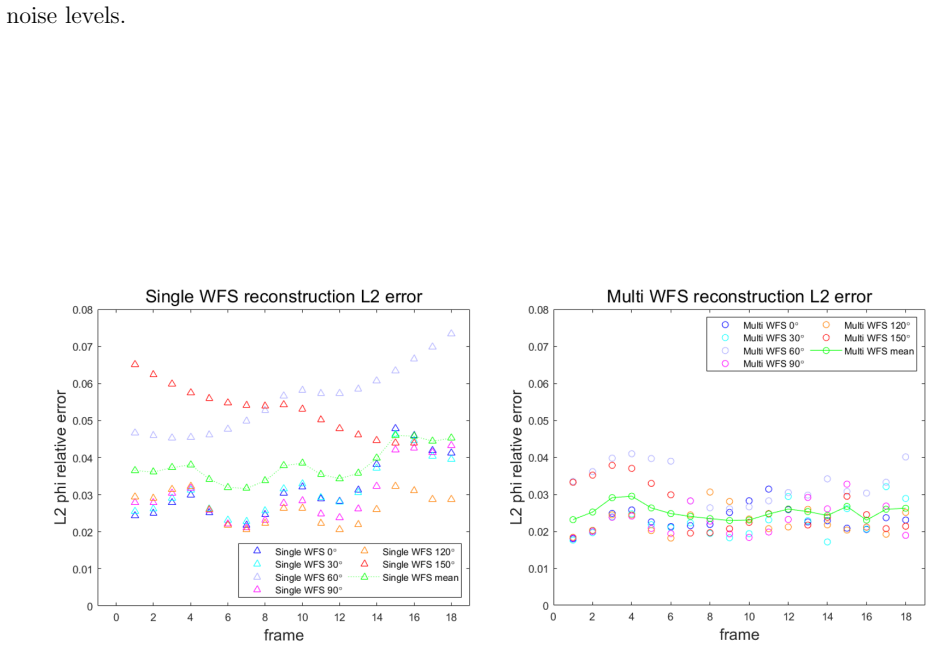
- Data from multiple WFSs under identical conditions yields more robust phase recovery than single-WFS reconstructions.
- The functional analysis confirms that the regularized solution resides in the Sobolev space H^{11/6}.
Where Pith is reading between the lines
- The post-processing fusion could be retrofitted to existing adaptive-optics hardware to raise image quality without adding sensors.
- Joint estimation of wind velocities alongside the phase might be needed when velocity priors are uncertain.
- Real-time variants could fold the multi-frame idea into live correction loops during observations.
- The same frozen-flow fusion principle might transfer to other moving-medium imaging tasks outside astronomy.
Load-bearing premise
The reconstruction requires accurate prior knowledge of wind velocities in the atmospheric turbulence layers together with the validity of the Taylor frozen flow hypothesis over the relevant time scales.
What would settle it
Run a controlled simulation with known ground-truth high-resolution phase where the input wind velocities are deliberately offset by 15 percent from truth and measure whether the reconstruction error rises sharply compared to the matched-velocity case.
Figures





read the original abstract
In ground-based astronomy, Adaptive Optics (AO) is a pivotal technique, engineered to correct wavefront phase distortions and thereby enhance the quality of the observed images. Integral to an AO system is the wavefront sensor (WFS), which is crucial for detecting wavefront aberrations from guide stars, essential for phase calculations. Many models based on a single-WFS model have been proposed to obtain the high-resolution phase of the incoming wavefront. In this paper, we delve into the realm of multiple WFSs within the framework of state-of-the-art telescope setups for high-resolution phase reconstruction. We propose a model for reconstructing a high-resolution wavefront from a sequence of wavefront gradient data from multiple WFSs in a multi-frame post-processing setting. Our model is based on the turbulence statistics and the Taylor frozen flow hypothesis, incorporating knowledge of the wind velocities in atmospheric turbulence layers. We also introduce an $H_2$ regularization term, especially for atmospheric characteristics under von Karman statistics, and provide a theoretical analysis for $H^2$ space within $H^{11/6}$. Numerical simulations are conducted to demonstrate the robustness and effectiveness of our regularization term and multi-WFS reconstruction strategy under identical experimental conditions.
Editorial analysis
A structured set of objections, weighed in public.
Referee Report
Summary. The manuscript proposes a model for high-resolution wavefront reconstruction in adaptive optics using sequences of gradient measurements from multiple wavefront sensors in a multi-frame post-processing setting. The approach incorporates turbulence statistics and the Taylor frozen-flow hypothesis with known wind velocities for atmospheric layers, introduces an H₂ regularization term suited to von Karman statistics, provides a theoretical analysis of H² embedding within H^{11/6}, and reports numerical simulations demonstrating robustness under identical conditions.
Significance. If the central assumptions hold and the method can be quantitatively validated, the work could contribute a physically motivated super-resolution technique for AO post-processing that leverages multi-sensor and temporal data. The explicit use of external turbulence priors and a tailored regularization term represents a constructive direction, though the absence of detailed performance metrics currently limits evaluation of its practical advantage over existing single-WFS approaches.
major comments (3)
- [Numerical simulations] Numerical simulations section: the abstract states that simulations demonstrate robustness and effectiveness, yet no error bars, quantitative metrics (RMS wavefront error, Strehl ratio, etc.), simulation parameters (frame count, r₀, WFS geometry, noise levels), or direct comparisons against single-WFS baselines are supplied. This omission prevents assessment of whether the multi-frame fusion actually improves reconstruction.
- [Model formulation] Model formulation (forward model and reconstruction equations): the linear mapping from measured gradients to high-resolution phase is derived under the assumption of exact layer wind velocities and strict Taylor frozen-flow validity over the multi-frame interval. No sensitivity analysis to velocity mismatch or temporal decorrelation is presented; any violation directly invalidates the inverse problem being solved by the subsequent H₂-regularized estimator.
- [Theoretical analysis] Theoretical analysis section: the claim of an H² space embedded within H^{11/6} for von Karman statistics is asserted to justify the regularization term, but the derivation, key steps, or proof are not shown. Without this material the regularization choice remains heuristic rather than theoretically grounded.
minor comments (2)
- [Abstract] Abstract: the phrase 'under identical experimental conditions' is used without defining the conditions or referencing the relevant simulation parameters.
- [Regularization term] Notation: the precise definition of the H₂ term and the value or selection method for its regularization parameter are not stated explicitly, complicating reproducibility.
Simulated Author's Rebuttal
We thank the referee for the constructive and detailed comments on our manuscript. We have carefully reviewed each major point and provide point-by-point responses below. Where appropriate, we indicate the revisions that will be incorporated into the next version of the paper.
read point-by-point responses
-
Referee: Numerical simulations section: the abstract states that simulations demonstrate robustness and effectiveness, yet no error bars, quantitative metrics (RMS wavefront error, Strehl ratio, etc.), simulation parameters (frame count, r₀, WFS geometry, noise levels), or direct comparisons against single-WFS baselines are supplied. This omission prevents assessment of whether the multi-frame fusion actually improves reconstruction.
Authors: We agree that the numerical results section requires additional quantitative detail to enable direct evaluation of the proposed method. In the revised manuscript we will expand this section to include: (i) explicit simulation parameters (number of frames, r₀ values, WFS geometries, noise levels), (ii) RMS wavefront error and Strehl ratio metrics with error bars obtained from multiple turbulence realizations, and (iii) side-by-side comparisons against single-WFS reconstruction baselines under identical conditions. These additions will be presented in updated tables and figures. revision: yes
-
Referee: Model formulation (forward model and reconstruction equations): the linear mapping from measured gradients to high-resolution phase is derived under the assumption of exact layer wind velocities and strict Taylor frozen-flow validity over the multi-frame interval. No sensitivity analysis to velocity mismatch or temporal decorrelation is presented; any violation directly invalidates the inverse problem being solved by the subsequent H₂-regularized estimator.
Authors: The referee correctly notes that the forward model relies on known wind velocities and the Taylor frozen-flow hypothesis. These assumptions are standard in multi-frame AO reconstruction literature, yet we acknowledge that a dedicated sensitivity study is missing. In the revision we will add a new subsection that quantifies reconstruction degradation under small velocity mismatches (e.g., ±10 % and ±20 % perturbations) and under controlled temporal decorrelation, thereby demonstrating the practical robustness of the H₂-regularized estimator. revision: yes
-
Referee: Theoretical analysis section: the claim of an H² space embedded within H^{11/6} for von Karman statistics is asserted to justify the regularization term, but the derivation, key steps, or proof are not shown. Without this material the regularization choice remains heuristic rather than theoretically grounded.
Authors: We agree that the theoretical justification for the H₂ regularization term should be presented with explicit derivation steps. In the revised manuscript we will expand the theoretical analysis section to include the key mathematical steps establishing the continuous embedding of H² into H^{11/6} under von Karman turbulence statistics, together with the relevant Sobolev-space arguments that motivate the choice of regularization. revision: yes
Circularity Check
Derivation chain uses external turbulence priors and known velocities without self-referential reduction
full rationale
The paper's model for high-resolution wavefront reconstruction is explicitly constructed from established turbulence statistics, the Taylor frozen-flow hypothesis, and supplied wind-velocity vectors as independent inputs. The H2 regularization term and its embedding in H^{11/6} for von Karman statistics are presented as an added theoretical contribution rather than a quantity fitted to the target data or derived from a self-citation chain. No equation or step is shown to equate a claimed prediction back to a fitted parameter or to a prior result whose only justification is the present authors' own work. The forward model therefore remains falsifiable against external benchmarks (measured wind profiles, independent turbulence characterizations) and does not collapse to its own inputs by construction.
Axiom & Free-Parameter Ledger
axioms (2)
- domain assumption Taylor frozen flow hypothesis holds for the relevant time scales and turbulence layers
- domain assumption Atmospheric turbulence obeys von Karman statistics
Lean theorems connected to this paper
-
IndisputableMonolith/Foundation/DimensionForcing.leanreality_from_one_distinction unclear?
unclearRelation between the paper passage and the cited Recognition theorem.
we also introduce an H2 regularization term, especially for atmospheric characteristics under von Karman statistics, and provide a theoretical analysis for H² space within H^{11/6}
What do these tags mean?
- matches
- The paper's claim is directly supported by a theorem in the formal canon.
- supports
- The theorem supports part of the paper's argument, but the paper may add assumptions or extra steps.
- extends
- The paper goes beyond the formal theorem; the theorem is a base layer rather than the whole result.
- uses
- The paper appears to rely on the theorem as machinery.
- contradicts
- The paper's claim conflicts with a theorem or certificate in the canon.
- unclear
- Pith found a possible connection, but the passage is too broad, indirect, or ambiguous to say the theorem truly supports the claim.
Reference graph
Works this paper leans on
- [1]
-
[2]
Wavefront reconstruction methods for adaptive optics systems on ground-based telescopes
Johnathan M Bardsley. “Wavefront reconstruction methods for adaptive optics systems on ground-based telescopes”. In: SIAM Journal on Matrix Analysis and Applications 30.1 (2008), pp. 67–83
work page 2008
-
[3]
Frozen flow or not? Investigating the predictability of the atmo- sphere
Nazim Ali Bharmal. “Frozen flow or not? Investigating the predictability of the atmo- sphere”. In: Journal of Physics: Conference Series . Vol. 595. 1. IOP Publishing. 2015, p. 012003
work page 2015
-
[4]
High-resolution image reconstruction with multisensors
NK Bose and KJ Boo. “High-resolution image reconstruction with multisensors”. In: International Journal of Imaging Systems and Technology 9.4 (1998), pp. 294–304
work page 1998
-
[5]
Xiaohao Cai, Raymond Chan, and Tieyong Zeng. “A two-stage image segmentation method using a convex variant of the Mumford–Shah model and thresholding”. In: SIAM Journal on Imaging Sciences 6.1 (2013), pp. 368–390
work page 2013
-
[6]
Wavelet algorithms for high-resolution image reconstruction
Raymond H Chan, Tony F Chan, Lixin Shen, and Zuowei Shen. “Wavelet algorithms for high-resolution image reconstruction”. In: SIAM Journal on Scientific Computing 24.4 (2003), pp. 1408–1432
work page 2003
-
[7]
A phase model for point spread function estimation in ground-based astronomy
Raymond Honfu Chan, XiaoMing Yuan, and WenXing Zhang. “A phase model for point spread function estimation in ground-based astronomy”. In: Science China Mathematics 56 (2013), pp. 2701–2710
work page 2013
-
[8]
Tony F Chan and Jianhong Shen.Image processing and analysis: variational, PDE, wavelet, and stochastic methods. SIAM, 2005
work page 2005
-
[9]
Paolo Ciliegi, Guido Agapito, and Matteo Aliverti et al. “MAORY/MORFEO at ELT: general overview up to the preliminary design and a look towards the final design”. In: Adaptive Optics Systems VIII . Ed. by Laura Schreiber, Dirk Schmidt, and Elise Vernet. Vol. 12185. International Society for Optics and Photonics. SPIE, 2022, p. 1218514. doi: 10.1117/12.262...
-
[10]
Turbulence: an introduction for scientists and engineers
Peter Alan Davidson. Turbulence: an introduction for scientists and engineers . Oxford university press, 2015
work page 2015
-
[11]
Richard Davies and Markus Kasper. “Adaptive optics for astronomy”. In: Annual Review of Astronomy and Astrophysics 50.1 (2012), pp. 305–351
work page 2012
-
[12]
Hitchhiker’s guide to the fractional Sobolev spaces
Eleonora Di Nezza, Giampiero Palatucci, and Enrico Valdinoci. “Hitchhiker’s guide to the fractional Sobolev spaces”. In: Bulletin des sciences math´ ematiques 136.5 (2012), pp. 521–573
work page 2012
-
[13]
Optimal wave-front reconstruction strategies for multi conjugate adaptive optics
T. Fusco, J.-M. Conan, G. Rousset, L.M. Mugnier, and V. Michau. “Optimal wave-front reconstruction strategies for multi conjugate adaptive optics”. In: J. Opt. Soc. Am. A 18.10 (2001), pp. 2527–2538
work page 2001
-
[14]
Introduction to Fourier optics
Joseph W Goodman. Introduction to Fourier optics. Roberts and Company publishers, 2005
work page 2005
-
[15]
Joseph W Goodman. “Statistical optics”. In: Journal of the Optical Society of America A 2.9 (1985), pp. 1448–1454
work page 1985
-
[16]
Wavelet methods in multi-conjugate adaptive optics
T. Helin and M. Yudytskiy. “Wavelet methods in multi-conjugate adaptive optics”. In: Inverse Problems 29.8 (July 2013), p. 085003. doi: 10.1088/0266-5611/29/8/085003. 25
-
[17]
Reginald J Hill. “Review of optical scintillation methods of measuring the refractive-index spectrum, inner scale and surface fluxes”. In: Waves in Random Media 2.3 (1992), p. 179
work page 1992
-
[18]
RJ Hill. “Spectra of fluctuations in refractivity, temperature, humidity, and the temperature- humidity cospectrum in the inertial and dissipation ranges”. In: Radio Science 13.6 (1978), pp. 953–961
work page 1978
-
[19]
Reconstruction of the high resolution phase in a closed loop adaptive optics system
Rihuan Ke, Roland Wagner, Ronny Ramlau, and Raymond Chan. “Reconstruction of the high resolution phase in a closed loop adaptive optics system”. In: SIAM Journal on Imaging Sciences 13.2 (2020), pp. 775–806
work page 2020
-
[20]
Fast PSF reconstruction using the frozen flow hypothesis
James Nagy, Stuart Jefferies, and Qing Chu. “Fast PSF reconstruction using the frozen flow hypothesis”. In: Proceedings of the Advanced Maui Optical and Space Surveillance Technologies Conference. 2010, pp. 13–16
work page 2010
-
[21]
History and principles of Shack-Hartmann wavefront sensing
Ben C Platt and Ronald Shack. History and principles of Shack-Hartmann wavefront sensing. 2001
work page 2001
-
[22]
The telescope point spread function
Rene Racine. “The telescope point spread function”. In: Publications of the Astronomical Society of the Pacific 108.726 (1996), p. 699
work page 1996
-
[23]
An augmented wavelet reconstructor for atmospheric tomog- raphy
R. Ramlau and B. Stadler. “An augmented wavelet reconstructor for atmospheric tomog- raphy”. In: Electronic Transactions on Numerical Analysis (ETNA) 54 (2021), pp. 256– 275
work page 2021
-
[24]
Fran¸ cois Roddier. “Adaptive optics in astronomy”. In: (1999)
work page 1999
-
[25]
The effects of atmospheric turbulence in optical astronomy
Fran¸ cois Roddier. “The effects of atmospheric turbulence in optical astronomy”. In: Progress in optics. Vol. 19. Elsevier, 1981, pp. 281–376
work page 1981
-
[26]
Michael C Roggemann and Byron M Welsh. Imaging through turbulence. CRC press, 2018
work page 2018
-
[27]
Gerard Rousset. “Wave-front sensors”. In: Adaptive optics in astronomy 1 (1999), p. 91
work page 1999
-
[28]
Principles of mathematical analysis
Walter Rudin et al. Principles of mathematical analysis . Vol. 3. McGraw-hill New York, 1964
work page 1964
-
[29]
Production and use of a lenticular Hartmann screen
Ronald Shack. “Production and use of a lenticular Hartmann screen”. In: J. Opt. Soc. Am. 61.656 (1971)
work page 1971
-
[30]
The effects of the turbulent atmosphere on wave propagation
Valerian Ilitch Tatarskii. “The effects of the turbulent atmosphere on wave propagation”. In: Jerusalem: Israel Program for Scientific Translations, 1971 (1971)
work page 1971
-
[31]
Geoffrey Ingram Taylor. “The spectrum of turbulence”. In:Proceedings of the Royal Society of London. Series A-Mathematical and Physical Sciences 164.919 (1938), pp. 476–490
work page 1938
-
[32]
Hendrik Tennekes and John Leask Lumley. A first course in turbulence . MIT press, 1972
work page 1972
-
[33]
On the stability of inverse problems
Andrey Nikolayevich Tikhonov et al. “On the stability of inverse problems”. In: Dokl. akad. nauk sssr . Vol. 39. 5. 1943, pp. 195–198
work page 1943
-
[34]
Multiframe image restoration and registration
Roger Y Tsai and Thomas S Huang. “Multiframe image restoration and registration”. In: Multiframe image restoration and registration 1 (1984), pp. 317–339
work page 1984
-
[35]
Theodore Von K´ arm´ an.Mechanical similitude and turbulence . 611. National Advisory Committee for Aeronautics, 1931
work page 1931
-
[36]
R. Wagner, D. Saxenhuber, R. Ramlau, and S. Hubmer. “Direction dependent point spread function reconstruction for multi-conjugate adaptive optics on giant segmented mirror telescopes”. In: Astronomy and Computing 40 (July 2022), p. 100590. doi: 10. 1016/j.ascom.2022.100590. 26
-
[37]
Point spread function recon- struction for Single-conjugate Adaptive Optics
Roland Wagner, Christoph Hofer, and Ronny Ramlau. “Point spread function recon- struction for Single-conjugate Adaptive Optics”. In: Journal of Astronomical Telescopes, Instruments, and Systems 4.4 (2018), p. 049003. doi: 10.1117/1.JATIS.4.4.049003
-
[38]
Off-axis point spread function reconstruction for single conjugate adaptive optics
Roland Wagner, Jenny Niebsch, and Ronny Ramlau. “Off-axis point spread function reconstruction for single conjugate adaptive optics”. In: J. Opt. Soc. Am. A 40.7 (July 2023), pp. 1382–1391. doi: 10.1364/JOSAA.488843 . url: https://opg.optica.org/ josaa/abstract.cfm?URI=josaa-40-7-1382
-
[39]
John C Wyngaard. “Atmospheric turbulence”. In: Annual Review of Fluid Mechanics 24.1 (1992), pp. 205–234
work page 1992
-
[40]
Finite element-wavelet hybrid algorithm for atmospheric tomography
M. Yudytskiy, T. Helin, and R. Ramlau. “Finite element-wavelet hybrid algorithm for atmospheric tomography”. In: J. Opt. Soc. Am. A 31.3 (Mar. 2014), pp. 550–560. doi: 10.1364/JOSAA.31.000550 . url: http://josaa.osa.org/abstract.cfm?URI=josaa- 31-3-550
-
[41]
Regularization and variable selection via the elastic net
Hui Zou and Trevor Hastie. “Regularization and variable selection via the elastic net”. In: Journal of the Royal Statistical Society Series B: Statistical Methodology 67.2 (2005), pp. 301–320. 27
work page 2005
discussion (0)
Sign in with ORCID, Apple, or X to comment. Anyone can read and Pith papers without signing in.