REVIEW 4 major objections 5 minor 49 references
How Much Do Large Language Model Cheat on Evaluation? Benchmarking Overestimation under the One-Time-Pad-Based Framework
T0 review · 4 major / 5 minor · reviewed 2026-08-15 · deepseek-v4-flash
Pith's one-line read ArxivRoll claims that the gap between a model's public and private benchmark scores directly measures the share of its performance that comes from contamination or training bias.
desk verdict Worth reading for the fresh-benchmark machinery, but the headline metric is not a proportion and the paper never validates it as one. read the letter →
The pith
A machine-rendered reading of the paper's core claim, the machinery that carries it, and where it could break.
The reading
What carries the argument
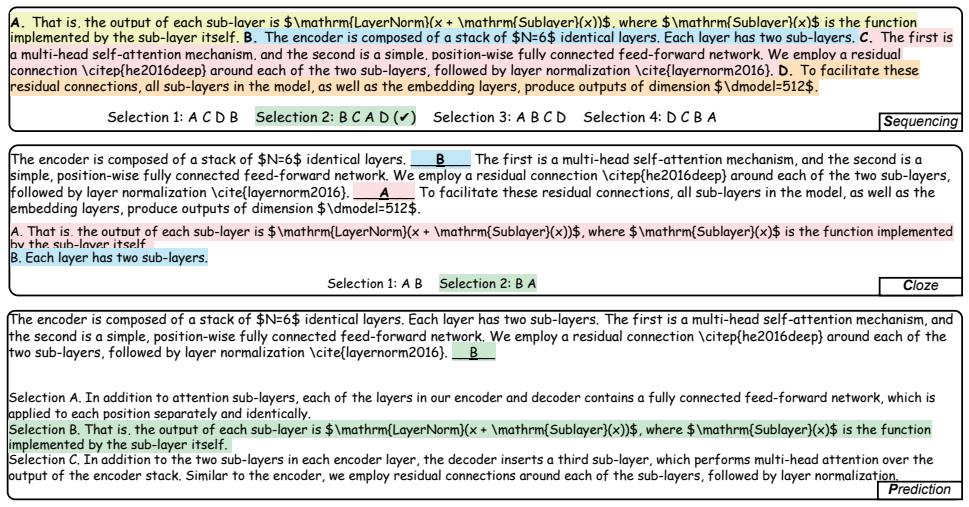
The carrying objects are SCP and the Rugged Scores. SCP turns a short excerpt of a recent preprint into three objective multiple-choice tasks: Sequencing asks for the order of shuffled sentences, Cloze asks for the correct masked sentence in a paragraph, and Prediction asks which of four continuations follows the excerpt. This generator provides the confidentiality and freshness of the private set without human annotation. The Rugged Score RSI is the ratio-symmetric public-minus-private gap defined in Eq. (1), and RSII is the variance-based spread across private domains defined in Eq. (2). Together with the release-then-expire lifecycle of each private set, these form the mechanism by which the paper converts a suspected bias into a number.
What would settle it
Fine-tune a small open model on a held-out sample of ArxivRollBench while a matched control model sees none of it; if the fine-tuned model's RSI does not clearly exceed the control's, the gap is not mostly contamination.
Extended reading notes
Core claim
The paper's central claim is that overestimation is not a vague risk but a quantity, and that the quantity is the normalised gap between performance on public and private benchmarks. Concretely, RSI is defined by Eq. (1) as twice the average of $(M_p - M_c)/(M_p + M_c)$ over matched public–private pairs plus an analogous unmatched term, so RSI $=0$ means a model performs equally on both and higher RSI means its public score is increasingly inflated. RSII, defined in Eq. (2), is the standard deviation of the model's accuracy across private domains, with a normalised variant dividing by the mean, and is claimed to measure biased overtraining. The private benchmarks are generated automatically from papers too recent for training data, which is what makes the gap interpretable as contamination rather than as ordinary difficulty.
Load-bearing premise
The whole contamination reading rests on the assumption that the public-minus-private performance gap is caused by contamination or training bias, not by the private tasks being harder, differently formatted, or drawn from a different distribution.
Editorial extensions
If this is right
- A leaderboard that lists RSI next to accuracy lets a reader see at a glance whether a model's ranking comes from public-benchmark inflation or genuine ability.
- Because every evaluation period uses a fresh private set, earlier ArxivRollBench releases can be published freely without weakening later assessments.
- Domain-level RSI identifies which fields a model has overtrained on, so a developer can target training away from benchmark-specific strengths.
- RSII gives a second, orthogonal signal: a model with balanced capabilities across domains scores low, while one trained hard on only the evaluated domains scores high.
- Existing public benchmarks can be retrofitted as the 'public' side of the pair, so the framework does not require abandoning established benchmark sets.
Reading between the lines
- A natural test of the contamination reading is to take a small open model, fine-tune it on a held-out slice of ArxivRollBench, and show that its RSI rises while a matched control model's RSI stays flat; the paper's Eq. (1) predicts that directly.
- The same ratio-symmetric gap could be computed between two versions of one benchmark, an old public release and a refreshed one, giving a contamination estimate that needs no new task generator.
- For closed API models, the 'private' side is fresh but the public side is uncertain, so RSI should be interpreted as an upper bound on contamination rather than an exact proportion until the benchmark-pair difficulty is matched.
- If SCP tasks measure mainly text coherence rather than domain knowledge, RSI would partly reflect task-format sensitivity; comparing RSI across SCP variants would reveal how much of the gap is format-specific.
Signed reviews
Editorial analysis
A structured set of objections, weighed in public.
Referee Report
Summary. The paper proposes ArxivRoll, a dynamic LLM evaluation framework with two components: SCP, an automated generator of private test cases from recent arXiv articles, and Rugged Scores (RS), which are claimed to quantify the proportion of public benchmark contamination and training bias. The authors construct private benchmarks, meta-evaluate their quality, and use the public-private performance gap to compute RSI values for a range of open and closed LLMs. The central claim is that these rugged scores measure the proportion of cheating behavior or contamination in a model's performance on public benchmarks.
Significance. If the interpretation of RS were valid, the paper would offer a valuable, transparent, reproducible, and dynamically refreshed evaluation pipeline, and its quantification of overestimation would be a useful complement to static benchmarks. The SCP construction is genuinely interesting, the authors release their code, and the correlation analysis with ChatbotArena provides some evidence that the private benchmark ranks models sensibly. However, the central measurement claim is not supported: RSI as defined in Eq. (1) is not a proportion, the paper's own numbers exceed 100%, and no validation is provided that the public-private gap is attributable to contamination rather than to task-format differences.
major comments (4)
- [§1, §2.1, §2.3, Eq. (1), Table 3] The central claim that RSI quantifies the proportion of contamination is contradicted by the metric's own definition. For a single matched pair, the matched-pair term of Eq. (1) is 2(p−c)/(p+c), which is a symmetrized relative gap, not a proportion: it is unbounded above and approaches 2 as c → 0. Table 3 reports Absolute RSI values of 1.21 and 1.41, and Section 4.3 explicitly says these are 'even larger than 100%'. Section 2.3 itself concedes that 'RSI is not a normalized metric'. Even under the authors' assumption that the entire public-private gap is due to contamination, no standard contamination proportion equals 2(p−c)/(p+c); natural candidates such as (p−c)/p or (p−c)/(1−c) give different values (e.g., for p=0.5, c=0.25, the matched-pair term is 0.67 while these candidates are 0.5 and 0.33). The paper provides no derivation linking Eq. (1) to a proportion, so the headline claim that RS 'quantify the proportion of cheating behavior' is unsupported by the paper's own definition.
- [§2.1, §3.2, §4.3] The interpretation of the public-private performance gap as a contamination proportion requires that the gap be attributable to contamination rather than to differences in task format, content, difficulty, or domain shift. The public benchmarks (MMLU, MMLU Pro, and the vaguely described 'domain-specific datasets' in Appendix A) differ substantially from the private SCP tasks, which are sequencing, cloze, and prediction on arXiv text fragments. The paper provides no synthetic contamination experiment, no controlled benchmarks matched in format and difficulty, and no calibration against known contamination. The correlation analysis in Section 3.2 validates only that private-benchmark rankings resemble ChatbotArena rankings; it does not validate the gap interpretation. Consequently, Eq. (1) is at best a task-specific accuracy gap, and the contamination reading is an unvalidated assumption.
- [Appendix A, §2.3] The construction of the public-private pairs used in Eq. (1) is underspecified. Appendix A states that MMLU, MMLU Pro, and 'domain-specific datasets, such as those commonly used in Math' are used, but it does not report which public benchmarks are paired with which of the eight private domains, the number of pairs Np, the sizes of the unmatched sets, or how the aggregate terms in Eq. (1) are weighted. Since RSI depends on all of these choices, the RSI values in Table 3 are not reproducible from the manuscript as written. The authors should provide the exact benchmark inventory, the pairing rule, and the uncertainty propagated through Eq. (1).
- [Table 3, Tables 2, 6, 7] RSI values in Table 3 are reported without confidence intervals, despite the large standard errors in the underlying private-benchmark accuracies (e.g., several models in Table 2 have error bars of ±7–8 percentage points). For reported differences such as Llama3.1-70B (RSI 0.48) versus Llama3-8B (RSI 0.74), the gap is likely within the measurement noise. Without uncertainty propagation, the qualitative claims in Section 4.3 about which model families exhibit the highest overestimation are not supported.
minor comments (5)
- [§2.2, Appendix A] The free parameters N and Nf are only defined in Appendix A (N=1, Nf=80); they should be defined in the main text where the SCP algorithm is introduced, and a sensitivity analysis for these choices would strengthen the benchmark construction.
- [Figure 5] The axis labels in Figure 5 are garbled by font-encoding artifacts and are not readable, so the reader cannot verify the 'growing overestimation' claim from the figure.
- [Table 3] The column headed 'Relative Rank Changes' mixes arrow glyphs with numeric values and is never clearly defined; it should be renamed and explained, for example by stating whether it is a relative RSI score or a rank shift.
- [Appendix C, Table 13] In the ArxivRollBench2026a results, 'moonshotai/kimi-k2.6' is ranked first with a valid accuracy of 70.8% despite a raw accuracy of 5.6% and a coverage of 7.9%; the pooled valid-response protocol can materially reorder the leaderboard when coverage is low, and this should be discussed in the main text.
- [§1] The title's phrase 'How Much Do Large Language Model Cheat on Evaluation?' suggests intentionality, while the paper also addresses unintentional contamination and biased overtraining; a more neutral phrasing such as 'overestimation in evaluation' would better match the content.
Circularity Check
No significant circularity: Rugged Scores are defined formulas evaluated on external benchmarks; the 'proportion' wording is an over-interpretation, not a circular derivation.
full rationale
The central derivation chain is self-contained in the sense required by the circularity pass. RSI (Eq. 1) and RSII (Eq. 2) are explicitly defined formulas computed from measured accuracies on separately constructed public and private benchmarks; no parameter is fitted to a target conclusion, and no 'prediction' is statistically forced by a fitted input. The private benchmarks are generated by SCP from fresh arXiv articles and validated against the external ChatbotArena in Section 3.2, providing independent support. The paper's self-citations (Liang et al. 2025a,b; Bai et al. 2025; Shang et al. 2025; Xiao et al. 2025) appear only for experimental conventions such as greedy search and for related work, not as load-bearing justification of the metric or its interpretation. The one substantive concern flagged by the paper itself is in Section 2.3: 'RSI is not a normalized metric,' and Table 3 reports values above 100%, which contradicts the wording in Sections 1 and 2.1 that RS quantifies 'the proportion' of contamination or cheating. That is an interpretive over-claim and a metric-validity problem, not a circular reduction: the paper never defines an independent contamination proportion and then derives RSI from it, nor does it define RSI in terms of that proportion. The public-private gap is a defined quantity, and calling it a proportion is an unsupported label rather than a self-referential derivation. Under the hard rules, this does not constitute circularity, so the score is low despite the wording concern.
Assumptions & free parameters
free parameters (2)
- N (number of consensus phrases per fragment) =
1
- Nf (minimum word count for fragment filtering) =
80
assumptions (3)
- domain assumption Recent arXiv papers are unseen by the evaluated LLMs.
- ad hoc to paper The public-private performance gap reflects contamination and training bias.
- domain assumption ChatbotArena rankings are a reliable proxy for LLM capability.
Cite this review
Pith. "Pith review of How Much Do Large Language Model Cheat on Evaluation? Benchmarking Overestimation under the One-Time-Pad-Based Framework." pith.science (2026). https://pith.science/paper/SX7PTBO5
@misc{pith2026250719219,
  author       = {Pith},
  title        = {Pith review of: How Much Do Large Language Model Cheat on Evaluation? Benchmarking Overestimation under the One-Time-Pad-Based Framework},
  year         = {2026},
  howpublished = {\url{https://pith.science/paper/SX7PTBO5}},
  note         = {Machine review of arXiv:2507.19219}
}
read the original abstract
Overestimation in evaluating large language models (LLMs) has become an increasing concern. Due to the contamination of public benchmarks or imbalanced model training, LLMs may achieve unreal evaluation results on public benchmarks, either intentionally or unintentionally, which leads to unfair comparisons among LLMs and undermines their realistic capability assessments. Existing benchmarks attempt to address these issues by keeping test cases permanently secret, mitigating contamination through human evaluation, or repeatedly collecting and constructing new samples. However, these approaches fail to ensure reproducibility, transparency, and high efficiency simultaneously. Moreover, the extent of overestimation in current LLMs remains unquantified. To address these issues, we propose ArxivRoll, a dynamic evaluation framework inspired by one-time pad encryption in cryptography. ArxivRoll comprises two key components: \emph{i) SCP (Sequencing, Cloze, and Prediction)}, an automated generator for private test cases, and \emph{ii) Rugged Scores (RS)}, metrics that measure the proportion of public benchmark contamination and training bias. Leveraging SCP, ArxivRoll constructs a new benchmark every six months using recent articles from ArXiv and employs them for one-time evaluations of LLM performance. Extensive experiments demonstrate the high quality of our benchmark, and we provide a systematic evaluation of current LLMs. The source code is available at https://github.com/liangzid/ArxivRoll/.
Figures


Figures from the paper (4 more)


Reference graph
Works this paper leans on
-
[1]
, " * write output.state after.block = add.period write newline
ENTRY address archivePrefix author booktitle chapter edition editor eid eprint howpublished institution isbn journal key month note number organization pages publisher school series title type volume year label extra.label sort.label short.list INTEGERS output.state before.all mid.sentence after.sentence after.block FUNCTION init.state.consts #0 'before.a...
-
[2]
write newline
" write newline "" before.all 'output.state := FUNCTION n.dashify 't := "" t empty not t #1 #1 substring "-" = t #1 #2 substring "--" = not "--" * t #2 global.max substring 't := t #1 #1 substring "-" = "-" * t #2 global.max substring 't := while if t #1 #1 substring * t #2 global.max substring 't := if while FUNCTION word.in bbl.in capitalize " " * FUNCT...
-
[3]
online" 'onlinestring :=
ENTRY address archivePrefix author booktitle chapter edition editor eid eprint eprinttype howpublished institution journal key month note number organization pages publisher school series title type volume year doi pubmed url lastchecked label extra.label sort.label short.list INTEGERS output.state before.all mid.sentence after.sentence after.block STRING...
-
[4]
write newline
" write newline "" before.all 'output.state := FUNCTION n.dashify 't := "" t empty not t #1 #1 substring "-" = t #1 #2 substring "--" = not "--" * t #2 global.max substring 't := t #1 #1 substring "-" = "-" * t #2 global.max substring 't := while if t #1 #1 substring * t #2 global.max substring 't := if while FUNCTION word.in bbl.in capitalize " " * FUNCT...
- [5]
-
[6]
Abraham, R. G.; and Chapelle, C. A. 1992. The Meaning of Cloze Test Scores: An Item Difficulty Perspective. The Modern Language Journal, 76(4): 468--479
work page 1992
-
[7]
AI@Meta. 2024. Llama 3 Model Card
2024
-
[8]
Alderson, J. C. 1979. The Cloze Procedure and Proficiency in English as a Foreign Language. TESOL Quarterly, 13(2): 219--227
work page 1979
Show all 49 references
-
[9]
Bormuth, J. R. 1968. The Cloze Readability Procedure. Elementary English, 45(4): 429--436
1968
-
[10]
Britannica. 2024. Gestalt psychology. Encyclopedia Britannica
2024
-
[11]
N.; Li, T.; Li, D.; Zhu, B.; Zhang, H.; Jordan, M
Chiang, W.; Zheng, L.; Sheng, Y.; Angelopoulos, A. N.; Li, T.; Li, D.; Zhu, B.; Zhang, H.; Jordan, M. I.; Gonzalez, J. E.; and Stoica, I. 2024. Chatbot Arena: An Open Platform for Evaluating LLMs by Human Preference. In Forty-first International Conference on Machine Learning,...
2024
-
[12]
Cobbe, K.; Kosaraju, V.; Bavarian, M.; Chen, M.; Jun, H.; Kaiser, L.; Plappert, M.; Tworek, J.; Hilton, J.; Nakano, R.; Hesse, C.; and Schulman, J. 2021. Training Verifiers to Solve Math Word Problems. CoRR, abs/2110.14168
2021 arXiv
-
[13]
Dong, Y.; Jiang, X.; Liu, H.; Jin, Z.; Gu, B.; Yang, M.; and Li, G. 2024. Generalization or Memorization: Data Contamination and Trustworthy Evaluation for Large Language Models. In Ku, L.-W.; Martins, A.; and Srikumar, V., eds., Findings of the Association for Computational L...
2024
-
[14]
Elo, A. 1967. The proposed USCF rating system, its development, theory, and applications. Chess Life XXII (8): 242--247
1967
-
[15]
Gao, L.; Tow, J.; Abbasi, B.; Biderman, S.; Black, S.; DiPofi, A.; Foster, C.; Golding, L.; Hsu, J.; Le Noac'h, A.; Li, H.; McDonell, K.; Muennighoff, N.; Ociepa, C.; Phang, J.; Reynolds, L.; Schoelkopf, H.; Skowron, A.; Sutawika, L.; Tang, E.; Thite, A.; Wang, B.; Wang, K.; a...
2024
-
[16]
Gunasekar, S.; Zhang, Y.; Aneja, J.; Mendes, C. C. T.; Giorno, A. D.; Gopi, S.; Javaheripi, M.; Kauffmann, P.; de Rosa, G.; Saarikivi, O.; Salim, A.; Shah, S.; Behl, H. S.; Wang, X.; Bubeck, S.; Eldan, R.; Kalai, A. T.; Lee, Y. T.; and Li, Y. 2023. Textbooks Are All You Need. ...
2023 arXiv
-
[17]
Hendrycks, D.; Burns, C.; Basart, S.; Zou, A.; Mazeika, M.; Song, D.; and Steinhardt, J. 2021. Measuring Massive Multitask Language Understanding. Proceedings of the International Conference on Learning Representations (ICLR)
2021
-
[18]
Huang, Z.; Wang, Z.; Xia, S.; Li, X.; Zou, H.; Xu, R.; Fan, R.; Ye, L.; Chern, E.; Ye, Y.; Zhang, Y.; Yang, Y.; Wu, T.; Wang, B.; Sun, S.; Xiao, Y.; Li, Y.; Zhou, F.; Chern, S.; Qin, Y.; Ma, Y.; Su, J.; Liu, Y.; Zheng, Y.; Zhang, S.; Lin, D.; Qiao, Y.; and Liu, P. 2024. Olympi...
2024 arXiv
-
[19]
Javaheripi, M.; Bubeck, S.; Abdin, M.; Aneja, J.; Bubeck, S.; Mendes, C. C. T.; Chen, W.; Del Giorno, A.; Eldan, R.; Gopi, S.; et al. 2023. Phi-2: The surprising power of small language models. Microsoft Research Blog, 1(3): 3
2023
-
[20]
Z.; Zhong, M.; Schaeffer, R.; Ouyang, S.; Han, J.; and Koyejo, S
Jiang, M.; Liu, K. Z.; Zhong, M.; Schaeffer, R.; Ouyang, S.; Han, J.; and Koyejo, S. 2024. Investigating Data Contamination for Pre-training Language Models. CoRR, abs/2401.06059
2024 arXiv
-
[21]
E.; Yang, J.; Wettig, A.; Yao, S.; Pei, K.; Press, O.; and Narasimhan, K
Jimenez, C. E.; Yang, J.; Wettig, A.; Yao, S.; Pei, K.; Press, O.; and Narasimhan, K. R. 2024. SWE-bench: Can Language Models Resolve Real-world Github Issues? In The Twelfth International Conference on Learning Representations, ICLR 2024, Vienna, Austria, May 7-11, 2024 . Ope...
2024
-
[22]
E.; and Stoica, I
Li, T.; Chiang, W.-L.; Frick, E.; Dunlap, L.; Wu, T.; Zhu, B.; Gonzalez, J. E.; and Stoica, I. 2024 a . From Crowdsourced Data to High-Quality Benchmarks: Arena-Hard and BenchBuilder Pipeline. arXiv preprint arXiv:2406.11939
2024 arXiv
-
[23]
E.; and Stoica, I
Li, T.; Chiang, W.-L.; Frick, E.; Dunlap, L.; Zhu, B.; Gonzalez, J. E.; and Stoica, I. 2024 b . From Live Data to High-Quality Benchmarks: The Arena-Hard Pipeline
2024
-
[24]
D.; Gunasekar, S.; and Lee, Y
Li, Y.; Bubeck, S.; Eldan, R.; Giorno, A. D.; Gunasekar, S.; and Lee, Y. T. 2023. Textbooks Are All You Need II: phi-1.5 technical report. arXiv:2309.05463
2023 arXiv
-
[25]
Li, Y.; Guo, Y.; Guerin, F.; and Lin, C. 2024 c . An Open-Source Data Contamination Report for Large Language Models. In Al-Onaizan, Y.; Bansal, M.; and Chen, Y.-N., eds., Findings of the Association for Computational Linguistics: EMNLP 2024, 528--541. Miami, Florida, USA: Ass...
2024
-
[26]
Mather, G. 2006. Foundations of perception. Psychology Press
2006
-
[27]
Microsoft. 2024. Phi-3 Technical Report: A Highly Capable Language Model Locally on Your Phone. arXiv:2404.14219
2024 arXiv
-
[28]
Miller, F. 1882. Telegraphic Code to Insure Privacy and Secrecy in the Transmission of Telegrams. C.M. Cornwell
-
[29]
Mirzadeh, S.; Alizadeh, K.; Shahrokhi, H.; Tuzel, O.; Bengio, S.; and Farajtabar, M. 2024. GSM-Symbolic: Understanding the Limitations of Mathematical Reasoning in Large Language Models. CoRR, abs/2410.05229
2024 arXiv
-
[30]
OpenAI. 2024 a . GPT-4 Technical Report. arXiv:2303.08774
2024 arXiv
-
[31]
OpenAI. 2024 b . GPT-4o System Card. arXiv:2410.21276
2024 arXiv
-
[32]
Palavalli, M.; Bertsch, A.; and Gormley, M. 2024. A Taxonomy for Data Contamination in Large Language Models. In Sainz, O.; Garc \' a Ferrero, I.; Agirre, E.; Ander Campos, J.; Jacovi, A.; Elazar, Y.; and Goldberg, Y., eds., Proceedings of the 1st Workshop on Data Contaminatio...
2024
-
[33]
Shannon, C. E. 1949. Communication theory of secrecy systems. The Bell System Technical Journal, 28(4): 656--715
1949
-
[34]
Team, T. T.-B. 2025. Terminal-Bench: A Benchmark for AI Agents in Terminal Environments
2025
-
[35]
Touvron, H.; Martin, L.; Stone, K.; Albert, P.; Almahairi, A.; Babaei, Y.; Bashlykov, N.; Batra, S.; Bhargava, P.; Bhosale, S.; Bikel, D.; Blecher, L.; Ferrer, C. C.; Chen, M.; Cucurull, G.; Esiobu, D.; Fernandes, J.; Fu, J.; Fu, W.; Fuller, B.; Gao, C.; Goswami, V.; Goyal, N....
2023 arXiv
-
[36]
Wang, B.; and Komatsuzaki, A. 2021. GPT-J-6B: A 6 Billion Parameter Autoregressive Language Model . https://github.com/kingoflolz/mesh-transformer-jax
2021
-
[37]
R.; Zhang, S.; Sun, Y.; and Wang, W
Wang, X.; Hu, Z.; Lu, P.; Zhu, Y.; Zhang, J.; Subramaniam, S.; Loomba, A. R.; Zhang, S.; Sun, Y.; and Wang, W. 2024 a . SciBench: Evaluating College-Level Scientific Problem-Solving Abilities of Large Language Models. In Forty-first International Conference on Machine Learning...
2024
-
[38]
Wang, Y.; Ma, X.; Zhang, G.; Ni, Y.; Chandra, A.; Guo, S.; Ren, W.; Arulraj, A.; He, X.; Jiang, Z.; Li, T.; Ku, M.; Wang, K.; Zhuang, A.; Fan, R.; Yue, X.; and Chen, W. 2024 b . MMLU-Pro: A More Robust and Challenging Multi-Task Language Understanding Benchmark. arXiv:2406.01574
2024 arXiv
-
[39]
Wang, Z.; Bukharin, A.; Delalleau, O.; Egert, D.; Shen, G.; Zeng, J.; Kuchaiev, O.; and Dong, Y. 2024 c . HelpSteer2-Preference: Complementing Ratings with Preferences. arXiv:2410.01257
2024 arXiv
-
[40]
White, C.; Dooley, S.; Roberts, M.; Pal, A.; Feuer, B.; Jain, S.; Shwartz - Ziv, R.; Jain, N.; Saifullah, K.; Naidu, S.; Hegde, C.; LeCun, Y.; Goldstein, T.; Neiswanger, W.; and Goldblum, M. 2024. LiveBench: A Challenging, Contamination-Free LLM Benchmark. CoRR, abs/2406.19314
2024 arXiv
-
[41]
Wu, M.; Zhang, Z.; Dong, Q.; Xi, Z.; Zhao, J.; Jin, S.; Fan, X.; Zhou, Y.; Fu, Y.; Liu, Q.; Zhang, S.; and Zhang, Q. 2025. Reasoning or Memorization? Unreliable Results of Reinforcement Learning Due to Data Contamination. arXiv:2507.10532
2025
-
[42]
Wu, Z.; Qiu, L.; Ross, A.; Aky \"u rek, E.; Chen, B.; Wang, B.; Kim, N.; Andreas, J.; and Kim, Y. 2024. Reasoning or Reciting? Exploring the Capabilities and Limitations of Language Models Through Counterfactual Tasks. In Duh, K.; Gomez, H.; and Bethard, S., eds., Proceedings ...
2024
-
[43]
Xu, C.; Guan, S.; Greene, D.; and Kechadi, M. T. 2024. Benchmark Data Contamination of Large Language Models: A Survey. CoRR, abs/2406.04244
2024 arXiv
-
[44]
E.; and Stoica, I
Yang, S.; Chiang, W.; Zheng, L.; Gonzalez, J. E.; and Stoica, I. 2023. Rethinking Benchmark and Contamination for Language Models with Rephrased Samples. CoRR, abs/2311.04850
2023 arXiv
-
[45]
Ye, T.; Xu, Z.; Li, Y.; and Allen-Zhu, Z. 2024. Physics of Language Models: Part 2.1, Grade-School Math and the Hidden Reasoning Process. arXiv:2407.20311
2024 arXiv
-
[46]
Yue, X.; Ni, Y.; Zheng, T.; Zhang, K.; Liu, R.; Zhang, G.; Stevens, S.; Jiang, D.; Ren, W.; Sun, Y.; Wei, C.; Yu, B.; Yuan, R.; Sun, R.; Yin, M.; Zheng, B.; Yang, Z.; Liu, Y.; Huang, W.; Sun, H.; Su, Y.; and Chen, W. 2024. MMMU: A Massive Multi-Discipline Multimodal Understand...
2024
-
[47]
Zhang, Z.; Chen, J.; and Yang, D. 2024. DARG: Dynamic Evaluation of Large Language Models via Adaptive Reasoning Graph. In Globersons, A.; Mackey, L.; Belgrave, D.; Fan, A.; Paquet, U.; Tomczak, J. M.; and Zhang, C., eds., Advances in Neural Information Processing Systems 38: ...
2024
-
[48]
Z.; Yang, D.; and Xie, X
Zhu, K.; Chen, J.; Wang, J.; Gong, N. Z.; Yang, D.; and Xie, X. 2024 a . DyVal: Dynamic Evaluation of Large Language Models for Reasoning Tasks. In The Twelfth International Conference on Learning Representations, ICLR 2024, Vienna, Austria, May 7-11, 2024 . OpenReview.net
2024
-
[49]
Zhu, K.; Wang, J.; Zhao, Q.; Xu, R.; and Xie, X. 2024 b . Dynamic Evaluation of Large Language Models by Meta Probing Agents. In Forty-first International Conference on Machine Learning, ICML 2024, Vienna, Austria, July 21-27, 2024 . OpenReview.net
2024
Reviewed August 15, 2026 · model on record in the stance chip above.
Discussion (0). Continue with ORCID to comment.