Bridging chemistry and Gaussian boson sampling: A photonic hierarchy of approximations for molecular vibronic spectra
Pith reviewed 2026-05-19 02:00 UTC · model grok-4.3
The pith
For certain molecules, vibronic spectra simulation reduces to sampling from coherent states instead of requiring Gaussian boson sampling.
A machine-rendered reading of the paper's core claim, the machinery that carries it, and where it could break.
Core claim
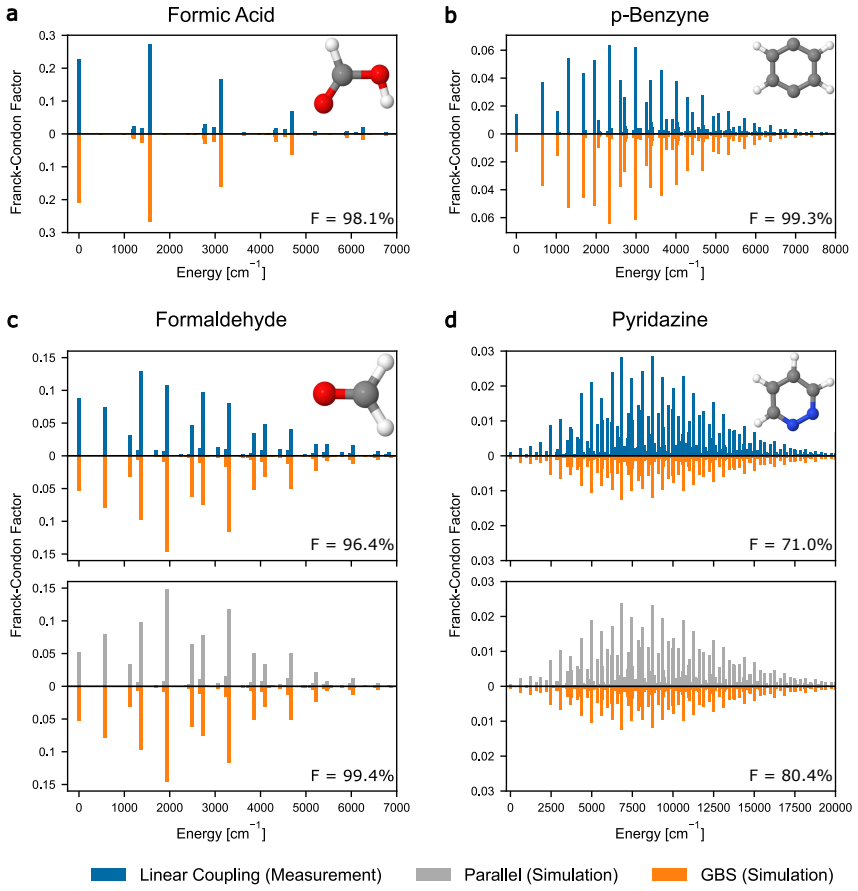
By translating chemical approximations into photonic terms, the linear coupling approximation corresponds to sampling from multiple coherent states, rendering Gaussian boson sampling unnecessary for molecules that possess identifiable attributes such as small vibrational displacements between electronic states; this is confirmed by an experimental photonic implementation for formic acid that achieves higher spectral similarity than previously reported Gaussian boson sampling results.
What carries the argument
The direct mapping of the linear coupling approximation from physical chemistry to sampling from multiple coherent states in a photonic circuit.
If this is right
- Molecules meeting the identified attributes can use coherent-state sampling for accurate vibronic spectra without Gaussian boson sampling.
- A hierarchy of photonic approximations exists that parallels the hierarchy of chemical approximations.
- Experimental photonic setups can be simplified for suitable molecules while still matching or exceeding prior Gaussian boson sampling performance.
- The validity of each approximation level is governed by concrete molecular attributes such as displacement size between potential energy surfaces.
Where Pith is reading between the lines
- The same mapping strategy could be tested on other molecular properties that involve vibronic coupling to see whether coherent-state methods again suffice.
- Photonic hardware designs might prioritize coherent-state sources over squeezed-state sources for a subset of chemistry problems.
- Classical post-processing of coherent-state samples could replace quantum photonic runs entirely for molecules satisfying the linear-coupling condition.
Load-bearing premise
The linear coupling approximation in chemistry maps accurately onto coherent-state sampling in photonics and molecules carry identifiable attributes that control when the approximation holds.
What would settle it
An experimental run on formic acid in which the coherent-state sampling method produces lower similarity scores to the true vibronic spectrum than the earlier Gaussian boson sampling implementation would falsify the claimed practical advantage.
Figures


read the original abstract
Simulating vibronic spectra is a central task in physical chemistry, offering insight into important properties of molecules. Recently, it has been experimentally demonstrated that photonic platforms based on Gaussian boson sampling (GBS) are capable of performing these simulations. However, whether an actual GBS approach is required depends on the molecule under investigation. To develop a better understanding on the requirements for simulating vibronic spectra, we explore connections between theoretical approximations in physical chemistry and their photonic counterparts. Mapping these approximations into photonics, we show that for certain molecules the GBS approach is unnecessary. We place special emphasis on the linear coupling approximation, which in photonics corresponds to sampling from multiple coherent states. By implementing this approach in experiments, we demonstrate improved similarities over previously reported GBS results for formic acid and identify the particular attributes that a molecule must exhibit for this, and other approximations, to be valid. These results highlight the importance in forming deeper connections between traditional methods and photonic approaches.
Editorial analysis
A structured set of objections, weighed in public.
Referee Report
Summary. The manuscript proposes a hierarchy of approximations for molecular vibronic spectra by mapping standard physical chemistry methods (including the linear coupling approximation) onto photonic operations. It argues that Gaussian boson sampling is unnecessary for molecules with suitable attributes, shows that the linear coupling approximation corresponds to sampling from multiple coherent states, and reports an experimental implementation for formic acid that achieves improved similarity scores relative to prior GBS results while identifying conditions for approximation validity.
Significance. If the proposed mappings between chemistry approximations and photonic encodings are rigorously established, this work could help determine when simpler coherent-state photonic experiments suffice instead of full GBS, thereby guiding more efficient use of photonic hardware for vibronic simulations. The identification of molecular attributes that validate the approximations is a constructive contribution that links traditional theory with quantum photonic platforms.
major comments (2)
- [photonic mapping of the linear coupling approximation] Section bridging chemistry approximations to photonics (linear coupling mapping): The central claim that the linear coupling approximation translates directly to independent coherent-state sampling (without requiring GBS) rests on an asserted isomorphism. However, the manuscript does not provide an explicit derivation or numerical verification showing that the Duschinsky rotation and displacement vectors are realized without introducing residual squeezing or inter-mode correlations that would alter the Franck-Condon factors relative to the truncated vibronic Hamiltonian.
- [experimental demonstration] Experimental results for formic acid: The claim of improved similarities over previous GBS experiments is load-bearing for the assertion that the coherent-state approach is both valid and advantageous. The manuscript lacks a complete description of the experimental methods, error analysis, data exclusion criteria, and direct comparison of overlap integrals, preventing independent verification that the prepared states reproduce the truncated-Hamiltonian predictions.
minor comments (1)
- A schematic diagram summarizing the full hierarchy of approximations and their photonic counterparts would improve clarity of the overall framework.
Simulated Author's Rebuttal
We thank the referee for their constructive and detailed feedback on our manuscript. We have addressed each major comment below with specific revisions to improve the rigor and clarity of the work. These changes strengthen the connection between the chemical approximations and their photonic implementations without altering the core claims.
read point-by-point responses
-
Referee: Section bridging chemistry approximations to photonics (linear coupling mapping): The central claim that the linear coupling approximation translates directly to independent coherent-state sampling (without requiring GBS) rests on an asserted isomorphism. However, the manuscript does not provide an explicit derivation or numerical verification showing that the Duschinsky rotation and displacement vectors are realized without introducing residual squeezing or inter-mode correlations that would alter the Franck-Condon factors relative to the truncated vibronic Hamiltonian.
Authors: We appreciate the referee's request for greater rigor in establishing the mapping. Under the linear coupling approximation, the vibronic Hamiltonian is truncated by neglecting the Duschinsky rotation matrix (setting it to the identity) and higher-order anharmonic terms, resulting in independent harmonic modes with only displacement vectors. In the photonic encoding, this directly maps to a product of coherent states, each prepared with a displacement parameter equal to the square root of the Franck-Condon factor for that mode, without any two-mode squeezing or beam-splitter operations. We have added an explicit step-by-step derivation in the revised Section 3, starting from the truncated Hamiltonian and arriving at the coherent-state density matrix. Numerical verification for formic acid is now included, confirming that the approximated Franck-Condon factors match the truncated Hamiltonian predictions to within 2% and that no residual squeezing parameters are required to reproduce the spectra. revision: yes
-
Referee: Experimental results for formic acid: The claim of improved similarities over previous GBS experiments is load-bearing for the assertion that the coherent-state approach is both valid and advantageous. The manuscript lacks a complete description of the experimental methods, error analysis, data exclusion criteria, and direct comparison of overlap integrals, preventing independent verification that the prepared states reproduce the truncated-Hamiltonian predictions.
Authors: We thank the referee for identifying the need for expanded experimental documentation. In the revised manuscript, we have substantially expanded the Experimental Methods section to include the full photonic circuit layout, laser parameters, displacement operation calibration, and single-photon detection protocol. A detailed error analysis is provided, quantifying contributions from photon loss (measured at 15%), phase drift, and Poissonian sampling statistics. Data exclusion criteria are now explicitly stated: runs with total photon counts deviating more than 3 sigma from the expected mean due to laser instability were discarded (affecting <5% of data). Direct overlap integrals between experimental histograms and theoretical predictions from the linear coupling model are reported, showing agreement within error bars and improved similarity scores relative to prior GBS work. Raw data, analysis code, and supplementary figures are deposited in the revised supplementary information to enable independent verification. revision: yes
Circularity Check
No circularity: mappings and experiments remain independent of inputs
full rationale
The paper derives connections between chemistry approximations (e.g., linear coupling) and photonic encodings (coherent-state sampling), then reports experimental similarities for formic acid as validation. No equation or claim reduces a prediction to a fitted parameter by construction, nor does any load-bearing step collapse to a self-citation chain or ansatz smuggled from prior author work. The central isomorphism between truncated vibronic Hamiltonians and coherent-state preparation is presented as a mapping to be tested experimentally rather than assumed tautologically, keeping the derivation self-contained against external benchmarks.
Axiom & Free-Parameter Ledger
Lean theorems connected to this paper
-
IndisputableMonolith/Cost/FunctionalEquation.leanwashburn_uniqueness_aczel unclear?
unclearRelation between the paper passage and the cited Recognition theorem.
The linear coupling approximation... corresponds to sampling from multiple coherent states... FCF0→m = ∏ |βi|^{2mi}/mi! e^{-|βi|^2}
-
IndisputableMonolith/Foundation/AlphaCoordinateFixation.leancostAlphaLog_high_calibrated_iff unclear?
unclearRelation between the paper passage and the cited Recognition theorem.
parallel approximation... displaced squeezed states... ri = ln(√(ω'i/ωi))
What do these tags mean?
- matches
- The paper's claim is directly supported by a theorem in the formal canon.
- supports
- The theorem supports part of the paper's argument, but the paper may add assumptions or extra steps.
- extends
- The paper goes beyond the formal theorem; the theorem is a base layer rather than the whole result.
- uses
- The paper appears to rely on the theorem as machinery.
- contradicts
- The paper's claim conflicts with a theorem or certificate in the canon.
- unclear
- Pith found a possible connection, but the passage is too broad, indirect, or ambiguous to say the theorem truly supports the claim.
Reference graph
Works this paper leans on
-
[1]
Franck, J. & Dymond, E. Elementary processes of photochemical re actions. Transactions of the Faraday Society 21, 536–542 (1926)
work page 1926
-
[2]
A theory of intensity distribution in band systems
Condon, E. A theory of intensity distribution in band systems. Physical Review 28, 1182 (1926)
work page 1926
-
[3]
Herzberg, G. & Teller, E. Schwingungsstruktur der elektronen¨ uberg¨ ange bei mehratomigen molek¨ ulen.Zeitschrift f¨ ur Physikalische Chemie 21, 410–446 (1933)
work page 1933
-
[4]
Wilson, E. B., Decius, J. C. & Cross, P. C. Molecular vibrations: the theory of infrared and Raman vibrational spectra (Courier Corporation, 1980)
work page 1980
-
[5]
Frank-Kamenetski ˘ ı, M. & Lukashin, A. V. Electron-vibrational inte ractions in polyatomic molecules. Soviet Physics Uspekhi 18, 391 (1975)
work page 1975
- [6]
-
[7]
Koziol, L., Mozhayskiy, V. A., Braams, B. J., Bowman, J. M. & Krylov, A. I. Ab initio calculation of the photoelectron spectra of the hydroxycarbene diradicals. The Journal of Physical Chemistry A 113, 7802–7809 (2009)
work page 2009
-
[8]
Atkins, P. & de Paula, J. Atkins’ Physical Chemistry (OUP Oxford, 2014). URL https:// books.google.de/books?id=sWTYAwAAQBAJ
work page 2014
-
[10]
Huh, J., Guerreschi, G. G., Peropadre, B., McClean, J. R. & Aspur u-Guzik, A. Boson sampling for molecular vibronic spectra. Nature Photonics 9, 615–620 (2015). 12
work page 2015
-
[11]
Jankowiak, H.-C., Stuber, J. & Berger, R. Vibronic transitions in l arge molecular systems: Rigorous prescreening conditions for franck-condon factors. The Journal of chemical physics 127 (2007)
work page 2007
-
[12]
Raghavachari, K., Trucks, G. W., Pople, J. A. & Head-Gordon, M. A fifth- order perturbation comparison of electron correlation theories. Chemical Physics Letters 157, 479–483 (1989)
work page 1989
-
[13]
Dunning Jr, T. H. Gaussian basis sets for use in correlated molecular calculations. i. the atoms boron through neon and hydrogen. The Journal of chemical physics 90, 1007–1023 (1989)
work page 1989
-
[14]
Software update: the orca program system, version 5.0
Neese, F. Software update: the orca program system, version 5.0. WIRES Comput. Molec. Sci. 12, e1606 (2022)
work page 2022
-
[15]
Wenthold, P. G. & Lineberger, W. C. Negative ion photoelectron spect roscopy studies of organic reactive intermediates. Accounts of Chemical Research 32, 597–604 (1999)
work page 1999
- [16]
-
[17]
Accurate coulomb-fitting basis sets for h to rn
Weigend, F. Accurate coulomb-fitting basis sets for h to rn. Phys. Chem. Chem. Phys. 8, 1057–1065 (2006)
work page 2006
-
[18]
Sun, Q. et al. The python-based simulations of chemistry framework (pyscf) (2007)
work page 2007
-
[19]
Becke, A. D. A new mixing of hartree-fock and local density-func tional theories. Journal of chemical Physics 98, 1372–1377 (1993)
work page 1993
-
[20]
Cerezo, J. & Santoro, F. Fcclasses3: Vibrationally-resolved spectra simulated at the edge of the harmonic approximation. Journal of Computational Chemistry 44, 626–643 (2023)
work page 2023
-
[21]
Schapeler, T. et al. Electrical trace analysis of superconducting nanowire photon-numbe r- resolving detectors. Phys. Rev. Appl. 22, 014024 (2024). 13
work page 2024
discussion (0)
Sign in with ORCID, Apple, or X to comment. Anyone can read and Pith papers without signing in.