REVIEW 4 major objections 4 minor 29 references
Let It Go? Not Quite: Addressing Item Cold Start in Sequential Recommendations with Content-Based Initialization
T0 review · 4 major / 4 minor · reviewed 2026-08-06 · deepseek-v4-flash
Pith's one-line read Adding a small, norm-bounded trainable delta to frozen content embeddings lets transformer-based sequential recommenders serve cold items without sacrificing warm-item performance.
desk verdict A simple, plausible cold-start fix for ID-based sequential recommenders that mostly works, though the mechanism is less clean than claimed and one dataset undercuts the headline. read the letter →
The pith
A machine-rendered reading of the paper's core claim, the machinery that carries it, and where it could break.
The reading
What carries the argument
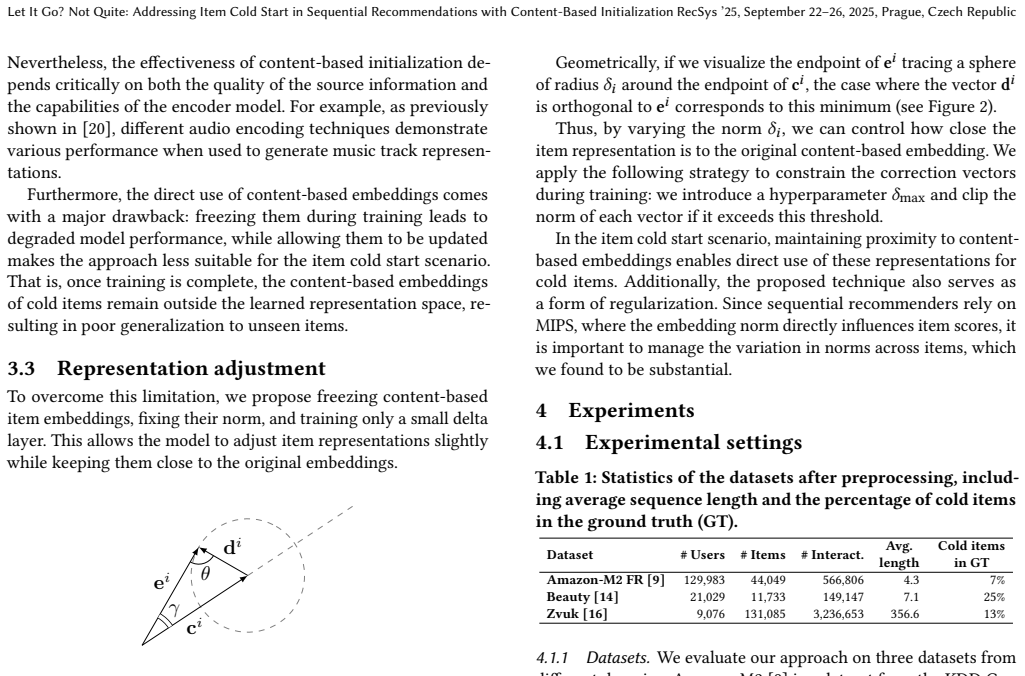
The central device is a norm-bounded trainable delta added to a frozen, unit-norm content embedding: $e_i = c_i + d_i$ with $\lVert c_i\rVert = 1$ and $\lVert d_i\rVert = \delta_i \le \delta_{\max} < 1$. Using the law of sines, the paper derives $\mathrm{sim}(c_i, e_i) = \sqrt{1-\delta_i^2\sin^2\theta}$, whose minimum is $\sqrt{1-\delta_{\max}^2}$; this bound is what keeps adjusted items near their semantic origin. Content embeddings are standardized and reduced by PCA to the model dimension so they can participate in the same maximum-inner-product search (MIPS) scoring $h_u \cdot e_i$ used by SASRec, and clipping the delta norm also regularizes the embedding norms that would otherwise distort MIPS scores.
What would settle it
Embed a held-out set of items from a distribution visibly different from the training items (for example, new categories or a new language), apply the paper's standardization and PCA, and measure cold-item HR@10 with $\delta_{\max} = 0.5$; if the score falls to the content-KNN level or below, the transferable-proximity assumption is refuted.
Extended reading notes
Core claim
Adding a bounded trainable correction to a frozen content embedding is the paper's answer to item cold start in sequential recommender systems. The proposed item representation is $e_i = c_i + d_i$, where $c_i$ is the content embedding, $\lVert d_i\rVert \le \delta_{\max} < 1$, and the norm cap guarantees the final vector stays within cosine distance $\sqrt{1-\delta_{\max}^2}$ of its content anchor. The authors report that a SASRec model trained this way substantially improves cold-item metrics across Amazon-M2, Beauty, and Zvuk compared with content-based initialization, while warm-item performance remains stable.
Load-bearing premise
The method assumes that content embeddings for never-seen items, after standardization and PCA to the model dimension, already sit close enough to the trained scoring space that a single delta cap, chosen on one e-commerce dataset, keeps them reliable across text and audio domains.
Editorial extensions
If this is right
- Cold items can be scored at inference time from content embeddings alone plus the bounded delta, with no learned embedding for the new item.
- Compared with content-initialized SASRec, the trainable-delta variant improves cold-item NDCG@10 on Amazon-M2 (0.359 vs 0.297), Beauty (0.022 vs 0.018), and Zvuk (0.021 vs 0.014), while warm-item metrics stay stable or improve slightly.
- The same recipe works across text descriptions (E5 embeddings) and audio representations, so the method is not tied to one content modality.
- Bounding the delta norm also regularizes the spread of embedding norms, which matters because MIPS scores are directly proportional to item embedding norm.
- The benefit extends to low-frequency items and to sequences that contain cold items as input, not only to cold items as ground truth.
Reading between the lines
- The geometric argument is not SASRec-specific: it only assumes a MIPS scoring rule and an item embedding table, so the same bounded-delta recipe should transfer to other sequential or even non-sequential ID-based recommenders; the paper does not run that comparison.
- Because the delta norm is a per-item quantity, inspecting which items end up with large deltas could measure how far an item's collaborative behavior departs from its content description, a diagnostic the paper does not develop.
- A production corollary the paper leaves implicit is index freshness: because content embeddings stay fixed, a new item can be inserted into the MIPS index at any time without retraining, and the bound $\sqrt{1-\delta_{\max}^2}$ certifies how close the inserted vector remains to its content anchor.
Signed reviews
Editorial analysis
A structured set of objections, weighed in public.
Referee Report
Summary. The paper proposes a method for item cold start in sequential recommenders such as SASRec. Each item embedding is decomposed into a frozen content-derived component c_i, normalized to unit norm, and a trainable correction vector d_i whose norm is capped by delta_max. Warm items are scored with e_i = c_i + d_i, while cold items are scored directly with c_i at inference. The authors derive a relation between the norm of d_i and the cosine similarity between c_i and e_i (Eqs. 2-5), and evaluate the approach on two text-based e-commerce datasets (Amazon-M2, Beauty) and one audio-based music dataset (Zvuk), comparing against a content-based KNN, standard SASRec, and SASRec with full fine-tuning of content-initialized embeddings. They report improvements in cold-item metrics and claim consistent gains across all three datasets.
Significance. If the result holds, the method is practically attractive: it is a simple, architecture-agnostic modification of ID-based sequential recommenders, it preserves warm-item performance, and the paper provides code and uses temporal splits with five seeds. The mathematical derivation in Eqs. (2)-(5) is correct, and the paper's framing of the cold-start problem as a MIPS issue is useful. However, the central empirical claim is not yet fully supported: the reported gains on Beauty are within error bars, and the proposed mechanism is not isolated from a norm-based ranking artifact. The significance would be solid after a norm-controlled evaluation and a more careful statistical comparison.
major comments (4)
- [Section 3.3, Eqs. (1)-(5), Table 2] The central claim that bounded deltas improve cold-item metrics through content alignment is not isolated from a norm confound. For warm items, e_i = c_i + d_i with ||c_i||=1 and ||d_i|| <= 0.5, so ||e_i|| can range from 0.5 to 1.5; cold items are always scored with ||c_i||=1. Since SASRec scores items by h_u . e_i (Eq. 1), any systematic tendency of trained warm embeddings to have norms below 1 gives cold items a mechanical ranking advantage that is unrelated to the semantic closeness of c_i to the user representation. The paper notes in Section 3.3 that norm variation matters but reports no statistics on the distribution of ||e_i|| and no ablation that controls for norm, such as L2-normalizing all item embeddings at inference before MIPS or adding a norm penalty during training. Without such an experiment, the attribution of the cold-item gains to content alignment is not established.
- [Section 4.1.3] The implementation description does not state that the content embeddings are L2-normalized after standardization and PCA, although Section 3.3 defines c_i with ||c_i||=1 and Eqs. (2)-(5) depend on that assumption. If normalization is omitted, the constraint ||d_i|| <= delta_max does not control the cosine similarity relative to c_i as claimed, and the norms of cold-item content embeddings can vary across items. Please specify the exact normalization applied after PCA and, if necessary, add it to the pipeline.
- [Section 4.2.1, Table 2] The claim of 'substantial improvements in cold-item metrics across all three datasets' is not supported on Beauty. For cold ground-truth items, HR@10 is 0.032 +/- 0.004 for the content-initialization baseline versus 0.038 +/- 0.008 for the proposed method, and NDCG@10 is 0.018 +/- 0.002 versus 0.022 +/- 0.004; the error bars overlap substantially in both cases. Five seeds are reported, but no paired significance test is provided. Either significance testing should be added or the claim should be restricted to the datasets where the improvement is statistically reliable.
- [Section 4.2.2] The value delta_max = 0.5 is selected from sensitivity analysis on Amazon-M2 and then fixed for Beauty and Zvuk. No sensitivity results are shown for the other datasets, so the paper assumes that the same cap transfers from text to audio embeddings and across domains. Because delta_max directly controls the trade-off in Eqs. (4)-(5) and the cold/warm balance, the main comparisons on Beauty and Zvuk should include a small sensitivity grid for those datasets or an explicit justification for why the same delta_max should transfer.
minor comments (4)
- [Figure 2 caption] The caption does not define the angles theta and gamma; the text defines them, but adding the definitions to the caption would improve readability.
- [Sections 4.2.3 and 4.2.4] The analyses of cold items in input sequences and of low-frequency items are presented only for Amazon-M2; adding the analogous plots for Beauty or Zvuk would strengthen the claim that the method generalizes across modalities.
- [Reference [2]] Reference [2] is cited as a URL without full bibliographic details; please provide a peer-reviewed or archival version.
- [Section 5] The conclusion describes the results as showing 'superior quality metrics,' which is stronger than the evidence on Beauty supports; the wording should reflect the statistical uncertainty.
Circularity Check
No significant circularity: the main result is an empirical comparison; the only self-citations are methodological and non-load-bearing.
full rationale
The paper's central claim (Section 4.2.1) is that SASRec with a bounded trainable delta improves cold-item metrics over content-based KNN and fully fine-tuned content initialization. This is an empirical result: the delta layer is trained with standard cross-entropy, and cold-item evaluation uses frozen c_i in Eq. (1). Nothing in Eqs. (2)-(5) or in the training objective encodes the reported HR@10/NDCG@10 numbers; the gains could have gone the other way. The geometric identities in Section 3.3 are exact statements about vectors (cos gamma = sqrt(1 - delta_i^2 sin^2 theta)), not assumptions that entail the conclusion. The selection of delta_max = 0.5 on Amazon-M2 and its transfer to Beauty/Zvuk is ordinary hyperparameter fixing, not a fitted quantity relabeled as a prediction. Several evaluation choices (temporal split, full CE loss, Zvuk dataset, RePlay metrics) cite the authors' own prior work, but these citations support infrastructure rather than the substantive cold-start claim; the comparison baselines (SASRec, content-based KNN) are external and the datasets are public or previously released. A possible norm confound (cold c_i have unit norm while warm e_i norms vary) is a validity concern, not a circularity, because the paper does not derive its reported improvements from that norm difference by construction.
Assumptions & free parameters
free parameters (1)
- delta_max (maximum norm of trainable delta vector) =
0.5
assumptions (4)
- standard math Law of sines and Euclidean triangle geometry
- domain assumption Content embeddings (E5 text, Zvuk audio) are semantically informative for the recommendation task
- domain assumption Cold items appearing only in the test set have content embeddings computable at inference and are representative of real new items
- ad hoc to paper The bounded delta cap delta_max=0.5 transfers across text and audio modalities without per-dataset tuning
Cite this review
Pith. "Pith review of Let It Go? Not Quite: Addressing Item Cold Start in Sequential Recommendations with Content-Based Initialization." pith.science (2026). https://pith.science/paper/4AZ326A5
@misc{pith2026250719473,
  author       = {Pith},
  title        = {Pith review of: Let It Go? Not Quite: Addressing Item Cold Start in Sequential Recommendations with Content-Based Initialization},
  year         = {2026},
  howpublished = {\url{https://pith.science/paper/4AZ326A5}},
  note         = {Machine review of arXiv:2507.19473}
}
read the original abstract
Many sequential recommender systems suffer from the cold start problem, where items with few or no interactions cannot be effectively used by the model due to the absence of a trained embedding. Content-based approaches, which leverage item metadata, are commonly used in such scenarios. One possible way is to use embeddings derived from content features such as textual descriptions as initialization for the model embeddings. However, directly using frozen content embeddings often results in suboptimal performance, as they may not fully adapt to the recommendation task. On the other hand, fine-tuning these embeddings can degrade performance for cold-start items, as item representations may drift far from their original structure after training. We propose a novel approach to address this limitation. Instead of entirely freezing the content embeddings or fine-tuning them extensively, we introduce a small trainable delta to frozen embeddings that enables the model to adapt item representations without letting them go too far from their original semantic structure. This approach demonstrates consistent improvements across multiple datasets and modalities, including e-commerce datasets with textual descriptions and a music dataset with audio-based representation.
Figures


Figures from the paper (1 more)

Reference graph
Works this paper leans on
-
[1]
Artun Boz, Wouter Zorgdrager, Zoe Kotti, Jesse Harte, Panos Louridas, Vassilios Karakoidas, Dietmar Jannach, and Marios Fragkoulis. 2025. Improving sequential recommendations with llms. ACM Transactions on Recommender Systems (2025). doi:10.1145/3711667
-
[2]
Shaked Brody and Shoval Lagziel. 2024. SimRec: Mitigating the cold- start problem in sequential recommendation by integrating item similarity. (2024). https://www.amazon.science/publications/simrec-mitigating-the-cold- start-problem-in-sequential-recommendation-by-integrating-item-similarity
work page 2024
-
[3]
Hao Chen, Zefan Wang, Feiran Huang, Xiao Huang, Yue Xu, Yishi Lin, Peng He, and Zhoujun Li. 2022. Generative adversarial framework for cold-start item recommendation. In Proceedings of the 45th International ACM SIGIR Conference on Research and Development in Information Retrieval . 2565–2571. doi:10.1145/ 3477495.3531897
arXiv 2022
-
[4]
Danil Gusak, Anna Volodkevich, Anton Klenitskiy, Alexey Vasilev, and Evgeny Frolov. 2025. Time to Split: Exploring Data Splitting Strategies for Offline Evalu- ation of Sequential Recommenders. In Proceedings of the 19th ACM Conference on Recommender Systems. doi:10.1145/3705328.3748164
arXiv 2025
-
[6]
Balázs Hidasi and Ádám Tibor Czapp. 2023. Widespread flaws in offline eval- uation of recommender systems. In Proceedings of the 17th acm conference on recommender systems. 848–855. doi:10.1145/3604915.3608839
arXiv 2023
-
[7]
Feiran Huang, Zefan Wang, Xiao Huang, Yufeng Qian, Zhetao Li, and Hao Chen
-
[8]
Yitong Ji, Aixin Sun, Jie Zhang, and Chenliang Li. 2023. A critical study on data leakage in recommender system offline evaluation. ACM Transactions on Information Systems 41, 3 (2023), 1–27. doi:10.1145/3569930
doi:10.1145/3569930 2023
-
[9]
Wei Jin, Haitao Mao, Zheng Li, Haoming Jiang, Chen Luo, Hongzhi Wen, Haoyu Han, Hanqing Lu, Zhengyang Wang, Ruirui Li, et al . 2023. Amazon-m2: A multilingual multi-locale shopping session dataset for recommendation and text generation. Advances in Neural Information Processing Systems 36 (2023), 8006–
work page 2023
Show all 29 references
-
[10]
Wang-Cheng Kang and Julian McAuley. 2018. Self-attentive sequential recom- mendation. In 2018 IEEE international conference on data mining (ICDM) . IEEE, 197–206. doi:10.1109/ICDM.2018.00035
2018
-
[11]
Anton Klenitskiy and Alexey Vasilev. 2023. Turning dross into gold loss: is bert4rec really better than sasrec?. In Proceedings of the 17th ACM Conference on Recommender Systems. 1120–1125. doi:10.1145/3604915.3610644
2023
-
[13]
Jiacheng Li, Ming Wang, Jin Li, Jinmiao Fu, Xin Shen, Jingbo Shang, and Julian McAuley. 2023. Text is all you need: Learning language representations for se- quential recommendation. In Proceedings of the 29th ACM SIGKDD Conference on Knowledge Discovery and Data Mining . 1258...
2023
-
[14]
Julian McAuley, Christopher Targett, Qinfeng Shi, and Anton Van Den Hengel
-
[15]
Walid Shalaby, Sejoon Oh, Amir Afsharinejad, Srijan Kumar, and Xiquan Cui
-
[16]
Valeriy Shevchenko, Nikita Belousov, Alexey Vasilev, Vladimir Zholobov, Artyom Sosedka, Natalia Semenova, Anna Volodkevich, Andrey Savchenko, and Alexey Zaytsev. 2024. From Variability to Stability: Advancing RecSys Benchmarking Practices. In Proceedings of the 30th ACM SIGKDD...
2024
-
[17]
Aixin Sun. 2023. Take a fresh look at recommender systems from an evaluation standpoint. In Proceedings of the 46th International ACM SIGIR Conference on Research and Development in Information Retrieval . 2629–2638. doi:10.1145/ 3539618.3591931
2023
-
[18]
Fei Sun, Jun Liu, Jian Wu, Changhua Pei, Xiao Lin, Wenwu Ou, and Peng Jiang. 2019. BERT4Rec: Sequential recommendation with bidirectional en- coder representations from transformer. In Proceedings of the 28th ACM in- ternational conference on information and knowledge manageme...
2019
-
[19]
Zhu Sun, Di Yu, Hui Fang, Jie Yang, Xinghua Qu, Jie Zhang, and Cong Geng. 2020. Are we evaluating rigorously? benchmarking recommendation for reproducible evaluation and fair comparison. In Proceedings of the 14th ACM Conference on Recommender Systems. 23–32. doi:10.1145/33833...
2020
-
[20]
Yan-Martin Tamm and Anna Aljanaki. 2024. Comparative Analysis of Pretrained Audio Representations in Music Recommender Systems. InProceedings of the 18th ACM Conference on Recommender Systems. 934–938. doi:10.1145/3640457.3688172
2024
-
[21]
Aaron Van den Oord, Sander Dieleman, and Benjamin Schrauwen. 2013. Deep content-based music recommendation. Advances in neural information processing systems 26 (2013). https://dl.acm.org/doi/10.5555/2999792.2999907
2013
-
[22]
Alexey Vasilev, Anna Volodkevich, Denis Kulandin, Tatiana Bysheva, and Anton Klenitskiy. 2024. RePlay: a Recommendation Framework for Experimentation and Production Use. In Proceedings of the 18th ACM Conference on Recommender Systems. 1191–1194. doi:10.1145/3640457.3691701
2024
-
[23]
Maksims Volkovs, Guangwei Yu, and Tomi Poutanen. 2017. Dropoutnet: Ad- dressing cold start in recommender systems. Advances in neural information processing systems 30 (2017). https://dl.acm.org/doi/10.5555/3295222.3295249
2017
- [24]
- [25]
-
[26]
Yinwei Wei, Xiang Wang, Qi Li, Liqiang Nie, Yan Li, Xuanping Li, and Tat-Seng Chua. 2021. Contrastive learning for cold-start recommendation. In Proceedings of the 29th ACM international conference on multimedia . 5382–5390. doi:10.1145/ 3474085.3475665
2021
-
[27]
Yongchun Zhu, Ruobing Xie, Fuzhen Zhuang, Kaikai Ge, Ying Sun, Xu Zhang, Leyu Lin, and Juan Cao. 2021. Learning to warm up cold item embeddings for cold- start recommendation with meta scaling and shifting networks. In Proceedings of the 44th International ACM SIGIR Conference...
2021
-
[2015]
In Proceedings of the 38th international ACM SIGIR conference on research and development in information retrieval
Image-based recommendations on styles and substitutes. In Proceedings of the 38th international ACM SIGIR conference on research and development in information retrieval. 43–52. doi:10.1145/2766462.2767755
-
[2022]
In Proceedings of the 16th ACM Conference on Recommender Systems
M2TRec: Metadata-aware Multi-task Transformer for Large-scale and Cold-start free Session-based Recommendations. In Proceedings of the 16th ACM Conference on Recommender Systems . 573–578. doi:10.1145/3523227.3551477
-
[2023]
Aligning distillation for cold-start item recommendation. In Proceedings RecSys ’25, September 22–26, 2025, Prague, Czech Republic Anton Pembek, Artem Fatkulin, Anton Klenitskiy, and Alexey Vasilev of the 46th International ACM SIGIR Conference on Research and Development in I...
2025
-
[8026]
https://dl.acm.org/doi/10.5555/3666122.3666473
Reviewed August 6, 2026 · model on record in the stance chip above.
Discussion (0). Continue with ORCID to comment.