REVIEW 3 major objections 3 minor 88 references
A Machine Learning Framework for Predicting Microphysical Properties of Ice Crystals from Cloud Particle Imagery
T0 review · 3 major / 3 minor · reviewed 2026-08-06 · deepseek-v4-flash
Pith's one-line read The paper proposes a synthetic-image training pipeline in which machine learning models, particularly a ResNet-18, predict the effective density, effective surface area, and bullet count of rosette ice crystals from 2D projections with…
desk verdict Solid proof-of-concept undermined by two fixable internal errors: image-level split likely leaks the same crystal into train and test, and Table 3 reports RMSE < MAE, which is mathematically impossible. read the letter →
The pith
A machine-rendered reading of the paper's core claim, the machinery that carries it, and where it could break.
The reading
What carries the argument
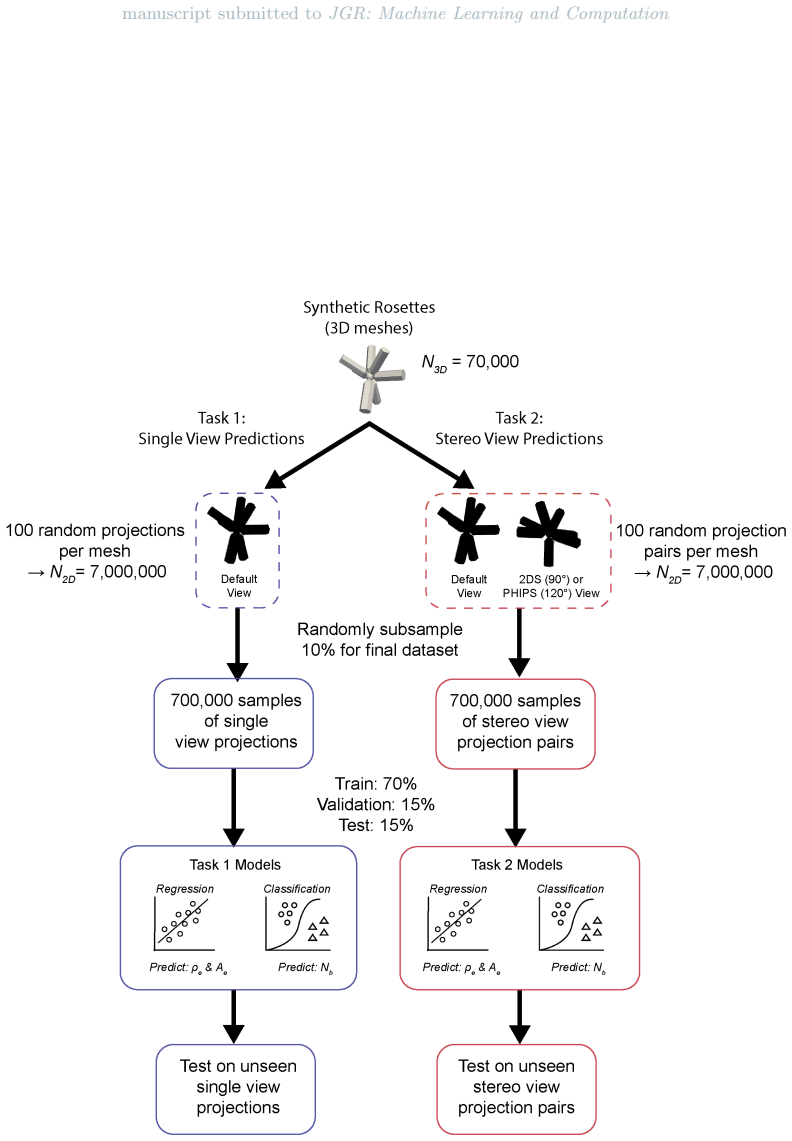
The mechanism that carries the argument is the parametric rosette generator. It constructs a central sphere of radius $r_0$ and $N_b$ bullet arms with basal half-length $a$, prism aspect ratio $c/a$, tip height $h_p$, and tip penetration $h_0$; the arms are seeded at optimal spherical-code points and randomly perturbed within angular caps $\theta = \phi_{N_b}/3$. Parameter ranges are matched to scanning-electron-microscope measurements from a single balloon campaign, and 70,000 randomized crystals are rendered into 100 orthographic binary masks each, producing 7 million labeled 2D–3D pairs (700,000 used for training). The same generator creates 90° and 120° stereo pairs to emulate two-view probes. The ML models—linear baselines, random forest, MLP, CNN, and ResNet-18—are the estimator apparatus; ResNet-18 is the best performer.
What would settle it
Run the trained models on real CPI images of rosettes for which independent 3D ground truth exists—for example, crystals imaged in flight and later measured by micro-CT, or laboratory-grown rosettes with known mass and surface area—and compare predicted versus measured $\rho_e$, $A_e$, and $N_b$. If accuracy on real images approaches the synthetic test accuracy ($R^2$ near 0.99), the representative assumption holds; a large drop would falsify it. A computationally cheaper falsifier: compute a distributional distance between synthetic masks and real CPI images and show that prediction error scales with that distance.
Extended reading notes
Core claim
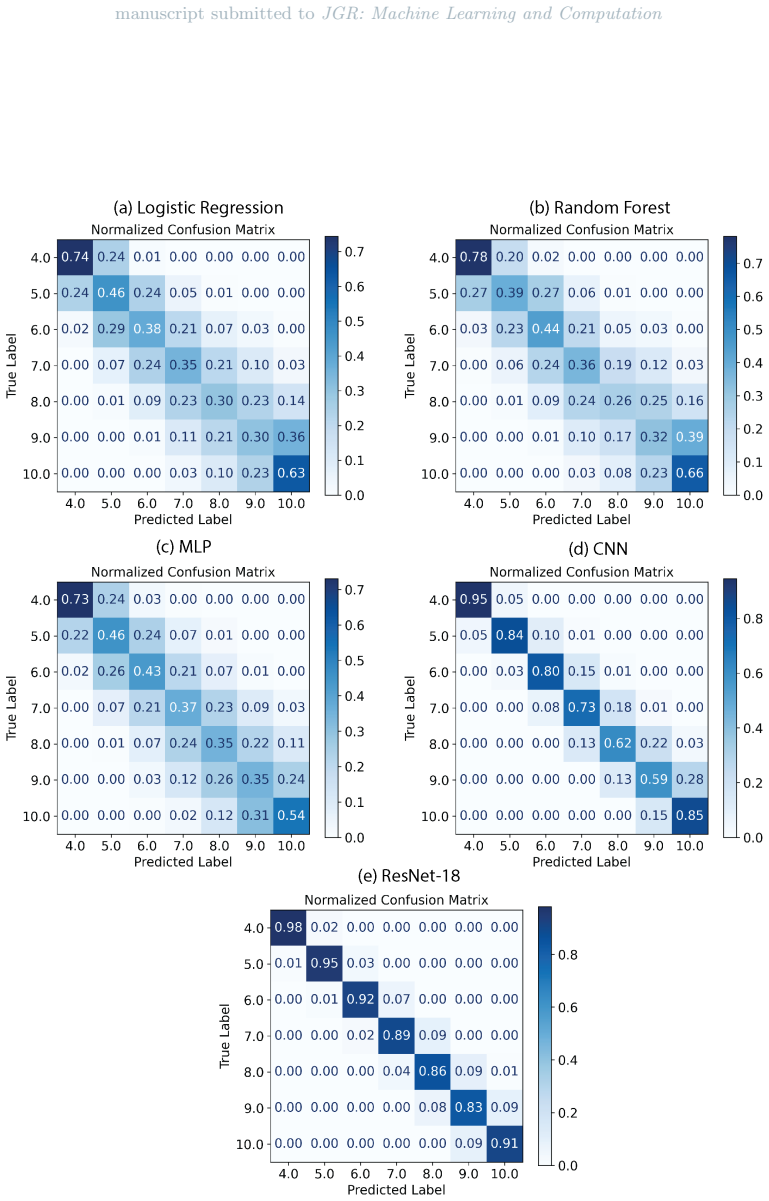
The central claim is that a neural network trained on idealized, computationally generated bullet rosettes can recover 3D microphysical attributes from 2D orthographic masks with high accuracy, provided the training distribution spans the geometric variability of natural rosettes. The paper establishes this on a held-out synthetic test set: a ResNet-18, a residual convolutional neural network, predicts effective density with $R^2=0.99$, effective surface area with $R^2=0.98$, and number of bullets with balanced accuracy and F1 of 0.91 from a single view; a stereo ResNet-18 using 90° view pairs improves F1 to 0.98 and reduces RMSE by 40% for the two regression targets. A second important claim is that the silhouette itself—not fine interior detail—carries most of the information, since binary masks suffice for high skill, and that classical engineered features such as area ratio dominate the learned predictions.
Load-bearing premise
The real-world version of the claim rests on the assumption that synthetic rosettes rendered as clean binary masks are representative of real CPI images, including the instrument's 2.3 µm resolution limits, noise, blur, and non-binary illumination; the paper explicitly states this validation is out of scope.
Editorial extensions
If this is right
- Mass and surface area become estimable per crystal from single-view CPI images, enabling bottom-up, observationally constrained mass–size ($m$–$D$) relationships from millions of historical images.
- Stereo imaging adds measurable value—40% RMSE reduction for the regression targets and an F1 gain from 0.91 to 0.98 for bullet count—providing a quantitative argument for multi-view probes like 2D-S and PHIPS.
- Because binary silhouettes are sufficient, the method is likely portable to other imaging and sizing probes with minimal preprocessing, potentially expanding the usable observation archive.
- The framework is habit-agnostic by construction: the same pipeline can be retargeted to columns, plates, and aggregates once representative generative geometry exists.
Reading between the lines
- The reported accuracies are probably an upper bound: real CPI images contain blur, noise, and intensity structure absent from binary orthographic renders, so sim-to-real degradation is expected until domain randomization or fine-tuning on real images is added.
- The dominance of area ratio in the SHAP analysis suggests that a substantial fraction of the predictive signal is captured by classical silhouette statistics; the marginal benefit of deep models is largest when a second view is available.
- A natural testable extension is measuring how prediction error varies with image quality (blur, defocus, noise) on synthetic data; this would map the robustness envelope before field deployment.
- Since the geometric priors come from a single three-day balloon sampling, a multi-campaign morphometric dataset would likely be needed for operational mass–size constraints across cloud types.
Signed reviews
Editorial analysis
A structured set of objections, weighed in public.
Referee Report
Summary. The paper presents a supervised machine learning pipeline for predicting three-dimensional microphysical properties of rosette ice crystals—effective density (ρe), effective surface area (Ae), and number of bullets (Nb)—from two-dimensional projected imagery. Synthetic 3D crystal geometries are generated from ICEBall-constrained parameters, rendered as binary orthographic projections, and used to train five single-view model families plus stereo-view variants. The authors report high test accuracy on synthetic images (R² = 0.99 for ρe, 0.98 for Ae, F1 = 0.91 for Nb) and quantify improvement from a second view. They frame the work as a proof-of-concept for eventually applying such models to real CPI data, explicitly deferring validation on real observations to future work.
Significance. If the reported results are robust, this is a useful proof-of-concept: the paper ships code and data, compares five model families, includes stereo-view experiments, and outlines a concrete downstream application to mass-dimensional relationships. The synthetic-to-real transfer gap is honestly acknowledged in Section 5, and the circularity concern that targets are derived from the same geometry that generates images does not, on reading, constitute a defect: the targets are not fed into the models, and the task is a standard supervised inverse problem. However, the central quantitative claims are currently undermined by the apparent image-level train/test split and by internally inconsistent error metrics in Table 3. Until these are resolved, the high reported numbers cannot be taken at face value, and the significance for the stated goal of estimating properties from in situ CPI imagery remains prospective rather than demonstrated.
major comments (3)
- [§2.2] The 70/15/15 split described in Section 2.2 appears to be applied at the image level to the 700,000-image subset, but the full dataset was generated from 70,000 unique 3D crystals with 100 random projections per crystal (Section 2.1). If the same particle ID appears in both training and test sets, then the test images are different orientations of crystals whose geometry the model has already seen, and the reported R² = 0.99, 0.98 and F1 = 0.91 reflect memorization of crystal geometry rather than generalization to unseen crystals. Because the authors state that the dataset includes a unique particle ID for each sample, a particle-level split is straightforward; the manuscript must clarify the split granularity and, if the split is currently image-level, re-run the evaluation with all 100 projections of any crystal confined to a single split. The term 'unseen synthetic images' in the abstract is misleading unless this is done.
- [Table 3] Several entries in Table 3 are mathematically impossible: for example, the single-view linear regression for ρe reports RMSE = 1.17×10⁻² and MAE = 9.19×10⁻², even though RMSE ≥ MAE for any set of predictions (equivalently, √mean(e²) ≥ mean|e|). The same ordering problem appears in essentially every row (e.g., RF ρe: RMSE 9.68×10⁻³ versus MAE 8.03×10⁻²). This indicates a unit error, a swapped column, or an error in metric computation. Since the error magnitudes are part of the quantitative claims (e.g., stereo models reduce RMSE by 40%), the table must be corrected and the reported reductions recomputed.
- [Abstract and §5] The abstract claims the framework predicts 3D properties 'from in situ two-dimensional imagery' and will allow downstream constraints on parameterizations, but all evaluation is on synthetic orthographic binary masks, and Section 5 explicitly states that ensuring synthetic data are representative of real CPI images is future work. This is a load-bearing gap for the abstract's central claim: the reported high accuracy is a synthetic benchmark, and no evidence is offered that the idealized rosette model (Eqs. 1–3), the ICEBall-constrained parameter ranges from three days of data, or the clean binary renders transfer to noisy, out-of-focus 2.3-µm CPI imagery. The authors should either add a real-data validation or clearly re-scope the abstract and title-level claims from 'in situ imagery' to 'synthetic imagery that approximates in situ data.'
minor comments (3)
- [Table 1] The range for r0 in Table 1 is listed as '[a, b] µm', but the text of Section 2.1 states r0 is bound by 0.5·a and a; the table entry should presumably read '[a/2, a] µm'.
- [§2.2.1] The text says that eight features were used as inputs for the non-convolutional models, but it then enumerates only seven features (aspect ratio, elliptical aspect ratio, number of extreme points, contour area, area ratio, complexity, and circularity), and Appendix A also lists seven. Either a feature is missing or the count should be seven, and the text and appendix should be made consistent.
- [Figure 12 caption] The final sentence of the Figure 12 caption says 'impact on model impact'; this appears to be a typo for 'impact on model output' or 'impact on the model's prediction'.
Circularity Check
Evaluation split leaks the same crystal into train and test, so the headline 'unseen image' accuracy is partly forced by per-crystal memorization rather than demonstrated generalization.
-
fitted input called prediction
[Section 2.1 (data generation) and Section 2.2 (train/validation/test split)]
"After generating 1,400 combinations of base geometric parameters, 50 random variants were created from each base state, resulting in 70,000 randomly perturbed parameter sets. ... For each crystal, the attributes listed in Table 2 were calculated and 100 random 2D projections were rendered. ... A training, validation, and test split of 70%, 15%, and 15% was used on the final 700,000 sample dataset."
The 700,000-image dataset is built from 70,000 crystals with 100 projections each, so on average each crystal contributes about 10 images to the subsample. The split is described on the 'sample dataset' (images), not on unique particle IDs, even though the dataset records a unique particle ID. Consequently, multiple projections of the same crystal fall on both sides of the split. A model trained on some views of a crystal can memorize the geometry-to-target association for that crystal and then 'predict' the same rho_e, A_e, or N_b from a different view of the same crystal in the test set.
full rationale
The central learning task is not circular in the narrow sense: rho_e, A_e, and N_b are computed from the 3D geometry, while the models see only rendered masks, and no target value is provided at inference; the reported R^2/F1 are empirical learning outcomes rather than algebraic identities. The main circularity is in the evaluation protocol. The paper generates 70,000 crystals and renders 100 projections per crystal, then applies a 70/15/15 split 'on the final 700,000 sample dataset.' Because the split is described at the image/sample level, and the dataset records a unique particle ID, the test set contains different projections of crystals whose other projections are in the training set. A high-capacity model can therefore memorize the target associated with each crystal from training views and recognize the same crystal from a new view at test time. The abstract's 'unseen synthetic images' are then unseen only in viewpoint, not in crystal identity, so the headline R^2=0.99/0.98 and F1=0.91 are partially forced by construction. This is a data-split/leakage issue rather than a derivation identity, but it has the same effect as fitting a per-crystal parameter and calling the result a prediction. The acknowledged synthetic-to-real transfer gap (Section 5) is a limitation, not a circularity. The self-citations (Pokrifka et al. 2023 for rosette geometry, Przybylo et al. 2022 for features) are not load-bearing because the equations and feature definitions appear in this paper and the parameter ranges are tied to ICEBall SEM observations. Separately, Table 3 lists RMSE > MAE for the linear regression (e.g., rho_e RMSE 1.17e-2 vs MAE 9.19e-2), which is mathematically impossible and indicates a metric-computation error; this is a correctness risk, not a circular step.
Assumptions & free parameters
assumptions (6)
- domain assumption Rosette crystals can be represented by a central sphere with Nb bullet arms, each a hexagonal prism with a pyramidal tip, parameterized by a, c/a, hp, h0, r0, and Nb.
- domain assumption The geometric parameter ranges derived from three days of ICEBall SEM imagery (October 23 to 25, 2021) are representative of the rosette population in cirrus clouds targeted by CPI.
- domain assumption The linear parameterizations r0 = fr0 * (beta_r0,1 * Nb + beta_r0,0), hp = fhp * (beta_hp,1 * Nb + beta_hp,0), and h0 = fh0 * r0 / 2 are adequate for generating realistic rosettes.
- domain assumption Bullet arms are placed on the sphere using spherical codes with random perturbation within a cap of angle theta = phi_Nb / 3, with each bullet's c-axis normal to the sphere surface.
- domain assumption Orthographic binary masks are sufficient proxies for CPI images; rendering artifacts such as diffraction, blur, grayscale shading, and 2.3 µm pixel quantization are unnecessary for learning.
- domain assumption The 70/15/15 split of the 700,000-image dataset produces a valid test set for measuring generalization to unseen crystals.
Cite this review
Pith. "Pith review of A Machine Learning Framework for Predicting Microphysical Properties of Ice Crystals from Cloud Particle Imagery." pith.science (2026). https://pith.science/paper/NLBSLRER
@misc{pith2026250719759,
  author       = {Pith},
  title        = {Pith review of: A Machine Learning Framework for Predicting Microphysical Properties of Ice Crystals from Cloud Particle Imagery},
  year         = {2026},
  howpublished = {\url{https://pith.science/paper/NLBSLRER}},
  note         = {Machine review of arXiv:2507.19759}
}
abstract
The microphysical properties of ice crystals are important because they significantly alter the radiative properties and spatiotemporal distributions of clouds, which in turn strongly affect Earth's climate. However, it is challenging to measure key properties of ice crystals, such as mass or morphological features. Here, we present a framework for predicting three-dimensional (3D) microphysical properties of ice crystals from in situ two-dimensional (2D) imagery. First, we computationally generate synthetic ice crystals using 3D modeling software along with geometric parameters estimated from the 2021 Ice Cryo-Encapsulation Balloon (ICEBall) field campaign. Then, we use synthetic crystals to train machine learning (ML) models to predict effective density ($\rho_{e}$), effective surface area ($A_e$), and number of bullets ($N_b$) from synthetic rosette imagery. When tested on unseen synthetic images, we find that our ML models can predict microphysical properties with high accuracy. For $\rho_{e}$ and $A_e$, respectively, our best-performing single view models achieved $R^2$ values of 0.99 and 0.98. For $N_b$, our best single view model achieved a balanced accuracy and F1 score of 0.91. We also quantify the marginal prediction improvements from incorporating a second view. A stereo view ResNet-18 model reduced RMSE by 40% for both $\rho_e$ and $A_e$, relative to a single view ResNet-18 model. For $N_b$, we find that a stereo view ResNet-18 model improved the F1 score by 8%. This work provides a novel ML-driven framework for estimating ice microphysical properties from in situ imagery, which will allow for downstream constraints on microphysical parameterizations, such as the mass-size relationship.
Figures


Figures from the paper (9 more)





Reference graph
Works this paper leans on
-
[1]
abdelmonemPHIPSHALOAirborne2016a APACrefauthors Abdelmonem, A. , J \"a rvinen, E. , Duft, D. , Hirst, E. , Vogt, S. , Leisner, T. \ Schnaiter, M. APACrefauthors \ 2016 07 . PHIPS -- HALO : The Airborne Particle Habit Imaging and Polar Scattering Probe -- Part 1: Design and Operation PHIPS -- HALO : The airborne Particle Habit Imaging and Polar Scattering ...
-
[2]
albrechtFastElectronTomography2020 APACrefauthors Albrecht, W. \ Bals, S. APACrefauthors \ 2020 12 . Fast Electron Tomography for Nanomaterials Fast Electron Tomography for Nanomaterials . The Journal of Physical Chemistry C 124 50 27276--27286 . APACrefDOI doi:10.1021/acs.jpcc.0c08939 APACrefDOI
-
[3]
, Matrosov, S Y
atlasRadarRadiationProperties1995 APACrefauthors Atlas, D. , Matrosov, S Y. , Heymsfield, A J. , Chou, M D. \ Wolff, D B. APACrefauthors \ 1995 11 . Radar and Radiation Properties of Ice Clouds Radar and Radiation Properties of Ice Clouds . Journal of Applied Meteorology and Climatology
1995
-
[4]
auCadQueryCadqueryCadQuery2024 APACrefauthors AU , Wright, J. , thebluedirt , Boyd, M. , Lorenz , Solutions, I T. jdegenstein APACrefauthors \ 2024 01 . CadQuery /Cadquery: CadQuery 2.4.0. CadQuery /cadquery: CadQuery 2.4.0. Zenodo . APACrefDOI doi:10.5281/zenodo.10513848 APACrefDOI
-
[5]
baileyComprehensiveHabitDiagram2009 APACrefauthors Bailey, M P. \ Hallett, J. APACrefauthors \ 2009 . A Comprehensive Habit Diagram for Atmospheric Ice Crystals: Confirmation from the Laboratory, AIRS II , and Other Field Studies A comprehensive habit diagram for atmospheric ice crystals: Confirmation from the laboratory, AIRS II , and other field studies...
-
[6]
bakerImprovementDeterminationIce2006 APACrefauthors Baker, B. \ Lawson, R P. APACrefauthors \ 2006 . Improvement in Determination of Ice Water Content from Two-Dimensional Particle Imagery. Part I : Image-to-mass Relationships Improvement in determination of ice water content from two-dimensional particle imagery. Part I : Image-to-mass relationships . Jo...
-
[7]
APACrefauthors \ 1974 10
baumgartGeometricModelingComputer1974 APACrefauthors Baumgart, B G. APACrefauthors \ 1974 10 . Geometric Modeling for Computer Vision Geometric Modeling for Computer Vision \ . Stanford University
1974
-
[8]
breimanRandomForests2001 APACrefauthors Breiman, L. APACrefauthors \ 2001 10 . Random Forests Random Forests . Machine Learning 45 1 5--32 . APACrefDOI doi:10.1023/A:1010933404324 APACrefDOI
Show all 88 references
-
[9]
\ Francis, P N
brownImprovedMeasurementsIce1995 APACrefauthors Brown, P R A. \ Francis, P N. APACrefauthors \ 1995 . Improved Measurements of the Ice Water Content in Cirrus Using a Total-Water Probe Improved Measurements of the Ice Water Content in Cirrus Using a Total-Water Probe . Journal...
1995 doi
-
[10]
\ Servin, M
buttImportanceSilhouetteOptimization2020 APACrefauthors Butt, W u R. \ Servin, M. APACrefauthors \ 2020 12 . The Importance of Silhouette Optimization in 3D Shape Reconstruction System from Multiple Object Scenes The importance of silhouette optimization in 3D shape reconstruc...
-
[11]
APACrefauthors \ 2009 09
camps-vallsMachineLearningRemote2009 APACrefauthors Camps-Valls , G. APACrefauthors \ 2009 09 . Machine Learning in Remote Sensing Data Processing Machine learning in remote sensing data processing . 2009 IEEE International Workshop on Machine Learning for Signal Processing 20...
2009
-
[12]
, Morrison, H
chandrakarWhatControlsCrystal2024 APACrefauthors Chandrakar, K K. , Morrison, H. , Harrington, J Y. , Pokrifka, G. \ Magee, N. APACrefauthors \ 2024 . What Controls Crystal Diversity and Microphysical Variability in Cirrus Clouds ? What Controls Crystal Diversity and Microphys...
2024 doi
-
[13]
\ Titterington, D M
chengNeuralNetworksReview1994 APACrefauthors Cheng, B. \ Titterington, D M. APACrefauthors \ 1994 . Neural Networks : A Review from a Statistical Perspective Neural Networks : A Review from a Statistical Perspective . Statistical Science 9 1 2--30
1994
-
[14]
, Field, P R
cottonEffectiveDensitySmall2013 APACrefauthors Cotton, R J. , Field, P R. , Ulanowski, Z. , Kaye, P H. , Hirst, E. , Greenaway, R S. Dorsey, J. APACrefauthors \ 2013 10 . The Effective Density of Small Ice Particles Obtained from in Situ Aircraft Observations of Mid-Latitude C...
2013 doi
-
[15]
, Anthes, R A
cucurullObservingSystemSimulation2024 APACrefauthors Cucurull, L. , Anthes, R A. , Casey, S P F. , Mueller, M J. \ Vidal, A. APACrefauthors \ 2024 06 . Observing System Simulation Experiments ( OSSEs ) in Support of Next-Generation NOAA Satellite Constellation Observing System...
2024 doi
-
[16]
, Clothiaux, E E
dasIceCrystalHabit2025 APACrefauthors Das, A. , Clothiaux, E E. \ Harrington, J Y. APACrefauthors \ 2025 . Ice Crystal Habit Effects on the Resilience of Arctic Mixed-Phase Stratus Clouds in a One-Dimensional Model Ice Crystal Habit Effects on the Resilience of Arctic Mixed-Ph...
2025 doi
-
[17]
\ Mitchell, D L
erfaniDevelopingBoundingIce2016 APACrefauthors Erfani, E. \ Mitchell, D L. APACrefauthors \ 2016 . Developing and Bounding Ice Particle Mass- and Area-Dimension Expressions for Use in Atmospheric Models and Remote Sensing Developing and bounding ice particle mass- and area-dim...
2016 doi
-
[18]
, Korfiatis, P
ericksonMachineLearningMedical2017 APACrefauthors Erickson, B J. , Korfiatis, P. , Akkus, Z. \ Kline, T L. APACrefauthors \ 2017 03 . Machine Learning for Medical Imaging Machine Learning for Medical Imaging . RadioGraphics 37 2 505--515 . APACrefDOI doi:10.1148/rg.2017160130 ...
2017 doi
-
[19]
, Atlas, R
fridlindDerivationPhysicalOptical2016 APACrefauthors Fridlind, A M. , Atlas, R. , van Diedenhoven , B. , Um, J. , McFarquhar, G M. , Ackerman, A S. Lawson, R P. APACrefauthors \ 2016 . Derivation of Physical and Optical Properties of Mid-Latitude Cirrus Ice Crystals for a Size...
2016
-
[20]
, Fallgatter, C
garrettFallSpeedMeasurement2012 APACrefauthors Garrett, T J. , Fallgatter, C. , Shkurko, K. \ Howlett, D. APACrefauthors \ 2012 . Fall Speed Measurement and High-Resolution Multi-Angle Photography of Hydrometeors in Free Fall Fall speed measurement and high-resolution multi-an...
2012 doi
-
[21]
APACrefauthors \ 2018 03
gigerMachineLearningMedical2018 APACrefauthors Giger, M L. APACrefauthors \ 2018 03 . Machine Learning in Medical Imaging Machine Learning in Medical Imaging . Journal of the American College of Radiology 15 3, Part B 512--520 . APACrefDOI doi:10.1016/j.jacr.2017.12.028 APACrefDOI
2018 doi
-
[22]
, Oyallon, E
grinsztajnWhyTreebasedModels2022 APACrefauthors Grinsztajn, L. , Oyallon, E. \ Varoquaux, G. APACrefauthors \ 2022 . Why Do Tree-Based Models Still Outperform Deep Learning on Typical Tabular Data? Why do tree-based models still outperform deep learning on typical tabular data...
2022
-
[23]
, Liu, Y
guoDeepLearningVisual2016 APACrefauthors Guo, Y. , Liu, Y. , Oerlemans, A. , Lao, S. , Wu, S. \ Lew, M S. APACrefauthors \ 2016 04 . Deep Learning for Visual Understanding: A Review Deep learning for visual understanding: A review . Neurocomputing 187 27--48 . APACrefDOI doi:1...
2016 doi
-
[24]
, Flin, F
haffarXrayTomography3D2021 APACrefauthors Haffar, I. , Flin, F. , Geindreau, C. , Petillon, N. , Gervais, P C. \ Edery, V. APACrefauthors \ 2021 05 . X-Ray Tomography for 3D Analysis of Ice Particles in Jet A-1 Fuel X-ray tomography for 3D analysis of ice particles in jet A-1 ...
2021 doi
-
[25]
, Laga, H
hanImageBased3DObject2021 APACrefauthors Han, X F. , Laga, H. \ Bennamoun, M. APACrefauthors \ 2021 05 . Image- Based 3D Object Reconstruction : State-of-the-Art and Trends in the Deep Learning Era Image- Based 3D Object Reconstruction : State-of-the-Art and Trends in the Deep...
2021
-
[26]
APACrefauthors \ 2012 09
haroShapeSilhouetteConsensus2012 APACrefauthors Haro, G. APACrefauthors \ 2012 09 . Shape from Silhouette Consensus Shape from Silhouette Consensus . Pattern Recognition 45 9 3231--3244 . APACrefDOI doi:10.1016/j.patcog.2012.02.029 APACrefDOI
2012 doi
-
[27]
\ Magee, N
harringtonIceCryoEncapsulationBalloon2023 APACrefauthors Harrington, J. \ Magee, N. APACrefauthors \ 2023 05 . Ice Cryo-Encapsulation Balloon ( Project ICEBall ) Field Campaign Report Ice Cryo-Encapsulation Balloon ( Project ICEBall ) Field Campaign Report \ \ \ DOE/SC-ARM--23...
2023 doi
-
[28]
, Zhang, X
heDeepResidualLearning2015 APACrefauthors He, K. , Zhang, X. , Ren, S. \ Sun, J. APACrefauthors \ 2015 12 . Deep Residual Learning for Image Recognition Deep Residual Learning for Image Recognition \ ( \ arXiv:1512.03385). arXiv . APACrefDOI doi:10.48550/arXiv.1512.03385 APACrefDOI
-
[29]
, McMurdie, L A
houzeOlympicMountainsExperiment2017 APACrefauthors Houze, R A. , McMurdie, L A. , Petersen, W A. , Schwaller, M R. , Baccus, W. , Lundquist, J D. Chandrasekar, V. APACrefauthors \ 2017 10 . The Olympic Mountains Experiment ( OLYMPEX ) The Olympic Mountains Experiment ( OLYMPEX...
2017 doi
-
[30]
, Adachi, S
ishimotoSnowParticlesExtracted2018 APACrefauthors Ishimoto, H. , Adachi, S. , Yamaguchi, S. , Tanikawa, T. , Aoki, T. \ Masuda, K. APACrefauthors \ 2018 04 . Snow Particles Extracted from X-ray Computed Microtomography Imagery and Their Single-Scattering Properties Snow partic...
2018 doi
-
[31]
, McFarquhar, G M
jacksonDependenceIceMicrophysics2012 APACrefauthors Jackson, R C. , McFarquhar, G M. , Korolev, A V. , Earle, M E. , Liu, P S. , Lawson, R P. Freer, M. APACrefauthors \ 2012 . The Dependence of Ice Microphysics on Aerosol Concentration in Arctic Mixed-Phase Stratus Clouds duri...
2012 doi
-
[32]
, Jourdan, O
jarvinenAdditionalGlobalClimate2018 APACrefauthors J \"a rvinen, E. , Jourdan, O. , Neubauer, D. , Yao, B. , Liu, C. , Andreae, M O. Schnaiter, M. APACrefauthors \ 2018 11 . Additional Global Climate Cooling by Clouds Due to Ice Crystal Complexity Additional global climate coo...
2018 doi
-
[33]
, Harrington, J Y
jensenImpactsIceParticle2018 APACrefauthors Jensen, A A. , Harrington, J Y. \ Morrison, H. APACrefauthors \ 2018 . Impacts of Ice Particle Shape and Density Evolution on the Distribution of Orographic Precipitation Impacts of ice particle shape and density evolution on the dis...
2018 doi
-
[34]
, Pfister, L
jensenNASAAirborneTropical2017 APACrefauthors Jensen, E J. , Pfister, L. , Jordan, D E. , Bui, T V. , Ueyama, R. , Singh, H B. Pfeilsticker, K. APACrefauthors \ 2017 01 . The NASA Airborne Tropical Tropopause Experiment : High-Altitude Aircraft Measurements in the Tropical Wes...
2017 doi
-
[35]
, Oue, M
jiangWhatCanWe2017 APACrefauthors Jiang, Z. , Oue, M. , Verlinde, J. , Clothiaux, E E. , Aydin, K. , Botta, G. \ Lu, Y. APACrefauthors \ 2017 03 . What Can We Conclude about the Real Aspect Ratios of Ice Particle Aggregates from Two-Dimensional Images ? What Can We Conclude ab...
2017 doi
-
[36]
, Verlinde, J
jiangShapesFallOrientations2019 APACrefauthors Jiang, Z. , Verlinde, J. , Clothiaux, E E. , Aydin, K. \ Schmitt, C. APACrefauthors \ 2019 07 . Shapes and Fall Orientations of Ice Particle Aggregates Shapes and Fall Orientations of Ice Particle Aggregates . Journal of the Atmos...
2019 doi
-
[37]
APACrefauthors \ 1972
kajikawaMeasurementFallingVelocity1972 APACrefauthors Kajikawa, M. APACrefauthors \ 1972 . Measurement of Falling Velocity of Individual Snow Crystals Measurement of Falling Velocity of Individual Snow Crystals . Journal of the Meteorological Society of Japan. Ser. II 50 6 . A...
1972 doi
-
[38]
, Huang, G J
kleinkortVisualHullMethod2017 APACrefauthors Kleinkort, C. , Huang, G J. , Bringi, V N. \ Notaro s , B M. APACrefauthors \ 2017 03 . Visual Hull Method for Realistic 3D Particle Shape Reconstruction Based on High-Resolution Photographs of Snowflakes in Free Fall from Multiple ...
2017
-
[39]
, Singer, C E
lambPerspectivesSystematicCloud2025 APACrefauthors Lamb, K D. , Singer, C E. , Loftus, K. , Morrison, H. , Powell, M. , Ko, J. Gentine, P. APACrefauthors \ 2025 07 . Perspectives on Systematic Cloud Microphysics Scheme Development with Machine Learning . Perspectives on System...
2025
-
[40]
APACrefauthors \ 1994 02
laurentiniVisualHullConcept1994 APACrefauthors Laurentini, A. APACrefauthors \ 1994 02 . The Visual Hull Concept for Silhouette-Based Image Understanding The visual hull concept for silhouette-based image understanding . IEEE Transactions on Pattern Analysis and Machine Intell...
1994 doi
-
[41]
, Baker, B
lawsonSituObservationsMicrophysical2006 APACrefauthors Lawson, R P. , Baker, B. , Pilson, B. \ Mo, Q. APACrefauthors \ 2006 12 . In Situ Observations of the Microphysical Properties of Wave , Cirrus , and Anvil Clouds . Part II : Cirrus Clouds In Situ Observations of the Micro...
2006 doi
-
[42]
, Baker, B A
lawsonOverviewMicrophysicalProperties2001 APACrefauthors Lawson, R P. , Baker, B A. , Schmitt, C G. \ Jensen, T L. APACrefauthors \ 2001 . An Overview of Microphysical Properties of Arctic Clouds Observed in May and July 1998 during FIRE ACE An overview of microphysical proper...
2001 doi
-
[43]
, O'Connor, D
lawson2DSStereoProbe2006 APACrefauthors Lawson, R P. , O'Connor, D. , Zmarzly, P. , Weaver, K. , Baker, B. , Mo, Q. \ Jonsson, H. APACrefauthors \ 2006 11 . The 2D-S ( Stereo ) Probe : Design and Preliminary Tests of a New Airborne , High-Speed , High-Resolution Particle Imagi...
2006 doi
-
[44]
, Woods, S
lawsonReviewIceParticle2019 APACrefauthors Lawson, R P. , Woods, S. , Jensen, E. , Erfani, E. , Gurganus, C. , Gallagher, M. Kr \"a mer, M. APACrefauthors \ 2019 09 . A Review of Ice Particle Shapes in Cirrus Formed In Situ and in Anvils A Review of Ice Particle Shapes in Cirr...
2019 doi
-
[45]
, Woods, S
lawsonMicrophysicsIcePrecipitation2015 APACrefauthors Lawson, R P. , Woods, S. \ Morrison, H. APACrefauthors \ 2015 06 . The Microphysics of Ice and Precipitation Development in Tropical Cumulus Clouds The Microphysics of Ice and Precipitation Development in Tropical Cumulus C...
2015 doi
-
[46]
, Bengio, Y
lecunDeepLearning2015 APACrefauthors LeCun, Y. , Bengio, Y. \ Hinton, G. APACrefauthors \ 2015 05 . Deep Learning Deep learning . Nature 521 7553 436--444 . APACrefDOI doi:10.1038/nature14539 APACrefDOI
2015 doi
-
[47]
, Bottou, L
lecunGradientbasedLearningApplied1998 APACrefauthors Lecun, Y. , Bottou, L. , Bengio, Y. \ Haffner, P. APACrefauthors \ 1998 11 . Gradient-Based Learning Applied to Document Recognition Gradient-based learning applied to document recognition . Proceedings of the IEEE 86 11 227...
1998 doi
-
[48]
, Fontaine, E
leroyIceCrystalSizes2016 APACrefauthors Leroy, D. , Fontaine, E. , Schwarzenboeck, A. \ Strapp, J W. APACrefauthors \ 2016 . Ice Crystal Sizes in High Ice Water Content Clouds. Part I : On the Computation of Median Mass Diameter from in Situ Measurements Ice Crystal sizes in h...
2016 doi
-
[49]
\ Conklin, M
lipovetskyAnalysisRegressionGame2001 APACrefauthors Lipovetsky, S. \ Conklin, M. APACrefauthors \ 2001 . Analysis of Regression in Game Theory Approach Analysis of regression in game theory approach . Applied Stochastic Models in Business and Industry 17 4 319--330 . APACrefDO...
2001 doi
-
[50]
\ Hobbs, P V
locatelliFallSpeedsMasses1974 APACrefauthors Locatelli, J D. \ Hobbs, P V. APACrefauthors \ 1974 . Fall Speeds and Masses of Solid Precipitation Particles Fall speeds and masses of solid precipitation particles . Journal of Geophysical Research 79 15 . APACrefDOI doi:10.1029/j...
1974 doi
-
[51]
APACrefauthors \ 2015 06
louppeUnderstandingRandomForests2015 APACrefauthors Louppe, G. APACrefauthors \ 2015 06 . Understanding Random Forests : From Theory to Practice Understanding Random Forests : From Theory to Practice \ ( \ arXiv:1407.7502). arXiv
2015 arXiv
-
[52]
\ Lee, S I
lundbergUnifiedApproachInterpreting2017 APACrefauthors Lundberg, S. \ Lee, S I. APACrefauthors \ 2017 11 . A Unified Approach to Interpreting Model Predictions A Unified Approach to Interpreting Model Predictions \ ( \ arXiv:1705.07874). arXiv . APACrefDOI doi:10.48550/arXiv.1...
-
[53]
\ Langleben, M P
marshallTHEORYSNOWCRYSTALHABIT1954 APACrefauthors Marshall, J S. \ Langleben, M P. APACrefauthors \ 1954 04 . A THEORY OF SNOW-CRYSTAL HABIT AND GROWTH A THEORY OF SNOW-CRYSTAL HABIT AND GROWTH . Journal of Atmospheric Sciences
1954
-
[54]
, W., Timothy A
maxwellImplementationMachinelearningClassification2018 APACrefauthors Maxwell, A E. , W., Timothy A. \ and Fang , F. APACrefauthors \ 2018 05 . Implementation of Machine-Learning Classification in Remote Sensing: An Applied Review Implementation of machine-learning classificat...
2018
-
[55]
, Baumgardner, D
mcfarquharProcessingIceCloud2017 APACrefauthors McFarquhar, G M. , Baumgardner, D. , Bansemer, A. , Abel, S J. , Crosier, J. , French, J. Dong, J Y. APACrefauthors \ 2017 . Processing of Ice Cloud In Situ Data Collected by Bulk Water , Scattering , and Imaging Probes : Fundame...
2017
-
[56]
mcfarquharSmallCloudParticle2013 APACrefauthors McFarquhar, G M. , Um, J. \ Jackson, R. APACrefauthors \ 2013 05 . Small Cloud Particle Shapes in Mixed-Phase Clouds Small Cloud Particle Shapes in Mixed-Phase Clouds . Journal of Applied Meteorology and Climatology . APACrefDOI ...
2013 doi
-
[57]
\ Dunin-Borkowski , R E
midgleyElectronTomographyHolography2009 APACrefauthors Midgley, P A. \ Dunin-Borkowski , R E. APACrefauthors \ 2009 04 . Electron Tomography and Holography in Materials Science Electron tomography and holography in materials science . Nature Materials 8 4 271--280 . APACrefDOI...
2009 doi
-
[58]
\ Morrison, H
milbrandtParameterizationCloudMicrophysics2016 APACrefauthors Milbrandt, J A. \ Morrison, H. APACrefauthors \ 2016 . Parameterization of Cloud Microphysics Based on the Prediction of Bulk Ice Particle Properties. Part III : Introduction of Multiple Free Categories Parameteriza...
2016 doi
-
[59]
, Zhang, R
mitchellMassdimensionalRelationshipsIce1990 APACrefauthors Mitchell, D L. , Zhang, R. \ Pitter, R L. APACrefauthors \ 1990 . Mass-Dimensional Relationships for Ice Particles and the Influence of Riming on Snowfall Rates Mass-dimensional relationships for ice particles and the ...
1990 doi
-
[60]
\ Milbrandt, J A
morrisonParameterizationCloudMicrophysics2015 APACrefauthors Morrison, H. \ Milbrandt, J A. APACrefauthors \ 2015 . Parameterization of Cloud Microphysics Based on the Prediction of Bulk Ice Particle Properties. Part I : Scheme Description and Idealized Tests Parameterization ...
2015 doi
-
[61]
, Milbrandt, J A
morrisonParameterizationCloudMicrophysics2015a APACrefauthors Morrison, H. , Milbrandt, J A. , Bryan, G H. , Ikeda, K. , Tessendorf, S A. \ Thompson, G. APACrefauthors \ 2015 . Parameterization of Cloud Microphysics Based on the Prediction of Bulk Ice Particle Properties. Part...
2015
-
[62]
, van Lier-Walqui , M
morrisonConfrontingChallengeModeling2020 APACrefauthors Morrison, H. , van Lier-Walqui , M. , Fridlind, A M. , Grabowski, W W. , Harrington, J Y. , Hoose, C. Xue, L. APACrefauthors \ 2020 . Confronting the Challenge of Modeling Cloud and Precipitation Microphysics Confronting ...
2020 doi
-
[63]
\ Hallett, J
oraltayMeltingLayerLaboratory2005 APACrefauthors Oraltay, R G. \ Hallett, J. APACrefauthors \ 2005 02 . The Melting Layer : A Laboratory Investigation of Ice Particle Melt and Evaporation near 0 ^ C The Melting Layer : A Laboratory Investigation of Ice Particle Melt and Evapor...
2005 doi
-
[64]
, Gross, S
paszkeAutomaticDifferentiationPyTorch2017 APACrefauthors Paszke, A. , Gross, S. , Chintala, S. , Chanan, G. , Yang, E. , DeVito, Z. Lerer, A. APACrefauthors \ 2017 . Automatic Differentiation in PyTorch Automatic differentiation in PyTorch . 31st Conference on Neural Informati...
2017
-
[65]
, Varoquaux, G
pedregosaScikitlearnMachineLearning2011 APACrefauthors Pedregosa, F. , Varoquaux, G. , Gramfort, A. , Michel, V. , Thirion, B. , Grisel, O. Duchesnay, E. APACrefauthors \ 2011 . Scikit-Learn: Machine Learning in Python Scikit-learn: Machine Learning in Python . Journal of Mach...
2011
-
[66]
, Moyle, A M
pokrifkaEffectiveDensityDerived2023 APACrefauthors Pokrifka, G F. , Moyle, A M. \ Harrington, J Y. APACrefauthors \ 2023 01 . Effective Density Derived from Laboratory Measurements of the Vapor Growth Rates of Small Ice Crystals at -65 ^ to -40 ^ C Effective Density Derived fr...
2023 doi
-
[67]
, Sulia, K J
przybyloClassificationCloudParticle2022 APACrefauthors Przybylo, V M. , Sulia, K J. , Schmitt, C G. \ Lebo, Z J. APACrefauthors \ 2022 04 . Classification of Cloud Particle Imagery from Aircraft Platforms Using Convolutional Neural Networks Classification of Cloud Particle Ima...
2022 doi
-
[68]
APACrefauthors \ 2004 08
ritmanMicroComputedTomographyCurrent2004 APACrefauthors Ritman, E L. APACrefauthors \ 2004 08 . Micro- Computed Tomography --- Current Status and Developments Micro- Computed Tomography --- Current Status and Developments . Annual Review of Biomedical Engineering 6 Volume 6, 2...
2004
-
[69]
\ Soryani, M
samavatiDeepLearningbased3D2023 APACrefauthors Samavati, T. \ Soryani, M. APACrefauthors \ 2023 09 . Deep Learning-Based 3D Reconstruction: A Survey Deep learning-based 3D reconstruction: A survey . Artificial Intelligence Review 56 9 9175--9219 . APACrefDOI doi:10.1007/s10462...
2023 doi
-
[70]
\ Heymsfield, A J
schmittDimensionalCharacteristicsIce2010 APACrefauthors Schmitt, C G. \ Heymsfield, A J. APACrefauthors \ 2010 . The Dimensional Characteristics of Ice Crystal Aggregates from Fractal Geometry The dimensional characteristics of ice crystal aggregates from fractal geometry . Jo...
2010 doi
-
[71]
\ Heymsfield, A J
schmittObservationalQuantificationSeparation2014 APACrefauthors Schmitt, C G. \ Heymsfield, A J. APACrefauthors \ 2014 . Observational Quantification of the Separation of Simple and Complex Atmospheric Ice Particles Observational quantification of the separation of simple and ...
2014 doi
-
[72]
, J \"a rvinen, E
schnaiterPHIPSHALOAirborneParticle2018 APACrefauthors Schnaiter, M. , J \"a rvinen, E. , Abdelmonem, A. \ Leisner, T. APACrefauthors \ 2018 . PHIPS-HALO : The Airborne Particle Habit Imaging and Polar Scattering Probe - Part 2: Characterization and First Results PHIPS-HALO : T...
2018 doi
-
[73]
, Martin, K
schroederVisualizationToolkit4th2006 APACrefauthors Schroeder, W. , Martin, K. \ Lorensen, B. APACrefauthors \ 2006 . The Visualization Toolkit (4th Ed.) The Visualization Toolkit (4th ed.) . Kitware
2006
-
[74]
o m Resolution Electron tomography at 2.4- ngstr \
scottElectronTomography24angstrom2012 APACrefauthors Scott, M C. , Chen, C C. , Mecklenburg, M. , Zhu, C. , Xu, R. , Ercius, P. Miao, J. APACrefauthors \ 2012 03 . Electron Tomography at 2.4- ngstr \"o m Resolution Electron tomography at 2.4- ngstr \"o m resolution . Nature 48...
2012 doi
-
[75]
, Sato, Y
shimaPredictingMorphologyIce2020 APACrefauthors Shima, S I. , Sato, Y. , Hashimoto, A. \ Misumi, R. APACrefauthors \ 2020 . Predicting the Morphology of Ice Particles in Deep Convection Using the Super-Droplet Method: Development and Evaluation of SCALE-SDM 0.2.5-2.2.0, -2.2.1...
2020
-
[76]
, Hardin, R H
sloaneSphericalCodes2000 APACrefauthors Sloane, N J A. , Hardin, R H. \ Smith, W. APACrefauthors \ 2000 . Spherical Codes . Spherical Codes . http://neilsloane.com/packings/
2000
-
[77]
\ Igel, A L
sterzingerEffectsIceHabit2021 APACrefauthors Sterzinger, L J. \ Igel, A L. APACrefauthors \ 2021 . The Effects of Ice Habit on Simulated Orographic Snowfall The Effects of Ice Habit on Simulated Orographic Snowfall . JOURNAL OF HYDROMETEOROLOGY 22 6 1649--1661 . APACrefDOI doi...
2021 doi
-
[78]
\ Kononenko, I
strumbeljExplainingPredictionModels2014 APACrefauthors S trumbelj, E. \ Kononenko, I. APACrefauthors \ 2014 12 . Explaining Prediction Models and Individual Predictions with Feature Contributions Explaining prediction models and individual predictions with feature contribution...
2014 doi
-
[79]
\ Kaszynski, A A
sullivanPyVista3DPlotting2019 APACrefauthors Sullivan, C B. \ Kaszynski, A A. APACrefauthors \ 2019 05 . PyVista : 3D Plotting and Mesh Analysis through a Streamlined Interface for the Visualization Toolkit ( VTK ) PyVista : 3D plotting and mesh analysis through a streamlined ...
2019 doi
-
[80]
\ Voigt, A
sullivanIceMicrophysicalProcesses2021 APACrefauthors Sullivan, S C. \ Voigt, A. APACrefauthors \ 2021 07 . Ice Microphysical Processes Exert a Strong Control on the Simulated Radiative Energy Budget in the Tropics Ice microphysical processes exert a strong control on the simul...
2021 doi
-
[81]
, Gommers, R
virtanenSciPy10Fundamental2020 APACrefauthors Virtanen, P. , Gommers, R. , Oliphant, T E. , Haberland, M. , Reddy, T. , Cournapeau, D. van Mulbregt , P. APACrefauthors \ 2020 03 . SciPy 1.0: Fundamental Algorithms for Scientific Computing in Python SciPy 1.0: Fundamental algor...
2020 doi
-
[82]
, Schnaiter, M
wagnerLightScatteringMicrophysical2024 APACrefauthors Wagner, S W. , Schnaiter, M. , Xu, G. , Nehlert, F. \ J \"a rvinen, E. APACrefauthors \ 2024 11 . Light Scattering and Microphysical Properties of Atmospheric Bullet Rosette Ice Crystals Light scattering and microphysical p...
2024 doi
-
[83]
wangImpactCloudIce2020 APACrefauthors Wang, Y. , Su, H. , Jiang, J H. , Xu, F. \ Yung, Y L. APACrefauthors \ 2020 . Impact of Cloud Ice Particle Size Uncertainty in a Climate Model and Implications for Future Satellite Missions Impact of Cloud Ice Particle Size Uncertainty in ...
2020 doi
-
[84]
, Yang, P
wendischEffectsIceCrystal2007 APACrefauthors Wendisch, M. , Yang, P. \ Pilewskie, P. APACrefauthors \ 2007 . Effects of Ice Crystal Habit on Thermal Infrared Radiative Properties and Forcing of Cirrus Effects of ice crystal habit on thermal infrared radiative properties and fo...
2007 doi
-
[85]
\ Midgley, P A
weylandElectronTomography2004 APACrefauthors Weyland, M. \ Midgley, P A. APACrefauthors \ 2004 12 . Electron Tomography Electron tomography . Materials Today 7 12 32--40 . APACrefDOI doi:10.1016/S1369-7021(04)00569-3 APACrefDOI
2004 doi
-
[86]
, Dobbie, S
yangEffectObservedVertical2012 APACrefauthors Yang, H. , Dobbie, S. , Herbert, R. , Connolly, P. , Gallagher, M. , Ghosh, S. Clayton, J. APACrefauthors \ 2012 07 . The Effect of Observed Vertical Structure, Habits, and Size Distributions on the Solar Radiative Properties and C...
2012
-
[87]
, Song, Y
yaoMolecularArchitectureSARSCoV22020 APACrefauthors Yao, H. , Song, Y. , Chen, Y. , Wu, N. , Xu, J. , Sun, C. Li, S. APACrefauthors \ 2020 10 . Molecular Architecture of the SARS-CoV-2 Virus Molecular Architecture of the SARS-CoV-2 Virus . Cell 183 3 730-738.e13 . APACrefDOI d...
2020 doi
-
[88]
, Fang, K T
zhouMixtureDiscrepancyQuasirandom2013 APACrefauthors Zhou, Y D. , Fang, K T. \ Ning, J H. APACrefauthors \ 2013 06 . Mixture Discrepancy for Quasi-Random Point Sets Mixture discrepancy for quasi-random point sets . Journal of Complexity 29 3 283--301 . APACrefDOI doi:10.1016/j...
2013 doi
Reviewed August 6, 2026 · model on record in the stance chip above.
Discussion (0). Continue with ORCID to comment.