REVIEW 5 major objections 5 minor 1 cited by
Large Language Model Agent for Structural Drawing Generation Using ReAct Prompt Engineering and Retrieval Augmented Generation
T0 review · 5 major / 5 minor · reviewed 2026-08-06 · deepseek-v4-flash
Pith's one-line read A six-LLM chain converts natural-language beam descriptions into AutoCAD drawing code.
desk verdict A credible modular LLM-agent pipeline for structural drawing code, undercut by an evaluation that never executes the code and a workload claim that is never measured. read the letter →
The pith
A machine-rendered reading of the paper's core claim, the machinery that carries it, and where it could break.
The reading
What carries the argument
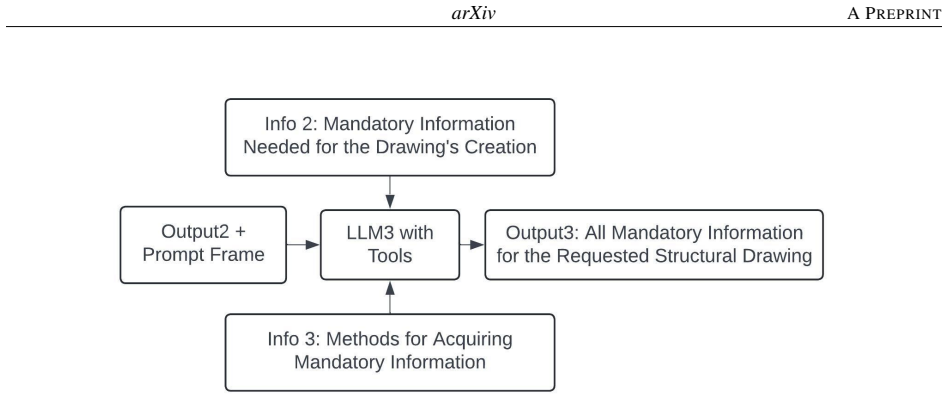
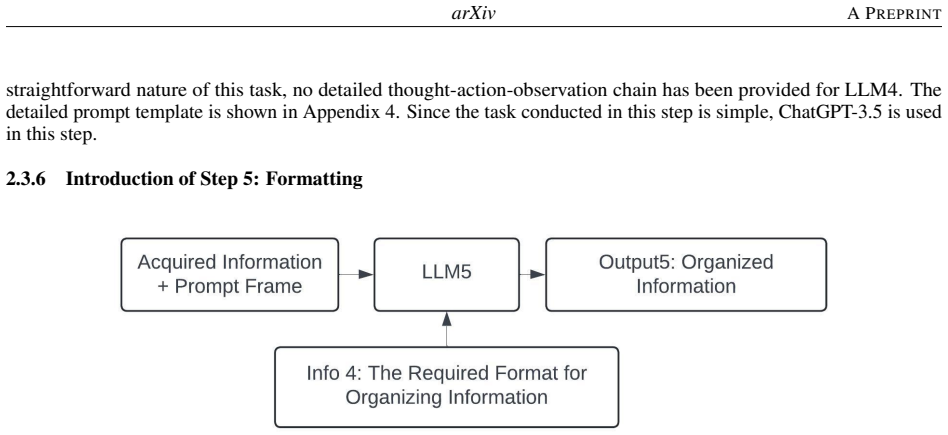
The load-bearing mechanism is a six-step LLM agent pipeline built on ReAct prompting and retrieval-augmented generation. ReAct is a prompting pattern that makes each model output alternating Thought, Action, and Observation steps before a final answer, so the model reasons about what it knows before acting; RAG supplies the model with human-curated external facts, organized as five Info categories per drawing type, instead of relying on parametric memory alone. The pipeline's division of labor carries the argument: the early, simple steps can use a lightweight LLM while the calculation, formatting, and code-generation steps use a stronger LLM, and the reinforced concrete case splits step 3 into three substeps to respect token limits. The formatting step also matters because it converts heterogeneous information into a fixed JSON schema that makes code generation more stable and the reasoning transparent to a human checker.
What would settle it
Take the 100 recorded outputs for the reinforced concrete beam, execute each generated step-6 script in AutoCAD or an equivalent CAD engine, and compare the rendered geometry, including vertex positions, rebar circles, stirrup lines, arcs, and hook lines, against the specified 24x14 inch section; if a significant share of scripts rated successful at the text level produce misplaced, missing, or overlapping elements, the central conversion claim fails. A complementary check is to measure how long the same drawings take an experienced drafter from scratch.
Extended reading notes
Core claim
On the paper's own terms, the central discovery is that structural drawing generation becomes tractable for an LLM when it is decomposed into six narrow tasks, each with its own prompt, its own retrieval-augmented background knowledge, and its own reasoning-and-acting trace. The pipeline converts a free-text user description into a structured JSON specification and then into Python code that uses the pyautocad interface to draw the cross-section. Each drawing type is supported by a human-curated database entry specifying useful information, mandatory information, calculation procedures, a required output format, and step-by-step coding instructions; this external knowledge is what keeps the LLM on a reliable path instead of hallucinating details. The paper reports per-step success rates of 77 to 100 percent over 100 runs for the three beam cross-section types, with the hardest geometry-calculating substeps on the reinforced concrete beam at 85, 77, and 81 percent and the final code-generation step at 83 percent for that case.
Load-bearing premise
The load-bearing assumption is that an output counts as successful when its generated text and structure are complete and error-free on inspection; the paper never executes the generated Python code in AutoCAD or verifies the geometry of the resulting drawing, so the claim that drawings are produced rests on text-level correctness being a valid proxy for a usable drawing.
Editorial extensions
If this is right
- An engineer can describe a standard beam cross-section in plain language and receive draft AutoCAD code, with per-step success rates of 77 to 100 percent on the tested cases.
- A new member type can be added by writing a new database entry with useful information, mandatory information, calculation methods, and coding steps, without retraining the models.
- Larger-context foundation models could allow substeps to be merged, reducing the error propagation that the current six-step chain is designed to avoid.
- Human engineers remain the final check: the reported accuracy is on step outputs, not on executed drawings, so the practical value of the workflow depends on a human review stage.
Reading between the lines
- The reported accuracy is a text-level measure; running each generated script in AutoCAD and measuring geometric errors would almost certainly lower the numbers, so the workload-reduction claim should be read as conditional on executed-code validation.
- Because the database entries carry the domain knowledge, the real engineering cost of this approach shifts from drafting to curating and maintaining that knowledge base for each structure type and code edition.
- A testable extension would be to measure end-to-end wall-clock time from prompt to final checked drawing against manual drafting for the same three sections; the paper reports workload reduction qualitatively, not through a time comparison.
- The scheme is most plausible for standard, parametrically defined sections like the ones demonstrated; novel structures would require the database to be extended first, so the method's generality is bounded by database coverage.
Editorial analysis
A structured set of objections, weighed in public.
Referee Report
Summary. The paper introduces an LLM-agent pipeline that converts natural-language descriptions of structural drawings into Python code targeting AutoCAD. The pipeline comprises six steps: drawing-type identification, useful-information extraction, mandatory-information calculation, workspace-detail extraction, JSON formatting, and code generation, with ReAct prompting and RAG using author-curated external knowledge. Three case studies are presented: a reinforced-concrete beam cross-section, a steel beam cross-section, and a precast beam cross-section. The authors report per-step completion accuracies over 100 runs, ranging from 77% to 100%, and claim that the approach enables direct and efficient conversion of descriptions into AutoCAD drawings while significantly reducing manual drafting workload.
Significance. If the evaluation supported the claims, the work would be a useful proof-of-concept for LLM-assisted drafting in civil engineering. The modular six-step pipeline, the use of ReAct and RAG, and the three diverse case studies are reasonable contributions, and the authors are transparent about several limitations, including model 'laziness', missing key information, and the need for human final checks. However, the current evidence is not sufficient for the central claims: the evaluation measures text-level correctness of intermediate steps rather than the correctness of the produced AutoCAD drawing, no generated code is executed in AutoCAD, no end-to-end success rate is reported, the workload-reduction claim is unquantified, and no ablation isolates the contribution of RAG or ReAct. The strengths are the clarity of the pipeline design and the honest discussion of failure modes, but the empirical validation needs substantial strengthening before the claimed benefits can be accepted.
major comments (5)
- [§4.4, Table 5] The success criterion in §4.4 is defined as fulfilling a step's task requirements 'without any omissions or errors in the generated text or structure', but the paper never executes the generated Python code in AutoCAD, never inspects a resulting .dwg file, and reports no end-to-end success rate. The abstract and introduction claim 'direct conversion of a structural drawing's natural language description into an AutoCAD drawing', yet the per-step accuracies in Table 5 support conclusions only about text and code formatting, not about the correctness of the final drawing. Please add an evaluation that executes the code in AutoCAD (or a simulator), verifies geometric entities against the specification, and reports the fraction of runs that produce a usable drawing. Also clarify whether Figures 9-11 were produced by executing the generated code; the caption says the sample drawing is 'simplified just for demonstration', which is ambiguous about whether the code was actually run.
- [Table 2, Step 3-1] In the RC beam example, Step 3-1 lists the top-right No. 8 rebar center as (13, 21). With a 14-inch width, 2-inch clear cover, No. 8 radius 0.5 inch, and No. 4 stirrup diameter 0.5 inch, the correct x-coordinate is 14 - (2 + 0.5 + 0.5) = 11. Step 3-2 and all subsequent steps correctly use (11, 21). Under the §4.4 success definition, Step 3-1 should be counted as a failure; either the evaluation tolerates a coordinate error that would produce an incorrect drawing, or later LLM steps silently repair an earlier error, which means the reported per-step percentages do not reflect what the abstract claims. Please state which situation holds and adjust the reported accuracies and the evaluation methodology accordingly.
- [§4.2, §4.3] For the steel and precast beam case studies, the LLM does not generate the section geometry; it copies from preset .dwg files (e.g., 'steelBeamDrawingSet/W1100X390.dwg' and 'Preset_Prestressed_Concrete/I-Beam_I.dwg'). The existence and content of these source files are never shipped or otherwise made available, and the generated SendCommand strings ('SELECT ALL ', 'COPYCLIP ', 'PASTECLIP') are not verified against real AutoCAD behavior. The demonstration for these cases is therefore contingent on unverified external assets, and the claimed conversion to an AutoCAD drawing is not directly evidenced. Please provide the preset files or describe their contents, and test the generated file-copying workflow in an actual AutoCAD session.
- [Abstract, §5] The abstract states that the method enables 'significantly reducing the workload compared to current working process associated with manual drawing production', but the paper contains no measurement of manual drafting time, no user study, no baseline comparison, and no workload metric. The workload-reduction claim is central to the paper's motivation and cannot be supported by the current evaluation. Either add a quantitative comparison (e.g., time and effort to draft the same drawings manually versus using the pipeline) or temper the claim to describe the method as a potential assistive tool whose workload benefits remain to be demonstrated.
- [§2, §4] The paper attributes the pipeline's performance to ReAct prompt engineering and RAG, but it reports no ablation or baseline experiments without these components. The per-step accuracies in Table 5 evaluate the full pipeline only. Because the injected 'external knowledge' is authored by the same team and prescribes the exact geometry rules, JSON schema, and code commands, the results show that the LLM can follow these prescriptions, but they do not establish that RAG or ReAct improves accuracy or reliability over a simpler prompting approach. Please include baselines (e.g., zero-shot or few-shot prompting without RAG, or a single-LLM pipeline) to support the claimed benefits of the proposed techniques.
minor comments (5)
- [Throughout] There are numerous typographical errors, including 'Lanugage' in §2.2, 'Corss-section' in §3.3, 'BEam' in §4.1, and 'Manual Salmeron' versus 'Manuel Salmeron' in the author contributions. Please proofread the manuscript carefully.
- [Table 5] The table does not include confidence intervals for the reported percentages, and the row for 'Step 3' in the RC beam case uses sub-steps 3-1, 3-2, 3-3 without explaining in the caption how these relate to the overall six-step pipeline. Please add confidence intervals, state the number of runs in the caption, and clarify the sub-step notation.
- [§3.2.2, Appendix A] The steel beam designation is inconsistent: the example uses 'W1100X390' while Appendix A uses 'HP360X174'. Standardize the notation and, if 'W1100X390' is a non-standard or metric designation, provide a reference or explanation.
- [Appendices C, H, K] The appendix prompt templates contain several formatting and spelling issues (e.g., 'ALW AYS', 'infomation', 'mathematic') and inconsistent use of uppercase and spacing in code commands. Please clean up the prompts and ensure they exactly match the text described in Sections 2 and 3.
- [§4.4] The list of observed error types is useful, but the paper does not report the frequency of each error type or how errors at one step propagate to later steps. A short error analysis with examples from failed runs would make the reliability discussion more concrete.
Circularity Check
The evaluation is self-referential: step 'success' is defined as conforming to author-written prompt requirements, and steel/precast 'generation' is file copying by construction.
-
self definitional
[Section 4.4 (Performance Evaluation); requirements defined in Section 2.3.2 and Appendices G–K]
"A successful completion was defined as fulfilling the task requirements of a specific step without any omissions or errors in the generated text or structure."
The metric's target is supplied by the method itself. Section 2.3.2 says 'we leverage a database curated by human experts to fetch pertinent background details', and Appendices G–K list the exact mandatory-information formulas, JSON keys, and pyautocad commands that define each step. Section 4.4 then scores success as 'fulfilling the task requirements' of those prompts. Thus a correct answer is, by construction, one that conforms to the authors' injected instructions; the reported accuracy is a self-consistency score, not a measure of whether a valid AutoCAD drawing was produced. No code is executed and no drawing is checked. The abstract's claim of 'direct conversion ... into an AutoCAD drawing' is therefore not derived from an independent target.
-
other
[Sections 3.2.2, 3.3.2, 4.2 and Appendix K (Step 6 external knowledge for steel and precast beams)]
"The sample drawing is shown in figure 10 and since we directly copy the drawing from source files, users can regulate source files based on their need."
For steel and precast beam case studies, Step 6 code does not generate geometry. Appendix K instructs LLM6 to open a pre-existing source file (e.g., os.path.join(os.getcwd(),'steelBeamDrawingSet','W1100X390.dwg')) and to copy/paste it into a target drawing; the paper admits 'we directly copy the drawing from source files'. The 'generated structural drawing' therefore equals the source .dwg asset, an input selected by catalog name. Presenting this as 'generative AI-based method for generating structural drawings' renames retrieval/copying as generation; the claimed conversion reduces to a lookup by construction.
full rationale
The paper's central evaluation is not an independent test of drawing generation. Section 4.4 defines success as fulfilling each step's 'task requirements', and those requirements are exactly the author-written 'external knowledge' in Appendices G–K (mandatory-information formulas, JSON schema, pyautocad command sequences). The reported 77–100% accuracies therefore measure instruction-following with respect to the method's own prompts; no generated code is executed in AutoCAD and no drawing file is independently checked. This is a self-definitional metric: the target is the input. Additionally, for two of the three case studies (steel and precast beams), the 'generated' drawing is produced by opening a pre-existing .dwg file and copying it, so the claimed natural-language-to-drawing conversion reduces to a lookup. The RC example in Table 2 further shows the stated success criterion was not actually enforced: Step 3-1 places the top-right No. 8 bar at x=13 in a 14-inch section with 2-in clear cover and No. 4 stirrups, while Step 3-2/5/6 use x=11; under §4.4, Step 3-1 should have been counted as an error. No significant self-citation circularity was found; the circularity is in the evaluation definition and in the copy-as-generation label.
Assumptions & free parameters
assumptions (3)
- domain assumption Reinforced concrete geometry rules embedded in Appendix H are correct and sufficient.
- domain assumption The source DWG files for steel and precast beams contain correct representations of the named sections.
- domain assumption LLM outputs can be reliably parsed and executed from the constrained '<result>' format.
Cite this review
Pith. "Pith review of Large Language Model Agent for Structural Drawing Generation Using ReAct Prompt Engineering and Retrieval Augmented Generation." pith.science (2026). https://pith.science/paper/SCDA43W3
@misc{pith2026250719771,
  author       = {Pith},
  title        = {Pith review of: Large Language Model Agent for Structural Drawing Generation Using ReAct Prompt Engineering and Retrieval Augmented Generation},
  year         = {2026},
  howpublished = {\url{https://pith.science/paper/SCDA43W3}},
  note         = {Machine review of arXiv:2507.19771}
}
read the original abstract
Structural drawings are widely used in many fields, e.g., mechanical engineering, civil engineering, etc. In civil engineering, structural drawings serve as the main communication tool between architects, engineers, and builders to avoid conflicts, act as legal documentation, and provide a reference for future maintenance or evaluation needs. They are often organized using key elements such as title/subtitle blocks, scales, plan views, elevation view, sections, and detailed sections, which are annotated with standardized symbols and line types for interpretation by engineers and contractors. Despite advances in software capabilities, the task of generating a structural drawing remains labor-intensive and time-consuming for structural engineers. Here we introduce a novel generative AI-based method for generating structural drawings employing a large language model (LLM) agent. The method incorporates a retrieval-augmented generation (RAG) technique using externally-sourced facts to enhance the accuracy and reliability of the language model. This method is capable of understanding varied natural language descriptions, processing these to extract necessary information, and generating code to produce the desired structural drawing in AutoCAD. The approach developed, demonstrated and evaluated herein enables the efficient and direct conversion of a structural drawing's natural language description into an AutoCAD drawing, significantly reducing the workload compared to current working process associated with manual drawing production, facilitating the typical iterative process of engineers for expressing design ideas in a simplified way.
Figures


Figures from the paper (8 more)



Forward citations
Cited by 1 Pith paper
-
Automating structural reliability analysis with a multi-agent large language model framework
A multi-agent LLM framework automates structural reliability analysis from natural-language input to interpreted β and Pf, with a QLoRA-tuned method-planning agent.
Reference graph
Works this paper leans on
-
[1]
Drawing in the engineering design process: Learning from the first 150 years of modern engineering
E Brito, R Póvoas, and P Providência. Drawing in the engineering design process: Learning from the first 150 years of modern engineering. InStructures and Architecture, pages 871–878. CRC Press, 2016
work page 2016
-
[2]
Cad software industry trends and directions.The Engineering Design Graphics Journal, 63(1), 1999
Patrick E Connolly. Cad software industry trends and directions.The Engineering Design Graphics Journal, 63(1), 1999
work page 1999
-
[3]
Raymond J. A. Buhr, Gerald M. Karam, Carol J. Hayes, and C. Murray Woodside. Software cad: A revolutionary approach.IEEE Transactions on Software Engineering, 15(3):235–249, 1989
work page 1989
-
[4]
Effectiveness of autocad 3d software as a learning support tool
Fatariah Zakaria, Ahmad Othman, et al. Effectiveness of autocad 3d software as a learning support tool. International Journal of Emerging Technologies in Learning (iJET), 7(2):57–60, 2012
work page 2012
-
[5]
Rebekka V olk, Julian Stengel, and Frank Schultmann. Building information modeling (bim) for existing build- ings—literature review and future needs.Automation in construction, 38:109–127, 2014
work page 2014
-
[6]
Construction management with autocad.Journal of Management in Engineering, 7(3):267–278, 1991
Amir Tavakoli and Kenneth L Klika. Construction management with autocad.Journal of Management in Engineering, 7(3):267–278, 1991
work page 1991
-
[7]
Hyunjun Kim, Eunjong Ahn, Myoungsu Shin, and Sung-Han Sim. Crack and noncrack classification from concrete surface images using machine learning.Structural Health Monitoring, 18(3):725–738, 2019
work page 2019
-
[8]
Rapid, automated post-event image classification and documentation
Chul Min Yeum, Shirley J Dyke, Bedrich Benes, Thomas Hacker, Julio Ramirez, Alana Lund, and Santiago Pujol. Rapid, automated post-event image classification and documentation. In7th Int’l Conference on Advances in Experimental Structural Engineering, 2017. 23 arXivA PREPRINT
work page 2017
Show all 67 references
-
[9]
Mixed training of deep convolutional neural network for bridge deterioration detection with uav and inspection report sourced images
J Dang and P Chun. Mixed training of deep convolutional neural network for bridge deterioration detection with uav and inspection report sourced images. InBridge Maintenance, Safety, Management, Life-Cycle Sustainability and Innovations, pages 308–312. CRC Press, 2021
2021
-
[10]
Vision-based structural inspection using multiscale deep convolutional neural networks.arXiv preprint arXiv:1805.01055, 2018
Vedhus Hoskere, Yasutaka Narazaki, Tu Hoang, and BillieF Spencer Jr. Vision-based structural inspection using multiscale deep convolutional neural networks.arXiv preprint arXiv:1805.01055, 2018
2018 arXiv
-
[11]
Deep learning-based crack damage detection using convolutional neural networks.Computer-Aided Civil and Infrastructure Engineering, 32(5):361–378, 2017
Young-Jin Cha, Wooram Choi, and Oral Büyüköztürk. Deep learning-based crack damage detection using convolutional neural networks.Computer-Aided Civil and Infrastructure Engineering, 32(5):361–378, 2017
2017
-
[12]
Faster r-cnn: Towards real-time object detection with region proposal networks.Advances in neural information processing systems, 28, 2015
Shaoqing Ren, Kaiming He, Ross Girshick, and Jian Sun. Faster r-cnn: Towards real-time object detection with region proposal networks.Advances in neural information processing systems, 28, 2015
2015
-
[13]
Deep learning–based fully automated pavement crack detection on 3d asphalt surfaces with an improved cracknet
Allen Zhang, Kelvin CP Wang, Yue Fei, Yang Liu, Siyu Tao, Cheng Chen, Joshua Q Li, and Baoxian Li. Deep learning–based fully automated pavement crack detection on 3d asphalt surfaces with an improved cracknet. Journal of Computing in Civil Engineering, 32(5):04018041, 2018
2018
-
[14]
Towards rapid and automated vulnerability classification of concrete buildings.Earthquake Engineering and Engineering Vibration, 22(2):309–332, 2023
Lissette Iturburu, Jean Kwannandar, Shirley J Dyke, Xiaoyu Liu, Xin Zhang, and Julio Ramirez. Towards rapid and automated vulnerability classification of concrete buildings.Earthquake Engineering and Engineering Vibration, 22(2):309–332, 2023
2023
-
[15]
Optimal policy for structure maintenance: A deep reinforcement learning framework.Structural Safety, 83:101906, 2020
Shiyin Wei, Yuequan Bao, and Hui Li. Optimal policy for structure maintenance: A deep reinforcement learning framework.Structural Safety, 83:101906, 2020
2020
-
[16]
Reinforcement learning-based bridge inspection management.STRUCTURAL HEALTH MONITORING 2023, 2023
XIN ZHANG, MANUEL SALMERON, BENJAMIN E WOGEN, XIAOYU LIU, LISSETTE ITURBURU, and SHIRLEY DYKE. Reinforcement learning-based bridge inspection management.STRUCTURAL HEALTH MONITORING 2023, 2023
2023
-
[17]
Generative adversarial networks for labeled acceleration data augmentation for structural damage detection.Journal of Civil Structural Health Monitoring, 13(1):181–198, 2023
Furkan Luleci, F Necati Catbas, and Onur Avci. Generative adversarial networks for labeled acceleration data augmentation for structural damage detection.Journal of Civil Structural Health Monitoring, 13(1):181–198, 2023
2023
-
[18]
Generative adversarial networks review in earthquake-related engineering fields.Bulletin of Earthquake Engineering, 22(7):3511–3562, 2024
Giuseppe Carlo Marano, Marco Martino Rosso, Angelo Aloisio, and Giansalvo Cirrincione. Generative adversarial networks review in earthquake-related engineering fields.Bulletin of Earthquake Engineering, 22(7):3511–3562, 2024
2024
-
[19]
Generative adversarial network for damage identification in civil structures.Shock and Vibration, 2021(1):3987835, 2021
Zahra Rastin, Gholamreza Ghodrati Amiri, and Ehsan Darvishan. Generative adversarial network for damage identification in civil structures.Shock and Vibration, 2021(1):3987835, 2021
2021
-
[20]
Generative ai: The new geotechnical assistant?Journal of Geotechnical and Geoenvironmental Engineering, 149(10):02823004, 2023
Travis A Shoemaker, Charbel Beaino, Dylan M Centella R, Wendi Zhao, Carine Tanissa, Jack Lawrence, and Youssef MA Hashash. Generative ai: The new geotechnical assistant?Journal of Geotechnical and Geoenvironmental Engineering, 149(10):02823004, 2023
2023
-
[21]
Intelligent generative design for shear wall cross-sectional size using rule-embedded generative adversarial network.Journal of Structural Engineering, 149(11):04023161, 2023
Yitian Feng, Yifan Fei, Yuanqing Lin, Wenjie Liao, and Xinzheng Lu. Intelligent generative design for shear wall cross-sectional size using rule-embedded generative adversarial network.Journal of Structural Engineering, 149(11):04023161, 2023
2023
-
[22]
Opportunities and challenges of generative ai in construc- tion industry: Focusing on adoption of text-based models.Buildings, 14(1):220, 2024
Prashnna Ghimire, Kyungki Kim, and Manoj Acharya. Opportunities and challenges of generative ai in construc- tion industry: Focusing on adoption of text-based models.Buildings, 14(1):220, 2024
2024
-
[23]
Attention is all you need.Advances in neural information processing systems, 30:I, 2017
Vaswani Ashish. Attention is all you need.Advances in neural information processing systems, 30:I, 2017
2017
-
[24]
Detection and classification of surface defects on hot-rolled steel using vision transformers.Heliyon, 10(19), 2024
Vinod Vasan, Naveen Venkatesh Sridharan, Sugumaran Vaithiyanathan, and Mohammadreza Aghaei. Detection and classification of surface defects on hot-rolled steel using vision transformers.Heliyon, 10(19), 2024
2024
-
[25]
A survey of large language models.arXiv preprint arXiv:2303.18223, 1(2), 2023
Wayne Xin Zhao, Kun Zhou, Junyi Li, Tianyi Tang, Xiaolei Wang, Yupeng Hou, Yingqian Min, Beichen Zhang, Junjie Zhang, Zican Dong, et al. A survey of large language models.arXiv preprint arXiv:2303.18223, 1(2), 2023
2023 arXiv
-
[26]
Chatgpt and open-ai models: A preliminary review.Future Internet, 15(6):192, 2023
Konstantinos I Roumeliotis and Nikolaos D Tselikas. Chatgpt and open-ai models: A preliminary review.Future Internet, 15(6):192, 2023
2023
-
[27]
Application of chatgpt in civil engineering.East African Journal of Engineering, 6(1):104–112, 2023
Martin Aluga. Application of chatgpt in civil engineering.East African Journal of Engineering, 6(1):104–112, 2023
2023
-
[28]
Nitin Rane, Saurabh Choudhary, and Jayesh Rane. Integrating building information modelling (bim) with chatgpt, bard, and similar generative artificial intelligence in the architecture, engineering, and construction industry: applications, a novel framework, challenges, and fut...
2023
-
[29]
Prompt engineering with chatgpt: a guide for academic writers.Annals of biomedical engineering, 51(12):2629–2633, 2023
Louie Giray. Prompt engineering with chatgpt: a guide for academic writers.Annals of biomedical engineering, 51(12):2629–2633, 2023. 24 arXivA PREPRINT
2023
-
[30]
React: Synergizing reasoning and acting in language models
Shunyu Yao, Jeffrey Zhao, Dian Yu, Nan Du, Izhak Shafran, Karthik Narasimhan, and Yuan Cao. React: Synergizing reasoning and acting in language models. InInternational Conference on Learning Representations (ICLR), 2023
2023
-
[31]
Llm lies: Hallucinations are not bugs, but features as adversarial examples.arXiv preprint arXiv:2310.01469, 2023
Jia-Yu Yao, Kun-Peng Ning, Zhen-Hui Liu, Mu-Nan Ning, Yu-Yang Liu, and Li Yuan. Llm lies: Hallucinations are not bugs, but features as adversarial examples.arXiv preprint arXiv:2310.01469, 2023
2023 arXiv
-
[32]
Retrieval-augmented generation for knowledge- intensive nlp tasks.Advances in neural information processing systems, 33:9459–9474, 2020
Patrick Lewis, Ethan Perez, Aleksandra Piktus, Fabio Petroni, Vladimir Karpukhin, Naman Goyal, Heinrich Küttler, Mike Lewis, Wen-tau Yih, Tim Rocktäschel, et al. Retrieval-augmented generation for knowledge- intensive nlp tasks.Advances in neural information processing systems...
2020
-
[33]
Retrieval augmented generation using engineering design knowledge.Knowledge- Based Systems, 303:112410, 2024
L Siddharth and Jianxi Luo. Retrieval augmented generation using engineering design knowledge.Knowledge- Based Systems, 303:112410, 2024
2024
-
[34]
Aios: Llm agent operating system.arXiv preprint arXiv:2403.16971, 2024
Kai Mei, Xi Zhu, Wujiang Xu, Wenyue Hua, Mingyu Jin, Zelong Li, Shuyuan Xu, Ruosong Ye, Yingqiang Ge, and Yongfeng Zhang. Aios: Llm agent operating system.arXiv preprint arXiv:2403.16971, 2024
2024 arXiv
-
[35]
Data interpreter: An llm agent for data science.arXiv preprint arXiv:2402.18679, 2024
Sirui Hong, Yizhang Lin, Bang Liu, Bangbang Liu, Binhao Wu, Ceyao Zhang, Chenxing Wei, Danyang Li, Jiaqi Chen, Jiayi Zhang, et al. Data interpreter: An llm agent for data science.arXiv preprint arXiv:2402.18679, 2024
2024 arXiv
-
[36]
AutoCAD Software
Autodesk Inc. AutoCAD Software. https://www.autodesk.com/products/autocad/overview, 2024. Accessed: 2025-07-18
2024
-
[37]
Revit Software
Autodesk Inc. Revit Software. https://www.autodesk.com/products/revit/overview, 2024. Accessed: 2025-07-18
2024
-
[38]
SketchUp Software.https://www.sketchup.com/en, 2024
Trimble Inc. SketchUp Software.https://www.sketchup.com/en, 2024. Accessed: 2025-07-18
2024
-
[39]
Hidden markov models in speech and language processing
K Knill and S Young. Hidden markov models in speech and language processing. InCorpus-based methods in language and speech processing, pages 27–68. Springer, 1997
1997
-
[40]
Gaussian mixture models
Douglas Reynolds. Gaussian mixture models. InEncyclopedia of biometrics, pages 827–832. Springer, 2015
2015
-
[41]
A comprehensive survey of ai-generated content (aigc): A history of generative ai from gan to chatgpt.arXiv preprint arXiv:2303.04226, 2023
Yihan Cao, Siyu Li, Yixin Liu, Zhiling Yan, Yutong Dai, Philip S Yu, and Lichao Sun. A comprehensive survey of ai-generated content (aigc): A history of generative ai from gan to chatgpt.arXiv preprint arXiv:2303.04226, 2023
2023 arXiv
-
[42]
Faster and smaller n-gram language models
Adam Pauls and Dan Klein. Faster and smaller n-gram language models. InProceedings of the 49th annual meeting of the Association for Computational Linguistics: Human Language Technologies, pages 258–267, 2011
2011
-
[43]
Recurrent neural networks.Design and applications, 5(64-67):2, 2001
Larry R Medsker, Lakhmi Jain, et al. Recurrent neural networks.Design and applications, 5(64-67):2, 2001
2001
-
[44]
Long short-term memory.Supervised sequence labelling with recurrent neural networks, pages 37–45, 2012
Alex Graves. Long short-term memory.Supervised sequence labelling with recurrent neural networks, pages 37–45, 2012
2012
-
[45]
Empirical evaluation of gated recurrent neural networks on sequence modeling.arXiv preprint arXiv:1412.3555, 2014
Junyoung Chung, Caglar Gulcehre, KyungHyun Cho, and Yoshua Bengio. Empirical evaluation of gated recurrent neural networks on sequence modeling.arXiv preprint arXiv:1412.3555, 2014
2014 arXiv
-
[46]
Generative adversarial networks.Communications of the ACM, 63(11):139–144, 2020
Ian Goodfellow, Jean Pouget-Abadie, Mehdi Mirza, Bing Xu, David Warde-Farley, Sherjil Ozair, Aaron Courville, and Yoshua Bengio. Generative adversarial networks.Communications of the ACM, 63(11):139–144, 2020
2020
-
[47]
An introduction to variational autoencoders.F oundations and Trends® in Machine Learning, 12(4):307–392, 2019
Diederik P Kingma, Max Welling, et al. An introduction to variational autoencoders.F oundations and Trends® in Machine Learning, 12(4):307–392, 2019
2019
-
[48]
Attention is all you need.Advances in neural information processing systems, 30, 2017
Ashish Vaswani, Noam Shazeer, Niki Parmar, Jakob Uszkoreit, Llion Jones, Aidan N Gomez, Łukasz Kaiser, and Illia Polosukhin. Attention is all you need.Advances in neural information processing systems, 30, 2017
2017
-
[49]
A survey on vision transformer.IEEE transactions on pattern analysis and machine intelligence, 45(1):87–110, 2022
Kai Han, Yunhe Wang, Hanting Chen, Xinghao Chen, Jianyuan Guo, Zhenhua Liu, Yehui Tang, An Xiao, Chunjing Xu, Yixing Xu, et al. A survey on vision transformer.IEEE transactions on pattern analysis and machine intelligence, 45(1):87–110, 2022
2022
-
[50]
Swin transformer: Hierarchical vision transformer using shifted windows
Ze Liu, Yutong Lin, Yue Cao, Han Hu, Yixuan Wei, Zheng Zhang, Stephen Lin, and Baining Guo. Swin transformer: Hierarchical vision transformer using shifted windows. InProceedings of the IEEE/CVF international conference on computer vision, pages 10012–10022, 2021
2021
-
[51]
ChatGPT (Feb 18 version) [Large language model]
OpenAI. ChatGPT (Feb 18 version) [Large language model]. https://openai.com/chatgpt, 2025. Accessed: 2025-07-18
2025
-
[52]
Bert: Pre-training of deep bidirectional transformers for language understanding
Jacob Devlin, Ming-Wei Chang, Kenton Lee, and Kristina Toutanova. Bert: Pre-training of deep bidirectional transformers for language understanding. InProceedings of the 2019 conference of the North American chapter of the association for computational linguistics: human langua...
2019
-
[53]
Distraction generation using google T5: A study
Fernando Gonzalez Adauto and Kevin Golan. Distraction generation using google T5: A study. InUnpublished manuscript, 2022. Available from: https://feradauto.github.io/files/distraction_generation. pdf(Accessed: 2025-07-18)
2022
-
[54]
Llama: Open and efficient foundation language models.arXiv preprint arXiv:2302.13971, 2023
Hugo Touvron, Thibaut Lavril, Gautier Izacard, Xavier Martinet, Marie-Anne Lachaux, Timothée Lacroix, Baptiste Rozière, Naman Goyal, Eric Hambro, Faisal Azhar, et al. Llama: Open and efficient foundation language models.arXiv preprint arXiv:2302.13971, 2023
2023 arXiv
-
[55]
A prompt pattern catalog to enhance prompt engineering with chatgpt
Jules White, Quchen Fu, Sam Hays, Michael Sandborn, Carlos Olea, Henry Gilbert, Ashraf Elnashar, Jesse Spencer-Smith, and Douglas C Schmidt. A prompt pattern catalog to enhance prompt engineering with chatgpt. arXiv preprint arXiv:2302.11382, 2023
2023 arXiv
-
[56]
Chain-of-thought prompting elicits reasoning in large language models.Advances in neural information processing systems, 35:24824–24837, 2022
Jason Wei, Xuezhi Wang, Dale Schuurmans, Maarten Bosma, Fei Xia, Ed Chi, Quoc V Le, Denny Zhou, et al. Chain-of-thought prompting elicits reasoning in large language models.Advances in neural information processing systems, 35:24824–24837, 2022
2022
-
[57]
Tree of thoughts: Deliberate problem solving with large language models.Advances in neural information processing systems, 36:11809–11822, 2023
Shunyu Yao, Dian Yu, Jeffrey Zhao, Izhak Shafran, Tom Griffiths, Yuan Cao, and Karthik Narasimhan. Tree of thoughts: Deliberate problem solving with large language models.Advances in neural information processing systems, 36:11809–11822, 2023
2023
-
[58]
Self-consistency improves chain of thought reasoning in language models.arXiv preprint arXiv:2203.11171, 2022
Xuezhi Wang, Jason Wei, Dale Schuurmans, Quoc Le, Ed Chi, Sharan Narang, Aakanksha Chowdhery, and Denny Zhou. Self-consistency improves chain of thought reasoning in language models.arXiv preprint arXiv:2203.11171, 2022
2022 arXiv
-
[59]
Retrieval-augmented generation for large language models: A survey.arXiv preprint arXiv:2312.10997, 2(1), 2023
Yunfan Gao, Yun Xiong, Xinyu Gao, Kangxiang Jia, Jinliu Pan, Yuxi Bi, Yixin Dai, Jiawei Sun, Haofen Wang, and Haofen Wang. Retrieval-augmented generation for large language models: A survey.arXiv preprint arXiv:2312.10997, 2(1), 2023
2023 arXiv
-
[60]
Knowing before seeing: Incor- porating post-retrieval information into pre-retrieval query intention classification
Xueqing Ma, Xiaochi Wei, Yixing Gao, Runyang Feng, Dawei Yin, and Yi Chang. Knowing before seeing: Incor- porating post-retrieval information into pre-retrieval query intention classification. InInternational Conference on Knowledge Science, Engineering and Management, pages 3...
2023
-
[61]
Llm-based custom chatbot using langchain
Devangi Das, Rajeev Lochan Rath, Tarundeep Singh, Sushruta Mishra, Vinita Malik, Rajeev Sobti, and Biswajit Brahma. Llm-based custom chatbot using langchain. InInternational Conference On Innovative Computing And Communication, pages 257–267. Springer, 2024
2024
-
[62]
American Institute of Steel Construction, Chicago, IL, 15th edition, 2017
American Institute of Steel Construction.Steel Construction Manual. American Institute of Steel Construction, Chicago, IL, 15th edition, 2017. 26 arXivA PREPRINT Appendix A: Prompt Template for Step 1 You are an excellent assistant with finding what type of structural drawing ...
2017
-
[63]
Precast beam cross-section is standard but the position of the strands are defined by a user
Usually, steel beam cross-section is standard while the rectangular concrete beam cross-section is specifically designed. Precast beam cross-section is standard but the position of the strands are defined by a user
-
[64]
- Type of Structure: name of type
Standard steel beam cross-section and precast beam cross-section usually has a specific name indicating the size of the steel beam, e.g., HP360X174 You should follow this format: <format> Description: the natural language description of the user about a specific type of struct...
-
[66]
Unit: unit name
If user specified the unit for this structural drawing, record in the final output in the format of "Unit: unit name". Else, record in the final output in the format of "Unit: Millimeter". To complete this task, you need to follow the following format: <format> Description: th...
-
[67]
Save: Path
Identify if user wanted to save the structural drawing to specific path. If so, record in the final output in the format of "Save: Path". If not, record in the final output in the format of "Save: False"
-
[68]
Unit: unit name
If user specified the unit for this structural drawing, record in the final output in the format of "Unit: unit name". Else, record in the final output in the format of "Unit: Millimeter". 36 arXivA PREPRINT Appendix J: External Knowledge for Step 5 (JSON Format) "rectangular ...
Reviewed August 6, 2026 · model on record in the stance chip above.
Discussion (0). Sign in to comment.