REVIEW 2 major objections 5 minor 64 references
TrackAny3D: Transferring Pretrained 3D Models for Category-unified 3D Point Cloud Tracking
T0 review · 2 major / 5 minor · reviewed 2026-08-06 · deepseek-v4-flash
Pith's one-line read TrackAny3D transfers a frozen pretrained 3D model to track any object category in LiDAR point clouds.
desk verdict A credible category-unified 3D SOT method with a genuinely new pretraining-transfer combination, but the SOTA claim hinges on a baseline comparison whose reproduction status is never stated. read the letter →
The pith
A machine-rendered reading of the paper's core claim, the machinery that carries it, and where it could break.
The reading
What carries the argument
The load-bearing object is a frozen RECON Transformer encoder, a point-cloud model pretrained with masked reconstruction and contrastive learning, kept frozen to preserve geometric priors. Around it the paper places three learnable mechanisms: a two-path adapter (one path adapts the representation, one gated path scales the adaptation per token), a Mixture-of-Geometry-Experts (MoGE) layer with eight experts and Top-K routing placed on even-numbered layers, and temporal context optimization with a learnable temporal token propagated frame to frame plus per-point learnable mask weights. The role of this stack is to let the pretrained representation stay intact while the task-specific modules absorb cross-category geometric variation and temporal drift.
What would settle it
Re-run the four reproduced baselines and MoCUT from their official code under identical category-unified splits, point sampling, clip length, and training schedule, and check whether TrackAny3D's mean-success margins (1.3 percent over MoCUT on KITTI and 3.38 percent on NuScenes) persist; if the baselines rise to meet or exceed TrackAny3D under a standardized protocol, the central claim fails.
Extended reading notes
Core claim
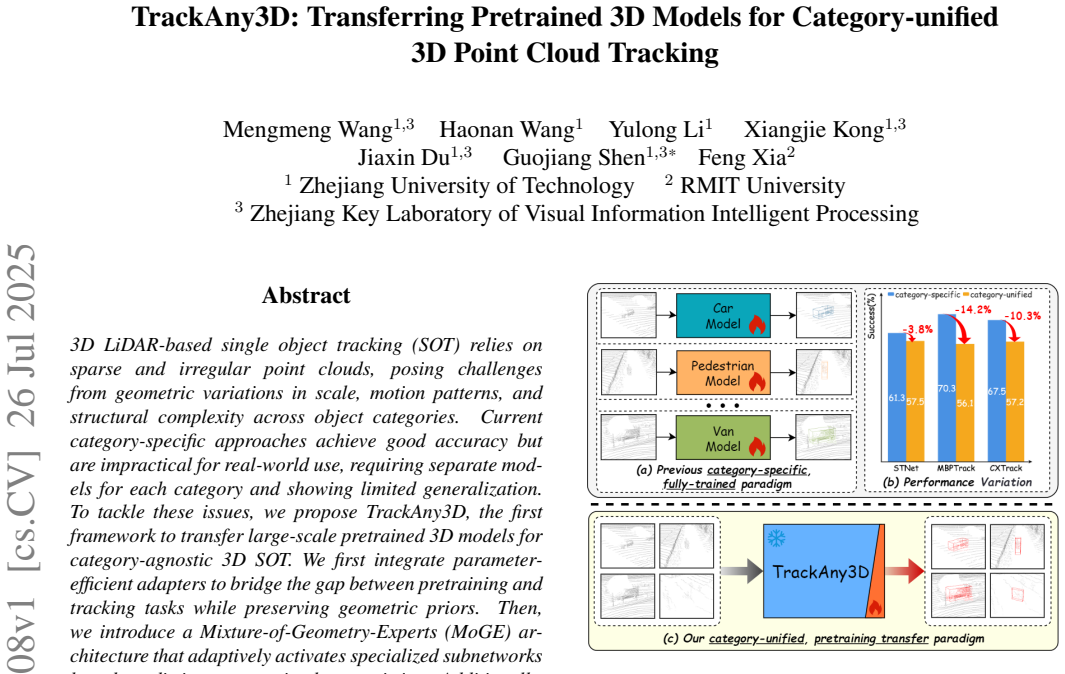
On its own terms, the paper's central claim is that category-agnostic 3D single-object tracking can be achieved by freezing a pretrained 3D encoder (RECON) and adding three transfer components: a two-path adapter that controls how much the frozen features change, a Mixture-of-Geometry-Experts layer whose router activates different expert subnetworks for rigid versus deformable geometry, and a temporal mechanism with a learnable token plus dynamic mask weighting. The authors report that full fine-tuning of RECON under the category-unified setting yields 62.0 percent mean success on KITTI, while the frozen-encoder adapter design reaches 64.8 percent, and adding all components reaches 67.1 percent. They also report direct cross-dataset transfer from KITTI to Waymo with 64.0 percent success on vehicles, higher than any compared method, including category-specific trackers.
Load-bearing premise
The load-bearing premise is that the paper's reproductions of STNet, CXTrack, M2Track, MBPTrack, and MoCUT under the category-unified setting faithfully match the original methods; the paper gives no reproduction logs, exact schedules, or seeds, so the reported margins could be artifacts of those runs.
Editorial extensions
If this is right
- If the central claim holds, a single trained 3D tracker can replace the current practice of maintaining one model per object category, cutting storage and deployment overhead.
- Freezing the pretrained encoder means only a small fraction of parameters (5.30 million tunable) need to be trained, so adapting to new tracking data is much cheaper than full fine-tuning.
- The reported KITTI-to-Waymo transfer suggests the paradigm may generalize across datasets, not just across categories, without extra adaptation.
- Because the reported numbers are competitive with category-specific trackers while using one shared network, a single deployable model may suffice for multiple classes in real-world systems.
Reading between the lines
- The paper leaves open whether the MoGE router is genuinely learning geometry rather than category proxies; a test on categories absent during training could separate the two.
- The temporal token propagation could in principle be combined with other point-cloud backbones or applied to related sparse-input tasks such as 3D multi-object tracking, though the paper does not test this.
- Because the gains come from adding lightweight modules to a frozen encoder, larger or newer pretrained point-cloud models might push the same recipe further than RECON.
- The dynamic mask weighting suggests that mask quality itself can be learned from data; one concrete extension is to let the mask initialization depend on the previous frame's prediction instead of fixed constants.
Editorial analysis
A structured set of objections, weighed in public.
Referee Report
Summary. TrackAny3D proposes a category-unified 3D LiDAR single-object tracking framework that transfers a frozen pretrained point-cloud model (RECON) to the tracking task. The method adds two-path gated adapters in each Transformer layer, a Mixture-of-Geometry-Experts (MoGE) module with top-k routing, a learnable temporal token propagated across frames, and a dynamic mask weighting mechanism. Experiments on KITTI, NuScenes, and Waymo report state-of-the-art category-unified results (67.1%, 54.57%, and 64.0% mean success, respectively), with ablations on KITTI attributing gains to each component. The paper's central claim is that TrackAny3D is the first framework to transfer large-scale pretrained 3D models for category-agnostic 3D SOT and that it outperforms the closest unified competitor MoCUT by small but consistent margins.
Significance. If the comparison is properly controlled, the paper would be a useful contribution: it demonstrates that PEFT-style transfer of a frozen pretrained 3D encoder can work for category-unified 3D SOT, and the component ablations (Tables 4-7) are clean and internally consistent. The cross-dataset evaluation on Waymo using a KITTI-trained model is a valuable generalization test. However, the central SOTA claim depends on a fair, controlled comparison with MoCUT, and the manuscript currently provides neither a statement of whether MoCUT was reproduced under the same protocol nor any variance information. These gaps are load-bearing because the reported margins over MoCUT are only 1.3, 3.38, and 2.1 success points on the three benchmarks.
major comments (2)
- [Sec. 4.2 (Tables 1-3)] The category-unified comparison is not fully controlled for the key competitor. The text states that STNet, M2Track, CXTrack, and MBPTrack were reproduced from official code, but it does not state whether MoCUT (or SiamCUT) was reproduced under the same category-unified protocol or whether its rows are taken from the MoCUT paper. The SOTA claim rests on margins of 1.3 success points on KITTI, 3.38 on NuScenes, and 2.1 on Waymo over MoCUT; if MoCUT's published numbers used a different point budget (e.g., 1024 instead of 128), clip length, training schedule, or data-split conventions, the comparison is not controlled and the ordering could flip. Please reproduce MoCUT under the exact category-unified protocol used for the other baselines and report its per-class results, or provide a quantitative justification for why the published numbers are directly comparable.
- [Sec. 4.1 and Sec. 4.2] No training protocol or variance information is reported for TrackAny3D or for the reproduced baselines. The implementation details give only the input point counts (Nt=Ns=128), adapter bottleneck (r=72), MoGE size (M=8, K=4), and the GPU; they omit epochs, optimizer, learning rate schedule, batch size, augmentation, clip sampling details, and random seeds. All tables report a single run with no error bars or statistical tests. Because the headline KITTI margin over MoCUT is 1.3 success points and per-class differences are also only a few points, run-to-run variance alone could affect the conclusions. Please provide the full training recipe, report results over at least three seeds with means and standard deviations for the main tables, and specify the exact configuration used for each reproduced unified baseline.
minor comments (5)
- [Abstract and Sec. 2.2] The abstract's claim of being 'the first framework to transfer large-scale pretrained 3D models' should be qualified, since Sec. 2.2 acknowledges MemDisst [48] as using 3D pretraining; the novelty should be stated as the first PEFT-based category-unified transfer rather than the first use of 3D pretraining in tracking.
- [Sec. 3.3 (Eqs. 6-7)] The routing weight R_j(Z_j,K) in Eq. (6) is summed over m, but Eq. (7) defines a softmax over the full Top-K score vector; please clarify that unselected experts receive zero weight and define the m-th component of the router output explicitly.
- [Sec. 3.4 and Table 6] The note that setting the propagation length to 2 'corresponds to not using temporal tokens' is inconsistent with Eq. (8), where a two-frame clip already incorporates the previous frame's output token; please clarify what the length-2 implementation actually does and how the temporal token is used in training.
- [Figure 3] The expert-activation analysis is qualitative; please report quantitative router statistics (e.g., per-class activation proportions or routing entropy) to support the claim that MoGE experts specialize by geometric characteristics rather than merely by category labels.
- [General] The paper does not mention code release; for reproducibility, please include code or a detailed appendix with the full training recipe and the exact commands/configurations used for the reproduced baselines. Also fix the typo 'Pedestrain' in Table 6.
Circularity Check
No significant circularity: the paper's claims are empirical benchmark results, not derivations from fitted inputs or self-cited constraints.
full rationale
TrackAny3D is an empirical computer-vision systems paper. Its central claims are (i) a category-unified 3D SOT architecture built on the frozen RECON encoder with adapters, MoGE, temporal tokens, and dynamic mask weights, and (ii) state-of-the-art success rates on KITTI, NuScenes, and Waymo. These claims are supported by direct experiments against public benchmarks and by ablations in Tables 4-7; no equation is constructed so that a fitted parameter is later reported as a prediction. The pretrained encoder RECON is an external model trained on ShapeNet/ScanNet-style representation learning, and it is kept frozen, so there is no definitional identity between the pretraining objective and the tracking metrics. The self-citations (SyncTrack [27], Correlation Pyramid Network [43], ActionCLIP [44], M2-CLIP [45]) appear only as related-work context and as prior examples of unified modeling or PEFT; none is invoked to justify the claimed SOTA or to forbid alternative designs. The reproduction-protocol concern about MoCUT baseline numbers raised in reviewing is a correctness and reproducibility risk, not a circularity: even if the margin were a protocol artifact, that would not make TrackAny3D's result equivalent to its inputs by construction. Therefore the circularity score is 0.
Assumptions & free parameters
free parameters (5)
- Adapter bottleneck dimension r =
72
- Number of MoGE experts M and top-k K =
M=8, K=4
- Base mask values =
0.8 target, 0.2 background, 0.5 search
- Temporal propagation length =
3 frames
- Input point counts Nt and Ns =
128 and 128
assumptions (3)
- domain assumption The frozen RECON pretrained encoder provides geometric priors that transfer to sparse LiDAR point cloud tracking.
- domain assumption The target object size remains constant across frames, so only (x, y, z, yaw) need to be predicted.
- domain assumption The benchmark evaluation protocol (success rate and precision) measures tracking quality as intended.
Cite this review
Pith. "Pith review of TrackAny3D: Transferring Pretrained 3D Models for Category-unified 3D Point Cloud Tracking." pith.science (2026). https://pith.science/paper/3JZECWPW
@misc{pith2026250719908,
  author       = {Pith},
  title        = {Pith review of: TrackAny3D: Transferring Pretrained 3D Models for Category-unified 3D Point Cloud Tracking},
  year         = {2026},
  howpublished = {\url{https://pith.science/paper/3JZECWPW}},
  note         = {Machine review of arXiv:2507.19908}
}
read the original abstract
3D LiDAR-based single object tracking (SOT) relies on sparse and irregular point clouds, posing challenges from geometric variations in scale, motion patterns, and structural complexity across object categories. Current category-specific approaches achieve good accuracy but are impractical for real-world use, requiring separate models for each category and showing limited generalization. To tackle these issues, we propose TrackAny3D, the first framework to transfer large-scale pretrained 3D models for category-agnostic 3D SOT. We first integrate parameter-efficient adapters to bridge the gap between pretraining and tracking tasks while preserving geometric priors. Then, we introduce a Mixture-of-Geometry-Experts (MoGE) architecture that adaptively activates specialized subnetworks based on distinct geometric characteristics. Additionally, we design a temporal context optimization strategy that incorporates learnable temporal tokens and a dynamic mask weighting module to propagate historical information and mitigate temporal drift. Experiments on three commonly-used benchmarks show that TrackAny3D establishes new state-of-the-art performance on category-agnostic 3D SOT, demonstrating strong generalization and competitiveness. We hope this work will enlighten the community on the importance of unified models and further expand the use of large-scale pretrained models in this field.
Figures


Figures from the paper (1 more)

Reference graph
Works this paper leans on
-
[1]
nuscenes: A multi- modal dataset for autonomous driving
Holger Caesar, Varun Bankiti, Alex H Lang, Sourabh V ora, Venice Erin Liong, Qiang Xu, Anush Krishnan, Yu Pan, Gi- ancarlo Baldan, and Oscar Beijbom. nuscenes: A multi- modal dataset for autonomous driving. In Proceedings of the IEEE/CVF conference on computer vision and pattern recognition, pages 11621–11631, 2020. 2, 5
work page 2020
-
[2]
Shapenet: An information-rich 3d model repository
Angel X Chang, Thomas Funkhouser, Leonidas Guibas, Pat Hanrahan, Qixing Huang, Zimo Li, Silvio Savarese, Manolis Savva, Shuran Song, Hao Su, et al. Shapenet: An information-rich 3d model repository. arXiv preprint arXiv:1512.03012, 2015. 2, 4
arXiv 2015
-
[3]
Joint classification and regression for visual tracking with fully convolutional siamese networks
Ying Cui, Dongyan Guo, Yanyan Shao, Zhenhua Wang, Chunhua Shen, Liyan Zhang, and Shengyong Chen. Joint classification and regression for visual tracking with fully convolutional siamese networks. International Journal of Computer Vision, pages 1–17, 2022. 1
work page 2022
-
[4]
Scannet: Richly-annotated 3d reconstructions of indoor scenes
Angela Dai, Angel X Chang, Manolis Savva, Maciej Hal- ber, Thomas Funkhouser, and Matthias Nießner. Scannet: Richly-annotated 3d reconstructions of indoor scenes. In Proceedings of the IEEE conference on computer vision and pattern recognition, pages 5828–5839, 2017. 2
work page 2017
-
[5]
Bert: Pre-training of deep bidirectional trans- formers for language understanding
Jacob Devlin, Ming-Wei Chang, Kenton Lee, and Kristina Toutanova. Bert: Pre-training of deep bidirectional trans- formers for language understanding. In Proceedings of the 2019 conference of the North American chapter of the asso- ciation for computational linguistics: human language tech- nologies, volume 1 (long and short papers) , pages 4171– 4186, 2019. 2
2019
-
[6]
An image is worth 16x16 words: Trans- formers for image recognition at scale
Alexey Dosovitskiy, Lucas Beyer, Alexander Kolesnikov, Dirk Weissenborn, Xiaohua Zhai, Thomas Unterthiner, Mostafa Dehghani, Matthias Minderer, Georg Heigold, Syl- vain Gelly, et al. An image is worth 16x16 words: Trans- formers for image recognition at scale. arXiv preprint, 2020. 3
work page 2020
-
[7]
Zheng Fang, Sifan Zhou, Yubo Cui, and Sebastian Scherer. 3d-siamrpn: An end-to-end learning method for real-time 3d single object tracking using raw point cloud. IEEE Sensors Journal, 21(4):4995–5011, 2020. 2
work page 2020
-
[8]
Clip-adapter: Better vision-language models with feature adapters
Peng Gao, Shijie Geng, Renrui Zhang, Teli Ma, Rongyao Fang, Yongfeng Zhang, Hongsheng Li, and Yu Qiao. Clip-adapter: Better vision-language models with feature adapters. arXiv preprint arXiv:2110.04544, 2021. 2, 3
arXiv 2021
Show all 64 references
-
[9]
Are we ready for autonomous driving? the kitti vision benchmark suite
Andreas Geiger, Philip Lenz, and Raquel Urtasun. Are we ready for autonomous driving? the kitti vision benchmark suite. In 2012 IEEE conference on computer vision and pat- tern recognition, pages 3354–3361. IEEE, 2012. 2, 5
2012
-
[10]
Lever- aging shape completion for 3d siamese tracking
Silvio Giancola, Jesus Zarzar, and Bernard Ghanem. Lever- aging shape completion for 3d siamese tracking. InProceed- ings of the IEEE/CVF conference on computer vision and pattern recognition, pages 1359–1368, 2019. 1, 2, 7
2019
-
[11]
Parameter-efficient transfer learning for nlp
Neil Houlsby, Andrei Giurgiu, Stanislaw Jastrzebski, Bruna Morrone, Quentin De Laroussilhe, Andrea Gesmundo, Mona Attariyan, and Sylvain Gelly. Parameter-efficient transfer learning for nlp. In International conference on machine learning, pages 2790–2799. PMLR, 2019. 2, 3
2019
-
[12]
Lora: Low-rank adaptation of large language models
Edward J Hu, Yelong Shen, Phillip Wallis, Zeyuan Allen- Zhu, Yuanzhi Li, Shean Wang, Lu Wang, Weizhu Chen, et al. Lora: Low-rank adaptation of large language models. ICLR, 1(2):3, 2022. 3
2022
-
[13]
Clip2point: Transfer clip to point cloud classifica- tion with image-depth pre-training
Tianyu Huang, Bowen Dong, Yunhan Yang, Xiaoshui Huang, Rynson WH Lau, Wanli Ouyang, and Wangmeng Zuo. Clip2point: Transfer clip to point cloud classifica- tion with image-depth pre-training. In Proceedings of the IEEE/CVF International Conference on Computer Vision , pages 221...
2023
-
[14]
3d siamese voxel-to-bev tracker for sparse point clouds
Le Hui, Lingpeng Wang, Mingmei Cheng, Jin Xie, and Jian Yang. 3d siamese voxel-to-bev tracker for sparse point clouds. Advances in Neural Information Processing Systems, 34:28714–28727, 2021. 2, 6, 7
2021
-
[15]
3d siamese transformer network for single object tracking on point clouds
Le Hui, Lingpeng Wang, Linghua Tang, Kaihao Lan, Jin Xie, and Jian Yang. 3d siamese transformer network for single object tracking on point clouds. In Computer Vision–ECCV 2022: 17th European Conference, Tel Aviv, Israel, October 23–27, 2022, Proceedings, Part II, pages 293–31...
2022
-
[16]
Vi- sual prompt tuning
Menglin Jia, Luming Tang, Bor-Chun Chen, Claire Cardie, Serge Belongie, Bharath Hariharan, and Ser-Nam Lim. Vi- sual prompt tuning. In ECCV, 2022. 2, 3
2022
-
[17]
Maple: Multi-modal prompt learning
Muhammad Uzair Khattak, Hanoona Rasheed, Muhammad Maaz, Salman Khan, and Fahad Shahbaz Khan. Maple: Multi-modal prompt learning. In Proceedings of the IEEE/CVF Conference on Computer Vision and Pattern Recognition, pages 19113–19122, 2023. 3, 5
2023
-
[18]
Temporal-aware siamese tracker: Integrate temporal context for 3d object tracking
Kaihao Lan, Haobo Jiang, and Jin Xie. Temporal-aware siamese tracker: Integrate temporal context for 3d object tracking. In Proceedings of the Asian Conference on Com- puter Vision, pages 399–414, 2022. 7
2022
-
[19]
Citetracker: Correlating image and text for visual tracking
Xin Li, Yuqing Huang, Zhenyu He, Yaowei Wang, Huchuan Lu, and Ming-Hsuan Yang. Citetracker: Correlating image and text for visual tracking. InProceedings of the IEEE/CVF international conference on computer vision , pages 9974– 9983, 2023. 1, 2
2023
-
[20]
Seq- track3d: Exploring sequence information for robust 3d point cloud tracking
Yu Lin, Zhiheng Li, Yubo Cui, and Zheng Fang. Seq- track3d: Exploring sequence information for robust 3d point cloud tracking. In 2024 IEEE International Conference on Robotics and Automation (ICRA) , pages 6959–6965. IEEE,
2024
-
[21]
Visual instruction tuning
Haotian Liu, Chunyuan Li, Qingyang Wu, and Yong Jae Lee. Visual instruction tuning. Advances in neural information processing systems, 36:34892–34916, 2023. 2, 3
2023
-
[22]
M3sot: multi-frame, multi- field, multi-space 3d single object tracking
Jiaming Liu, Yue Wu, Maoguo Gong, Qiguang Miao, Wen- ping Ma, Cai Xu, and Can Qin. M3sot: multi-frame, multi- field, multi-space 3d single object tracking. In Proceed- ings of the AAAI Conference on Artificial Intelligence, pages 3630–3638, 2024. 2, 6
2024
-
[23]
Roberta: A robustly optimized bert pretraining approach
Yinhan Liu, Myle Ott, Naman Goyal, Jingfei Du, Mandar Joshi, Danqi Chen, Omer Levy, Mike Lewis, Luke Zettle- moyer, and Veselin Stoyanov. Roberta: A robustly optimized bert pretraining approach. arXiv preprint arXiv:1907.11692,
1907 arXiv
-
[24]
V oxeltrack: Exploring multi-level voxel representation for 3d point cloud object tracking
Yuxuan Lu, Jiahao Nie, Zhiwei He, Hongjie Gu, and Xudong Lv. V oxeltrack: Exploring multi-level voxel representation for 3d point cloud object tracking. In Proceedings of the 32nd ACM International Conference on Multimedia , pages 6345–6354, 2024. 2
2024
-
[25]
Modeling con- tinuous motion for 3d point cloud object tracking
Zhipeng Luo, Gongjie Zhang, Changqing Zhou, Zhonghua Wu, Qingyi Tao, Lewei Lu, and Shijian Lu. Modeling con- tinuous motion for 3d point cloud object tracking. In Pro- ceedings of the AAAI Conference on Artificial Intelligence , pages 4026–4034, 2024. 1, 2, 6, 7
2024
-
[26]
Exploring point-bev fusion for 3d point cloud ob- ject tracking with transformer
Zhipeng Luo, Changqing Zhou, Liang Pan, Gongjie Zhang, Tianrui Liu, Yueru Luo, Haiyu Zhao, Ziwei Liu, and Shi- jian Lu. Exploring point-bev fusion for 3d point cloud ob- ject tracking with transformer. IEEE transactions on pattern analysis and machine intelligence, 2024. 6, 7
2024
-
[27]
Synchronize feature extracting and matching: A single branch framework for 3d object tracking
Teli Ma, Mengmeng Wang, Jimin Xiao, Huifeng Wu, and Yong Liu. Synchronize feature extracting and matching: A single branch framework for 3d object tracking. In Proceed- ings of the IEEE/CVF International Conference on Com- puter Vision, pages 9953–9963, 2023. 1, 2, 6
2023
-
[28]
Osp2b: One-stage point-to-box net- work for 3d siamese tracking
Jiahao Nie, Zhiwei He, Yuxiang Yang, Zhengyi Bao, Mingyu Gao, and Jing Zhang. Osp2b: One-stage point-to-box net- work for 3d siamese tracking. In Proceedings of the Thirty- Second International Joint Conference on Artificial Intelli- gence, pages 1285–1293, 2023. 2
2023
-
[29]
Glt-t: Global-local transformer voting for 3d single object tracking in point clouds
Jiahao Nie, Zhiwei He, Yuxiang Yang, Mingyu Gao, and Jing Zhang. Glt-t: Global-local transformer voting for 3d single object tracking in point clouds. In Proceedings of the AAAI Conference on Artificial Intelligence, pages 1957– 1965, 2023. 2, 6, 7
1957
-
[30]
Towards category unification of 3d single object tracking on point clouds
Jiahao Nie, Zhiwei He, Xudong Lv, Xueyi Zhou, Dong- Kyu Chae, and Fei Xie. Towards category unification of 3d single object tracking on point clouds. arXiv preprint arXiv:2401.11204, 2024. 2, 6, 7
2024 arXiv
-
[31]
P2p: Part-to-part motion cues guide a strong tracking framework for lidar point clouds
Jiahao Nie, Fei Xie, Sifan Zhou, Xueyi Zhou, Dong-Kyu Chae, and Zhiwei He. P2p: Part-to-part motion cues guide a strong tracking framework for lidar point clouds. arXiv preprint arXiv:2407.05238, 2024. 1, 2
2024 arXiv
-
[32]
St-adapter: Parameter-efficient image-to-video transfer learning
Junting Pan, Ziyi Lin, Xiatian Zhu, Jing Shao, and Hong- sheng Li. St-adapter: Parameter-efficient image-to-video transfer learning. Advances in Neural Information Process- ing Systems, 35:26462–26477, 2022. 2, 3
2022
-
[33]
Masked autoencoders for point cloud self-supervised learning
Yatian Pang, Wenxiao Wang, Francis EH Tay, Wei Liu, Yonghong Tian, and Li Yuan. Masked autoencoders for point cloud self-supervised learning. In European conference on computer vision, pages 604–621. Springer, 2022. 2, 3
2022
-
[34]
Pointnet: Deep learning on point sets for 3d classification and segmentation
Charles R Qi, Hao Su, Kaichun Mo, and Leonidas J Guibas. Pointnet: Deep learning on point sets for 3d classification and segmentation. In Proceedings of the IEEE conference on computer vision and pattern recognition, pages 652–660,
-
[35]
Deep hough voting for 3d object detection in point clouds
Charles R Qi, Or Litany, Kaiming He, and Leonidas J Guibas. Deep hough voting for 3d object detection in point clouds. In proceedings of the IEEE/CVF International Con- ference on Computer Vision, pages 9277–9286, 2019. 2
2019
-
[36]
P2b: Point-to-box network for 3d object tracking in point clouds
Haozhe Qi, Chen Feng, Zhiguo Cao, Feng Zhao, and Yang Xiao. P2b: Point-to-box network for 3d object tracking in point clouds. In Proceedings of the IEEE/CVF conference on computer vision and pattern recognition, pages 6329–6338,
-
[37]
Contrast with reconstruct: Contrastive 3d representation learning guided by generative pretraining
Zekun Qi, Runpei Dong, Guofan Fan, Zheng Ge, Xiangyu Zhang, Kaisheng Ma, and Li Yi. Contrast with reconstruct: Contrastive 3d representation learning guided by generative pretraining. In International Conference on Machine Learn- ing, pages 28223–28243. PMLR, 2023. 3, 6
2023
-
[38]
Learning transferable visual models from natural language supervision
Alec Radford, Jong Wook Kim, Chris Hallacy, Aditya Ramesh, Gabriel Goh, Sandhini Agarwal, Girish Sastry, Amanda Askell, Pamela Mishkin, Jack Clark, Gretchen Krueger, and Ilya Sutskever. Learning transferable visual models from natural language supervision. In ICML, pages 8748–...
2021
-
[39]
Ptt: Point-track-transformer module for 3d single object tracking in point clouds
Jiayao Shan, Sifan Zhou, Zheng Fang, and Yubo Cui. Ptt: Point-track-transformer module for 3d single object tracking in point clouds. In 2021 IEEE/RSJ International Conference on Intelligent Robots and Systems (IROS), pages 1310–1316. IEEE, 2021. 7
2021
-
[40]
Outra- geously large neural networks: The sparsely-gated mixture- of-experts layer
Noam Shazeer, Azalia Mirhoseini, Krzysztof Maziarz, Andy Davis, Quoc Le, Geoffrey Hinton, and Jeff Dean. Outra- geously large neural networks: The sparsely-gated mixture- of-experts layer. arXiv preprint arXiv:1701.06538, 2017. 4
2017 arXiv
-
[41]
Scalability in perception for autonomous driving: Waymo open dataset
Pei Sun, Henrik Kretzschmar, Xerxes Dotiwalla, Aurelien Chouard, Vijaysai Patnaik, Paul Tsui, James Guo, Yin Zhou, Yuning Chai, Benjamin Caine, et al. Scalability in perception for autonomous driving: Waymo open dataset. In Proceed- ings of the IEEE/CVF conference on computer ...
2020
-
[42]
Llama: Open and efficient foundation language models
Hugo Touvron, Thibaut Lavril, Gautier Izacard, Xavier Martinet, Marie-Anne Lachaux, Timoth´ee Lacroix, Baptiste Rozi`ere, Naman Goyal, Eric Hambro, Faisal Azhar, et al. Llama: Open and efficient foundation language models. arXiv preprint arXiv:2302.13971, 2023. 2, 3
2023 arXiv
-
[43]
Correlation pyramid network for 3d single ob- ject tracking
Mengmeng Wang, Teli Ma, Xingxing Zuo, Jiajun Lv, and Yong Liu. Correlation pyramid network for 3d single ob- ject tracking. In Proceedings of the IEEE/CVF Conference on Computer Vision and Pattern Recognition , pages 3216– 3225, 2023. 1, 2
2023
-
[44]
Actionclip: Adapting language-image pretrained models for video action recognition
Mengmeng Wang, Jiazheng Xing, Jianbiao Mei, Yong Liu, and Yunliang Jiang. Actionclip: Adapting language-image pretrained models for video action recognition. IEEE Trans- actions on Neural Networks and Learning Systems, 2023. 2, 3
2023
-
[45]
M2-clip: A multimodal, multi-task adapting framework for video action recognition
Mengmeng Wang, Jiazheng Xing, Boyuan Jiang, Jun Chen, Jianbiao Mei, Xingxing Zuo, Guang Dai, Jingdong Wang, and Yong Liu. M2-clip: A multimodal, multi-task adapting framework for video action recognition. Proceedings of the AAAI conference on artificial intelligence, 2024. 2
2024
-
[46]
Dynamic graph cnn for learning on point clouds
Yue Wang, Yongbin Sun, Ziwei Liu, Sanjay E Sarma, Michael M Bronstein, and Justin M Solomon. Dynamic graph cnn for learning on point clouds. ACM Transactions on Graphics (tog), 38(5):1–12, 2019. 3
2019
-
[47]
Vita-clip: Video and text adaptive clip via multimodal prompting
Syed Talal Wasim, Muzammal Naseer, Salman Khan, Fa- had Shahbaz Khan, and Mubarak Shah. Vita-clip: Video and text adaptive clip via multimodal prompting. In Proceedings of the IEEE/CVF Conference on Computer Vision and Pat- tern Recognition, pages 23034–23044, 2023. 5
2023
-
[48]
Boosting 3d single object tracking with 2d matching distilla- tion and 3d pre-training
Qiangqiang Wu, Yan Xia, Jia Wan, and Antoni B Chan. Boosting 3d single object tracking with 2d matching distilla- tion and 3d pre-training. In European Conference on Com- puter Vision, pages 270–288. Springer, 2024. 3, 7
2024
-
[49]
Pointcontrast: Unsupervised pre- training for 3d point cloud understanding
Saining Xie, Jiatao Gu, Demi Guo, Charles R Qi, Leonidas Guibas, and Or Litany. Pointcontrast: Unsupervised pre- training for 3d point cloud understanding. In Computer Vision–ECCV 2020: 16th European Conference, Glasgow, UK, August 23–28, 2020, Proceedings, Part III 16 , pages...
2020
-
[50]
Cxtrack: Improving 3d point cloud tracking with contextual information
Tian-Xing Xu, Yuan-Chen Guo, Yu-Kun Lai, and Song-Hai Zhang. Cxtrack: Improving 3d point cloud tracking with contextual information. In Proceedings of the IEEE/CVF Conference on Computer Vision and Pattern Recognition (CVPR), pages 1084–1093, 2023. 2, 6, 7
2023
-
[51]
Mbptrack: Improving 3d point cloud tracking with memory networks and box priors
Tian-Xing Xu, Yuan-Chen Guo, Yu-Kun Lai, and Song-Hai Zhang. Mbptrack: Improving 3d point cloud tracking with memory networks and box priors. In Proceedings of the IEEE/CVF International Conference on Computer Vision , pages 9911–9920, 2023. 1, 2, 3, 6, 7
2023
-
[52]
Siammo: Siamese motion-centric 3d object tracking
Yuxiang Yang, Yingqi Deng, Jing Zhang, Hongjie Gu, and Zhekang Dong. Siammo: Siamese motion-centric 3d object tracking. arXiv preprint arXiv:2408.01688, 2024. 2
2024 arXiv
-
[53]
Joint feature learning and relation modeling for tracking: A one-stream framework
Botao Ye, Hong Chang, Bingpeng Ma, Shiguang Shan, and Xilin Chen. Joint feature learning and relation modeling for tracking: A one-stream framework. In European conference on computer vision, pages 341–357. Springer, 2022. 1, 3
2022
-
[54]
Point-bert: Pre-training 3d point cloud transformers with masked point modeling
Xumin Yu, Lulu Tang, Yongming Rao, Tiejun Huang, Jie Zhou, and Jiwen Lu. Point-bert: Pre-training 3d point cloud transformers with masked point modeling. In Proceedings of the IEEE/CVF conference on computer vision and pattern recognition, pages 19313–19322, 2022. 2, 3
2022
-
[55]
Instance-aware dynamic prompt tuning for pre-trained point cloud models
Yaohua Zha, Jinpeng Wang, Tao Dai, Bin Chen, Zhi Wang, and Shu-Tao Xia. Instance-aware dynamic prompt tuning for pre-trained point cloud models. In Proceedings of the IEEE/CVF International Conference on Computer Vision , pages 14161–14170, 2023. 3
2023
-
[56]
Robust 3d tracking with quality-aware shape completion
Jingwen Zhang, Zikun Zhou, Guangming Lu, Jiandong Tian, and Wenjie Pei. Robust 3d tracking with quality-aware shape completion. In Proceedings of the AAAI Conference on Arti- ficial Intelligence, pages 7160–7168, 2024. 2, 7
2024
-
[57]
Tip-adapter: Training-free clip-adapter for better vision- language modeling
Renrui Zhang, Rongyao Fang, Peng Gao, Wei Zhang, Kunchang Li, Jifeng Dai, Yu Qiao, and Hongsheng Li. Tip-adapter: Training-free clip-adapter for better vision- language modeling. arXiv preprint arXiv:2111.03930, 2021. 3
2021 arXiv
-
[58]
Pointclip: Point cloud understanding by clip
Renrui Zhang, Ziyu Guo, Wei Zhang, Kunchang Li, Xu- peng Miao, Bin Cui, Yu Qiao, Peng Gao, and Hongsheng Li. Pointclip: Point cloud understanding by clip. In Proceedings of the IEEE/CVF conference on computer vision and pattern recognition, pages 8552–8562, 2022. 2, 3
2022
-
[59]
Box-aware feature en- hancement for single object tracking on point clouds
Chaoda Zheng, Xu Yan, Jiantao Gao, Weibing Zhao, Wei Zhang, Zhen Li, and Shuguang Cui. Box-aware feature en- hancement for single object tracking on point clouds. In Proceedings of the IEEE/CVF International Conference on Computer Vision, pages 13199–13208, 2021. 2, 7
2021
-
[60]
Beyond 3d siamese tracking: A motion-centric paradigm for 3d single object tracking in point clouds
Chaoda Zheng, Xu Yan, Haiming Zhang, Baoyuan Wang, Shenghui Cheng, Shuguang Cui, and Zhen Li. Beyond 3d siamese tracking: A motion-centric paradigm for 3d single object tracking in point clouds. In Proceedings of the IEEE/CVF Conference on Computer Vision and Pattern Recogniti...
2022
-
[61]
Odtrack: Online dense temporal token learning for visual tracking
Yaozong Zheng, Bineng Zhong, Qihua Liang, Zhiyi Mo, Shengping Zhang, and Xianxian Li. Odtrack: Online dense temporal token learning for visual tracking. In Proceed- ings of the AAAI conference on artificial intelligence , pages 7588–7596, 2024. 5
2024
-
[62]
Pttr: Relational 3d point cloud object tracking with transformer
Changqing Zhou, Zhipeng Luo, Yueru Luo, Tianrui Liu, Liang Pan, Zhongang Cai, Haiyu Zhao, and Shijian Lu. Pttr: Relational 3d point cloud object tracking with transformer. In Proceedings of the IEEE/CVF Conference on Computer Vision and Pattern Recognition, pages 8531–8540, 2022. 6, 7
2022
-
[63]
Learning to prompt for vision-language models
Kaiyang Zhou, Jingkang Yang, Chen Change Loy, and Ziwei Liu. Learning to prompt for vision-language models. IJCV,
-
[64]
Dynamic adapter meets prompt tuning: Parameter-efficient transfer learning for point cloud analysis
Xin Zhou, Dingkang Liang, Wei Xu, Xingkui Zhu, Yihan Xu, Zhikang Zou, and Xiang Bai. Dynamic adapter meets prompt tuning: Parameter-efficient transfer learning for point cloud analysis. In Proceedings of the IEEE/CVF Conference on Computer Vision and Pattern Recognition, pages...
2024
Reviewed August 6, 2026 · model on record in the stance chip above.
Discussion (0). Continue with ORCID to comment.