REVIEW 4 major objections 5 minor 1 cited by
Improving the Performance of Sequential Recommendation Systems with an Extended Large Language Model
T0 review · 4 major / 5 minor · reviewed 2026-08-06 · deepseek-v4-flash
Pith's one-line read Replacing Llama2 with Llama3 raises LlamaRec's ranking performance by 38.65% on ML-100K, with smaller but consistent gains on Beauty and Games.
desk verdict A useful benchmark update—swap Llama2 for Llama3.1 in LlamaRec and get better numbers—but the retriever-tuning confound means the headline 38.65% gain is not cleanly attributable to the LLM swap. read the letter →
The pith
A machine-rendered reading of the paper's core claim, the machinery that carries it, and where it could break.
The reading
What carries the argument
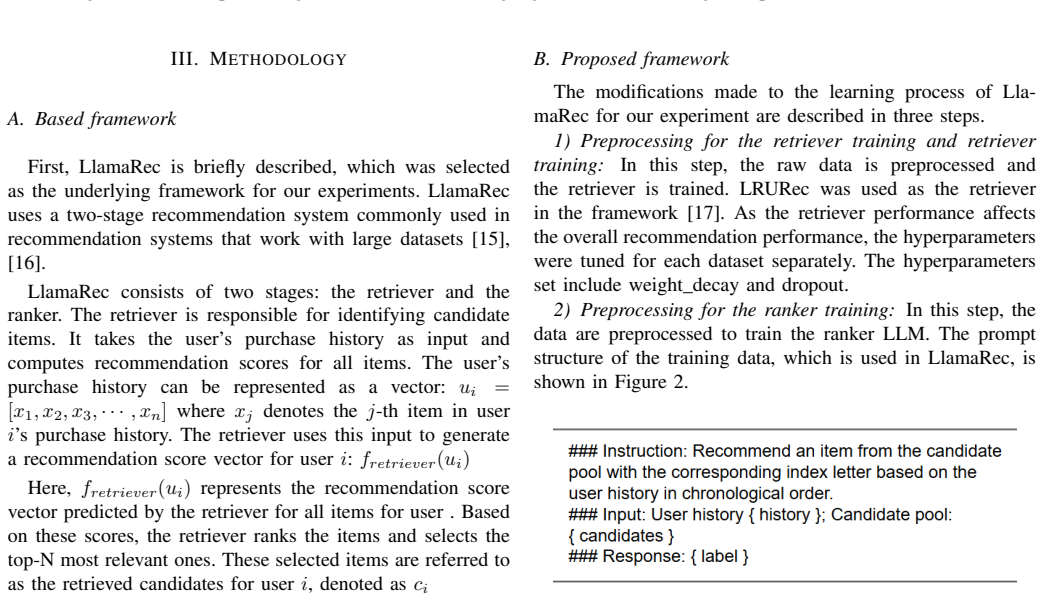
The object that carries the argument is the ranker LLM inside LlamaRec's two-stage pipeline. LlamaRec first uses LRURec as a retriever to produce candidate items, then a fine-tuned LLM ranker re-ranks the candidates through a custom verbalizer that turns the logits of index characters into a probability distribution. The paper replaces only the ranker model, from Llama2-7B to Llama3.1-8B, keeps QLoRA for parameter-efficient fine-tuning, and updates the tokenizer to the compatible version; all other components remain fixed. The measured differences in ranking metrics are attributed to the newer LLM's larger pretraining corpus and Grouped Query Attention architecture.
What would settle it
Rerun LlamaRec's original Llama2-7B ranker with exactly the retriever weight-decay and dropout settings reported here and the same seed 42; if the reported margins shrink to near zero, the effect is not due to the LLM swap alone.
Extended reading notes
Core claim
The paper claims that the recommendation quality of LlamaRec, a two-stage sequential recommender whose ranker is a fine-tuned Llama2-7B, improves substantially when the ranker LLM is replaced by Llama3.1-8B while keeping the two-stage structure, prompt format, and training procedure unchanged. On the ranker's own evaluation, this swap yields average gains of 38.65% on ML-100K, 8.69% on Beauty, and 8.19% on Games, with the best checkpoints selected by NDCG@10. The authors' conclusion is that newer open LLMs are directly transferable into existing LLM-based recommendation pipelines, producing large performance improvements without structural redesign.
Load-bearing premise
The paper assumes that the only meaningful change between LlamaRec and its version is the LLM itself, but it does not show that the baseline used the same per-dataset retriever hyperparameters, and it relies on a single random seed.
Editorial extensions
If this is right
- If the replacement effect is real, any Llama2-based two-stage recommender can be upgraded by swapping in Llama3-class weights with minimal engineering.
- Recommendation systems can track LLM release cycles and gain improvements without changing the retriever, prompt schema, or inference pipeline.
- The reported gains suggest that most of the quality gap between older and newer LLM-based recommenders lies in the base model, not in framework design.
- QLoRA fine-tuning of Llama3 keeps training feasible at 8B parameters, so the upgrade is cost-effective for practical deployments.
Reading between the lines
- The paper's comparison may confound LLM replacement with retriever hyperparameter tuning, since the retriever's weight decay and dropout were tuned per dataset and the paper does not show that the LlamaRec baseline used those same settings.
- The headline 38.65% gain comes from a small dataset and a single seed, so multi-seed runs would reveal whether the improvement is stable or partly noise.
- A direct extension would test the same swap in other two-stage LLM recommenders and predict that gains scale with the generation gap between the base models.
Editorial analysis
A structured set of objections, weighed in public.
Referee Report
Summary. The paper proposes replacing Llama2-7b with Llama3.1-8b in the LlamaRec two-stage sequential recommendation framework, keeping the retriever and ranker architecture otherwise unchanged. The authors report ranker performance improvements of 38.65%, 8.69%, and 8.19% on ML-100K, Beauty, and Games, respectively, and similar overall improvements, concluding that upgrading the LLM is a cost-effective way to improve recommendation quality. The evaluation uses leave-one-out data with MRR, NDCG, and Recall at 5 and 10, and a single seed (42) throughout.
Significance. If the causal attribution is correct, the result is practically valuable: it would show that a simple model swap, without structural changes, can substantially improve an existing LLM-based recommender. The paper has real strengths: the primary comparison is a direct before/after change inside the same framework, the seed is fixed, the reported average improvements are consistent with the numbers in Tables II and III, and the authors honestly note that Recall@5 improves less than other metrics. The main weakness is that the manuscript does not establish that the baseline and proposed runs differ only in the LLM, because the retriever hyperparameters were tuned per dataset and the baseline configuration is not described. The single-seed design is a secondary but real limitation.
major comments (4)
- [III.B.1 and IV.D] The central claim that only the LLM changed is not yet established. Section III.B.1 states that the LRURec retriever hyperparameters (weight decay and dropout) were tuned for each dataset separately, and Section IV.D lists those values, but the manuscript never states whether the LlamaRec baseline in Tables II and III was run with the same tuned retriever, the same candidate generation, and the same R subsets, or whether the baseline numbers were taken from the original paper. Because Equation (1) defines the ranker evaluation on the subset R of users for whom the retriever top-k contains the correct item, retriever settings determine both the difficulty and the composition of the ranking task; a better-tuned retriever can raise the reported ranker metrics even with an unchanged LLM. Please report the exact baseline configuration or re-run the baseline under identical retriever and preprocessing settings.
- [IV] All experiments use a single random seed (42) with no repeated runs, confidence intervals, or significance tests. The improvements on Beauty and Games are in the 6-12% range for most metrics, which is small enough that run-to-run variance could change the conclusion, and even the large ML-100K gain deserves a variance estimate given that QLoRA training is stochastic. Please provide mean and standard deviation over at least three seeds, or otherwise demonstrate stability.
- [I, III.B.3, IV] The paper claims the replacement makes recommendations 'more sophisticated and faster' (Section I) and presents the approach as cost-effective, but no inference speed, memory, or training-time measurements are reported. In addition, the replacement is not parameter-identical: Llama3.1-8b has about 1B more parameters than Llama2-7b and uses a different tokenizer, as the authors themselves note when changing the tokenizer in Section III.B.2. The performance comparison may still be meaningful, but the speed and cost-effectiveness claims should be either measured or removed.
- [V.B / Table IV] The comparison with PALR, GPT4Rec, RecMind, and POD uses published numbers that may come from different preprocessing, candidate generation, and evaluation protocols; the manuscript does not state that these baselines were evaluated under the same leave-one-out setup and the same user subset as the proposed method. The phrase 'overwhelmingly dominant' (Section V.B) is therefore stronger than the evidence supports. Please specify the provenance of each baseline number and restrict conclusions to what the comparison can support, or add a like-for-like re-implementation.
minor comments (5)
- [IV.C.1] The sentence 't uses a validation dataset...' at the start of Section IV.C.1 appears truncated; it should read 'The ranker uses a validation dataset...'.
- [Equations (1)-(6)] In Equation (6), the typesetting of |\bar R| is broken, and the weighted-average formula should state explicitly that M is computed as a per-user average before aggregation, otherwise the equation is ambiguous.
- [V.A] The reported average improvements match Tables II and III, but averaging relative improvements over six metrics gives disproportionate weight to large relative gains on small baseline values (e.g., M@5 on ML-100K, +71.35%). Reporting per-metric absolute changes or including NDCG@10 as the headline metric would aid interpretation.
- [IV] The paper claims 'identical input data was provided during preprocessing and training' but does not document the data split or whether the same validation-based model selection was used for the baseline; please add a reproducibility statement covering both runs.
- [III.B.3] Reference [18] is about quantization of Llama3, not specifically about QLoRA for ranking; consider citing the original QLoRA work or a more directly applicable empirical study for the claim that QLoRA maintains performance on Llama3.
Circularity Check
No significant circularity: the reported gains are measured experimental outcomes, not derivations that reduce to the paper's own inputs.
full rationale
The paper's central claim is an empirical hypothesis test: replacing Llama2-7b with Llama3.1-8b inside the LlamaRec framework improves measured ranking metrics (Section I, V.A). The reported improvements in Tables II and III are measured outcomes of that comparison, not quantities defined in terms of the target result. No fitted parameter is renamed as a prediction; the retriever hyperparameters are tuned per dataset, but their values are not used to construct the reported improvements as identities. The paper does not derive the gains from an equation that assumes the gains. There are no load-bearing self-citations: references [9], [17], and [18] are external prior works and are not by the present authors. No uniqueness theorem, ansatz, or known result is smuggled in via a self-citation chain. The retriever tuning described in Sections III.B.1 and IV.D is a potential experimental-control concern: the paper does not demonstrate that the LlamaRec baseline used the same tuned retriever settings, so the gains might partly reflect retriever configuration rather than the LLM swap. That is a validity threat, not circularity, because the claim does not become equivalent to its inputs by construction. The single-seed protocol is likewise a reproducibility concern, not a circularity concern. Overall, the derivation chain is self-contained as an experimental comparison, and no circular step can be exhibited.
Assumptions & free parameters
free parameters (5)
- Retriever weight decay =
0 (ML-100K); 0.01 (Beauty, Games)
- Retriever dropout =
0.5
- Ranker QLoRA configuration =
r=8, alpha=32, dropout=0.05, learning rate 1e-4, Q and V modules
- Ranker training schedule =
batch size 16 (ML-100K) or 12 (others), 1 epoch, max 20 history items, 20 candidates
- Evaluation window and model selection =
k=5 and k=10; NDCG@10 used for validation
assumptions (4)
- domain assumption Llama3.1-8b is a better base model than Llama2-7b for the recommendation fine-tuning task.
- domain assumption The leave-one-out evaluation with a fixed seed 42 is sufficient to attribute performance differences to the LLM replacement.
- domain assumption Baseline numbers for PALR, GPT4Rec, RecMind, and POD taken from prior papers are comparable to the authors' runs.
- domain assumption The baseline LlamaRec retriever was trained under the same retriever hyperparameters as the proposed framework.
Cite this review
Pith. "Pith review of Improving the Performance of Sequential Recommendation Systems with an Extended Large Language Model." pith.science (2026). https://pith.science/paper/MLEPGWJD
@misc{pith2026250719990,
  author       = {Pith},
  title        = {Pith review of: Improving the Performance of Sequential Recommendation Systems with an Extended Large Language Model},
  year         = {2026},
  howpublished = {\url{https://pith.science/paper/MLEPGWJD}},
  note         = {Machine review of arXiv:2507.19990}
}
read the original abstract
Recently, competition in the field of artificial intelligence (AI) has intensified among major technological companies, resulting in the continuous release of new large-language models (LLMs) that exhibit improved language understanding and context-based reasoning capabilities. It is expected that these advances will enable more efficient personalized recommendations in LLM-based recommendation systems through improved quality of training data and architectural design. However, many studies have not considered these recent developments. In this study, it was proposed to improve LLM-based recommendation systems by replacing Llama2 with Llama3 in the LlamaRec framework. To ensure a fair comparison, random seed values were set and identical input data was provided during preprocessing and training. The experimental results show average performance improvements of 38.65\%, 8.69\%, and 8.19\% for the ML-100K, Beauty, and Games datasets, respectively, thus confirming the practicality of this method. Notably, the significant improvements achieved by model replacement indicate that the recommendation quality can be improved cost-effectively without the need to make structural changes to the system. Based on these results, it is our contention that the proposed approach is a viable solution for improving the performance of current recommendation systems.
Figures


Forward citations
Cited by 1 Pith paper
-
SRBench: A Comprehensive Benchmark for Sequential Recommendation with Large Language Models
SRBench is a multi-dimensional benchmark for sequential recommendation that uses prompt engineering and a coupled extraction mechanism to support fair evaluation of both neural-network and LLM-based models across accu...
Reference graph
Works this paper leans on
-
[1]
A. Vaswani, N. Shazeer, N. Parmar, J. Uszkoreit, L. Jones, A. N. Gomez, L. Kaiser, and I. Polosukhin. Attention is all you need. Advances in Neural Information Processing Systems , 30, 2017
work page 2017
-
[2]
S. Geng, S. Liu, Z. Fu, Y . Ge, and Y . Zhang. Recommendation as language processing (rlp): A unified pretrain, personalized prompt & predict paradigm (p5). In Proceedings of the 16th ACM Conference on Recommender Systems , pages 299–315, 2022
work page 2022
-
[3]
W. C. Kang, J. Ni, N. Mehta, M. Sathiamoorthy, L. Hong, E. Chi, and D. Z. Cheng. Do llms understand user preferences? evaluating llms on user rating prediction. arXiv preprint arXiv:2305.06474, 2023
arXiv 2023
-
[4]
L. Wu, Z. Zheng, Z. Qiu, H. Wang, H. Gu, T. Shen, C. Qin, C. Zhu, H. Zhu, and Q. Liu. A survey on large language models for recommen- dation. World Wide Web, 27:60, 2024
work page 2024
-
[5]
OpenAI. Chatgpt. https://openai.com/blog/chatgpt, 2022. Accessed: 2025-06-05
work page 2022
-
[6]
A. Grattafiori, A. Dubey, A. Jauhri, A. Pandey, A. Kadian, A. Al- Dahle, and P. Vasic. The llama 3 herd of models. arXiv preprint arXiv:2407.21783, 2024
arXiv 2024
-
[7]
H. Touvron, L. Martin, K. Stone, P. Albert, A. Almahairi, Y . Babaei, and T. Scialom. Llama 2: Open foundation and fine-tuned chat models. arXiv preprint arXiv:2307.09288, 2023
arXiv 2023
-
[8]
J. Ainslie, J. Lee-Thorp, M. De Jong, Y . Zemlyanskiy, F. Lebr ´on, and S. Sanghai. Gqa: Training generalized multi-query transformer models from multi-head checkpoints. arXiv preprint arXiv:2305.13245, 2023
arXiv 2023
Show all 25 references
-
[9]
Z. Yue, S. Rabhi, G. D. S. P. Moreira, D. Wang, and E. Oldridge. Llamarec: Two-stage recommendation using large language models for ranking. arXiv preprint arXiv:2311.02089, 2023
2023 arXiv
- [10]
-
[11]
Gemini 2.5 pro
DeepMind. Gemini 2.5 pro. https://deepmind.google/models/gemini/ pro/, 2025. Accessed: 2025-06-05
2025
-
[12]
Introducing claude 3.5 sonnet
Anthropic. Introducing claude 3.5 sonnet. https://www.anthropic.com/ news/claude-3-5-sonnet, 2024. Accessed: 2025-06-05
2024
-
[13]
Z. Chu, H. Hao, X. Ouyang, S. Wang, Y . Wang, Y . Shen, and S. Li. Leveraging large language models for pretrained recommender systems. arXiv preprint arXiv:2308.10837, 2023
2023 arXiv
-
[14]
K. Bao, J. Zhang, Y . Zhang, W. Wang, F. Feng, and X. He. Tallrec: An effective and efficient tuning framework to align large language model with recommendation. In Proceedings of the 17th ACM Conference on Recommender Systems , pages 1007–1014, 2023
2023
-
[15]
Covington, J
P. Covington, J. Adams, and E. Sargin. Deep neural networks for youtube recommendations. In Proceedings of the 10th ACM Conference on Recommender Systems , pages 191–198, 2016
2016
-
[16]
Higley, E
K. Higley, E. Oldridge, R. Ak, S. Rabhi, and G. de Souza Pereira Mor- eira. Building and deploying a multi-stage recommender system with merlin. In Proceedings of the 16th ACM Conference on Recommender Systems, pages 632–635, 2022
2022
-
[17]
Z. Yue, Y . Wang, Z. He, H. Zeng, J. McAuley, and D. Wang. Linear recurrent units for sequential recommendation. In Proceedings of the 17th ACM International Conference on Web Search and Data Mining , pages 930–938, 2024
2024
-
[18]
Huang, X
W. Huang, X. Zheng, X. Ma, H. Qin, C. Lv, H. Chen, J. Luo, X. Qi, X. Liu, and M. Magno. An empirical study of llama3 quantization: From llms to mllms. Visual Intelligence, 2:36, 2024
2024
-
[19]
F. M. Harper and J. A. Konstan. The movielens datasets: History and context. ACM Transactions on Interactive Intelligent Systems (TIIS) , 5(4):1–19, 2015
2015
-
[20]
He and J
R. He and J. McAuley. Ups and downs: Modeling the visual evolution of fashion trends with one-class collaborative filtering. In Proceedings of the 25th International Conference on World Wide Web , pages 507–517, 2016
2016
-
[21]
McAuley, C
J. McAuley, C. Targett, Q. Shi, and A. Van Den Hengel. Image-based recommendations on styles and substitutes. In Proceedings of the 38th International ACM SIGIR Conference on Research and Development in Information Retrieval , pages 43–52, Santiago, Chile, 2015
2015
-
[22]
F. Yang, Z. Chen, Z. Jiang, E. Cho, X. Huang, and Y . Lu. Palr: Personalization aware llms for recommendation. arXiv preprint arXiv:2305.07622, 2023
2023 arXiv
-
[23]
J. Li, W. Zhang, T. Wang, G. Xiong, A. Lu, and G. Medioni. Gpt4rec: A generative framework for personalized recommendation and user interests interpretation. arXiv preprint arXiv:2304.03879, 2023
2023 arXiv
-
[24]
Y . Wang, Z. Jiang, Z. Chen, F. Yang, Y . Zhou, E. Cho, and Y . Yang. Recmind: Large language model powered agent for recommendation. arXiv preprint arXiv:2308.14296, 2023
2023 arXiv
-
[25]
L. Li, Y . Zhang, and L. Chen. Prompt distillation for efficient llm- based recommendation. In Proceedings of the 32nd ACM International Conference on Information and Knowledge Management , pages 1348– 1357, Birmingham, UK, 2023
2023
Reviewed August 6, 2026 · model on record in the stance chip above.
Discussion (0). Sign in to comment.