REVIEW 5 major objections 5 minor 42 references
Strategic Filtering for Content Moderation: Free Speech or Free of Distortion?
T0 review · 5 major / 5 minor · reviewed 2026-08-06 · deepseek-v4-flash
Pith's one-line read This paper frames content moderation as a mechanism-design problem and shows that, for linear and other bounded-complexity filters, a polynomial number of offline samples suffices to approximate the optimal trade-off between reducing…
desk verdict New welfare framing for moderation with a solid hardness result, but the offline-data story runs into an observability gap the paper doesn't confront. read the letter →
The pith
A machine-rendered reading of the paper's core claim, the machinery that carries it, and where it could break.
The reading
What carries the argument
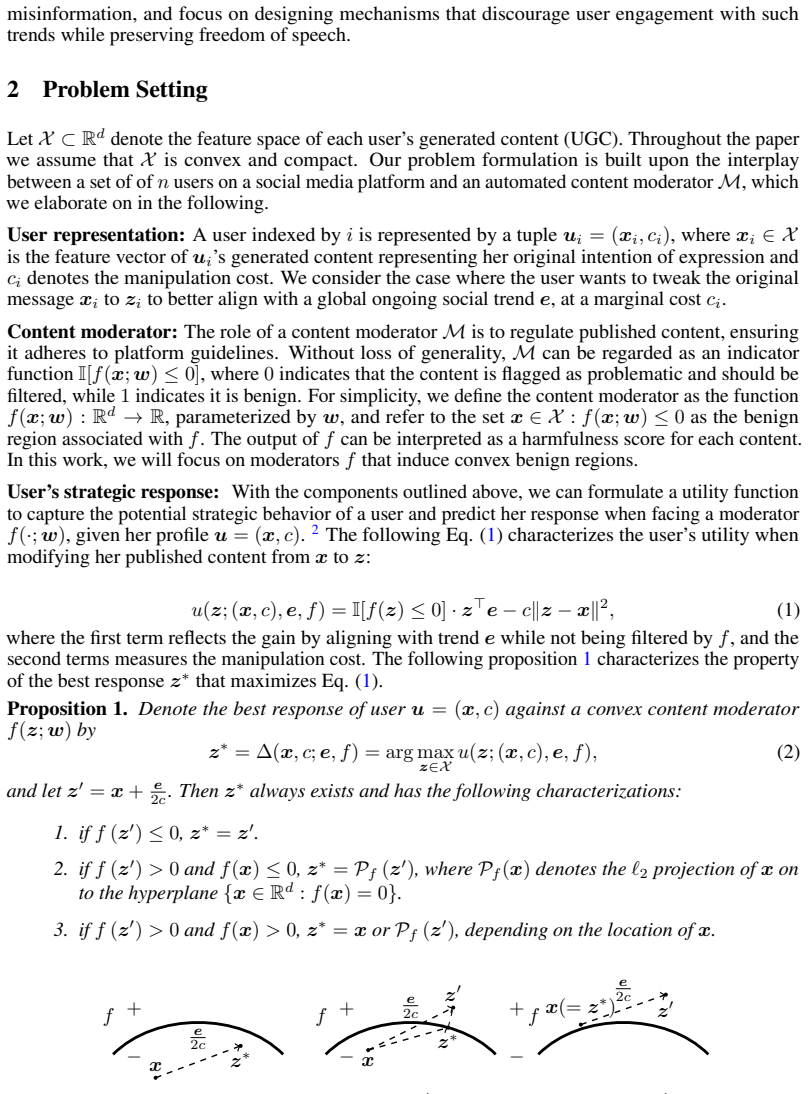
The load-bearing object is the strategic best response $\Delta(x,c;e,f)$ of Eq. (2), whose closed form (Proposition 1) converts a policy question into a constrained empirical optimization over distortion-mitigation functions $h(f;x,c)$. Sample efficiency is carried by the pseudo-dimension of the induced class $\mathcal{H}_{\mathcal{F}}$ together with the VC-dimension of the filter class $\mathcal{F}$, bounded via composition lemmas for linear, piecewise-linear, and feature-mapped linear filters; the hardness result is carried by a reduction from maximum feasible linear subsystems with mandatory constraints.
What would settle it
Train the model on a dataset where each user's true intent $x$ and manipulation cost $c$ are known, deploy the recommended linear filter, and measure edited posts against the prediction of Proposition 1: benign ideal points $x+e/(2c)$ should appear unchanged, and filtered ideal points should appear at their $\ell_2$ projection onto the boundary. Systematic mismatch, such as users whose posts are filtered quitting the platform instead of projecting, would invalidate the distortion model. As a purely computational check, brute-force search over small random instances should never beat the relaxed problem's claimed optimum by more than numerical error.
Extended reading notes
Core claim
The central discovery is that the moderation problem has a closed-form user response: each user moves from $x$ to $x + e/(2c)$ if that point is benign, and otherwise projects it onto the decision boundary. The paper then writes the welfare objective as expected distortion mitigation $h(f;x,c)$ subject to a hard free-speech constraint, proves uniform-convergence sample bounds in terms of $\mathrm{VCDim}(\mathcal{F})$ and $\mathrm{PDim}(\mathcal{H}_{\mathcal{F}})$, and shows NP-hardness for exact optimal linear filters. Its design conclusion is that the welfare-maximizing moderator places the decision boundary where content concentrates, rather than simply suppressing more content.
Load-bearing premise
The whole optimization assumes the platform knows the global trend direction $e$ and each user's manipulation cost $c_i$, and that every user best-responds exactly according to the utility in Eq. (1); if real users' costs or unmanipulated intentions are invisible or their behavior differs, the computed moderator no longer optimizes the stated trade-off.
Editorial extensions
If this is right
- For linear filters, $O(d^2/\varepsilon^2)$ offline samples (up to log factors) suffice to approximate the optimal distortion/speech trade-off within additive error $\varepsilon$ with high probability.
- No polynomial-time algorithm can find the exact optimal linear moderator under the hard free-speech constraint unless P = NP, even when the constraint is relaxed by a slack $\epsilon$.
- A penalty-based method with $\lambda$ chosen by binary search produces a family of moderators spanning the trade-off; increasing $\lambda$ shifts the boundary toward the margin, preserving more speech at the cost of less distortion mitigation.
- Distortion mitigation is maximized when the decision boundary sits where content is concentrated, while the free-speech constraint pulls it toward the margin, yielding the inverted-U trade-off seen in the toy example and experiments.
- For piecewise-linear filters, learnability degrades exponentially in the number of linear pieces, so the guarantees are practical only for small $m$.
Reading between the lines
- If manipulation costs must be inferred from observed edits rather than given, the sample-complexity bound would need an extra estimation-error term; the paper assumes costs are known inputs.
- A different free-speech metric, such as counting filtered original posts rather than filtered idealized manipulated posts, would change the optimization landscape and could change both the hardness and the design principle.
- The "boundary near content mass" principle predicts a measurable pattern: incremental shifts of a moderation boundary toward content density should reduce trend-following edits before filter rates rise sharply.
- The hardness construction uses homogeneous costs across users in the reduction; heterogeneous costs or low-dimensional structure might create tractable subcases that the paper does not explore.
Editorial analysis
A structured set of objections, weighed in public.
Referee Report
Summary. The paper studies content moderation as a Stackelberg game in which users strategically adapt content toward a known social trend e subject to a moderation filter, balancing social distortion mitigation (DM) against freedom-of-speech preservation. It defines an optimization problem over moderator classes (OP(7)/OP(8)), proves a generalization/sample-complexity bound for the empirical DM objective (Theorem 1) with bounds for linear and piecewise-linear classes (Proposition 3), proves NP-hardness of exactly optimizing linear moderators (Theorem 2), and proposes a penalty-based heuristic solved by projected gradient descent with a smoothed surrogate loss, evaluated on synthetic data. The paper also draws a conceptual conclusion that welfare-maximizing moderation places the decision boundary where content concentrates.
Significance. If the technical results are repaired, the paper would make a useful contribution to strategic machine learning and welfare-oriented moderation: it formalizes a non-accuracy-based welfare objective for moderation, gives a conditional statistical learning guarantee for linear and piecewise-linear filters, and identifies a nontrivial computational hardness result. The model and closed-form best-response characterization (Proposition 1) are clean, and the appendix contains substantial proof sketches. However, the current version has several load-bearing gaps: the offline data assumption is not justified observably, the main sample-complexity theorem has an undefined range parameter and unstated boundedness assumptions, the NP-hardness reduction has an incomplete converse direction, and the empirical evaluation does not establish approximation quality. These issues are fixable within the manuscript's scope, but they need to be addressed before the central claims can be accepted.
major comments (5)
- [Section 3, OP(8); Section 4, Theorem 1] The offline dataset S consists of pairs (x_i, c_i) where x_i is a user's original expressive intent and c_i is a private manipulation cost. These are pre-moderation, unobservable quantities. The only observable quantity is the published best response z*, and the map (x,c) -> z* is non-injective (for an unfiltered user and a linear incumbent, z* = x + e/(2c), so any c' > 0 with x' = z* - e/(2c') yields the same z*). The paper gives no estimation procedure, no identifiability analysis, and no assumption connecting S to observable posts. Consequently, Theorem 1 proves learnability from an oracle dataset of true intentions, not from data a platform can actually collect. The claims that finite offline data suffice for practical content moderation are unsupported unless the paper explicitly states and defends an observability assumption or reframes the result as conditional on access to such oracle data.
- [Section 4, Theorem 1; Section 2] Theorem 1 states a sample complexity of O(1/epsilon^2 (H^2(PDim(H_F)+ln(1/delta))+VCDim(F))) but H is never defined. The range of h(f;x,c) is also not bounded a priori: D(bot; (x,c),e) = ||e/(2c)||^2, which is unbounded as c approaches 0. The paper assumes X is convex and compact but gives no condition on C beyond drawing c from a distribution. Without an assumption such as c in [c_min, c_max] with c_min > 0, and without defining H as a uniform upper bound on |h| over f in F, the stated bound is vacuous or at best incomplete. This is central because Theorem 1 is the paper's main statistical learnability claim.
- [Appendix D.2, Theorem 2] The proof of NP-hardness of epsilon-MAX-FLS with mandatory constraints has a gap in the converse direction. After assuming a solution x satisfies at least 3n+m optional constraints and violates at most q=2n+2m mandatory constraints, the text states that x must satisfy all constraints of type (45) and exactly m constraints among (46) and (47). This does not follow: an assignment could satisfy fewer than 3n coverage constraints in (45) while satisfying more than m constraints among (46) and (47) (for example, if x_{m+1} is nonzero and several x_j are zero, both (46) and (47) cannot both hold, but the counting still needs proof). The reduction to Exact 3-Set Cover is therefore incomplete as written, and the computational hardness result of Theorem 2 needs a repaired argument.
- [Section 5.2, Proposition 4 and binary search] The binary-search method for finding the penalty strength lambda assumes that each instance of OP(14) is solved to global optimality, since Proposition 4 is stated for 'any solution' and the monotonicity comparison uses optimal values of the penalized objective. However, OP(14) is a nonconvex indefinite quadratic program, and the paper's solver is projected gradient descent on a smoothed surrogate. No guarantee is provided that the local solution returned by PGD is a global optimum, so the claim that the platform can 'identify the optimal lambda' by solving O(log n + log(1/delta)) instances is not justified. The monotonicity result is mathematically sound, but its algorithmic application requires either exact solving or a stated approximation guarantee.
- [Section 5.3 and Appendix E.1] The experiments do not validate the quality of the heuristic. The paper reports only the heuristic's own objective values and freedom-of-speech index as lambda varies, with no comparison against exact optima on small instances, no random or no-moderation baseline, and no quantification of the gap to the optimal value of OP(15). Additionally, the surrogate loss in Eq. (56) does not agree with the true loss for y > a (filtered users), and no consistency or approximation guarantee is given for minimizing the surrogate. The statement that the proposed technique 'can effectively approximate a solution' is therefore unsupported by the current evidence. The authors should add a small-scale exact or grid-search comparison, or at least report the surrogate-vs-true objective gap on the generated data.
minor comments (5)
- [Appendix C.1, Eq. (24)-(25)] There is a sign inconsistency in the definition of H1: h1 is introduced as -(w^T x + b)^2 + (w^T e)^2 tilde{x}_{d+1}^2, but Eq. (24) and the expansion in Eq. (25) write it as +(w^T x + b)^2 - w_{d+1}^2 tilde{x}_{d+1}^2. Since pseudo-dimension is invariant to negating functions when thresholds range over a symmetric interval, this may not change the final bound, but the notation should be corrected for consistency.
- [Section 1.1 and Definition 2] The 'key insight' that moderation is most effective when the boundary lies near the content mass is essentially a restatement of the definition of DM in Eq. (5) and the closed form in Eq. (19): the objective explicitly rewards users with -w^T e/(2c) < w^T x + b <= 0. It would be more appropriate to present this as an interpretation of the model rather than a discovered design principle.
- [Section 4, Theorem 1] The symbol U is used both for the distribution over X x C and for the training sample ('any distribution U on X x C, a training sample U'), which is confusing. Rename the distribution to D or the sample to S.
- [Section 3, OP(7)] The notation E_{(x,c) ~ U} appears as E(x,c)~U in the displayed equation; please fix the typesetting.
- [Figure 3 caption] The word 'compupted' in the caption is a typo for 'computed'.
Circularity Check
No significant circularity: the optimization, sample-complexity, and NP-hardness results are conditional deductions from stated definitions, and self-citations are not load-bearing.
full rationale
This paper's derivation chain is self-contained. Proposition 1 solves the user utility maximization in Eq. (1) by convex optimization, and Definitions 1 and 2 fix the social-distortion and distortion-mitigation objectives; OP(7) and OP(8) are the resulting constrained optimization statements, not fitted predictions. Theorem 1 is a standard uniform-convergence argument over the function classes F and H_F (Pollard) with a union bound, and Proposition 3 bounds VC and pseudo-dimensions from the closed-form best responses; neither uses the conclusion as an input. Theorem 2 proves NP-hardness by an explicit reduction from MAX-FLS with mandatory constraints and Exact 3-Set Cover. The 'boundary near content mass' design principle is a mathematical consequence of Eq. (5) and Proposition 2, so it is definitional in character but not a circular prediction: no fitted parameter is later reported as a discovery. Self-citations (Ahmadi et al., Sundaram et al., Rosenfeld-Xu, Yao et al.) occur only in contextual or related-work passages and do not carry any theorem. The offline-sample guarantee is conditional on access to un-manipulated (x_i, c_i) samples; the absence of an estimation procedure from observed posts is an observability limitation of the model, not a circularity, because Theorem 1's statement is conditional and its proof does not depend on the quantity being predicted.
Assumptions & free parameters
free parameters (4)
- per-user manipulation cost c_i
- global trend direction e =
unit vector e=(1,0,...,0) in experiments
- penalty strength lambda =
0.1 to 100 in experiments
- surrogate smoothing epsilon =
0.9
assumptions (5)
- domain assumption Users maximize u(z)=I[f(z)<=0] z^T e - c||z-x||^2 and therefore best respond by moving toward x+e/(2c) and projecting onto the boundary if needed.
- ad hoc to paper Social distortion is counted only for users whose original content is benign (f(x)<=0).
- ad hoc to paper Freedom of speech is operationalized as the fraction of users whose ideal manipulated point x+e/(2c) passes the filter.
- domain assumption The content space X is convex and compact, and the user cost distribution C is left unspecified with c_i implicitly positive.
- domain assumption The moderator function class F induces convex benign regions.
invented entities (1)
-
Social distortion mitigation (DM) objective
Cite this review
Pith. "Pith review of Strategic Filtering for Content Moderation: Free Speech or Free of Distortion?." pith.science (2026). https://pith.science/paper/J6T72XBX
@misc{pith2026250720061,
  author       = {Pith},
  title        = {Pith review of: Strategic Filtering for Content Moderation: Free Speech or Free of Distortion?},
  year         = {2026},
  howpublished = {\url{https://pith.science/paper/J6T72XBX}},
  note         = {Machine review of arXiv:2507.20061}
}
read the original abstract
User-generated content (UGC) on social media platforms is vulnerable to incitements and manipulations, necessitating effective regulations. To address these challenges, those platforms often deploy automated content moderators tasked with evaluating the harmfulness of UGC and filtering out content that violates established guidelines. However, such moderation inevitably gives rise to strategic responses from users, who strive to express themselves within the confines of guidelines. Such phenomena call for a careful balance between: 1. ensuring freedom of speech -- by minimizing the restriction of expression; and 2. reducing social distortion -- measured by the total amount of content manipulation. We tackle the problem of optimizing this balance through the lens of mechanism design, aiming at optimizing the trade-off between minimizing social distortion and maximizing free speech. Although determining the optimal trade-off is NP-hard, we propose practical methods to approximate the optimal solution. Additionally, we provide generalization guarantees determining the amount of finite offline data required to approximate the optimal moderator effectively.
Figures


Figures from the paper (2 more)


Reference graph
Works this paper leans on
-
[1]
Saba Ahmadi, Hedyeh Beyhaghi, Avrim Blum, and Keziah Naggita. The strategic perceptron. pages 6--25, 2021
work page 2021
-
[2]
On classification of strategic agents who can both game and improve
Saba Ahmadi, Hedyeh Beyhaghi, Avrim Blum, and Keziah Naggita. On classification of strategic agents who can both game and improve. arXiv preprint arXiv:2203.00124, 2022
arXiv 2022
-
[3]
Multiagent evaluation mechanisms
Tal Alon, Magdalen Dobson, Ariel Procaccia, Inbal Talgam-Cohen, and Jamie Tucker-Foltz. Multiagent evaluation mechanisms. 34 0 (02): 0 1774--1781, 2020
work page 2020
-
[4]
The complexity and approximability of finding maximum feasible subsystems of linear relations
Edoardo Amaldi and Viggo Kann. The complexity and approximability of finding maximum feasible subsystems of linear relations. Theoretical computer science, 147 0 (1-2): 0 181--210, 1995
work page 1995
-
[5]
Neural network learning: Theoretical foundations, volume 9
Martin Anthony, Peter L Bartlett, Peter L Bartlett, et al. Neural network learning: Theoretical foundations, volume 9. cambridge university press Cambridge, 1999
work page 1999
-
[6]
Big data's disparate impact
Solon Barocas and Andrew D Selbst. Big data's disparate impact. Calif. L. Rev., 104: 0 671, 2016
2016
-
[7]
Gaming helps! learning from strategic interactions in natural dynamics
Yahav Bechavod, Katrina Ligett, Steven Wu, and Juba Ziani. Gaming helps! learning from strategic interactions in natural dynamics. In International Conference on Artificial Intelligence and Statistics, pages 1234--1242. PMLR, 2021
work page 2021
-
[8]
Social bots distort the 2016 us presidential election online discussion
Alessandro Bessi and Emilio Ferrara. Social bots distort the 2016 us presidential election online discussion. First monday, 21 0 (11-7), 2016
work page 2016
Show all 42 references
-
[9]
Automated diffusion? bots and their influence during the 2016 us presidential election
Olga Boichak, Sam Jackson, Jeff Hemsley, and Sikana Tanupabrungsun. Automated diffusion? bots and their influence during the 2016 us presidential election. In Transforming Digital Worlds: 13th International Conference, iConference 2018, Sheffield, UK, March 25-28, 2018, Procee...
2016
-
[10]
Social media, freedom of speech, and the future of our democracy
Lee C Bollinger and Geoffrey R Stone. Social media, freedom of speech, and the future of our democracy. Oxford University Press, 2022
2022
-
[11]
Free speech and the regulation of social media content
Valerie C Brannon. Free speech and the regulation of social media content. Congressional Research Service (CRS) Reports and Issue Briefs, pages NA--NA, 2019
2019
-
[12]
Stackelberg games for adversarial prediction problems
Michael Br \"u ckner and Tobias Scheffer. Stackelberg games for adversarial prediction problems. In Proceedings of the 17th ACM SIGKDD international conference on Knowledge discovery and data mining, pages 547--555, 2011
2011
-
[13]
A new order: The digital services act and consumer protection
Caroline Cauffman and Catalina Goanta. A new order: The digital services act and consumer protection. European Journal of Risk Regulation, 12 0 (4): 0 758--774, 2021
2021
-
[14]
Learning strategy-aware linear classifiers
Yiling Chen, Yang Liu, and Chara Podimata. Learning strategy-aware linear classifiers. volume 33, pages 15265--15276, 2020
2020
-
[15]
Adversarial classification
Nilesh Dalvi, Pedro Domingos, Mausam, Sumit Sanghai, and Deepak Verma. Adversarial classification. In Proceedings of the tenth ACM SIGKDD international conference on Knowledge discovery and data mining, pages 99--108, 2004
2004
-
[16]
Incentive compatible regression learning
Ofer Dekel, Felix Fischer, and Ariel D Procaccia. Incentive compatible regression learning. In Proceedings of the nineteenth annual ACM-SIAM symposium on Discrete algorithms, pages 884--893, 2008
2008
-
[17]
Strategic classification from revealed preferences
Jinshuo Dong, Aaron Roth, Zachary Schutzman, Bo Waggoner, and Zhiwei Steven Wu. Strategic classification from revealed preferences. pages 55--70, 2018
2018
-
[18]
Beyond the hashtag: Circumventing content moderation on social media
Ysabel Gerrard. Beyond the hashtag: Circumventing content moderation on social media. New Media & Society, 20 0 (12): 0 4492--4511, 2018
2018
-
[19]
Custodians of the Internet: Platforms, content moderation, and the hidden decisions that shape social media
Tarleton Gillespie. Custodians of the Internet: Platforms, content moderation, and the hidden decisions that shape social media. Yale University Press, 2018
2018
-
[20]
Nika Haghtalab, Nicole Immorlica, Brendan Lucier, and Jack Z. Wang. Maximizing welfare with incentive-aware evaluation mechanisms. pages 160--166, 2020
2020
-
[21]
Exact penalty functions in nonlinear programming
S P Han and Olvi L Mangasarian. Exact penalty functions in nonlinear programming. Mathematical programming, 17: 0 251--269, 1979
1979
-
[22]
Strategic classification
Moritz Hardt, Nimrod Megiddo, Christos Papadimitriou, and Mary Wootters. Strategic classification. pages 111--122, 2016
2016
-
[23]
The disparate effects of strategic manipulation
Lily Hu, Nicole Immorlica, and Jennifer Wortman Vaughan. The disparate effects of strategic manipulation. In Proceedings of the Conference on Fairness, Accountability, and Transparency, FAT* '19, page 259–268, 2019
2019
-
[24]
How do classifiers induce agents to invest effort strategically? ACM Transactions on Economics and Computation (TEAC), 8 0 (4): 0 1--23, 2020
Jon Kleinberg and Manish Raghavan. How do classifiers induce agents to invest effort strategically? ACM Transactions on Economics and Computation (TEAC), 8 0 (4): 0 1--23, 2020
2020
-
[25]
The new governors: The people, rules, and processes governing online speech
Kate Klonick. The new governors: The people, rules, and processes governing online speech. Harv. L. Rev., 131: 0 1598, 2017
2017
-
[26]
Strategic classification made practical
Sagi Levanon and Nir Rosenfeld. Strategic classification made practical. In International Conference on Machine Learning, pages 6243--6253. PMLR, 2021
2021
-
[27]
Cyberbullying among young people: Laws and policies in selected member states
MURPHY COLIN MICHAEL. Cyberbullying among young people: Laws and policies in selected member states. 2024
2024
-
[28]
The social cost of strategic classification
Smitha Milli, John Miller, Anca D Dragan, and Moritz Hardt. The social cost of strategic classification. In Proceedings of the Conference on Fairness, Accountability, and Transparency, pages 230--239, 2019
2019
-
[29]
Numerical optimization
Jorge Nocedal and Stephen J Wright. Numerical optimization. Springer, 1999
1999
-
[30]
Hate speech regulation on social media: An intractable contemporary challenge
Catherine O’Regan and Stefan Theil. Hate speech regulation on social media: An intractable contemporary challenge. Research Outreach, 2020
2020
-
[31]
Performative prediction
Juan Perdomo, Tijana Zrnic, Celestine Mendler-D \"u nner, and Moritz Hardt. Performative prediction. volume 119, pages 7599--7609. PMLR, 2020
2020
-
[32]
D. Pollard. Convergence of Stochastic Processes. Springer New York, 1984. ISBN 9780387909905. URL https://books.google.com/books?id=B2vgGMa9vd4C
1984
-
[33]
Digital detritus:'error'and the logic of opacity in social media content moderation
Sarah T Roberts. Digital detritus:'error'and the logic of opacity in social media content moderation. First Monday, 2018
2018
-
[34]
Machine learning should maximize welfare, not (only) accuracy
Nir Rosenfeld and Haifeng Xu. Machine learning should maximize welfare, not (only) accuracy. arXiv preprint arXiv:2502.11981, 2025
2025 arXiv
-
[35]
On the density of families of sets
Norbert Sauer. On the density of families of sets. Journal of Combinatorial Theory, Series A, 13 0 (1): 0 145--147, 1972
1972
-
[36]
An attack on free speech? examining content moderation,(de-), and (re-) platforming on american right-wing alternative social media
Brittany Shaughnessy, Eliana DuBosar, Myiah J Hutchens, and Ilyssa Mann. An attack on free speech? examining content moderation,(de-), and (re-) platforming on american right-wing alternative social media. New Media & Society, page 14614448241228850, 2024
2024
-
[37]
A combinatorial problem; stability and order for models and theories in infinitary languages
Saharon Shelah. A combinatorial problem; stability and order for models and theories in infinitary languages. Pacific Journal of Mathematics, 41 0 (1): 0 247--261, 1972
1972
-
[38]
Pac-learning for strategic classification
Ravi Sundaram, Anil Vullikanti, Haifeng Xu, and Fan Yao. Pac-learning for strategic classification. Journal of Machine Learning Research, 24 0 (192): 0 1--38, 2023
2023
-
[39]
Cyber-violence against women
Jessica West. Cyber-violence against women. Battered Women's Support Services, 2014
2014
-
[40]
Unveiling user satisfaction and creator productivity trade-offs in recommendation platforms
Fan Yao, Yiming Liao, Jingzhou Liu, Shaoliang Nie, Qifan Wang, Haifeng Xu, and Hongning Wang. Unveiling user satisfaction and creator productivity trade-offs in recommendation platforms. Advances in Neural Information Processing Systems, 37: 0 86958--86984, 2024 a
2024
-
[41]
User welfare optimization in recommender systems with competing content creators
Fan Yao, Yiming Liao, Mingzhe Wu, Chuanhao Li, Yan Zhu, James Yang, Jingzhou Liu, Qifan Wang, Haifeng Xu, and Hongning Wang. User welfare optimization in recommender systems with competing content creators. In Proceedings of the 30th ACM SIGKDD Conference on Knowledge Discover...
2024
-
[42]
How much is too much: the difficulties of social media content moderation
Greyson K Young. How much is too much: the difficulties of social media content moderation. Information & Communications Technology Law, 31 0 (1): 0 1--16, 2022
2022
Reviewed August 6, 2026 · model on record in the stance chip above.
Discussion (0). Sign in to comment.