REVIEW 5 major objections 5 minor 1 cited by
What Language(s) Does Aya-23 Think In? How Multilinguality Affects Internal Language Representations
T0 review · 5 major / 5 minor · reviewed 2026-08-06 · deepseek-v4-flash
Pith's one-line read Aya-23-8B, a decoder-only model trained on balanced multilingual data, activates multiple typologically related language representations during translation and concentrates its language-specific neurons in final layers 27 to 31, in…
desk verdict Aya-23's code-mixed processing is worth a look, but the paper's headline claim about 'language-specific neurons' is actually about code-mixing detectors, and the stats and data release don't support the conclusion. read the letter →
The pith
A machine-rendered reading of the paper's core claim, the machinery that carries it, and where it could break.
The reading
What carries the argument
The argument is carried by two interpretability tools applied to three models. The logit lens projects each transformer layer's residual-stream hidden state through the unembedding matrix and reads off token probabilities, letting the authors track when languages become visible during translation; they sum over synonyms in 13 languages from the Dumas et al. dataset. Neuron specialization uses feed-forward ReLU activations: following Tan et al., neurons whose activations cover 90% of a language's total activation are treated as specialized, and intersection-over-union between languages measures sharing; following Kojima et al., average precision scores each neuron's ability to distinguish code-mixed from non-code-mixed texts, classifying neurons as top-k, medium, or bottom-k and locating them across layers. The third ingredient is a synthetic code-mixed dataset built from WMT24++ sentences by replacing words at 25%, 50%, and 75% rates using machine-translation dictionaries, with French and Chinese as base languages and five partner languages, so that language-pair typology and script are controlled.
What would settle it
Re-run the two neuron analyses on a corpus of naturally code-switched text from actual bilingual speakers, matched for the same ten language pairs and roughly the same mixing rates. If base-language dominance over the mixed-in language, the persistent French clustering advantage, and the final-layer concentration in layers 27-31 fail to reproduce, the paper's central claims are falsified.
Extended reading notes
Core claim
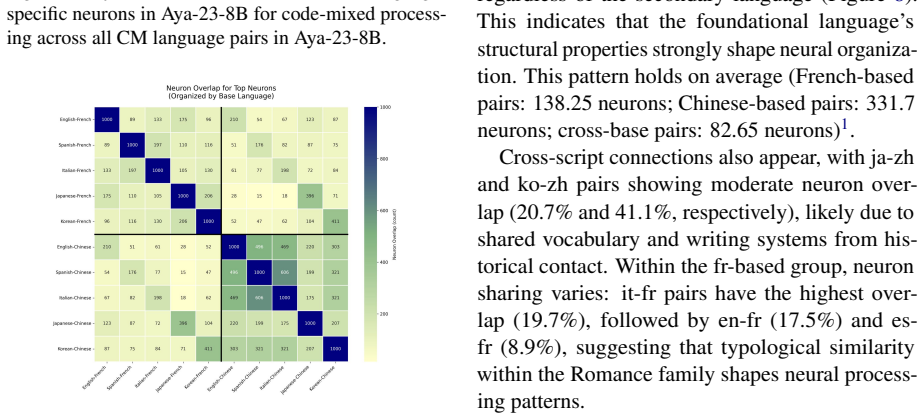
On the paper's own terms, the central discovery is that Aya-23-8B's internal representations are multilingual rather than pivot-centric. In logit-lens tests over 54 translation tasks, Aya-23 activates multiple languages in intermediate-to-late layers: during English-to-Chinese translation it also raises Japanese token probabilities, and its activation patterns differ significantly from Llama 3.1 and Chinese-LLaMA-2 in 8 of 13 languages after multiple-comparison correction. Output language shapes the internal language probabilities more strongly than input language across all models. At the neuron level, code-mixed French- and Chinese-based inputs produce clustering patterns that favor French across all three models, while neuron overlap is driven more by the base language than by the mixed-in partner, with Chinese-based pairs overlapping more than French-based pairs. For Aya-23, top-k code-mixing neurons concentrate in layers 27-31 with a pronounced spike at layer 31, which the authors interpret as evidence that balanced multilingual training defers language-specific processing to the generation stage.
Load-bearing premise
The load-bearing premise is that the rule-based, word-by-word code-mixed dataset, made by random replacement through machine translation without grammar or word-sense disambiguation, is a faithful stand-in for real code-switched language; if authentic code-switching engages different internal pathways, the findings on base-language dominance and final-layer neuron concentration would not generalize.
Editorial extensions
If this is right
- Cross-lingual transfer in balanced models may follow typological family lines rather than a universal English pivot, since Aya-23 activates languages such as Japanese while translating between English and Chinese.
- Code-mixed translation systems should expect the base language to dominate internal processing: French-based pairs show consistent neuron clustering regardless of mixing rate, while Chinese-based pairs show higher overlap overall.
- Language-control interventions in models like Aya-23 may be most effective in the final layers, where code-mixing neurons concentrate with a pronounced spike at layer 31.
- Neuron sharing tracks orthography and historical contact: same-script Romance pairs and zh-ja or zh-ko pairs share more neurons, and translation performance degrades more slowly on those pairs as mixing rate rises.
- Aya-23 remains more robust to increased code-mixing rates than Llama 3.1 or Chinese-LLaMA-2, as shown by BLEU scores on mixed inputs.
Reading between the lines
- The authors do not test natural code-switching, so a direct extension would be to run the same neuron-localization pipeline on a corpus of naturally code-switched text from actual bilingual speakers; if base-language dominance and final-layer concentration fail to reproduce there, the claims are limited to synthetic code-mixing.
- If final-layer concentration is a general signature of balanced multilingual training, then steering or editing a model's output language might target a narrow band of layers instead of being spread across the network, an intervention the paper does not attempt.
- The observation that typologically related but unseen languages are activated during translation suggests logit-lens activation could serve as a cheap diagnostic for whether a new language is being processed through a family relation rather than through an English bridge, but the paper does not propose such a diagnostic.
Editorial analysis
A structured set of objections, weighed in public.
Referee Report
Summary. The paper compares internal language representations of Aya-23-8B, Llama 3.1-8B, and Chinese-LLaMA-2-7B across translation, cloze, and code-mixed inputs. It uses logit lens to test whether a balanced multilingual model activates multiple languages during translation, activation-frequency neuron overlap to study neuron sharing across code-mixed language pairs, and activation-strength classification to locate language-specific neurons by layer. The main claims are that Aya-23 activates typologically related languages rather than relying only on an English pivot, that base language rather than mixed-in language shapes code-mixed neuron sharing, and that language-specific neurons for code-mixed inputs concentrate in final layers 27-31. The paper also reports BLEU-based translation quality on the code-mixed data and states limitations acknowledging the synthetic nature of the data and the code-mixing-detector interpretation of the Kojima-style labels.
Significance. If the claims held, the paper would extend interpretability findings from English-centric models to a balanced multilingual decoder, with implications for how training data composition shapes language encoding and cross-lingual transfer. It uses established tools (logit lens, Tan et al. and Kojima et al. neuron specialization), plans to release its controlled code-mixed dataset, and is unusually explicit about limitations. There is no formal parameter-fitting circularity; the central concern is construct validity: the operational definitions do not match the constructs asserted in the abstract and conclusion. The current evidence does not support the claims as stated: the neuron-specialization result is a code-mixing detector result by the paper's own admission, the per-layer significance claims appear statistically impossible as described, and the logit-lens comparisons include unsupported languages. These issues are local enough to be addressable by re-analysis and reframing, but they block acceptance now.
major comments (5)
- [Section 2.4 and Limitations] The Kojima-style experiment labels inputs as code-mixed vs. non-code-mixed and computes AP per neuron, so the top-k neurons are detectors of whether any mixing occurred, not of which language is represented. The Limitations section states this explicitly, saying the measure is 'better characterized as code-mixing neurons rather than pure language neurons.' Therefore H3, as stated ('where do language-specific neurons concentrate'), is not tested by this experiment, and the Abstract and Conclusion overstate the result when they say Aya's language-specific neurons for code-mixed inputs concentrate in layers 27-31. The authors should either re-label the finding as code-mixing neurons and revise the abstract and conclusion accordingly, or re-run the classification with per-language positive labels (e.g., French-mixed vs. Chinese-mixed) to actually measure language specificity.
- [Section 3.2, Figure 5] The per-layer Mann-Whitney comparisons are described as comparing IoU overlap values for 5 French-based pairs (fr-en, fr-es, fr-it, fr-ja, fr-ko) with 5 Chinese-based pairs (zh-en, zh-es, zh-it, zh-ja, zh-ko). With n1=n2=5, the smallest achievable two-sided p-value is 0.0079, which is above the stated Bonferroni threshold of 0.05/32 = 0.0016. The reported proportions of significant layers (28/32, 31/32, 24/32) are therefore impossible under the described test. The manuscript must report the actual sampling units (e.g., multiple sentences per pair, repeated IoU computations) and the exact test procedure; otherwise the three-phase and French-advantage claims are unsupported.
- [Section 3.1] The logit-lens model comparisons include languages not supported by the models: the paper itself notes that Aya-23-8B lacks et and fi, Llama 3.1 excludes et, fi, ja, ko, nl, ru, and zh, and Chinese-LLaMA supports only zh. Reporting '8/13 languages differ' across all 13 languages mixes genuine processing differences with tokenizer and vocabulary non-support. The statistical comparison should be restricted to languages each model actually supports, or to a common token set, and the 8/13 count should be recomputed on that basis.
- [Section 2.2 and Limitations] The major empirical claims about code-mixed processing rest on a dataset generated by rule-based word-by-word replacement via Google Translate, without grammar or word-sense disambiguation, which the authors admit 'often produces unnatural sentences that may not accurately represent authentic code-switching behavior.' This limits the external validity of the H2 and H4 conclusions. The Abstract and Conclusion should explicitly say 'synthetic word-level mixing' when drawing conclusions about code-switching, and the authors should ideally validate one main result on a natural code-switching corpus.
- [Limitations vs Results] The Limitations section is inconsistent with the Results and Conclusion. It states that for the Kojima experiment 'we can only conclude that code-mixed inputs are processed differently in the very late layers,' which concerns H3, but then says the Tan et al. experiment does not 'fully support hypothesis H3' even though that experiment tests H2; it also attributes a late-layer conclusion to H4, which is about variation by language pair and model. The hypotheses need to be mapped cleanly to experiments, and the claim that 'this pattern confirms our hypothesis H3' should be reconciled with the Limitations text.
minor comments (5)
- [Section 3.1] The list after '8/13 languages with p < 0.0013: de, ru, zh, es, ja, ko, it' contains seven languages; please correct the count or the list.
- [Figure 5 caption] The caption states phase boundaries at layers 5 and 17, while the text describes early (0-10), middle (11-21), and late (22-31) phases; please align these descriptions.
- [Section 2.4] The text uses 'jp' once alongside 'ja' for Japanese; please use a consistent language code.
- [Figure 6] The BLEU scores are reported without confidence intervals or significance tests; claims such as 'Aya-23-8B consistently outperforms' and 'greater resilience' should be accompanied by uncertainty estimates or a statement that these are point estimates.
- [Section 2.2] The sentence 'We focus on a subsection of 7 languages and take fr and zh as base languages, each mixed with five partner languages ... resulting in ten language pairs' is easy to misread because the number of partner languages per base is five but the total distinct languages are seven; consider rewording for clarity.
Circularity Check
The final-layer 'language-specific neuron' finding is a code-mixing-detector result by the paper's own label definition.
-
self definitional
[Section 2.4 (Kojima et al.'s Approach), Section 3.2 (Activation Strength Experiments), Limitations]
"For each code-mixed pair lt, texts are labeled positive (bi = 1) or negative (bi = 0). ... This difference likely stems from the fact that what we measure is better characterized as 'code-mixing neurons' rather than pure language neurons, since our classification task distinguished between code-mixed and non-code-mixed inputs."
The neuron-selection criterion is Average Precision against a binary label b, which the Limitations defines as code-mixed versus non-code-mixed input. Therefore the 'top-k language-specific neurons' are selected precisely because they detect code-mixed text, not because they encode a specific language. Calling them language-specific neurons is a relabeling of the code-mixing detector. The abstract's finding (3), the H3 confirmation, and the Conclusion's claim that balanced multilingual training pushes language-specific differentiation to the generation stage reduce, by construction, to the statement that code-mixing detectors concentrate in layers 27-31. The paper itself concedes only that code-mixed inputs are processed differently in very late layers.
full rationale
The central neuron-localization derivation for H3 is not self-contained: the Kojima-style analysis defines the label as code-mixed versus non-code-mixed, so every top-k neuron is by construction a code-mixing detector. The paper's own Limitations states this explicitly ('what we measure is better characterized as code-mixing neurons'). The Abstract, Section 3.2, and Conclusion nevertheless rename this detector as 'language-specific neurons' and attribute the final-layer spike to balanced multilingual training. That central claim therefore reduces, by the paper's own definition, to 'code-mixing detectors are concentrated in layers 27-31.' Other parts of the paper are largely independent: the logit-lens analysis is an external observation of token probabilities, and the Tan/IoU activation-frequency analysis is a descriptive overlap measurement; neither is circular, though both are weakened by the acknowledged token-overlap, unsupported-language, and unnatural-code-mixing confounds. Because the most prominent neuron-localization finding is a labeled construct renamed as a discovery, the circularity score is 6 rather than 0.
Assumptions & free parameters
free parameters (4)
- logit_lens_probability_threshold =
0.1
- neuron_coverage_k_tan =
90%
- top_k_neurons_kojima =
1000
- code_mixing_ratios =
25%, 50%, 75%
assumptions (4)
- domain assumption Logit lens probabilities reflect the language the model is thinking in at each layer.
- domain assumption Neurons with highest activation frequency are language-specific.
- domain assumption Dumas et al.'s dataset adequately separates languages with minimal token overlap.
- domain assumption Rule-based word-level code mixing approximates real code-switching.
Cite this review
Pith. "Pith review of What Language(s) Does Aya-23 Think In? How Multilinguality Affects Internal Language Representations." pith.science (2026). https://pith.science/paper/4HPTLOEB
@misc{pith2026250720279,
  author       = {Pith},
  title        = {Pith review of: What Language(s) Does Aya-23 Think In? How Multilinguality Affects Internal Language Representations},
  year         = {2026},
  howpublished = {\url{https://pith.science/paper/4HPTLOEB}},
  note         = {Machine review of arXiv:2507.20279}
}
read the original abstract
Large language models (LLMs) excel at multilingual tasks, yet their internal language processing remains poorly understood. We analyze how Aya-23-8B, a decoder-only LLM trained on balanced multilingual data, handles code-mixed, cloze, and translation tasks compared to predominantly monolingual models like Llama 3 and Chinese-LLaMA-2. Using logit lens and neuron specialization analyses, we find: (1) Aya-23 activates typologically related language representations during translation, unlike English-centric models that rely on a single pivot language; (2) code-mixed neuron activation patterns vary with mixing rates and are shaped more by the base language than the mixed-in one; and (3) Aya-23's languagespecific neurons for code-mixed inputs concentrate in final layers, diverging from prior findings on decoder-only models. Neuron overlap analysis further shows that script similarity and typological relations impact processing across model types. These findings reveal how multilingual training shapes LLM internals and inform future cross-lingual transfer research.
Figures


Figures from the paper (4 more)


Forward citations
Cited by 1 Pith paper
-
Verbalizable Representations Form a Global Workspace in Language Models
Language models represent their current reasoning in a small, readable set of verbalizable vectors (the J-space) that functions like a global workspace.
Reference graph
Works this paper leans on
-
[6]
arXiv preprint arXiv:2410.11079
Code-mixer ya nahi: Novel approaches to measuring multilingual llms’ code-mixing capabil- ities. arXiv preprint arXiv:2410.11079. Daniil Gurgurov, Ivan Vykopal, Josef van Genabith, and Simon Ostermann
-
[8]
arXiv preprint arXiv:2307.10169
Challenges and applications of large language models. arXiv preprint arXiv:2307.10169. Takeshi Kojima, Itsuki Okimura, Yusuke Iwasawa, Hit- omi Yanaka, and Yutaka Matsuo
-
[9]
arXiv preprint arXiv:2404.02431
On the multi- lingual ability of decoder-based pre-trained language models: Finding and controlling language-specific neurons. arXiv preprint arXiv:2404.02431. Jack Lindsey, Wes Gurnee, Emmanuel Ameisen, Brian Chen, Adam Pearce, Nicholas L. Turner, Craig Citro, David Abrahams, Shan Carter, Basil Hosmer, Jonathan Marcus, Michael Sklar, Adly Templeton, Tren...
-
[10]
Language-specific Neurons Do Not Facilitate Cross-Lingual Transfer
Language- specific neurons do not facilitate cross-lingual trans- fer. arXiv preprint arXiv:2503.17456. Nostalgebraist
-
[11]
Do multilingual llms think in english? arXiv preprint arXiv:2502.15603. Aarohi Srivastava, Abhinav Rastogi, Abhishek Rao, Abu Awal Md Shoeb, Abubakar Abid, Adam Fisch, Adam R Brown, Adam Santoro, Aditya Gupta, Adrià Garriga-Alonso, et al
-
[13]
Neuron Specialization: Leveraging intrinsic task modularity for multilingual machine translation
Neuron specialization: Leveraging intrinsic task modularity for multilingual machine translation. arXiv preprint arXiv:2404.11201. Tianyi Tang, Wenyang Luo, Haoyang Huang, Dong- dong Zhang, Xiaolei Wang, Xin Zhao, Furu Wei, and Ji-Rong Wen
-
[14]
arXiv preprint arXiv:2402.16438
Language-specific neurons: The key to multilingual capabilities in large language models. arXiv preprint arXiv:2402.16438. Hugo Touvron, Louis Martin, Kevin Stone, Peter Al- bert, Amjad Almahairi, Yasmine Babaei, Nikolay Bashlykov, Soumya Batra, Prajjwal Bhargava, Shruti Bhosale, et al
-
[15]
arXiv preprint arXiv:2307.09288
Llama 2: Open founda- tion and fine-tuned chat models. arXiv preprint arXiv:2307.09288. Mingyang Wang, Lukas Lange, Heike Adel, Yunpu Ma, Jannik Strötgen, and Hinrich Schütze
Show all 19 references
-
[16]
arXiv preprint arXiv:2505.14815
Lan- guage mixing in reasoning language models: Pat- terns, impact, and internal causes. arXiv preprint arXiv:2505.14815. Chris Wendler, Veniamin Veselovsky, Giovanni Monea, and Robert West
-
[17]
arXiv preprint arXiv:2503.07990
Enhancing multilingual language mod- els for code-switched input data. arXiv preprint arXiv:2503.07990. Zhen Yang, Bojie Hu, Ambyera Han, Shen Huang, and Qi Ju
-
[18]
In Proceedings of the 2020 Conference on Empirical Methods in Natural Language Processing (EMNLP), pages 2624–2636, Online
CSP:code-switching pre-training for neural machine translation. In Proceedings of the 2020 Conference on Empirical Methods in Natural Language Processing (EMNLP), pages 2624–2636, Online. Association for Computational Linguistics. Yiran Zhao, Wenxuan Zhang, Guizhen Chen, Kenji...
2020
-
[19]
Chengzhi Zhong, Fei Cheng, Qianying Liu, Junfeng Jiang, Zhen Wan, Chenhui Chu, Yugo Murawaki, and Sadao Kurohashi
How do large language models handle multilingualism? arXiv preprint arXiv:2402.18815. Chengzhi Zhong, Fei Cheng, Qianying Liu, Junfeng Jiang, Zhen Wan, Chenhui Chu, Yugo Murawaki, and Sadao Kurohashi. 2024a. Beyond english-centric llms: What language do multilingual language m...
-
[2012]
https://github.com/fxsjy/jieba
jieba: Chinese text segmenta- tion. https://github.com/fxsjy/jieba. Ac- cessed: 2025-05-17. Jean Kaddour, Joshua Harris, Maximilian Mozes, Her- bie Bradley, Roberta Raileanu, and Robert McHardy
2025
-
[2017]
arXiv preprint arXiv:1710.04087
Word translation without parallel data. arXiv preprint arXiv:1710.04087. Yiming Cui, Ziqing Yang, and Xin Yao. 2023a. Efficient and Effective Text Encoding for Chinese LLaMA and Alpaca. arXiv pre-print. Yiming Cui, Ziqing Yang, and Xin Yao. 2023b. Effi- cient and effective tex...
-
[2020]
arXiv preprint arXiv:2010.04482
Word level language identification in english telugu code mixed data. arXiv preprint arXiv:2010.04482. Ayushman Gupta, Akhil Bhogal, and Kripabandhu Ghosh
2010 arXiv
-
[2022]
arXiv preprint arXiv:2206.04615
Beyond the imitation game: Quantifying and extrapolating the capabilities of language models. arXiv preprint arXiv:2206.04615. Shaomu Tan, Di Wu, and Christof Monz
-
[2023]
arXiv preprint arXiv:2302.04023
A multi- task, multilingual, multimodal evaluation of chatgpt on reasoning, hallucination, and interactivity. arXiv preprint arXiv:2302.04023. Alexis Conneau, Guillaume Lample, Marc’Aurelio Ran- zato, Ludovic Denoyer, and Hervé Jégou
-
[2024]
arXiv preprint arXiv:2411.08745
Separat- ing tongue from thought: Activation patching reveals language-agnostic concept representations in trans- formers. arXiv preprint arXiv:2411.08745. Aaron Grattafiori, Abhimanyu Dubey, Abhinav Jauhri, Abhinav Pandey, Abhishek Kadian, Ahmad Al- Dahle, Aiesha Letman, Akhi...
-
[2025]
arXiv preprint arXiv:2505.05111
Unveiling language-specific fea- tures in large language models via sparse autoen- coders. arXiv preprint arXiv:2505.05111. Daniel Deutsch, Eleftheria Briakou, Isaac Caswell, Mara Finkelstein, Rebecca Galor, Juraj Juraska, Geza Kovacs, Alison Lui, Ricardo Rei, Jason Riesa, Shr...
Reviewed August 6, 2026 · model on record in the stance chip above.
Discussion (0). Sign in to comment.