REVIEW 3 major objections 6 minor 62 references
Controllable Feature Whitening for Hyperparameter-Free Bias Mitigation
T0 review · 3 major / 6 minor · reviewed 2026-08-06 · deepseek-v4-flash
Pith's one-line read Removing linear correlations between target and bias features before the final linear classifier significantly mitigates bias and matches or beats prior methods on four benchmarks, with a single default coefficient.
desk verdict Strong empirical debiasing method whose stated mechanism is not actually established; worth engaging, needs revision. read the letter →
The pith
A machine-rendered reading of the paper's core claim, the machinery that carries it, and where it could break.
The reading
What carries the argument
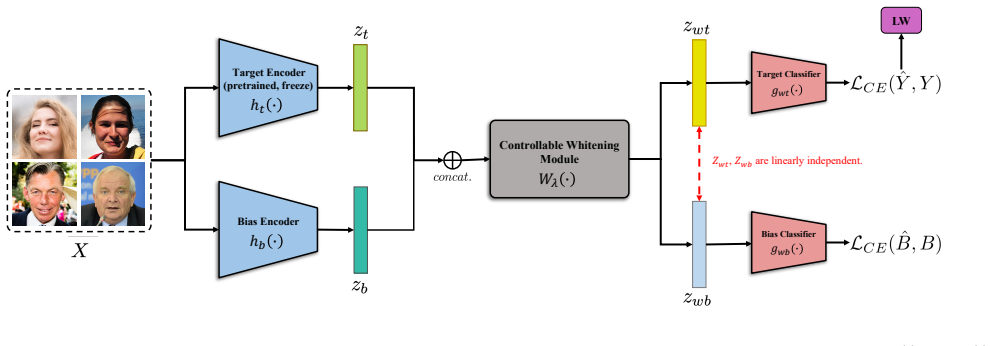
The central mechanism is the controllable whitening module $W_{\lambda}$, defined by $z_w = \Sigma_{\lambda}^{-1/2}(z - \mu)$, applied to $z = [z_t; z_b]$. Here $\Sigma_b$ is the covariance of the concatenated features on the biased training set, $\Sigma_u$ is the same covariance re-weighted so all $(Y, B)$ groups have equal probability, and $\Sigma_{\lambda} = \lambda \Sigma_u + (1-\lambda) \Sigma_b$. The inverse square root is computed with coupled Newton-Schultz iterations, which the paper uses both for numerical stability and for the freedom to choose a unitary rotation so that $z_{wt}$ stays close to $z_t$. This one module does the work of an adversarial discriminator: by making the whitened target and bias channels linearly independent, it prevents a linear layer from predicting one from the other, and the $\lambda$ knob interpolates between demographic parity and equalized odds.
What would settle it
Train CFW on Biased FFHQ with $\lambda = 0$, freeze the module, and fit a fresh linear probe to predict gender from the whitened target features $z_{wt}$ alone. If this probe reaches substantially above-chance accuracy while $z_{wt}$ and $z_{wb}$ remain orthogonal by construction, the claimed mechanism would be refuted, since the bias would remain linearly readable in the features actually fed to the target classifier.
Extended reading notes
Core claim
The central discovery is that satisfying linear independence between the two halves of a whitened feature vector is sufficient to stop a last-layer linear classifier from exploiting a known bias attribute, even though linear independence is weaker than statistical independence. The paper demonstrates this by extracting a target feature $z_t$ from a frozen pretrained encoder and a bias feature $z_b$ from a separately trained bias encoder, then whitening the concatenated vector. After whitening with the coupled Newton-Schultz iteration, the whitened target features $z_{wt}$ and whitened bias features $z_{wb}$ have zero covariance, so neither can be predicted by a linear map from the other. Training a bias classifier on $z_{wb}$ forces $z_{wt}$ to forget bias information in the linear regime, and training the target classifier on $z_{wt}$ yields predictions that barely track the bias attribute. The paper also claims that re-weighting the covariance matrix over the unbiased group distribution turns the same mechanism into an equalized-odds regularizer, and that interpolating biased and unbiased covariances with a coefficient $\lambda \in [0,1]$ trades off demographic parity against task utility, with $\lambda = 0.25$ a reliable default.
Load-bearing premise
The make-or-break premise is that zeroing out the linear correlation between the whitened target features and whitened bias features is enough to stop the final classifier from using the bias attribute, even though this is weaker than full statistical independence and the whitening transform mixes both original feature sets.
Editorial extensions
If this is right
- If linear decorrelation is sufficient, bias mitigation reduces to a fixed whitening step applied only to the features before the last linear layer, leaving the pretrained target encoder frozen.
- The same whitening module, with covariance re-weighting, addresses both demographic parity and equalized odds: small $\lambda$ enforces demographic parity, large $\lambda$ enforces equalized odds, and intermediate values give a smooth trade-off.
- Because no adversarial network or regularization penalty is needed, training is stable and uses a single default coefficient ($\lambda = 0.25$) that works across all four benchmark datasets.
- Combining the whitening module with a better pretrained representation, such as a SelecMix-pretrained target encoder, further improves results, so the method composes with representation-quality improvements.
- The method improves worst-group accuracy and shrinks the gap between unbiased and bias-conflicting accuracy on Celeb-A and WaterBirds, and it outperforms last-layer retraining approaches when the backbone is not ImageNet-pretrained.
Reading between the lines
- A testable extension is to apply the same whitening operation to text or tabular tasks whose final classifier is also linear, since the claimed mechanism depends only on linear readability of the bias in the final features.
- The paper does not test this, but the mechanism implies that the bias removed is only what the bias encoder $h_b$ can linearize; a weaker bias encoder could leave bias in $z_{wt}$ even when $z_{wt}$ and $z_{wb}$ are orthogonal.
- The claim that $\lambda = 0.25$ is hyperparameter-free is empirical across four datasets; a stronger test would sweep $\lambda$ on additional group-shift benchmarks to see whether the default holds beyond the presented suite.
- Because whitening acts on the covariance of the current batch, the method could be sensitive to batch composition; a natural extension would be to test whether the same $\lambda$ remains effective under severe group imbalance or small batch sizes.
Editorial analysis
A structured set of objections, weighed in public.
Referee Report
Summary. The paper proposes Controllable Feature Whitening (CFW), a debiasing method that whitens the concatenation of a frozen target-encoder feature z_t and a trained bias-encoder feature z_b, then trains separate linear classifiers on the two whitened blocks z_wt and z_wb to predict the target and bias attributes, respectively. The covariance matrix used for whitening is a weighted average of the biased and reweighted (class-balanced) covariance estimates, with weight λ, so that λ=0 targets demographic parity and λ=1 targets equalized odds. The authors set λ=0.25 on bFFHQ and use it across all datasets, claiming the method is hyperparameter-free. They report state-of-the-art or competitive results on Corrupted CIFAR-10, Biased FFHQ, WaterBirds, and Celeb-A, including worst-group accuracy and equalized-odds metrics, and provide ablations on loss weighting and on the choice of inverse-square-root solver.
Significance. The empirical contribution is substantial: CFW obtains the best or second-best worst-group accuracy on WaterBirds, strong bias-conflicting accuracy on bFFHQ and Celeb-A, and consistently low equalized-odds violation on Celeb-A, with multiple random seeds and ablations. The method is simple, avoids adversarial training, and the use of a single λ=0.25 across datasets is a meaningful practical convenience. If the linear-decorrelation mechanism is accepted, the paper offers a useful addition to the debiasing toolkit. However, the paper's central theoretical justification, that linear decorrelation between whitened target and bias features suffices to remove linear bias information from the target branch, is not established; this weakens the claimed connection between the mechanism and the strong empirical results. The paper does not mention code release, which would further aid reproducibility.
major comments (3)
- [Sec. 4.1 (after Eq. 6)] The claim that, because z_wt and z_wb are linearly independent and g_wb is trained to predict B from z_wb, the whitened target feature z_wt "becomes incapable of linearly encoding bias information" does not follow from the construction. Whitening enforces Cov(z_wt, z_wb)=0, not Cov(z_wt, B)=0. Since the whitening map is invertible, the best linear predictor of B in the full whitened space generally has nonzero coefficients on both blocks; nothing in Eq. (6) penalizes the linear predictability of B from z_wt. This is not merely a formal gap: in a simple one-dimensional example with jointly Gaussian z_t and z_b, the whitened target block retains nonzero correlation with B unless B is exactly a linear function of z_wb. Please provide direct evidence for the mechanism, e.g., train a linear probe on z_wt to predict B and report its accuracy against chance before and after whitening, or give a formal condition under which the claim holds. The current indirect evidence (t-SNE in Fig. 5 and group accuracies) does not discriminate between genuine removal of bias information from z_wt and other explanations such as the reweighted covariance reducing the bias-aligned signal.
- [Secs. 4.2, 5.3, and Table 4] The statement in Sec. 4.2 that "demographic parity and equalized odds become equivalent in an unbiased distribution" is true as a property of the data distribution, but it does not imply that whitening with Σ_u "naturally promotes" equalized odds. Equalized odds is a property of the predictor, not of the whitening covariance alone, and the classifier is still trained on the biased dataset. The empirical ΔEO results in Fig. 3 are encouraging, but the explanation should be reframed as an empirical observation or supported by an explicit derivation.
- [Secs. 4.1, 5.3, and Table 4] The "hyperparameter-free" claim is not fully supported because the loss-weighting (LW) scheme is a separate component used in the main results but never specified. Table 4 shows that the full method includes "+ LW", and Sec. 5.1 says LW under-weights bias-aligned samples, but the paper does not state how the per-group weights are computed or whether any strength parameter is involved. If LW has a tunable weight, the title and abstract overstate the hyperparameter-free property; if it is fixed, please provide the exact recipe in the appendix. At minimum, the abstract should be qualified to "no per-dataset tuning of λ" and the LW details should be supplied for reproducibility.
minor comments (6)
- [Abstract] The word "systemically" should be "systematically".
- [Sec. 5.1 and Fig. 2 caption] Typo "stabilizeining" should be "stabilizing"; also use "bias-conflicting" consistently in the caption text.
- [Table 6 and Abstract] The abstract's "outperforms existing approaches on four benchmark datasets" is too strong because on WaterBirds the mean accuracy of Ours (96.82) is below Vanilla (98.1), as the paper itself notes; please restrict the claim to worst-group or bias-conflicting performance or qualify the mean-accuracy comparison.
- [Appendix B] The paper does not specify whether the whitening statistics at test time are batch statistics or running averages; since whitening is data-dependent, this should be stated for reproducibility.
- [Table 3] The shorthand "T=a/S=m" and similar entries in Table 3 are not defined in the caption; please clarify the naming convention.
- [References] References [38] and [39] are duplicates of the same Celeb-A paper; one should be removed and the citations merged.
Circularity Check
No significant circularity: the whitening construction is fixed and externally evaluated; the only mild tuning is the single λ value selected on bFFHQ.
full rationale
The central method is not derived from the benchmark results. CFW is a fixed transformation: concatenated target/bias features are whitened with Σλ = λΣu + (1−λ)Σb, split, and followed by linear classifiers trained with cross-entropy (Eq. 6). The reported metrics (unbiased, bias-conflicting, worst-group accuracy, ∆DP, ∆EO) are evaluated on held-out test data, so the evaluation is not an input to the construction. The single coefficient λ = 0.25 is chosen empirically on bFFHQ and then transferred to other datasets; this is hyperparameter selection, not a fitted quantity that is renamed as a prediction, and it does not make the reported gains forced by construction. The paper's load-bearing claim that zero covariance between zwt and zwb makes zwt incapable of linearly encoding B is an empirical/analytic hypothesis: whitening enforces Cov(zwt, zwb)=0, not Cov(zwt, B)=0, and the paper does not prove the implication. That is a potential correctness gap, but it is not circularity, because the construction does not assume the conclusion. Self-citations (refs. 10, 29, 32) are used for technical background or backbone training, not as the only support for the central claim, and no uniqueness theorem is imported from the authors' prior work. The derivation chain therefore does not reduce to its own inputs.
Assumptions & free parameters
free parameters (3)
- lambda (weight coefficient) =
0.25
- T (Newton-Schultz iterations) =
5
- Loss weighting (LW) scheme =
unspecified
assumptions (4)
- domain assumption Linear independence between the whitened feature blocks is sufficient to prevent bias transfer through the last linear layer.
- domain assumption The unbiased distribution can be approximated by a uniform joint distribution over Y and B, P(y,b|D_u)=1/(N_Y*N_B).
- domain assumption Freezing the target encoder and only training the bias encoder and linear heads is enough to achieve fairness.
- standard math Batch-level covariance estimates provide reliable whitening statistics.
Cite this review
Pith. "Pith review of Controllable Feature Whitening for Hyperparameter-Free Bias Mitigation." pith.science (2026). https://pith.science/paper/3GBEHKEV
@misc{pith2026250720284,
  author       = {Pith},
  title        = {Pith review of: Controllable Feature Whitening for Hyperparameter-Free Bias Mitigation},
  year         = {2026},
  howpublished = {\url{https://pith.science/paper/3GBEHKEV}},
  note         = {Machine review of arXiv:2507.20284}
}
read the original abstract
As the use of artificial intelligence rapidly increases, the development of trustworthy artificial intelligence has become important. However, recent studies have shown that deep neural networks are susceptible to learn spurious correlations present in datasets. To improve the reliability, we propose a simple yet effective framework called controllable feature whitening. We quantify the linear correlation between the target and bias features by the covariance matrix, and eliminate it through the whitening module. Our results systemically demonstrate that removing the linear correlations between features fed into the last linear classifier significantly mitigates the bias, while avoiding the need to model intractable higher-order dependencies. A particular advantage of the proposed method is that it does not require regularization terms or adversarial learning, which often leads to unstable optimization in practice. Furthermore, we show that two fairness criteria, demographic parity and equalized odds, can be effectively handled by whitening with the re-weighted covariance matrix. Consequently, our method controls the trade-off between the utility and fairness of algorithms by adjusting the weighting coefficient. Finally, we validate that our method outperforms existing approaches on four benchmark datasets: Corrupted CIFAR-10, Biased FFHQ, WaterBirds, and Celeb-A.
Figures


Figures from the paper (1 more)

Reference graph
Works this paper leans on
-
[1]
A closer look at memorization in deep networks
Devansh Arpit, Stanisław Jastrz˛ ebski, Nicolas Ballas, David Krueger, Emmanuel Bengio, Maxinder S Kanwal, Tegan Maharaj, Asja Fischer, Aaron Courville, Yoshua Bengio, et al. A closer look at memorization in deep networks. In International conference on machine learning , pages 233–
-
[2]
Learning de-biased representations with biased representations
Hyojin Bahng, Sanghyuk Chun, Sangdoo Yun, Jaegul Choo, and Seong Joon Oh. Learning de-biased representations with biased representations. In International Conference on Ma- chine Learning, pages 528–539. PMLR, 2020. 1, 7
work page 2020
-
[3]
Mitigating biases in blackbox feature extractors for image classification tasks
Abhipsa Basu, Saswat Subhajyoti Mallick, et al. Mitigating biases in blackbox feature extractors for image classification tasks. Advances in Neural Information Processing Systems, 37:106411–106439, 2025. 7
work page 2025
-
[4]
Anthony J Bell and Terrence J Sejnowski. The “indepen- dent components” of natural scenes are edge filters. Vision research, 37(23):3327–3338, 1997. 3, 8
work page 1997
-
[5]
Al- gorithms for the matrix pth root
Dario A Bini, Nicholas J Higham, and Beatrice Meini. Al- gorithms for the matrix pth root. Numerical Algorithms, 39 (4):349–378, 2005. 3
work page 2005
-
[6]
Rubi: Reducing unimodal biases for visual question answering
Remi Cadene, Corentin Dancette, Matthieu Cord, Devi Parikh, et al. Rubi: Reducing unimodal biases for visual question answering. Advances in neural information pro- cessing systems, 32, 2019. 3
work page 2019
-
[7]
Building classifiers with independency constraints
Toon Calders, Faisal Kamiran, and Mykola Pechenizkiy. Building classifiers with independency constraints. In 2009 IEEE International Conference on Data Mining Workshops, pages 13–18. IEEE, 2009. 3
work page 2009
-
[8]
Fast model debias with machine un- learning
Ruizhe Chen, Jianfei Yang, Huimin Xiong, Jianhong Bai, Tianxiang Hu, Jin Hao, Yang Feng, Joey Tianyi Zhou, Jian Wu, and Zuozhu Liu. Fast model debias with machine un- learning. Advances in Neural Information Processing Sys- tems, 36:14516–14539, 2023. 7
work page 2023
Show all 62 references
-
[9]
Better may not be fairer: A study on subgroup discrepancy in image classification
Ming-Chang Chiu, Pin-Yu Chen, and Xuezhe Ma. Better may not be fairer: A study on subgroup discrepancy in image classification. In Proceedings of the IEEE/CVF International Conference on Computer Vision, pages 4956–4966, 2023. 3
2023
-
[10]
Improving generalization of batch whitening by convo- lutional unit optimization
Yooshin Cho, Hanbyel Cho, Youngsoo Kim, and Junmo Kim. Improving generalization of batch whitening by convo- lutional unit optimization. In Proceedings of the IEEE/CVF International Conference on Computer Vision, pages 5321– 5329, 2021. 3
2021
-
[11]
Flexibly fair representation learning by disentan- glement
Elliot Creager, David Madras, Jörn-Henrik Jacobsen, Marissa Weis, Kevin Swersky, Toniann Pitassi, and Richard Zemel. Flexibly fair representation learning by disentan- glement. In International conference on machine learning , pages 1436–1445. PMLR, 2019. 1
2019
-
[12]
Cholesky factor- ization of matrices in parallel and ranking of graphs
Dariusz Dereniowski and Marek Kubale. Cholesky factor- ization of matrices in parallel and ranking of graphs. In In- ternational conference on parallel processing and applied mathematics, pages 985–992. Springer, 2003. 3, 8
2003
-
[13]
Whitening for self-supervised representation learning
Aleksandr Ermolov, Aliaksandr Siarohin, Enver Sangineto, and Nicu Sebe. Whitening for self-supervised representation learning. In International Conference on Machine Learning, pages 3015–3024. PMLR, 2021. 3
2021
-
[14]
On formalizing fair- ness in prediction with machine learning
Pratik Gajane and Mykola Pechenizkiy. On formalizing fair- ness in prediction with machine learning. arXiv preprint arXiv:1710.03184, 2017. 4
2017 arXiv
-
[15]
Equality of op- portunity in supervised learning
Moritz Hardt, Eric Price, and Nati Srebro. Equality of op- portunity in supervised learning. Advances in neural infor- mation processing systems, 29, 2016. 2, 4
2016
-
[16]
Deep residual learning for image recognition
Kaiming He, Xiangyu Zhang, Shaoqing Ren, and Jian Sun. Deep residual learning for image recognition. In Proceed- ings of the IEEE conference on computer vision and pattern recognition, pages 770–778, 2016. 1
2016
-
[17]
Newton’s method for the matrix square root
Nicholas J Higham. Newton’s method for the matrix square root. Mathematics of computation, 46(174):537–549, 1986. 3, 8
1986
-
[18]
Functions of matrices: theory and com- putation
Nicholas J Higham. Functions of matrices: theory and com- putation. SIAM, 2008. 3, 8
2008
-
[19]
Decorre- lated batch normalization
Lei Huang, Dawei Yang, Bo Lang, and Jia Deng. Decorre- lated batch normalization. In Proceedings of the IEEE Con- ference on Computer Vision and Pattern Recognition, pages 791–800, 2018. 1
2018
-
[20]
It- erative normalization: Beyond standardization towards ef- ficient whitening
Lei Huang, Yi Zhou, Fan Zhu, Li Liu, and Ling Shao. It- erative normalization: Beyond standardization towards ef- ficient whitening. In Proceedings of the IEEE/CVF Con- ference on Computer Vision and Pattern Recognition, pages 4874–4883, 2019. 1, 8
2019
-
[21]
An investigation into the stochasticity of batch whiten- ing
Lei Huang, Lei Zhao, Yi Zhou, Fan Zhu, Li Liu, and Ling Shao. An investigation into the stochasticity of batch whiten- ing. In Proceedings of the IEEE/CVF Conference on Com- puter Vision and Pattern Recognition , pages 6439–6448,
-
[22]
Selecmix: Debiased learning by mixing up contradicting pairs
Inwoo Hwang, Sangjun Lee, Yunhyeok Kwak, Seong Joon Oh, Damien Teney, Jin-Hwa Kim, and Byoung-Tak Zhang. Selecmix: Debiased learning by mixing up contradicting pairs. In ICML 2022: Workshop on Spurious Correlations, Invariance and Stability, 2022. 7
2022
-
[23]
Neu- ral tangent kernel: Convergence and generalization in neural networks
Arthur Jacot, Franck Gabriel, and Clément Hongler. Neu- ral tangent kernel: Convergence and generalization in neural networks. Advances in neural information processing sys- tems, 31, 2018. 3
2018
-
[24]
Fair feature distillation for visual recognition
Sangwon Jung, Donggyu Lee, Taeeon Park, and Taesup Moon. Fair feature distillation for visual recognition. In Proceedings of the IEEE/CVF conference on computer vi- sion and pattern recognition, pages 12115–12124, 2021. 8
2021
-
[25]
A style-based generator architecture for generative adversarial networks
Tero Karras, Samuli Laine, and Timo Aila. A style-based generator architecture for generative adversarial networks. In Proceedings of the IEEE/CVF conference on computer vi- sion and pattern recognition, pages 4401–4410, 2019. 2, 12
2019
-
[26]
Optimal whitening and decorrelation
Agnan Kessy, Alex Lewin, and Korbinian Strimmer. Optimal whitening and decorrelation. The American Statistician, 72 (4):309–314, 2018. 3, 8
2018
-
[27]
Supervised contrastive learning
Prannay Khosla, Piotr Teterwak, Chen Wang, Aaron Sarna, Yonglong Tian, Phillip Isola, Aaron Maschinot, Ce Liu, and Dilip Krishnan. Supervised contrastive learning. Advances in neural information processing systems, 33:18661–18673,
-
[28]
Avoiding discrimination through causal reason- ing
Niki Kilbertus, Mateo Rojas Carulla, Giambattista Paras- candolo, Moritz Hardt, Dominik Janzing, and Bernhard 9 Schölkopf. Avoiding discrimination through causal reason- ing. Advances in neural information processing systems, 30,
-
[29]
Learning not to learn: Training deep neural networks with biased data
Byungju Kim, Hyunwoo Kim, Kyungsu Kim, Sungjin Kim, and Junmo Kim. Learning not to learn: Training deep neural networks with biased data. In Proceedings of the IEEE/CVF conference on computer vision and pattern recognition , pages 9012–9020, 2019. 1, 3, 8
2019
-
[30]
Biaswap: Removing dataset bias with bias-tailored swapping augmen- tation
Eungyeup Kim, Jihyeon Lee, and Jaegul Choo. Biaswap: Removing dataset bias with bias-tailored swapping augmen- tation. In Proceedings of the IEEE/CVF International Con- ference on Computer Vision, pages 14992–15001, 2021. 2, 3, 5, 12
2021
-
[31]
Learning debiased classifier with biased committee
Nayeong Kim, Sehyun Hwang, Sungsoo Ahn, Jaesik Park, and Suha Kwak. Learning debiased classifier with biased committee. Advances in Neural Information Processing Sys- tems, 35:18403–18415, 2022. 3, 5, 7, 12
2022
-
[32]
Nlnl: Negative learning for noisy labels
Youngdong Kim, Junho Yim, Juseung Yun, and Junmo Kim. Nlnl: Negative learning for noisy labels. In Proceedings of the IEEE/CVF International Conference on Computer Vi- sion, pages 101–110, 2019. 1
2019
-
[33]
Last layer re-training is sufficient for robustness to spu- rious correlations
Polina Kirichenko, Pavel Izmailov, and Andrew Gordon Wil- son. Last layer re-training is sufficient for robustness to spu- rious correlations. arXiv preprint arXiv:2204.02937, 2022. 4, 7, 13
2022 arXiv
-
[34]
Learning multiple layers of features from tiny images
Alex Krizhevsky and Geoffrey Hinton. Learning multiple layers of features from tiny images. Technical Report 0, Uni- versity of Toronto, Toronto, Ontario, 2009. 2, 5, 12
2009
-
[35]
Deep neural networks as gaussian processes
Jaehoon Lee, Yasaman Bahri, Roman Novak, Samuel S Schoenholz, Jeffrey Pennington, and Jascha Sohl-Dickstein. Deep neural networks as gaussian processes. arXiv preprint arXiv:1711.00165, 2017. 3
2017 arXiv
-
[36]
Learning debiased representation via disentan- gled feature augmentation
Jungsoo Lee, Eungyeup Kim, Juyoung Lee, Jihyeon Lee, and Jaegul Choo. Learning debiased representation via disentan- gled feature augmentation. Advances in Neural Information Processing Systems, 34:25123–25133, 2021. 1, 3, 7, 12
2021
-
[37]
Just train twice: Improving group robustness without training group information
Evan Z Liu, Behzad Haghgoo, Annie S Chen, Aditi Raghu- nathan, Pang Wei Koh, Shiori Sagawa, Percy Liang, and Chelsea Finn. Just train twice: Improving group robustness without training group information. In International Confer- ence on Machine Learning, pages 6781–6792. PMLR,...
2021
-
[38]
Deep learning face attributes in the wild
Ziwei Liu, Ping Luo, Xiaogang Wang, and Xiaoou Tang. Deep learning face attributes in the wild. In Proceedings of the IEEE international conference on computer vision, pages 3730–3738, 2015. 2, 12
2015
-
[39]
Deep learning face attributes in the wild
Ziwei Liu, Ping Luo, Xiaogang Wang, and Xiaoou Tang. Deep learning face attributes in the wild. In Proceedings of International Conference on Computer Vision (ICCV), 2015. 5
2015
-
[40]
Learning from failure: De-biasing classifier from biased classifier
Junhyun Nam, Hyuntak Cha, Sungsoo Ahn, Jaeho Lee, and Jinwoo Shin. Learning from failure: De-biasing classifier from biased classifier. Advances in Neural Information Pro- cessing Systems, 33:20673–20684, 2020. 1, 2, 3, 5, 7, 12, 13
2020
-
[41]
Spread spurious attribute: Improving worst-group accu- racy with spurious attribute estimation
Junhyun Nam, Jaehyung Kim, Jaeho Lee, and Jinwoo Shin. Spread spurious attribute: Improving worst-group accu- racy with spurious attribute estimation. arXiv preprint arXiv:2204.02070, 2022. 7, 13
2022 arXiv
-
[42]
Learning disentangled representation for fair facial attribute classification via fairness-aware information align- ment
Sungho Park, Sunhee Hwang, Dohyung Kim, and Hyeran Byun. Learning disentangled representation for fair facial attribute classification via fairness-aware information align- ment. In Proceedings of the AAAI conference on artificial intelligence, pages 2403–2411, 2021. 8
2021
-
[43]
Fair contrastive learn- ing for facial attribute classification
Sungho Park, Jewook Lee, Pilhyeon Lee, Sunhee Hwang, Dohyung Kim, and Hyeran Byun. Fair contrastive learn- ing for facial attribute classification. In Proceedings of the IEEE/CVF Conference on Computer Vision and Pattern Recognition, pages 10389–10398, 2022. 8
2022
-
[44]
Gradient reversal against discrimination: A fair neural network learning approach
Edward Raff and Jared Sylvester. Gradient reversal against discrimination: A fair neural network learning approach. In 2018 IEEE 5th International Conference on Data Science and Advanced Analytics (DSAA) , pages 189–198. IEEE,
2018
-
[45]
Learning unbiased representations via mutual information backpropagation
Ruggero Ragonesi, Riccardo V olpi, Jacopo Cavazza, and Vittorio Murino. Learning unbiased representations via mutual information backpropagation. In Proceedings of the IEEE/CVF Conference on Computer Vision and Pattern Recognition, pages 2729–2738, 2021. 1
2021
-
[46]
why should i trust you?
Marco Tulio Ribeiro, Sameer Singh, and Carlos Guestrin. " why should i trust you?" explaining the predictions of any classifier. In Proceedings of the 22nd ACM SIGKDD interna- tional conference on knowledge discovery and data mining , pages 1135–1144, 2016. 1
2016
-
[47]
Fairbatch: Batch selection for model fairness
Yuji Roh, Kangwook Lee, Steven Euijong Whang, and Changho Suh. Fairbatch: Batch selection for model fairness. arXiv preprint arXiv:2012.01696, 2020. 3
2012 arXiv
-
[48]
Unsuper- vised domain adaptation using feature-whitening and con- sensus loss
Subhankar Roy, Aliaksandr Siarohin, Enver Sangineto, Samuel Rota Bulo, Nicu Sebe, and Elisa Ricci. Unsuper- vised domain adaptation using feature-whitening and con- sensus loss. In Proceedings of the IEEE/CVF Conference on Computer Vision and Pattern Recognition , pages 9471– ...
2019
-
[49]
Distributionally robust neural networks for group shifts: On the importance of regularization for worst- case generalization
Shiori Sagawa, Pang Wei Koh, Tatsunori B Hashimoto, and Percy Liang. Distributionally robust neural networks for group shifts: On the importance of regularization for worst- case generalization. arXiv preprint arXiv:1911.08731, 2019. 2, 5, 7, 12, 13
1911 arXiv
-
[50]
Information-theoretic bias reduction via causal view of spu- rious correlation
Seonguk Seo, Joon-Young Lee, and Bohyung Han. Information-theoretic bias reduction via causal view of spu- rious correlation. arXiv preprint arXiv:2201.03121 , 2022. 2
2022 arXiv
-
[51]
Whitening and coloring batch transform for gans
Aliaksandr Siarohin, Enver Sangineto, and Nicu Sebe. Whitening and coloring batch transform for gans. arXiv preprint arXiv:1806.00420, 2018. 3
2018 arXiv
-
[52]
End: Entangling and disentangling deep rep- resentations for bias correction
Enzo Tartaglione, Carlo Alberto Barbano, and Marco Grangetto. End: Entangling and disentangling deep rep- resentations for bias correction. In Proceedings of the IEEE/CVF conference on computer vision and pattern recognition, pages 13508–13517, 2021. 4, 5, 7, 12
2021
-
[53]
Learning robust representations by projecting super- ficial statistics out
Haohan Wang, Zexue He, Zachary C Lipton, and Eric P Xing. Learning robust representations by projecting super- ficial statistics out. arXiv preprint arXiv:1903.06256, 2019. 7 10
1903 arXiv
-
[54]
Improving out-of-distribution robustness via selective augmentation
Huaxiu Yao, Yu Wang, Sai Li, Linjun Zhang, Weixin Liang, James Zou, and Chelsea Finn. Improving out-of-distribution robustness via selective augmentation. In International Con- ference on Machine Learning, pages 25407–25437. PMLR,
-
[55]
Network deconvolution
Chengxi Ye, Matthew Evanusa, Hua He, Anton Mitrokhin, Tom Goldstein, James A Yorke, Cornelia Fermüller, and Yiannis Aloimonos. Network deconvolution. arXiv preprint arXiv:1905.11926, 2019. 3, 8
1905 arXiv
-
[56]
Wide residual net- works
Sergey Zagoruyko and Nikos Komodakis. Wide residual net- works. arXiv preprint arXiv:1605.07146, 2016. 1
2016 arXiv
-
[57]
Mitigating unwanted biases with adversarial learning
Brian Hu Zhang, Blake Lemoine, and Margaret Mitchell. Mitigating unwanted biases with adversarial learning. In Proceedings of the 2018 AAAI/ACM Conference on AI, Ethics, and Society, pages 335–340, 2018. 4
2018
-
[58]
Contrastive adapters for foundation model group robustness
Michael Zhang and Christopher Ré. Contrastive adapters for foundation model group robustness. Advances in Neural In- formation Processing Systems, 35:21682–21697, 2022. 7
2022
-
[59]
Correct-n-contrast: A contrastive approach for improving robustness to spurious correlations
Michael Zhang, Nimit S Sohoni, Hongyang R Zhang, Chelsea Finn, and Christopher Ré. Correct-n-contrast: A contrastive approach for improving robustness to spurious correlations. arXiv preprint arXiv:2203.01517, 2022. 3, 7, 13
2022 arXiv
-
[60]
Generalized cross entropy loss for training deep neural networks with noisy labels
Zhilu Zhang and Mert Sabuncu. Generalized cross entropy loss for training deep neural networks with noisy labels. Ad- vances in neural information processing systems , 31, 2018. 3
2018
-
[61]
Learning bias-invariant representation by cross-sample mutual information minimization
Wei Zhu, Haitian Zheng, Haofu Liao, Weijian Li, and Jiebo Luo. Learning bias-invariant representation by cross-sample mutual information minimization. In Proceedings of the IEEE/CVF International Conference on Computer Vision , pages 15002–15012, 2021. 1, 3, 7, 12
2021
-
[62]
Ob- ject recognition with and without objects
Zhuotun Zhu, Lingxi Xie, and Alan L Yuille. Ob- ject recognition with and without objects. arXiv preprint arXiv:1611.06596, 2016. 1 11 Supplementary Material for Controllable Feature Whitening for Hyperparameter-Free Bias Mitigation A. Datasets Corrupted CIFAR-10 was proposed ...
2016 arXiv
Reviewed August 6, 2026 · model on record in the stance chip above.
Discussion (0). Sign in to comment.