REVIEW 4 major objections 6 minor 35 references
Prostate Cancer Classification Using Multimodal Feature Fusion and Explainable AI
T0 review · 4 major / 6 minor · reviewed 2026-08-06 · deepseek-v4-flash
Pith's one-line read Fusing BERT-embedded clinical notes with numeric labs stages prostate cancer at 99 percent test accuracy.
desk verdict The paper's only new result—text features improving intermediate-stage recall—is contradicted by its own impossible ablation numbers. read the letter →
The pith
A machine-rendered reading of the paper's core claim, the machinery that carries it, and where it could break.
The reading
What carries the argument
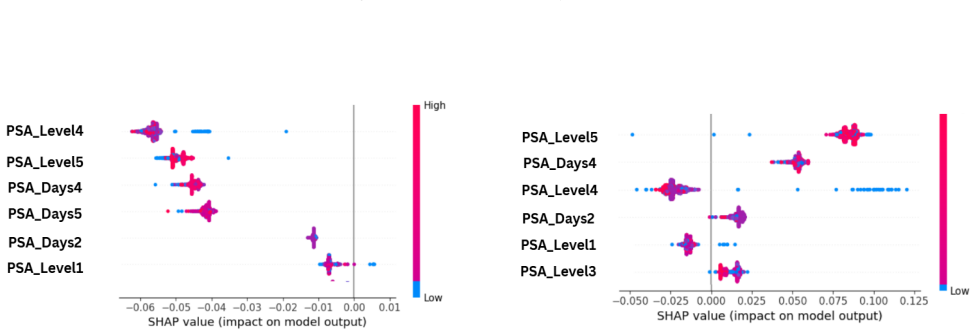
The load-bearing mechanism is the feature-fusion pipeline: each patient's textual columns are concatenated into one string, embedded with BERT's [CLS] token, reduced with PCA to 39 components retaining 98.07% of variance, then concatenated with unscaled numeric columns, and the combined vector is fed to a Random Forest whose per-class weights are balanced and which is trained with SMOTE-augmented folds. The fusion is what lets the classifier exploit complementary signal: PSA screening levels dominate numerically, while the text-derived components contribute the patterns that lift recall for the intermediate stages.
What would settle it
Run the same pipeline after removing 'pros cancer diagdays' and 'pros dx psa gap' from the numerical columns. If the combined-feature accuracy and the Stage III/IV recall advantage collapse toward the numeric-only numbers, the paper's central claim about multimodal fusion is unsupported.
Extended reading notes
Core claim
The paper's central claim is that multimodal fusion of BERT-derived textual features with numeric laboratory features yields a Random Forest classifier that reaches 0.99 test-set accuracy and 0.9987 macro-AUC on four AJCC prostate cancer stages in the PLCO dataset, with per-class recall of 1.00 (Stage II), 0.90 (Stage III), and 0.90 (Stage IV), and that this performance depends on the text modality: the ablation shows combined-feature recall for Stage III (0.900) and Stage IV (0.900) exceeds both the numerical-only (0.824, 0.668) and textual-only (0.725, 0.676) configurations. The authors frame this as a demonstration that a simple, transparent BERT+RF pipeline can be clinically useful rather than an exercise in complex architecture.
Load-bearing premise
The reported accuracy presupposes that the numeric features 'pros cancer diagdays' (Prostate Confirmed Cancer Diagnosis Days) and 'pros dx psa gap' are knowable before the stage is assigned; if they are computed from the diagnosis timeline or encode the outcome, the near-perfect results are leakage, not prediction.
Editorial extensions
If this is right
- A hospital that already stores structured lab panels plus free-text notes can reproduce this pipeline on a single workstation, without GPU training of a deep classifier.
- If the accuracy holds prospectively, the model could serve as a decision-support triage tool that flags patients likely to be Stage III/IV and routes them to confirmatory imaging or biopsy.
- SHAP rankings give clinicians a per-prediction feature attribution, making the model auditable in a way black-box imaging models are not.
- The ablation result quantifies the value of unstructured notes: institutions that only build numeric models are leaving intermediate-stage recall on the table.
- The stacking and averaging variants being weaker implies the simple concatenation is the right fusion choice for this data scale.
Reading between the lines
- Editorial inference: a decisive check is to drop 'pros cancer diagdays' and 'pros dx psa gap'—both are built from the diagnosis timeline—and rerun the ablation; if the combined-feature advantage narrows, the textual lift is partly an artifact of temporal leakage.
- Editorial inference: because the test set contains only four Stage I samples, the reported class-0 recall (0.50) has a wide confidence interval; a prospective cohort with more localized cancers would be needed to claim balanced multi-stage usability.
- Editorial inference: the same BERT+RF fusion recipe could be lifted to other PLCO cancer arms (lung, colorectal, ovarian) where structured labs and narrative risk-factor text co-exist, turning this paper into a reusable template.
- Editorial inference: if the temporal features are indeed post-diagnostic, then the practical recipe would be to replace them with screening-time PSA velocities, testing whether text still rescues intermediate stages.
Signed reviews
Editorial analysis
A structured set of objections, weighed in public.
Referee Report
Summary. This manuscript proposes a multimodal pipeline for prostate cancer staging on the PLCO dataset, combining BERT embeddings of clinical text with numerical lab/demographic features via PCA reduction, SMOTE, and a Random Forest classifier, with SHAP for interpretability. The central claim is that the combined model reaches a mean cross-validation accuracy of 98% and a test accuracy of 99% (macro AUC 0.9987), and that an ablation study shows textual features raise recall for intermediate stages (Class 2 from 0.824 to 0.900; Class 3 from 0.668 to 0.900). The paper also compares the proposed model with averaging and stacking ensembles and with prior published classifiers.
Significance. If correct, the paper would provide a simple, interpretable and computationally light alternative for prostate cancer staging in resource-constrained settings, with a concrete demonstration of complementary value from unstructured clinical text. The use of a public dataset, a transparent BERT+RF pipeline, and SHAP-based explanations are appropriate strengths. However, the reported evidence is not internally consistent: the headline accuracy changes from 0.99 to 0.90 in different sections, the sample size changes from 8,769 to 3,882, and the ablation recall table cannot be produced from the stated test-set class supports. The near-perfect results may also be inflated by diagnosis-derived numerical features whose temporal relation to the target label is not established. As a result, the paper's main claims are not currently supported.
major comments (4)
- [Section 3.1 and 3.2.1] The numerical feature set includes 'pros cancer diagdays' (Prostate Confirmed Cancer Diagnosis Days), 'pros dx psa' (most recent PSA before diagnosis), and 'pros dx psa gap'. These features are defined relative to the confirmed prostate cancer diagnosis and may therefore encode the outcome that the model is asked to predict. The manuscript does not state that these variables were measured before the AJCC stage was assigned, nor does it provide a temporal train/test split. Because the target is cancer stage, a model using diagnosis-day information can trivially achieve high accuracy, which would invalidate both the 0.99 accuracy claim and the modality comparison. The authors should re-run the experiments with features available at screening time only, or explicitly justify why these variables are not leakage.
- [Sections 5.4, 5.7, 5.8, and Table 10] The central accuracy number is reported inconsistently: the Abstract and Table 5 report 99% test accuracy, Table 10 lists the proposed method as 0.99, but Sections 5.7 and 5.8 state twice that the proposed model's accuracy is 0.90. These are not rounding differences, and the reader cannot tell which result is the actual one. The sample size is also inconsistent: Section 3.2.1 states 8,769 effective samples and Table 5 sums to 1,754 test samples (20% of 8,769), while the Conclusion (Section 6.1) says the dataset comprises 3,882 samples. The empirical basis of the paper needs to be stated once, consistently, before any of the comparative claims can be assessed.
- [Table 7 and Section 5.5] The ablation recall values in Table 7 are arithmetically incompatible with the test-set class supports reported in Table 5 (4, 1536, 145, 69). For example, Class 2 recall of 0.824 would require 119.48 true positives out of 145, and Class 3 recall of 0.668 would require 46.092 true positives out of 69; the nearest possible values are 119/145 = 0.8207, 120/145 = 0.8276, 46/69 = 0.6667, and 47/69 = 0.6812. The same problem affects the textual-only values 0.725 and 0.676 and the class-0 values 0.425 and 0.450 on support 4. Unless a different, undocumented test set was used, Table 7 cannot be derived from the paper's own data, so the central claim that text lifts Class 2/3 recall is unsupported.
- [Section 3.3 and Table 7] The ablation comparison is labeled 'No SMOTE', whereas the main pipeline described in Section 3.3 always applies SMOTE to the training folds. The manuscript does not explain whether the 'combined' column in Table 7 corresponds to the proposed model or to a variant trained without SMOTE. If the ablation deliberately removes SMOTE, then the claim in the Abstract and Section 5.5 that 'combined features' improve recall is not a statement about the proposed pipeline, and the comparison is not apples-to-apples with the test-set results in Table 5, which were obtained with SMOTE. This needs to be clarified and, more importantly, the ablation must be re-run on the actual proposed pipeline.
minor comments (6)
- [Section 3.2.1] The text contains an unresolved placeholder 'See Table ??' when describing the extraction of 8,769 samples.
- [Section 5.2] The sentence 'while Principal Component 39 explains only 0.08Cumulative Variance Explained' is missing a word break or period; it should read '0.08. Cumulative Variance Explained'.
- [Section 3.3] The LaTeX citation command 'citefernandez2018smote' appears literally in the text instead of a rendered reference.
- [Table 9] Several entries are misformatted: the averaging model's Class 0 precision is given as '99' instead of 0.99, and the stacked model's Class 3 precision is given as '01' instead of 1.00.
- [References] Some citations do not match their context: reference [5] is a dietary-pattern PCA meta-analysis, not a general PCA methods citation; reference [12] is a BPMRI bone-metastasis study but is cited as 'Castillo et al. using random forest on numerical biopsy data'; and reference [19] is a systematic review but is cited as 'Jose M. Castillo et al. using logistic regression and CNNs for MRI'.
- [Section 6.1] The conclusion's sample size of 3,882 contradicts the 8,769 samples described in Section 3.2.1; the source of the discrepancy should be resolved or removed.
Circularity Check
No circularity: the paper is an empirical model comparison, not a derivation that reduces to its inputs.
full rationale
The paper makes no derivation-level claims in which an output is defined in terms of its inputs or an imported uniqueness result forces a conclusion. The central contribution is an empirical pipeline that concatenates numeric features with PCA-reduced BERT embeddings and trains a Random Forest classifier on PLCO data. Accuracy, recall, and AUC are measured by cross-validation and on a held-out test set; the ablation study compares recall across feature configurations. These are experimental comparisons, not analytic identities. No fitted parameter is renamed as a prediction, and no equation in the paper shows that a reported result equals its own construction. The self-citations present (e.g., references [4] and [26], which share authors with this paper) are incidental examples of prior BERT and deep-learning applications; they do not carry the load-bearing premise, which is the empirical performance of the proposed pipeline. Concerns such as possible target leakage through variables like 'pros cancer diagdays' or the arithmetic inconsistencies in Table 7 are legitimate correctness and reproducibility risks, but they are not circularity in the sense of a derivation reducing to its own assumptions. The empirical claims remain externally checkable against the PLCO data and standard evaluation metrics, so no circularity is identified.
Assumptions & free parameters
free parameters (3)
- PCA variance threshold =
0.98 (n_components=0.98)
- Random Forest hyperparameters =
Not specified
- SMOTE balancing =
Not specified
assumptions (4)
- domain assumption The AJCC 5th edition stage labels in the PLCO 'pros stage' variable are treated as ground truth.
- domain assumption The selected numeric and textual columns capture the clinically relevant information and are available at the time of staging.
- ad hoc to paper The concatenation of BERT embeddings (reduced by PCA) and numeric features is an appropriate fusion that preserves complementary information.
- domain assumption SMOTE-generated synthetic samples do not distort the class distribution in a way that inflates test performance.
Cite this review
Pith. "Pith review of Prostate Cancer Classification Using Multimodal Feature Fusion and Explainable AI." pith.science (2026). https://pith.science/paper/GXG27MZQ
@misc{pith2026250720714,
  author       = {Pith},
  title        = {Pith review of: Prostate Cancer Classification Using Multimodal Feature Fusion and Explainable AI},
  year         = {2026},
  howpublished = {\url{https://pith.science/paper/GXG27MZQ}},
  note         = {Machine review of arXiv:2507.20714}
}
read the original abstract
Prostate cancer, the second most prevalent male malignancy, requires advanced diagnostic tools. We propose an explainable AI system combining BERT (for textual clinical notes) and Random Forest (for numerical lab data) through a novel multimodal fusion strategy, achieving superior classification performance on PLCO-NIH dataset (98% accuracy, 99% AUC). While multimodal fusion is established, our work demonstrates that a simple yet interpretable BERT+RF pipeline delivers clinically significant improvements - particularly for intermediate cancer stages (Class 2/3 recall: 0.900 combined vs 0.824 numerical/0.725 textual). SHAP analysis provides transparent feature importance rankings, while ablation studies prove textual features' complementary value. This accessible approach offers hospitals a balance of high performance (F1=89%), computational efficiency, and clinical interpretability - addressing critical needs in prostate cancer diagnostics.
Figures


Figures from the paper (5 more)



Reference graph
Works this paper leans on
-
[1]
World cancer research fund international
“World cancer research fund international.” https://www.wcrf.org/cancer-trends/ prostate-cancer-statistics/:~:text= Prostate%20cancer%20is%20the%202nd%20most% 20commonly%20occurring%20cancer%20in,4th% 20most%20common%20cancer%20overall. Ac- cessed: 2023-8-10
work page 2023
- [2]
-
[3]
Bert: Pre-training of deep bidirectional trans- formers for language understanding,
J. Devlin, M.-W. Chang, K. Lee, and K. Toutanova, “Bert: Pre-training of deep bidirectional trans- formers for language understanding,” arXiv preprint arXiv:1810.04805, 2018
arXiv 2018
-
[4]
Exploring bert and elmo for bangla spam sms dataset creation and detection,
F. Khan, R. Mustafa, F. Tasnim, T. Mahmud, M. S. Hossain, and K. Andersson, “Exploring bert and elmo for bangla spam sms dataset creation and detection,” in 2023 26th International Conference on Computer and Information Technology (ICCIT) , pp. 1–6, 2023
work page 2023
-
[5]
V. Garcia-Larsen, V. Morton, T. Norat, A. Mor- eira, J. F. Potts, T. Reeves, and I. Bakolis, “Dietary patterns derived from principal component analysis (pca) and risk of colorectal cancer: a systematic re- view and meta-analysis,” European journal of clini- cal nutrition, vol. 73, no. 3, pp. 366–386, 2019
work page 2019
-
[6]
Smote for learning from imbalanced data: progress and challenges, marking the 15-year an- niversary,
A. Fern´ andez, S. Garcia, F. Herrera, and N. V. Chawla, “Smote for learning from imbalanced data: progress and challenges, marking the 15-year an- niversary,” Journal of artificial intelligence research, vol. 61, pp. 863–905, 2018
work page 2018
-
[7]
Prediction of breast cancer re- currence in five years using machine learning tech- niques and shap,
I. Keren Evangeline, S. Angeline Kirubha, and J. Glory Precious, “Prediction of breast cancer re- currence in five years using machine learning tech- niques and shap,” in Intelligent Computing Tech- niques for Smart Energy Systems: Proceedings of ICTSES 2021 , pp. 441–453, Springer, 2022
work page 2021
-
[8]
K. Dwivedi, A. Rajpal, S. Rajpal, M. Agarwal, V. Kumar, and N. Kumar, “An explainable ai-driven biomarker discovery framework for non-small cell lung cancer classification,” Computers in Biology and Medicine, vol. 153, p. 106544, 2023
work page 2023
Show all 35 references
-
[9]
An enhanced deep learning tech- nique for prostate cancer identification based on mri scans,
H. Hashem, Y. Alsakar, A. Elgarayhi, M. Elmogy, and M. Sallah, “An enhanced deep learning tech- nique for prostate cancer identification based on mri scans,” arXiv preprint arXiv:2208.00583 , 2022
2022 arXiv
-
[10]
Automatic glea- son grading of h and e stained microscopic prostate images using deep convolutional neural networks,
A. Gummeson, I. Arvidsson, M. Ohlsson, N. C. Overgaard, A. Krzyzanowska, A. Heyden, A. Bjartell, and K. Astr¨ om, “Automatic glea- son grading of h and e stained microscopic prostate images using deep convolutional neural networks,” in Medical Imaging 2017: Digital Pathology ,...
2017
-
[11]
Prostate can- cer classification with multiparametric mri transfer learning model,
Y. Yuan, W. Qin, M. Buyyounouski, B. Ibragimov, S. Hancock, B. Han, and L. Xing, “Prostate can- cer classification with multiparametric mri transfer learning model,” Medical physics , vol. 46, no. 2, pp. 756–765, 2019
2019
-
[12]
A machine learning radiomics model based on bpmri to predict bone metastasis in newly di- agnosed prostate cancer patients.,
S. Xinyang, Z. Shuang, S. Tianci, H. Xiangyu, W. Yangyang, D. Mengying, Z. Jingran, and Y. Feng, “A machine learning radiomics model based on bpmri to predict bone metastasis in newly di- agnosed prostate cancer patients.,” Magnetic Reso- nance Imaging, vol. 107, pp. 15–23, 2024
2024
-
[13]
Machine learning approach for classification of prostate cancer based on clinical biomarkers,
O. ¨OZHAN and F. H. YA ˘GIN, “Machine learning approach for classification of prostate cancer based on clinical biomarkers,” The Journal of Cognitive Systems, vol. 7, no. 2, pp. 17–20, 2022
2022
-
[14]
Prediction of prostate cancer us- ing machine learning algorithms,
M. Srivenkatesh, “Prediction of prostate cancer us- ing machine learning algorithms,” Int. J. Recent Technol. Eng, vol. 8, no. 5, pp. 5353–5362, 2020
2020
-
[15]
Improving accuracy: Com- parative analysis of machine learning models for prostate cancer prediction,
S. Beltozar-Clemente, E. Diaz-Vega, I. C. Ramos, and R. T. Navarrete, “Improving accuracy: Com- parative analysis of machine learning models for prostate cancer prediction,” International Journal of Intelligent Systems and Applications in Engineering , vol. 12, no. 2, pp. 654–...
2024
-
[16]
Performance analysis of machine learning classifiers for predicting diabetes and prostate cancer,
A. Laabidi and M. Aissaoui, “Performance analysis of machine learning classifiers for predicting diabetes and prostate cancer,” in 2020 1st international con- ference on innovative research in applied science, en- gineering and technology (IRASET), pp. 1–6, IEEE, 2020
2020
-
[17]
A novel deep learning-based technique for detect- ing prostate cancer in mri images,
S. K. Singh, A. Sinha, H. Singh, A. Mahanti, A. Pa- tel, S. Mahajan, A. K. Pandit, and V. Varadarajan, “A novel deep learning-based technique for detect- ing prostate cancer in mri images,”Multimedia Tools and Applications , vol. 83, no. 5, pp. 14173–14187, 2024
2024
-
[18]
Gleason score prediction for the severity of prostate metastasis using machine learn- ing,
O. Bamigbade, “Gleason score prediction for the severity of prostate metastasis using machine learn- ing,” 2024
2024
-
[19]
Automated classifica- tion of significant prostate cancer on mri: a system- atic review on the performance of machine learning applications,
J. M. Castillo T, M. Arif, W. J. Niessen, I. G. Schoots, and J. F. Veenland, “Automated classifica- tion of significant prostate cancer on mri: a system- atic review on the performance of machine learning applications,” Cancers, vol. 12, no. 6, p. 1606, 2020
2020
-
[20]
A state-of- the-art review on machine learning-based methods for prostate cancer diagnosis,
A. M. ali Ahmed and A. A. Mohammed, “A state-of- the-art review on machine learning-based methods for prostate cancer diagnosis,” UHD Journal of Sci- ence and Technology, vol. 5, no. 1, pp. 41–47, 2021
2021
-
[21]
Comparison of ma- chine learning to deep learning for automated anno- tation of gleason patterns in whole mount prostate cancer histology,
S. R. Duenweg, M. Brehler, S. A. Bobholz, A. K. Lowman, A. Winiarz, F. Kyereme, A. Nencka, K. A. Iczkowski, and P. S. LaViolette, “Comparison of ma- chine learning to deep learning for automated anno- tation of gleason patterns in whole mount prostate cancer histology,” bioRxi...
2022
-
[22]
Textured-based deep learn- ing in prostate cancer classification with 3t multi- parametric mri: comparison with pi-rads-based clas- sification,
Y. Liu, H. Zheng, Z. Liang, Q. Miao, W. G. Bris- bane, L. S. Marks, S. S. Raman, R. E. Reiter, G. Yang, and K. Sung, “Textured-based deep learn- ing in prostate cancer classification with 3t multi- parametric mri: comparison with pi-rads-based clas- sification,” Diagnostics, v...
2021
-
[23]
Accessed:, 2024
“The national cancer institute (nci) and the recipi- ent hereby enter into this agreement for the trans- fer of data collected in the course of the prostate, lung, colorectal and ovarian cancer screening trial (data) to recipient through nci’s cancer data ac- cess system (cdas...
2024
-
[24]
Cancerbert: a bert model for extracting breast cancer phenotypes from electronic health records,
S. Zhou, L. Wang, N. Wang, H. Liu, and R. Zhang, “Cancerbert: a bert model for extracting breast cancer phenotypes from electronic health records,” arXiv preprint arXiv:2108.11303 , 2021
2021 arXiv
-
[25]
Skcv: Strat- ified k-fold cross-validation on ml classifiers for pre- dicting cervical cancer,
S. Prusty, S. Patnaik, and S. K. Dash, “Skcv: Strat- ified k-fold cross-validation on ml classifiers for pre- dicting cervical cancer,” Frontiers in Nanotechnol- ogy, vol. 4, p. 972421, 2022
2022
-
[26]
Deep learning hybrid models for multilingual cyberbully- ing detection: Insights from bangla and chittagonian languages,
T. Mahmud, M. Ptaszynski, and F. Masui, “Deep learning hybrid models for multilingual cyberbully- ing detection: Insights from bangla and chittagonian languages,” in 2023 26th International Conference on Computer and Information Technology (ICCIT) , pp. 1–6, 2023
2023
-
[27]
Scikit-learn,
O. Kramer and O. Kramer, “Scikit-learn,” Machine learning for evolution strategies , pp. 45–53, 2016
2016
-
[28]
Explaining intrusion detection-based convolutional neural networks using shapley additive explanations (shap),
R. Younisse, A. Ahmad, and Q. Abu Al-Haija, “Explaining intrusion detection-based convolutional neural networks using shapley additive explanations (shap),” Big Data and Cognitive Computing , vol. 6, no. 4, p. 126, 2022
2022
-
[29]
An ensemble method of the machine learning to prognosticate the gastric cancer,
H. Baradaran Rezaei, A. Amjadian, M. V. Sebt, R. Askari, and A. Gharaei, “An ensemble method of the machine learning to prognosticate the gastric cancer,” Annals of Operations Research , vol. 328, no. 1, pp. 151–192, 2023
2023
-
[30]
Optimized stacking ensemble learn- ing model for breast cancer detection and classifica- tion using machine learning,
M. Kumar, S. Singhal, S. Shekhar, B. Sharma, and G. Srivastava, “Optimized stacking ensemble learn- ing model for breast cancer detection and classifica- tion using machine learning,” Sustainability, vol. 14, no. 21, p. 13998, 2022
2022
-
[31]
AUC µ: A performance metric for multi-class machine learning models,
R. Kleiman and D. Page, “AUC µ: A performance metric for multi-class machine learning models,” in Proceedings of the 36th International Conference on Machine Learning (K. Chaudhuri and R. Salakhutdi- nov, eds.), vol. 97 of Proceedings of Machine Learn- ing Research , pp. 3439–...
2019
-
[32]
What clinical trials of ablation for atrial fibrillation tell us – and what they do not,
R. Amuthan and A. B. Curtis, “What clinical trials of ablation for atrial fibrillation tell us – and what they do not,” The Journal of Innovations in Cardiac Rhythm Management, vol. 12, pp. 4537–4543, 2021
2021
-
[33]
A comparative study of pcs and pam50 prostate cancer classifica- tion schemes,
J. Yoon, M. Kim, E. M. Posadas, S. J. Freed- land, Y. Liu, E. Davicioni, R. B. Den, B. J. Trock, R. J. Karnes, E. A. Klein, et al. , “A comparative study of pcs and pam50 prostate cancer classifica- tion schemes,” Prostate cancer and prostatic dis- eases, vol. 24, no. 3, pp. 7...
2021
-
[34]
An introduction to shap values and machine learning interpretability
“An introduction to shap values and machine learning interpretability.” https://www.datacamp.com/tutorial/ introduction-to-shap-values-machine-learning-interpretability ,
-
[2024]
Acknowledgment The study was undertaken at the Artificial Intelligence Laboratory (AI Lab) of Rangamati Science and Technol- ogy University in Bangladesh
Accessed:, 2024. Acknowledgment The study was undertaken at the Artificial Intelligence Laboratory (AI Lab) of Rangamati Science and Technol- ogy University in Bangladesh. The authors express sin- cere gratitude to the lab’s head for providing invaluable guidance, consistent e...
2024
Reviewed August 6, 2026 · model on record in the stance chip above.
Discussion (0). Continue with ORCID to comment.