Planckian bound on quantum dynamical entropy
Pith reviewed 2026-05-19 02:33 UTC · model grok-4.3
The pith
Monitoring thermal fluctuations in many-body quantum systems yields an entropy growth rate bounded by a universal Planckian value.
A machine-rendered reading of the paper's core claim, the machinery that carries it, and where it could break.
Core claim
A simplified quantum dynamical entropy is introduced to quantify information gain from continuous monitoring of an observable. In the thermodynamic and long-time limits the entropy rate for generic many-body systems is computed explicitly from the two-point correlation functions of the monitored observable. This computation supports the conjecture of a universal Planckian bound on the entropy rate, together with related results on the purification rate.
What carries the argument
Simplified Connes-Narnhofer-Thirring quantum dynamical entropy, which quantifies information gain from monitoring thermal fluctuations of an extensive observable via its two-point correlation functions.
If this is right
- The entropy rate is determined solely by two-point correlation functions without requiring full knowledge of the many-body state.
- A nonzero entropy growth rate appears in generic many-body systems once thermal fluctuations of extensive observables are monitored outside classical and large-N limits.
- The same framework yields related bounds on the purification rate of quantum states.
- The conjectured bound would apply universally to the information extraction rate from thermal states in the stated limits.
Where Pith is reading between the lines
- The bound may connect to other Planckian limits appearing in quantum chaos and hydrodynamic descriptions of many-body systems.
- It supplies a concrete, testable prediction for the information gain rate that could be checked in quantum simulators or cold-atom experiments.
- Extensions of the same monitoring construction might apply to driven or open quantum systems where correlation functions remain accessible.
Load-bearing premise
The entropy rate and its conjectured bound are obtained only after taking the thermodynamic limit and the long-time limit for a generic many-body system in which thermal fluctuations of an extensive observable produce nonzero information gain away from classical or large-N regimes.
What would settle it
An explicit calculation of the entropy rate for a concrete model such as the transverse-field Ising chain in the thermodynamic limit that either exceeds or saturates the conjectured Planckian bound.
Figures


read the original abstract
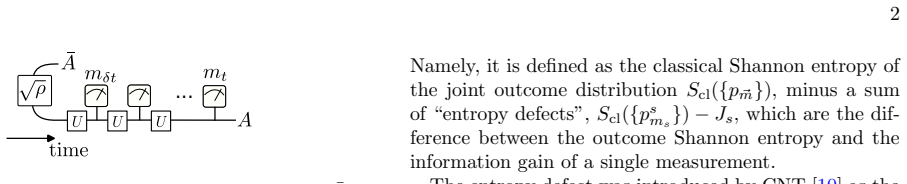
We introduce a simplified version of Connes-Narnhofer-Thirring's quantum dynamical entropy for quantum systems. It quantifies the amount of information gained about the initial condition from continuously monitoring an observable. A nonzero entropy growth rate can be obtained by monitoring the thermal fluctuation of an extensive observable in a generic many-body system, away from classical or large $N$ limits. We explicitly compute the entropy rate in the thermodynamic and long-time limit, in terms of the two-point correlation functions. We conjecture a universal Planckian bound for the entropy rate. Related results on the purification rate are also obtained.
Editorial analysis
A structured set of objections, weighed in public.
Referee Report
Summary. The paper introduces a simplified version of the Connes-Narnhofer-Thirring quantum dynamical entropy that quantifies information gained by continuously monitoring an observable. It derives an explicit expression for the entropy rate in the thermodynamic and long-time limits in terms of two-point correlation functions for thermal fluctuations of extensive observables. The central claim is a conjecture of a universal Planckian bound on this rate for generic many-body quantum systems away from classical or large-N regimes, with related results on purification rates.
Significance. If the conjecture is substantiated, the result would link quantum information gain rates to a fundamental Planckian scale, offering a potential diagnostic for thermalization and chaos in many-body systems. The explicit reduction to two-point functions is a positive feature that enables direct comparison with correlation data from numerics or experiments.
major comments (2)
- [Abstract and §4 (Conjecture)] The central Planckian bound is introduced only as a conjecture following the entropy-rate computation; no derivation is supplied that starts from the two-point correlation expression and arrives at the bound without additional unstated steps or limits. This makes it impossible to assess whether the bound follows rigorously or rests on the generic positivity assumption.
- [§3 (Entropy rate computation) and discussion after the main formula] The claim that a nonzero entropy rate is obtained generically for thermal fluctuations of extensive observables in the thermodynamic and long-time limits (away from classical/large-N regimes) is load-bearing for universality. The manuscript does not supply a proof or counter-example analysis showing that the two-point functions alone guarantee positivity independent of higher-order correlations or model-specific details.
minor comments (2)
- [§2] Notation for the simplified entropy should be introduced with a clear comparison to the original Connes-Narnhofer-Thirring definition to avoid ambiguity.
- [§3] The thermodynamic-limit procedure and the precise order of limits (thermodynamic before long-time) should be stated explicitly with any required uniformity conditions.
Simulated Author's Rebuttal
We thank the referee for the careful reading and insightful comments on our manuscript. We address each major comment below, clarifying the status of our results and indicating where we will revise the text for improved transparency.
read point-by-point responses
-
Referee: [Abstract and §4 (Conjecture)] The central Planckian bound is introduced only as a conjecture following the entropy-rate computation; no derivation is supplied that starts from the two-point correlation expression and arrives at the bound without additional unstated steps or limits. This makes it impossible to assess whether the bound follows rigorously or rests on the generic positivity assumption.
Authors: We agree that the Planckian bound is presented strictly as a conjecture and is not derived rigorously from the two-point correlation formula alone. The explicit entropy-rate expression we obtain is an integral over the connected two-point functions of the monitored observable. The conjecture arises by combining this expression with standard assumptions on the decay of correlations in generic many-body systems (finite correlation length or diffusive scaling) together with the positivity of the entropy production rate and the existence of a Planckian time scale set by ħ/k_B T. We do not claim a model-independent lower bound that follows solely from the two-point formula without these inputs. In the revised manuscript we will (i) restate the conjecture with an explicit list of the additional physical assumptions, (ii) add a short paragraph explaining the heuristic steps that motivate the Planckian scale, and (iii) include a brief discussion of why a fully rigorous proof appears to require techniques beyond the present reduction to two-point functions. revision: partial
-
Referee: [§3 (Entropy rate computation) and discussion after the main formula] The claim that a nonzero entropy rate is obtained generically for thermal fluctuations of extensive observables in the thermodynamic and long-time limits (away from classical/large-N regimes) is load-bearing for universality. The manuscript does not supply a proof or counter-example analysis showing that the two-point functions alone guarantee positivity independent of higher-order correlations or model-specific details.
Authors: We accept that the generic positivity statement is central and that the manuscript does not contain a general proof that the two-point functions alone force a strictly positive rate for every possible dynamics. The entropy-rate formula depends only on the two-point correlator, yet the sign of the resulting integral is determined by the long-time behavior of that correlator, which in turn is constrained by the underlying many-body dynamics. Higher-order correlations enter indirectly through the equations of motion that govern the two-point functions. In the revised version we will add a dedicated subsection that (a) recalls the explicit integral expression, (b) states the minimal conditions on the two-point functions (e.g., exponential or power-law decay with a finite correlation time) that guarantee positivity, and (c) briefly contrasts the classical and large-N limits where these conditions fail. We will also include a short numerical illustration for a non-integrable spin chain to support the generic claim, while acknowledging that a complete classification of all possible two-point functions lies outside the scope of the paper. revision: yes
Circularity Check
No circularity: entropy rate derived from two-point functions; Planckian bound is explicit conjecture
full rationale
The paper defines a simplified quantum dynamical entropy from observable monitoring and derives its rate explicitly in the thermodynamic/long-time limits as a functional of independent two-point correlation functions. The universal Planckian bound is stated as a conjecture based on the positivity of this rate for thermal fluctuations of extensive observables in generic many-body systems (away from classical/large-N limits). This is an assumption supporting the conjecture, not a reduction of the bound to the paper's own fitted inputs or self-definitional equations. No self-citation chains, ansatzes smuggled via prior work, or renaming of known results appear in the load-bearing steps. The derivation remains self-contained against external benchmarks.
Axiom & Free-Parameter Ledger
axioms (2)
- standard math Standard framework of quantum mechanics and statistical mechanics for open quantum systems
- domain assumption Existence of well-defined thermodynamic and long-time limits for generic many-body systems
invented entities (1)
-
Simplified quantum dynamical entropy
no independent evidence
Lean theorems connected to this paper
-
IndisputableMonolith/Cost/FunctionalEquation.leanwashburn_uniqueness_aczel unclear?
unclearRelation between the paper passage and the cited Recognition theorem.
We explicitly compute the entropy rate in the thermodynamic and long-time limit, in terms of the two-point correlation functions. We conjecture a universal Planckian bound for the entropy rate.
-
IndisputableMonolith/Foundation/RealityFromDistinction.leanreality_from_one_distinction unclear?
unclearRelation between the paper passage and the cited Recognition theorem.
A nonzero entropy growth rate can be obtained by monitoring the thermal fluctuation of an extensive observable in a generic many-body system
What do these tags mean?
- matches
- The paper's claim is directly supported by a theorem in the formal canon.
- supports
- The theorem supports part of the paper's argument, but the paper may add assumptions or extra steps.
- extends
- The paper goes beyond the formal theorem; the theorem is a base layer rather than the whole result.
- uses
- The paper appears to rely on the theorem as machinery.
- contradicts
- The paper's claim conflicts with a theorem or certificate in the canon.
- unclear
- Pith found a possible connection, but the passage is too broad, indirect, or ambiguous to say the theorem truly supports the claim.
Reference graph
Works this paper leans on
-
[1]
A. N. Kolmogorov, A new metric invariant of tran- sient dynamical systems and automorphisms in lebesgue spaces, Dokl. Akad. Nauk SSSR (1958)
work page 1958
-
[2]
Y. G. Sinai, On the notion of entropy of a dynamical system, in Dokl. Akad. Nauk SSSR , Vol. 124 (1959) pp. 768–771
work page 1959
-
[3]
Y. G. Sinai, Kolmogorov-sinai entropy, Scholarpedia 4, 2034 (2009)
work page 2034
-
[4]
Walters, An introduction to ergodic theory , Vol
P. Walters, An introduction to ergodic theory , Vol. 79 (Springer Science & Business Media, 2000)
work page 2000
-
[5]
B. Hasselblatt and Y. Pesin, Pesin entropy formula, Scholarpedia 3, 3733 (2008), revision #185293
work page 2008
-
[6]
V. Latora and M. Baranger, Kolmogorov-sinai entropy rate versus physical entropy, Phys. Rev. Lett. 82, 520 (1999)
work page 1999
-
[7]
P. Gaspard and G. Nicolis, Transport properties, lya- punov exponents, and entropy per unit time, Phys. Rev. Lett. 65, 1693 (1990)
work page 1990
-
[8]
M. C. Gutzwiller, Chaos in classical and quantum me- chanics, Vol. 1 (Springer Science & Business Media, 2013)
work page 2013
-
[9]
A. Connes and E. Størmer, Entropy for automorphisms of II1 von neumann algebras, Acta Mathematica 134, 289 (1975)
work page 1975
- [10]
-
[11]
Voiculescu, Dynamical approximation entropies and topological entropy in operator algebras, Commun
D. Voiculescu, Dynamical approximation entropies and topological entropy in operator algebras, Commun. Math. Phys. , 249 (1995)
work page 1995
-
[12]
R. Alicki and M. Fannes, Defining quantum dynamical entropy, Letters in Mathematical Physics 32, 75 (1994)
work page 1994
-
[13]
W. Slomczynski and K. Zyczkowski, Quantum chaos: An entropy approach, Journal of Mathematical Physics 35, 5674 (1994)
work page 1994
-
[14]
Hudetz, Quantum dynamical entropy revisited, Ba- nach Center Publications 43, 241 (1998)
T. Hudetz, Quantum dynamical entropy revisited, Ba- nach Center Publications 43, 241 (1998)
work page 1998
-
[15]
L. Accardi, M. Ohya, and N. Watanabe, Note on quantum dynamical entropies, Reports on Mathematical Physics 38, 457 (1996), xXVIII symposium on mathe- matical physics
work page 1996
-
[16]
Benatti, Deterministic chaos in infinite quantum sys- tems (Springer Science & Business Media, 2012)
F. Benatti, Deterministic chaos in infinite quantum sys- tems (Springer Science & Business Media, 2012)
work page 2012
-
[17]
T. Goldfriend and J. Kurchan, Quantum kolmogorov- sinai entropy and pesin relation, Phys. Rev. Res. 3, 023234 (2021)
work page 2021
-
[18]
H. Narnhofer and W. Thirring, Dynamical entropy of quasifree automorphisms, Letters in Mathematical Physics 14, 89 (1987)
work page 1987
-
[19]
F. Benatti, T. Hudetz, and A. Knauf, Quantum chaos and dynamical entropy, Communications in Mathemati- cal Physics 198, 607 (1998)
work page 1998
- [20]
-
[21]
C. W. von Keyserlingk, T. Rakovszky, F. Pollmann, and S. L. Sondhi, Operator hydrodynamics, otocs, and en- tanglement growth in systems without conservation laws, Phys. Rev. X 8, 021013 (2018)
work page 2018
-
[22]
P. Kos, M. Ljubotina, and T. Prosen, Many-body quan- tum chaos: Analytic connection to random matrix the- ory, Phys. Rev. X 8, 021062 (2018)
work page 2018
-
[23]
A. Chan, A. De Luca, and J. T. Chalker, Solution of a minimal model for many-body quantum chaos, Phys. Rev. X 8, 041019 (2018)
work page 2018
-
[24]
M. P. Fisher, V. Khemani, A. Nahum, and S. Vijay, Random quantum circuits, Annual Review of Condensed Matter Physics 14, 335 (2023)
work page 2023
-
[25]
L. D’Alessio, Y. Kafri, A. Polkovnikov, and M. Rigol, From quantum chaos and eigenstate thermalization to statistical mechanics and thermodynamics, Advances in Physics 65, 239 (2016)
work page 2016
-
[26]
A. Chi-Chih Yao, Quantum circuit complexity, in Pro- ceedings of 1993 IEEE 34th Annual Foundations of Com- puter Science (1993) pp. 352–361
work page 1993
-
[27]
Susskind, Computational complexity and black hole horizons, Fortschritte der Physik 64, 24
L. Susskind, Computational complexity and black hole horizons, Fortschritte der Physik 64, 24
-
[28]
Y. Sekino and L. Susskind, Fast scramblers, Journal of High Energy Physics 2008, 065 (2008)
work page 2008
-
[29]
L. K. Joshi, A. Elben, A. Vikram, B. Vermersch, V. Gal- itski, and P. Zoller, Probing many-body quantum chaos with quantum simulators, Phys. Rev. X 12, 011018 (2022)
work page 2022
-
[30]
J. Choi, A. L. Shaw, I. S. Madjarov, X. Xie, R. Finkel- stein, J. P. Covey, J. S. Cotler, D. K. Mark, H.-Y. Huang, A. Kale, H. Pichler, F. G. S. L. Brand˜ ao, S. Choi, and M. Endres, Preparing random states and benchmarking with many-body quantum chaos, Nature613, 468 (2023)
work page 2023
-
[31]
D. E. Parker, X. Cao, A. Avdoshkin, T. Scaffidi, and E. Altman, A universal operator growth hypothesis, Phys. Rev. X 9, 041017 (2019)
work page 2019
-
[32]
D. Muth, R. G. Unanyan, and M. Fleischhauer, Dynam- ical simulation of integrable and nonintegrable models in the heisenberg picture, Phys. Rev. Lett. 106, 077202 (2011)
work page 2011
-
[33]
B. Bertini, P. Kos, and T. Prosen, Operator Entangle- ment in Local Quantum Circuits I: Chaotic Dual-Unitary Circuits, SciPost Phys. 8, 067 (2020)
work page 2020
-
[34]
V. Alba, J. Dubail, and M. Medenjak, Operator entan- glement in interacting integrable quantum systems: The case of the rule 54 chain, Phys. Rev. Lett. 122, 250603 (2019)
work page 2019
-
[35]
J. Kudler-Flam, L. Nie, and S. Ryu, Conformal field the- ory and the web of quantum chaos diagnostics, Journal of High Energy Physics 2020, 175 (2020)
work page 2020
-
[36]
T. Prosen, Chaos and complexity of quantum motion, Journal of Physics A: Mathematical and Theoretical 40, 7881 (2007)
work page 2007
-
[37]
P. Gaspard, Comment on dynamical randomness in quan- tum systems, Progress of Theoretical Physics Supplement 116, 369 (1994)
work page 1994
- [38]
-
[39]
J. Maldacena, S. H. Shenker, and D. Stanford, A bound on chaos, Journal of High Energy Physics 2016, 106 (2016)
work page 2016
-
[40]
C. Murthy and M. Srednicki, Bounds on chaos from the eigenstate thermalization hypothesis, Phys. Rev. Lett. 123, 230606 (2019)
work page 2019
-
[41]
L. V. Delacr´ etaz, A bound on thermalization from diffu- 6 sive fluctuations, Nature Physics 21, 669 (2025)
work page 2025
-
[42]
S. A. Hartnoll and A. P. Mackenzie, Colloquium: Planck- ian dissipation in metals, Rev. Mod. Phys. 94, 041002 (2022)
work page 2022
-
[43]
Lucas, Operator size at finite temperature and planck- ian bounds on quantum dynamics, Phys
A. Lucas, Operator size at finite temperature and planck- ian bounds on quantum dynamics, Phys. Rev. Lett. 122, 216601 (2019)
work page 2019
-
[44]
P. K. Kovtun, D. T. Son, and A. O. Starinets, Viscosity in strongly interacting quantum field theories from black hole physics, Phys. Rev. Lett. 94, 111601 (2005)
work page 2005
- [45]
-
[46]
S. Sachdev and J. Ye, Gapless spin-fluid ground state in a random quantum heisenberg magnet, Phys. Rev. Lett. 70, 3339 (1993)
work page 1993
-
[47]
Kitaev, A simple model of quantum holography (2015)
A. Kitaev, A simple model of quantum holography (2015)
work page 2015
-
[48]
J. Maldacena and D. Stanford, Remarks on the sachdev- ye-kitaev model, Phys. Rev. D 94, 106002 (2016)
work page 2016
-
[49]
A. Kitaev and S. J. Suh, The soft mode in the sachdev- ye-kitaev model and its gravity dual, Journal of High Energy Physics 2018, 183 (2018)
work page 2018
-
[50]
D. Chowdhury, A. Georges, O. Parcollet, and S. Sachdev, Sachdev-ye-kitaev models and beyond: Window into non-fermi liquids, Rev. Mod. Phys. 94, 035004 (2022)
work page 2022
-
[51]
M. J. Gullans and D. A. Huse, Dynamical purifica- tion phase transition induced by quantum measurements, Phys. Rev. X 10, 041020 (2020)
work page 2020
-
[52]
B. Skinner, J. Ruhman, and A. Nahum, Measurement- induced phase transitions in the dynamics of entangle- ment, Phys. Rev. X 9, 031009 (2019)
work page 2019
-
[53]
Y. Li, X. Chen, and M. P. A. Fisher, Quantum zeno effect and the many-body entanglement transition, Phys. Rev. B 98, 205136 (2018)
work page 2018
-
[54]
Y. Bao, S. Choi, and E. Altman, Theory of the phase transition in random unitary circuits with measurements, Phys. Rev. B 101, 104301 (2020)
work page 2020
-
[55]
C.-M. Jian, Y.-Z. You, R. Vasseur, and A. W. W. Ludwig, Measurement-induced criticality in random quantum cir- cuits, Phys. Rev. B 101, 104302 (2020)
work page 2020
-
[56]
V. B. Bulchandani, S. L. Sondhi, and J. T. Chalker, Random-matrix models of monitored quantum circuits, Journal of Statistical Physics 191, 55 (2024)
work page 2024
-
[57]
A. De Luca, C. Liu, A. Nahum, and T. Zhou, Universality classes for purification in nonunitary quantum processes, arXiv:2312.17744 10.48550/arXiv.2312.17744 (2023)
- [58]
-
[59]
C.-F. Chen, M. J. Kastoryano, F. G. Brand˜ ao, and A. Gily´ en, Quantum thermal state preparation, arXiv preprint arXiv:2303.18224 10.48550/arXiv.2303.18224 (2023)
work page internal anchor Pith review doi:10.48550/arxiv.2303.18224 2023
-
[60]
H. M. Wiseman and G. J. Milburn, Quantum Measure- ment and Control (Cambridge University Press, 2009)
work page 2009
-
[61]
L. Henderson and V. Vedral, Classical, quantum and to- tal correlations, Journal of Physics A: Mathematical and General 34, 6899 (2001)
work page 2001
-
[62]
H. Ollivier and W. H. Zurek, Quantum discord: A mea- sure of the quantumness of correlations, Phys. Rev. Lett. 88, 017901 (2001)
work page 2001
-
[63]
P. Strasberg, T. E. Reinhard, and J. Schindler, First prin- ciples numerical demonstration of emergent decoherent histories, Phys. Rev. X 14, 041027 (2024)
work page 2024
-
[64]
J. Wang and P. Strasberg, Decoherence of histories: Chaotic versus integrable systems, Phys. Rev. Lett. 134, 220401 (2025)
work page 2025
-
[65]
Kamenev, Field Theory of Non-Equilibrium Systems (Cambridge University Press, 2011)
A. Kamenev, Field Theory of Non-Equilibrium Systems (Cambridge University Press, 2011)
work page 2011
-
[66]
Srednicki, Chaos and quantum thermalization, Phys
M. Srednicki, Chaos and quantum thermalization, Phys. Rev. E 50, 888 (1994)
work page 1994
-
[67]
J. M. Deutsch, Eigenstate thermalization hypothesis, Re- ports on Progress in Physics 81, 082001 (2018)
work page 2018
-
[68]
S. Pappalardi, L. Foini, and J. Kurchan, Eigenstate ther- malization hypothesis and free probability, Phys. Rev. Lett. 129, 170603 (2022)
work page 2022
-
[69]
L. Foini and J. Kurchan, Eigenstate thermalization hy- pothesis and out of time order correlators, Phys. Rev. E 99, 042139 (2019)
work page 2019
-
[70]
Y. Liao and V. Galitski, Nonlinear sigma model approach to many-body quantum chaos: Regularized and unregu- larized out-of-time-ordered correlators, Phys. Rev. B 98, 205124 (2018)
work page 2018
-
[71]
A. Romero-Berm´ udez, K. Schalm, and V. Scopelliti, Reg- ularization dependence of the otoc. which lyapunov spec- trum is the physical one?, Journal of High Energy Physics 2019, 107 (2019)
work page 2019
- [72]
- [73]
-
[74]
S. Pappalardi, L. Foini, and J. Kurchan, Quantum bounds and fluctuation-dissipation relations, SciPost Phys. 12, 130 (2022)
work page 2022
-
[75]
J. Hauschild, E. Leviatan, J. H. Bardarson, E. Altman, M. P. Zaletel, and F. Pollmann, Finding purifications with minimal entanglement, Phys. Rev. B 98, 235163 (2018)
work page 2018
-
[76]
D. E. Parker, X. Cao, and M. P. Zaletel, Local matrix product operators: Canonical form, compression, and control theory, Phys. Rev. B 102, 035147 (2020)
work page 2020
-
[77]
S. Mukerjee, V. Oganesyan, and D. Huse, Statistical the- ory of transport by strongly interacting lattice fermions, Phys. Rev. B 73, 035113 (2006)
work page 2006
-
[78]
M. Crossley, P. Glorioso, and H. Liu, Effective field the- ory of dissipative fluids, Journal of High Energy Physics 2017, 95 (2017)
work page 2017
-
[79]
A. A. Michailidis, D. A. Abanin, and L. V. Delacr´ etaz, Corrections to diffusion in interacting quantum systems, Phys. Rev. X 14, 031020 (2024)
work page 2024
-
[80]
L. Capizzi, J. Wang, X. Xu, L. Mazza, and D. Poletti, Hy- drodynamics and the eigenstate thermalization hypothe- sis, Phys. Rev. X 15, 011059 (2025)
work page 2025
discussion (0)
Sign in with ORCID, Apple, or X to comment. Anyone can read and Pith papers without signing in.