REVIEW 4 major objections 5 minor 47 references
iLSU-T: an Open Dataset for Uruguayan Sign Language Translation
T0 review · 4 major / 5 minor · reviewed 2026-08-06 · deepseek-v4-flash
Pith's one-line read iLSU-T introduces the first large-scale dataset and baseline benchmark for Uruguayan Sign Language translation, with 185+ hours of interpreted video paired with Spanish text.
desk verdict A genuinely useful first dataset for a low-resource sign language, with benchmark numbers that are provisional until the clip-alignment heuristic is validated. read the letter →
The pith
A machine-rendered reading of the paper's core claim, the machinery that carries it, and where it could break.
The reading
What carries the argument
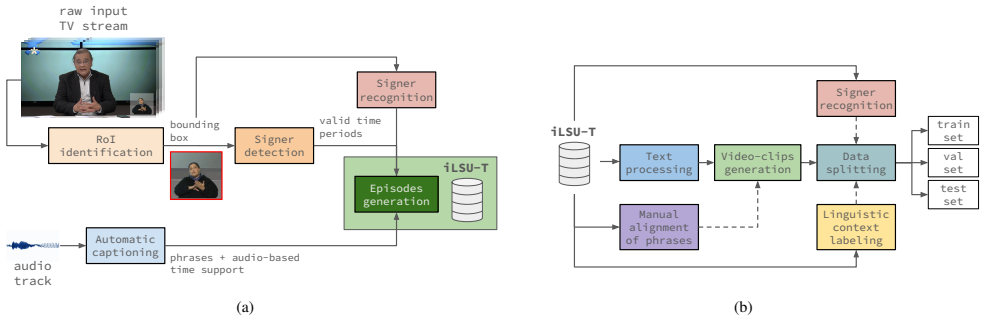
The load-bearing mechanism is a five-stage processing pipeline: region-of-interest identification, signer recognition with a KNN-based face classifier, automatic captioning with the WhisperX speech recognizer, manual phrase alignment by a sign language expert using pauses and epenthesis (transitional movements between signs) as cut points, and linguistic context labeling. For the benchmark experiments, video clips are generated from text phrases by automatic clipping with random pre- and post-delays drawn from uniform distributions, $t_1 \sim U(0.4,1.2)$ seconds and $t_2 \sim U(2.1,2.9)$ seconds, chosen by visual inspection. This clipping procedure is what pairs each video clip with a Spanish sentence, so the entire translation benchmark rests on it.
What would settle it
Take the over-20-hours of manually aligned episodes, run the automatic clipping rules on the same episodes, and measure the temporal overlap between each automatically produced clip and the expert-marked phrase boundaries; if a large fraction of clips miss the true signing interval, for instance by overlapping it by less than half, then the clip-text pairing that all translation scores depend on is not valid.
Extended reading notes
Core claim
The central claim is that iLSU-T is the first dataset that makes Uruguayan Sign Language translation tractable: it contains more than 185 hours of curated RGB video of interpreted LSU, synchronized audio, and Spanish text transcriptions, organized into 571 episodes and 86,550 video clips across three broadcast sources. The paper further claims that the dataset supports the first recorded benchmark of state-of-the-art sign language translation methods on LSU, with the parliamentary source giving the best scores (BLEU-4 up to 3.82, ROUGE-L up to 16.05) and the other sources scoring lower. The authors present these numbers not as a solved task but as a baseline that shows both the usefulness of the dataset and the difficulty of aligning interpreted video with text.
Load-bearing premise
The entire benchmark depends on the assumption that clipping each text-phrase time span with random delays of $t_1 \sim U(0.4,1.2)$ seconds before and $t_2 \sim U(2.1,2.9)$ seconds after reliably captures the sign-language rendering of that phrase; if the true interpreter delay falls outside these ranges, or varies by source or signer, the video clips and Spanish sentences are misaligned.
Editorial extensions
If this is right
- The reported BLEU and ROUGE scores become the first quantitative reference points for LSU translation, allowing future systems to be compared against a fixed benchmark.
- Because the parliamentary source's better scores are tied to duplicated phrases between train and test, evaluation on iLSU-T should report duplicate and non-duplicate performance separately.
- The manual phrase-alignment annotations covering over 20 hours provide ground truth that can be used to train or validate automatic alignment methods.
- The three tested methods are all visual-only and gloss-free, so iLSU-T is a testbed for approaches that add audio, skeleton data, or explicit alignment supervision.
Reading between the lines
- The random-delay clipping strategy likely understates what an alignment-aware model could achieve; the manual alignments could be used to train a predictor of true phrase boundaries, a test the paper does not run.
- The three sources differ in setting, interpreter style, and text duplication, so iLSU-T can serve as a domain-shift benchmark for sign language translation rather than only a single-dataset benchmark.
- Because video clips overlap and each phrase is treated independently, the benchmark ignores cross-phrase context such as coreference, so a model using episode-level context might score higher than these isolated-phrase baselines.
- If interpreter delay varies by source, per-source clipping parameters would likely change alignment quality; that hypothesis is directly testable with the existing manual annotations.
Editorial analysis
A structured set of objections, weighed in public.
Referee Report
Summary. The paper introduces iLSU-T, a publicly released multimodal dataset for Uruguayan Sign Language (LSU) translation, built from 571 episodes of interpreted TV and parliamentary video totaling 187.4 hours, with 18 signers, three sources, WhisperX-derived Spanish text, linguistic topic and genre labels, and over 20 hours of expert manual text-video alignment. It describes a preprocessing pipeline (RoI annotation, signer identification, automatic captioning, manual phrase alignment, contextual labeling) and evaluates three gloss-free sign language translation methods (SLT, STLCU, GASLT) with two I3D feature extractors on four data configurations, reporting BLEU and ROUGE-L baselines. The authors frame iLSU-T as the first large-scale LSU translation resource and the reported numbers as the first LSU benchmark.
Significance. If the clip-text pairing is trustworthy, the dataset fills a real gap: no large-scale public LSU translation resource exists, and the three-source structure with different signers and backgrounds is valuable for studying domain shift. Strengths include the public release with configuration files, the expert manual alignment subset, the linguistic context labeling, and the candid discussion of known limitations of ASR-derived text, fingerspelling, and coreference. The dataset's scientific value, however, rests on the validity of the automatic text-video association used to create the 86,550 training clips; the paper's own caveats in Section VI make that the central risk. The baseline numbers are conditional on the clipping procedure, so they should be treated as provisional until the alignment is validated. The contribution is significant for the low-resource sign language translation community if that validation is supplied.
major comments (4)
- [IV-B1 and VI] The entire benchmark depends on the random-delay clipping procedure, but the procedure is never validated. Section IV-B1 sets t1 ~ U(0.4,1.2) and t2 ~ U(2.1,2.9) seconds for all sources and signers based on visual inspection of a random sample of episodes, and the paper calls this a first approximation and labels automatic text-video alignment an open problem (Section VI). Because Sources 1-3 involve different broadcast formats and interpreting styles, a single delay distribution can systematically produce clips whose paired Spanish text does not correspond to the signed content, which would invalidate every BLEU/ROUGE value in Tables III-VI. The authors already have the tool needed to test this: Section III-D reports over 20 hours of expert manual alignments, but no comparison between automatic and manual clip boundaries is reported. I ask for a quantitative validation on the manually aligned episodes (e.g., distribution of delay offsets per source and signer, agreement between automatic and manual boundaries, and re-estimated delay parameters), plus an analysis of how much the final metrics change when using the manual alignments as test references. Without this, the dataset's core clip-text pairs remain unverified.
- [VI and Fig. 5] The performance gap on Source-3 is partly explained by duplicate text phrases between splits, but the problem is not confined to Source-3. Section VI states that Source-3 includes duplicate text phrases between train, validation, and test, and Figure 5 shows that duplicate phrases score dramatically higher (e.g., BLEU-4 27.89 vs 3.09). However, Section IV-B1's claim that the text content of clips is a priori independent is insufficient because identical or near-identical Spanish sentences recur within and across episodes (parliamentary protocol phrases, news items), and random clip-level splitting can place them in different splits. The whole-dataset and Source-1/Source-2 results in Tables III-V are therefore also exposed to this leakage unless explicit deduplication was performed. Please report the fraction of test (and validation) clips whose reference sentence or a near-duplicate appears in the training set for all four configurations, and provide results on a deduplicated split. This is required to interpret the Source-3 advantage and the general baselines.
- [III-B3 and VI] The reference text is produced by WhisperX automatic speech recognition without a reported word error rate, and the paper itself gives an example of a mistranscribed sentence (a ese cuenta de otra solicitud y licencia llegada a la mesa, Table VII discussion) and notes punctuation errors that affect clipping. Because BLEU and ROUGE-L compare against these noisy references, the absolute scores in Tables III-VI are not trustworthy as translation quality estimates, and punctuation errors also alter t1/t2-based clip boundaries. I recommend quantifying ASR quality (e.g., WER/CER on a human-transcribed subset, including the over-20-hours of manual alignments) and reporting at least one evaluation using manually corrected transcripts on the test set. This would also clarify how much of the reported gap is due to the translation models versus the reference quality.
- [IV-B2 and Tables III-VI] Tables III-VI report single-run scores with random splits and random delays, but no seeds, confidence intervals, or variance estimates are given. Because the data splits and the clipping delays are stochastic, the reported differences between methods and feature extractors (e.g., Table III STLCU vs GASLT) may be within run-to-run noise. Please provide seeds or multiple runs with mean and standard deviation, at least for the main configurations, so the baseline comparisons are reproducible and interpretable.
minor comments (5)
- [Abstract and Table I] The dataset name appears as iLSU T in the abstract and iLSU-T elsewhere; please standardize. Also, Table I lists 201.5 hours while Section III-C reports 187.4 hours and Section IV-B1 reports 201.52 hours as the total duration of all video clips; clarify that the latter is the overlapping sum of clips while the episode-level curated content is 187.4 hours.
- [Table VII] The method name is misspelled as SCULT in the table header; it should be STLCU.
- [IV-A3] The statement that substituting word encoding for BPE performs better is made without supporting numbers; please add a short comparison or remove the claim.
- [III-B2] The KNN classifier uses 50 samples per signer and a median filter with a 30-second minimum signer duration; please state explicitly whether these values were tuned and list them in the reproducibility notes, like the delay parameters in IV-B1.
- [Eq. (1)] The ROUGE-L formula uses beta=1.2 in a non-standard F-measure form; since all methods use the same official implementation this is not a correctness issue, but please define ROUGE-L consistently with the cited reference [26].
Circularity Check
No significant circularity: dataset construction and external baselines are self-contained; the random-delay clipping is an acknowledged heuristic, not a prediction forced by its own inputs.
full rationale
The paper's central claims are the construction of a new dataset and the reporting of baseline translation scores for three external state-of-the-art methods. The automatic clipping procedure in Section IV-B1 samples delays t1~U(0.4,1.2) and t2~U(2.1,2.9), chosen by visual inspection from a sample of episodes, to associate video clips with text phrases. This is an input-generation heuristic, not a fitted parameter that is then renamed as a prediction. The BLEU and ROUGE values in Tables III-VI are measurements of externally developed models on the resulting clips; no equation in the paper reduces any reported score to the delay parameters, and the scores are not used to validate or 'predict' the delay choice. The paper explicitly concedes in Section VI that the video-clip conformation is 'based on empirically adjusted random delays' and 'allows for a first approximation,' and it states that automatic sign language segmentation and text-video alignment are open problems. That is an acknowledged limitation affecting internal validity, not a circular derivation. The only self-citation is reference [36], used to define 'resting position' in the manual alignment discussion; this is a definitional anchor for an auxiliary annotation effort described in Section III-D and is not load-bearing for the reported baselines. No uniqueness theorem is imported, no ansatz is smuggled in via the authors' prior work, and no known result is renamed as a new contribution. Therefore no circular step can be exhibited, and the appropriate finding is no significant circularity.
Assumptions & free parameters
free parameters (3)
- Pre/post delay ranges for automatic clipping =
t1 ~ U(0.4, 1.2) s, t2 ~ U(2.1, 2.9) s
- Minimum signer duration for median filter =
30 seconds
- Training samples per signer for KNN face classifier =
50 samples per signer
assumptions (5)
- domain assumption WhisperX automatic captioning provides sufficiently accurate Spanish transcriptions to be used as phrase references for translation training and evaluation.
- ad hoc to paper Text-to-sign delay in simultaneous interpretation can be modeled by a fixed uniform random delay independent of source, signer, and phrase.
- domain assumption Pauses and epenthetic movements provide valid linguistic boundaries for segmenting LSU into phrases.
- domain assumption I3D features pretrained on ASL and BSL transfer sufficiently to LSU to support fair benchmarking.
- ad hoc to paper Random clip-level splitting adequately prevents train/test information leakage, despite overlapping clips and repeated text phrases.
Cite this review
Pith. "Pith review of iLSU-T: an Open Dataset for Uruguayan Sign Language Translation." pith.science (2026). https://pith.science/paper/RGTC6JJD
@misc{pith2026250721104,
  author       = {Pith},
  title        = {Pith review of: iLSU-T: an Open Dataset for Uruguayan Sign Language Translation},
  year         = {2026},
  howpublished = {\url{https://pith.science/paper/RGTC6JJD}},
  note         = {Machine review of arXiv:2507.21104}
}
read the original abstract
Automatic sign language translation has gained particular interest in the computer vision and computational linguistics communities in recent years. Given each sign language country particularities, machine translation requires local data to develop new techniques and adapt existing ones. This work presents iLSU T, an open dataset of interpreted Uruguayan Sign Language RGB videos with audio and text transcriptions. This type of multimodal and curated data is paramount for developing novel approaches to understand or generate tools for sign language processing. iLSU T comprises more than 185 hours of interpreted sign language videos from public TV broadcasting. It covers diverse topics and includes the participation of 18 professional interpreters of sign language. A series of experiments using three state of the art translation algorithms is presented. The aim is to establish a baseline for this dataset and evaluate its usefulness and the proposed pipeline for data processing. The experiments highlight the need for more localized datasets for sign language translation and understanding, which are critical for developing novel tools to improve accessibility and inclusion of all individuals. Our data and code can be accessed.
Figures


Figures from the paper (2 more)


Reference graph
Works this paper leans on
-
[1]
S. Albanie, G. Varol, L. Momeni, H. Bull, T. Afouras, H. Chowdhury, N. Fox, B. Woll, R. Cooper, A. McParland, et al. BBC-Oxford British sign language dataset. arXiv preprint arXiv:2111.03635 , 2021
arXiv 2021
-
[2]
M. Bain, J. Huh, T. Han, and A. Zisserman. WhisperX: time-accurate speech transcription of long-form audio. INTERSPEECH 2023, 2023
work page 2023
- [3]
-
[4]
D. Bragg, O. Koller, M. Bellard, L. Berke, P. Boudreault, A. Braf- fort, N. Caselli, M. Huenerfauth, H. Kacorri, T. Verhoef, C. V ogler, and M. Ringel Morris. Sign language recognition, generation, and translation: An interdisciplinary perspective. In Proceedings of the 21st International ACM SIGACCESS Conference on Computers and Accessibility, ASSETS ’19...
work page 2019
- [5]
-
[6]
H. Bull, T. Afouras, G. Varol, S. Albanie, L. Momeni, and A. Zisser- man. Aligning subtitles in sign language videos. In Proceedings of the IEEE/CVF International Conference on Computer Vision (ICCV) , pages 11552–11561, October 2021
work page 2021
-
[7]
H. Bull, M. Gouiff `es, and A. Braffort. Automatic Segmentation of Sign Language into Subtitle-Units. In Computer Vision – ECCV 2020 Workshops, volume 12536, pages 186–198. Springer International Publishing, Cham, 2020. Series Title: Lecture Notes in Computer Science
work page 2020
-
[8]
N. C. Camg ¨oz, S. Hadfield, O. Koller, H. Ney, and R. Bowden. Neural sign language translation. In 2018 IEEE/CVF Conference on Computer Vision and Pattern Recognition (CVPR) , pages 7784–7793, 2018
work page 2018
Show all 47 references
-
[9]
N. C. Camg ¨oz, O. Koller, S. Hadfield, and R. Bowden. Sign language transformers: Joint end-to-end sign language recognition and translation. In 2020 IEEE/CVF Conference on Computer Vision and Pattern Recognition (CVPR), pages 10020–10030, 2020
2020
-
[10]
Carreira and A
J. Carreira and A. Zisserman. Quo Vadis, Action Recognition? A new model and the Kinetics Dataset. In 2017 IEEE Conference on Computer Vision and Pattern Recognition (CVPR) , pages 4724–4733, 2017
2017
-
[11]
G. E. Ciapuscio. Tipos textuales . Universidad de Buenos Aires, Argentina, 1994
1994
-
[12]
Dal Bianco, G
P. Dal Bianco, G. R ´ıos, F. Ronchetti, F. Quiroga, O. Stanchi, W. Hasperu´e, and A. Rosete. LSA-T: the first continuous argentinian sign language dataset for sign language translation. In Advances in Artificial Intelligence – IBERAMIA 2022, pages 293–304, Cham, 2022. Springer...
2022
-
[13]
De Coster, D
M. De Coster, D. Shterionov, M. Van Herreweghe, and J. Dambre. Machine translation from signed to spoken languages: state of the art and challenges. Universal Access in the Information Society , 23(3):1305–1331, Aug. 2024
2024
-
[14]
De Coster, M
M. De Coster, M. Van Herreweghe, and J. Dambre. Sign language recognition with transformer networks. In Proceedings of the Twelfth Language Resources and Evaluation Conference , pages 6018–6024. European Language Resources Association, 2020
2020
-
[15]
De Coster, M
M. De Coster, M. Van Herreweghe, and J. Dambre. Isolated sign recognition from RGB video using pose flow and self-attention. In 2021 IEEE/CVF Conference on Computer Vision and Pattern Recognition Workshops (CVPRW), pages 3436–3445, 2021
2021
-
[16]
R. M. de Quadros and R. R. Segala. Traduc ¸ ˜ao intermodal, inter- semi´otica e interlingu ´ıstica de textos escritos em portugu ˆes para a Libras oral. Cadernos de traduc ¸˜ao, (2):354–386, 2015
2015
-
[17]
Duarte, S
A. Duarte, S. Palaskar, L. Ventura, D. Ghadiyaram, K. DeHaan, F. Metze, J. Torres, and X. Giro-i Nieto. How2sign: A large-scale multimodal dataset for continuous american sign language. In 2021 IEEE/CVF Conference on Computer Vision and Pattern Recognition (CVPR), pages 2734–2...
2021
-
[18]
C. Geraci. Epenthesis in Italian Sign Language. Sign Language & Linguistics, 12(1):3–51, 2009
2009
-
[19]
Jiang, B
S. Jiang, B. Sun, L. Wang, Y . Bai, K. Li, and Y . Fu. Skeleton aware multi-modal sign language recognition. In 2021 IEEE/CVF Conference on Computer Vision and Pattern Recognition Workshops (CVPRW) , pages 3408–3418, 2021
2021
-
[20]
Jurafsky and J
D. Jurafsky and J. H. Martin. Speech and Language Processing: An Introduction to Natural Language Processing, Computational Linguis- tics, and Speech Recognition with Language Models. 3rd edition, 2024. Online manuscript released August 20, 2024
2024
-
[21]
S.-K. Ko, C. J. Kim, H. Jung, and C. Cho. Neural sign language translation based on human keypoint estimation. Applied sciences , 9(13):2683, 2019
2019
-
[22]
Koller, J
O. Koller, J. Forster, and H. Ney. Continuous sign language recognition: towards large vocabulary statistical recognition systems handling multiple signers. Computer Vision and Image Understanding, 141:108–125, 2015
2015
-
[23]
D. Li, C. Xu, X. Yu, K. Zhang, B. Swift, H. Suominen, and H. Li. TSPNet: hierarchical feature learning via temporal semantic pyramid for sign language translation. Advances in Neural Information Pro- cessing Systems, 33:12034–12045, 2020
2020
-
[24]
D. Li, X. Yu, C. Xu, L. Petersson, and H. Li. Transferring cross- domain knowledge for video sign language recognition. In 2020 IEEE/CVF Conference on Computer Vision and Pattern Recognition (CVPR), pages 6204–6213, 2020
2020
-
[25]
S. K. Liddell. Think and believe: sequentiality in American Sign Language. Language, 60(2):372–399, 1984
1984
-
[26]
Lin and F
C.-Y . Lin and F. J. Och. Automatic evaluation of machine translation quality using longest common subsequence and skip-bigram statistics. In Proceedings of the 42nd annual meeting of the association for computational linguistics (ACL-04) , pages 605–612, 2004
2004
-
[27]
K. Lin, X. Wang, L. Zhu, K. Sun, B. Zhang, and Y . Yang. Gloss- free end-to-end sign language translation. In Proceedings of the 61st Annual Meeting of the Association for Computational Linguistics (Volume 1: Long Papers), pages 12904–12916, Toronto, Canada, July
-
[28]
Moryossef, Z
A. Moryossef, Z. Jiang, M. M ¨uller, S. Ebling, and Y . Goldberg. Linguistically motivated sign language segmentation. In H. Bouamor, J. Pino, and K. Bali, editors, Findings of the Association for Compu- tational Linguistics: EMNLP 2023 , pages 12703–12724, Singapore, Dec. 202...
2023
-
[29]
Moryossef, I
A. Moryossef, I. Tsochantaridis, R. Aharoni, S. Ebling, and S. Narayanan. Real-time sign language detection using human pose estimation. In A. Bartoli and A. Fusiello, editors, Computer Vision – ECCV 2020 Workshops, pages 237–248, Cham, 2020. Springer Inter- national Publishing
2020
-
[30]
Papineni, S
K. Papineni, S. Roukos, T. Ward, and W.-J. Zhu. BLEU: a method for automatic evaluation of machine translation. In Proceedings of the 40th annual meeting of the Association for Computational Linguistics , pages 311–318, 2002
2002
-
[31]
M. Post. A call for clarity in reporting BLEU scores. In Proceedings of the Third Conference on Machine Translation: Research Papers , pages 186–191, Brussels, Belgium, Oct. 2018. Association for Com- putational Linguistics
2018
-
[32]
K. Renz, N. C. Stache, S. Albanie, and G. Varol. Sign language segmentation with temporal convolutional networks. In ICASSP 2021 - 2021 IEEE International Conference on Acoustics, Speech and Signal Processing (ICASSP), pages 2135–2139, 2021
2021
-
[33]
X. Shen, S. Yuan, H. Sheng, H. Du, and X. Yu. Auslan-Daily: Australian sign language translation for daily communication and news. Advances in Neural Information Processing Systems , 36, 2024
2024
-
[34]
B. Shi, D. Brentari, G. Shakhnarovich, and K. Livescu. Fingerspelling detection in American Sign Language. In 2021 IEEE/CVF Conference on Computer Vision and Pattern Recognition (CVPR) , pages 4164– 4173, 2021
2021
-
[35]
B. Shi, D. Brentari, G. Shakhnarovich, and K. Livescu. Open-domain sign language translation learned from online video. In Proceedings of the 2022 Conference on Empirical Methods in Natural Language Processing, pages 6365–6379, Abu Dhabi, United Arab Emirates, Dec
2022
-
[36]
A. E. Stassi, M. Tancredi, R. Aguirre, A. G ´omez, B. Carballido, A. M ´endez, S. Beheregaray, A. Fojo, V . Koleszar, and G. Randall. LSU-DS: an uruguayan sign language public dataset for automatic recognition. In Proceedings of the 11th International Conference on Pattern Rec...
-
[37]
Tarr ´es, G
L. Tarr ´es, G. I. G´allego, A. Duarte, J. Torres, and X. Gir´o-i Nieto. Sign language translation from instructional videos. In 2023 IEEE/CVF Conference on Computer Vision and Pattern Recognition Workshops (CVPRW), pages 5625–5635, 2023
2023
-
[38]
Varol, L
G. Varol, L. Momeni, S. Albanie, T. Afouras, and A. Zisserman. Read and attend: temporal localisation in sign language videos. In 2021 IEEE/CVF Conference on Computer Vision and Pattern Recognition (CVPR), pages 16852–16861, 2021
2021
-
[39]
V oskou, K
A. V oskou, K. P. Panousis, D. Kosmopoulos, D. N. Metaxas, and S. Chatzis. Stochastic transformer networks with linear competing units: application to end-to-end SL translation. In 2021 IEEE/CVF International Conference on Computer Vision (ICCV) , pages 11926– 11935, 2021
2021
-
[40]
R. Wong, N. C. Camg ¨oz, and R. Bowden. Hierarchical I3D for sign spotting. In Computer Vision – ECCV 2022 Workshops , pages 243– 255, Cham, 2023. Springer Nature Switzerland
2022
-
[41]
A. Yin, T. Zhong, L. Tang, W. Jin, T. Jin, and Z. Zhao. Gloss attention for gloss-free sign language translation. In 2023 IEEE/CVF Conference on Computer Vision and Pattern Recognition (CVPR) , pages 2551–2562, 2023
2023
-
[42]
Zhang, V
T. Zhang, V . Kishore, F. Wu, K. Q. Weinberger, and Y . Artzi. BERTScore: Evaluating text generation with BERT. In International Conference on Learning Representations (ICLR) , 2020
2020
-
[43]
H. Zhou, W. Zhou, W. Qi, J. Pu, and H. Li. Improving sign language translation with monolingual data by sign back-translation. In 2021 IEEE/CVF Conference on Computer Vision and Pattern Recognition (CVPR), pages 1316–1325, 2021
2021
-
[44]
Z. Zhou, T. Tan, and Y . Qian. Punctuation prediction for streaming on- device speech recognition. In ICASSP 2022 - 2022 IEEE International Conference on Acoustics, Speech and Signal Processing (ICASSP) , pages 7277–7281, 2022
2022
-
[45]
Q. Zhu, J. Li, F. Yuan, J. Fan, and Q. Gan. A Chinese continuous sign language dataset based on complex environments. arXiv preprint arXiv:2409.11960, 2024
2024 arXiv
-
[705]
INSTICC, SciTePress, 2022
2022
-
[2022]
Association for Computational Linguistics
Reviewed August 6, 2026 · model on record in the stance chip above.
Discussion (0). Continue with ORCID to comment.