REVIEW 4 major objections 5 minor 64 references
Advancing Compositional LLM Reasoning with Structured Task Relations in Interactive Multimodal Communications
T0 review · 4 major / 5 minor · reviewed 2026-08-06 · deepseek-v4-flash
Pith's one-line read The paper claims that a single multimodal LLM can serve many interactive applications by partitioning its low-rank adaptation weights into per-task blocks and training those blocks in the order given by a task dependency graph.
desk verdict The LoRA-partitioning idea is worth a look, but the evaluation lets ContextLoRA see the task graph at test time, so the core 'learned dependencies' claim is not established. read the letter →
The pith
A machine-rendered reading of the paper's core claim, the machinery that carries it, and where it could break.
The reading
What carries the argument
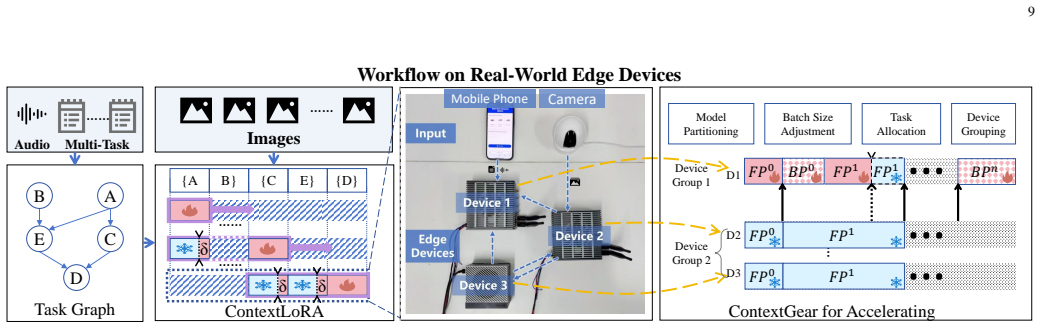
The load-bearing mechanism is the task dependency graph feeding a sliding-window freeze-train-mask schedule over a column-partitioned LoRA matrix. Source tasks are trained first with all other blocks masked; a later task's block is trained while a fraction 1−δ of each prerequisite block stays frozen and the rest of the matrix is masked. The same partitioned structure also drives ContextGear's pipeline: frozen blocks need no backward pass, so devices unevenly split forward and forward-plus-backward work, and an optimization loop minimizes the longer of the two group runtimes by adjusting the model split point, batch size, task reassignment, and device grouping.
What would settle it
Run the same partitioned freeze-train-mask procedure with the task graph replaced by (a) a random or reversed dependency order and (b) a simple curriculum that trains tasks in the same sequence but never freezes or masks prerequisite blocks. If either variant matches ContextLoRA's final-task accuracy, the claim that structured task relations are embedded in the parameters is not supported.
Extended reading notes
Core claim
On its own terms, the paper's discovery is that task relationships can be embedded directly into a low-rank adaptation matrix. Each task gets a contiguous column block of the matrix. A hand-built directed acyclic graph of task prerequisites is converted into a topological ordering, and blocks are trained in that order: the current task's block is trainable, a configurable fraction δ of each prerequisite block is also trainable while the rest is frozen, and all unrelated blocks are masked. The result, ContextLoRA, is claimed to give one model the accuracy of per-task specialization while preserving independent deployability of each block. The same partitioning enables ContextGear, a pipeline schedule in which one group of devices handles forward and backward passes for trainable blocks and another handles only forward passes for frozen blocks, with workload balanced by model partitioning, batch size, task allocation, and device grouping.
Load-bearing premise
The load-bearing premise is that the hand-constructed task dependency graphs correctly and sufficiently capture inter-task structure, and that it is the graph-driven freeze-train-mask ordering, not the parameter partitioning or the mere sequence of tasks, that produces the accuracy gains; the paper does not ablate a graph against a plain curriculum, and its weak-dependency test replaces only two of three prerequisite links, dropping accuracy from 93 to 90.5 percent.
Editorial extensions
If this is right
- If ContextLoRA works as claimed, one deployed model can serve many interactive applications, with each task block deployed independently or combined into a single model.
- Because task relations live in parameters, inference needs no inter-task router, so per-request latency and inter-device communication drop.
- The frozen ratio δ becomes a user-facing control: increasing it preserves each sub-task's independence, decreasing it shifts the model's emphasis toward final downstream tasks.
- The robustness results imply that label pollution in one task harms only that task's block, so a targeted repair or re-training of one segment can restore system performance.
- ContextGear's pipeline design means distributed fine-tuning of a 13-billion-parameter model is roughly 20 percent faster on edge-class hardware with unchanged memory footprint.
Reading between the lines
- The same partitioned-schedule recipe should transfer to any acyclic multi-task workflow, not just communication scenarios, since nothing in the mechanism is specific to images or wireless networks.
- A natural extension the paper leaves implicit is learning δ from data or per-task rather than hand-setting one ratio, which could remove a tuning burden that currently sits with the user.
- A limitation worth testing externally: the method explicitly excludes cyclic task structures, so it cannot directly represent workflows with iterative refinement; the paper's proposed dialogue-based workaround may not preserve the same accuracy benefit.
- If the graph is the real driver, then automatic graph discovery from task descriptions could replace hand construction and would make the method applicable to new domains without manual workflow design.
Editorial analysis
A structured set of objections, weighed in public.
Referee Report
Summary. The paper presents a system for fine-tuning a single multimodal LLM on multiple interactive multimodal application tasks. ContextLoRA partitions a LoRA weight matrix into per-task segments and trains them in an order determined by a manually constructed task dependency graph, applying freeze, train, and mask phases; ContextGear is a pipeline-parallel scheduling and optimization scheme for distributing this training across edge devices. The experiments use three self-constructed vision-language benchmarks (Internet of Vehicles, intelligent factory, smart city; 12 tasks total), compare ContextLoRA with LoRA, HydraLoRA, and MoLE, compare ContextGear with JoRA and DeepSpeed, and include a three-device Jetson testbed. The central claims are that ContextLoRA embeds task relationships into model parameters, improving compositional reasoning, and that ContextGear reduces training time while maintaining accuracy.
Significance. If the causal claims were established, the paper would make a useful contribution: it attacks a real deployment problem (multiple IMA tasks on resource-constrained devices), it ships a concrete algorithmic proposal with an implementable scheduling objective, it includes a real-world testbed evaluation, and the authors state that code will be released. The robustness experiments under label noise and the frozen-ratio analysis are also valuable. However, the significance is currently qualified by three gaps: the task dependency graph is a hand-supplied input used both to order training and to condition the model at inference, so the claimed 'latent dependency learning' is not isolated from the curriculum and partitioning choices; the main ablation for the graph hypothesis does not actually vary graph topology; and the evaluation metric is a self-defined partial-credit score whose operational details are not specified. These gaps bear directly on the paper's principal novelty claim.
major comments (4)
- [Section VI-E, Figure 9(a)] The only experiment intended to probe the role of task dependencies does not ablate the dependency graph. The text says Tasks 1 and 2 are replaced with tasks that have 'weak dependencies on Task 4', but it does not report removing or randomizing the graph edges; the illustrated topology still has direct prerequisite edges into Task 4. Varying task semantics while keeping the graph topology and the freeze/train/mask ordering intact cannot distinguish whether the accuracy gain comes from the graph structure, from the sliding-window curriculum, or from the partitioned LoRA matrix alone. A proper ablation would remove the relevant prerequisite edges, randomize the graph while holding the training procedure identical, or compare ContextLoRA against a curriculum that uses the same ordering without the graph being supplied at test time. As written, the claim that 'task relationships are embedded into model parameters' is not separately evidenced.
- [Section III-A, Section V, Section VI-A] The task dependency graph is manually constructed by the authors and serves two roles simultaneously: it determines the training order in Algorithm 1, and it is given as an input to the multimodal LLM at inference (Figure 5 and Section VI-A state that the inputs include 'images, task descriptions, and task graphs'). The baselines do not receive such a graph, so the reported accuracy advantage could in part come from test-time conditioning on a hand-authored graph rather than from a parameter-level embedding of task relations. Please add a control that provides the same graph as input to a baseline trained without ContextLoRA's freeze/train/mask procedure, and an ablation in which ContextLoRA is trained with the graph but evaluated without it. Without these controls, the central claim that dependencies are learned into the parameters remains a construction artifact rather than a demonstrated empirical property.
- [Section VI-D, Section VI-E] The evaluation metric is under-specified and is defined by the authors. Accuracy is computed from a 1/0.5/0 scoring rule in which a response receives 1 point if all selected options match, 0.5 if some match, and 0 otherwise; however, the paper does not specify how open-ended answers (e.g., the driving-strategy answer in Task 4) are converted into 'selected options', what parsing or extraction is applied, whether the partial-credit judgment is made by a human with a rubric or by a programmatic matcher, or whether scoring is done blindly. Since Task 4 is open-ended and is the central showcase (93% versus 81% in Figure 7(a)), the main quantitative claim is not reproducible from the text. Please provide the full evaluation protocol, the exact prompts, and examples of scored outputs, including how 0.5 versus 1.0 points are assigned.
- [Section VI-E, Table IV] The experimental reporting does not support the strength of the efficiency and accuracy claims. All accuracy numbers are single point estimates with no repeated seeds, error bars, or significance tests, on test sets of only 400 Q&A pairs per dataset. The training-time claims also need alignment with the table: Table IV shows ContextGear versus JoRA for LLaVA-7B as 15'19" versus 15'45" (about 2.7% improvement), and versus DeepSpeed as about 5.2%, while the text says the approach achieves 'nearly a 20% speed improvement over the best baseline' and later references improvements of 'over 22%' and 'more than 40%'. Please report repeated runs with variance, and state which rows support each percentage claim.
minor comments (5)
- [Section VI-A, Table II] The text says fine-tuning uses a total of 8 epochs, while Table II reports Epoch 4; please reconcile the two values.
- [Section V, Figure 5(c)] The text states that each dataset contains 1,200 images, but Figure 5(c) says the smart city dataset uses 800 images, and the smart city training set is 3,200 Q&A pairs rather than 4,800; please clarify whether the image count or the number of Q&A pairs is inconsistent.
- [Section III-B] The notation W(δ) is not defined precisely: the text says 'δ% columns of parameters that are activated' and also calls δ the frozen ratio, while Section VI-E refers to the 'freezing rate 1 − δ'; please define the parameter consistently and state whether it is the fraction of frozen columns or the fraction of activated columns.
- [References] Reference [17] appears to have a garbled title ('Artificial Intelligence Computing for a Smart City, G-Enabled Network in Box...') and is missing the '6G' fragment; please correct it.
- [Figure 7] The caption says the figure compares accuracy and robustness, but panels (a)-(c) are accuracy and panels (d)-(f) are robustness; please state this explicitly in the caption and legend.
Circularity Check
No circularity found: ContextLoRA's graph-conditioned freeze/train/mask procedure is a construction, and its accuracy and speed gains are empirical comparisons rather than identities with its inputs.
full rationale
I examined the paper's derivation chain for reductions of claimed results to their own inputs. ContextLoRA takes a manually constructed task dependency graph (Section III-A), topologically sorts it into an ordered list, partitions the LoRA matrix column-wise by task, and applies freeze/train/mask operations according to Eq. (6). This is a well-defined training construction: the graph determines which parameter segments are trained, frozen, or masked, but it does not logically determine the reported accuracies. The accuracy numbers in Figure 7 and Table III are empirical outcomes of running this procedure on LLaVA against LoRA, HydraLoRA, and MoLE, not mathematical consequences of the graph input. No parameter is fitted to a subset of data and then reported as a prediction; the frozen-ratio study (Figure 8) varies a hyperparameter and observes behavior, which is not a fitted-input-called-prediction pattern. ContextGear's time comparisons (Table IV) are measured runtimes against JoRA and DeepSpeed, and its optimization objective (Eq. 11) minimizes a modeled training time, but the reported gains are empirical. The paper's references to prior work by some of the same authors (e.g., Refs. [8], [12], [14]) are background citations for 6G, wireless networks, and video anomaly benchmarks; they are not load-bearing for the central ContextLoRA or ContextGear claims, and no uniqueness theorem or prior ansatz is imported from those works to force the method. The main weakness is experimental, not circular: Section III-A states that 'The task dependency graphs are manually constructed based on the workflow of IMAs,' and the graph-ablation experiment in Section VI-E (Figure 9(a)) replaces two tasks with 'tasks that have weak dependencies on Task 4' while still retaining prerequisite edges, so it does not cleanly isolate the causal role of graph structure from the curriculum or the parameter partitioning. That is a validity/control concern and should be weighed as correctness risk, not as circularity, because the paper's central accuracy comparisons remain external empirical evidence rather than identities with the graph input.
Assumptions & free parameters
free parameters (1)
- delta (frozen ratio) =
varied in experiments, e.g., from full freezing to partial freezing; exact values in Figure 8 not listed numerically
assumptions (3)
- domain assumption Task dependency graphs G=(V,E) are manually constructed and assumed to reflect true IMA workflows (Eq. 1, Section III-A).
- domain assumption Column-wise partitioning of the LoRA matrix W=[W1,...,Wn] preserves task-specific function and allows freezing/masking without harming the base model (Section II-B).
- ad hoc to paper The scoring protocol for multiple-choice accuracy (0/0.5/1 points) is a valid measure of compositional reasoning for open-ended answers (Section VI-D).
Cite this review
Pith. "Pith review of Advancing Compositional LLM Reasoning with Structured Task Relations in Interactive Multimodal Communications." pith.science (2026). https://pith.science/paper/BS5RAMGW
@misc{pith2026250721199,
  author       = {Pith},
  title        = {Pith review of: Advancing Compositional LLM Reasoning with Structured Task Relations in Interactive Multimodal Communications},
  year         = {2026},
  howpublished = {\url{https://pith.science/paper/BS5RAMGW}},
  note         = {Machine review of arXiv:2507.21199}
}
read the original abstract
Interactive multimodal applications (IMAs), such as route planning in the Internet of Vehicles, enrich users' personalized experiences by integrating various forms of data over wireless networks. Recent advances in large language models (LLMs) utilize mixture-of-experts (MoE) mechanisms to empower multiple IMAs, with each LLM trained individually for a specific task that presents different business workflows. In contrast to existing approaches that rely on multiple LLMs for IMAs, this paper presents a novel paradigm that accomplishes various IMAs using a single compositional LLM over wireless networks. The two primary challenges include 1) guiding a single LLM to adapt to diverse IMA objectives and 2) ensuring the flexibility and efficiency of the LLM in resource-constrained mobile environments. To tackle the first challenge, we propose ContextLoRA, a novel method that guides an LLM to learn the rich structured context among IMAs by constructing a task dependency graph. We partition the learnable parameter matrix of neural layers for each IMA to facilitate LLM composition. Then, we develop a step-by-step fine-tuning procedure guided by task relations, including training, freezing, and masking phases. This allows the LLM to learn to reason among tasks for better adaptation, capturing the latent dependencies between tasks. For the second challenge, we introduce ContextGear, a scheduling strategy to optimize the training procedure of ContextLoRA, aiming to minimize computational and communication costs through a strategic grouping mechanism. Experiments on three benchmarks show the superiority of the proposed ContextLoRA and ContextGear. Furthermore, we prototype our proposed paradigm on a real-world wireless testbed, demonstrating its practical applicability for various IMAs. We will release our code to the community.
Figures


Figures from the paper (7 more)




Reference graph
Works this paper leans on
-
[1]
A review on methods and applications in multimodal deep learning,
S. Jabeen, X. Li, M. S. Amin, O. Bourahla, S. Li, and A. Jabbar, “A review on methods and applications in multimodal deep learning,” ACM Transactions on Multimedia Computing, Communications and Applications, vol. 19, no. 2s, pp. 1–41, 2023
work page 2023
-
[2]
L. Wen, X. Yang, D. Fu, X. Wang, P. Cai, X. Li, M. Tao, Y . Li, X. Linran, D. Shang et al. , “On the Road with GPT-4V (ision): Explorations of Utilizing Visual-Language Model as Autonomous Driving Agent,” in ICLR Workshop, 2024
work page 2024
-
[3]
6G-Enabled Network in Box for Internet of Connected Vehicles,
Z. Lv, L. Qiao, and I. You, “6G-Enabled Network in Box for Internet of Connected Vehicles,” IEEE transactions on intelligent transportation systems, vol. 22, no. 8, pp. 5275–5282, 2020
work page 2020
-
[4]
LLM Enhanced Reconfigurable Intelligent Surface for Energy-Efficient and Reliable 6G IoV,
Q. Liu, J. Mu, D. ChenZhang, Y . Liu, and T. Hong, “LLM Enhanced Reconfigurable Intelligent Surface for Energy-Efficient and Reliable 6G IoV,” IEEE Transactions on Vehicular Technology, 2024
work page 2024
-
[5]
W. Tian, X. Ding, G. Liu, Y . Dai, and Z. Han, “A UA V-Assisted Secure Communication System by Jointly Optimizing Transmit Power and Trajectory in the Internet of Things,” IEEE Transactions on Green Communications and Networking , vol. 7, no. 4, pp. 2025–2037, 2023
work page 2025
-
[6]
ITU-R, “Recommendation ITU-R M.2160-0(11/2023) M Series: Mobile, radiodetermination, amateur and related satellite services Framework and overall objectives of the future development of IMT for 2030 and beyond,” 2023
work page 2023
-
[7]
Possible Applications of Sixth Generation Communication Networks,
E. V . Tonkikh, K. D. Burobina, and A. A. Shurakhov, “Possible Applications of Sixth Generation Communication Networks,” in Sys- tems of Signals Generating and Processing in the Field of on Board Communications, 2020, pp. 1–6
work page 2020
-
[8]
Mining KPI correlations for non-parametric anomaly diagnosis in wireless networks,
T. Sui, X. Tao, H. Wu, X. Zhang, J. Xu, and G. Nan, “Mining KPI correlations for non-parametric anomaly diagnosis in wireless networks,” Science China Information Sciences , vol. 66, no. 6, p. 162301, 2023
work page 2023
Show all 64 references
-
[9]
A Tutorial on Ultrareliable and Low-Latency Communications in 6G: Integrating Domain Knowledge Into Deep Learning,
C. She, C. Sun, Z. Gu, Y . Li, C. Yang, H. V . Poor, and B. Vucetic, “A Tutorial on Ultrareliable and Low-Latency Communications in 6G: Integrating Domain Knowledge Into Deep Learning,” Proceedings of the IEEE, vol. 109, no. 3, pp. 204–246, 2021
2021
-
[10]
6G Wireless Systems: Vision, Requirements, Challenges, Insights, and Opportunities,
H. Tataria, M. Shafi, A. F. Molisch, M. Dohler, H. Sj ¨oland, and F. Tufvesson, “6G Wireless Systems: Vision, Requirements, Challenges, Insights, and Opportunities,” Proceedings of the IEEE , vol. 109, no. 7, pp. 1166–1199, 2021
2021
-
[11]
The Roadmap to 6G: AI Empowered Wireless Networks,
K. B. Letaief, W. Chen, Y . Shi, J. Zhang, and Y .-J. A. Zhang, “The Roadmap to 6G: AI Empowered Wireless Networks,” IEEE Communi- cations Magazine, vol. 57, no. 8, pp. 84–90, 2019
2019
-
[12]
Overview of AI and communication for 6G network: fundamentals, challenges, and future research opportunities,
Q. Cui, X. You, N. Wei, G. Nan, X. Zhang, J. Zhang, X. Lyu, M. Ai, X. Tao, Z. Feng et al. , “Overview of AI and communication for 6G network: fundamentals, challenges, and future research opportunities,” Science China Information Sciences , vol. 68, no. 7, p. 171301, 2025
2025
-
[13]
Survey on the Internet of Vehicles: Network Architectures and Appli- cations,
B. Ji, X. Zhang, S. Mumtaz, C. Han, C. Li, H. Wen, and D. Wang, “Survey on the Internet of Vehicles: Network Architectures and Appli- cations,” IEEE Communications Standards Magazine , vol. 4, no. 1, pp. 34–41, 2020. 14
2020
-
[14]
Uncovering what, why and How: A Comprehensive Benchmark for Causation Understanding of Video Anomaly,
H. Du, S. Zhang, B. Xie, G. Nan, J. Zhang, J. Xu, H. Liu, S. Leng, J. Liu, H. Fan, D. Huang, J. Feng, L. Chen, C. Zhang, X. Li, H. Zhang, J. Chen, Q. Cui, and X. Tao, “Uncovering what, why and How: A Comprehensive Benchmark for Causation Understanding of Video Anomaly,” in CVP...
2024
-
[15]
An LLM-Based vision and Language Cobot Navigation Approach for Human-Centric Smart Manufacturing,
T. Wang, J. Fan, and P. Zheng, “An LLM-Based vision and Language Cobot Navigation Approach for Human-Centric Smart Manufacturing,” Journal of Manufacturing Systems , 2024
2024
-
[16]
The smart factory as a key construct of industry 4.0: A systematic literature review,
P. Osterrieder, L. Budde, and T. Friedli, “The smart factory as a key construct of industry 4.0: A systematic literature review,” International Journal of Production Economics , vol. 221, p. 107476, 2020
2020
-
[17]
Artificial Intelligence Computing for a Smart City, G-Enabled Network in Box for Internet of Connected Vehicles,
S. See, “Artificial Intelligence Computing for a Smart City, G-Enabled Network in Box for Internet of Connected Vehicles,” in SCITA, 2018, pp. 6–8
2018
-
[18]
Semisu- pervised deep reinforcement learning in support of IoT and smart city services,
M. Mohammadi, A. Al-Fuqaha, M. Guizani, and J.-S. Oh, “Semisu- pervised deep reinforcement learning in support of IoT and smart city services,” IEEE Internet of Things Journal , vol. 5, no. 2, pp. 624–635, 2017
2017
-
[19]
Cross-Task Multimodal Reinforcement for Long Tail Next POI Recommendation,
J. Du, S. Zhou, J. Yu, P. Han, and S. Shang, “Cross-Task Multimodal Reinforcement for Long Tail Next POI Recommendation,” IEEE Trans- actions on Multimedia , vol. 26, pp. 1996–2005, 2024
1996
-
[20]
Multi-modal Knowledge-aware Reinforcement Learning Network for Explainable Recommendation,
S. Tao, R. Qiu, Y . Ping, and H. Ma, “Multi-modal Knowledge-aware Reinforcement Learning Network for Explainable Recommendation,” Knowledge-Based Systems, vol. 227, p. 107217, 2021
2021
-
[21]
A Hierarchical Hybrid Learning Framework for Multi-Agent Trajectory Prediction,
Y . Jiao, M. Miao, Z. Yin, C. Lei, X. Zhu, X. Zhao, L. Nie, and B. Tao, “A Hierarchical Hybrid Learning Framework for Multi-Agent Trajectory Prediction,” IEEE Transactions on Intelligent Transportation Systems , vol. 25, no. 8, pp. 10 344–10 354, 2024
2024
-
[22]
Inter- active Interior Design Recommendation via Coarse-to-fine Multimodal Reinforcement Learning,
H. Zhang, Y . Sun, W. Guo, Y . Liu, H. Lu, X. Lin, and H. Xiong, “Inter- active Interior Design Recommendation via Coarse-to-fine Multimodal Reinforcement Learning,” in MM, 2023, p. 6472–6480
2023
-
[23]
Multimodal Large Language Models: A Survey,
J. Wu, W. Gan, Z. Chen, S. Wan, and P. S. Yu, “Multimodal Large Language Models: A Survey,” in IEEE Big Data, 2023, pp. 2247–2256
2023
-
[24]
NExT-GPT: Any-to-Any Multimodal LLM,
S. Wu, H. Fei, L. Qu, W. Ji, and T.-S. Chua, “NExT-GPT: Any-to-Any Multimodal LLM,” in ICML, 2024
2024
-
[25]
Survey on Deep Multi-modal Data Analytics: Collaboration, Rivalry, and Fusion,
Y . Wang, “Survey on Deep Multi-modal Data Analytics: Collaboration, Rivalry, and Fusion,” ACM TOMM, vol. 17, no. 1s, pp. 1–25, 2021
2021
-
[26]
Reparameterized Policy Learning for Multimodal Trajectory Optimization,
Z. Huang, L. Liang, Z. Ling, X. Li, C. Gan, and H. Su, “Reparameterized Policy Learning for Multimodal Trajectory Optimization,” in ICML, 2023, pp. 13 957–13 975
2023
-
[27]
LoRA: Low-Rank Adaptation of Large Language Models,
E. J. Hu, P. Wallis, Z. Allen-Zhu, Y . Li, S. Wang, L. Wang, W. Chen et al. , “LoRA: Low-Rank Adaptation of Large Language Models,” in ICLR, 2021
2021
-
[28]
Mixture-of-Experts with Expert Choice Routing,
Y . Zhou, T. Lei, H. Liu, N. Du, Y . Huang, V . Zhao, A. M. Dai, z. Chen, Q. V . Le, and J. Laudon, “Mixture-of-Experts with Expert Choice Routing,” in NeurIPS, vol. 35, 2022, pp. 7103–7114
2022
-
[29]
Data Quality- Aware Task Offloading in Mobile Edge Computing: An Optimal Stop- ping Theory Approach,
I. Alghamdi, C. Anagnostopoulos, and D. P. Pezaros, “Data Quality- Aware Task Offloading in Mobile Edge Computing: An Optimal Stop- ping Theory Approach,” Future Generation Computer Systems, vol. 117, pp. 462–479, 2021
2021
-
[30]
Consumer Privacy Concerns about Internet Marketing,
H. Wang, M. K. Lee, and C. Wang, “Consumer Privacy Concerns about Internet Marketing,” Communications of the ACM , vol. 41, no. 3, pp. 63–70, 1998
1998
-
[31]
Towards QoS-aware provisioning of chained virtual security services in edge networks,
M. M. Iordache-Sica, C. Anagnostopoulos, and D. P. Pezaros, “Towards QoS-aware provisioning of chained virtual security services in edge networks,” in IM, 2021, pp. 178–186
2021
-
[32]
Mixture of experts: a literature survey,
S. Masoudnia and R. Ebrahimpour, “Mixture of experts: a literature survey,” Artificial Intelligence Review , vol. 42, pp. 275–293, 2014
2014
-
[33]
TeamLoRA: Boosting Low-Rank Adaptation with Ex- pert Collaboration and Competition,
T. Lin, J. Liu, W. Zhang, Z. Li, Y . Dai, H. Li, Z. Yu, W. He, J. Li, H. Jiang et al., “TeamLoRA: Boosting Low-Rank Adaptation with Ex- pert Collaboration and Competition,” arXiv preprint arXiv:2408.09856 , 2024
2024 arXiv
-
[34]
MFTCoder: Boosting Code LLMs with Multitask Fine-Tuning,
B. Liu, C. Chen, Z. Gong, C. Liao, H. Wang, Z. Lei, M. Liang, D. Chen, M. Shen, H. Zhou, W. Jiang, H. Yu, and J. Li, “MFTCoder: Boosting Code LLMs with Multitask Fine-Tuning,” in ACM SIGKDD, 2024, p. 5430–5441
2024
-
[35]
Seeded LoRA: Collaborative Fine-Tuning Through Seed Initialization of Adapters,
A. R. Salamanca, A. ¨Ust¨un, N. S. Detlefsen, and T. Dettmers, “Seeded LoRA: Collaborative Fine-Tuning Through Seed Initialization of Adapters,” in ICML Workshops, 2024
2024
-
[36]
Learning to Route Among Specialized Experts for Zero-Shot Generalization,
M. Muqeeth, H. Liu, Y . Liu, and C. Raffel, “Learning to Route Among Specialized Experts for Zero-Shot Generalization,” in ICML, 2024
2024
-
[37]
LoraRetriever: Input-Aware LoRA Retrieval and Composition for Mixed Tasks in the Wild,
Z. Zhao, L. Gan, G. Wang, W. Zhou, H. Yang, K. Kuang, and F. Wu, “LoraRetriever: Input-Aware LoRA Retrieval and Composition for Mixed Tasks in the Wild,” arXiv preprint arXiv:2402.09997 , 2024
2024 arXiv
-
[38]
Towards Modular LLMs by Building and Reusing a Library of LoRAs,
O. Ostapenko, Z. Su, E. Ponti, L. Charlin, N. L. Roux, L. Caccia, and A. Sordoni, “Towards Modular LLMs by Building and Reusing a Library of LoRAs,” in ICML, 2024
2024
-
[39]
LoraHub: Efficient Cross-Task Generalization via Dynamic LoRA Composition,
C. Huang, Q. Liu, B. Y . Lin, C. Du, T. Pang, and M. Lin, “LoraHub: Efficient Cross-Task Generalization via Dynamic LoRA Composition,” in R0-FoMo:Robustness of Few-shot and Zero-shot Learning in Large Foundation Models, 2023
2023
-
[40]
Swarm Par- allelism: Training Large Models Can Be Surprisingly Communication- Efficient,
M. Ryabinin, T. Dettmers, M. Diskin, and A. Borzunov, “Swarm Par- allelism: Training Large Models Can Be Surprisingly Communication- Efficient,” in ICML, 2023, pp. 29 416–29 440
2023
-
[41]
PyTorch Dis- tributed: Experiences on Accelerating Data Parallel Training,
S. Li, Y . Zhao, R. Varma, O. Salpekar, P. Noordhuis, T. Li, A. Paszke, J. Smith, B. Vaughan, P. Damania, and S. Chintala, “PyTorch Dis- tributed: Experiences on Accelerating Data Parallel Training,” Proc. VLDB Endow., vol. 13, no. 12, p. 3005–3018, Aug. 2020
2020
-
[42]
Petuum: A New Platform for Distributed Machine Learning on Big Data,
E. P. Xing, Q. Ho, W. Dai, J. K. Kim, J. Wei, S. Lee, X. Zheng, P. Xie, A. Kumar, and Y . Yu, “Petuum: A New Platform for Distributed Machine Learning on Big Data,” IEEE Transactions on Big Data , vol. 1, no. 2, pp. 49–67, 2015
2015
-
[43]
Tesseract: Parallelize the Tensor Parallelism Efficiently,
B. Wang, Q. Xu, Z. Bian, and Y . You, “Tesseract: Parallelize the Tensor Parallelism Efficiently,” in ICPP, 2023
2023
-
[44]
GPipe: Efficient Training of Giant Neural Networks using Pipeline Parallelism,
Y . Huang, Y . Cheng, A. Bapna, O. Firat, D. Chen, M. Chen, H. Lee, J. Ngiam, Q. V . Le, Y . Wu, and z. Chen, “GPipe: Efficient Training of Giant Neural Networks using Pipeline Parallelism,” in NeurIPS, vol. 32. Curran Associates, Inc., 2019
2019
-
[45]
PipeMare: Asynchronous Pipeline Parallel DNN Training,
B. Yang, J. Zhang, J. Li, C. Re, C. Aberger, and C. De Sa, “PipeMare: Asynchronous Pipeline Parallel DNN Training,” in MLSys, vol. 3, 2021, pp. 269–296
2021
-
[46]
TeraPipe: Token-Level Pipeline Parallelism for Training Large-Scale Language Models,
Z. Li, S. Zhuang, S. Guo, D. Zhuo, H. Zhang, D. X. Song, and I. Stoica, “TeraPipe: Token-Level Pipeline Parallelism for Training Large-Scale Language Models,” in ICML, 2021
2021
-
[47]
A Hybrid Tensor-Expert-Data Parallelism Approach to Optimize Mixture-of-Experts Training,
S. Singh, O. Ruwase, A. A. Awan, S. Rajbhandari, Y . He, and A. Bhatele, “A Hybrid Tensor-Expert-Data Parallelism Approach to Optimize Mixture-of-Experts Training,” in ACM ICS, 2023, p. 203–214
2023
-
[48]
HetPipe: Enabling Large DNN Training on (Whimpy) Heterogeneous GPU Clusters through Integration of Pipelined Model Parallelism and Data Parallelism,
J. H. Park, G. Yun, C. M. Yi, N. T. Nguyen, S. Lee, J. Choi, S. H. Noh, and Y . ri Choi, “HetPipe: Enabling Large DNN Training on (Whimpy) Heterogeneous GPU Clusters through Integration of Pipelined Model Parallelism and Data Parallelism,” in USENIX, Jul. 2020, pp. 307–321
2020
-
[49]
PipeDream: Generalized Pipeline Parallelism for DNN Training,
D. Narayanan, A. Harlap, A. Phanishayee, V . Seshadri, N. R. Devanur, G. R. Ganger, P. B. Gibbons, and M. Zaharia, “PipeDream: Generalized Pipeline Parallelism for DNN Training,” in SOSP, 2019, p. 1–15
2019
-
[50]
Visual Instruction Tuning,
H. Liu, C. Li, Q. Wu, and Y . J. Lee, “Visual Instruction Tuning,” in Advances in Neural Information Processing Systems , vol. 36, 2023, pp. 34 892–34 916
2023
-
[51]
HydraLoRA: An Asym- metric LoRA Architecture for Efficient Fine-Tuning,
C. Tian, Z. Shi, Z. Guo, L. Li, and C. Xu, “HydraLoRA: An Asym- metric LoRA Architecture for Efficient Fine-Tuning,” arXiv preprint arXiv:2404.19245, 2024
2024 arXiv
-
[52]
Mixture of LoRA Experts,
X. Wu, S. Huang, and F. Wei, “Mixture of LoRA Experts,” in ICLR, 2024
2024
-
[53]
JORA: JAX Tensor-Parallel LoRA Library for Retrieval Augmented Fine-Tuning,
A. Tahir, L. Cheng, and H. Liu, “JORA: JAX Tensor-Parallel LoRA Library for Retrieval Augmented Fine-Tuning,” in ACL, Aug. 2024, pp. 152–159
2024
-
[54]
ZeRO: Memory Optimizations Toward Training Trillion Parameter Models,
S. Rajbhandari, J. Rasley, O. Ruwase, and Y . He, “ZeRO: Memory Optimizations Toward Training Trillion Parameter Models,” inSC, 2020, pp. 1–16
2020
-
[55]
Wireless Sensor-Based Traffic Light Control,
M. Tubaishat, Q. Qi, Y . Shang, and H. Shi, “Wireless Sensor-Based Traffic Light Control,” in CCNC, 2008, pp. 702–706
2008
-
[56]
Tactile Internet for Autonomous Vehicles: Latency and Reliability Analysis,
S. Tanwar, S. Tyagi, I. Budhiraja, and N. Kumar, “Tactile Internet for Autonomous Vehicles: Latency and Reliability Analysis,” IEEE Wireless Communications, vol. 26, no. 4, pp. 66–72, 2019
2019
-
[57]
Energy-Aware AI- Driven Framework for Edge-Computing-Based IoT Applications,
M. Zawish, N. Ashraf, R. I. Ansari, and S. Davy, “Energy-Aware AI- Driven Framework for Edge-Computing-Based IoT Applications,” IEEE Internet of Things Journal , vol. 10, no. 6, pp. 5013–5023, 2022
2022
-
[58]
Vision-Aided Ultra-Reliable Low-Latency Communications for Smart Factory,
Y . Feng, F. Gao, X. Tao, S. Ma, and H. V . Poor, “Vision-Aided Ultra-Reliable Low-Latency Communications for Smart Factory,” IEEE Transactions on Communications, vol. 72, no. 6, pp. 3439–3453, 2024
2024
-
[59]
Edge Computing for Autonomous Driving: Opportunities and Challenges,
S. Liu, L. Liu, J. Tang, B. Yu, Y . Wang, and W. Shi, “Edge Computing for Autonomous Driving: Opportunities and Challenges,” Proceedings of the IEEE , vol. 107, no. 8, pp. 1697–1716, 2019
2019
-
[60]
Elastic Urban Video Surveillance System Using Edge Computing,
J. Wang, J. Pan, and F. Esposito, “Elastic Urban Video Surveillance System Using Edge Computing,” in Proceedings of the Workshop on Smart Internet of Things , 2017, pp. 1–6
2017
-
[61]
Edge Computing in Industrial Internet of Things: Architecture, Advances and Challenges,
T. Qiu, J. Chi, X. Zhou, Z. Ning, M. Atiquzzaman, and D. O. Wu, “Edge Computing in Industrial Internet of Things: Architecture, Advances and Challenges,” IEEE Communications Surveys & Tutorials, vol. 22, no. 4, pp. 2462–2488, 2020
2020
-
[62]
FedFMSL: Federated Learning of Foundations Models With Sparsely Activated LoRA,
P. Wu, K. Li, T. Wang, Y . Dong, V . C. Leung, and F. Wang, “FedFMSL: Federated Learning of Foundations Models With Sparsely Activated LoRA,” IEEE Transactions on Mobile Computing , pp. 1–16, 2024. 15
2024
-
[63]
Het- erogeneous LoRA for Federated Fine-tuning of On-Device Foundation Models,
Y . J. Cho, L. Liu, Z. Xu, A. Fahrezi, M. Barnes, and G. Joshi, “Het- erogeneous LoRA for Federated Fine-tuning of On-Device Foundation Models,” in NeurIPS, 2023
2023
-
[64]
FedFMSL: Federated Learning of Foundation Models With Sparsely Activated LoRA,
P. Wu, K. Li, T. Wang, Y . Dong, V . C. M. Leung, and F. Wang, “FedFMSL: Federated Learning of Foundation Models With Sparsely Activated LoRA,” IEEE Transactions on Mobile Computing , vol. 23, no. 12, pp. 15 167–15 181, 2024
2024
Reviewed August 6, 2026 · model on record in the stance chip above.
Discussion (0). Sign in to comment.