REVIEW 2 major objections 6 minor 17 references
(2,2)-GB Codes: Classification and Comparison with weight-4 Surface Codes
T0 review · 2 major / 6 minor · reviewed 2026-08-06 · deepseek-v4-flash
Pith's one-line read The paper constructs three infinite families of (2,2)-generalized bicycle codes that reach optimal surface-code parameters, including the first optimal even-distance family previously claimed impossible.
desk verdict New even-distance (2,2)-GB family closes a real gap; the main distance proof has a fixable hole at Corollary III.3. read the letter →
The pith
A machine-rendered reading of the paper's core claim, the machinery that carries it, and where it could break.
The reading
What carries the argument
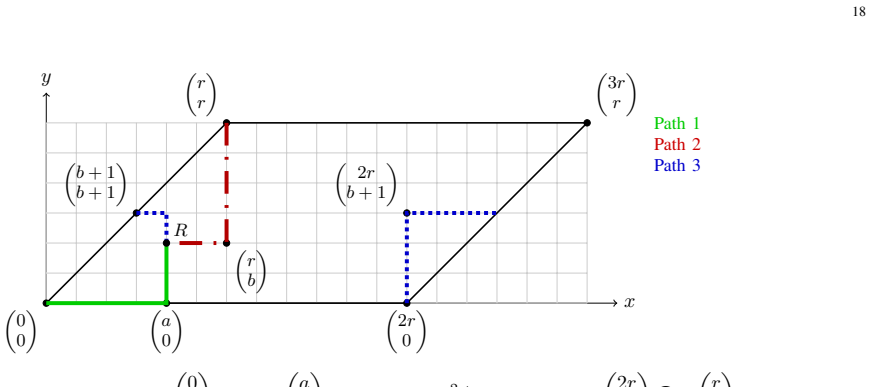
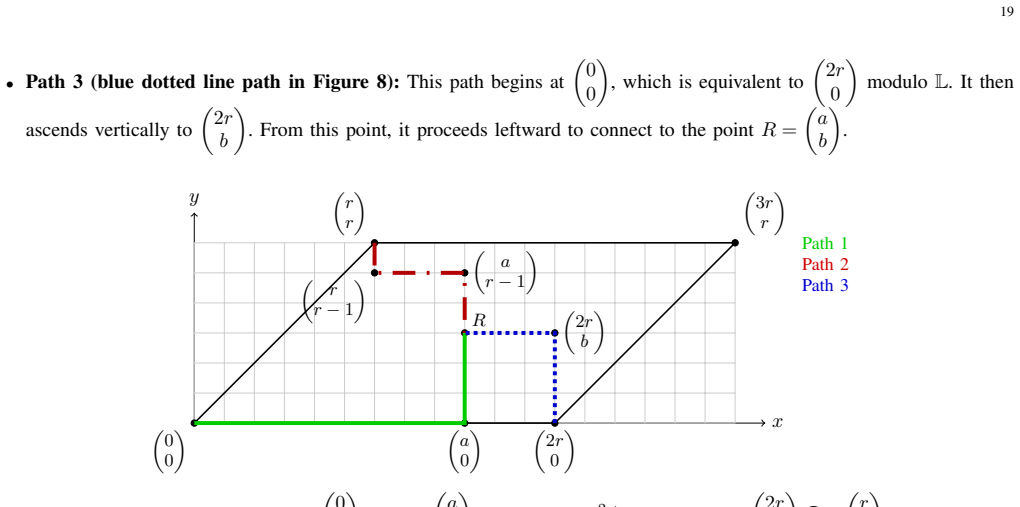
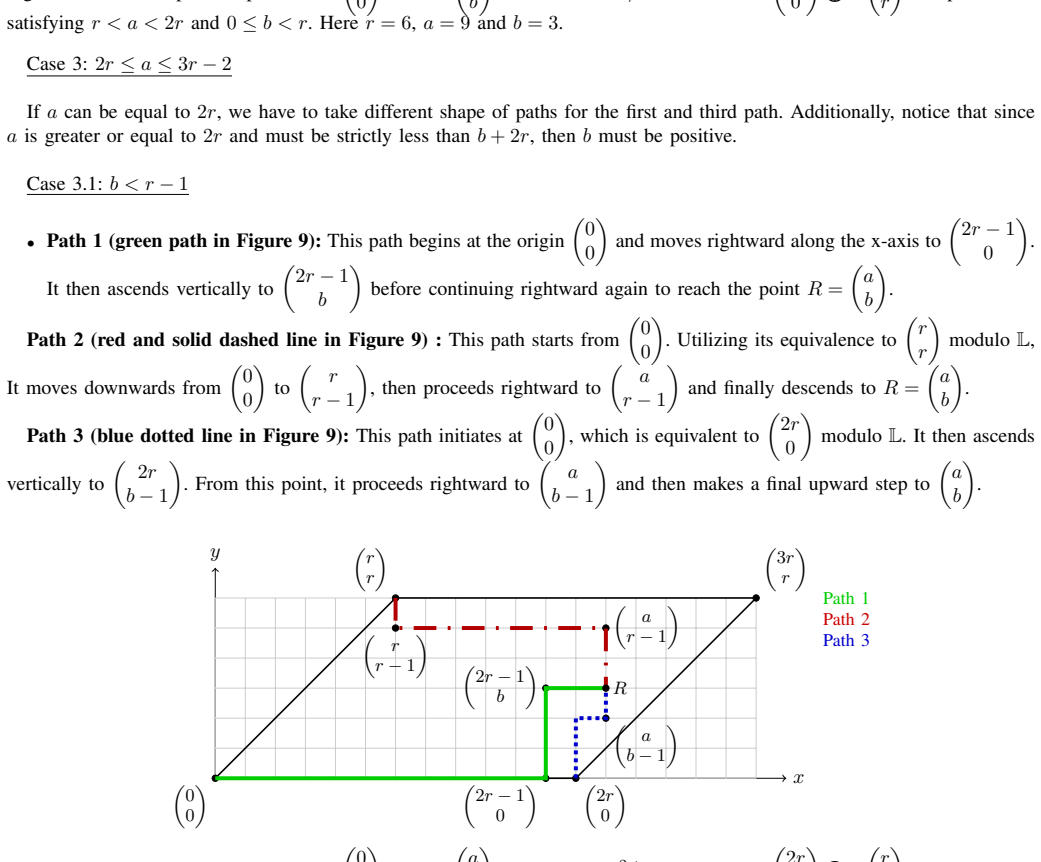
The load-bearing object is the lattice $L = \mathbb{Z}(n,0)+\mathbb{Z}(\alpha,-1)$ associated to $\mathrm{GB}(1+X,1+X^{\alpha},n)$, together with $\lambda(L)$, the minimal Manhattan norm over non-zero lattice vectors. Theorem II.7 states $d \geq \lambda(L)$; the proof lifts simple cycles of the quotient Cayley graph to $\mathbb{Z}^2$-walks and shows that each nontrivial cycle gives a non-zero lattice endpoint. This turns code design into a lattice-geometry problem: choose $(n,\alpha)$ so that every short $\mathbb{Z}^2$-path fails to close modulo $(n,\alpha)$. A second piece of machinery is the CSS graph-preserving (CGP) equivalence relation, a permutation-only equivalence that preserves both the CSS form and the underlying Cayley graph, used with a classical 2-isomorphism-to-isomorphism theorem to prove structural distinctness.
What would settle it
Take a concrete pair $(n,\alpha)$, for example $n=8,\alpha=3$, exhaustively compute the minimum distance of $\mathrm{GB}(1+X,1+X^{\alpha},n)$, and compare it to $\lambda(\mathbb{Z}(n,0)+\mathbb{Z}(\alpha,-1))$; any instance with $d < \lambda$ would falsify Theorem II.7. A more targeted test is to enumerate simple cycles of $(\mathbb{Z}/n\mathbb{Z},1,\alpha)$ with zero net displacement and check whether any is not a sum of faces, which would directly falsify Corollary III.3.
Extended reading notes
Core claim
The central discovery is that the minimum distance of a (2,2)-GB code can be read off from a lattice: for the code $\mathrm{GB}(1+X,1+X^{\alpha},n)$, with $n\geq 6$ and $1\leq \alpha\leq n-1$, the distance is at least $\lambda(L)$, the smallest Manhattan length of a non-zero vector in $L = \mathbb{Z}(n,0) + \mathbb{Z}(\alpha,-1)$. The proof maps every cycle in the Cayley graph $(\mathbb{Z}/n\mathbb{Z},1,\alpha)$ to a walk in $\mathbb{Z}^2$ whose endpoint lies in $L$ and whose Manhattan norm is no larger than the cycle length; a cycle that is not a sum of faces must have non-zero endpoint. With this bound in hand, the authors select lattices with large Manhattan minimum to obtain explicit optimal codes. In particular $\mathrm{GB}(1+X,1+X^{2r-1},2r^2)$ has parameters $[[4r^2,2,2r]]$, contradicting the earlier claim that optimal even-distance GB codes could not exist, and the families are distinguished from known surface codes by a graph-based CSS-preserving equivalence relation.
Load-bearing premise
The argument assumes that a simple loop in the cyclic graph with equal counts of forward and backward steps of each type unwraps to a simple loop in the integer grid; the paper states this without proof, and the lower bound depends on it.
Editorial extensions
If this is right
- The family $\mathrm{GB}(1+X,1+X^{2r-1},2r^2)$ realizes optimal even-distance parameters $[[4r^2,2,2r]]$ for every $r$, so even distances are no longer a gap for (2,2)-GB codes.
- The family $\mathrm{GB}(1+X,1+X^n,n^2)$ matches the toric code parameters $[[2n^2,2,n]]$ while being inequivalent to the standard toric code under the paper's CGP-equivalence.
- The odd-distance family $\mathrm{GB}(1+X,1+X^{2t+1},t^2+(t+1)^2)$ is CGP-equivalent to the best-known odd-distance 2D surface code, giving an alternative construction of the same code.
- The lattice criterion $d \geq \lambda(L)$ gives a concrete design rule: any pair $(n,\alpha)$ whose lattice $\mathbb{Z}(n,0)+\mathbb{Z}(\alpha,-1)$ has large Manhattan minimum yields a high-distance (2,2)-GB code.
- The classification tables list all extremal non-equivalent (2,2)-GB codes of length below 200, with representatives and counts, providing a benchmark for future decoder and implementation studies.
Reading between the lines
- If Theorem II.7 extends to parameters outside the stated range, the search for optimal (2,2)-GB codes becomes a purely number-theoretic optimization over $(n,\alpha)$; checking this computationally for all lengths below 200 would be a direct test.
- The same cycle-lifting argument may generalize to (a,b)-GB codes with $a,b>2$ by passing to higher-dimensional lattices, potentially producing optimal families beyond weight 4.
- The CGP-equivalence framework suggests that the relevant invariant for comparing Cayley-graph CSS codes is the isomorphism class of the underlying abelian group; if true, classification of equivalence classes reduces to a group-theory problem.
- The even-distance result may prompt re-examination of other 'impossible' parameter claims for GB codes, since the mechanism that broke the even-distance barrier is a lattice choice rather than a change of code family.
Editorial analysis
A structured set of objections, weighed in public.
Referee Report
Summary. This paper studies (2,2)-Generalized Bicycle (GB) codes, CSS codes built from pairs of binary circulant matrices with two nonzero entries per row and viewed as Cayley graphs (Z/nZ,a,b). The main theoretical result is Theorem II.7, a lower bound d_min ≥ λ(L) on the minimum distance of GB(1+X,1+X^α,n), where L is the lattice Z(n,0)+Z(α,-1) and λ(L) is the shortest Manhattan norm of a nonzero lattice vector. Using this bound, the authors construct three infinite families with optimal parameters [[2n^2,2,n]], [[4r^2,2,2r]], and [[(2t+1)^2+1,2,2t+1]]; the even-distance family is claimed to be the first optimal even-distance (2,2)-GB construction. They then introduce a CSS-preserving 'CGP-equivalence' relation for comparing Cayley-graph-based CSS codes, prove non-CGP-equivalence of the first two families to the standard Kitaev and rotated even-distance surface codes, prove equivalence of the third family to the optimal odd-distance surface code, and provide a computational classification of extremal (2,2)-GB codes with length below 200.
Significance. If the proof gaps identified below are closed, the paper is a solid and useful contribution. The lattice lower bound is elegant and parameter-free, the three distance computations are explicit and checkable, and the non-equivalence arguments via Whitney's theorem are substantial. The construction of optimal even-distance (2,2)-GB codes addresses a real gap in the literature relative to [13]. The paper also ships a classification repository [17], which supports reproducibility of the tables. The constructions involve no fitted constants and the lower-bound lattice vectors are computed directly, so I see no circularity.
major comments (2)
- [III.C-4 / Corollary III.3] The proof of Corollary III.3 asserts without argument that if C is a simple cycle of (Z/nZ,1,α) with n_1(C)=n_{-1}(C) and n_α(C)=n_{-α}(C), then the associated Z^2-walk γ_C starting at the origin is also a simple cycle. This is the load-bearing step of the proof of Theorem II.7: without simplicity, Lemma III.2 cannot be applied, and the endpoint P_r could be zero without forcing C to be a sum of faces, so the lower bound d≥λ(L) would not follow. The assertion is very likely correct (if P_i=P_j, then C_i=C_0+Φ(P_i)=C_j, contradicting simplicity of C), but the argument is absent. Please add this proof explicitly.
- [III.D / Lemma III.2] The induction proving Lemma III.2 is only a sketch. The step 'within Int(Γ), at least one of these two scenarios is true' does not formally establish the existence of a square S whose removal leaves a simple Z^2-cycle γ through the origin surrounding exactly q squares; the cases of S sharing one or two edges with Γ, and the handling of squares incident with the origin, need a rigorous case analysis. Because Lemma III.2 is used in Corollary III.3 and hence in Theorem II.7, this gap should be closed (e.g., by a standard cell-decomposition argument) before the lower-bound result is considered proved.
minor comments (6)
- [III.C] The step-type list contains a typo: 'k+α → α' should be 'k+α → k' (or 'k → k−α').
- [IV.B / Lemma IV.3] The displayed inequality '2r|rx+y| − |y| |+|y|' has a typo and should read '2r|rx+y|-|y|+|y|'.
- [Abstract and Section VI] The claim that the first two families are inequivalent to 'all previously known optimal weight-4 2D surface codes' is broader than what is proved; the proofs cover the periodic-lattice surface codes of [4] and the Kitaev toric code. Please qualify the claim to the class actually treated.
- [III, proof of Theorem II.7] The reduction to 1≤α≤n/2 via Proposition II.6 is stated but not demonstrated; a short derivation using the invariance under X→X^{-1} and column shifts should be included.
- [IV.A and IV.C] The small cases n=2 and t=1 in Lemmas IV.2 and IV.4 are verified 'by computer simulations'; please specify the exact method (e.g., exhaustive enumeration of codewords or the specific SageMath/Magma function) so the reader can reproduce those checks.
- [Throughout] There are numerous formatting artifacts in the equations (e.g., 'X n2', '[[4r2,2,2r|', and missing superscripts in the introduction); a careful proofreading pass is needed.
Circularity Check
No significant circularity: the minimum-distance bound and the three optimal families are derived parameter-free with explicit upper-bound codewords; the only questionable step (Corollary III.3) is an unproved lemma, not a circular reduction.
full rationale
The paper's central derivation is self-contained. Theorem II.7 lower-bounds the minimum distance by lambda(L), the shortest Manhattan norm in the explicitly defined lattice L = Z(n,0) + Z(alpha,-1); no fitted constant or externally imported distance value is used. The three families in Proposition IV.1 are each verified from both sides: the lower bound is obtained by computing lambda(L) directly, and the upper bound is an explicit low-weight codeword, such as the weight-n vector (0, sum_k X^{nk}) in Lemma IV.2, the weight-2r vector in Lemma IV.3, and the weight-(2t+1) pair (U,V) in Lemma IV.4. Thus the equalities d=n, d=2r, and d=2t+1 do not reduce to their own inputs; they are exact matches between a proven bound and an exhibited codeword. The claim that even-distance optimal GB codes were previously considered impossible is attributed to Pryadko and Wang [13] and contradicted by an explicit construction, so it is not a self-citation chain. The authors cite their own GitHub repository [17], but only as a supplement to the classification tables, not as evidence for any theorem. The one genuinely delicate step is Corollary III.3, which asserts without proof that a balanced simple quotient cycle lifts to a simple grid cycle; this is a proof gap that could invalidate Theorem II.7 if false, but it is not a circular step: the asserted implication is not equivalent to the theorem's conclusion, and the paper does not define the conclusion in terms of the premise. For the same reason, the skeptical observation about the missing lattice-lift proof is a correctness risk to be resolved by an explicit argument, not evidence that the derivation is circular.
Assumptions & free parameters
assumptions (3)
- standard math Whitney's theorem: a 2-isomorphism between 3-connected graphs implies graph isomorphism (Theorem VI.3).
- domain assumption The quotient map from Z^2 lattice walks to the (Z/nZ,1,alpha) Cayley graph is a covering map; simple cycles lift to simple lattice cycles (Corollary III.3).
- domain assumption CSS code minimum distance equals the shortest non-trivial cycle not in the face span for these Cayley graph codes (Section III.A).
Cite this review
Pith. "Pith review of (2,2)-GB Codes: Classification and Comparison with weight-4 Surface Codes." pith.science (2026). https://pith.science/paper/3COJBQP5
@misc{pith2026250721237,
  author       = {Pith},
  title        = {Pith review of: (2,2)-GB Codes: Classification and Comparison with weight-4 Surface Codes},
  year         = {2026},
  howpublished = {\url{https://pith.science/paper/3COJBQP5}},
  note         = {Machine review of arXiv:2507.21237}
}
read the original abstract
Generalized Bicycle (GB) codes offer a compelling alternative to surface codes for quantum error correction. This paper focuses on (2,2)-Generalized Bicycle codes, constructed from pairs of binary circulant matrices with two non-zero elements per row. Leveraging a lower bound on their minimum distance, we construct three novel infinite families of optimal (2,2)-GB codes with parameters [[ 2n^2, 2, n ]], [[ 4r^2, 2, 2r ]], and [[(2t + 1)^2 + 1, 2, 2t + 1 ]]. These families match the performance of Kitaev's toric code and the best 2D weight-4 surface codes, reaching known theoretical limits. In particular, the second family breaks a long-held belief by providing optimal even-distance GB codes, previously deemed impossible. All are CSS codes derived from Cayley graphs. Recognizing that standard equivalence relations do not preserve their CSS structure, we introduce a CSS-preserving equivalence relation for rigorous comparison of Cayley graph-based CSS codes. Under this framework, the first two families are inequivalent to all previously known optimal weight-4 2D surface codes, while the third family is equivalent to the best-known odd-distance 2D surface code. Finally, we classify all extremal, non-equivalent (2,2)-GB codes with length below 200 and present a comparison table with existing notable 2D weight-4 surface codes.
Figures


Figures from the paper (7 more)




Reference graph
Works this paper leans on
-
[13]
Distance bounds for generalized bicycle codes,
R. Wang and L. P. Pryadko, “Distance bounds for generalized bicycle codes,” arXiv:2203.17216, 2022
arXiv 2022
-
[17]
Classification of (2,2)-Generalized Bicycle (GB) Codes,
F. Arnault, P. Gaborit, N. Saussay, “Classification of (2,2)-Generalized Bicycle (GB) Codes,” GitHub repository, 2025. Accessed on: Jul. 13, 2025. [Online]. Available: https://github.com/NicolasSaussay/weight-4_GB-Codes_Classification
work page 2025
-
[1]
Polynomial-time algorithms for prime factorization and discrete logarithms on a quantum computer,
P. W. Shor, “Polynomial-time algorithms for prime factorization and discrete logarithms on a quantum computer,”SIAM Review, vol. 41, no. 2, pp. 303–332, 1999
1999
-
[2]
M. A. Nielsen and I. L. Chuang,Quantum Computation and Quantum Information: 10th Anniversary Edition. Cambridge University Press, 2010
2010
-
[3]
Fault-tolerant quantum computation by anyons,
A. Kitaev, “Fault-tolerant quantum computation by anyons,”Annals of Physics, vol. 303, no. 1, pp. 2–30, Jan. 2003
work page 2003
-
[4]
Homological error correction: Classical and quantum codes,
H. Bombin and M. A. Martin-Delgado, “Homological error correction: Classical and quantum codes,”Journal of Mathematical Physics, vol. 48, no. 5, p. 052105, May 2007
work page 2007
-
[5]
A. Leverrier and G. Zémor, “Quantum tanner codes,” arXiv:2202.13641, 2022
arXiv 2022
-
[6]
Asymptotically good quantum and locally testable classical LDPC codes,
P. Panteleev and G. Kalachev, “Asymptotically good quantum and locally testable classical LDPC codes,” arXiv:2111.03654, 2022
arXiv 2022
Show all 17 references
-
[7]
High-threshold and low-overhead fault-tolerant quantum memory,
S. Bravyi, A. W. Cross, J. M. Gambetta, D. Maslov, P. Rall, and T. J. Yoder, “High-threshold and low-overhead fault-tolerant quantum memory,” arXiv:2308.07915, 2024
2024 arXiv
-
[8]
Fiber bundle codes: Breaking then 1/2polylog(n)barrier for quantum LDPC codes,
M. B. Hastings, J. Haah, and R. O’Donnell, “Fiber bundle codes: Breaking then 1/2polylog(n)barrier for quantum LDPC codes,” inProc. 53rd Annu. ACM SIGACT Symp. Theory Comput. (STOC), 2021, pp. 1276–1288
2021
-
[9]
Good quantum error-correcting codes exist,
A. R. Calderbank and P. W. Shor, “Good quantum error-correcting codes exist,”Physical Review A, vol. 54, no. 2, pp. 1098–1105, Aug. 1996
1996
-
[10]
Error correcting codes in quantum theory,
A. M. Steane, “Error correcting codes in quantum theory,”Phys. Rev. Lett., vol. 77, no. 5, pp. 793–797, Jul. 1996
1996
-
[11]
Quantum Kronecker sum-product low-density parity-check codes with finite rate,
A. A. Kovalev and L. P. Pryadko, “Quantum Kronecker sum-product low-density parity-check codes with finite rate,”Phys. Rev. A, vol. 88, no. 1, p. 012311, Jul. 2013
2013
-
[12]
Sparse-graph codes for quantum error correction,
D. MacKay, G. Mitchison, and P. McFadden, “Sparse-graph codes for quantum error correction,”IEEE Trans. Inf. Theory, vol. 50, no. 10, pp. 2315–2330, 2004
2004
-
[14]
Analysis of the error-correcting radius of a renormalisation decoder for Kitaev’s toric code,
W. Rozendaal and G. Zémor, “Analysis of the error-correcting radius of a renormalisation decoder for Kitaev’s toric code,”arXiv, arXiv:2309.12165, Sep. 2023
2023 arXiv
-
[15]
Collection of codes constructed for ‘Distance bounds for generalized bicycle codes’,
R. Wang and L. P. Pryadko, “Collection of codes constructed for ‘Distance bounds for generalized bicycle codes’,” GitHub repository, 2022. Accessed on: Mar. 30, 2022. [Online]. Available: https://github.com/QEC-pages/GB-codes
2022
-
[16]
Congruent graphs and the connectivity of graphs,
H. Whitney, “Congruent graphs and the connectivity of graphs,”American Journal of Mathematics, vol. 54, no. 1, pp. 150–168, 1932
1932
Reviewed August 6, 2026 · model on record in the stance chip above.
Discussion (0). Continue with ORCID to comment.