REVIEW 2 major objections 5 minor 41 references
APT: Improving Diffusion Models for High Resolution Image Generation with Adaptive Path Tracing
T0 review · 2 major / 5 minor · reviewed 2026-08-06 · deepseek-v4-flash
Pith's one-line read A training-free add-on that corrects two upsampling-induced latent distortions lets patch-based diffusion models generate sharper high-resolution images while sampling about 40% faster.
desk verdict Solid empirical patch for high-res diffusion, but the paper's explanation of its own adaptive scheduling is contradicted by its Table B. read the letter →
The pith
A machine-rendered reading of the paper's core claim, the machinery that carries it, and where it could break.
The reading
What carries the argument
The carrier is the progressive "upsample-diffuse-denoise" loop introduced by patch-based methods, in which a low-resolution latent is upsampled (e.g., ×2 then ×1.5 then ×1.3) and denoised through overlapping local patches and dilated patches the size of the pretrained latent. On this loop APT installs two operations. Statistical Matching normalizes each dilated patch $\tilde{d}_0^k = \frac{\sigma_{z_0}}{\sigma_{d_0^k}}(d_0^k - \mu_{d_0^k}) + \mu_{z_0}$, forcing the moments of the upsampled latent to match the reference latent $z_0$. Scale-aware Scheduling exponentiates the $\beta$ schedule, $\beta_t = [(\beta_0)^{\eta_s} + \frac{t}{T}((\beta_T)^{\eta_s} - (\beta_0)^{\eta_s})]^{1/\eta_s}$, with an exponent $\eta_s$ that depends on the current upscaling factor, making the noise grow faster in later timesteps so the fixed-size local patches receive a noise level consistent with their higher pixel redundancy. The two operations together, the paper argues, bring the upsampled latent back onto the manifold the network was trained on and allow the denoising path to be shortened.
What would settle it
Run the same pipeline at an intermediate scale the paper did not tune (e.g., 1.8×) and measure per-patch signal-to-noise ratio: if the SNR of local patches still varies as widely as it does with the unmodified schedule, or if the best $\eta$ for that scale falls outside the curve defined by the paper's three values, the single-scalar scheduling premise fails. A second check is to disable Statistical Matching under nearest-neighbor upsampling, where first and second moments already match the reference; if the detail metrics remain high, moment matching is not the operative mechanism.
Extended reading notes
Core claim
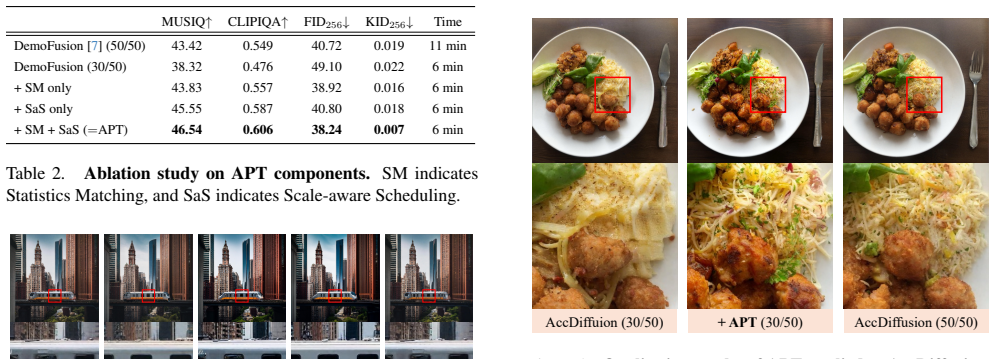
The central discovery is that two local, cheap corrections to the upsampled latent are sufficient to restore the conditions the pre-trained network expects. Statistical Matching maps each dilated patch's pixel distribution onto the reference latent's mean and variance, removing the interpolation-induced drift that would otherwise accumulate over progressive stages. Scale-aware Scheduling replaces the fixed schedule with a $\beta$ schedule exponentiated by a per-scale parameter $\eta_s$, so that noise rises faster in the more redundant patches and the effective signal-to-noise ratio matches the pre-trained regime. The paper shows that these two operations, applied inside the existing "upsample-diffuse-denoise" loop of DemoFusion, generate 2048×2048 and 4096×4096 images with better detail scores (MUSIQ, CLIPIQA, $\mathrm{FID}_c$, $\mathrm{KID}_c$) than the baselines while running in about 60% of the time.
Load-bearing premise
The method assumes that a single value of $\eta_s$ per upscaling step can restore the correct noise level for every fixed-size patch at that step, and that the values chosen on one validation set will keep being optimal for other scales, resolutions, and backbone models.
Editorial extensions
If this is right
- High-resolution (2K–4K) generation becomes a plug-in inference-time fix: the same SDXL weights, with APT around them, produce sharper images at roughly 40% lower sampling cost than DemoFusion or AccDiffusion at full steps.
- Shortcut sampling at 30/50 steps stops being a lossy trade-off: with the corrected schedule, the model behaves as if it had seen the right SNR curve, so detail scores stay at or above the 50-step baseline.
- The results generalize across at least two patch-based frameworks (DemoFusion and AccDiffusion), indicating the two corrections address the shared failure of the pipeline rather than a quirk of one implementation.
- The analysis suggests that any future patch-based upsampler should either preserve the mean and variance of the reference latent or apply statistical matching; otherwise the same two degradations will reappear.
Reading between the lines
- The paper's own ablations show that Statistical Matching helps even under nearest-neighbor upsampling, where the mean and variance of dilated patches already equal the reference's; this hints the real mechanism may be a regularizing effect on higher-order statistics or on the fusion step, which a moment-only explanation does not cover.
- Table B's optimum η moves from 2.5 at ×2.0 to 3.5 at ×1.3, i.e., the exponent increases as the per-step upscaling factor decreases; if that inverse trend is stable, the 'adaptive' component could be reduced to a simple function of the upscaling factor, removing the grid search.
- A testable extension is whether η values transfer across base models: if the same three values hold for a different latent diffusion model, the schedule is a property of latent redundancy; if not, the method must be re-tuned per model.
- The shortcut-sampling result suggests the bottleneck for high-resolution generation is not the number of steps but the SNR mismatch; extending the same reasoning to cascade pipelines could enable much deeper progressive upsampling than the three stages tested here.
Editorial analysis
A structured set of objections, weighed in public.
Referee Report
Summary. The paper proposes Adaptive Path Tracing (APT), a training-free framework to improve patch-based latent diffusion models for high-resolution image generation. APT combines two components: Statistical Matching, which normalizes the mean and variance of dilated patches of the upsampled latent to match the original low-resolution latent, and Scale-aware Scheduling, which adjusts the noise schedule exponent η_s based on the upscaling factor. The paper also introduces a shortcut denoising procedure that reduces the number of sampling steps from 50 to 30. The method is evaluated on a newly constructed 1,000-image test set from OpenImages at 2048×2048 and 4096×4096 resolutions, using DemoFusion and AccDiffusion as baselines, and reports improved MUSIQ, CLIPIQA, FID_c, and KID_c scores with roughly 40% faster inference. The central empirical claim is that APT improves fine detail quality and enables faster sampling with minimal degradation.
Significance. If the central claim holds, APT is a useful practical contribution to training-free high-resolution generation, with the advantage of not requiring model fine-tuning and of being applicable to multiple patch-based backbones. The paper provides a genuinely held-out test set, a separate validation set for hyperparameter tuning, pseudocode in Algorithm 1, and detailed ablations, which are strengths. The main weakness is that the description and validation of Scale-aware Scheduling are internally inconsistent: the stated trend between η and scaling factor is contradicted by the authors' own Table B and by the supplementary text. Because η_s is the only scale-adaptive mechanism, this inconsistency undermines the 'adaptive' claim and currently reduces the method to per-scale grid search. The empirical quality improvements in Tables 1 and 2 still stand, but the paper's scientific narrative about why the schedule works needs substantial revision.
major comments (2)
- [Section 4.4, Eq. (5); Section 5.4.2; Table B; Supplementary C.2] The paper states in Section 4.4 that 'as s grows, pixel redundancy increases, necessitating faster noise growth to maintain a balanced SNR, which in turn requires a corresponding increase in η_s.' However, the validation sweep in Table B shows the opposite ordering: the optimal η is 2 for scale 2.0, 3 for scale 1.5, and 3.5 for scale 1.3. Thus, as the scale factor decreases, the optimal η increases. Supplementary C.2 even states the reverse of the main text: 'as the upsampling scale decreases, a slower SNR decay becomes more effective,' which matches Table B but directly contradicts Section 4.4. This is not a minor wording issue because η_s is the sole parameter implementing Scale-aware Scheduling in Eq. (5); the explanation of the mechanism is therefore internally inconsistent and must be reconciled.
- [Section 5.4.2; Table B; Section 4.4] Even after reconciling the trend, the paper does not demonstrate that Scale-aware Scheduling is genuinely adaptive. The η_s values are chosen by grid search on a validation set for each discrete scale (2.0, 1.5, 1.3), and there is no rule, formula, or fitted relation that would allow setting η for an unseen scale. The paper only shows that a per-scale tuned exponent improves results on the tested scales; it does not show a predictive relationship between η and the scaling factor. Since the central claim includes 'adaptive' scheduling, the authors should either provide a validated predictive model for η(s) or revise the claim to acknowledge that the schedule is per-scale tuned rather than adaptive in a generalizable sense.
minor comments (5)
- [Table 1] The method name 'HiDiffuion' is a typo and should be 'HiDiffusion'.
- [Table 2] The label 'Statistics Matching' should be 'Statistical Matching' to match the terminology used throughout the paper.
- [Figure 9 and Figure A (supplementary)] The axis labels in Figure 9 and in Figure A of the supplementary are partially garbled or truncated; please ensure all axis labels and legends are legible.
- [Algorithm 1, lines 16-17] The formula for the number of local patches L uses h, w, and r, but the relationship between h_r, w_r and the overlap ratio r is not defined; please clarify the notation.
- [Supplementary B.3, Algorithm 1] The pseudocode refers to 'Samplingglobal' and 'Samplinglocal' without defining these operations; please add brief definitions or a reference to the original DemoFusion formulation.
Circularity Check
Test-set quality results are held out and independent, but the paper's scale-awareness claim reduces to the validation grid search that chose η, and the stated trend is contradicted by Table B.
-
fitted input called prediction
[Section 4.4; Section 5.4.2; Supplementary Table B and C.2]
"As s grows, pixel redundancy increases, necessitating faster noise growth to maintain a balanced SNR, which in turn requires a corresponding increase in ηs. ... Our results confirm this hypothesis, showing that as the scaling factor increases, the optimal η value also rises, achieving the best performance for each resolution."
The confirmation of the η-versus-scale hypothesis uses the same validation grid search that selected η at each scale: Table B is the selector and the evidence. Each optimal η is chosen as the best-performing value for its resolution, and the ordered sequence of the chosen values is then presented as verification of the mechanism. No held-out scale or independent redundancy measurement is used, so the 'scale-aware' trend is a post-hoc description of fitted hyperparameters, not a prediction.
full rationale
The central empirical claims — APT improves detail and enables 30-step shortcut sampling — are tested against baselines on a held-out 1K OpenImages test set (Table 1) and in component ablations (Table 2), so they are not circular: the comparison does not reduce to the construction of the method. Statistical Matching is an explicit normalization (Eq. 3) whose benefit is demonstrated by intervention, and the shortcut-speed gain is a direct consequence of using 30 rather than 50 steps, with the quality retention measured independently. There is no load-bearing self-citation: DemoFusion, AccDiffusion, and Simple Diffusion are external prior works, not the authors' own. The one genuinely circular element is the scale-awareness claim in Section 5.4.2: 'optimal η increases with scaling factor' is read off the same validation grid search that chose each η, and the trend stated in Section 4.4 conflicts with the per-step scale labels in Table B and Supplementary C.2. Because that trend is the only support for the adaptive scheduling mechanism, the 'adaptive' part is currently a per-scale tuned lookup table rather than a validated rule. This affects the mechanism claim but not the held-out quality comparison, so the overall circularity is moderate.
Assumptions & free parameters
free parameters (2)
- eta_s (Scale-aware Scheduling exponent) =
2.5 for step scale 2.0, 3.0 for 1.5, 3.5 for 1.3 (Table B); text says 2, 3, 3.5
- Shortcut timestep T0 =
30 of 50 total DDIM steps
assumptions (5)
- standard math Diffusion forward process is Gaussian with schedule q(z_t|z_{t-1}) = N(sqrt(1-beta_t) z_{t-1}, beta_t I)
- domain assumption Latent mean and variance in LDMs are the dominant factors controlling decoded color and frequency content
- domain assumption Pixel redundancy within a fixed-size patch increases as the receptive field shrinks with increasing image resolution
- ad hoc to paper Distribution shift from bicubic upsampling is sufficiently captured by mean and variance of dilated patches
- ad hoc to paper A single scalar eta_s can restore the intended SNR for all content types at a given scale
Cite this review
Pith. "Pith review of APT: Improving Diffusion Models for High Resolution Image Generation with Adaptive Path Tracing." pith.science (2026). https://pith.science/paper/OM6W6MX3
@misc{pith2026250721690,
  author       = {Pith},
  title        = {Pith review of: APT: Improving Diffusion Models for High Resolution Image Generation with Adaptive Path Tracing},
  year         = {2026},
  howpublished = {\url{https://pith.science/paper/OM6W6MX3}},
  note         = {Machine review of arXiv:2507.21690}
}
read the original abstract
Latent Diffusion Models (LDMs) are generally trained at fixed resolutions, limiting their capability when scaling up to high-resolution images. While training-based approaches address this limitation by training on high-resolution datasets, they require large amounts of data and considerable computational resources, making them less practical. Consequently, training-free methods, particularly patch-based approaches, have become a popular alternative. These methods divide an image into patches and fuse the denoising paths of each patch, showing strong performance on high-resolution generation. However, we observe two critical issues for patch-based approaches, which we call ``patch-level distribution shift" and ``increased patch monotonicity." To address these issues, we propose Adaptive Path Tracing (APT), a framework that combines Statistical Matching to ensure patch distributions remain consistent in upsampled latents and Scale-aware Scheduling to deal with the patch monotonicity. As a result, APT produces clearer and more refined details in high-resolution images. In addition, APT enables a shortcut denoising process, resulting in faster sampling with minimal quality degradation. Our experimental results confirm that APT produces more detailed outputs with improved inference speed, providing a practical approach to high-resolution image generation.
Figures


Figures from the paper (5 more)




Reference graph
Works this paper leans on
-
[1]
Multidiffusion: Fusing diffusion paths for controlled image generation
Omer Bar-Tal, Lior Yariv, Yaron Lipman, and Tali Dekel. Multidiffusion: Fusing diffusion paths for controlled image generation. arXiv preprint arXiv:2302.08113, 2023. 2, 3
arXiv 2023
-
[2]
Mikołaj Bi ´nkowski, Danica J Sutherland, Michael Arbel, and Arthur Gretton. Demystifying mmd gans. arXiv preprint arXiv:1801.01401, 2018. 6, 1
arXiv 2018
-
[3]
In- structpix2pix: Learning to follow image editing instructions
Tim Brooks, Aleksander Holynski, and Alexei A Efros. In- structpix2pix: Learning to follow image editing instructions. In Proceedings of the IEEE/CVF Conference on Computer Vision and Pattern Recognition, pages 18392–18402, 2023. 2
2023
-
[4]
Any-resolution training for high- resolution image synthesis
Lucy Chai, Michael Gharbi, Eli Shechtman, Phillip Isola, and Richard Zhang. Any-resolution training for high- resolution image synthesis. In European Conference on Computer Vision, pages 170–188. Springer, 2022. 6, 1
work page 2022
-
[5]
Pixart- \sigma: Weak-to-strong training of diffusion transformer for 4k text-to-image generation
Junsong Chen, Chongjian Ge, Enze Xie, Yue Wu, Lewei Yao, Xiaozhe Ren, Zhongdao Wang, Ping Luo, Huchuan Lu, and Zhenguo Li. Pixart- \sigma: Weak-to-strong training of diffusion transformer for 4k text-to-image generation. arXiv preprint arXiv:2403.04692, 2024. 2
arXiv 2024
-
[6]
Scalable high-resolution pixel-space image syn- thesis with hourglass diffusion transformers
Katherine Crowson, Stefan Andreas Baumann, Alex Birch, Tanishq Mathew Abraham, Daniel Z Kaplan, and Enrico Shippole. Scalable high-resolution pixel-space image syn- thesis with hourglass diffusion transformers. InInternational Conference on Machine Learning, 2024. 2
work page 2024
-
[7]
Demofusion: Democratising high- resolution image generation with no $$$
Ruoyi Du, Dongliang Chang, Timothy Hospedales, Yi-Zhe Song, and Zhanyu Ma. Demofusion: Democratising high- resolution image generation with no $$$. In Proceedings of the IEEE/CVF Conference on Computer Vision and Pattern Recognition, pages 6159–6168, 2024. 2, 3, 4, 5, 8, 1
work page 2024
-
[8]
Jiatao Gu, Shuangfei Zhai, Yizhe Zhang, Joshua M Susskind, and Navdeep Jaitly. Matryoshka diffusion models. In Inter- national Conference on Learning Representations, 2023. 2
work page 2023
Show all 41 references
-
[9]
Make a cheap scaling: A self-cascade diffusion model for higher-resolution adapta- tion
Lanqing Guo, Yingqing He, Haoxin Chen, Menghan Xia, Xiaodong Cun, Yufei Wang, Siyu Huang, Yong Zhang, Xin- tao Wang, Qifeng Chen, et al. Make a cheap scaling: A self-cascade diffusion model for higher-resolution adapta- tion. In European Conference on Computer Vision , pages 3...
2025
-
[10]
Scalecrafter: Tuning-free higher- resolution visual generation with diffusion models
Yingqing He, Shaoshu Yang, Haoxin Chen, Xiaodong Cun, Menghan Xia, Yong Zhang, Xintao Wang, Ran He, Qifeng Chen, and Ying Shan. Scalecrafter: Tuning-free higher- resolution visual generation with diffusion models. In In- ternational Conference on Learning Representations , 202...
2023
-
[11]
Prompt-to-prompt im- age editing with cross attention control
Amir Hertz, Ron Mokady, Jay Tenenbaum, Kfir Aberman, Yael Pritch, and Daniel Cohen-Or. Prompt-to-prompt im- age editing with cross attention control. arXiv preprint arXiv:2208.01626, 2022. 2
2022 arXiv
-
[12]
Gans trained by a two time-scale update rule converge to a local nash equilib- rium
Martin Heusel, Hubert Ramsauer, Thomas Unterthiner, Bernhard Nessler, and Sepp Hochreiter. Gans trained by a two time-scale update rule converge to a local nash equilib- rium. Advances in Neural Information Processing Systems , 30, 2017. 6, 1
2017
-
[13]
Denoising diffu- sion probabilistic models
Jonathan Ho, Ajay Jain, and Pieter Abbeel. Denoising diffu- sion probabilistic models. Advances in Neural Information Processing Systems, 33:6840–6851, 2020. 4
2020
-
[14]
Cascaded diffu- sion models for high fidelity image generation
Jonathan Ho, Chitwan Saharia, William Chan, David J Fleet, Mohammad Norouzi, and Tim Salimans. Cascaded diffu- sion models for high fidelity image generation. Journal of Machine Learning Research, 23(47):1–33, 2022. 2
2022
-
[15]
sim- ple diffusion: End-to-end diffusion for high resolution im- ages
Emiel Hoogeboom, Jonathan Heek, and Tim Salimans. sim- ple diffusion: End-to-end diffusion for high resolution im- ages. In International Conference on Machine Learning , pages 13213–13232. PMLR, 2023. 2, 4
2023
-
[16]
One more step: A versatile plug-and-play module for rectifying diffusion schedule flaws and enhancing low-frequency controls
Minghui Hu, Jianbin Zheng, Chuanxia Zheng, Chaoyue Wang, Dacheng Tao, and Tat-Jen Cham. One more step: A versatile plug-and-play module for rectifying diffusion schedule flaws and enhancing low-frequency controls. In Proceedings of the IEEE/CVF Conference on Computer Vi- sion ...
2024
-
[17]
Fouriscale: A frequency perspective on training-free high-resolution image synthesis
Linjiang Huang, Rongyao Fang, Aiping Zhang, Guanglu Song, Si Liu, Yu Liu, and Hongsheng Li. Fouriscale: A frequency perspective on training-free high-resolution image synthesis. arXiv preprint arXiv:2403.12963, 2024. 2, 3, 5
2024 arXiv
-
[18]
Training- free diffusion model adaptation for variable-sized text-to- image synthesis
Zhiyu Jin, Xuli Shen, Bin Li, and Xiangyang Xue. Training- free diffusion model adaptation for variable-sized text-to- image synthesis. Advances in Neural Information Processing Systems, 36, 2024. 2
2024
-
[19]
Elucidating the design space of diffusion-based generative models
Tero Karras, Miika Aittala, Timo Aila, and Samuli Laine. Elucidating the design space of diffusion-based generative models. Advances in Neural Information Processing Sys- tems, 35:26565–26577, 2022. 4
2022
-
[20]
Musiq: Multi-scale image quality transformer
Junjie Ke, Qifei Wang, Yilin Wang, Peyman Milanfar, and Feng Yang. Musiq: Multi-scale image quality transformer. In Proceedings of the IEEE/CVF International Conference on Computer Vision, pages 5148–5157, 2021. 6
2021
-
[21]
Arbitrary-scale image gen- eration and upsampling using latent diffusion model and im- plicit neural decoder
Jinseok Kim and Tae-Kyun Kim. Arbitrary-scale image gen- eration and upsampling using latent diffusion model and im- plicit neural decoder. In Proceedings of the IEEE/CVF Con- ference on Computer Vision and Pattern Recognition, pages 9202–9211, 2024. 2
2024
-
[22]
Pick-a-pic: An open dataset of user preferences for text-to-image generation
Yuval Kirstain, Adam Polyak, Uriel Singer, Shahbuland Ma- tiana, Joe Penna, and Omer Levy. Pick-a-pic: An open dataset of user preferences for text-to-image generation. Advances in Neural Information Processing Systems , 36: 36652–36663, 2023. 6
2023
-
[23]
The open images dataset v4: Unified image classification, object detection, and visual relationship detection at scale
Alina Kuznetsova, Hassan Rom, Neil Alldrin, Jasper Ui- jlings, Ivan Krasin, Jordi Pont-Tuset, Shahab Kamali, Stefan Popov, Matteo Malloci, Alexander Kolesnikov, et al. The open images dataset v4: Unified image classification, object detection, and visual relationship detection...
1956
-
[24]
Syncdiffusion: Coherent montage via synchronized joint diffusions
Yuseung Lee, Kunho Kim, Hyunjin Kim, and Minhyuk Sung. Syncdiffusion: Coherent montage via synchronized joint diffusions. Advances in Neural Information Processing Systems, 36:50648–50660, 2023. 2, 3
2023
-
[25]
Blip-2: Bootstrapping language-image pre-training with frozen image encoders and large language models
Junnan Li, Dongxu Li, Silvio Savarese, and Steven Hoi. Blip-2: Bootstrapping language-image pre-training with frozen image encoders and large language models. In In- 8 ternational Conference on Machine Learning, pages 19730– 19742. PMLR, 2023. 6, 1
2023
-
[26]
Microsoft coco: Common objects in context
Tsung-Yi Lin, Michael Maire, Serge Belongie, James Hays, Pietro Perona, Deva Ramanan, Piotr Doll´ar, and C Lawrence Zitnick. Microsoft coco: Common objects in context. In European Conference on Computer Vision, pages 740–755. Springer, 2014. 5
2014
-
[27]
Accdiffusion: An accurate method for higher-resolution im- age generation
Zhihang Lin, Mingbao Lin, Meng Zhao, and Rongrong Ji. Accdiffusion: An accurate method for higher-resolution im- age generation. In European Conference on Computer Vi- sion, pages 38–53. Springer, 2025. 2, 5
2025
-
[28]
Sdedit: Guided image synthesis and editing with stochastic differential equa- tions
Chenlin Meng, Yutong He, Yang Song, Jiaming Song, Jia- jun Wu, Jun-Yan Zhu, and Stefano Ermon. Sdedit: Guided image synthesis and editing with stochastic differential equa- tions. arXiv preprint arXiv:2108.01073, 2021. 2
2021 arXiv
-
[29]
Sdxl: Improving latent diffusion models for high-resolution image synthesis
Dustin Podell, Zion English, Kyle Lacey, Andreas Blattmann, Tim Dockhorn, Jonas M ¨uller, Joe Penna, and Robin Rombach. Sdxl: Improving latent diffusion models for high-resolution image synthesis. In International Con- ference on Learning Representations, 2023. 2, 5, 6, 1
2023
-
[30]
High-resolution image synthesis with latent diffusion models
Robin Rombach, Andreas Blattmann, Dominik Lorenz, Patrick Esser, and Bj ¨orn Ommer. High-resolution image synthesis with latent diffusion models. In Proceedings of the IEEE/CVF Conference on Computer Vision and Pattern Recognition, pages 10684–10695, 2022. 2
2022
-
[31]
Laion-5b: An open large-scale dataset for training next generation image-text models
Christoph Schuhmann, Romain Beaumont, Richard Vencu, Cade Gordon, Ross Wightman, Mehdi Cherti, Theo Coombes, Aarush Katta, Clayton Mullis, Mitchell Worts- man, et al. Laion-5b: An open large-scale dataset for training next generation image-text models. Advances in Neural In- f...
2022
-
[32]
Resmaster: Mastering high- resolution image generation via structural and fine-grained guidance
Shuwei Shi, Wenbo Li, Yuechen Zhang, Jingwen He, Biao Gong, and Yinqiang Zheng. Resmaster: Mastering high- resolution image generation via structural and fine-grained guidance. arXiv preprint arXiv:2406.16476, 2024. 2
2024 arXiv
-
[33]
Denois- ing diffusion implicit models
Jiaming Song, Chenlin Meng, and Stefano Ermon. Denois- ing diffusion implicit models. In International Conference on Learning Representations, 2021. 1
2021
-
[34]
Score-based generative modeling through stochastic differential equa- tions
Yang Song, Jascha Sohl-Dickstein, Diederik P Kingma, Ab- hishek Kumar, Stefano Ermon, and Ben Poole. Score-based generative modeling through stochastic differential equa- tions. arXiv preprint arXiv:2011.13456, 2020. 4
2011 arXiv
-
[35]
Is one gpu enough? pushing image generation at higher-resolutions with founda- tion models
Athanasios Tragakis, Marco Aversa, Chaitanya Kaul, Roder- ick Murray-Smith, and Daniele Faccio. Is one gpu enough? pushing image generation at higher-resolutions with founda- tion models. arXiv preprint arXiv:2406.07251, 2024. 2
2024 arXiv
-
[36]
Ex- ploring clip for assessing the look and feel of images
Jianyi Wang, Kelvin CK Chan, and Chen Change Loy. Ex- ploring clip for assessing the look and feel of images. InPro- ceedings of the AAAI conference on artificial intelligence , pages 2555–2563, 2023. 6
2023
-
[37]
Resshift: Efficient diffusion model for image super- resolution by residual shifting
Zongsheng Yue, Jianyi Wang, and Chen Change Loy. Resshift: Efficient diffusion model for image super- resolution by residual shifting. Advances in Neural Infor- mation Processing Systems, 36:13294–13307, 2023. 6
2023
-
[38]
Designing a practical degradation model for deep blind image super-resolution
Kai Zhang, Jingyun Liang, Luc Van Gool, and Radu Timo- fte. Designing a practical degradation model for deep blind image super-resolution. In Proceedings of the IEEE/CVF International Conference on Computer Vision, pages 4791– 4800, 2021. 2
2021
-
[39]
Adding conditional control to text-to-image diffusion models
Lvmin Zhang, Anyi Rao, and Maneesh Agrawala. Adding conditional control to text-to-image diffusion models. In Proceedings of the IEEE/CVF International Conference on Computer Vision, pages 3836–3847, 2023. 2
2023
-
[40]
Hidiffusion: Unlocking high-resolution creativity and effi- ciency in low-resolution trained diffusion models
Shen Zhang, Zhaowei Chen, Zhenyu Zhao, Zhenyuan Chen, Yao Tang, Yuhao Chen, Wengang Cao, and Jiajun Liang. Hidiffusion: Unlocking high-resolution creativity and effi- ciency in low-resolution trained diffusion models. arXiv preprint arXiv:2311.17528, 2023. 3, 5
2023 arXiv
-
[41]
Uni-controlnet: All-in-one control to text-to-image diffusion models
Shihao Zhao, Dongdong Chen, Yen-Chun Chen, Jianmin Bao, Shaozhe Hao, Lu Yuan, and Kwan-Yee K Wong. Uni-controlnet: All-in-one control to text-to-image diffusion models. Advances in Neural Information Processing Sys- tems, 36, 2024. 2 9
2024
Reviewed August 6, 2026 · model on record in the stance chip above.
Discussion (0). Sign in to comment.