REVIEW 5 major objections 5 minor 48 references
MultiEditor: Controllable Multimodal Object Editing for Driving Scenarios Using 3D Gaussian Splatting Priors
T0 review · 5 major / 5 minor · reviewed 2026-08-06 · deepseek-v4-flash
Pith's one-line read A dual-branch diffusion framework with 3D Gaussian Splatting priors jointly edits images and LiDAR point clouds in driving scenes, and the generated rare-vehicle data improves downstream detection on underrepresented classes.
desk verdict A plausible 3DGS-prior framework for joint image/LiDAR editing, but the main evaluation is reconstruction-with-the-answer, so the headline numbers overstate editing performance. read the letter →
The pith
A machine-rendered reading of the paper's core claim, the machinery that carries it, and where it could break.
The reading
What carries the argument
The load-bearing object is the depth-guided deformable cross-modality condition module (Eqs. 13-18). It first converts a range-image cell (φ, θ) with range r into 3D Cartesian coordinates, projects that point into the image plane using the camera intrinsics and LiDAR-to-camera extrinsics, and then uses deformable cross-attention to sample local features around the projected pixel from the other modality's latent. A zero-initialized tanh gate lets the module start as identity and gradually learn how strongly to inject cross-modal features. This module is what turns the coarse geometric correspondence from 3DGS-rendered depth into adaptive mutual guidance, and the ablation without it (w/o cross-modality, DAS 3.20 vs 3.16; FPD 98.80 vs 97.49) shows it is the component the consistency claim rests on.
What would settle it
Take a scene and a target object for which a 3DGS model exists, then corrupt the 3DGS-rendered depth map by adding realistic noise (e.g., 0.5 m error) while leaving the rendered appearance identical; if the Chamfer Distance and Depth Alignment Score stay near the uncorrupted values, the geometric-prior claim is not load-bearing. Alternatively, attempt to insert a vehicle category with no prebuilt 3DGS template; if cross-modality consistency collapses to the naive-baseline level, the claim that 3DGS priors are what enable joint editing is falsified.
Extended reading notes
Core claim
On the paper's own terms, the central discovery is that joint editing of images and point clouds is feasible and beneficial when the target object is represented by a 3D Gaussian Splatting model that supplies both appearance and geometric depth. The dual-branch denoising formulation (Eqs. 3-5) makes each modality's noise prediction conditional on features extracted from the other modality's latent, anchored by 3DGS-rendered depth through the depth-guided deformable cross-modality condition module. The paper reports that this design yields a Chamfer Distance of 1.65 for point cloud editing versus 33.23 for the range-only baseline, and a Depth Alignment Score of 3.16 versus 11.34 for the naive combination of separate editors, and that augmenting van-class training data with generated samples improves YOLOv5 mAP and PointPillars AP on that rare class.
Load-bearing premise
The method assumes a good 3D Gaussian Splatting model of each object to be inserted already exists, and that it renders accurate images and depth from the viewpoints needed; if that model is absent, coarse, or inaccurate, the pixel pastes and depth-guided cross-modal alignment lose their anchor and editing fidelity degrades.
Editorial extensions
If this is right
- If MultiEditor is correct, autonomous-driving datasets can be rebalanced by inserting rare vehicle categories into both images and point clouds in a geometrically consistent way, without manual annotation of the synthetic samples.
- Training 2D and 3D detectors on real plus generated data should improve accuracy on underrepresented classes; the paper reports +4.5% AP@0.5 for YOLOv5 and +5.34% AP Easy for PointPillars on the van class.
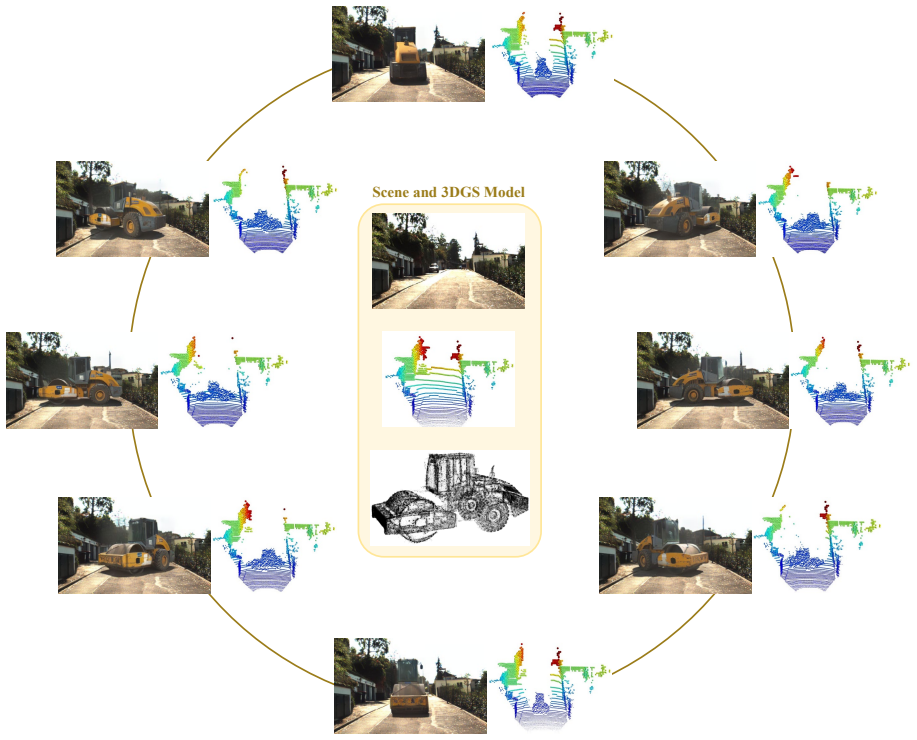
- The same joint-editing pipeline could serve as a controllable test-bed for perception models, varying object pose, distance, and orientation at 45-degree intervals as shown for atypical vehicles.
- Because both branches are trained jointly with a shared 3DGS prior, the framework is a step toward a unified generative model over camera and LiDAR rather than independent per-modality generators.
Reading between the lines
- A direct consequence the paper does not explore: the method's benefit should be largest exactly where 3DGS templates are hardest to build—extreme long-tail classes with few real views—so the practical ceiling is set by template availability, not by the diffusion model.
- One could test a natural extension by replacing the 3DGS depth prior with a learned monocular depth estimate; if cross-modality consistency degrades sharply, that would confirm the specific role of geometric priors versus learned correspondence.
- The DAS metric relies on a pretrained depth estimator; our reading is that gains on DAS might partly reflect the estimator's sensitivity to synthetic textures, so a direct LiDAR-image alignment metric (e.g., projected-point overlap) would be a sturdier check of the consistency claim.
Editorial analysis
A structured set of objections, weighed in public.
Referee Report
Summary. MultiEditor is a dual-branch latent diffusion framework for jointly editing image and LiDAR range-view data in driving scenes, using a 3D Gaussian Splatting (3DGS) model of the target object to render both RGB and depth priors. The image branch combines pasted 3DGS renders, CLIP embeddings, and a reconstruction/refinement dual-branch objective, while the range branch uses a custom VAE-based latent diffusion model with pasted 3DGS depth. A depth-guided deformable cross-modality attention module exchanges intermediate features between the two branches. Experiments on KITTI report image FID/LPIPS/CLIP-I, point-cloud CD/FPD, and DAS, claiming superiority over SD, PbE, AnyDoor, RangeLDM, and AnyDoor+RangeLDM, together with ablations and a downstream detection experiment on rare van-class vehicles. The paper is clearly written and the module design is coherent, but the quantitative evaluation protocol substantially undermines the paper's central claims.
Significance. If the evaluation were unbiased, the paper would make a useful contribution: it proposes a novel architectural use of 3DGS priors for joint image-and-LiDAR object editing, with a plausible mechanism for cross-modality feature exchange. The training pipeline is detailed, and the downstream detection experiment addresses a practically important long-tail problem. The main limitation is that the quantitative results in Table 1 are generated on a reconstruction benchmark in which the model receives the very object it is asked to reproduce, rather than on a genuine editing benchmark with novel objects. This confound affects the headline claims of visual and geometric superiority, and the atypical-vehicle and downstream claims are currently supported only by qualitative examples and an uncontrolled augmentation experiment. The method itself is not inherently unsound, so the issues are addressable with additional experiments, but they are load-bearing for the paper's conclusions.
major comments (5)
- [Experiments—Dataset Construction; Eqs. (7) and (12)] The quantitative evaluation is a reconstruction benchmark, not an editing benchmark. The supplement states that editing scenarios are simulated by 'deliberately occluding the same target object' and training the model to reconstruct it. In Eq. (7), the pixel-level condition hp_c is built by pasting the target object's image into the ROI, and in Eq. (12) hp_r is built from the 3DGS-rendered depth of the same object. The model is therefore conditioned on the appearance and geometry of the very object it is asked to generate. Low CD and FPD in Table 1 largely measure how faithfully the output copies the injected condition, rather than measuring editing ability for novel objects or novel placements. This circularity is load-bearing for the claim of 'superior performance' in geometric fidelity and suggests the numbers in Table 1 should not be read as evidence of editing superiority.
- [Table 1 and Baselines] The comparison in Table 1 does not give the baselines the same object-specific 3DGS prior. AnyDoor receives a reference image but not the 3DGS depth paste, and RangeLDM is evaluated without the 3DGS structural condition. Since the 3DGS render is a major part of the proposed method's advantage, the comparison conflates the effect of the object prior with the effect of the editing framework. A fair comparison would either provide all methods with an equivalent 3DGS-rendered condition or evaluate on a protocol where the target object is not the same as the pasted condition, e.g., inserting a 3DRealCar asset into a held-out KITTI scene. Without such a comparison, the claimed superiority over prior editing methods is not established.
- [Editing of Atypical Vehicles; Figures 5 and 8] The claim that MultiEditor is 'the first framework capable of flexibly editing atypical vehicles' is supported only by qualitative visuals. No quantitative metrics are reported for the 3DRealCar insertion experiments, so it is impossible to assess fidelity, geometric accuracy, or cross-modality consistency for novel object types. The paper should report metrics comparable to Table 1 on a held-out set of atypical-vehicle insertions, including different viewpoints and distances, and ideally include a baseline that receives the same 3DGS prior.
- [Downstream Task Benefits; Table 3] The downstream detection experiment does not control for the increase in positive training samples. The Real+Gen condition adds 1,192 far-side van samples to the training set; any augmentation method that adds labeled van instances would likely improve AP on a rare class. The paper should compare against adding the same number of real van instances, or against simpler augmentation such as copy-paste of real van points and images, and should report recall and per-class AP in addition to AP@0.7 and mAP. Without these controls, the 'substantially enhances detection accuracy' claim cannot be attributed to MultiEditor's joint consistency rather than to sample count.
- [Evaluation Metrics—DAS] The cross-modality DAS metric is partially circular. The 3DGS-rendered depth of the target object is injected into both the image and the range-image branches as a condition, and DAS then compares the generated point cloud against depth estimated from the generated image. Both outputs therefore share the same 3DGS depth prior, so a low DAS may reflect consistency with the injected prior rather than consistency with independently verified geometry. The paper should also report a cross-modality metric that does not rely on the 3DGS depth used during generation, for example by projecting the generated point cloud onto a held-out LiDAR scan or by using an independent depth sensor.
minor comments (5)
- [Eq. (3)] The text introducing the two denoising models says 'we introduce two denoising models, ϵθr and ϵθr', but the second should clearly be ϵθc; please fix this typo.
- [Eq. (10)] The references for the VGG-19 network and the ImageNet pretraining are missing; the text shows '(?)' in both places.
- [Eq. (14)] The normalization factor d in the projection equation is not defined; please specify that it is the depth of the transformed point and how it is computed from the range value.
- [Table 2] The 'feature addition condition' ablation row is not described in the method section; please either define it in the main text or move the definition to the supplement with a clear reference.
- [Related Work] The paper compares against combined AnyDoor+RangeLDM but does not compare with multi-modal editing or synthesis baselines such as X-Drive, MObI, or GenMM; a brief explanation of why these are not included in Table 1 would help the reader calibrate the claims.
Circularity Check
Quantitative 'editing' results reduce to reconstructing an object that is itself supplied as the pixel/depth condition; central claim is partially circular.
-
self definitional
[Experiments — Dataset and Data Construction; Eq. (7); Eq. (12)]
"Specifically, we simulate editing scenarios by deliberately occluding the same target object in image and point cloud modalities. The model is trained to reconstruct the occluded regions conditioned on the target object accurately. ... During inference, the 3DGS-rendered image of the target object is pasted into the ROI."
The benchmark defines 'editing' as reconstruction of an object that is also supplied as the condition. Eq. (7) feeds VAE(c_p) with c_p a paste of the target object, and Eq. (12) feeds VAE(r_p) with the same object's 3DGS-rendered depth. Table 1 then scores LPIPS, CLIP-I, CD, and FPD against the original object. A model that copies the pasted condition into the masked region already attains near-perfect object-fidelity scores, so the reported 'superior visual and geometric fidelity' is substantially forced by the self-conditioning construction rather than by a demonstrated ability to edit unseen objects. The baselines are not given the same-object paste/depth condition, so the comparison does not isolate editing skill.
full rationale
The central architecture is self-contained: the dual-branch diffusion equations (3)-(6) are not circular, and there is no load-bearing self-citation or imported uniqueness theorem. The circularity is concentrated in the quantitative evaluation of the headline claim. Table 1 is produced on a reconstruction benchmark: the paper explicitly trains by 'occluding the same target object' and reconstructing it 'conditioned on the target object.' Because Eq. (7) and Eq. (12) build the pixel/depth conditions from the very object whose LPIPS, CLIP-I, CD, and FPD are measured, the 'predicted' edited object is, in the object region, largely the conditioning input itself; a copy/paste baseline would score near-perfectly on object fidelity. The baselines do not receive this same-object 3DGS paste, so the comparison is not a fair measure of editing. This makes the central 'superior visual and geometric fidelity' claim partially circular by construction. The atypical-vehicle results are qualitative only, and the DAS metric is an output-to-output consistency score; these are benchmark limitations rather than additional formal circularity. Overall score 6: the method has independent algorithmic content, but its main quantitative support reduces to reconstructing the conditioning object.
Assumptions & free parameters
free parameters (4)
- lambda_refine-C =
0.01
- Training augmentation probabilities =
20% per augmentation
- Image center crop size =
600x375
- Range image size =
128x64
assumptions (6)
- standard math DDPM forward/reverse diffusion and VAE latent space are valid generative models for images and range images
- domain assumption Camera-to-LiDAR projection via the pinhole model and known extrinsics is accurate
- domain assumption 3DGS renders photorealistic RGB images and accurate depth for target objects
- domain assumption Segmentation masks from Grounding DINO + SAM and object-shadow masks from Wang et al. 2022 are reliable
- domain assumption DepthAnythingV2 depth estimates, after rescaling with LiDAR, are suitable as the reference for the DAS metric
- ad hoc to paper The manually screened dataset of 4,021 training pairs is representative and free of selection bias
Cite this review
Pith. "Pith review of MultiEditor: Controllable Multimodal Object Editing for Driving Scenarios Using 3D Gaussian Splatting Priors." pith.science (2026). https://pith.science/paper/JQ2WVA6L
@misc{pith2026250721872,
  author       = {Pith},
  title        = {Pith review of: MultiEditor: Controllable Multimodal Object Editing for Driving Scenarios Using 3D Gaussian Splatting Priors},
  year         = {2026},
  howpublished = {\url{https://pith.science/paper/JQ2WVA6L}},
  note         = {Machine review of arXiv:2507.21872}
}
read the original abstract
Autonomous driving systems rely heavily on multimodal perception data to understand complex environments. However, the long-tailed distribution of real-world data hinders generalization, especially for rare but safety-critical vehicle categories. To address this challenge, we propose MultiEditor, a dual-branch latent diffusion framework designed to edit images and LiDAR point clouds in driving scenarios jointly. At the core of our approach is introducing 3D Gaussian Splatting (3DGS) as a structural and appearance prior for target objects. Leveraging this prior, we design a multi-level appearance control mechanism--comprising pixel-level pasting, semantic-level guidance, and multi-branch refinement--to achieve high-fidelity reconstruction across modalities. We further propose a depth-guided deformable cross-modality condition module that adaptively enables mutual guidance between modalities using 3DGS-rendered depth, significantly enhancing cross-modality consistency. Extensive experiments demonstrate that MultiEditor achieves superior performance in visual and geometric fidelity, editing controllability, and cross-modality consistency. Furthermore, generating rare-category vehicle data with MultiEditor substantially enhances the detection accuracy of perception models on underrepresented classes.
Figures


Figures from the paper (5 more)




Reference graph
Works this paper leans on
-
[1]
, " * write output.state after.block = add.period write newline
ENTRY address archivePrefix author booktitle chapter edition editor eid eprint howpublished institution isbn journal key month note number organization pages publisher school series title type volume year label extra.label sort.label short.list INTEGERS output.state before.all mid.sentence after.sentence after.block FUNCTION init.state.consts #0 'before.a...
-
[2]
write newline
" write newline "" before.all 'output.state := FUNCTION n.dashify 't := "" t empty not t #1 #1 substring "-" = t #1 #2 substring "--" = not "--" * t #2 global.max substring 't := t #1 #1 substring "-" = "-" * t #2 global.max substring 't := while if t #1 #1 substring * t #2 global.max substring 't := if while FUNCTION word.in bbl.in capitalize " " * FUNCT...
-
[3]
Buburuzan, A.; Sharma, A.; Redford, J.; Dokania, P. K.; and Mueller, R. 2025. Mobi: Multimodal object inpainting using diffusion models. In Proceedings of the Computer Vision and Pattern Recognition Conference, 1974--1984
work page 2025
-
[4]
Chae, Y.; Kim, H.; and Yoon, K.-J. 2024. Towards robust 3d object detection with lidar and 4d radar fusion in various weather conditions. In Proceedings of the IEEE/CVF Conference on Computer Vision and Pattern Recognition, 15162--15172
work page 2024
-
[5]
Chen, X.; Huang, L.; Liu, Y.; Shen, Y.; Zhao, D.; and Zhao, H. 2024. Anydoor: Zero-shot object-level image customization. In Proceedings of the IEEE/CVF conference on computer vision and pattern recognition, 6593--6602
2024
-
[6]
Dosovitskiy, A.; Beyer, L.; Kolesnikov, A.; Weissenborn, D.; Zhai, X.; Unterthiner, T.; Dehghani, M.; Minderer, M.; Heigold, G.; Gelly, S.; et al. 2020. An image is worth 16x16 words: Transformers for image recognition at scale. arXiv preprint arXiv:2010.11929
arXiv 2020
-
[7]
Du, X.; Wang, Y.; Sun, H.; Wu, Z.; Sheng, H.; Wang, S.; Ying, J.; Lu, M.; Zhu, T.; Zhan, K.; et al. 2024. 3drealcar: An in-the-wild rgb-d car dataset with 360-degree views. arXiv preprint arXiv:2406.04875
arXiv 2024
-
[8]
Gao, R.; Chen, K.; Xie, E.; Hong, L.; Li, Z.; Yeung, D.-Y.; and Xu, Q. 2023. Magicdrive: Street view generation with diverse 3d geometry control. arXiv preprint arXiv:2310.02601
arXiv 2023
Show all 48 references
-
[9]
Geiger, A.; Lenz, P.; Stiller, C.; and Urtasun, R. 2013. Vision meets robotics: The kitti dataset. The international journal of robotics research, 32(11): 1231--1237
2013
-
[10]
Gou, J.; Sun, S.; Zhang, J.; Si, J.; Qian, C.; and Zhang, L. 2023. Taming the power of diffusion models for high-quality virtual try-on with appearance flow. In Proceedings of the 31st ACM International Conference on Multimedia, 7599--7607
2023
-
[11]
L.; and Choi, Y
Hessel, J.; Holtzman, A.; Forbes, M.; Bras, R. L.; and Choi, Y. 2021. Clipscore: A reference-free evaluation metric for image captioning. arXiv preprint arXiv:2104.08718
2021 arXiv
-
[12]
Heusel, M.; Ramsauer, H.; Unterthiner, T.; Nessler, B.; and Hochreiter, S. 2017. Gans trained by a two time-scale update rule converge to a local nash equilibrium. Advances in neural information processing systems, 30
2017
-
[13]
Hu, Q.; Zhang, Z.; and Hu, W. 2024. Rangeldm: Fast realistic lidar point cloud generation. In European Conference on Computer Vision, 115--135. Springer
2024
-
[14]
W.; et al
Huang, B.; Wen, Y.; Zhao, Y.; Hu, Y.; Liu, Y.; Jia, F.; Mao, W.; Wang, T.; Zhang, C.; Chen, C. W.; et al. 2025. Subjectdrive: Scaling generative data in autonomous driving via subject control. In Proceedings of the AAAI Conference on Artificial Intelligence, volume 39, 3617--3625
2025
-
[15]
Isola, P.; Zhu, J.-Y.; Zhou, T.; and Efros, A. A. 2017. Image-to-image translation with conditional adversarial networks. In Proceedings of the IEEE conference on computer vision and pattern recognition, 1125--1134
2017
-
[16]
Johnson, J.; Alahi, A.; and Fei-Fei, L. 2016. Perceptual losses for real-time style transfer and super-resolution. In European conference on computer vision, 694--711. Springer
2016
-
[17]
Kerbl, B.; Kopanas, G.; Leimk \"u hler, T.; and Drettakis, G. 2023. 3D Gaussian splatting for real-time radiance field rendering. ACM Trans. Graph., 42(4): 139--1
2023
-
[18]
P.; Welling, M.; et al
Kingma, D. P.; Welling, M.; et al. 2013. Auto-encoding variational bayes
2013
-
[19]
C.; Lo, W.-Y.; et al
Kirillov, A.; Mintun, E.; Ravi, N.; Mao, H.; Rolland, C.; Gustafson, L.; Xiao, T.; Whitehead, S.; Berg, A. C.; Lo, W.-Y.; et al. 2023. Segment anything. In Proceedings of the IEEE/CVF international conference on computer vision, 4015--4026
2023
-
[20]
H.; Vora, S.; Caesar, H.; Zhou, L.; Yang, J.; and Beijbom, O
Lang, A. H.; Vora, S.; Caesar, H.; Zhou, L.; Yang, J.; and Beijbom, O. 2019. Pointpillars: Fast encoders for object detection from point clouds. In Proceedings of the IEEE/CVF conference on computer vision and pattern recognition, 12697--12705
2019
-
[21]
Li, B.; Guo, J.; Liu, H.; Zou, Y.; Ding, Y.; Chen, X.; Zhu, H.; Tan, F.; Zhang, C.; Wang, T.; et al. 2025 a . Uniscene: Unified occupancy-centric driving scene generation. In Proceedings of the Computer Vision and Pattern Recognition Conference, 11971--11981
2025
-
[22]
Li, H.; Yang, Z.; Qian, Z.; Zhao, G.; Huang, Y.; Yu, J.; Zhou, H.; and Liu, L. 2025 b . Dualdiff: Dual-branch diffusion model for autonomous driving with semantic fusion. arXiv preprint arXiv:2505.01857
2025 arXiv
-
[23]
Liang, Y.; Yan, Z.; Chen, L.; Zhou, J.; Yan, L.; Zhong, S.; and Zou, X. 2025. DriveEditor: A Unified 3D Information-Guided Framework for Controllable Object Editing in Driving Scenes. In Proceedings of the AAAI Conference on Artificial Intelligence, volume 39, 5164--5172
2025
-
[24]
Liu, S.; Zeng, Z.; Ren, T.; Li, F.; Zhang, H.; Yang, J.; Jiang, Q.; Li, C.; Yang, J.; Su, H.; et al. 2024. Grounding dino: Marrying dino with grounded pre-training for open-set object detection. In European conference on computer vision, 38--55. Springer
2024
-
[25]
Ljungbergh, W.; Taveira, B.; Zheng, W.; Tonderski, A.; Peng, C.; Kahl, F.; Petersson, C.; Felsberg, M.; Keutzer, K.; Tomizuka, M.; et al. 2025. R3D2: Realistic 3D Asset Insertion via Diffusion for Autonomous Driving Simulation. arXiv preprint arXiv:2506.07826
2025 arXiv
-
[26]
Ma, T.; Yang, X.; and Latecki, L. J. 2010. Boosting chamfer matching by learning chamfer distance normalization. In European Conference on Computer Vision, 450--463. Springer
2010
-
[27]
Nakashima, K.; and Kurazume, R. 2024. Lidar data synthesis with denoising diffusion probabilistic models. In 2024 IEEE International Conference on Robotics and Automation (ICRA), 14724--14731. IEEE
2024
-
[28]
W.; Hallacy, C.; Ramesh, A.; Goh, G.; Agarwal, S.; Sastry, G.; Askell, A.; Mishkin, P.; Clark, J.; et al
Radford, A.; Kim, J. W.; Hallacy, C.; Ramesh, A.; Goh, G.; Agarwal, S.; Sastry, G.; Askell, A.; Mishkin, P.; Clark, J.; et al. 2021. Learning transferable visual models from natural language supervision. In International conference on machine learning, 8748--8763. PmLR
2021
-
[29]
Ran, H.; Guizilini, V.; and Wang, Y. 2024. Towards realistic scene generation with lidar diffusion models. In Proceedings of the IEEE/CVF Conference on Computer Vision and Pattern Recognition, 14738--14748
2024
-
[30]
Redmon, J.; Divvala, S.; Girshick, R.; and Farhadi, A. 2016. You only look once: Unified, real-time object detection. In Proceedings of the IEEE conference on computer vision and pattern recognition, 779--788
2016
-
[31]
J.; Mohamed, S.; and Wierstra, D
Rezende, D. J.; Mohamed, S.; and Wierstra, D. 2014. Stochastic backpropagation and approximate inference in deep generative models. In International conference on machine learning, 1278--1286. PMLR
2014
-
[32]
Rombach, R.; Blattmann, A.; Lorenz, D.; Esser, P.; and Ommer, B. 2022. High-resolution image synthesis with latent diffusion models. In Proceedings of the IEEE/CVF conference on computer vision and pattern recognition, 10684--10695
2022
-
[33]
W.; Park, S
Shu, D. W.; Park, S. W.; and Kwon, J. 2019. 3d point cloud generative adversarial network based on tree structured graph convolutions. In Proceedings of the IEEE/CVF international conference on computer vision, 3859--3868
2019
-
[34]
Singh, B.; Kulharia, V.; Yang, L.; Ravichandran, A.; Tyagi, A.; and Shrivastava, A. 2024. Genmm: Geometrically and temporally consistent multimodal data generation for video and lidar. arXiv preprint arXiv:2406.10722
2024 arXiv
-
[35]
Wang, T.; Hu, X.; Heng, P.-A.; and Fu, C.-W. 2022. Instance shadow detection with a single-stage detector. IEEE transactions on pattern analysis and machine intelligence, 45(3): 3259--3273
2022
-
[36]
Wang, X.; Zhu, Z.; Huang, G.; Chen, X.; Zhu, J.; and Lu, J. 2024. Drivedreamer: Towards real-world-drive world models for autonomous driving. In European conference on computer vision, 55--72. Springer
2024
-
[37]
Wei, D.; Li, Z.; and Liu, P. 2025. Omni-scene: Omni-gaussian representation for ego-centric sparse-view scene reconstruction. In Proceedings of the Computer Vision and Pattern Recognition Conference, 22317--22327
2025
-
[38]
Wen, Y.; Zhao, Y.; Liu, Y.; Jia, F.; Wang, Y.; Luo, C.; Zhang, C.; Wang, T.; Sun, X.; and Zhang, X. 2024. Panacea: Panoramic and controllable video generation for autonomous driving. In Proceedings of the IEEE/CVF Conference on Computer Vision and Pattern Recognition, 6902--6912
2024
-
[39]
Wu, Y.; Zhang, K.; Qian, J.; Xie, J.; and Yang, J. 2024. Text2lidar: Text-guided lidar point cloud generation via equirectangular transformer. In European Conference on Computer Vision, 291--310. Springer
2024
-
[40]
E.; and Huang, G
Xia, Z.; Pan, X.; Song, S.; Li, L. E.; and Huang, G. 2022. Vision transformer with deformable attention. In Proceedings of the IEEE/CVF conference on computer vision and pattern recognition, 4794--4803
2022
-
[41]
T.; Ding, M.; Tomizuka, M.; and Zhan, W
Xie, Y.; Xu, C.; Peng, C.; Zhao, S.; Ho, N.; Pham, A. T.; Ding, M.; Tomizuka, M.; and Zhan, W. 2024. X-Drive: Cross-modality consistent multi-sensor data synthesis for driving scenarios. arXiv preprint arXiv:2411.01123
2024 arXiv
-
[42]
Yan, Y.; Xu, Z.; Lin, H.; Jin, H.; Guo, H.; Wang, Y.; Zhan, K.; Lang, X.; Bao, H.; Zhou, X.; et al. 2025. Streetcrafter: Street view synthesis with controllable video diffusion models. In Proceedings of the Computer Vision and Pattern Recognition Conference, 822--832
2025
-
[43]
Yang, B.; Gu, S.; Zhang, B.; Zhang, T.; Chen, X.; Sun, X.; Chen, D.; and Wen, F. 2023. Paint by example: Exemplar-based image editing with diffusion models. In Proceedings of the IEEE/CVF conference on computer vision and pattern recognition, 18381--18391
2023
-
[44]
Yang, L.; Kang, B.; Huang, Z.; Zhao, Z.; Xu, X.; Feng, J.; and Zhao, H. 2024. Depth anything v2. Advances in Neural Information Processing Systems, 37: 21875--21911
2024
-
[45]
Yu, Z.; Wang, H.; Yang, J.; Wang, H.; Cao, J.; Ji, Z.; and Sun, M. 2025. Sgd: Street view synthesis with gaussian splatting and diffusion prior. In 2025 IEEE/CVF Winter Conference on Applications of Computer Vision (WACV), 3812--3822. IEEE
2025
-
[46]
A.; Shechtman, E.; and Wang, O
Zhang, R.; Isola, P.; Efros, A. A.; Shechtman, E.; and Wang, O. 2018. The unreasonable effectiveness of deep features as a perceptual metric. In Proceedings of the IEEE conference on computer vision and pattern recognition, 586--595
2018
-
[47]
Zhao, G.; Wang, X.; Zhu, Z.; Chen, X.; Huang, G.; Bao, X.; and Wang, X. 2025. Drivedreamer-2: Llm-enhanced world models for diverse driving video generation. In Proceedings of the AAAI Conference on Artificial Intelligence, volume 39, 10412--10420
2025
-
[48]
Zhao, Y.; Lv, W.; Xu, S.; Wei, J.; Wang, G.; Dang, Q.; Liu, Y.; and Chen, J. 2024. DETRs Beat YOLOs on Real-time Object Detection. In Proceedings of the IEEE/CVF Conference on Computer Vision and Pattern Recognition (CVPR), 16965--16974
2024
Reviewed August 6, 2026 · model on record in the stance chip above.
Discussion (0). Sign in to comment.