Constraining neutron-proton effective mass splitting through nuclear giant dipole resonance within transport approach
Pith reviewed 2026-05-19 02:53 UTC · model grok-4.3
The pith
Incorporating giant dipole resonance data from lead-208 with known isoscalar mass values fixes the neutron-proton effective mass splitting coefficient at saturation density to 0.200 with uncertainties of +0.101 and -0.094.
A machine-rendered reading of the paper's core claim, the machinery that carries it, and where it could break.
Core claim
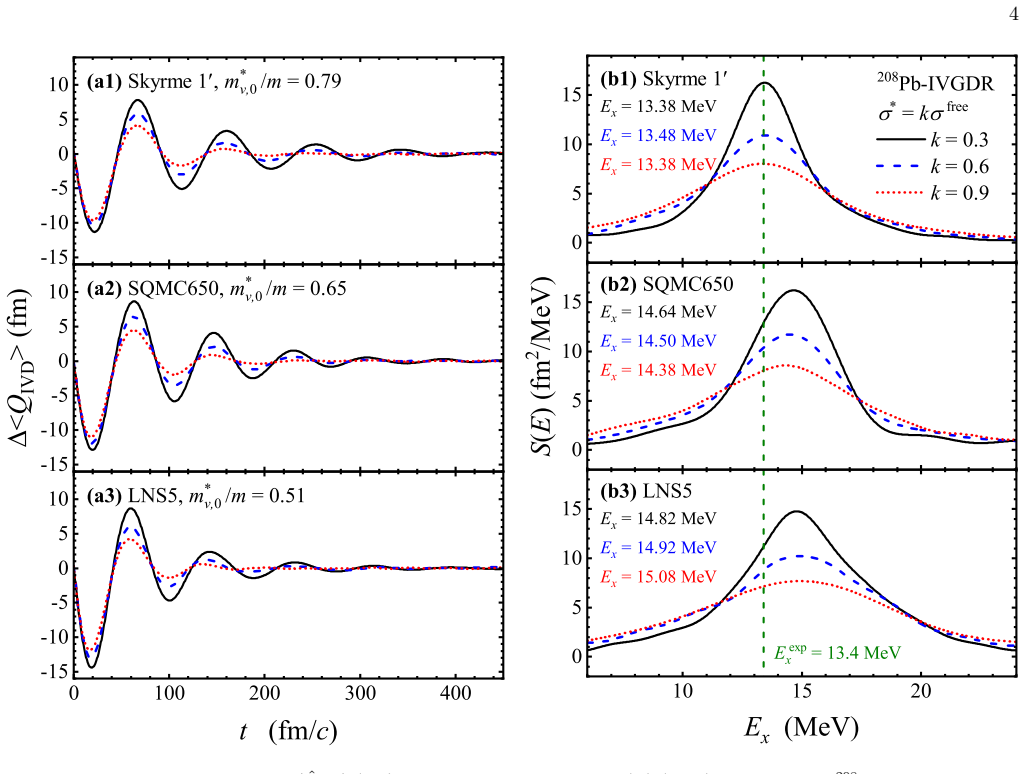
Within the Boltzmann-Uehling-Uhlenbeck framework and a representative set of Skyrme functionals, the energy-weighted sum rule m1 of the isovector giant dipole resonance depends primarily on the isovector effective mass m*_v,0 while the width Γ depends primarily on the in-medium cross section σ*. Bayesian analysis of both observables extracts m*_v,0/m = 0.731^{+0.027}_{-0.023}. When this result is combined with the independently measured isoscalar effective mass m*_s,0/m = 0.820 ± 0.030, the linear neutron-proton effective mass splitting coefficient at saturation density is obtained as Δm*_1(ρ0)/m = 0.200^{+0.101}_{-0.094}.
What carries the argument
Sensitivity of the isovector giant dipole resonance energy-weighted sum rule and width to the isovector effective mass and in-medium cross section, extracted via Bayesian analysis inside the Boltzmann-Uehling-Uhlenbeck transport model with Skyrme functionals.
If this is right
- The isovector effective mass at saturation density is constrained to 0.731 with uncertainties of roughly 0.025.
- The linear splitting coefficient between neutron and proton effective masses at normal density is fixed near 0.2.
- Skyrme parametrizations can now be filtered more tightly for use in calculations of neutron-rich nuclei and heavy-ion collisions.
- The same transport-plus-Bayesian method can be applied to other resonances to test consistency of the extracted masses.
Where Pith is reading between the lines
- The splitting value may improve equation-of-state models for neutron-star crusts where proton fractions are low.
- Repeating the analysis on other closed-shell nuclei would test whether the linear splitting assumption holds across different densities.
- If surface or pairing corrections prove important, they would shift the inferred splitting and could be quantified by comparing transport results to microscopic calculations.
Load-bearing premise
The chosen Boltzmann-Uehling-Uhlenbeck transport model and Skyrme functionals reproduce the observed isovector giant dipole resonance sum rule and width without large systematic errors from omitted higher-order correlations or surface effects.
What would settle it
An independent experimental determination of the neutron-proton effective mass splitting at saturation density that lies well outside the interval 0.106 to 0.301 would contradict the extracted central value.
Figures


read the original abstract
Based on the Boltzmann-Uehling-Uhlenbeck equation, we investigate the effects of the isovector nucleon effective mass $m^*_{v,0}$ and the in-medium nucleon-nucleon cross section $\sigma^*$ on the isovector giant dipole resonance~(IVGDR) in $^{208}{\rm Pb}$, employing a set of representative Skyrme energy density functionals. We find that the energy-weighted sum rule $m_1$ of the IVGDR is highly sensitive to $m^{*}_{v,0}$ and only mildly dependent on $\sigma^*$, while the width $\Gamma$ of the IVGDR is primarily governed by $\sigma^*$ with a moderate sensitivity to $m^*_{v,0}$. From a Bayesian analysis of both $m_1$ and $\Gamma$, we infer the isovector effective mass $m^{*}_{v,0}/m$ = $0.731^{+0.027}_{-0.023}$, where $m$ is the bare nucleon mass. Furthermore, by incorporating the isoscalar effective mass $m^*_{s,0}/m = 0.820 \pm 0.030$, extracted from the isoscalar giant quadrupole resonance in $^{208}{\rm Pb}$, the linear neutron-proton effective mass splitting coefficient at saturation density $\rho_0$ is determined to be $\Delta m^*_1 (\rho_0)/m = 0.200 ^{+0.101}_{-0.094}$.
Editorial analysis
A structured set of objections, weighed in public.
Referee Report
Summary. The paper uses the Boltzmann-Uehling-Uhlenbeck transport model with a set of Skyrme energy density functionals to study the isovector giant dipole resonance in 208Pb. It reports that the energy-weighted sum rule m1 is highly sensitive to the isovector effective mass m*_v,0 while the width Gamma is primarily sensitive to the in-medium cross section sigma*. A Bayesian analysis of experimental m1 and Gamma yields m*_v,0/m = 0.731^{+0.027}_{-0.023}. Combining this with an external isoscalar effective mass m*_s,0/m = 0.820 ± 0.030 from the isoscalar giant quadrupole resonance determines the neutron-proton effective mass splitting coefficient at saturation density as Delta m*_1 (rho0)/m = 0.200^{+0.101}_{-0.094}.
Significance. If the transport model faithfully reproduces the IVGDR observables, the work supplies a useful new constraint on the isovector effective mass splitting, which enters the nuclear symmetry energy and has implications for neutron-rich systems and neutron-star properties. The explicit separation of parameter sensitivities and the use of Bayesian inference to propagate uncertainties from both m1 and Gamma constitute a clear methodological strength. The result is falsifiable through future comparisons with additional resonance data or ab initio calculations.
major comments (2)
- [Bayesian analysis section] The Bayesian posterior on m*_v,0/m (and therefore the derived Delta m*_1) rests on the premise, stated in the method and analysis sections, that the chosen BUU implementation plus Skyrme functionals reproduce the experimental m1 and Gamma without large systematic offsets from omitted physics such as higher-order correlations or surface effects. No explicit quantification or bounding of such possible biases is provided; any constant offset in the predicted m1 would shift the entire posterior and directly enlarge the uncertainty on the reported splitting coefficient.
- [Results and discussion] The linear combination that produces Delta m*_1 (rho0)/m = (m*_v,0 - m*_s,0)/2m assumes the external m*_s,0 value is fully independent and that its uncertainty is Gaussian. The manuscript does not show the explicit error propagation or discuss possible correlations between the two effective-mass determinations, which could affect the quoted asymmetric uncertainties +0.101/-0.094.
minor comments (2)
- [Abstract] The abstract and introduction use the symbol Delta m*_1 without immediately defining its relation to m*_v,0 and m*_s,0; a brief parenthetical definition would improve readability.
- [Figure captions] Figure captions should explicitly state the Skyrme parametrizations shown and the range of sigma* values varied, to allow readers to reproduce the sensitivity plots without consulting the main text.
Simulated Author's Rebuttal
We thank the referee for the thoughtful and constructive comments, which help clarify the strengths and limitations of our analysis. We address each major comment point by point below.
read point-by-point responses
-
Referee: [Bayesian analysis section] The Bayesian posterior on m*_v,0/m (and therefore the derived Delta m*_1) rests on the premise, stated in the method and analysis sections, that the chosen BUU implementation plus Skyrme functionals reproduce the experimental m1 and Gamma without large systematic offsets from omitted physics such as higher-order correlations or surface effects. No explicit quantification or bounding of such possible biases is provided; any constant offset in the predicted m1 would shift the entire posterior and directly enlarge the uncertainty on the reported splitting coefficient.
Authors: We acknowledge the validity of this concern. Our analysis relies on the assumption that the BUU transport model with the selected Skyrme functionals captures the dominant physics of the IVGDR without large systematic shifts. While prior validations of the model against other observables support this, we agree that an explicit discussion of possible biases from omitted effects would strengthen the manuscript. In the revised version we will add a dedicated paragraph in the discussion section that explores the sensitivity of m1 to variations in surface terms and higher-order correlations, and that provides a rough estimate of how a constant offset in m1 would propagate into the posterior width. A complete, quantitative bounding of all conceivable biases lies beyond the present scope and would require a separate, resource-intensive study. revision: partial
-
Referee: [Results and discussion] The linear combination that produces Delta m*_1 (rho0)/m = (m*_v,0 - m*_s,0)/2m assumes the external m*_s,0 value is fully independent and that its uncertainty is Gaussian. The manuscript does not show the explicit error propagation or discuss possible correlations between the two effective-mass determinations, which could affect the quoted asymmetric uncertainties +0.101/-0.094.
Authors: We thank the referee for highlighting this point. The neutron-proton splitting is obtained from a simple linear difference between the two effective masses, which were extracted from independent observables (IVGDR versus ISGQR) and different analyses. In the revised manuscript we will insert the explicit error-propagation formula used to obtain the reported asymmetric uncertainties, assuming Gaussian errors and statistical independence. We will also add a short paragraph discussing possible correlations, noting that any shared dependence on the underlying Skyrme parametrization is expected to be weak because the external m*_s,0 value originates from a separate, published analysis of the isoscalar giant quadrupole resonance. revision: yes
Circularity Check
No significant circularity; central result combines independent experimental inputs via model inference
full rationale
The derivation infers m*_v,0/m via Bayesian analysis of IVGDR m1 and Γ observables in the BUU model with Skyrme EDFs, then arithmetically combines it with the separately measured m*_s,0/m from ISGQR to obtain Δm*_1(ρ0)/m. No step reduces by construction to a prior fit, self-citation chain, or redefinition; the isoscalar value is explicitly external and the isovector posterior is data-constrained rather than a renamed input. The transport model is used as an interpretive tool against experimental benchmarks, satisfying the self-contained criterion.
Axiom & Free-Parameter Ledger
free parameters (1)
- m*_v,0/m
axioms (1)
- domain assumption The Boltzmann-Uehling-Uhlenbeck equation with Skyrme mean fields and in-medium cross sections sufficiently describes the dynamics of the isovector giant dipole resonance.
Lean theorems connected to this paper
-
IndisputableMonolith/Cost/FunctionalEquation.leanwashburn_uniqueness_aczel unclear?
unclearRelation between the paper passage and the cited Recognition theorem.
Based on the Boltzmann-Uehling-Uhlenbeck equation, we investigate the effects of the isovector nucleon effective mass m*_v,0 and the in-medium nucleon-nucleon cross section σ* on the isovector giant dipole resonance (IVGDR) in 208Pb, employing a set of representative Skyrme energy density functionals.
-
IndisputableMonolith/Foundation/RealityFromDistinction.leanreality_from_one_distinction unclear?
unclearRelation between the paper passage and the cited Recognition theorem.
From a Bayesian analysis of both m1 and Γ, we infer the isovector effective mass m*_v,0/m = 0.731^{+0.027}_{-0.023}
What do these tags mean?
- matches
- The paper's claim is directly supported by a theorem in the formal canon.
- supports
- The theorem supports part of the paper's argument, but the paper may add assumptions or extra steps.
- extends
- The paper goes beyond the formal theorem; the theorem is a base layer rather than the whole result.
- uses
- The paper appears to rely on the theorem as machinery.
- contradicts
- The paper's claim conflicts with a theorem or certificate in the canon.
- unclear
- Pith found a possible connection, but the passage is too broad, indirect, or ambiguous to say the theorem truly supports the claim.
Reference graph
Works this paper leans on
-
[1]
K. A. Brueckner, Two-Body Forces and Nuclear Satura- tion. III. Details of the Structure of the Nucleus, Phys. Rev. 97, 1353 (1955). 8
work page 1955
-
[2]
J. P. Jeukenne, A. Lejeune, and C. Mahaux, Many-body theory of nuclear matter, Phys. Rep. 25, 83 (1976)
work page 1976
- [3]
-
[4]
U.-G. Meißner, A. M. Rakhimov, A. Wirzba, et al. , Neutron-proton mass difference in nuclear matter, The Eur. Phys. J. A 31, 357 (2007)
work page 2007
-
[5]
U.-G. Meißner, A. M. Rakhimov, A. Wirzba, et al. , Neutron-proton mass difference in isospin-asymmetric nuclear matter, The Eur. Phys. J. A 32, 299 (2007)
work page 2007
- [6]
-
[7]
B.-A. Li and L.-W. Chen, Neutron-proton effective mass splitting in neutron-rich matter and its impacts on nu- clear reactions, Mod. Phys. Lett. A 30, 1530010 (2015)
work page 2015
-
[8]
Xu, Isospin splitting of nucleon effective mass and shear viscosity of nuclear matter, Phys
J. Xu, Isospin splitting of nucleon effective mass and shear viscosity of nuclear matter, Phys. Rev. C 91, 037601 (2015)
work page 2015
- [9]
-
[10]
Z.-Q. Feng, Effective mass splitting of neutron and proton and isospin emission in heavy-ion collisions, Nucl. Phys. A 878, 3 (2012)
work page 2012
-
[11]
Feng, Isospin splitting of nucleon effective mass and isospin effect in heavy-ion collisions, Nucl
Z.-Q. Feng, Isospin splitting of nucleon effective mass and isospin effect in heavy-ion collisions, Nucl. Sci. Tech. 24, 050504 (2013)
work page 2013
- [12]
-
[13]
F. Zhang and J. Su, Probing neutron-proton effective mass splitting using nuclear stopping and isospin mix in heavy-ion collisions in GeV energy region, Nucl. Sci. Tech. 31, 77 (2020)
work page 2020
-
[14]
F.-Y. Wang, J.-P. Yang, X. Chen, et al., Probing nucleon effective mass splitting with light particle emission, Nucl. Sci. Tech. 34, 94 (2023)
work page 2023
- [15]
-
[16]
J. Yang, X. Chen, Y. Cui, et al. , Extended skyrme momentum-dependent potential in asymmetric nuclear matter and transport models, Phys. Rev. C 109, 054624 (2024)
work page 2024
- [17]
-
[18]
P. Morfouace, C. Tsang, Y. Zhang, et al. , Constrain- ing the symmetry energy with heavy-ion collisions and Bayesian analyses, Phys. Lett. B 799, 135045 (2019)
work page 2019
-
[19]
L. Tong, P. Li, F. Li, et al. , Nucleon effective mass split- ting and density-dependent symmetry energy effects on elliptic flow in heavy ion collisions at E lab= 0.09-1.5 GeV/nucleon, Chin. Phys. C 44, 074103 (2020)
work page 2020
- [20]
- [21]
-
[22]
Steigman, Primordial nucleosynthesis: Successes and challenges, Int
G. Steigman, Primordial nucleosynthesis: Successes and challenges, Int. J. of Mode. Phys. E 15, 1 (2006)
work page 2006
-
[23]
S. Wang, H. Tong, Q. Zhao, et al. , Neutron-proton effec- tive mass splitting in neutron-rich matter, Phys. Rev. C 108, L031303 (2023)
work page 2023
- [24]
- [25]
-
[26]
Z. Zhang and L.-W. Chen, Isospin splitting of the nucleon effective mass from giant resonances in 208Pb, Phys. Rev. C 93, 034335 (2016)
work page 2016
-
[27]
H.-Y. Kong, J. Xu, L.-W. Chen, et al. , Constraining simultaneously nuclear symmetry energy and neutron- proton effective mass splitting with nucleus giant reso- nances using a dynamical approach, Phys. Rev. C 95, 034324 (2017)
work page 2017
-
[28]
J. Xu and W.-T. Qin, Nucleus giant resonances from an improved isospin-dependent Boltzmann-Uehling- Uhlenbeck transport approach, Phys. Rev. C102, 024306 (2020)
work page 2020
-
[29]
Z. Zhang, X.-B. Feng, and L.-W. Chen, Bayesian infer- ence on isospin splitting of nucleon effective mass from giant resonances in 208Pb, Chin. Phys. C 45, 064104 (2021)
work page 2021
-
[30]
H.-Y. Lan, D. Wu, J.-X. Liu, et al., Photonuclear produc- tion of nuclear isomers using bremsstrahlung induced by laser-wakefield electrons, Nucl. Sci. Tech. 34, 74 (2023)
work page 2023
-
[31]
Q.-K. Sun, Y. Zhang, Z.-R. Hao, et al. , Enhancing relia- bility in photonuclear cross-section fitting with bayesian neural networks, Nucl. Sci. Tech. 36, 52 (2025)
work page 2025
-
[32]
P. Jiao, Z.-R. Hao, Q.-K. Sun, et al. , Measurements of 27Al(γ, n) reaction using quasi-monoenergetic γ beams from 13.2 to 21.7 MeV at SLEGS, Nucl. Sci. Tech. 36, 66 (2025)
work page 2025
-
[33]
J. Xu, J. Zhou, Z. Zhang, et al. , Constraining isovec- tor nuclear interactions with giant resonances within a Bayesian approach, Phys. Lett. B 810, 135820 (2020)
work page 2020
-
[34]
Z. Z. Li, Y. F. Niu, and G. Col` o, Toward a Unified Description of Isoscalar Giant Monopole Resonances in a Self-Consistent Quasiparticle-Vibration Coupling Ap- proach, Phys. Rev. Lett. 131, 082501 (2023)
work page 2023
-
[35]
Y.-D. Song, R. Wang, Z. Zhang, et al. , Nuclear giant quadruple resonance within a transport approach and its constraint on the nucleon effective mass, Phys. Rev. C 104, 044603 (2021)
work page 2021
-
[36]
Col´ o, A novel way to study the nuclear collective ex- citations, Nucl
G. Col´ o, A novel way to study the nuclear collective ex- citations, Nucl. Sci. Tech. 34, 189 (2023)
work page 2023
-
[37]
W. B. He, Y. G. Ma, X. G. Cao, et al. , Giant dipole res- onance as a fingerprint of alpha clustering configurations in 12C and 16O, Phys. Rev. Lett. 113, 032506 (2014)
work page 2014
-
[38]
B.-S. Huang and Y.-G. Ma, Dipole excitation of 6Li and 9Be studied with an extended quantum molecular dy- namics model, Phys. Rev. C 103, 054318 (2021)
work page 2021
-
[39]
J. Su, L. Zhu, and C. Guo, Constraints on the effective mass splitting by the isoscalar giant quadrupole reso- nance, Phys. Rev. C 101, 044606 (2020). 9
work page 2020
-
[40]
X. Wang, L. Zhu, and J. Su, Providing physics guidance in Bayesian neural networks from the input layer: The case of giant dipole resonance predictions, Phys. Rev. C 104, 034317 (2021)
work page 2021
-
[41]
G. F. Bertsch, A guide to microscopic models for inter- mediate energy heavy ion collisions, Phys. Rep. 160, 189 (1988)
work page 1988
-
[42]
A. Bonasera, F. Gulminelli, and J. Molitoris, The Boltz- mann equation at the borderline. A decade of Monte Carlo simulations of a quantum kinetic equation, Phys. Rep. 243, 1 (1994)
work page 1994
-
[43]
O. Buss, T. Gaitanos, K. Gallmeister, et al. , Transport- theoretical description of nuclear reactions, Phys. Rep. 512, 1 (2012)
work page 2012
- [44]
-
[45]
Y.-X. Zhang, Y.-J. Wang, M. Colonna, et al. , Compari- son of heavy-ion transport simulations: Collision integral in a box, Phys. Rev. C 97, 034625 (2018)
work page 2018
-
[46]
A. Ono, J. Xu, M. Colonna, et al., Comparison of heavy- ion transport simulations: Collision integral with pions and ∆ resonances in a box, Phys. Rev. C 100, 044617 (2019)
work page 2019
-
[47]
M. Colonna, Y.-X. Zhang, Y.-J. Wang, et al. , Compar- ison of heavy-ion transport simulations: Mean-field dy- namics in a box, Phys. Rev. C 104, 024603 (2021)
work page 2021
-
[48]
TMEP collaboration, Transport model comparison stud- ies of intermediate-energy heavy-ion collisions, Prog. Part. Nucl. Phys. 125, 103962 (2022)
work page 2022
-
[49]
Danielewicz, Quantum theory of nonequilibrium pro- cesses, I, Ann
P. Danielewicz, Quantum theory of nonequilibrium pro- cesses, I, Ann. Phys. 152, 239 (1984)
work page 1984
-
[50]
A. Bonasera, V. N. Kondratyev, A. Smerzi,et al., Nuclear dynamics in the Wigner representation, Phys. Rev. Lett. 71, 505 (1993)
work page 1993
-
[51]
D. Vautherin and D. M. Brink, Hartree-Fock Calculations with Skyrme’s Interaction. I. Spherical Nuclei, Phys. Rev. C 5, 626 (1972)
work page 1972
-
[52]
E. Chabanat, P. Bonche, P. Haensel, et al. , A Skyrme parametrization from subnuclear to neutron star densi- ties, Nucl. Phys. A 627, 710 (1997)
work page 1997
-
[53]
E. Chabanat, P. Bonche, P. Haensel, et al. , A Skyrme parametrization from subnuclear to neutron star densi- ties Part II. Nuclei far from stabilities, Nucl. Phys. A 635, 231 (1998)
work page 1998
- [54]
- [55]
-
[56]
Wong, Dynamics of nuclear fluid
C.-Y. Wong, Dynamics of nuclear fluid. VIII. Time- dependent Hartree-Fock approximation from a classical point of view, Phys. Rev. C 25, 1460 (1982)
work page 1982
-
[57]
R. J. Lenk and V. R. Pandharipande, Nuclear mean field dynamics in the lattice Hamiltonian Vlasov method, Phys. Rev. C 39, 2242 (1989)
work page 1989
-
[58]
R. Wang, L.-W. Chen, and Z. Zhang, Nuclear collec- tive dynamics in the lattice Hamiltonian Vlasov method, Phys. Rev. C 99, 044609 (2019)
work page 2019
-
[59]
P. Danielewicz and G. F. Bertsch, Production of deuterons and pions in a transport model of energetic heavy-ion reactions, Nucl. Phys. A 533, 712 (1991)
work page 1991
- [60]
-
[61]
T. Gaitanos, A. B. Larionov, H. Lenske, et al., Breathing mode in an improved transport approach, Phys. Rev. C 81, 054316 (2010)
work page 2010
-
[62]
R. Wang, Z. Zhang, L.-W. Chen, et al. , Constraining the in-medium nucleon-nucleon cross section from the width of nuclear giant dipole resonance, Phys. Lett. B 807, 135532 (2020)
work page 2020
-
[63]
Y.-D. Song, R. Wang, Z. Zhang, et al. , In-medium nucleon-nucleon cross sections from characteristics of nu- clear giant resonances and nuclear stopping power, Phys. Rev. C 108, 064603 (2023)
work page 2023
-
[64]
R. Wang, Y.-G. Ma, L.-W. Chen, et al., Kinetic approach of light-nuclei production in intermediate-energy heavy- ion collisions, Phys. Rev. C 108, L031601 (2023)
work page 2023
-
[65]
R. Wang, Z. Zhang, Y.-G. Ma, et al., Alpha clustering in warm and dense nuclear matter from heavy-ion collisions (2025), arXiv:2507.16613 [nucl-th]
work page internal anchor Pith review Pith/arXiv arXiv 2025
-
[66]
S.-P. Wang, X. Li, R. Wang, et al. , Extended Skyrme effective interactions with higher-order momentum de- pendence for transport models and neutron stars, Phys. Rev. C 111, 054605 (2025)
work page 2025
-
[67]
R. Wang, Z. Zhang, L.-W. Chen, et al. , Nuclear Col- lective Dynamics in Transport Model With the Lattice Hamiltonian Method, Front. Phys. 8, 330 (2020)
work page 2020
-
[68]
Urban, Pygmy resonance and torus mode within Vlasov dynamics, Phys
M. Urban, Pygmy resonance and torus mode within Vlasov dynamics, Phys. Rev. C 85, 034322 (2012)
work page 2012
-
[69]
A. L. Fetter and J. D. Walecka, Quantum Theory of Many-Particle Systems (McGraw-Hill, New York, 1971)
work page 1971
-
[70]
S. S. Dietrich and B. L. Berman, Atlas of photoneutron cross sections obtained with monoenergetic photons, At. Data Nucl. Data Tables 38, 199 (1988)
work page 1988
-
[71]
X. Roca-Maza, X. Vi˜ nas, M. Centelles, et al. , Neutron skin thickness from the measured electric dipole polariz- ability in 68Ni, 120Sn, and 208Pb, Phys. Rev. C92, 064304 (2015)
work page 2015
- [72]
- [73]
-
[74]
C. J. Pethick, D. G. Ravenhall, and C. P. Lorenz, The inner boundary of a neutron-star crust, Nucl. Phys. A 584, 675 (1995)
work page 1995
-
[75]
D. Gambacurta, L. Li, G. Col` o,et al. , Determination of local energy density functionals from Brueckner-Hartree- Fock calculations, Phys. Rev. C 84, 024301 (2011)
work page 2011
-
[76]
K. Washiyama, K. Bennaceur, B. Avez, et al. , New parametrization of Skyrme’s interaction for regularized multireference energy density functional calculations, Phys. Rev. C 86, 054309 (2012)
work page 2012
-
[77]
Z. Zhang and L.-W. Chen, Constraining the symmetry energy at subsaturation densities using isotope binding energy difference and neutron skin thickness, Phys. Lett. B 726, 234 (2013)
work page 2013
-
[78]
V. A. Plujko, O. M. Gorbachenko, R. Capote, et al. , Giant dipole resonance parameters of ground-state pho- toabsorption: Experimental values with uncertainties, 10 At. Data Nucl. Data Tables 123-124, 1 (2018)
work page 2018
- [79]
-
[80]
X. Roca-Maza and N. Paar, Nuclear equation of state from ground and collective excited state properties of nu- clei, Prog. Part. Nucl. Phys. 101, 96 (2018)
work page 2018
discussion (0)
Sign in with ORCID, Apple, or X to comment. Anyone can read and Pith papers without signing in.