Quantum generative modeling for financial time series with temporal correlations
Pith reviewed 2026-05-19 02:04 UTC · model grok-4.3
The pith
Quantum generative networks can create financial time series that preserve both statistical distributions and temporal correlations.
A machine-rendered reading of the paper's core claim, the machinery that carries it, and where it could break.
Core claim
The central discovery is that QGANs composed of a quantum generator and classical discriminator can produce synthetic financial time series matching the target distribution while also exhibiting the desired temporal correlations. The quality of these properties depends on the choice of hyperparameters such as circuit depth and the simulation method used for the quantum generator, whether full simulation or tensor network approximation.
What carries the argument
The quantum generator based on parameterized quantum circuits, which leverages quantum correlations to model the temporal structure in financial returns.
Load-bearing premise
The chosen quantum circuit ansatz and any tensor-network truncations must preserve the temporal correlation structure of financial returns without introducing simulation-specific artifacts.
What would settle it
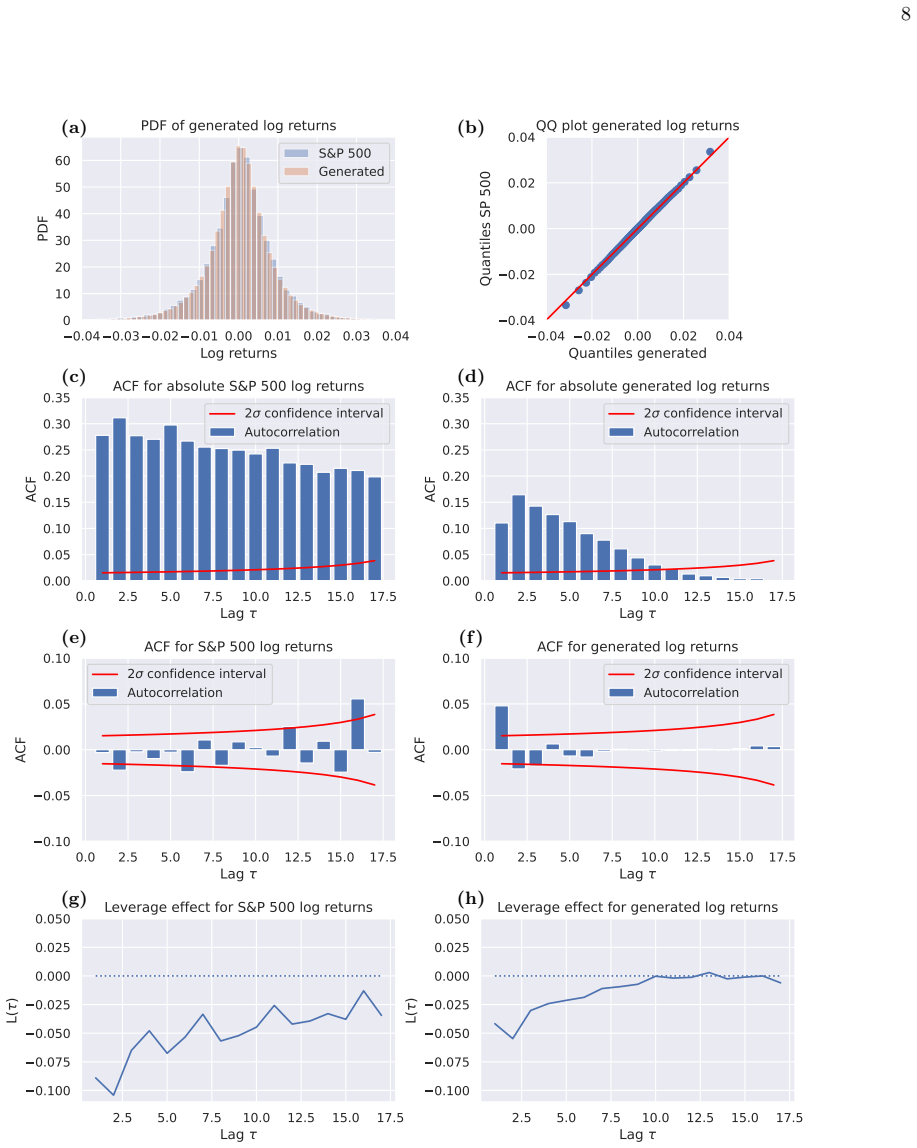
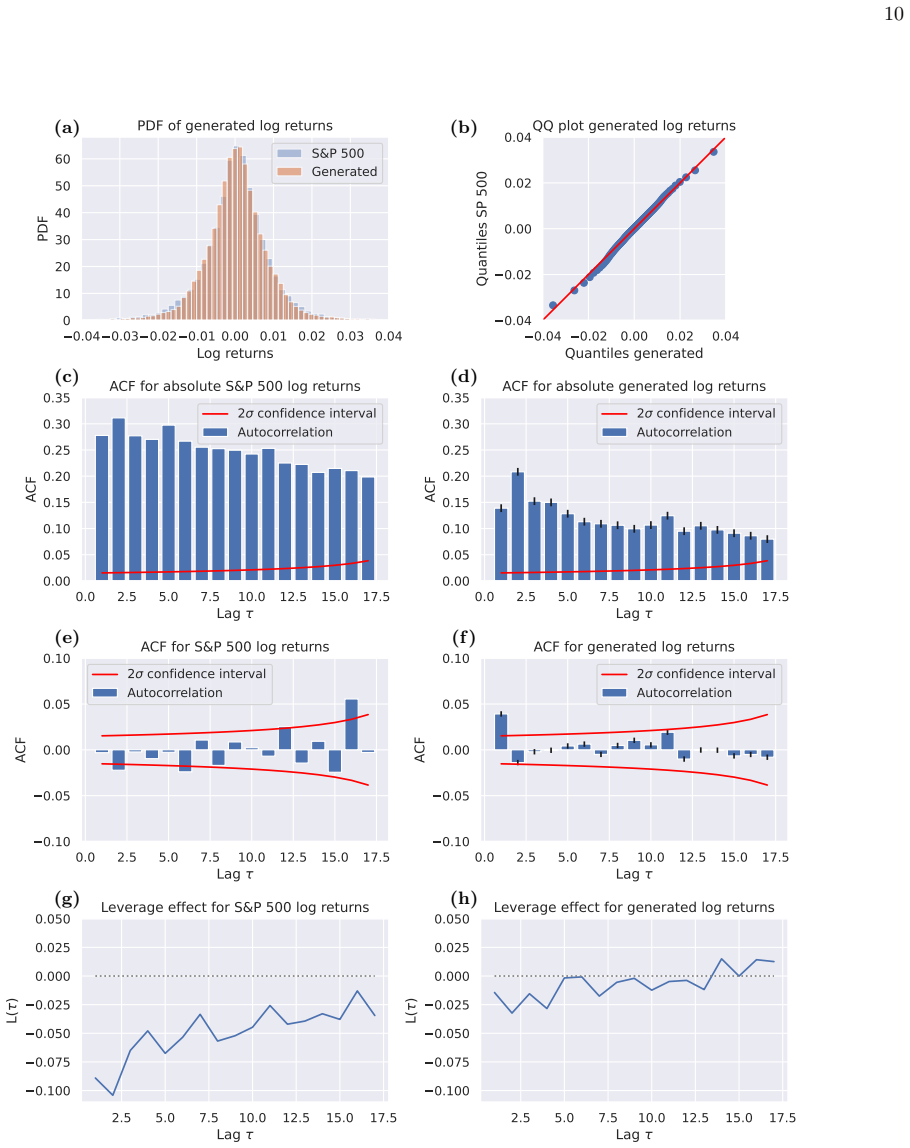
Generating a large set of synthetic series from the trained QGAN and comparing the autocorrelation function of the generated returns against the autocorrelation measured on held-out real financial data to check for statistically significant mismatch.
Figures






read the original abstract
Quantum generative adversarial networks (QGANs) have been investigated as a method for generating synthetic data with the goal of augmenting training data sets for neural networks. This is especially relevant for financial time series, since we only ever observe one realization of the process, namely the historical evolution of the market, which is further limited by data availability and the age of the market. However, for classical generative adversarial networks it has been shown that generated data may (often) not exhibit desired properties (also called stylized facts), such as matching a certain distribution or showing specific temporal correlations. Here, we investigate whether quantum correlations in quantum inspired models of QGANs can help in the generation of financial time series. We train QGANs, composed of a quantum generator and a classical discriminator, and investigate two approaches for simulating the quantum generator: a full simulation of the quantum circuits, and an approximate simulation using tensor network methods. We tested how the choice of hyperparameters, such as the circuit depth and bond dimensions, influenced the quality of the generated time series. The QGAN that we trained generate synthetic financial time series that not only match the target distribution but also exhibit the desired temporal correlations, with the quality of each property depending on the hyperparameters and simulation method.
Editorial analysis
A structured set of objections, weighed in public.
Referee Report
Summary. The paper investigates Quantum Generative Adversarial Networks (QGANs) consisting of a quantum generator and classical discriminator for producing synthetic financial time series. It compares exact circuit simulation with tensor-network approximations, varies hyperparameters including circuit depth and bond dimension, and reports that the generated series match the target distribution while also exhibiting desired temporal correlations, with quality depending on the chosen hyperparameters and simulation method.
Significance. If the empirical results are placed on firmer quantitative footing, the work would offer a concrete demonstration that quantum-inspired generators can capture both marginal distributions and autocorrelation structure in financial returns, a combination that remains challenging for classical GANs. The explicit comparison of full versus approximate simulation methods is a constructive element that could guide future scalability studies.
major comments (2)
- [Tensor-network simulation section] Tensor-network simulation section: the manuscript varies bond dimension yet provides no explicit convergence test of the full autocorrelation function (or higher-order temporal statistics) as bond dimension is increased toward the exact-simulation limit. Without such a check it remains possible that truncation systematically suppresses longer-range correlations while still permitting short-lag agreement under the tested hyperparameter regimes, rendering the reported temporal-correlation match an artifact of the approximation rather than an intrinsic property of the QGAN.
- [Results on generated time series] Results on generated time series: the abstract and main text assert that the series 'match the target distribution' and 'exhibit the desired temporal correlations,' but supply no quantitative metrics (e.g., Kolmogorov-Smirnov statistics, mean-squared autocorrelation error), error bars, or direct baseline comparisons against classical GANs with identical architecture and training budget. These omissions make it impossible to judge the magnitude of any quantum advantage or the robustness of the hyperparameter dependence.
minor comments (2)
- [Methods] Notation for the quantum circuit ansatz and the precise definition of the temporal-correlation loss term should be stated explicitly in a dedicated methods subsection rather than being referenced only through hyperparameter tables.
- [Figures] Figure captions describing generated versus real autocorrelation plots should include the exact lag range plotted and the bond-dimension values used for each curve.
Simulated Author's Rebuttal
We thank the referee for the constructive and detailed comments. We have revised the manuscript to strengthen the quantitative support for our claims regarding convergence and performance metrics. Point-by-point responses follow.
read point-by-point responses
-
Referee: [Tensor-network simulation section] Tensor-network simulation section: the manuscript varies bond dimension yet provides no explicit convergence test of the full autocorrelation function (or higher-order temporal statistics) as bond dimension is increased toward the exact-simulation limit. Without such a check it remains possible that truncation systematically suppresses longer-range correlations while still permitting short-lag agreement under the tested hyperparameter regimes, rendering the reported temporal-correlation match an artifact of the approximation rather than an intrinsic property of the QGAN.
Authors: We agree that an explicit convergence test of the autocorrelation function with increasing bond dimension would provide stronger evidence against truncation artifacts. In the revised manuscript we have added a dedicated convergence analysis (new figure and subsection) that plots the full autocorrelation function for bond dimensions ranging from low values up to the regime where tensor-network results match exact circuit simulation. The plots show that both short-lag and longer-range correlations converge to the exact-simulation values, indicating that the reported temporal correlations are not an artifact of the approximation under the tested regimes. revision: yes
-
Referee: [Results on generated time series] Results on generated time series: the abstract and main text assert that the series 'match the target distribution' and 'exhibit the desired temporal correlations,' but supply no quantitative metrics (e.g., Kolmogorov-Smirnov statistics, mean-squared autocorrelation error), error bars, or direct baseline comparisons against classical GANs with identical architecture and training budget. These omissions make it impossible to judge the magnitude of any quantum advantage or the robustness of the hyperparameter dependence.
Authors: We accept that quantitative metrics and error bars improve the ability to assess robustness. The revised results section now reports Kolmogorov-Smirnov statistics for marginal distribution matching and mean-squared autocorrelation error, each averaged over five independent training runs with standard-error bars. Regarding classical baselines, our study centers on the effect of quantum-generator simulation methods rather than a direct quantum-versus-classical advantage claim; nevertheless we have added a limited comparison to a classical generator of comparable parameter count under the same training protocol. A fully identical-architecture classical GAN study with matched compute budget is noted as valuable future work but lies outside the present scope focused on tensor-network versus exact quantum simulation. revision: partial
Circularity Check
No significant circularity in empirical QGAN training and simulation results
full rationale
The paper reports empirical outcomes from training quantum generative adversarial networks (with quantum generators simulated either exactly or via tensor networks) on financial time series. The central claims concern the generated samples' ability to reproduce target distributions and temporal correlations, with performance varying by hyperparameters such as circuit depth and bond dimension. These are direct outputs of the training and simulation procedures rather than any derivation chain that reduces to its own inputs by construction. No self-definitional equations, fitted parameters renamed as predictions, load-bearing self-citations, uniqueness theorems, or smuggled ansatzes appear in the described work. The investigation is self-contained as an experimental study whose results can be checked against external financial data statistics without circular reduction.
Axiom & Free-Parameter Ledger
free parameters (2)
- circuit depth
- bond dimension
axioms (1)
- domain assumption Quantum circuits can be classically simulated either exactly or via tensor-network approximations that preserve relevant correlations.
Lean theorems connected to this paper
-
IndisputableMonolith/Cost/FunctionalEquation.leanwashburn_uniqueness_aczel unclear?
unclearRelation between the paper passage and the cited Recognition theorem.
We train QGANs, composed of a quantum generator and a classical discriminator... simulated with full-state and MPS... bond dimension
-
IndisputableMonolith/Foundation/DimensionForcing.leanreality_from_one_distinction unclear?
unclearRelation between the paper passage and the cited Recognition theorem.
temporal correlations... volatility clustering... leverage effect
What do these tags mean?
- matches
- The paper's claim is directly supported by a theorem in the formal canon.
- supports
- The theorem supports part of the paper's argument, but the paper may add assumptions or extra steps.
- extends
- The paper goes beyond the formal theorem; the theorem is a base layer rather than the whole result.
- uses
- The paper appears to rely on the theorem as machinery.
- contradicts
- The paper's claim conflicts with a theorem or certificate in the canon.
- unclear
- Pith found a possible connection, but the passage is too broad, indirect, or ambiguous to say the theorem truly supports the claim.
Reference graph
Works this paper leans on
-
[1]
S. J. Prince, Understanding Deep Learning (MIT press, 2023)
work page 2023
-
[2]
I. J. Goodfellow, J. Pouget-Abadie, M. Mirza, B. Xu, D. Warde-Farley, S. Ozair, A. Courville, and Y. Ben- gio, Generative Adversarial Nets, in Advances in Neural Information Processing Systems , Vol. 27 (Curran Asso- ciates, Inc., 2014)
work page 2014
-
[3]
I. Goodfellow, J. Pouget-Abadie, M. Mirza, B. Xu, D. Warde-Farley, S. Ozair, A. Courville, and Y. Bengio, Generative adversarial networks, Communications of the ACM 63, 139 (2020)
work page 2020
-
[4]
Unsupervised Representation Learning with Deep Convolutional Generative Adversarial Networks
A. Radford, L. Metz, and S. Chintala, Unsupervised Rep- resentation Learning with Deep Convolutional Genera- tive Adversarial Networks (2016), arXiv:1511.06434 [cs]
work page internal anchor Pith review Pith/arXiv arXiv 2016
-
[5]
Progressive Growing of GANs for Improved Quality, Stability, and Variation
T. Karras, T. Aila, S. Laine, and J. Lehtinen, Progressive Growing of GANs for Improved Quality, Stability, and Variation (2018), arXiv:1710.10196 [cs]
work page internal anchor Pith review Pith/arXiv arXiv 2018
- [6]
-
[7]
J. Gui, Z. Sun, Y. Wen, D. Tao, and J. Ye, A review on generative adversarial networks: Algorithms, theory, and applications, IEEE transactions on knowledge and data engineering 35, 3313 (2021)
work page 2021
-
[8]
C. Shorten and T. M. Khoshgoftaar, A survey on Image Data Augmentation for Deep Learning, Journal of Big Data 6, 60 (2019). 14
work page 2019
-
[9]
F. H. K. dos Santos Tanaka and C. Aranha, Data Aug- mentation Using GANs, Proceedings of Machine Learn- ing Research XXX 1, 16 (2019)
work page 2019
-
[10]
M. F. Dixon, I. Halperin, and P. Bilokon, Machine Learn- ing in Finance: From Theory to Practice (Springer In- ternational Publishing, Cham, 2020)
work page 2020
-
[11]
V. K. Potluru, D. Borrajo, A. Coletta, N. Dalmasso, Y. El-Laham, E. Fons, M. Ghassemi, S. Gopalakrish- nan, V. Gosai, E. Kreaˇ ci´ c, G. Mani, S. Obitayo, D. Para- manand, N. Raman, M. Solonin, S. Sood, S. Vyetrenko, H. Zhu, M. Veloso, and T. Balch, Synthetic Data Appli- cations in Finance (2024), arXiv:2401.00081 [cs]
-
[12]
S. Assefa, Generating Synthetic Data in Finance: Oppor- tunities, Challenges and Pitfalls, SSRN Electronic Jour- nal 10.2139/ssrn.3634235 (2020)
-
[13]
Preskill, Quantum Computing in the NISQ era and beyond, Quantum 2, 79 (2018)
J. Preskill, Quantum Computing in the NISQ era and beyond, Quantum 2, 79 (2018)
work page 2018
- [14]
-
[15]
S. Lloyd and C. Weedbrook, Quantum Generative Ad- versarial Learning, Physical Review Letters 121, 040502 (2018)
work page 2018
-
[16]
P.-L. Dallaire-Demers and N. Killoran, Quantum genera- tive adversarial networks, Physical Review A 98, 012324 (2018)
work page 2018
-
[17]
S. Aaronson and A. Arkhipov, The Computational Com- plexity of Linear Optics, Theory of Computing 9, 143 (2013)
work page 2013
- [18]
- [19]
-
[20]
R. Molteni, S. C. Marshall, and V. Dunjko, Quantum ma- chine learning advantages beyond hardness of evaluation (2025), arXiv:2504.15964 [quant-ph]
- [21]
-
[22]
M. Dogariu, L.-D. S ¸tefan, B. A. Boteanu, C. Lamba, B. Kim, and B. Ionescu, Generation of Realistic Syn- thetic Financial Time-series, ACM Transactions on Mul- timedia Computing, Communications, and Applications 18, 1 (2022)
work page 2022
-
[23]
S. ¨Ostlund and S. Rommer, Thermodynamic Limit of Density Matrix Renormalization, Physical Review Let- ters 75, 3537 (1995)
work page 1995
-
[24]
F. Verstraete, M. , V., and J. and Cirac, Matrix prod- uct states, projected entangled pair states, and varia- tional renormalization group methods for quantum spin systems, Advances in Physics 57, 143 (2008)
work page 2008
-
[25]
S. D. J. Indices, S&P 500 ®, https://www.spglobal.com/spdji/en/indices/equity/sp- 500/#overview (2025), last accessed 2025-06-19
work page 2025
-
[26]
F. Black and M. Scholes, The Pricing of Options and Corporate Liabilities, Journal of Political Economy 81, 637 (1973)
work page 1973
-
[27]
R. Cont, Empirical properties of asset returns: Stylized facts and statistical issues, Quantitative Finance 1, 223 (2001)
work page 2001
-
[28]
Generative adversarial networks in finance: An overview,
F. Eckerli and J. Osterrieder, Generative Adver- sarial Networks in finance: An overview (2021), arXiv:2106.06364 [q-fin]
-
[29]
D. Saxena and J. Cao, Generative Adversarial Networks (GANs): Challenges, Solutions, and Future Directions, ACM Computing Surveys 54, 1 (2022)
work page 2022
-
[30]
M. Arjovsky, S. Chintala, and L. Bottou, Wasser- stein Generative Adversarial Networks, in Proceedings of the 34th International Conference on Machine Learning (PMLR, 2017) pp. 214–223
work page 2017
-
[31]
Villani, The Wasserstein distances, in Optimal Trans- port: Old and New , edited by C
C. Villani, The Wasserstein distances, in Optimal Trans- port: Old and New , edited by C. Villani (Springer, Berlin, Heidelberg, 2009) pp. 93–111
work page 2009
-
[32]
I. Gulrajani, F. Ahmed, M. Arjovsky, V. Dumoulin, and A. C. Courville, Improved training of wasserstein gans, Advances in neural information processing systems 30 (2017)
work page 2017
-
[33]
R. Sweke, J.-P. Seifert, D. Hangleiter, and J. Eisert, On the Quantum versus Classical Learnability of Discrete Distributions, Quantum 5, 417 (2021)
work page 2021
-
[34]
A generative modeling approach for benchmarking and training shallow quantum circuits
M. Benedetti, D. Garcia-Pintos, O. Perdomo, V. Leyton-Ortega, Y. Nam, and A. Perdomo- Ortiz, A generative modeling approach for bench- marking and training shallow quantum circuits, https://arxiv.org/abs/1801.07686v4 (2018)
work page internal anchor Pith review Pith/arXiv arXiv 2018
-
[35]
Differentiable Learning of Quantum Circuit Born Machine
J.-G. Liu and L. Wang, Differentiable Learn- ing of Quantum Circuit Born Machine, https://arxiv.org/abs/1804.04168v1 (2018)
work page internal anchor Pith review Pith/arXiv arXiv 2018
-
[36]
J. Romero and A. Aspuru-Guzik, Variational Quantum Generators: Generative Adversarial Quantum Machine Learning for Continuous Distributions, Advanced Quan- tum Technologies 4, 2000003 (2021)
work page 2021
- [37]
-
[38]
A. Barthe, M. Grossi, S. Vallecorsa, J. Tura, and V. Dun- jko, Parameterized quantum circuits as universal gen- erative models for continuous multivariate distributions (2024), arXiv:2402.09848 [quant-ph]
work page internal anchor Pith review arXiv 2024
- [39]
-
[40]
A. Kandala, A. Mezzacapo, K. Temme, M. Takita, M. Brink, J. M. Chow, and J. M. Gambetta, Hardware- efficient variational quantum eigensolver for small molecules and quantum magnets, nature549, 242 (2017)
work page 2017
-
[41]
S. Takahashi, Y. Chen, and K. Tanaka-Ishii, Modeling fi- nancial time-series with generative adversarial networks, Physica A: Statistical Mechanics and its Applications 527, 121261 (2019)
work page 2019
- [42]
- [43]
-
[44]
T. Takahashi and T. Mizuno, Generation of syn- thetic financial time series by diffusion models (2024), arXiv:2410.18897 [q-fin]
- [45]
-
[46]
T. A. Ngo, T. Nguyen, and T. C. Thang, A Survey of Re- cent Advances in Quantum Generative Adversarial Net- works, Electronics 12, 856 (2023)
work page 2023
- [47]
- [48]
-
[49]
H.-L. Huang, Y. Du, M. Gong, Y. Zhao, Y. Wu, C. Wang, S. Li, F. Liang, J. Lin, Y. Xu, R. Yang, T. Liu, M.- H. Hsieh, H. Deng, H. Rong, C.-Z. Peng, C.-Y. Lu, Y.- A. Chen, D. Tao, X. Zhu, and J.-W. Pan, Experimen- tal Quantum Generative Adversarial Networks for Image Generation, Physical Review Applied 16, 024051 (2021)
work page 2021
-
[50]
N.-R. Zhou, T.-F. Zhang, X.-W. Xie, and J.-Y. Wu, Hy- brid quantum–classical generative adversarial networks for image generation via learning discrete distribution, Signal Processing: Image Communication 110, 116891 (2023)
work page 2023
- [51]
-
[52]
S. L. Tsang, M. T. West, S. M. Erfani, and M. Us- man, Hybrid Quantum–Classical Generative Adversar- ial Network for High-Resolution Image Generation, IEEE Transactions on Quantum Engineering 4, 1 (2023)
work page 2023
-
[53]
H. Situ, Z. He, Y. Wang, L. Li, and S. Zheng, Quan- tum generative adversarial network for generating dis- crete distribution, Information Sciences 538, 193 (2020)
work page 2020
-
[54]
P.-Y. Kao, Y.-C. Yang, W.-Y. Chiang, J.-Y. Hsiao, Y. Cao, A. Aliper, F. Ren, A. Aspuru-Guzik, A. Zha- voronkov, M.-H. Hsieh, and Y.-C. Lin, Exploring the Ad- vantages of Quantum Generative Adversarial Networks in Generative Chemistry, Journal of Chemical Informa- tion and Modeling 63, 3307 (2023)
work page 2023
-
[55]
D. Herr, B. Obert, and M. Rosenkranz, Anomaly de- tection with variational quantum generative adversarial networks, Quantum Science and Technology 6, 045004 (2021)
work page 2021
-
[56]
F. Fuchs and B. Horvath, A Hybrid Quantum Wasser- stein GAN with Applications to Option Pricing (2023), Social Science Research Network:4514510
work page 2023
- [57]
-
[58]
A. Di Meglio, K. Jansen, I. Tavernelli, C. Alexandrou, S. Arunachalam, C. W. Bauer, K. Borras, S. Carrazza, A. Crippa, V. Croft, R. de Putter, A. Delgado, V. Dun- jko, D. J. Egger, E. Fern´ andez-Combarro, E. Fuchs, L. Funcke, D. Gonz´ alez-Cuadra, M. Grossi, J. C. Hal- imeh, Z. Holmes, S. K¨ uhn, D. Lacroix, R. Lewis, D. Luc- chesi, M. L. Martinez, F. Me...
work page 2024
-
[59]
E. Paquet and F. Soleymani, QuantumLeap: Hybrid quantum neural network for financial predictions, Expert Systems with Applications 195, 116583 (2022)
work page 2022
-
[60]
B. T. Kiani, G. De Palma, M. Marvian, Z.-W. Liu, and S. Lloyd, Learning quantum data with the quantum earth mover’s distance, Quantum Science and Technology 7, 045002 (2022)
work page 2022
-
[61]
S. Chakrabarti, H. Yiming, T. Li, S. Feizi, and X. Wu, Quantum Wasserstein Generative Adversarial Networks, in Advances in Neural Information Processing Systems , Vol. 32 (Curran Associates, Inc., 2019)
work page 2019
-
[62]
E. Schwander, Quantum Generative Modelling for Fi- nancial Time Series , Master’s thesis, Leiden University (2022)
work page 2022
-
[63]
M. Abadi, P. Barham, J. Chen, Z. Chen, A. Davis, J. Dean, M. Devin, S. Ghemawat, G. Irving, M. Isard, M. Kudlur, J. Levenberg, R. Monga, S. Moore, D. G. Murray, B. Steiner, P. Tucker, V. Vasudevan, P. War- den, M. Wicke, Y. Yu, and X. Zheng, TensorFlow: A system for large-scale machine learning, in Proceedings of the 12th USENIX Conference on Operating Sy...
work page 2016
-
[64]
J. Bradbury, R. Frostig, P. Hawkins, M. J. Johnson, C. Leary, D. Maclaurin, G. Necula, A. Paszke, J. Van- derPlas, S. Wanderman-Milne, and Q. Zhang, JAX: com- posable transformations of Python+NumPy programs (2018)
work page 2018
-
[65]
J. Gray, Quimb: A python package for quantum informa- tion and many-body calculations, Journal of Open Source Software 3, 819 (2018)
work page 2018
-
[66]
Hogenboom, WGAN Financial Time-Series , Master’s thesis, University Maastricht (2025)
C. Hogenboom, WGAN Financial Time-Series , Master’s thesis, University Maastricht (2025)
work page 2025
-
[67]
G. M. Goerg, The Lambert Way to Gaussianize Heavy- Tailed Data with the Inverse of Tukey’s h Transformation as a Special Case, The Scientific World Journal 2015, 909231 (2015)
work page 2015
-
[68]
M. Larocca, S. Thanasilp, S. Wang, K. Sharma, J. Bia- monte, P. J. Coles, L. Cincio, J. R. McClean, Z. Holmes, and M. Cerezo, Barren plateaus in variational quantum computing, Nature Reviews Physics , 1 (2025)
work page 2025
-
[69]
C. C. Shi, Effects of Observable Choices in the Per- formance of Variational Quantum Generative Models - CONFIDENTIAL, Ph.D. thesis, LIACS, Leiden Univer- sity (2024)
work page 2024
-
[70]
J. I. Cirac, D. P´ erez-Garc´ ıa, N. Schuch, and F. Ver- straete, Matrix product states and projected entangled pair states: Concepts, symmetries, theorems, Reviews of Modern Physics 93, 045003 (2021)
work page 2021
-
[71]
I. V. Oseledets, Tensor-Train Decomposition, SIAM Journal on Scientific Computing 33, 2295 (2011)
work page 2011
-
[72]
A. Berezutskii, M. Liu, A. Acharya, R. Ellerbrock, J. Gray, R. Haghshenas, Z. He, A. Khan, V. Kuzmin, D. Lyakh, D. Lykov, S. Mandr` a, C. Mansell, A. Mel- nikov, A. Melnikov, V. Mironov, D. Morozov, F. Neukart, A. Nocera, M. A. Perlin, M. Perelshtein, M. Steinberg, R. Shaydulin, B. Villalonga, M. Pflitsch, M. Pistoia, 16 V. Vinokur, and Y. Alexeev, Tensor...
-
[73]
F. Verstraete, D. Porras, and J. I. Cirac, Density Matrix Renormalization Group and Periodic Boundary Condi- tions: A Quantum Information Perspective, Physical Re- view Letters 93, 227205 (2004)
work page 2004
- [74]
-
[75]
F. Orlandi, E. Barbierato, and A. Gatti, Enhancing Fi- nancial Time Series Prediction with Quantum-Enhanced Synthetic Data Generation: A Case Study on the S&P 500 Using a Quantum Wasserstein Generative Adversar- ial Network Approach with a Gradient Penalty, Electron- ics 13, 2158 (2024)
work page 2024
-
[76]
D. Komninos, Quantum Computing for Generative Mod- eling and Applications, Master’s thesis, Technical Univer- sity of Crete (2023)
work page 2023
-
[77]
P. Rebentrost, B. Gupt, and T. R. Bromley, Quantum computational finance: Monte Carlo pricing of financial derivatives, Physical Review A 98, 022321 (2018)
work page 2018
-
[78]
S. Woerner and D. J. Egger, Quantum risk analysis, npj Quantum Information 5, 15 (2019)
work page 2019
-
[79]
M. MacMahon and D. Garlaschelli, Community Detec- tion for Correlation Matrices, Physical Review X 5, 021006 (2015)
work page 2015
-
[80]
Y. Wang, Z. Hu, B. C. Sanders, and S. Kais, Qudits and High-Dimensional Quantum Computing, Frontiers in Physics 8, 10.3389/fphy.2020.589504 (2020)
discussion (0)
Sign in with ORCID, Apple, or X to comment. Anyone can read and Pith papers without signing in.