REVIEW 5 major objections 5 minor 1 cited by
Foundation Models for Demand Forecasting via Dual-Strategy Ensembling
T0 review · 5 major / 5 minor · reviewed 2026-08-06 · deepseek-v4-flash
Pith's one-line read Hierarchical and architectural ensembling beats the top single-model M5 forecast and improves zero-shot sales prediction.
desk verdict In-domain M5 ensembling is plausible and worth a look; the zero-shot claim is unverifiable as written because Table 3's HE is never defined for unseen target groups and the AE numbers the text cites don't appear. read the letter →
The pith
A machine-rendered reading of the paper's core claim, the machinery that carries it, and where it could break.
The reading
What carries the argument
The machinery is a two-layer weighted-average ensemble. Hierarchical Ensemble (HE) trains one model $\mathcal{M}_\ell^{(i)}$ per group $i$ at a semantic level $\ell \in \{$store, store+category, store+department$\}$, produces level-specific forecasts $\hat{y}_\ell^{(i)} = \mathcal{M}_\ell^{(i)}(x_{1:T}^{(i)})$, and combines them as $\hat{y} = \sum_\ell w_\ell \hat{y}_\ell^{(i)}$. Architectural Ensemble (AE) takes $K$ diverse backbones and fuses their forecasts as $\hat{y} = \sum_k v_k \hat{y}_k$. The unified objective applies both layers, $\hat{y}_{\mathrm{final}} = \sum_k v_k \sum_\ell w_\ell \hat{y}_{\ell,k}^{(i)}$, with equal normalized weights used throughout. The load-bearing mechanism is that the component models fail in complementary ways: coarse-level aggregation models, fine-grained store models, tree-based window models, and transformer sequence models each dominate in different regimes, so their average is flatter and more accurate than any single view.
What would settle it
Implement the zero-shot HE protocol literally from Eq. (2): train store-level, store+category, and store+department models on M5 only, then use them to forecast the three external datasets without any target training. If the target store and category IDs do not match any source group, the forecasts cannot be produced by the stated mechanism, and reproducing the reported Sales1, Sales2, and Sales3 MSE/MAE values under a strict out-of-sample group split is the direct way to confirm or falsify the zero-shot HE claim.
Extended reading notes
Core claim
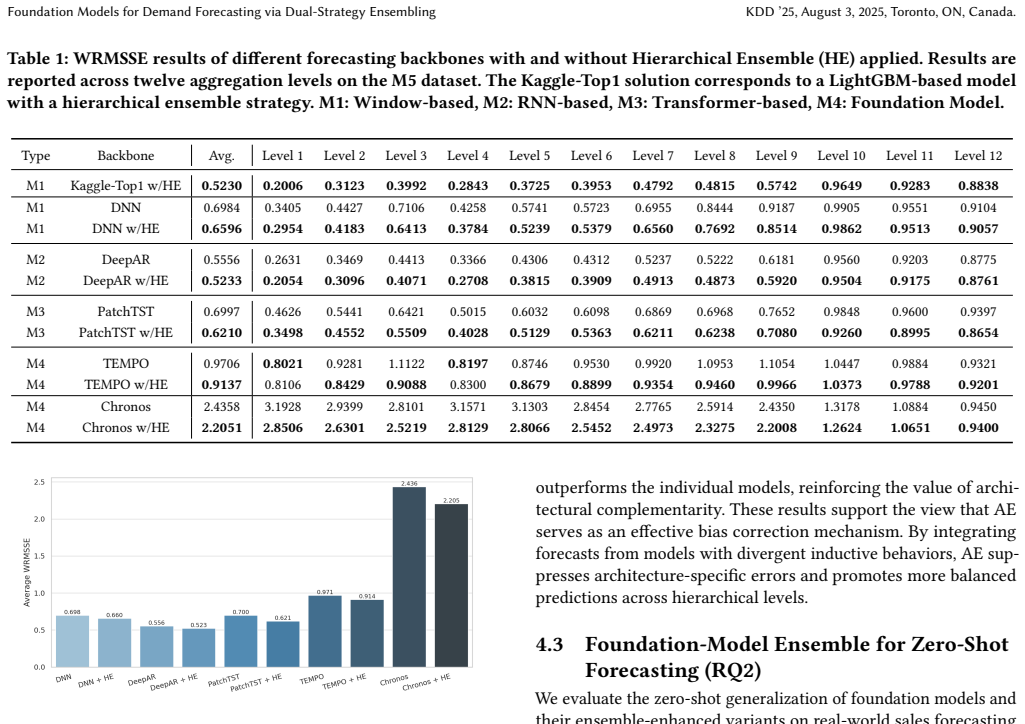
The paper's central claim is that two complementary sources of diversity—semantic hierarchy and architectural heterogeneity—carry most of the gains in demand forecasting, and that a simple weighted fusion of existing models can outperform each component. On M5, Hierarchical Ensemble improves DeepAR's WRMSSE from 0.5556 to 0.5233, PatchTST from 0.6997 to 0.6210, TEMPO from 0.9706 to 0.9137, and Chronos from 2.4358 to 2.2051. Architectural Ensemble then goes further: the LightGBM+PatchTST combination reaches 0.4989, below the 0.5230 of the Kaggle-Top1 solution. The same mechanisms transfer to three external sales datasets, where ensembled variants improve MSE/MAE over single backbones both when models are applied without fine-tuning and when they are retrained on the target data. The authors interpret the result as evidence that structured diversity acts as a regularizer that cancels out local, group-specific, and architecture-specific biases.
Load-bearing premise
The load-bearing assumption is that a Hierarchical Ensemble trained on the groups of one dataset can be applied to a new dataset whose stores, categories, and items were not seen in training; the paper does not specify how group models transfer, so the zero-shot HE results rest on that unstated mapping.
Editorial extensions
If this is right
- A deployment-ready forecaster can be assembled from existing models: the best M5 result in the paper comes from averaging LightGBM and PatchTST, not from a new architecture.
- Any tested backbone benefits from hierarchical partitioning, so HE behaves as a generic add-on rather than a per-model trick.
- Foundation models improve in zero-shot transfer when ensembled, suggesting that architectural diversity can partially substitute for retraining when the target domain has no labels.
- Across the twelve M5 hierarchy levels, no single partition wins everywhere; the ensemble matches or beats the best component at every level, which is why the fused forecast dominates.
- The same HE gain appears when models are retrained on three external datasets, so the benefit is not specific to M5's particular retailer structure.
Reading between the lines
- One natural testable extension is to replace the fixed equal weights in the ensemble equations with weights learned per hierarchy level, forecast horizon, or distribution-shift indicator; if the paper's diversity argument is right, adaptive weights should extract larger gains in regimes where one backbone degrades sharply.
- The zero-shot HE experiments imply a group-matching rule the paper leaves unspecified: M5-trained store and category models must be mapped to target store and item IDs to produce forecasts. Defining and testing such a mapping would settle whether zero-shot HE is a genuinely transferable construction or depends on target groups having source analogues.
- If orchestration matters more than architecture, then forecasting benchmark leaderboards may over-weight model novelty; reporting ensembles alongside single models would better reflect how winning forecasting systems are actually deployed.
- The layer-wise results suggest a hierarchy-of-experts view of demand data, where fine-grained models specialize to item-store noise and coarse models to aggregate trends; measuring error correlations between level-specific models would test whether the ensemble gains come from genuinely low-correlated failures.
Editorial analysis
A structured set of objections, weighed in public.
Referee Report
Summary. The paper proposes a dual-strategy ensemble framework for hierarchical sales forecasting: Hierarchical Ensemble (HE) trains separate models for each semantic group (store, store+category, store+department) and averages their predictions, while Architectural Ensemble (AE) averages predictions from diverse backbones (LightGBM, DeepAR, PatchTST, TEMPO, Chronos). Experiments on the M5 benchmark and three external sales datasets report WRMSSE, MSE, and MAE improvements, including a zero-shot setting. The central claims are that both ensemble strategies consistently improve accuracy over single backbones and that the framework enhances the zero-shot generalization of foundation models.
Significance. If the in-domain M5 results are reproducible, the paper's contribution is a simple and parameter-light orchestration layer: equal-weight fusion of existing backbones with hierarchy-aware specialization gives consistent average WRMSSE reductions, e.g., from 0.5230 for Kaggle-Top1 to 0.4989 for AE (LightGBM, PatchTST). The paper explicitly avoids fitted ensemble weights, which removes a potential circularity concern, and it uses external datasets as benchmarks. However, the zero-shot HE results are not a valid test of the method as defined, and the absence of variance information weakens the 'consistently outperforms' claim. The core idea is defensible, but the experimental protocol needs clarification and strengthening.
major comments (5)
- [§4.3, Eq. (2), Table 3] Eq. (2) defines HE as training an independent model M_l^(i) for every group i at level l (e.g., each store). Section 4.3 says zero-shot models are 'applied without fine-tuning', and Table 3's caption says foundation models are 'pre-trained on the M5 dataset without access to target domains'. These statements are not jointly satisfiable for the three external datasets, whose stores and categories are not the M5 groups: no group model exists for an unseen group, and the paper never specifies how M5-trained group models are assigned or aggregated for target groups of different hierarchy depth and temporal resolution. Please specify the zero-shot HE procedure precisely; if HE models were trained on target-domain groups, the result is full-shot leakage, not zero-shot, and if the global model was used, that is not the HE of Eq. (2).
- [Tables 1–4, §4.1.4] All tables report single scalar outcomes per configuration with no standard deviation, seeds, or significance tests. Several claimed improvements are small relative to likely run-to-run variation, for example TEMPO w/HE on Sales2 (1.1503 vs. 1.1814 MSE) and TEMPO w/HE on Sales1 (1.1173 vs. 1.1690 MSE). Without repeated runs or error bars, the paper's central 'consistently outperforms' conclusion is not established even for the in-domain results.
- [Sec. 3.1, Sec. 4.3, Table 3 caption] The training protocol is inconsistent. Section 3.1 says the adopted transformer is 'pre-trained on diverse temporal datasets and fine-tuned for hierarchical sales prediction on the M5 dataset', Section 4.3 says zero-shot models are applied 'without any fine-tuning', and Table 3's caption says 'Foundation models are pre-trained on the M5 dataset'. For Chronos and TEMPO, pretraining is not on M5. Please define exactly what 'pre-trained' and 'fine-tuned' mean for each row and state whether M5 labels were used at any stage in the zero-shot experiments.
- [§3.2.2, Table 1, Table 5] Several statements claim that the ensemble improves accuracy at all hierarchical levels, but the tables contradict this. In Table 1, TEMPO w/HE is worse than TEMPO at Level 1 (0.8106 vs. 0.8021) and Level 4 (0.8300 vs. 0.8197). In Table 5, the HE ensemble is worse than the best single partition at Level 4 (0.4028 vs. 0.3982 for Store-Dept) and at Level 10 (0.9260 vs. 0.9170 for Store). Please correct the overstatements in the abstract and Section 3.2.2, or report the precise subset of levels where the gains hold.
- [Sec. 4.4, Table 4] The full-shot protocol is described as 'retraining foundation models from scratch on each dataset', while the Table 4 caption says 'trained on each specific dataset' and the text later calls it 'retraining ... directly on each target dataset'. For pretrained backbones such as TEMPO and Chronos, 'from scratch' is ambiguous and likely inconsistent with the use of pretrained checkpoints. Specify whether full-shot models are fine-tuned from pretrained weights or trained from random initialization, and whether HE group models share the same initialization.
minor comments (5)
- [Sec. 3.2.2, Eq. (5)] The statement 'we assign equal normalized weights during ensembling' is not made precise; state explicitly that w_l = 1/L and v_k = 1/K and clarify how the nested aggregation in Eq. (5) handles groups that may be missing at some hierarchy levels.
- [Tables 3–4] MSE and MAE are reported on raw scales that differ greatly across the three datasets; include per-dataset series normalization or at least a simple baseline (e.g., seasonal naive) so the magnitudes of the external results are interpretable.
- [Figure 1] Figure 1 is referenced in Section 4.2.1 but no figure appears in the manuscript text; either include the figure with axis labels and a clear caption, or remove the reference.
- [References [14], [15], [16]] References [14], [15], and [16] point to the same repository with the same title; merge them and cite the actual sources for the M5 winning solution.
- [Abstract] The abstract says the framework enhances 'foundation models', but Tables 1 and 2 also evaluate LightGBM and DNN; adjust the wording to reflect that the framework is applied to a broader set of forecasting backbones.
Circularity Check
No circular dependency: ensemble weights are fixed, benchmarks are external, and the only self-cited backbone (TEMPO) is evaluated rather than assumed.
full rationale
The paper's central claim - that equal-weight Hierarchical (HE) and Architectural (AE) ensembles improve forecast accuracy - is supported by direct experiments on M5 (Tables 1, 2, 5) and on three external datasets (Tables 3, 4). The combination weights are explicitly set equal ('we assign equal normalized weights during ensembling', Sec. 3.2.2), so there is no fitted parameter that could be renamed as a prediction. The Kaggle-Top1 comparison is a baseline, not an input to the method. TEMPO [3] is co-authored by two of the present authors, but it is used only as an evaluated backbone (Tables 1 and 3), not as evidence for the ensemble claim; the claim is also tested on Chronos and PatchTST, so the self-citation is not load-bearing. Accordingly, I find no circular step. One non-circular correctness concern should be flagged: the zero-shot HE protocol (Sec. 4.3, Table 3) is under-specified relative to Eq. (2), because per-group models M_l^(i) are trained on M5 groups and the paper does not explain how they produce forecasts for unseen target groups under 'without fine-tuning'. This affects reproducibility, not circularity, since the reported zero-shot numbers are not derived from Eq. (2) by construction and no fitted input is being passed off as a prediction.
Assumptions & free parameters
free parameters (1)
- Equal ensemble weights w_l and v_k =
w_l = 1/3 (L=3 hierarchy levels), v_k = 1/K (K=2 in AE)
assumptions (3)
- domain assumption Partitioning retail sales by store, store+category, and store+dept yields groups with enough data and sufficient homogeneity for specialist models to beat a global model.
- domain assumption External datasets carry hierarchy metadata (store, category, department) compatible with M5 semantics, and HE grouping transfers across domains.
- domain assumption Single-run evaluation on fixed official splits is representative of model quality.
Cite this review
Pith. "Pith review of Foundation Models for Demand Forecasting via Dual-Strategy Ensembling." pith.science (2026). https://pith.science/paper/LJHQOA74
@misc{pith2026250722053,
  author       = {Pith},
  title        = {Pith review of: Foundation Models for Demand Forecasting via Dual-Strategy Ensembling},
  year         = {2026},
  howpublished = {\url{https://pith.science/paper/LJHQOA74}},
  note         = {Machine review of arXiv:2507.22053}
}
read the original abstract
Accurate demand forecasting is critical for supply chain optimization, yet remains difficult in practice due to hierarchical complexity, domain shifts, and evolving external factors. While recent foundation models offer strong potential for time series forecasting, they often suffer from architectural rigidity and limited robustness under distributional change. In this paper, we propose a unified ensemble framework that enhances the performance of foundation models for sales forecasting in real-world supply chains. Our method combines two complementary strategies: (1) Hierarchical Ensemble (HE), which partitions training and inference by semantic levels (e.g., store, category, department) to capture localized patterns; and (2) Architectural Ensemble (AE), which integrates predictions from diverse model backbones to mitigate bias and improve stability. We conduct extensive experiments on the M5 benchmark and three external sales datasets, covering both in-domain and zero-shot forecasting. Results show that our approach consistently outperforms strong baselines, improves accuracy across hierarchical levels, and provides a simple yet effective mechanism for boosting generalization in complex forecasting environments.
Figures
Forward citations
Cited by 1 Pith paper
-
Speaking Numbers to LLMs: Multi-Wavelet Number Embeddings for Time Series Forecasting
TempoWave maps scalar observations to multi-wavelet multi-scale digit embeddings that override standard LLM tokens and improve forecasting performance on five context-enriched benchmarks to a new state-of-the-art.
Reference graph
Works this paper leans on
-
[1]
Khaled Alkilane, Yihang He, and Der-Horng Lee. 2024. MixMamba: Time series modeling with adaptive expertise. Information Fusion 112 (2024), 102589
work page 2024
-
[2]
Abdul Fatir Ansari, Lorenzo Stella, Caner Turkmen, Xiyuan Zhang, Pedro Mercado, Huibin Shen, Oleksandr Shchur, Syama Sundar Rangapuram, Sebas- tian Pineda Arango, Shubham Kapoor, et al. 2024. Chronos: Learning the language of time series. arXiv preprint arXiv:2403.07815 (2024)
arXiv 2024
-
[3]
Defu Cao, Furong Jia, Sercan O Arik, Tomas Pfister, Yixiang Zheng, Wen Ye, and Yan Liu. 2023. Tempo: Prompt-based generative pre-trained transformer for time series forecasting. arXiv preprint arXiv:2310.04948 (2023)
arXiv 2023
-
[4]
Defu Cao, Wen Ye, Yizhou Zhang, and Yan Liu. 2024. Timedit: General- purpose diffusion transformers for time series foundation model. arXiv preprint arXiv:2409.02322 (2024)
arXiv 2024
-
[5]
Defu Cao, Yixiang Zheng, Parisa Hassanzadeh, Simran Lamba, Xiaomo Liu, and Yan Liu. 2023. Large scale financial time series forecasting with multi-faceted model. In Proceedings of the Fourth ACM International Conference on AI in Finance . 472–480
work page 2023
-
[6]
Peng Chen, Yingying Zhang, Yunyao Cheng, Yang Shu, Yihang Wang, Qing- song Wen, Bin Yang, and Chenjuan Guo. 2024. Pathformer: Multi-scale trans- formers with adaptive pathways for time series forecasting. arXiv preprint arXiv:2402.05956 (2024)
arXiv 2024
-
[7]
Abhimanyu Das, Weihao Kong, Rajat Sen, and Yichen Zhou. 2024. A decoder- only foundation model for time-series forecasting. In Forty-first International Conference on Machine Learning
2024
-
[8]
Azul Garza, Cristian Challu, and Max Mergenthaler-Canseco. 2023. TimeGPT-1. arXiv preprint arXiv:2310.03589 (2023)
arXiv 2023
Show all 61 references
-
[9]
Iman Ghalehkhondabi, Ehsan Ardjmand, Gary R Weckman, and William A Young
-
[10]
Peiliang Gong, Emadeldeen Eldele, Min Wu, Zhenghua Chen, Xiaoli Li, and Daoqiang Zhang. [n.d.]. Towards Adaptive Time Series Foundation Models Against Distribution Shift. ([n. d.])
-
[11]
MD Rokibul Hasan, Md Raisul Islam, and Md Anisur Rahman. 2025. Developing and implementing AI-driven models for demand forecasting in US supply chains: A comprehensive approach to enhancing predictive accuracy. Edelweiss applied science and technology 9, 1 (2025), 1045–1068
2025
-
[12]
Hansika Hewamalage, Pablo Montero-Manso, Christoph Bergmeir, and Rob J Hyndman. 2021. A look at the evaluation setup of the m5 forecasting competition. arXiv preprint arXiv:2108.03588 (2021)
2021 arXiv
-
[13]
Sagar Imambi, Kolla Bhanu Prakash, and GR Kanagachidambaresan. 2021. Py- Torch. Programming with TensorFlow: solution for edge computing applications (2021), 87–104
2021
-
[16]
Yeonjun IN. 2020. 1st Place Solution: M5 Forecasting - Accuracy . https://github.com/YeonJun-IN/data.science.competition/blob/master/4. %20%5Bkaggle%5DM5-Accuracy/ Accessed May 2025
2020
-
[17]
Md Abrar Jahin, Asef Shahriar, and Md Al Amin. 2024. Mcdfn: Supply chain demand forecasting via an explainable multi-channel data fusion network model integrating cnn, lstm, and gru. arXiv e-prints (2024), arXiv–2405
2024
-
[18]
Furong Jia, Kevin Wang, Yixiang Zheng, Defu Cao, and Yan Liu. 2024. Gpt4mts: Prompt-based large language model for multimodal time-series forecasting. In Proceedings of the AAAI Conference on Artificial Intelligence, Vol. 38. 23343–23351
2024
-
[19]
Ming Jin, Shiyu Wang, Lintao Ma, Zhixuan Chu, James Y Zhang, Xiaoming Shi, Pin-Yu Chen, Yuxuan Liang, Yuan-Fang Li, Shirui Pan, et al . 2023. Time-llm: Time series forecasting by reprogramming large language models. arXiv preprint arXiv:2310.01728 (2023)
2023 arXiv
-
[20]
Ming Jin, Yifan Zhang, Wei Chen, Kexin Zhang, Yuxuan Liang, Bin Yang, Jindong Wang, Shirui Pan, and Qingsong Wen. 2024. Position Paper: What Can Large Lan- guage Models Tell Us about Time Series Analysis.arXiv preprint arXiv:2402.02713 (2024)
2024 arXiv
-
[21]
Hatim Kagalwala, GV Radhakrishnan, Irshadullah Asim Mohammed, Rishi Reddy Kothinti, and Nirzar Kulkarni. 2025. Predictive analytics in supply chain man- agement: The role of AI and machine learning in demand forecasting. Advances in Consumer Research 2 (2025), 142–149
2025
-
[22]
Guolin Ke, Qi Meng, Thomas Finley, Taifeng Wang, Wei Chen, Weidong Ma, Qiwei Ye, and Tie-Yan Liu. 2017. Lightgbm: A highly efficient gradient boosting decision tree. Advances in neural information processing systems 30 (2017)
2017
-
[23]
Khaoula Khlie, Z Benmamoun, W Fethallah, and I Jebbor. 2024. Leveraging variational autoencoders and recurrent neural networks for demand forecasting in supply chain management: A case study. Journal of infrastructure, policy and development 8, 8 (2024), 6639
2024
-
[24]
Stephan Kolassa. 2022. Commentary on the M5 forecasting competition. Interna- tional Journal of Forecasting 38, 4 (2022), 1562–1568
2022
-
[25]
Praveen Kumar, Divya Choubey, Olamide Raimat Amosu, and Yewande Mariam Ogunsuji. 2024. AI-enhanced inventory and demand forecasting: Using AI to optimize inventory management and predict customer demand. World J. Adv. Res. Rev 23, 1 (2024)
2024
-
[26]
A David Lainder and Russell D Wolfinger. 2022. Forecasting with gradient boosted trees: augmentation, tuning, and cross-validation strategies: Winning solution to the M5 Uncertainty competition. International Journal of Forecasting 38, 4 (2022), 1426–1433
2022
-
[27]
Shixuan Li, Wei Yang, Peiyu Zhang, Xiongye Xiao, Defu Cao, Yuehan Qin, Xiaole Zhang, Yue Zhao, and Paul Bogdan. 2025. Climatellm: Efficient weather forecast- ing via frequency-aware large language models. arXiv preprint arXiv:2502.11059 (2025)
2025 arXiv
-
[28]
Xin Li, Yechi Xu, Rob Law, and Shouyang Wang. 2024. Enhancing tourism demand forecasting with a transformer-based framework. Annals of Tourism Research 107 (2024), 103791
2024
-
[29]
Bojing Liu, Mengxiang Li, Zihui Ji, Hongming Li, and Ji Luo. 2024. Intelligent productivity transformation: corporate market demand forecasting with the aid of an AI virtual assistant. Journal of Organizational and End User Computing (JOEUC) 36, 1 (2024), 1–27
2024
-
[30]
Chenxi Liu, Qianxiong Xu, Hao Miao, Sun Yang, Lingzheng Zhang, Cheng Long, Ziyue Li, and Rui Zhao. 2025. Timecma: Towards llm-empowered multivariate time series forecasting via cross-modality alignment. In Proceedings of the AAAI Conference on Artificial Intelligence, Vol. 39....
2025
-
[31]
Shizhan Liu, Hang Yu, Cong Liao, Jianguo Li, Weiyao Lin, Alex X Liu, and Schahram Dustdar. 2022. Pyraformer: Low-complexity pyramidal at- tention for long-range time series modeling and forecasting. In # PLACE- HOLDER_PARENT_METADATA_V ALUE#
2022
-
[32]
Siwei Liu and Di Jody Zhou. 2024. Using cross-validation methods to select time series models: Promises and pitfalls. Brit. J. Math. Statist. Psych. 77, 2 (2024), 337–355
2024
-
[33]
Xu Liu, Junfeng Hu, Yuan Li, Shizhe Diao, Yuxuan Liang, Bryan Hooi, and Roger Zimmermann. 2024. Unitime: A language-empowered unified model for cross- domain time series forecasting. In Proceedings of the ACM Web Conference 2024 . 4095–4106
2024
-
[34]
Qianli Ma, Zhen Liu, Zhenjing Zheng, Ziyang Huang, Siying Zhu, Zhongzhong Yu, and James T Kwok. 2024. A survey on time-series pre-trained models. IEEE Transactions on Knowledge and Data Engineering (2024)
2024
-
[35]
Spyros Makridakis, Fotios Petropoulos, and Evangelos Spiliotis. 2022. The M5 competition: conclusions. , 1576–1582 pages
2022
-
[36]
Arnab Mitra, Arnav Jain, Avinash Kishore, and Pravin Kumar. 2022. A compar- ative study of demand forecasting models for a multi-channel retail company: a novel hybrid machine learning approach. In Operations research forum, Vol. 3. Springer, 58
2022
-
[37]
Angel E Muñoz-Zavala, Jorge E Macías-Díaz, Daniel Alba-Cuéllar, and José A Guerrero-Díaz-de León. 2024. A literature review on some trends in artificial neural networks for modeling and simulation with time series. Algorithms 17, 2 (2024), 76
2024
-
[38]
Ali Roozbeh Nia, Anjali Awasthi, and Nadia Bhuiyan. 2021. Industry 4.0 and demand forecasting of the energy supply chain: A literature review. Computers & Industrial Engineering 154 (2021), 107128
2021
-
[39]
Yuqi Nie, Nam H Nguyen, Phanwadee Sinthong, and Jayant Kalagnanam. 2022. A time series is worth 64 words: Long-term forecasting with transformers. arXiv preprint arXiv:2211.14730 (2022)
2022 arXiv
-
[40]
Hao Niu, Guillaume Habault, Defu Cao, Yizhou Zhang, Roberto Legaspi, Huy Quang Ung, James Enouen, Shinya Wada, Chihiro Ono, Atsunori Mi- namikawa, et al. 2024. Mixture of Projection Experts for Multivariate Long-Term Time Series Forecasting. In 2024 International Conference on...
2024
-
[41]
Hao Niu, Guillaume Habault, Roberto Legaspi, Chuizheng Meng, Defu Cao, Shinya Wada, Chihiro Ono, and Yan Liu. 2023. Time-delayed multivariate time series predictions. In Proceedings of the 2023 SIAM International Conference on Data Mining (SDM). SIAM, 325–333
2023
-
[42]
Adedoyin Tolulope Oyewole, Chinwe Chinazo Okoye, Onyeka Chrisanctus Ofodile, and Emuesiri Ejairu. 2024. Reviewing predictive analytics in supply chain management: Applications and benefits. World Journal of Advanced Research and Reviews 21, 3 (2024), 568–574
2024
-
[43]
Kashif Rasul, Arjun Ashok, Andrew Robert Williams, Arian Khorasani, George Adamopoulos, Rishika Bhagwatkar, Marin Biloš, Hena Ghonia, Nadhir Vincent Hassen, Anderson Schneider, et al. 2023. Lag-llama: Towards foundation models for time series forecasting. arXiv preprint arXiv:...
2023 arXiv
-
[44]
David Salinas, Valentin Flunkert, Jan Gasthaus, and Tim Januschowski. 2020. DeepAR: Probabilistic forecasting with autoregressive recurrent networks. Inter- national journal of forecasting 36, 3 (2020), 1181–1191
2020
-
[45]
Brian Seaman and John Bowman. 2022. Applicability of the M5 to Forecasting at Walmart. International Journal of Forecasting 38, 4 (2022), 1468–1472. Foundation Models for Demand Forecasting via Dual-Strategy Ensembling KDD ’25, August 3, 2025, Toronto, ON, Canada
2022
-
[46]
Xiaoming Shi, Shiyu Wang, Yuqi Nie, Dianqi Li, Zhou Ye, Qingsong Wen, and Ming Jin. 2024. Time-moe: Billion-scale time series foundation models with mixture of experts. arXiv preprint arXiv:2409.16040 (2024)
2024 arXiv
-
[47]
Evangelos Spiliotis, Spyros Makridakis, Anastasios Kaltsounis, and Vassilios Assimakopoulos. 2021. Product sales probabilistic forecasting: An empirical evaluation using the M5 competition data. International Journal of Production Economics 240 (2021), 108237
2021
-
[48]
Kritika Swaminathan and Rakesh Venkitasubramony. 2024. Demand forecasting for fashion products: A systematic review. International Journal of Forecasting 40, 1 (2024), 247–267
2024
-
[49]
Vivienne Sze, Yu-Hsin Chen, Tien-Ju Yang, and Joel S Emer. 2017. Efficient processing of deep neural networks: A tutorial and survey. Proc. IEEE 105, 12 (2017), 2295–2329
2017
-
[50]
Evangelos Theodorou, Shengjie Wang, Yanfei Kang, Evangelos Spiliotis, Spyros Makridakis, and Vassilios Assimakopoulos. 2022. Exploring the representative- ness of the M5 competition data. International Journal of Forecasting 38, 4 (2022), 1500–1506
2022
-
[51]
Juan R Trapero, Enrique Holgado de Frutos, and Diego J Pedregal. 2024. Demand forecasting under lost sales stock policies. International Journal of Forecasting 40, 3 (2024), 1055–1068
2024
-
[52]
Diego Vallarino. 2024. A Dynamic Approach to Stock Price Prediction: Comparing RNN and Mixture of Experts Models Across Different Volatility Profiles. arXiv preprint arXiv:2410.07234 (2024)
2024 arXiv
-
[53]
Pradeep Verma. 2024. Transforming Supply Chains Through AI: Demand Fore- casting, Inventory Management, and Dynamic Optimization. Integrated Journal of Science and Technology 1, 9 (2024)
2024
-
[54]
Arnoud P Wellens, Maxi Udenio, and Robert N Boute. 2022. Transfer learning for hierarchical forecasting: Reducing computational efforts of M5 winning methods. International Journal of Forecasting 38, 4 (2022), 1482–1491
2022
-
[55]
Gerald Woo, Chenghao Liu, Akshat Kumar, Caiming Xiong, Silvio Savarese, and Doyen Sahoo. 2024. Unified training of universal time series forecasting transformers. (2024)
2024
-
[56]
Wen Ye, Wei Yang, Defu Cao, Yizhou Zhang, Lumingyuan Tang, Jie Cai, and Yan Liu. 2024. Domain-Oriented Time Series Inference Agents for Reasoning and Automated Analysis. arXiv preprint arXiv:2410.04047 (2024)
2024 arXiv
-
[57]
Xuguang Zhang, Pan Li, Xu Han, Yongbin Yang, and Yiwen Cui. 2024. Enhancing Time Series Product Demand Forecasting with Hybrid Attention-Based Deep Learning Models. IEEE Access (2024)
2024
-
[58]
Yunhao Zhang and Junchi Yan. 2023. Crossformer: Transformer utilizing cross- dimension dependency for multivariate time series forecasting. In The eleventh international conference on learning representations
2023
-
[59]
Haoyi Zhou, Shanghang Zhang, Jieqi Peng, Shuai Zhang, Jianxin Li, Hui Xiong, and Wancai Zhang. 2021. Informer: Beyond efficient transformer for long se- quence time-series forecasting. In Proceedings of the AAAI conference on artificial intelligence, Vol. 35. 11106–11115
2021
-
[60]
Tian Zhou, Peisong Niu, Liang Sun, Rong Jin, et al . 2023. One fits all: Power general time series analysis by pretrained lm. Advances in neural information processing systems 36 (2023), 43322–43355
2023
-
[61]
Florian Ziel. 2022. M5 competition uncertainty: Overdispersion, distributional forecasting, GAMLSS, and beyond. International Journal of Forecasting 38, 4 (2022), 1546–1554
2022
-
[2015]
Energy Systems 8 (2017), 411–447
2017
-
[2017]
An overview of energy demand forecasting methods published in 2005–
2005
Reviewed August 6, 2026 · model on record in the stance chip above.
Discussion (0). Sign in to comment.