IdeaBlocks: Expressing and Reusing Divergent Intents for Graphic Design Exploration using Generative AI
Pith reviewed 2026-05-19 02:04 UTC · model grok-4.3
The pith
IdeaBlocks lets designers break divergent intents into reusable blocks to explore more varied generative designs.
A machine-rendered reading of the paper's core claim, the machinery that carries it, and where it could break.
Core claim
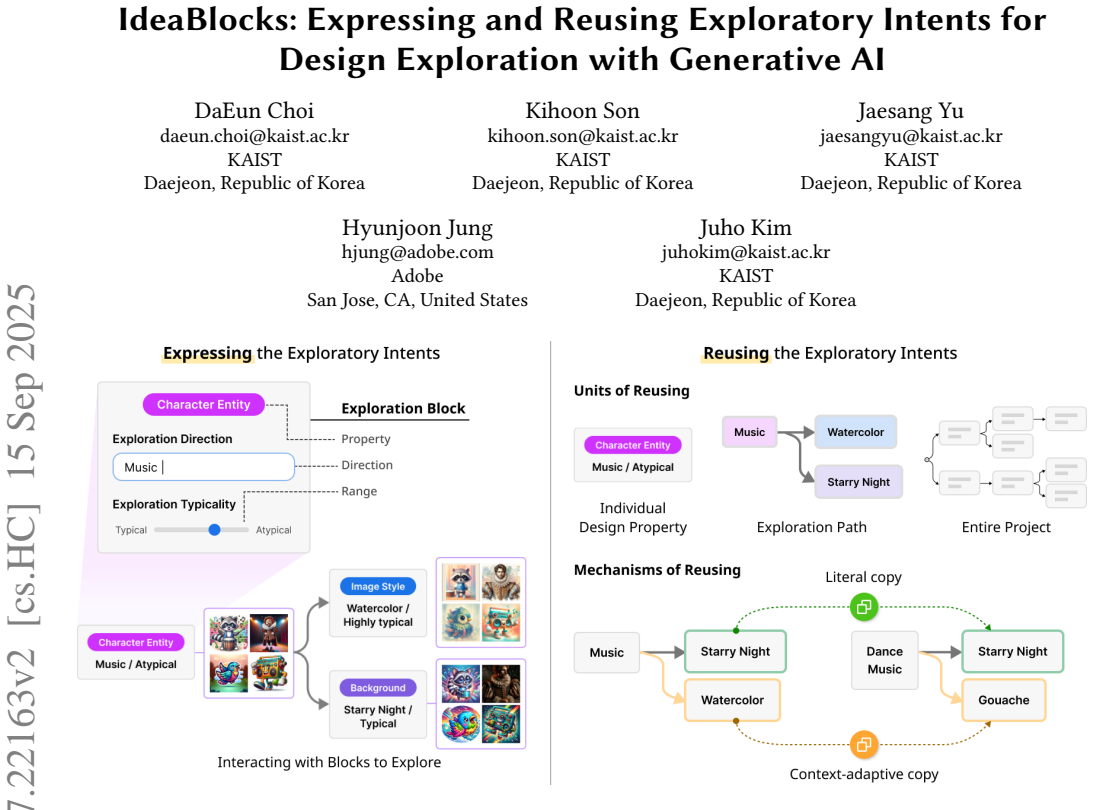
We define the anatomy of Divergent Intent as comprising property, direction, and range from a formative study with seven participants. IdeaBlocks lets users modularize these into Exploration Blocks that explicitly shape exploration boundaries and allow reuse of prior intents at multiple levels with literal or context-adaptive modes. In a comparative study with twelve participants, this produced 2.13 times more images explored and 12.5 percent greater visual diversity than the baseline, while a three-day deployment with six users showed distinct creative strategies from different reuse mechanisms.
What carries the argument
Exploration Blocks that modularize divergent intents (property, direction, range) and support multi-level reuse with literal or context-adaptive options.
If this is right
- Users can express open-ended search spaces instead of fixed targets for generative exploration.
- Multi-level reuse of successful strategies supports greater quantity and diversity of outputs.
- Different reuse mechanisms enable distinct creative strategies during design processes.
- Intent-aware interfaces can shift generative tools from convergence to effective divergence.
Where Pith is reading between the lines
- The block-based structure for intents could be tested in generative domains like 3D modeling or music composition.
- Repeated use might allow systems to learn and suggest personal libraries of divergent strategies over time.
- Pairing the reuse options with automated coherence checks could help maintain project consistency during broad exploration.
Load-bearing premise
The assumption that counting images explored and measuring their visual diversity accurately captures effective divergence in graphic design.
What would settle it
A follow-up study with professional designers on varied tasks that finds no increase in image count or visual diversity when using IdeaBlocks versus a standard interface.
Figures


read the original abstract
While designers increasingly leverage Generative AI for divergent exploration, current interaction is optimized for convergent refinement, forcing users to specify fixed targets rather than open-ended search spaces. Based on a formative study (N=7), we define the anatomy of Divergent Intent, comprising property, direction, and range, and identified two critical barriers: the lack of mechanisms to explicitly shape the parametric boundaries of exploration and the difficulty of reusing successful search strategies. We present IdeaBlocks, where users can modularize divergent intents into Exploration Blocks. Users can reuse prior intents at multiple levels (block, path, and project) with options for literal or context-adaptive reuse. In our comparative study (N=12), participants using IdeaBlocks explored 2.13 times more images with 12.5% greater visual diversity than the baseline, demonstrating how structured intent expression and reuse support effective divergence. A three-day deployment study (N=6) further revealed how different reuse mechanisms allowed distinct creative strategies, offering design implications for future intent-aware creativity supports.
Editorial analysis
A structured set of objections, weighed in public.
Referee Report
Summary. The paper presents IdeaBlocks, a system for graphic design exploration with generative AI that modularizes divergent intents (defined as comprising property, direction, and range from a formative study with N=7) into Exploration Blocks. Users can reuse intents at block, path, and project levels with literal or context-adaptive options. A comparative study (N=12) reports that IdeaBlocks users explored 2.13 times more images with 12.5% greater visual diversity than a baseline, while a three-day deployment study (N=6) illustrates distinct creative strategies enabled by the reuse mechanisms, yielding design implications for intent-aware creativity support tools.
Significance. If the central quantitative claims hold after addressing measurement details, the work offers a concrete contribution to HCI and generative design tools by shifting interaction from convergent refinement to structured divergent exploration. The empirical approach via controlled and deployment studies provides falsifiable outcomes on exploration volume and diversity, along with reusable design patterns for intent expression that could inform future systems.
major comments (2)
- [Comparative study] Comparative study section: The claim that structured intent expression and reuse support 'effective divergence' rests on the reported 2.13× increase in image count and 12.5% greater visual diversity, yet the manuscript provides no details on the visual diversity computation method (e.g., image features, distance metric, or aggregation), statistical tests performed, or exclusion criteria for the N=12 participants. These omissions make the quantitative support for the central claim only partially verifiable.
- [Abstract and results] Abstract and results sections: The interpretation of higher image counts and visual diversity as evidence of effective divergence lacks supporting measures such as expert-rated output quality, intent-fulfillment scores, or correlations between exploration volume and final design success. Without these, the leap from quantity/diversity metrics (operationalized from the N=7 formative study) to effectiveness remains an untested assumption that is load-bearing for the paper's conclusions.
minor comments (1)
- [System description] The description of reuse mechanisms (literal vs. context-adaptive) would benefit from a clarifying diagram or pseudocode example showing how context adaptation is implemented at the project level.
Simulated Author's Rebuttal
We thank the referee for their detailed and constructive comments on our manuscript. We believe the feedback will help improve the clarity and verifiability of our contributions. We address each major comment below, indicating the revisions we plan to make.
read point-by-point responses
-
Referee: [Comparative study] Comparative study section: The claim that structured intent expression and reuse support 'effective divergence' rests on the reported 2.13× increase in image count and 12.5% greater visual diversity, yet the manuscript provides no details on the visual diversity computation method (e.g., image features, distance metric, or aggregation), statistical tests performed, or exclusion criteria for the N=12 participants. These omissions make the quantitative support for the central claim only partially verifiable.
Authors: We agree that additional methodological details are necessary to fully verify the quantitative results. In the revised manuscript, we will expand the Comparative Study section to include a precise description of the visual diversity computation method (including image features, distance metric, and aggregation), the statistical tests performed, and the participant exclusion criteria (or confirmation that none were applied). These additions will make the support for our central claim fully verifiable. revision: yes
-
Referee: [Abstract and results] Abstract and results sections: The interpretation of higher image counts and visual diversity as evidence of effective divergence lacks supporting measures such as expert-rated output quality, intent-fulfillment scores, or correlations between exploration volume and final design success. Without these, the leap from quantity/diversity metrics (operationalized from the N=7 formative study) to effectiveness remains an untested assumption that is load-bearing for the paper's conclusions.
Authors: We appreciate this point and acknowledge that our evidence for 'effective divergence' relies primarily on the objective metrics of exploration volume and visual diversity, which were operationalized based on the formative study's definition of divergent intent. The three-day deployment study provides qualitative insights into how reuse mechanisms enable distinct creative strategies. However, we did not collect expert-rated quality or intent-fulfillment scores, as our focus was on demonstrating increased exploration rather than evaluating output quality. In the revision, we will add a limitations section explicitly discussing this scope and the assumption that greater volume and diversity indicate effective divergence in the context of our formative findings. We will also suggest future work to incorporate such measures. We maintain that the current results provide valuable evidence for the benefits of structured intent expression, but will clarify the boundaries of our claims. revision: partial
- We cannot add new quantitative measures such as expert-rated output quality or intent-fulfillment scores without new data collection, as these were not part of the original study design.
Circularity Check
No circularity: empirical results from independent user studies
full rationale
The paper grounds its claims in three separate user studies (formative N=7 to define Divergent Intent anatomy, comparative N=12 measuring image count and visual diversity, deployment N=6 for reuse strategies) without any mathematical derivations, fitted parameters, or predictions that reduce to the inputs by construction. Metrics are directly observed and operationalized from study data rather than self-defined or renamed as predictions; no self-citation chains, uniqueness theorems, or ansatzes are load-bearing for the central results. The work is self-contained against external benchmarks via reported study protocols and participant outcomes.
Axiom & Free-Parameter Ledger
axioms (1)
- domain assumption Small-N formative and comparative studies (N=7, N=12, N=6) can identify general barriers and validate interaction mechanisms in creativity support tools.
Lean theorems connected to this paper
-
IndisputableMonolith/Foundation/AbsoluteFloorClosure.leanreality_from_one_distinction unclear?
unclearRelation between the paper passage and the cited Recognition theorem.
we define the anatomy of Divergent Intent, comprising property, direction, and range... Exploration Blocks... typicality slider... reuse at multiple levels (block, path, and project) with options for literal or context-adaptive reuse
-
IndisputableMonolith/Cost/FunctionalEquation.leanwashburn_uniqueness_aczel unclear?
unclearRelation between the paper passage and the cited Recognition theorem.
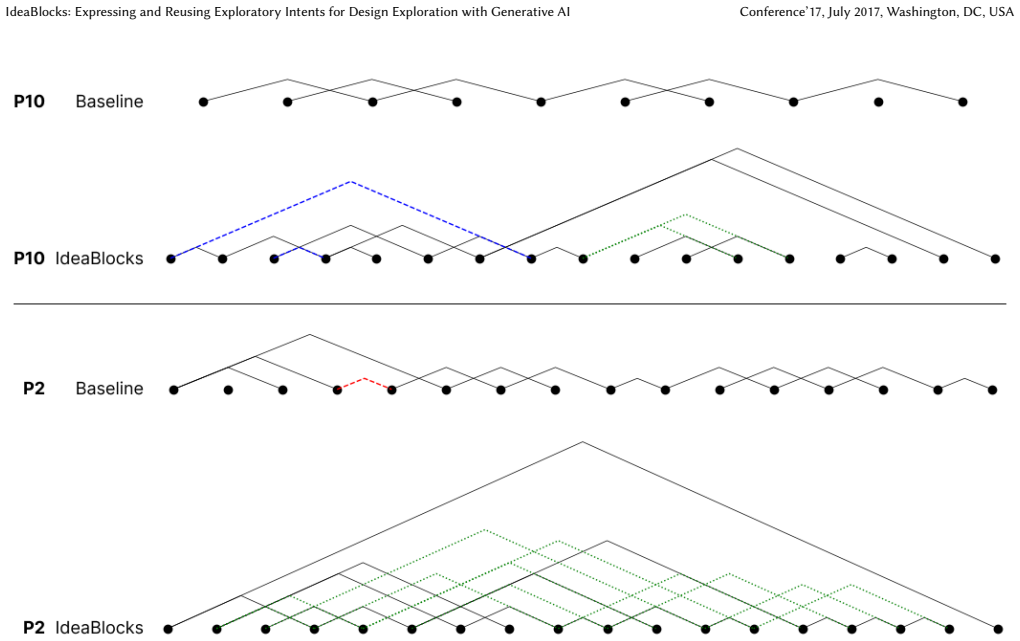
12.5% greater visual diversity... linkography analysis... higher entropy
What do these tags mean?
- matches
- The paper's claim is directly supported by a theorem in the formal canon.
- supports
- The theorem supports part of the paper's argument, but the paper may add assumptions or extra steps.
- extends
- The paper goes beyond the formal theorem; the theorem is a base layer rather than the whole result.
- uses
- The paper appears to rely on the theorem as machinery.
- contradicts
- The paper's claim conflicts with a theorem or certificate in the canon.
- unclear
- Pith found a possible connection, but the passage is too broad, indirect, or ambiguous to say the theorem truly supports the claim.
Reference graph
Works this paper leans on
-
[1]
Krzysztof Adamkiewicz, Paweł Wojciech Woźniak, Julia Dominiak, Andrzej Ro- manowski, Jakob Karolus, and Stanislav Frolov. 2025. PromptMap: An Alternative Interaction Style for AI-Based Image Generation. InProceedings of the 30th Interna- tional Conference on Intelligent User Interfaces (IUI ’25). Association for Computing Machinery, New York, NY, USA, 116...
-
[2]
Zamfirescu-Pereira, Kyu Won Kim, Pradeep Mani Rathnam, and Bjoern Hartmann
Shm Garanganao Almeda, J.D. Zamfirescu-Pereira, Kyu Won Kim, Pradeep Mani Rathnam, and Bjoern Hartmann. 2024. Prompting for Discovery: Flex- ible Sense-Making for AI Art-Making with Dreamsheets. InProceedings of the 2024 CHI Conference on Human Factors in Computing Systems(Honolulu, HI, USA) (CHI ’24). Association for Computing Machinery, New York, NY, US...
-
[3]
Gabriela Goldschmidt and. 2016. Linkographic Evidence for Concurrent Divergent and Convergent Thinking in Creative Design.Creativity Re- search Journal28, 2 (2016), 115–122. doi:10.1080/10400419.2016.1162497 arXiv:https://doi.org/10.1080/10400419.2016.1162497
-
[4]
Tyler Angert, Miroslav Suzara, Jenny Han, Christopher Pondoc, and Hariharan Subramonyam. 2023. Spellburst: A Node-based Interface for Exploratory Creative Coding with Natural Language Prompts. InProceedings of the 36th Annual ACM Symposium on User Interface Software and Technology(San Francisco, CA, USA) (UIST ’23). Association for Computing Machinery, Ne...
-
[5]
Michel Beaudouin-Lafon. 2000. Instrumental interaction: an interaction model for designing post-WIMP user interfaces. InProceedings of the SIGCHI Conference on Human Factors in Computing Systems(The Hague, The Netherlands)(CHI ’00). Association for Computing Machinery, New York, NY, USA, 446–453. doi:10. 1145/332040.332473
-
[6]
Stephen Brade, Bryan Wang, Mauricio Sousa, Sageev Oore, and Tovi Grossman
-
[7]
In: Proceedings of the 36th Annual ACM Symposium on User Interface Software and Technology
Promptify: Text-to-Image Generation through Interactive Prompt Explo- ration with Large Language Models. InProceedings of the 36th Annual ACM Symposium on User Interface Software and Technology(San Francisco, CA, USA) (UIST ’23). Association for Computing Machinery, New York, NY, USA, Article 96, 14 pages. doi:10.1145/3586183.3606725
- [8]
-
[9]
Dennis R. Brophy. 2001. Comparing the Attributes, Activities, and Perfor- mance of Divergent, Convergent, and Combination Thinkers.Creativity Re- search Journal13, 3-4 (2001), 439–455. doi:10.1207/S15326934CRJ1334_20 arXiv:https://doi.org/10.1207/S15326934CRJ1334_20
-
[10]
Alice Cai, Steven R Rick, Jennifer L Heyman, Yanxia Zhang, Alexandre Filipowicz, Matthew Hong, Matt Klenk, and Thomas Malone. 2023. DesignAID: Using Gener- ative AI and Semantic Diversity for Design Inspiration. InProceedings of The ACM Collective Intelligence Conference(Delft, Netherlands)(CI ’23). Association for Computing Machinery, New York, NY, USA, ...
-
[11]
Tracy Cassidy. 2011. The Mood Board Process Modeled and Un- derstood as a Qualitative Design Research Tool.Fashion Prac- tice3, 2 (2011), 225–251. doi:10.2752/175693811X13080607764854 arXiv:https://doi.org/10.2752/175693811X13080607764854
-
[12]
Erin Cherry and Celine Latulipe. 2014. Quantifying the Creativity Support of Digital Tools through the Creativity Support Index.ACM Trans. Comput.-Hum. Interact.21, 4, Article 21 (jun 2014), 25 pages. doi:10.1145/2617588
-
[13]
DaEun Choi, Sumin Hong, Jeongeon Park, John Joon Young Chung, and Juho Kim. 2024. CreativeConnect: Supporting Reference Recombination for Graphic Design Ideation with Generative AI. InProceedings of the 2024 CHI Conference on Human Factors in Computing Systems(Honolulu, HI, USA)(CHI ’24). Association for Computing Machinery, New York, NY, USA, Article 105...
- [14]
-
[15]
John Joon Young Chung and Eytan Adar. 2023. Artinter: AI-Powered Boundary Objects for Commissioning Visual Arts. InProceedings of the 2023 ACM Designing Interactive Systems Conference(Pittsburgh, PA, USA)(DIS ’23). Association for Computing Machinery, New York, NY, USA, 1997–2018. doi:10.1145/3563657. 3595961
-
[16]
John Joon Young Chung and Max Kreminski. 2024. Patchview: LLM-powered Worldbuilding with Generative Dust and Magnet Visualization. InProceedings of the 37th Annual ACM Symposium on User Interface Software and Technology (Pittsburgh, PA, USA)(UIST ’24). Association for Computing Machinery, New York, NY, USA, Article 77, 19 pages. doi:10.1145/3654777.3676352
-
[17]
Gregory Thomas Croisdale, John Joon Young Chung, Emily Huang, Gage Birch- meier, Xu Wang, and Anhong Guo. 2023. DeckFlow: A Card Game Interface for Exploring Generative Model Flows. InAdjunct Proceedings of the 36th Annual ACM Symposium on User Interface Software and Technology(San Francisco, CA, USA)(UIST ’23 Adjunct). Association for Computing Machinery...
-
[18]
Claudia Eckert and Martin Stacey. 2000. Sources of inspiration: a language of design.Design studies21, 5 (2000), 523–538
work page 2000
-
[19]
Ronald A. Finke, Thomas B. Ward, and Steven M. Smith. 1992.Creative Cognition: Theory, Research, and Applications. The MIT Press. doi:10.7551/mitpress/7722. 001.0001
-
[20]
Leilei Gan, Zhiyang Teng, Yue Zhang, Linchao Zhu, Fei Wu, and Yi Yang
-
[21]
doi:10.1109/TASLP.2022.3197316
SemGloVe: Semantic Co-Occurrences for GloVe From BERT.IEEE/ACM Transactions on Audio, Speech, and Language Processing30 (2022), 2696–2704. doi:10.1109/TASLP.2022.3197316
-
[22]
Frederic Gmeiner, Nicolai Marquardt, Michael Bentley, Hugo Romat, Michel Pahud, David Brown, Asta Roseway, Nikolas Martelaro, Kenneth Holstein, Ken Hinckley, et al . 2025. Intent Tagging: Exploring Micro-Prompting In- teractions for Supporting Granular Human-GenAI Co-Creation Workflows. arXiv:2502.18737 [cs.HC] https://arxiv.org/abs/2502.18737
-
[23]
2014.Linkography: unfolding the design process
Gabriela Goldschmidt. 2014.Linkography: unfolding the design process. Mit Press
work page 2014
-
[24]
Meera Hahn, Wenjun Zeng, Nithish Kannen, Rich Galt, Kartikeya Badola, Been Kim, and Zi Wang. 2024. Proactive Agents for Multi-Turn Text-to-Image Genera- tion Under Uncertainty. arXiv:2412.06771 [cs.AI] https://arxiv.org/abs/2412.06771 Conference’17, July 2017, Washington, DC, USA Choi et al
-
[25]
Sandra G. Hart and Lowell E. Staveland. 1988. Development of NASA-TLX (Task Load Index): Results of Empirical and Theoretical Research. InHuman Mental Workload, Peter A. Hancock and Najmedin Meshkati (Eds.). Advances in Psychology, Vol. 52. North-Holland, 139–183. doi:10.1016/S0166-4115(08)62386-9
-
[26]
Herring, Chia-Chen Chang, Jesse Krantzler, and Brian P
Scarlett R. Herring, Chia-Chen Chang, Jesse Krantzler, and Brian P. Bailey. 2009. Getting Inspired! Understanding How and Why Examples Are Used in Creative Design Practice. InProceedings of the SIGCHI Conference on Human Factors in Computing Systems(Boston, MA, USA)(CHI ’09). Association for Computing Machinery, New York, NY, USA, 87–96. doi:10.1145/15187...
-
[27]
Alexander Ivanov, David Ledo, Tovi Grossman, George Fitzmaurice, and Fraser Anderson. 2022. MoodCubes: Immersive Spaces for Collecting, Discovering and Envisioning Inspiration Materials. InProceedings of the 2022 ACM Designing Interactive Systems Conference(Virtual Event, Australia)(DIS ’22). Association for Computing Machinery, New York, NY, USA, 189–203...
-
[28]
Merrill, Kristi E Gamarel, and Oliver L
Youngseung Jeon, Seungwan Jin, Patrick C. Shih, and Kyungsik Han. 2021. Fash- ionQ: An AI-Driven Creativity Support Tool for Facilitating Ideation in Fashion Design. InProceedings of the 2021 CHI Conference on Human Factors in Computing Systems(Yokohama, Japan)(CHI ’21). Association for Computing Machinery, New York, NY, USA, Article 576, 18 pages. doi:10...
-
[29]
Peiling Jiang, Jude Rayan, Steven P. Dow, and Haijun Xia. 2023. Graphologue: Exploring Large Language Model Responses with Interactive Diagrams. InPro- ceedings of the 36th Annual ACM Symposium on User Interface Software and Technology(San Francisco, CA, USA)(UIST ’23). Association for Computing Machinery, New York, NY, USA, Article 3, 20 pages. doi:10.11...
-
[30]
Youwen Kang, Zhida Sun, Sitong Wang, Zeyu Huang, Ziming Wu, and Xiao- juan Ma. 2021. MetaMap: Supporting Visual Metaphor Ideation through Multi- dimensional Example-based Exploration. InProceedings of the 2021 CHI Con- ference on Human Factors in Computing Systems(Yokohama, Japan)(CHI ’21). Association for Computing Machinery, New York, NY, USA, Article 4...
-
[31]
Kevin Gonyop Kim, Richard Lee Davis, Alessia Eletta Coppi, Alberto Cattaneo, and Pierre Dillenbourg. 2022. Mixplorer: Scaffolding Design Space Exploration through Genetic Recombination of Multiple Peoples’ Designs to Support Novices’ Creativity. InProceedings of the 2022 CHI Conference on Human Factors in Com- puting Systems(New Orleans, LA, USA)(CHI ’22)...
-
[32]
Tae Soo Kim, DaEun Choi, Yoonseo Choi, and Juho Kim. 2022. Stylette: Styling the Web with Natural Language. InProceedings of the 2022 CHI Conference on Human Factors in Computing Systems(New Orleans, LA, USA)(CHI ’22). Association for Computing Machinery, New York, NY, USA, Article 5, 17 pages. doi:10.1145/ 3491102.3501931
-
[33]
Tae Soo Kim, Yoonjoo Lee, Minsuk Chang, and Juho Kim. 2023. Cells, Gen- erators, and Lenses: Design Framework for Object-Oriented Interaction with Large Language Models. InProceedings of the 36th Annual ACM Symposium on User Interface Software and Technology(San Francisco, CA, USA)(UIST ’23). As- sociation for Computing Machinery, New York, NY, USA, Artic...
-
[34]
Hyung-Kwon Ko, Gwanmo Park, Hyeon Jeon, Jaemin Jo, Juho Kim, and Jinwook Seo. 2023. Large-Scale Text-to-Image Generation Models for Visual Artists’ Creative Works. InProceedings of the 28th International Conference on Intelligent User Interfaces(Sydney, NSW, Australia)(IUI ’23). Association for Computing Machinery, New York, NY, USA, 919–933. doi:10.1145/...
-
[35]
If the Machine Is As Good As Me, Then What Use Am I?
Charlotte Kobiella, Yarhy Said Flores López, Franz Waltenberger, Fiona Draxler, and Albrecht Schmidt. 2024. "If the Machine Is As Good As Me, Then What Use Am I?" – How the Use of ChatGPT Changes Young Professionals’ Perception of Productivity and Accomplishment. InProceedings of the 2024 CHI Conference on Human Factors in Computing Systems(Honolulu, HI, ...
-
[36]
Janin Koch, Andrés Lucero, Lena Hegemann, and Antti Oulasvirta. 2019. May AI? Design Ideation with Cooperative Contextual Bandits. InProceedings of the 2019 CHI Conference on Human Factors in Computing Systems(Glasgow, Scotland Uk)(CHI ’19). Association for Computing Machinery, New York, NY, USA, 1–12. doi:10.1145/3290605.3300863
-
[37]
Janin Koch, Nicolas Taffin, Andrés Lucero, and Wendy E. Mackay. 2020. Se- manticCollage: Enriching Digital Mood Board Design with Semantic Labels. In Proceedings of the 2020 ACM Designing Interactive Systems Conference(Eindhoven, Netherlands)(DIS ’20). Association for Computing Machinery, New York, NY, USA, 407–418. doi:10.1145/3357236.3395494
-
[38]
Brian Lee, Savil Srivastava, Ranjitha Kumar, Ronen Brafman, and Scott R. Klem- mer. 2010. Designing with Interactive Example Galleries. InProceedings of the SIGCHI Conference on Human Factors in Computing Systems(Atlanta, Georgia, USA)(CHI ’10). Association for Computing Machinery, New York, NY, USA, 2257–2266. doi:10.1145/1753326.1753667
-
[39]
Vivian Liu, Han Qiao, and Lydia Chilton. 2022. Opal: Multimodal Image Gener- ation for News Illustration. InProceedings of the 35th Annual ACM Symposium on User Interface Software and Technology(Bend, OR, USA)(UIST ’22). Asso- ciation for Computing Machinery, New York, NY, USA, Article 73, 17 pages. doi:10.1145/3526113.3545621
-
[40]
Y.-C. Liu, A. Chakrabarti, and T. Bligh. 2003. Towards an ‘ideal’ approach for concept generation.Design Studies24, 4 (2003), 341–355. doi:10.1016/S0142- 694X(03)00003-6
-
[41]
Andrés Lucero. 2015. Funky-Design-Spaces: Interactive Environments for Creativ- ity Inspired by Observing Designers Making Mood Boards. InHuman-Computer Interaction – INTERACT 2015, Julio Abascal, Simone Barbosa, Mirko Fetter, Tom Gross, Philippe Palanque, and Marco Winckler (Eds.). Springer International Publishing, Cham, 474–492
work page 2015
-
[42]
Atefeh Mahdavi Goloujeh, Anne Sullivan, and Brian Magerko. 2024. Is It AI or Is It Me? Understanding Users’ Prompt Journey with Text-to-Image Generative AI Tools. InProceedings of the 2024 CHI Conference on Human Factors in Computing Systems(Honolulu, HI, USA)(CHI ’24). Association for Computing Machinery, New York, NY, USA, Article 183, 13 pages. doi:10....
-
[43]
Justin Matejka, Michael Glueck, Erin Bradner, Ali Hashemi, Tovi Grossman, and George Fitzmaurice. 2018. Dream Lens: Exploration and Visualization of Large-Scale Generative Design Datasets. InProceedings of the 2018 CHI Conference on Human Factors in Computing Systems(Montreal QC, Canada) (CHI ’18). Association for Computing Machinery, New York, NY, USA, 1...
-
[44]
Felix Müller-Wienbergen, Oliver Müller, Stefan Seidel, and Jörg Becker. 2011. Leaving the beaten tracks in creative work–A design theory for systems that sup- port convergent and divergent thinking.Journal of the Association for Information Systems12, 11 (2011), 2
work page 2011
-
[45]
Xiaohan Peng, Janin Koch, and Wendy E. Mackay. 2024. DesignPrompt: Using Multimodal Interaction for Design Exploration with Generative AI. InProceedings of the 2024 ACM Designing Interactive Systems Conference(Copenhagen, Denmark) (DIS ’24). Association for Computing Machinery, New York, NY, USA, 804–818. doi:10.1145/3643834.3661588
-
[46]
Yingzhe Peng, Xiaoting Qin, Zhiyang Zhang, Jue Zhang, Qingwei Lin, Xu Yang, Dongmei Zhang, Saravan Rajmohan, and Qi Zhang. 2025. Navigating the Un- known: A Chat-Based Collaborative Interface for Personalized Exploratory Tasks. InProceedings of the 30th International Conference on Intelligent User Interfaces (IUI ’25). Association for Computing Machinery,...
-
[47]
Jeffrey Pennington, Richard Socher, and Christopher Manning. 2014. GloVe: Global Vectors for Word Representation. InProceedings of the 2014 Conference on Empirical Methods in Natural Language Processing (EMNLP), Alessandro Moschitti, Bo Pang, and Walter Daelemans (Eds.). Association for Computational Linguistics, Doha, Qatar, 1532–1543. doi:10.3115/v1/D14-1162
-
[48]
Dustin Podell, Zion English, Kyle Lacey, Andreas Blattmann, Tim Dockhorn, Jonas Müller, Joe Penna, and Robin Rombach. 2023. SDXL: Improving Latent Diffusion Models for High-Resolution Image Synthesis. arXiv:2307.01952 [cs.CV] https://arxiv.org/abs/2307.01952
work page internal anchor Pith review Pith/arXiv arXiv 2023
-
[49]
Michael Polanyi. 2009. The tacit dimension. InKnowledge in organisations. Routledge, 135–146
work page 2009
-
[50]
Alec Radford, Jong Wook Kim, Chris Hallacy, Aditya Ramesh, Gabriel Goh, Sandhini Agarwal, Girish Sastry, Amanda Askell, Pamela Mishkin, Jack Clark, Gretchen Krueger, and Ilya Sutskever. 2021. Learning Transferable Visual Models From Natural Language Supervision. InProceedings of the 38th Inter- national Conference on Machine Learning (Proceedings of Machi...
work page 2021
-
[51]
Nils Reimers and Iryna Gurevych. 2019. Sentence-BERT: Sentence Embeddings using Siamese BERT-Networks. arXiv:1908.10084 [cs.CL] https://arxiv.org/abs/ 1908.10084
work page internal anchor Pith review Pith/arXiv arXiv 2019
-
[52]
Nathalie Riche, Anna Offenwanger, Frederic Gmeiner, David Brown, Hugo Romat, Michel Pahud, Nicolai Marquardt, Kori Inkpen, and Ken Hinckley. 2025. AI- Instruments: Embodying Prompts as Instruments to Abstract & Reflect Graphical Interface Commands as General-Purpose Tools. arXiv:2502.18736 [cs.HC] https: //arxiv.org/abs/2502.18736
-
[53]
Daniel Ritchie, Ankita Arvind Kejriwal, and Scott R. Klemmer. 2011. D.Tour: Style-Based Exploration of Design Example Galleries. InProceedings of the 24th Annual ACM Symposium on User Interface Software and Technology(Santa Barbara, California, USA)(UIST ’11). Association for Computing Machinery, New York, NY, USA, 165–174. doi:10.1145/2047196.2047216
- [54]
- [55]
-
[56]
Ben Shneiderman. 2007. Creativity support tools: accelerating discovery and innovation.Commun. ACM50, 12 (Dec. 2007), 20–32. doi:10.1145/1323688. 1323689
-
[57]
Herbert A Simon. 1996. The Sciences of the Artificial (3e éd.). IdeaBlocks: Expressing and Reusing Exploratory Intents for Design Exploration with Generative AI Conference’17, July 2017, Washington, DC, USA
work page 1996
-
[58]
Amy Smith, Barrett R. Anderson, Jasmine Tan Otto, Isaac Karth, Yuqian Sun, John Joon Young Chung, Melissa Roemmele, and Max Kreminski. 2025. Fuzzy Linkography: Automatic Graphical Summarization of Creative Activity Traces. arXiv:2502.04599 [cs.HC] https://arxiv.org/abs/2502.04599
-
[60]
Kihoon Son, DaEun Choi, Tae Soo Kim, Young-Ho Kim, and Juho Kim. 2024. GenQuery: Supporting Expressive Visual Search with Generative Models. In Proceedings of the 2024 CHI Conference on Human Factors in Computing Systems (Honolulu, HI, USA)(CHI ’24). Association for Computing Machinery, New York, NY, USA, Article 180, 19 pages. doi:10.1145/3613904.3642847
-
[61]
Sangho Suh, Meng Chen, Bryan Min, Toby Jia-Jun Li, and Haijun Xia. 2024. Luminate: Structured Generation and Exploration of Design Space with Large Language Models for Human-AI Co-Creation. InProceedings of the 2024 CHI Conference on Human Factors in Computing Systems(Honolulu, HI, USA)(CHI ’24). Association for Computing Machinery, New York, NY, USA, Art...
-
[62]
Sangho Suh, Bryan Min, Srishti Palani, and Haijun Xia. 2023. Sensecape: En- abling Multilevel Exploration and Sensemaking with Large Language Models. InProceedings of the 36th Annual ACM Symposium on User Interface Software and Technology(San Francisco, CA, USA)(UIST ’23). Association for Computing Machinery, New York, NY, USA, Article 1, 18 pages. doi:10...
-
[63]
Michael Terry and Elizabeth D. Mynatt. 2002. Recognizing creative needs in user interface design. InProceedings of the 4th Conference on Creativity & Cognition (Loughborough, UK)(C&C ’02). Association for Computing Machinery, New York, NY, USA, 38–44. doi:10.1145/581710.581718
-
[64]
In: Proceedings of the 2024 CHI Confer- ence on Human Factors in Computing Systems
Samangi Wadinambiarachchi, Ryan M. Kelly, Saumya Pareek, Qiushi Zhou, and Eduardo Velloso. 2024. The Effects of Generative AI on Design Fixation and Divergent Thinking. InProceedings of the 2024 CHI Conference on Human Factors in Computing Systems(Honolulu, HI, USA)(CHI ’24). Association for Computing Machinery, New York, NY, USA, Article 380, 18 pages. d...
-
[65]
Sitong Wang, Savvas Petridis, Taeahn Kwon, Xiaojuan Ma, and Lydia B Chilton
-
[66]
PopBlends: Strategies for Conceptual Blending with Large Language Models. InProceedings of the 2023 CHI Conference on Human Factors in Computing Systems (Hamburg, Germany)(CHI ’23). Association for Computing Machinery, New York, NY, USA, Article 435, 19 pages. doi:10.1145/3544548.3580948
-
[67]
Yunlong Wang, Shuyuan Shen, and Brian Y Lim. 2023. RePrompt: Automatic Prompt Editing to Refine AI-Generative Art Towards Precise Expressions. In Proceedings of the 2023 CHI Conference on Human Factors in Computing Systems (Hamburg, Germany)(CHI ’23). Association for Computing Machinery, New York, NY, USA, Article 22, 29 pages. doi:10.1145/3544548.3581402
-
[68]
Zhijie Wang, Yuheng Huang, Da Song, Lei Ma, and Tianyi Zhang. 2024. PromptCharm: Text-to-Image Generation through Multi-modal Prompting and Refinement. InProceedings of the 2024 CHI Conference on Human Factors in Com- puting Systems(Honolulu, HI, USA)(CHI ’24). Association for Computing Ma- chinery, New York, NY, USA, Article 185, 21 pages. doi:10.1145/36...
-
[69]
Zihan Yan, Chunxu Yang, Qihao Liang, and Xiang ’Anthony’ Chen. 2023. XCre- ation: A Graph-based Crossmodal Generative Creativity Support Tool. InProceed- ings of the 36th Annual ACM Symposium on User Interface Software and Technology (San Francisco, CA, USA)(UIST ’23). Association for Computing Machinery, New York, NY, USA, Article 48, 15 pages. doi:10.11...
-
[70]
Ryan Yen and Jian Zhao. 2024. Memolet: Reifying the Reuse of User-AI Con- versational Memories. InProceedings of the 37th Annual ACM Symposium on User Interface Software and Technology(Pittsburgh, PA, USA)(UIST ’24). Asso- ciation for Computing Machinery, New York, NY, USA, Article 58, 22 pages. doi:10.1145/3654777.3676388
-
[71]
Loutfouz Zaman, Wolfgang Stuerzlinger, Christian Neugebauer, Rob Woodbury, Maher Elkhaldi, Naghmi Shireen, and Michael Terry. 2015. GEM-NI: A System for Creating and Managing Alternatives In Generative Design. InProceedings of the 33rd Annual ACM Conference on Human Factors in Computing Systems(Seoul, Republic of Korea)(CHI ’15). Association for Computing...
-
[72]
Zamfirescu-Pereira, Richmond Y
J.D. Zamfirescu-Pereira, Richmond Y. Wong, Bjoern Hartmann, and Qian Yang
-
[73]
Why Johnny Can’t Prompt: How Non-AI Experts Try (and Fail) to Design LLM Prompts. InProceedings of the 2023 CHI Conference on Human Factors in Computing Systems(Hamburg, Germany)(CHI ’23). Association for Computing Machinery, New York, NY, USA, Article 437, 21 pages. doi:10.1145/3544548. 3581388
-
[74]
Xingchen Zeng, Ziyao Gao, Yilin Ye, and Wei Zeng. 2024. IntentTuner: An Interactive Framework for Integrating Human Intentions in Fine-tuning Text-to- Image Generative Models. InProceedings of the 2024 CHI Conference on Human Factors in Computing Systems(Honolulu, HI, USA)(CHI ’24). Association for Computing Machinery, New York, NY, USA, Article 182, 18 p...
-
[75]
Enhao Zhang and Nikola Banovic. 2021. Method for Exploring Generative Adversarial Networks (GANs) via Automatically Generated Image Galleries. In Proceedings of the 2021 CHI Conference on Human Factors in Computing Systems (Yokohama, Japan)(CHI ’21). Association for Computing Machinery, New York, NY, USA, Article 76, 15 pages. doi:10.1145/3411764.3445714
-
[76]
Lei Zhang, Jin Pan, Jacob Gettig, Steve Oney, and Anhong Guo. 2024. VRCopilot: Authoring 3D Layouts with Generative AI Models in VR. InProceedings of the 37th Annual ACM Symposium on User Interface Software and Technology(Pittsburgh, PA, USA)(UIST ’24). Association for Computing Machinery, New York, NY, USA, Article 96, 13 pages. doi:10.1145/3654777.3676451
-
[77]
Jiayi Zhou, Renzhong Li, Junxiu Tang, Tan Tang, Haotian Li, Weiwei Cui, and Yingcai Wu. 2024. Understanding Nonlinear Collaboration between Human and AI Agents: A Co-design Framework for Creative Design. InProceedings of the 2024 CHI Conference on Human Factors in Computing Systems(Honolulu, HI, USA) (CHI ’24). Association for Computing Machinery, New Yor...
-
[78]
How much do you understand how image generation AI models work?
Mingxu Zhou, Dengming Zhang, Weitao You, Ziqi Yu, Yifei Wu, Chenghao Pan, Huiting Liu, Tianyu Lao, and Pei Chen. 2024. StyleFactory: Towards Better Style Alignment in Image Creation through Style-Strength-Based Control and Evalua- tion. InProceedings of the 37th Annual ACM Symposium on User Interface Software and Technology(Pittsburgh, PA, USA)(UIST ’24)....
-
[80]
Direction (e.g., "Hippie") - This indicates the direction or theme that the user wants to diverge from within the property. # Task: IdeaBlocks: Expressing and Reusing Exploratory Intents for Design Exploration with Generative AI Conference’17, July 2017, Washington, DC, USA Your task is to generate 9 diverging directions. Direction variations must be spli...
work page 2017
-
[81]
4 Sub-directions – Directions that are subtypes of the direction
-
[82]
5 Unrelated Directions – Variations must be distinct, sharing no semantic similarity with each other. - Ensure the direction alternatives remain aligned with the property. - Ensure directional variations use clear, familiar terms and remain concise, avoiding unnecessary details. # Output Format Output should follow the JSON format: { "outputs": { "variati...
discussion (0)
Sign in with ORCID, Apple, or X to comment. Anyone can read and Pith papers without signing in.