REVIEW 2 major objections 5 minor 49 references
SourceSplice: Source Selection for Machine Learning Tasks
T0 review · 2 major / 5 minor · reviewed 2026-08-06 · deepseek-v4-flash
Pith's one-line read SourceSplice finds near-optimal training-source subsets with far fewer model trainings than exhaustive enumeration.
desk verdict Plausible heuristics for source subset selection, but the reported experiments never mention a held-out test set, so the central empirical claim of task utility is not yet supported. read the letter →
The pith
A machine-rendered reading of the paper's core claim, the machinery that carries it, and where it could break.
The reading
What carries the argument
The load-bearing mechanism is the swap valuation pair: for a source $s$ in the active set $A$, $\mathrm{rmVal}(s) = P(A) - P(A\setminus\{s\})$, and for $s$ in the inactive set $I$, $\mathrm{addVal}(s) = P(A\cup\{s\}) - P(A)$, where the profit $P(S) = G(S) - C(S)$ is gain (task utility) minus acquisition cost. SourceSplice sorts active sources by $\mathrm{rmVal}$ and inactive sources by $\mathrm{addVal}$, swaps the $k_{\mathrm{local}}$ lowest-$\mathrm{rmVal}$ active sources with the $k_{\mathrm{local}}$ highest-$\mathrm{addVal}$ inactive sources, increases $k_{\mathrm{local}}$ from 1 to the current subset size, and repeats the whole splicing loop for each subset size $i=1,\dots,s_{\max}$ (via the fixedSupport wrapper) until the active set stops changing. The 'gene splicing' name is a metaphor for these targeted exchanges; the algorithm's effectiveness rests on the assumption that marginal profits give reliable swap signals despite source interdependencies.
What would settle it
Take a small instance with 10 sources where the true profit $P(S)$ is computable for all 1,024 subsets, run SourceSplice across many random seeds, and compare its returned subset's profit to the exhaustive optimum; if a substantial fraction of runs land more than a few percent below the optimum, the claim that SourceSplice effectively identifies high-utility subsets is falsified.
Extended reading notes
Core claim
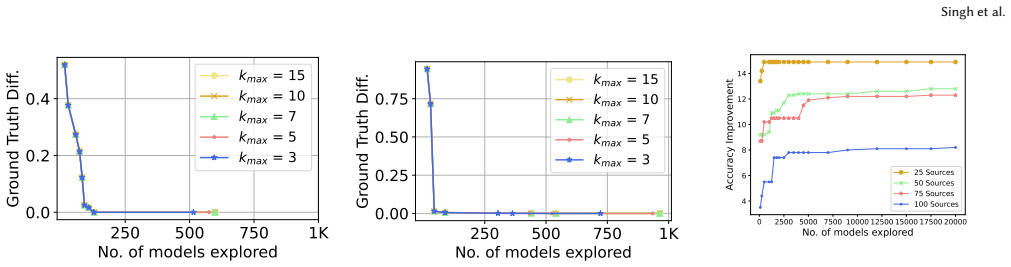
The central discovery is that a gene-splicing-style swap search over data sources finds source subsets whose task utility is effectively indistinguishable from the optimal subset for the classification, fairness, and regression tasks tested. The algorithm partitions sources into an active set and an inactive set, repeatedly removes the active source with the smallest marginal profit and adds the inactive source with the largest marginal profit, then repeats with an increasing number of swaps until the active set stabilizes. Across the ACSIncome, ACSPublicCoverage, and ACSTravelTime datasets, SourceSplice returned the ground-truth optimal subset in three of the five ML tasks and subset percentiles above 99.9 in the remaining ones, while training roughly 2% of the $2^{15}$ possible subsets. Under constrained training budgets it reaches the optimum with 16 to 32 times fewer model trainings than SourceGrasp and DSDM, and on a synthetic 100-source setup, exploring under 0.0003% of subsets yields a 13.5% accuracy improvement over using all sources.
Load-bearing premise
The methods assume every data source is a row-partition of a single relational table with the same schema, so any subset can be combined by concatenating rows and its utility measured by training a model on that concatenation; if sources have heterogeneous schemas, overlapping columns, or conflicting records, the marginal-profit swap valuations do not transfer.
Editorial extensions
If this is right
- A data scientist with 15 candidate sources can approximate the exhaustive optimum by training on the order of a few hundred subsets instead of 32,768, making utility-driven source selection practical in real data-discovery workflows.
- The same swap procedure can optimize composite objectives like accuracy plus group-fairness (true-positive-rate difference), not only raw accuracy or mean squared error, so source selection can serve fairness-aware dataset construction.
- Under fixed compute budgets, SourceSplice converges to the best-possible subset with 16 to 32 times fewer model trainings than SourceGrasp and DSDM in the tested settings.
- The method scales to larger source collections: with 100 synthetic sources, exploring under 0.0003% of the subset space still yields a 13.5% accuracy improvement over using all sources.
- Because SourceSplice explores all subset sizes up to $s_{\max}$, it can recover optimal subsets of very small cardinality, such as a single best source, that pure greedy addition would miss.
Reading between the lines
- Editorial inference: the swap valuations could be reused with a cheap surrogate of gain—for instance, a datamodel that predicts subset profit without retraining—so the same splicing loop could operate in a budget regime where even a few hundred real trainings are too many.
- Editorial inference: if task utility is submodular in sources, the marginal-profit swap signals are well-behaved and the procedure resembles a local-search guarantee; the paper's experiments are consistent with such behavior but the authors do not state or test submodularity.
- Editorial inference: the flat sensitivity to the maximum swap count suggests the swap heuristic is a robust inner loop for other subset-selection problems—feature selection, table union search, or data-augmentation pipelines—where the same active/inactive partition and valuation equations apply.
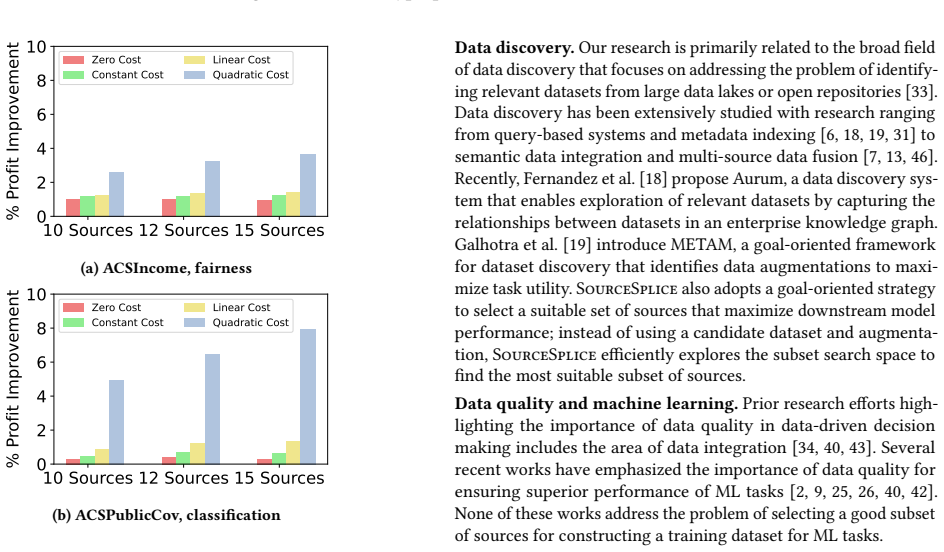
- Editorial inference: the cost-function experiments show relative profit gains grow as acquisition costs become more complex, implying the method's practical benefit may be largest when data sources are expensive and acquired per source.
Editorial analysis
A structured set of objections, weighed in public.
Referee Report
Summary. The paper formalizes a source-selection problem: given a set of data sources S and a supervised learning task, choose a subset S* maximizing profit P(S)=G(S)-C(S), where G(S) is a task-utility gain and C(S) is an acquisition cost. It proposes two heuristics: SourceGrasp, a GRASP-style greedy randomized construction with local search, and SourceSplice, an iterative active/inactive-set swapping procedure inspired by gene splicing. Experiments on ACSIncome, ACSPublicCoverage, and ACSTravelTime, with 15 sources obtained by partitioning the data by U.S. state, plus synthetic benchmarks, compare subset percentile, number of models explored, and runtime against exhaustive Naive, Greedy, Random, and DsDM baselines. The authors report that SourceSplice reaches near-optimal subset percentiles with far fewer model trainings and lower runtime than SourceGrasp and DsDM, and they provide ablations for s_max, k_max, cost functions, and scalability.
Significance. If the empirical claims held, the paper would offer a practically useful heuristic: a data scientist could choose a high-quality training-source subset with a few hundred model trainings instead of enumerating 2^15 combinations. The paper has clear strengths: an exhaustive ground-truth baseline over all subsets, a public code repository, and an evaluation metric (subset percentile) that directly measures performance against exhaustive search on the paper's own objective. However, the current manuscript does not establish that the optimized quantity is held-out task performance. Section 5.1.3 defines accuracy, TPR, and MSE without any reference to a test set, and Section 5.1.1 describes only full ACS tables partitioned by state, with no train/test split or cross-validation mentioned. The stress-test concern therefore lands directly: if G(S) is computed on the same rows used for training, the reported 'ground truth' optimum and all subset percentiles measure training-set fit rather than downstream task utility, which would not support the abstract's central claim.
major comments (2)
- [Section 5.1.3 and Section 5.1.1] No held-out evaluation protocol is specified anywhere in the experimental setup. Section 5.1.3 defines accuracy as 'the proportion of true predictions out of total predictions' and defines TPR and MSE without stating that predictions are made on a held-out test set, and Section 5.1.1 describes the ACS datasets only as full tables partitioned by state. If G(S) is evaluated on the same rows used to train the model, then the exhaustive Naive 'ground truth' and every subset percentile in Table 1 and Figures 3-8 are measuring in-sample fit, which is not 'task utility' for a downstream ML model and can be maximized by overfitting. This is load-bearing because the abstract's claim that SourceSplice 'effectively identifies subsets of data sources leading to high task utility' is unsupported without a specified split. Please state explicitly how every G(S) is evaluated, add held-out evaluation for all reported metrics, and use a nested protocol if the selection procedure itself uses validation performance.
- [Section 4, Algorithm 2 and Example 4.1] The pseudocode and the running example disagree on how source valuations are computed, and the pseudocode as written does not implement the described swap-by-valuation mechanism. First, lines 28 and 31 of Algorithm 2 use 'sorted(rmVal)' and 'sorted-reverse(addVal)' on dictionaries; in Python this sorts keys (source identifiers) rather than valuation values, so the algorithm would not actually remove the lowest-rmVal or add the highest-addVal sources. Second, lines 24-27 compute addVal(s) as P(A ∪ s) - P(A) before any removal, while Example 4.1 computes addVal(s5) = P({s1,s2,s3,s5}) - P({s1,s2,s3}) after removing s4, and the paragraph immediately after the example states that 's4 was already removed from A' before inactive-set valuations are computed. These two orderings can lead to different swap decisions. Since SourceSplice is the paper's main contribution, the pseudocode, example, and released code must be aligned, and the intended ordering (valuations before or after removals) must be stated explicitly.
minor comments (5)
- [Table 1] Table 1 reports averages over 10 executions for SourceGrasp and DsDM without standard deviations or confidence intervals; because several entries differ by less than 0.03 percentile, the claim that SourceSplice is 'comparable or better' is not supported at the reported precision.
- [Definition 2.3 and Section 5.3.5] The cost model in Definition 2.3 makes acquisition cost an increasing function of individual gain, and Section 5.3.5 only varies the exponent t of this self-defined cost formula; the conclusion that SourceSplice 'becomes more effective' for higher cost associations should be described as a sensitivity study of the chosen cost model rather than evidence about real-world acquisition costs.
- [Abstract and Section 5.1.1] The paper frames the problem for general data discovery, but the method assumes sources share one schema and are combined by row concatenation; please add an explicit limitation in Section 5.1.1 or the conclusions that the algorithms and experiments are evaluated for homogeneous relational partitions.
- [Example 2.6] Example 2.6 contains a typo: the second profit line repeats P({s1,s7}); it should refer to P({s4,s7}).
- [Section 5.2.2 and Figure 3] The text says Figure 3 shows total time for 15 sources, but the x-axis of Figure 3 shows 10, 12, and 15 sources; please clarify the intended setup.
Circularity Check
No significant circularity: both proposed algorithms evaluate the objective G(S) directly by training models on candidate subsets and comparing against a brute-force optimum; there is no fitted surrogate or load-bearing self-citation.
full rationale
SourceGrasp (Section 3) computes marginal gains as G(Selected ∪ s) - G(Selected) - C(s), and SourceSplice (Section 4) computes rmVal(s) = P(A) - P(A without s) and addVal(s) = P(A ∪ s) - P(A), where P(S) = G(S) - C(S) is the actual objective from Definition 2.5. Every valuation is an exact evaluation of the objective on a concrete subset; no parameter is fitted and then renamed as a prediction. The best subset is selected by directly comparing these measured profits, and effectiveness is reported as a percentile against the exhaustive Naive optimum computed with the same objective (Section 5.1.4, Table 1). The DsDM baseline does use a learned surrogate to predict subset utility, but it is a competing method, not the paper's contribution, and the SourceSplice efficiency claims are based on counting actual model trainings (Figure 4). There are no load-bearing self-citations: the references to GRASP [17], datamodels [21], DSDM [16], and the ACS datasets [12] are external and independently established. The gain definition in Section 5.1.3 omits an explicit statement of a held-out test split, which is a genuine experimental-validity risk if the accuracy, fairness, and MSE are computed in-sample; however, that would be a flaw in the evaluation protocol, not a circular derivation, because the algorithms do not claim to predict generalization from a fitted input. The cost model (Definition 2.3) is ad hoc but is set to zero in the headline experiments (Section 5.1.2), so it does not drive the central result. Overall, the derivation chain is self-contained: search explores the true objective, and the empirical claim is about search efficiency, not about a parameter fitted to the answer.
Assumptions & free parameters
free parameters (6)
- k (RCL size) in SourceGrasp =
5
- N (GRASP iterations) =
20
- s_max (max subset size) in SourceSplice =
15 (= |S|)
- k_max (max swaps) in SourceSplice =
7
- lambda in fairness objective =
unreported
- cost function parameters F, c, t =
example: F(x)=x-70, c=1/100, t=1
assumptions (4)
- domain assumption All data sources share a common schema and can be combined by concatenating rows
- domain assumption The gain G(S) is a deterministic, reliable evaluation of downstream utility
- ad hoc to paper Swapping low-rmVal active sources with high-addVal inactive sources improves the objective
- ad hoc to paper Cost of a source is a function of its individual gain
Cite this review
Pith. "Pith review of SourceSplice: Source Selection for Machine Learning Tasks." pith.science (2026). https://pith.science/paper/UBFVPX5H
@misc{pith2026250722186,
  author       = {Pith},
  title        = {Pith review of: SourceSplice: Source Selection for Machine Learning Tasks},
  year         = {2026},
  howpublished = {\url{https://pith.science/paper/UBFVPX5H}},
  note         = {Machine review of arXiv:2507.22186}
}
read the original abstract
Data quality plays a pivotal role in the predictive performance of machine learning (ML) tasks - a challenge amplified by the deluge of data sources available in modern organizations. Prior work in data discovery largely focus on metadata matching, semantic similarity or identifying tables that should be joined to answer a particular query, but do not consider source quality for high performance of the downstream ML task. This paper addresses the problem of determining the best subset of data sources that must be combined to construct the underlying training dataset for a given ML task. We propose SourceGrasp and SourceSplice, frameworks designed to efficiently select a suitable subset of sources that maximizes the utility of the downstream ML model. Both the algorithms rely on the core idea that sources (or their combinations) contribute differently to the task utility, and must be judiciously chosen. While SourceGrasp utilizes a metaheuristic based on a greediness criterion and randomization, the SourceSplice framework presents a source selection mechanism inspired from gene splicing - a core concept used in protein synthesis. We empirically evaluate our algorithms on three real-world datasets and synthetic datasets and show that, with significantly fewer subset explorations, SourceSplice effectively identifies subsets of data sources leading to high task utility. We also conduct studies reporting the sensitivity of SourceSplice to the decision choices under several settings.
Figures


Figures from the paper (6 more)



Reference graph
Works this paper leans on
-
[1]
Amazon Web Services. 2024. AWS Data Exchange. https://aws.amazon.com/data- exchange/
work page 2024
-
[2]
Abolfazl Asudeh, Zhongjun Jin, and H. V. Jagadish. 2019. Assessing and Rem- edying Coverage for a Given Dataset. In 2019 IEEE 35th International Con- ference on Data Engineering (ICDE) . IEEE, Macau, China, 554–565. https: //doi.org/10.1109/ICDE.2019.00056 ISSN: 2375-026X
arXiv 2019
-
[3]
Judie Attard, Fabrizio Orlandi, Simon Scerri, and Sören Auer. 2015. A systematic review of open government data initiatives. Government Information Quarterly 32, 4 (2015), 399–418. https://doi.org/10.1016/j.giq.2015.07.006
-
[4]
Susan M Berget, Claire Moore, and Phillip A Sharp. 1977. Spliced segments at the 5’ terminus of adenovirus 2 late mRNA. Proceedings of the National Academy of Sciences 74, 8 (1977), 3171–3175
work page 1977
-
[5]
Pablo Bermejo, Jose A Gámez, and Jose M Puerta. 2011. A GRASP algorithm for fast hybrid (filter-wrapper) feature subset selection in high-dimensional datasets. Pattern Recognition Letters 32, 5 (2011), 701–711
work page 2011
-
[6]
Dan Brickley, Matthew Burgess, and Natasha Noy. 2019. Google Dataset Search: Building a search engine for datasets in an open Web ecosystem. In The world wide web conference. 1365–1375
work page 2019
-
[7]
Michael J Cafarella, Alon Halevy, and Nodira Khoussainova. 2009. Data inte- gration for the relational web. Proceedings of the VLDB Endowment 2, 1 (2009), 1090–1101
work page 2009
-
[8]
Michael J Cafarella, Alon Halevy, Daisy Zhe Wang, Eugene Wu, and Yang Zhang
Show all 49 references
-
[9]
Chengliang Chai, Jiabin Liu, Nan Tang, Guoliang Li, and Yuyu Luo. 2022. Selective data acquisition in the wild for model charging. Proc. VLDB Endow. 15, 7 (March 2022), 1466–1478. https://doi.org/10.14778/3523210.3523223
2022
-
[10]
Nadiia Chepurko, Ryan Marcus, Emanuel Zgraggen, Raul Castro Fernandez, Tim Kraska, and David Karger. 2020. ARDA: automatic relational data augmentation for machine learning. arXiv preprint arXiv:2003.09758 (2020)
2020 arXiv
-
[11]
Datarade. 2024. Datarade: The Data Commerce Platform. https://datarade.ai/
2024
-
[12]
Frances Ding, Moritz Hardt, John Miller, and Ludwig Schmidt. 2021. Retiring adult: New datasets for fair machine learning. Advances in neural information processing systems 34 (2021), 6478–6490
2021
-
[13]
Xin Luna Dong, Laure Berti-Equille, and Divesh Srivastava. 2013. Data fusion: resolving conflicts from multiple sources. In Handbook of Data Quality: Research and Practice. Springer, 293–318
2013
-
[15]
Xin Luna Dong, Barna Saha, and Divesh Srivastava. 2012. Less is more: selecting sources wisely for integration. Proc. VLDB Endow. 6, 2 (Dec. 2012), 37–48. https: //doi.org/10.14778/2535568.2448938
2012
-
[16]
Logan Engstrom, Axel Feldmann, and Aleksander Mądry. 2024. DSDM: model- aware dataset selection with datamodels. In Proceedings of the 41st International Conference on Machine Learning (Vienna, Austria) (ICML’24). JMLR.org, Article 498, 36 pages
2024
-
[17]
Thomas A Feo and Mauricio GC Resende. 1995. Greedy randomized adaptive search procedures. Journal of global optimization 6 (1995), 109–133
1995
-
[18]
Raul Castro Fernandez, Ziawasch Abedjan, Famien Koko, Gina Yuan, Samuel Madden, and Michael Stonebraker. 2018. Aurum: A data discovery system. In2018 IEEE 34th International Conference on Data Engineering (ICDE) . IEEE, 1001–1012
2018
-
[19]
Sainyam Galhotra, Yue Gong, and Raul Castro Fernandez. 2023. Metam: Goal- oriented data discovery. In 2023 IEEE 39th International Conference on Data Engineering (ICDE). IEEE, 2780–2793
2023
-
[20]
Rihan Hai, Christos Koutras, Christoph Quix, and Matthias Jarke. 2023. Data lakes: A survey of functions and systems. IEEE Transactions on Knowledge and Data Engineering 35, 12 (2023), 12571–12590
2023
-
[21]
Andrew Ilyas, Sung Min Park, Logan Engstrom, Guillaume Leclerc, and Alek- sander Madry. 2022. Datamodels: Predicting Predictions from Training Data. In ICML
2022
-
[22]
George H John, Ron Kohavi, and Karl Pfleger. 1994. Irrelevant features and the subset selection problem. In Machine learning proceedings 1994 . Elsevier, 121–129
1994
-
[23]
Stanley Chun-Wei Lee and Omar Abdel-Wahab. 2016. Therapeutic targeting of splicing in cancer. Nature medicine 22, 9 (2016), 976–986
2016
-
[24]
Jun Li, Xiangbing Meng, Yuan Zong, Kunling Chen, Huawei Zhang, Jinxing Liu, Jiayang Li, and Caixia Gao. 2016. Gene replacements and insertions in rice by intron targeting using CRISPR–Cas9. Nature plants 2, 10 (2016), 1–6
2016
-
[25]
Yifan Li, Xiaohui Yu, and Nick Koudas. 2021. Data Acquisition for Improving Machine Learning Models. Proceedings of the VLDB Endowment 14, 10 (June 2021), 1832–1844. https://doi.org/10.14778/3467861.3467872 arXiv:2105.14107 [cs]
2021
-
[26]
Yifan Li, Xiaohui Yu, and Nick Koudas. 2024. Data Acquisition for Improving Model Confidence. Proc. ACM Manag. Data 2, 3, Article 131 (May 2024), 25 pages. https://doi.org/10.1145/3654934
2024 doi
-
[27]
Xiang Lin, Haizhu Chen, Ying-Qian Lu, Shunyan Hong, Xinde Hu, Yanxia Gao, Lu-Lu Lai, Jin-Jing Li, Zishuai Wang, Wenqin Ying, et al . 2020. Base editing- mediated splicing correction therapy for spinal muscular atrophy. Cell research 30, 6 (2020), 548–550
2020
-
[28]
Yiming Lin, Hongzhi Wang, Shuo Zhang, Jianzhong Li, and Hong Gao. 2016. Efficient quality-driven source selection from massive data sources. Journal of Systems and Software 118 (2016), 221–233
2016
-
[29]
Fatemeh Nargesian, Ken Q Pu, Erkang Zhu, Bahar Ghadiri Bashardoost, and Renée J Miller. 2020. Organizing data lakes for navigation. In Proceedings of the 2020 ACM SIGMOD International Conference on Management of Data . 1939–1950
2020
-
[30]
Fatemeh Nargesian, Erkang Zhu, Renée J Miller, Ken Q Pu, and Patricia C Arocena
-
[31]
Fatemeh Nargesian, Erkang Zhu, Ken Q Pu, and Renée J Miller. 2018. Table union search on open data. Proceedings of the VLDB Endowment 11, 7 (2018), 813–825
2018
-
[32]
Nasdaq. 2024. Nasdaq Data Link (formerly Quandl). https://data.nasdaq.com/
2024
-
[33]
Norman W Paton, Jiaoyan Chen, and Zhenyu Wu. 2023. Dataset discovery and exploration: A survey. Comput. Surveys 56, 4 (2023), 1–37
2023
-
[34]
Theodoros Rekatsinas, Amol Deshpande, Xin Luna Dong, Lise Getoor, and Divesh Srivastava. 2016. Sourcesight: Enabling effective source selection. In Proceedings of the 2016 International Conference on Management of Data . 2157–2160
2016
-
[35]
Theodoros Rekatsinas, Xin Luna Dong, and Divesh Srivastava. [n. d.]. Character- izing and selecting fresh data sources. In Proceedings of the 2014 ACM SIGMOD International Conference on Management of Data (Snowbird Utah USA, 2014-06- 18). ACM, 919–930. https://doi.org/10.1145/...
2014
-
[36]
El Kindi Rezig, Anshul Bhandari, Anna Fariha, Benjamin Price, Allan Vanterpool, Vijay Gadepally, and Michael Stonebraker. 2021. DICE: data discovery by example. Proceedings of the VLDB Endowment 14, 12 (2021), 2819–2822. SourceSplice: Source Selection for Machine Learning Tasks
2021
-
[37]
Celso C Ribeiro, Pierre Hansen, S Binato, WJ Hery, DM Loewenstern, and MGC Resende. 2002. A GRASP for job shop scheduling. Essays and surveys in meta- heuristics (2002), 59–79
2002
-
[38]
Swati Shilaskar and Ashok Ghatol. 2013. Feature selection for medical diagnosis: Evaluation for cardiovascular diseases. Expert systems with applications 40, 10 (2013), 4146–4153
2013
-
[39]
Andersson A Silva, Amanda S Xavier, David Macêdo, Cleber Zanchettin, and Adriano LI Oliveira. 2022. An Adapted GRASP Approach for Hyperparameter Search on Deep Networks Applied to Tabular Data. In 2022 International Joint Conference on Neural Networks (IJCNN) . IEEE, 1–8
2022
-
[40]
Ki Hyun Tae and Steven Euijong Whang. 2021. Slice tuner: A selective data acqui- sition framework for accurate and fair machine learning models. In Proceedings of the 2021 International Conference on Management of Data . 1771–1783
2021
-
[41]
Feng Tan, Xuezheng Fu, Yanqing Zhang, and Anu G Bourgeois. 2008. A genetic algorithm-based method for feature subset selection. Soft Computing 12 (2008), 111–120
2008
-
[42]
Tingting Wang, Shixun Huang, Zhifeng Bao, J Shane Culpepper, Volkan Dedeoglu, and Reza Arablouei. 2024. Optimizing Data Acquisition to Enhance Machine Learning Performance. Proceedings of the VLDB Endowment 17, 6 (2024), 1310–1323
2024
-
[43]
Gerhard Weikum. 2013. Data discovery. Data Science Journal 12 (2013)
2013
-
[44]
Yang and V
J. Yang and V. Honavar. 1998. Feature subset selection using a genetic algorithm. IEEE Intelligent Systems and their Applications 13, 2 (1998), 44–49. https://doi. org/10.1109/5254.671091
1998
-
[45]
Jian Yang and Chunxiao Xing. [n. d.]. Data Source Selection Based on an Im- proved Greedy Genetic Algorithm. 11, 2 ([n. d.]), 273. https://doi.org/10.3390/ sym11020273 Number: 2 Publisher: Multidisciplinary Digital Publishing Institute
-
[46]
Lili Zhang, Yuxiang Xie, Luan Xidao, and Xin Zhang. 2018. Multi-source het- erogeneous data fusion. In 2018 International Conference on Artificial Intelligence and Big Data (ICAIBD) . 47–51. https://doi.org/10.1109/ICAIBD.2018.8396165
2018
-
[47]
Zixuan Zhao and Raul Castro Fernandez. 2022. Leva: Boosting machine learning performance with relational embedding data augmentation. In Proceedings of the 2022 International Conference on Management of Data . 1504–1517
2022
-
[48]
Junxian Zhu, Canhong Wen, Jin Zhu, Heping Zhang, and Xueqin Wang. 2020. A polynomial algorithm for best-subset selection problem. Proceedings of the National Academy of Sciences 117, 52 (2020), 33117–33123
2020
-
[2008]
Proceedings of the VLDB Endowment 1, 1 (2008), 538–549
Webtables: exploring the power of tables on the web. Proceedings of the VLDB Endowment 1, 1 (2008), 538–549
2008
-
[2019]
Proceedings of the VLDB Endowment 12, 12 (2019), 1986–1989
Data lake management: challenges and opportunities. Proceedings of the VLDB Endowment 12, 12 (2019), 1986–1989
2019
Reviewed August 6, 2026 · model on record in the stance chip above.
Discussion (0). Continue with ORCID to comment.