REVIEW 2 major objections 4 minor 85 references
Learning from Heterogeneous Structural MRI via Collaborative Domain Adaptation for Late-Life Depression Assessment
T0 review · 2 major / 4 minor · reviewed 2026-08-06 · deepseek-v4-flash
Pith's one-line read A collaborative domain-adaptation model pairing a vision transformer with a CNN detects late-life depression from cross-site MRI, reaching 71.5% AUC without target labels.
desk verdict Useful hybrid ViT-CNN UDA framework for a real clinical problem, but the headline comparison is compromised by tuning pseudo-label thresholds on the target test folds. read the letter →
The pith
A machine-rendered reading of the paper's core claim, the machinery that carries it, and where it could break.
The reading
What carries the argument
The central mechanism is a collaborative dual-branch architecture: a Vision Transformer (ViT) branch that models global anatomical context and a convolutional neural network (CNN) branch that models local structural detail, each with its own encoder and classifier. Training proceeds in three stages: supervised training on labeled source data; self-supervised target feature adaptation in which the ViT classifiers are pushed to disagree on unlabeled target images (boundary exploration) and then the CNN encoder is trained to reduce that disagreement (feature consolidation); and collaborative training in which each branch generates confidence-filtered pseudo-labels—high-confidence predictions used as stand-in labels—for weakly augmented target images that supervise the other branch on strongly augmented versions, with Jensen-Shannon divergence used to admit only consistent predictions. The pseudo-label thresholds are $\theta_1 = 0.5$ for ViT-generated labels and $\theta_2 = 0.8$ for CNN-generated labels, and at inference only the CNN branch is used.
What would settle it
Re-run CDA on the same data with the thresholds fixed before any target label is seen (for example, set $\theta_1=\theta_2=0.6$ and hold a validation fold out once), and compare AUC on the untouched test folds; if the margin over the best baseline shrinks to nothing, the central comparative claim fails. A complementary check is whether a source-only CNN already reaches about 70% AUC on the target, which would suggest the adaptation stages contribute little.
Extended reading notes
Core claim
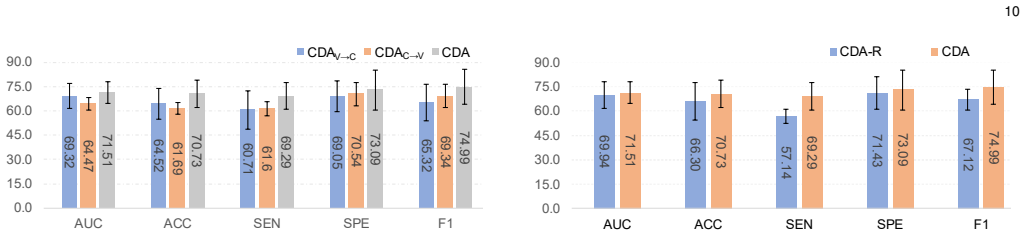
On its own terms, the paper claims that a dual-branch ViT-CNN model, adapted through the three-stage CDA procedure, transfers a late-life depression classifier from a source MRI cohort to a target MRI cohort without using any target labels. In the reported experiments, CDA attains the highest values among all compared methods on the cognitively-normal-depressed versus cognitively-normal binary task, with 71.51% AUC, 70.73% accuracy, 69.29% sensitivity, 73.09% specificity, and 74.99% F1 score, and it also leads the three-category classification in overall accuracy. The ablation studies attribute the gain to the combination of all three stages, the hybrid ViT-CNN backbone, the asymmetric role assignment in which the ViT explores class boundaries while the CNN consolidates features, the bidirectional pseudo-label exchange, and encoder pretraining on auxiliary brain MRI.
Load-bearing premise
The reported margin over baselines assumes that the pseudo-label thresholds were not tuned on the target-domain labels used for evaluation, because the paper describes no separate validation set for choosing $\theta_1$ and $\theta_2$.
Editorial extensions
If this is right
- A site with only tens of labeled target scans could still deploy a depression classifier by borrowing labeled MRI from a related site and adapting without needing target labels.
- Mixing global and local feature extractors in one adaptation framework beats using either architecture alone; the paper reports the hybrid variant outperforming the two-branch ViT-only and CNN-only variants on every metric.
- The asymmetric design is load-bearing: fixing the ViT as boundary explorer and the CNN as feature consolidator yields notably higher sensitivity (69.29%) than the reversed assignment (57.14%).
- Encoder pretraining on auxiliary brain MRI is a major contributor: removing it drops AUC by 2.67 points and sensitivity by 8.57 points in the binary task.
- The framework tolerates different source choices: a demographically similar source gives better transfer than a larger but more distant source, though the larger source still yields competitive performance.
Reading between the lines
- A fairer evaluation would fix the pseudo-label thresholds on a held-out validation split before touching the test folds; the paper reports tuning $\theta_1$ and $\theta_2$ on the target domain, so its margin over baselines may be optimistic.
- Because only the CNN is used at inference, the ViT effectively acts as a teacher; an ensemble of both branches at test time is a natural unexplored variant that might add robustness.
- The pseudo-label consistency mechanism closely resembles techniques from semi-supervised learning, so the same three-stage recipe may transfer to other neuroimaging tasks with scarce target cohorts, such as mild cognitive impairment staging or schizophrenia classification.
- A direct test of the framework's clinical value would be a prospective study on a third imaging site never used in development, measuring whether the AUC holds when no labels from that site are available for threshold selection.
Editorial analysis
A structured set of objections, weighed in public.
Referee Report
Summary. The paper proposes Collaborative Domain Adaptation (CDA), a three-stage unsupervised domain adaptation framework for late-life depression (LLD) identification from structural MRI. CDA combines a Vision Transformer (ViT) branch and a CNN branch: Stage 1 performs supervised training on a labeled source domain (NCODE), Stage 2 performs self-supervised target feature adaptation via an asymmetric classifier-discrepancy procedure, and Stage 3 performs collaborative training on unlabeled target data using confidence-filtered pseudo-labels and weak/strong augmentation. Experiments on the NBOLD target dataset report gains over eleven domain adaptation baselines for binary CN-D vs. CN-N classification (AUC 71.51%, ACC 70.73%) and for three-category classification (overall ACC 50.79%). The paper includes ablations for training stages, dual-branch architecture, threshold choices, inference branch, encoder fine-tuning, source domain, and encoder pretraining, and it releases source code.
Significance. If the reported results are trustworthy, CDA would be a practically useful contribution for cross-site neuroimaging classification with very small target cohorts, and the dual-branch ViT-CNN design with asymmetric boundary exploration is a reasonable extension of recent hybrid domain adaptation ideas. The paper's strengths are its comprehensive ablations, the explicit analysis of pretraining impact, the multi-site evaluation, and the public release of code. However, the central comparison in Table 3 is currently undermined by two evaluation concerns: the pseudo-label thresholds appear to be tuned using target-domain performance without a described validation split, and the deep baselines are not documented as sharing CDA's pretrained encoders. These issues directly affect the magnitude and attribution of the claimed gains.
major comments (2)
- [Section 6.3, Fig. 4, and Section 5.1] The threshold selection for θ1 and θ2 appears to leak target test labels into model selection. Section 5.1 describes five-fold cross-validation on the target data with one fold held out as a test set, but does not describe a separate validation split for hyperparameter tuning. Section 6.3 and Fig. 4 report that θ1 and θ2 are chosen by inspecting AUC/ACC as each threshold varies, and the final values (θ1=0.5, θ2=0.8) are then used in the main results. If the curves in Fig. 4 are computed on the same target folds used to produce Table 3, target labels enter hyperparameter selection, which violates the unsupervised domain adaptation protocol and biases the comparison in CDA's favor. This is material because Section 6.3 shows that threshold changes move AUC/ACC by several points, comparable to the 2-3 point gap between CDA and the strongest baselines in Table 3. Please clarify whether an inner validation split was used for threshold selection, and if not, rerun the experiments with thresholds fixed before seeing target labels or with a nested cross-validation procedure.
- [Section 4.4, Section 5.1, and Section 6.8] The comparison against deep baselines may be confounded by pretrained encoders. Section 4.4 states that CDA's ViT encoder is pretrained on IXI, OASIS-3, and BRATS, and its CNN encoder is pretrained on ADNI, while Section 5.1 says only that the competing deep methods use 'default settings' and 'comparable' architectures, without specifying whether they share the same pretrained encoders. Section 6.8 shows that removing this pretraining (CDAw/oP) reduces AUC by 2.67 percentage points, ACC by 3.52, and F1 by 5.65. Thus part of CDA's advantage in Table 3 could stem from pretraining rather than from the CDA algorithm itself. Please state explicitly whether the eight deep baselines used the same pretrained encoders, or add a version of CDA without pretraining to the main comparison table.
minor comments (4)
- [Section 4.2, Eq. (3)] In Eq. (3), f2 is defined as σ(FC(EV(xt_i))), i.e., the CNN classifier applied to ViT encoder features, whereas Eq. (4) applies both classifiers to the CNN encoder features EC. Please clarify whether this is intentional and explain the rationale, or correct the apparent typo.
- [Section 4.3, Eqs. (5)-(8)] The role of the JSD threshold τ=0.1 is unclear relative to the confidence thresholds θ1 and θ2. The text says samples with JSD below τ qualify for pseudo-label generation, but Eqs. (7)-(8) only include indicator functions on max(ŷ)>θ, with no mention of τ. Please clarify whether JSD filtering is applied before the θ thresholds, and if so, how it is incorporated into the loss.
- [Section 5.2] There is an apparent sentence fragment in the discussion of traditional UDA methods: 'compared to the end-to-end deep learning models. omical variations in 3D structural MRI.' This should be rewritten as a complete sentence.
- [Tables 4-5] The abstract's claim that CDA 'consistently outperforms' all baselines is stronger than the three-category results show: CDA's sensitivity for the CI class is 12.67%, lower than several baselines (e.g., TCA 21.67%, SCA 43.33%, DAN 40.00%). Please qualify the claim or discuss this limitation in the conclusion.
Circularity Check
Headline CDA numbers are selected, not predicted: θ2=0.8 is chosen by peaking AUC/ACC on the target domain (Sec. 6.3), with no separate validation set described in Sec. 5.1, so the SOTA comparison is partly fitted.
-
fitted input called prediction
[Section 4.4 (Eqs. 7-8), Section 5.1, Section 6.3 (Fig. 4), Table 3]
"Pseudo-labeling in collaborative training applies confidence thresholds specific to each branch: θ1 = 0.5 for ViT-generated labels and a more stringent θ2 = 0.8 for CNN. These empirically chosen thresholds ensure that only high-confidence pseudo-labels contribute to model training. ... In Fig. 4 (a), we fix θ1 = 0.5 and vary θ2 from 0.5 to 0.9. As θ2 increases, both AUC and ACC improve steadily, peaking at θ2 = 0.8 ... one subset was held out as the test set, while the remaining four subsets were used for training."
The final model uses θ2 = 0.8, and this value is selected because AUC/ACC on target-domain data peak there (Fig. 4). Section 5.1 describes only target test folds and training folds, with no separate validation set described. Thus the threshold choice appears to use the same target labels that later produce the reported Table 3 numbers (AUC 71.51%, ACC 70.73%). The reported 'prediction' is therefore the maximum of a target-performance sweep over θ2 rather than an independent evaluation, and the roughly 2-3 point margin over the strongest baselines (DAN and DeepCoral at 68.87% AUC) is partly purchased by target-label-driven tuning that the eleven competing methods did not receive.
full rationale
The paper's method itself is not a derivation from first principles, and most of its components are evaluated rather than assumed: Stage-wise ablations (Sec. 6.1), backbone comparisons (Sec. 6.2), collaborative-direction ablations (Sec. 6.4), inference-model choice (Sec. 6.5), asymmetric fine-tuning (Sec. 6.6), source-domain change (Sec. 6.7), and encoder-pretraining removal (Sec. 6.8) all provide independent, internal evidence for the framework's design. The pretraining gains are quantified by CDAw/oP, and the cited prior work is not load-bearing in a circular way. The one significant circular-style issue is the selection of the pseudo-label confidence thresholds θ1 and θ2. Section 4.4 calls them 'empirically chosen,' Section 6.3 shows them being chosen by observing where target-domain AUC/ACC peak (θ2 = 0.8), and Section 5.1 describes no validation set separate from the target test folds. Under that protocol, the reported CDA result is a fitted maximum over thresholds rather than an out-of-sample prediction, and the comparison against baselines that did not receive equivalent target-label-driven tuning is optimistic. This makes the central SOTA claim partially constructed by the evaluation itself, though the framework retains independent algorithmic content.
Assumptions & free parameters
free parameters (3)
- theta_1 (ViT pseudo-label confidence threshold) =
0.5
- theta_2 (CNN pseudo-label confidence threshold) =
0.8
- tau (JSD consistency threshold) =
0.1
assumptions (4)
- domain assumption The source and target domains share the same four diagnostic categories with consistent label meanings.
- domain assumption Pseudo-labels with confidence above the thresholds are accurate enough to supervise the other network branch.
- ad hoc to paper The ViT encoder defines sharper decision boundaries than the CNN encoder, justifying the asymmetric adaptation in Stage 2.
- domain assumption Pretrained encoders (MAE ViT on IXI/OASIS-3/BRATS and autoencoder CNN on ADNI) provide representations useful for the small NCODE/NBOLD domains.
Cite this review
Pith. "Pith review of Learning from Heterogeneous Structural MRI via Collaborative Domain Adaptation for Late-Life Depression Assessment." pith.science (2026). https://pith.science/paper/UQH7LRVL
@misc{pith2026250722321,
  author       = {Pith},
  title        = {Pith review of: Learning from Heterogeneous Structural MRI via Collaborative Domain Adaptation for Late-Life Depression Assessment},
  year         = {2026},
  howpublished = {\url{https://pith.science/paper/UQH7LRVL}},
  note         = {Machine review of arXiv:2507.22321}
}
read the original abstract
Accurate identification of late-life depression (LLD) using structural brain MRI is essential for monitoring disease progression and facilitating timely intervention. However, existing learning-based approaches for LLD detection are often constrained by limited sample sizes (e.g., tens), which poses significant challenges for reliable model training and generalization. Although incorporating auxiliary datasets can expand the training set, substantial domain heterogeneity, such as differences in imaging protocols, scanner hardware, and population demographics, often undermines cross-domain transferability. To address this issue, we propose a Collaborative Domain Adaptation (CDA) framework for LLD detection using T1-weighted MRIs. The CDA leverages a Vision Transformer (ViT) to capture global anatomical context and a Convolutional Neural Network (CNN) to extract local structural features, with each branch comprising an encoder and a classifier. The CDA framework consists of three stages: (a) supervised training on labeled source data, (b) self-supervised target feature adaptation and (c) collaborative training on unlabeled target data. We first train ViT and CNN on source data, followed by self-supervised target feature adaptation by minimizing the discrepancy between classifier outputs from two branches to make the categorical boundary clearer. The collaborative training stage employs pseudo-labeled and augmented target-domain MRIs, enforcing prediction consistency under strong and weak augmentation to enhance domain robustness and generalization. Extensive experiments conducted on multi-site T1-weighted MRI data demonstrate that the CDA consistently outperforms state-of-the-art unsupervised domain adaptation methods.
Figures


Figures from the paper (3 more)


Reference graph
Works this paper leans on
-
[1]
Depression in late life: Review and commentary,
D. G. Blazer, “Depression in late life: Review and commentary,” Journal of Gerontology Series A, vol. 58, no. 3, pp. M249–M265, 2003
2003
-
[2]
The vascular depression hypothesis: 10 years later,
G. S. Alexopoulos, “The vascular depression hypothesis: 10 years later,” Biological Psychiatry, vol. 60, no. 12, pp. 1304–1305, 2005
2005
-
[3]
Neuroanatomical substrates of depression in the elderly,
K. R. R. Krishnan, W. M. McDonald, P . M. Doraiswamy, L. A. Tupler, M. Husain, O. B. Boyko, G. S. Figiel, and E. H. Ellinwood Jr, “Neuroanatomical substrates of depression in the elderly,”Psycho- logical Medicine, vol. 27, no. 3, pp. 681–692, 1997
1997
-
[4]
Depression, hippocampal volume changes, and cognitive decline in a clinical sample of older depressed outpatients and non- depressed controls,
K. Sawyer, E. Corsentino, N. Sachs-Ericsson, and D. C. Steffens, “Depression, hippocampal volume changes, and cognitive decline in a clinical sample of older depressed outpatients and non- depressed controls,” Aging & Mental Health , vol. 16, no. 6, pp. 753–762, 2012
2012
-
[5]
Neuroimaging in dementia: A practical guide,
A. M. Mortimer, M. Likeman, and T. T. Lewis, “Neuroimaging in dementia: A practical guide,” Practical Neurology, vol. 13, no. 2, pp. 92–103, 2013
2013
-
[6]
White matter hyperintensities in late life depression: A systematic review,
L. L. Herrmann, M. Le Masurier, and K. P . Ebmeier, “White matter hyperintensities in late life depression: A systematic review,” Journal of Neurology, Neurosurgery & Psychiatry , vol. 79, no. 6, pp. 619–624, 2008
work page 2008
-
[7]
C. E. Sexton, C. E. Mackay, and K. P . Ebmeier, “A systematic review and meta-analysis of magnetic resonance imaging studies 12 in late-life depression,” The American Journal of Geriatric Psychiatry, vol. 21, no. 2, pp. 184–195, 2013
work page 2013
-
[8]
Brain age prediction using deep learning uncovers associated sequence variants,
B. A. J ´onsson, G. Bjornsdottir, T. E. Thorgeirsson, L. M. Ellingsen, G. B. Walters, D. F. Gudbjartsson, H. Stefansson, K. Stefansson, and M. O. Ulfarsson, “Brain age prediction using deep learning uncovers associated sequence variants,” Nature Communications , vol. 10, no. 1, p. 5409, 2019
work page 2019
Show all 85 references
-
[9]
Deep-Learning methods for par- allel magnetic resonance imaging reconstruction: A survey of the current approaches, trends, and issues,
F. Knoll, K. Hammernik, C. Zhang, S. Moeller, T. Pock, D. K. Sodickson, and M. Akcakaya, “Deep-Learning methods for par- allel magnetic resonance imaging reconstruction: A survey of the current approaches, trends, and issues,” IEEE Signal Processing Magazine, vol. 37, no. 1, p...
2020
-
[10]
The reliability of a deep learning model in clinical out-of-distribution MRI data: A multicohort study,
G. M ˚artensson, D. Ferreira, T. Granberg, L. Cavallin, K. Oppedal, A. Padovani, I. Rektorova, L. Bonanni, M. Pardini, M. G. Kram- berger et al., “The reliability of a deep learning model in clinical out-of-distribution MRI data: A multicohort study,” Medical Image Analysis, v...
2020
-
[11]
Convolutional neural networks for classification of Alzheimer’s disease: Overview and reproducible evaluation,
J. Wen, E. Thibeau-Sutre, M. Diaz-Melo, J. Samper-Gonz ´alez, A. Routier, S. Bottani, D. Dormont, S. Durrleman, N. Burgos, O. Colliot et al., “Convolutional neural networks for classification of Alzheimer’s disease: Overview and reproducible evaluation,” Medical Image Analysis...
2020
-
[12]
Promises and pitfalls of deep neural networks in neuroimaging-based psy- chiatric research,
F. Eitel, M.-A. Schulz, M. Seiler, H. Walter, and K. Ritter, “Promises and pitfalls of deep neural networks in neuroimaging-based psy- chiatric research,” Experimental Neurology, vol. 339, p. 113608, 2021
2021
-
[13]
Unsupervised domain adaptation by backpropagation,
Y. Ganin and V . Lempitsky, “Unsupervised domain adaptation by backpropagation,” in International Conference on Machine Learning . PMLR, 2015, pp. 1180–1189
2015
-
[14]
Domain adaptation and gner- alization of functional medical data: A systematic survey of brain data,
G. Sarafraz, A. Behnamnia, M. Hosseinzadeh, A. Balapour, A. Meghrazi, and H. R. Rabiee, “Domain adaptation and gner- alization of functional medical data: A systematic survey of brain data,” ACM Computing Surveys, vol. 56, no. 10, pp. 1–39, 2024
2024
-
[15]
DomainATM: Domain adaptation toolbox for medical data analysis,
H. Guan and M. Liu, “DomainATM: Domain adaptation toolbox for medical data analysis,” NeuroImage, vol. 268, p. 119863, 2023
2023
-
[16]
Learning transferable features with deep adaptation networks,
M. Long, Y. Cao, J. Wang, and M. Jordan, “Learning transferable features with deep adaptation networks,” in International Confer- ence on Machine Learning. PMLR, 2015, pp. 97–105
2015
-
[17]
Self-ensembling for visual domain adaptation,
G. French, M. Mackiewicz, and M. Fisher, “Self-ensembling for visual domain adaptation,” in International Conference on Learning Representations, no. 6, 2018
2018
-
[18]
MixMatch: A holistic approach to semi- supervised learning,
D. Berthelot, N. Carlini, I. Goodfellow, N. Papernot, A. Oliver, and C. A. Raffel, “MixMatch: A holistic approach to semi- supervised learning,” Advances in Neural Information Processing Systems, vol. 32, 2019
2019
-
[19]
Unsuper- vised cross-modality domain adaptation of ConvNets for biomed- ical image segmentations with adversarial loss,
Q. Dou, C. Ouyang, C. Chen, H. Chen, and P .-A. Heng, “Unsuper- vised cross-modality domain adaptation of ConvNets for biomed- ical image segmentations with adversarial loss,” in Proceedings of the 27th International Joint Conference on Artificial Intelligence , 2018, pp. 691–697
2018
-
[20]
Disease-image-specific learn- ing for diagnosis-oriented neuroimage synthesis with incomplete multi-modality data,
Y. Pan, M. Liu, Y. Xia, and D. Shen, “Disease-image-specific learn- ing for diagnosis-oriented neuroimage synthesis with incomplete multi-modality data,” IEEE Transactions on Pattern Analysis and Machine Intelligence, vol. 44, no. 10, pp. 6839–6853, 2021
2021
-
[21]
Transfer learning for Alzheimer’s disease through neuroimaging biomarkers: A systematic review,
D. Agarwal, G. Marques, I. de la Torre-D ´ıez, M. A. Franco Martin, B. Garc´ıa Zapira ´ın, and F. Mart ´ın Rodr ´ıguez, “Transfer learning for Alzheimer’s disease through neuroimaging biomarkers: A systematic review,” Sensors, vol. 21, no. 21, p. 7259, 2021
2021
-
[22]
Transfer learning based efficient schizophrenia classification on electroencephalogram (EEG) Signals: A cross-dataset study,
T. Liu, Y. Zhang, Y. Wu, T. Li, Z. Li, W. Chen, and S. Zhang, “Transfer learning based efficient schizophrenia classification on electroencephalogram (EEG) Signals: A cross-dataset study,” in Proceedings of the 2023 15th International Conference on Bioinformatics and Biomedica...
2023
-
[23]
Multi-adversarial domain adaptation,
Z. Pei, Z. Cao, M. Long, and J. Wang, “Multi-adversarial domain adaptation,” in Proceedings of the AAAI Conference on Artificial Intelligence, vol. 32, no. 1, 2018
2018
-
[24]
Adversarial domain adaptation with domain mixup,
M. Xu, J. Zhang, B. Ni, T. Li, C. Wang, Q. Tian, and W. Zhang, “Adversarial domain adaptation with domain mixup,” in Proceed- ings of the AAAI Conference on Artificial Intelligence , vol. 34, no. 04, 2020, pp. 6502–6509
2020
-
[25]
Domain-adaptive few-shot learning,
A. Zhao, M. Ding, Z. Lu, T. Xiang, Y. Niu, J. Guan, and J.-R. Wen, “Domain-adaptive few-shot learning,” in Proceedings of the IEEE/CVF Winter Conference on Applications of Computer Vision , 2021, pp. 1390–1399
2021
-
[26]
Un- supervised domain adaptation for medical imaging segmentation with self-ensembling,
C. S. Perone, P . Ballester, R. C. Barros, and J. Cohen-Adad, “Un- supervised domain adaptation for medical imaging segmentation with self-ensembling,” NeuroImage, vol. 194, pp. 1–11, 2019
2019
-
[27]
An image is worth 16x16 words: Transformers for image recognition at scale,
A. Dosovitskiy, L. Beyer, A. Kolesnikov, D. Weissenborn, X. Zhai, T. Unterthiner, M. Dehghani, M. Minderer, G. Heigold, S. Gelly et al. , “An image is worth 16x16 words: Transformers for image recognition at scale,” International Conference on Learning Represen- tations, 2021
2021
-
[28]
Deep residual learning for image recognition,
K. He, X. Zhang, S. Ren, and J. Sun, “Deep residual learning for image recognition,” in Proceedings of the IEEE Conference on Computer Vision and Pattern Recognition, 2016, pp. 770–778
2016
-
[29]
Pathways linking late-life depression to persistent cognitive impairment and dementia,
M. A. Butters, J. B. Young, O. Lopez, H. J. Aizenstein, B. H. Mul- sant, C. F. Reynolds III, S. T. DeKosky, and J. T. Becker, “Pathways linking late-life depression to persistent cognitive impairment and dementia,” Dialogues in Clinical Neuroscience , vol. 10, no. 3, pp. 345–357, 2008
2008
-
[30]
Vascular disease and future risk of depressive symptomatology in older adults: Findings from the health, aging, and body composition study,
B. T. Mast, T. Miles, B. W. Penninx, K. Yaffe, C. Rosano, S. Satter- field, H. N. Ayonayon, T. Harris, and E. M. Simonsick, “Vascular disease and future risk of depressive symptomatology in older adults: Findings from the health, aging, and body composition study,” Biological ...
2008
-
[31]
Gray matter abnormalities in major depressive disorder: A meta-analysis of voxel based morphometry studies,
E. Bora, A. Fornito, C. Pantelis, and M. Y ¨ucel, “Gray matter abnormalities in major depressive disorder: A meta-analysis of voxel based morphometry studies,” Journal of Affective Disorders , vol. 138, no. 1-2, pp. 9–18, 2012
2012
-
[32]
Gray matter volume in major depressive disorder: A meta-analysis of voxel-based morphometry studies,
C.-H. Lai, “Gray matter volume in major depressive disorder: A meta-analysis of voxel-based morphometry studies,” Psychiatry Research: Neuroimaging, vol. 211, no. 1, pp. 37–46, 2013
2013
-
[33]
Serotonin transporter polymorphisms, microstructural white matter abnormalities and remission of geri- atric depression,
G. S. Alexopoulos, C. F. Murphy, F. M. Gunning-Dixon, C. E. Glatt, V . Latoussakis, R. E. Kelly Jr, D. Kanellopoulos, S. Klimstra, K. O. Lim, R. C. Young et al. , “Serotonin transporter polymorphisms, microstructural white matter abnormalities and remission of geri- atric depr...
2009
-
[34]
Anterior cingulate cortical volumes and treatment remission of geriatric depression,
F. M. Gunning, J. Cheng, C. F. Murphy, D. Kanellopoulos, J. Acuna, M. J. Hoptman, S. Klimstra, S. Morimoto, J. Weinberg, and G. S. Alexopoulos, “Anterior cingulate cortical volumes and treatment remission of geriatric depression,” International Journal of Geriatric Psychiatry,...
2009
-
[35]
Cognition in late-life depression: treatment considerations,
A. M. Koenig and M. A. Butters, “Cognition in late-life depression: treatment considerations,” Current Treatment Options in Psychiatry, vol. 1, no. 1, pp. 1–14, 2014
2014
-
[36]
Structural neuroimaging of geri- atric depression,
S. Benjamin and D. C. Steffens, “Structural neuroimaging of geri- atric depression,” The Psychiatric Clinics of North America , vol. 34, no. 2, p. 423, 2011
2011
-
[37]
The vascular depression hypothesis: Mechanisms linking vascular disease with depression,
W. D. Taylor, H. J. Aizenstein, and G. Alexopoulos, “The vascular depression hypothesis: Mechanisms linking vascular disease with depression,” Molecular Psychiatry, vol. 18, no. 9, pp. 963–974, 2013
2013
-
[38]
Hippocampal volumes and the brain-derived neurotrophic factor val66met polymorphism in geriatric major depression,
D. Kanellopoulos, F. M. Gunning, S. S. Morimoto, M. J. Hopt- man, C. F. Murphy, R. E. Kelly Jr, C. Glatt, K. O. Lim, and G. S. Alexopoulos, “Hippocampal volumes and the brain-derived neurotrophic factor val66met polymorphism in geriatric major depression,” The American Journal...
2011
-
[39]
Multidi- mensional representations in late-life depression: Convergence in neuroimaging, cognition, clinical symptomatology and genetics,
J. Wen, C. H. Fu, D. Tosun, Y. Veturi, Z. Yang, A. Abdulkadir, E. Mamourian, D. Srinivasan, J. Bao, G. Erus et al. , “Multidi- mensional representations in late-life depression: Convergence in neuroimaging, cognition, clinical symptomatology and genetics,” arXiv preprint arXiv...
-
[40]
Disrupted intrinsic functional brain network in patients with late-life depression: Evidence from a multi-site dataset,
W. Tan, X. Ouyang, D. Huang, Z. Wu, Z. Liu, Z. He, Y. Long, R. meta MDD Consortium et al. , “Disrupted intrinsic functional brain network in patients with late-life depression: Evidence from a multi-site dataset,” Journal of Affective Disorders, vol. 323, pp. 631– 639, 2023
2023
-
[41]
Transfer learning for domain adaptation in MRI: Application in brain lesion segmentation,
M. Ghafoorian, A. Mehrtash, T. Kapur, N. Karssemeijer, E. Mar- chiori, M. Pesteie, C. R. Guttmann, F.-E. De Leeuw, C. M. Tempany, B. Van Ginneken et al., “Transfer learning for domain adaptation in MRI: Application in brain lesion segmentation,” in International Conference on ...
2017
-
[42]
Detect and correct bias in multi-site neuroimaging datasets,
C. Wachinger, A. Rieckmann, and S. P ¨olsterl, “Detect and correct bias in multi-site neuroimaging datasets,” Medical Image Analysis , vol. 67, p. 101879, 2021
2021
-
[43]
Learn to ignore: Domain adaptation for multi-site MRI analysis,
J. Wolleb, R. Sandk ¨uhler, F. Bieder, M. Barakovic, N. Hadjikhani, A. Papadopoulou, ¨O. Yaldizli, J. Kuhle, C. Granziera, and P . C. Cattin, “Learn to ignore: Domain adaptation for multi-site MRI analysis,” in International Conference on Medical Image Computing and Computer-A...
2022
-
[44]
Adversarial discriminative domain adaptation,
E. Tzeng, J. Hoffman, K. Saenko, and T. Darrell, “Adversarial discriminative domain adaptation,” in Proceedings of the IEEE Conference on Computer Vision and Pattern Recognition , 2017, pp. 13 7167–7176
2017
-
[45]
Disentangled representation and cross-modality image translation based unsupervised domain adaptation method for abdominal organ segmentation,
K. Jiang, L. Quan, and T. Gong, “Disentangled representation and cross-modality image translation based unsupervised domain adaptation method for abdominal organ segmentation,” Interna- tional Journal of Computer Assisted Radiology and Surgery , vol. 17, no. 6, pp. 1101–1113, 2022
2022
-
[46]
Unsupervised domain adaptation in brain lesion segmentation with adversarial networks,
K. Kamnitsas, C. Baumgartner, C. Ledig, V . Newcombe, J. Simp- son, A. Kane, D. Menon, A. Nori, A. Criminisi, D. Rueckert et al., “Unsupervised domain adaptation in brain lesion segmentation with adversarial networks,” in International Conference on Informa- tion Processing in...
2017
-
[47]
ADVENT: Adversarial entropy minimization for domain adaptation in se- mantic segmentation,
T.-H. Vu, H. Jain, M. Bucher, M. Cord, and P . P ´erez, “ADVENT: Adversarial entropy minimization for domain adaptation in se- mantic segmentation,” in Proceedings of the IEEE/CVF Conference on Computer Vision and Pattern Recognition, 2019, pp. 2517–2526
2019
-
[48]
Multi-site mri harmonization via attention-guided deep domain adaptation for brain disorder identification,
H. Guan, Y. Liu, E. Yang, P .-T. Yap, D. Shen, and M. Liu, “Multi-site mri harmonization via attention-guided deep domain adaptation for brain disorder identification,” Medical Image Analysis , vol. 71, p. 102076, 2021
2021
-
[49]
TransUnet: Transformers make strong encoders for medical image segmentation,
J. Chen, Y. Lu, Q. Yu, X. Luo, E. Adeli, Y. Wang, L. Lu, A. L. Yuille, and Y. Zhou, “TransUnet: Transformers make strong encoders for medical image segmentation,” arXiv preprint arXiv:2102.04306, 2021
2021 arXiv
-
[50]
UNETR: Transformers for 3D medical image segmentation,
A. Hatamizadeh, Y. Tang, V . Nath, D. Yang, A. Myronenko, B. Landman, H. R. Roth, and D. Xu, “UNETR: Transformers for 3D medical image segmentation,” in Proceedings of the IEEE/CVF Winter Conference on Applications of Computer Vision, 2022, pp. 574– 584
2022
-
[51]
Swin transformer: Hierarchical vision transformer using shifted windows,
Z. Liu, Y. Lin, Y. Cao, H. Hu, Y. Wei, Z. Zhang, S. Lin, and B. Guo, “Swin transformer: Hierarchical vision transformer using shifted windows,” in Proceedings of the IEEE/CVF International Conference on Computer Vision, 2021, pp. 10 012–10 022
2021
-
[52]
Self-challenging improves cross-domain generalization,
Z. Huang, H. Wang, E. P . Xing, and D. Huang, “Self-challenging improves cross-domain generalization,” in European Conference on Computer Vision. Springer, 2020, pp. 124–140
2020
-
[53]
Combining labeled and unlabeled data with co-training,
A. Blum and T. Mitchell, “Combining labeled and unlabeled data with co-training,” in Annual Conference on Computational Learning Theory, 1998, pp. 92–100
1998
-
[54]
A DIRT-T approach to unsupervised domain adaptation,
R. Shu, H. Bui, H. Narui, and S. Ermon, “A DIRT-T approach to unsupervised domain adaptation,” in International Conference on Learning Representations, 2018
2018
-
[55]
Universal domain adaptation,
K. You, M. Long, Z. Cao, J. Wang, and M. I. Jordan, “Universal domain adaptation,” in Proceedings of the IEEE/CVF Conference on Computer Vision and Pattern Recognition, 2019, pp. 2720–2729
2019
-
[56]
Unsupervised domain adaptation via structurally regularized deep clustering,
H. Tang, K. Chen, and K. Jia, “Unsupervised domain adaptation via structurally regularized deep clustering,” in Proceedings of the IEEE/CVF Conference on Computer Vision and Pattern Recognition , 2020, pp. 8725–8735
2020
-
[57]
Dual-stream representation fusion learning for accurate medical image segmen- tation,
R. Xu, C. Wang, S. Xu, W. Meng, and X. Zhang, “Dual-stream representation fusion learning for accurate medical image segmen- tation,” Engineering Applications of Artificial Intelligence, vol. 123, p. 106402, 2023
2023
-
[58]
A multi-view contrastive learning and semi-supervised self-distillation framework for early recurrence prediction in ovarian cancer,
C. Dong, Y. Wu, B. Sun, J. Bo, Y. Huang, Y. Geng, Q. Zhang, R. Liu, W. Guo, X. Wang et al. , “A multi-view contrastive learning and semi-supervised self-distillation framework for early recurrence prediction in ovarian cancer,” Computerized Medical Imaging and Graphics, vol. 1...
2025
-
[59]
Learning CNN on ViT: A hybrid model to explicitly class-specific boundaries for domain adaptation,
B. H. Ngo, N.-T. Do-Tran, T.-N. Nguyen, H.-G. Jeon, and T. J. Choi, “Learning CNN on ViT: A hybrid model to explicitly class-specific boundaries for domain adaptation,” in Proceedings of the IEEE/CVF Conference on Computer Vision and Pattern Recognition , 2024, pp. 28 545–28 554
2024
-
[60]
Negative affectivity, aging, and depression: Results from the neu- robiology of late-life depression (NBOLD) study,
D. C. Steffens, L. Wang, K. J. Manning, and G. D. Pearlson, “Negative affectivity, aging, and depression: Results from the neu- robiology of late-life depression (NBOLD) study,” The American Journal of Geriatric Psychiatry, vol. 25, no. 10, pp. 1135–1149, 2017
2017
-
[61]
The NCODE study: Clinical characteristics and longitudinal outcomes of depressed older adults,
D. C. Steffens, D. R. McQuoid, and K. R. R. Krishnan, “The NCODE study: Clinical characteristics and longitudinal outcomes of depressed older adults,” International Psychogeriatrics , vol. 16, pp. 23–35, 2004
2004
-
[62]
N4ITK: Improved N3 bias correction,
N. J. Tustison, B. B. Avants, P . A. Cook et al., “N4ITK: Improved N3 bias correction,” IEEE Transactions on Medical Imaging , vol. 29, no. 6, pp. 1310–1320, 2010
2010
-
[63]
A reproducible evaluation of ANTs similarity metric performance in brain image registration,
B. B. Avants, N. J. Tustison, G. Song et al. , “A reproducible evaluation of ANTs similarity metric performance in brain image registration,” NeuroImage, vol. 54, no. 3, pp. 2033–2044, 2011
2011
-
[64]
Automated anatomical labelling atlas 3,
E. T. Rolls, C.-C. Huang, C.-K. Lin et al., “Automated anatomical labelling atlas 3,” NeuroImage, vol. 206, p. 116189, 2020
2020
-
[65]
FreeSurfer,
B. Fischl, “FreeSurfer,” NeuroImage, vol. 62, no. 2, pp. 774–781, 2012
2012
-
[66]
TorchIO: A python library for efficient loading, preprocessing, augmentation and patch-based sampling of medical images in deep learning,
F. P ´erez-Garc´ıa, R. Sparks, and S. Ourselin, “TorchIO: A python library for efficient loading, preprocessing, augmentation and patch-based sampling of medical images in deep learning,” Com- puter Methods and Programs in Biomedicine, vol. 208, p. 106236, 2021
2021
-
[67]
MONAI: An open-source framework for deep learning in healthcare,
M. J. Cardoso, W. Li, R. Brown, N. Ma, E. Kerfoot, Y. Wang, B. Murrey, A. Myronenko, C. Zhao, D. Yang et al., “MONAI: An open-source framework for deep learning in healthcare,” arXiv preprint arXiv:2211.02701, 2022
2022 arXiv
-
[68]
Focal loss for dense object detection,
T.-Y. Lin, P . Goyal, R. Girshick, K. He, and P . Doll ´ar, “Focal loss for dense object detection,” in Proceedings of the IEEE International Conference on Computer Vision, 2017, pp. 2980–2988
2017
-
[69]
Maximum classifier discrepancy for unsupervised domain adaptation,
K. Saito, K. Watanabe, Y. Ushiku, and T. Harada, “Maximum classifier discrepancy for unsupervised domain adaptation,” in Proceedings of the IEEE Conference on Computer Vision and Pattern Recognition, 2018, pp. 3723–3732
2018
-
[70]
The Jensen- Shannon divergence,
M. L. Men ´endez, J. Pardo, L. Pardo, and M. Pardo, “The Jensen- Shannon divergence,” Journal of the Franklin Institute , vol. 334, no. 2, pp. 307–318, 1997
1997
-
[71]
On information and sufficiency,
S. Kullback and R. A. Leibler, “On information and sufficiency,” The Annals of Mathematical Statistics, vol. 22, no. 1, pp. 79–86, 1951
1951
-
[72]
Training data-efficient image transformers & distil- lation through attention,
H. Touvron, M. Cord, M. Douze, F. Massa, A. Sablayrolles, and H. J ´egou, “Training data-efficient image transformers & distil- lation through attention,” in International Conference on Machine Learning. PMLR, 2021, pp. 10 347–10 357
2021
-
[73]
Training ViT with limited data for Alzheimer’s disease classification: An empirical study,
K. Kunanbayev, V . Shen, and D.-S. Kim, “Training ViT with limited data for Alzheimer’s disease classification: An empirical study,” in International Conference on Medical Image Computing and Computer- Assisted Intervention. Springer, 2024, pp. 334–343
2024
-
[74]
The Alzheimer’s disease neuroimaging initiative (ADNI): MRI methods,
C. R. Jack, M. A. Bernstein, N. C. Fox, and et al., “The Alzheimer’s disease neuroimaging initiative (ADNI): MRI methods,” Journal of Magnetic Resonance Imaging, vol. 27, no. 4, pp. 685–691, 2008
2008
-
[75]
Brain anatomy prior modeling to forecast clinical progression of cognitive impairment with structural MRI,
L. Zhang, J. Wu, L. Wang, L. Wang, D. C. Steffens, S. Qiu, G. G. Potter, and M. Liu, “Brain anatomy prior modeling to forecast clinical progression of cognitive impairment with structural MRI,” Pattern Recognition, vol. 165, p. 111603, 2025
2025
-
[76]
Stochastic gradient descent tricks,
L. Bottou, “Stochastic gradient descent tricks,” in Neural Networks: Tricks of the Trade. Springer, 2012, pp. 421–436
2012
-
[77]
Survey on multiclass classification methods,
M. Aly, “Survey on multiclass classification methods,” California Institute of Technology, Tech. Rep., 2005
2005
-
[78]
Domain adaptation via transfer component analysis,
S. J. Pan, I. W. Tsang, J. T. Kwok, and Q. Yang, “Domain adaptation via transfer component analysis,” IEEE Transactions on Neural Networks, vol. 22, no. 2, pp. 199–210, 2010
2010
-
[79]
Transfer feature learning with joint distribution adaptation,
M. Long, J. Wang, G. Ding, J. Sun, and P . S. Yu, “Transfer feature learning with joint distribution adaptation,” in Proceedings of the IEEE International Conference on Computer Vision , 2013, pp. 2200– 2207
2013
-
[80]
Scatter component analysis: A unified framework for domain adaptation and domain generalization,
M. Ghifary, D. Balduzzi, W. B. Kleijn, and M. Zhang, “Scatter component analysis: A unified framework for domain adaptation and domain generalization,” IEEE Transactions on Pattern Analysis and Machine Intelligence, vol. 39, no. 7, pp. 1414–1430, 2016
2016
-
[81]
Deep CORAL: Correlation alignment for deep domain adaptation,
B. Sun and K. Saenko, “Deep CORAL: Correlation alignment for deep domain adaptation,” in European Conference on Computer Vision. Springer, 2016, pp. 443–450
2016
-
[82]
Transfer learning with dynamic adversarial adaptation network,
C. Yu, J. Wang, Y. Chen, and M. Huang, “Transfer learning with dynamic adversarial adaptation network,” in IEEE International Conference on Data Mining. IEEE, 2019, pp. 778–786
2019
-
[83]
Towards discriminability and diversity: Batch nuclear-norm maximization under label insufficient situations,
S. Cui, S. Wang, J. Zhuo, L. Li, Q. Huang, and Q. Tian, “Towards discriminability and diversity: Batch nuclear-norm maximization under label insufficient situations,” in Proceedings of the IEEE/CVF Conference on Computer Vision and Pattern Recognition , 2020, pp. 3941–3950
2020
-
[84]
Deep subdomain adaptation network for image classification,
Y. Zhu, F. Zhuang, J. Wang, G. Ke, J. Chen, J. Bian, H. Xiong, and Q. He, “Deep subdomain adaptation network for image classification,” IEEE Transactions on Neural Networks and Learning Systems, vol. 32, no. 4, pp. 1713–1722, 2020
2020
-
[85]
Source data-absent unsupervised domain adaptation through hypothesis transfer and labeling transfer,
J. Liang, D. Hu, Y. Wang, R. He, and J. Feng, “Source data-absent unsupervised domain adaptation through hypothesis transfer and labeling transfer,” IEEE Transactions on Pattern Analysis and Ma- chine Intelligence, vol. 44, no. 11, pp. 8602–8617, 2021
2021
Reviewed August 6, 2026 · model on record in the stance chip above.
Discussion (0). Sign in to comment.