REVIEW 5 major objections 4 minor 1 cited by
GVD: Guiding Video Diffusion Model for Scalable Video Distillation
T0 review · 5 major / 4 minor · reviewed 2026-08-06 · deepseek-v4-flash
Pith's one-line read Steering a pre-trained text-to-video diffusion model with per-class k-means cluster centers during denoising yields distilled video datasets that keep roughly 78% of full-data accuracy on MiniUCF while using under 2% of the frames, and…
desk verdict First diffusion-based video distillation method with strong empirical results, but the paper under-proves that its guidance term, not the fine-tuning, drives the gains. read the letter →
The pith
A machine-rendered reading of the paper's core claim, the machinery that carries it, and where it could break.
The reading
What carries the argument
The load-bearing object is the per-class cluster center $m_{k,c}$ obtained by k-means on the VQGAN-encoded latent representations of real videos. At each denoising step, the method computes a guidance term $g_t = m_{k,c} - \hat{x}_0^t$ using the model's own denoised prediction, and modifies the predicted noise by subtracting $\lambda \sqrt{1-\bar\alpha_t}\, g_t$. A frame-wise linear decay $\lambda_f = \lambda(1-f/F)$ weakens guidance for later frames, and guidance stops after timestep $t_{\text{stop}}$. This mechanism steers the generation toward class prototypes while preserving temporal coherence and diversity.
What would settle it
Generate the distilled dataset with the guidance vectors replaced by random latent vectors sampled from the same class's real-video encodings, and compare downstream recognition accuracy: if accuracy does not drop substantially, the specific k-means centers are not what carries the improvement, and the central claim fails.
Extended reading notes
Core claim
GVD claims that guiding every denoising step of a text-to-video diffusion model with class-level k-means cluster centers computed in VQGAN latent space produces distilled videos that are both more diverse and more representative than optimizing synthetic videos directly. The guidance is applied to the predicted clean latent at each step, scaled by a frame-wise linearly decaying coefficient, and halted after a timestep threshold to avoid over-guidance. A composition step stitches frames from multiple generated instances to pack more information into each distilled video, and soft labels from a pre-trained teacher further improve training. The result is state-of-the-art accuracy on MiniUCF and HMDB51 across IPC 5, 10, and 20, with cross-architecture generalization that optimization-based methods lack.
Load-bearing premise
The method assumes that k-means cluster centers computed in the VQGAN latent space of full videos are stable, class-representative prototypes that remain meaningful when used to guide the denoising trajectory of a different pre-trained diffusion model.
Editorial extensions
If this is right
- Training action recognition models on GVD-distilled video can recover roughly four-fifths of full-data accuracy while using about one-fiftieth of the frames.
- Distillation at IPC 20 and 448×256 resolution becomes affordable, since memory stays near 50 GB regardless of IPC.
- Distilled datasets from GVD transfer across MiniC3D, CNN+GRU, and CNN+RNN architectures more stably than optimization-based distillation.
- The method inherits the generative prior of the base text-to-video model, so distillation quality depends on that model's spatio-temporal knowledge.
Reading between the lines
- The same guiding scheme could in principle be lifted to other latent video diffusion models, since the guidance term only requires an encoder and a denoising U-Net; if the latent spaces are compatible, the method might distill classes from datasets the base model was never fine-tuned on.
- The frame-wise linear decay treats prototype guidance as reliable only in early generation; a testable extension would adapt the decay schedule per class based on how quickly the denoised prediction converges to the cluster center.
- Because the distilled videos are generated rather than selected, the method also offers a path to sharing compact synthetic datasets with privacy-sensitive video data, although the paper does not evaluate this.
Editorial analysis
A structured set of objections, weighed in public.
Referee Report
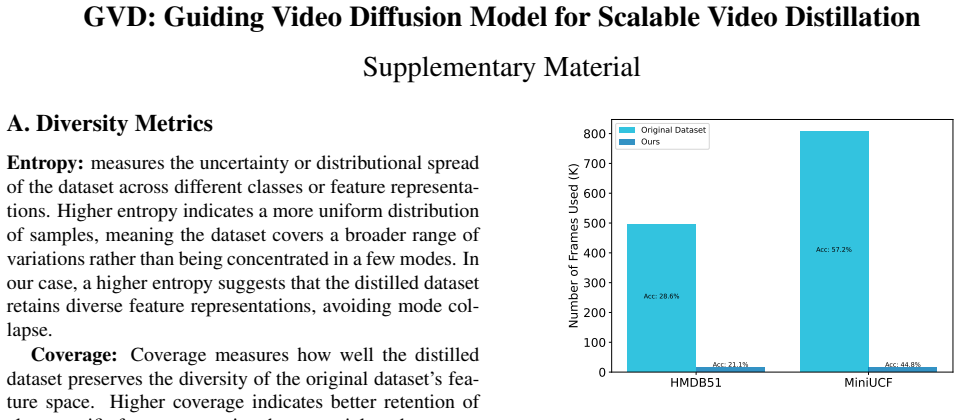
Summary. The paper proposes GVD, a video dataset distillation method built on a pre-trained text-to-video diffusion model (ModelScope). For each class, it computes k-means cluster centers in the VQGAN latent space of real videos, then uses these centers as per-frame guidance terms during DDIM denoising (Eq. 7), with a frame-wise linearly decaying guidance strength and an early stopping threshold t_stop. The distilled videos are further composed from multiple generated instances (MVIC) and optionally trained with soft labels. The method is evaluated on MiniUCF and HMDB51 with MiniC3D and other lightweight recognition models, and is claimed to reach 78.29% of full-dataset accuracy on MiniUCF using 1.98% of frames and 73.83% on HMDB51 using 3.30% of frames, while keeping memory usage roughly constant as IPC grows.
Significance. If the central guidance mechanism is genuinely responsible for the reported gains, GVD would be a meaningful step for video dataset distillation: it is the first video-distillation method built on a text-to-video diffusion prior, it demonstrates cross-architecture generalization, and it reports explicit diversity metrics (entropy, coverage, mean pairwise distance) beyond accuracy alone. The paper also deserves credit for showing that a video diffusion model can be steered toward class-specific latent prototypes without the optimization-based cost of prior video-distillation approaches. However, the current manuscript does not provide the decisive ablation needed to attribute the reported accuracy to the proposed guiding mechanism rather than to fine-tuning, MVIC, or soft labels; until that evidence is supplied, the significance of the paper's central claim remains unverified.
major comments (5)
- [Section 4.4.1, Fig. 7(a), Table 1, Eq. (7)] The paper never reports a λ=0 control with all other components held fixed. The 'Naive DM' baseline shown in Fig. 7(a) omits the guidance term, but it also omits MVIC and soft labels, and it is never reported under the main protocol of Table 1. Since the guiding term in Eq. (7) is the paper's central contribution, the reported gains over MTT+D and FRePo+D could in principle come entirely from fine-tuning the ModelScope model on class prompts, from MVIC, or from soft-label training. Please add a proper ablation that toggles only λ (e.g., λ=0 vs λ=0.1) while keeping fine-tuning, MVIC, soft labels, and the evaluation protocol identical to Table 1, with numeric results on both datasets and all IPC values.
- [Section 4.1 vs. Appendix D.2] There is a large inconsistency in the timestep threshold t_stop. Section 4.1 states 'Generation runs for 2000 timesteps, stopping guidance at step 1000', while Appendix D.2 reports the optimal t_stop as 25 (with only values 20–50 explored), a 40x difference. Because Eq. (9) applies guidance only for steps below t_stop, these two settings produce very different denoising trajectories. Please state precisely which t_stop was used for the Table 1 results, and report sensitivity of the main MiniUCF and HMDB51 accuracies to t_stop under the actual MiniC3D training protocol.
- [Appendix D.1, D.2, Section 4.2] The hyperparameters λ=0.1 and t_stop=25 are selected using classification accuracy of a MiniC3D model pre-trained on the full dataset evaluated on the generated videos, which is a different metric from the from-scratch MiniC3D training used in Table 1. No held-out validation split or cross-validation is described. Please either add a robustness analysis of λ and t_stop under the actual evaluation protocol used for Table 1, or justify why the pre-trained-model selection does not bias the headline accuracy numbers.
- [Section 3.3.1, Eqs. (4)–(6)] The cluster centers m_k are computed from VQGAN encodings of clean real videos, but the guidance term in Eq. (6) is applied to the predicted clean latent x̂^t_0 at each denoising step. No evidence is given that these two representations lie on the same manifold or remain aligned as the DDIM trajectory progresses, especially for the early steps where the latent is still very noisy. Please add diagnostics (for example, the distance between m_k and x̂^t_0 as a function of t, or an ablation of which denoising stages receive guidance) to support the mechanism that is claimed to be central.
- [Contributions, Section 3.4, Section 4.4.3] The paper claims 'fixed complexity regardless of IPC scale', but Algorithm 1 and Section 3.4 generate U×IPC video instances per class, so the total generation time necessarily grows linearly with IPC. The reported 50.08 GB figure in Section 4.4.3 is a memory measurement, not a total-compute measurement. Please clarify that only the per-instance memory is approximately constant, and report total generation time (or GPU-hours) for IPC=5, 10, and 20 so the scalability claim is stated accurately.
minor comments (4)
- [Figure 10(b), Appendix D.2] The x-axis in Figure 10(b) is labeled 'Timestep Threshold' with values 20, 25, 30, 50, but the main text says 2000 total timesteps and 1000 as the stopping step. Please clarify the units (raw steps versus fraction of total steps) so the reader can reconcile the apparent contradiction.
- [Table 1, Section 4.2] The text says the MiniUCF improvements over previous baselines are 3.5, 11.1, and 9.1 for IPC=5, 10, and 20. These numbers are not directly traceable from the table (e.g., at IPC=5, Ours is 33.3 and FRePo+D is 31.2, a difference of 2.1, while Ours with soft labels is 34.7). Please specify the exact baseline used for each improvement.
- [Section 3.5] The soft-label teacher is described only as 'a pre-trained teacher network'; please specify which model and which pretraining dataset are used, since this affects reproducibility and the interpretation of the soft-label gains in Figure 7(c).
- [Section 4.4.1, Fig. 7(a)] The Naive DM and K-Noise baselines are presented only as curves in Figure 7(a). Please include the numeric accuracy values for these baselines at each IPC so that the magnitude of the claimed improvement over 'no guidance' can be compared directly with Table 1.
Circularity Check
No significant circularity: the guidance mechanism is constructed from external latents and evaluated on held-out labels; self-citation to MGD3 is not load-bearing.
full rationale
The paper's derivation chain is self-contained. Cluster centers mk are computed by KMeans on VQGAN-encoded original videos per class (Eq. 4-5), which is an input derived from the source data, not from the output. The guidance term g_t = mk - xhat_0 (Eq. 6) is applied to the predicted clean latent during DDIM sampling (Eq. 7-10), and the final distilled videos are decoded and used to train a classifier tested on the original test set. No equation reduces to its own input by construction. The self-cited prior work MGD3 [4] (Chan-Santiago et al., overlapping authors) is credited with the static cluster-center guidance idea, but GVD's contribution is the video adaptation (frame-wise linear decay, MVIC, soft labels), and the paper provides ablations for these components (Fig. 7b-c, Table 3). The citation is therefore not load-bearing in the sense of carrying the argument; the method is implemented and evaluated in this paper. The absence of a lambda=0 control in the main table weakens causal attribution of the guidance term, but that is a correctness/experimental-design concern, not circularity. There is no fitted parameter disguised as a prediction, and no uniqueness theorem imported from the authors.
Assumptions & free parameters
free parameters (5)
- Guidance coefficient lambda =
0.1
- Timestep threshold t_stop =
25 (main text) / 20 (Appendix D.2 caption)
- Number of videos per group U =
4
- Soft-label mixing alpha =
0.2
- Soft-label temperature =
3.0
assumptions (3)
- domain assumption The VQGAN latent space of the video encoder is suitable for k-means clustering, and the resulting cluster centers are meaningful 'class prototypes' for guidance.
- domain assumption A pre-trained text-to-video diffusion model (ModelScope) contains sufficient prior knowledge of the target action classes that fine-tuning with text prompts can align its output distribution to the target dataset.
- domain assumption The denoising prediction x_hat_0 at each timestep can be steered by a simple linear guidance term without destabilizing the sampling trajectory.
Cite this review
Pith. "Pith review of GVD: Guiding Video Diffusion Model for Scalable Video Distillation." pith.science (2026). https://pith.science/paper/P5HKSBRH
@misc{pith2026250722360,
  author       = {Pith},
  title        = {Pith review of: GVD: Guiding Video Diffusion Model for Scalable Video Distillation},
  year         = {2026},
  howpublished = {\url{https://pith.science/paper/P5HKSBRH}},
  note         = {Machine review of arXiv:2507.22360}
}
read the original abstract
To address the larger computation and storage requirements associated with large video datasets, video dataset distillation aims to capture spatial and temporal information in a significantly smaller dataset, such that training on the distilled data has comparable performance to training on all of the data. We propose GVD: Guiding Video Diffusion, the first diffusion-based video distillation method. GVD jointly distills spatial and temporal features, ensuring high-fidelity video generation across diverse actions while capturing essential motion information. Our method's diverse yet representative distillations significantly outperform previous state-of-the-art approaches on the MiniUCF and HMDB51 datasets across 5, 10, and 20 Instances Per Class (IPC). Specifically, our method achieves 78.29 percent of the original dataset's performance using only 1.98 percent of the total number of frames in MiniUCF. Additionally, it reaches 73.83 percent of the performance with just 3.30 percent of the frames in HMDB51. Experimental results across benchmark video datasets demonstrate that GVD not only achieves state-of-the-art performance but can also generate higher resolution videos and higher IPC without significantly increasing computational cost.
Figures


Figures from the paper (8 more)




Forward citations
Cited by 1 Pith paper
-
ICM-Fusion: In-Context Meta-Optimized LoRA Fusion for Multi-Task Adaptation
ICM-Fusion uses a conditional VAE plus task-vector guidance to fuse multiple LoRA adapters into one model, reporting marginal average gains on vision and language benchmarks and larger gains in a few-shot long-tail setup.
Reference graph
Works this paper leans on
-
[1]
The k-means algorithm: A comprehensive survey and performance evaluation
Mohiuddin Ahmed, Raihan Seraj, and Syed Mo- hammed Shamsul Islam. The k-means algorithm: A comprehensive survey and performance evaluation. Elec- tronics, 9(8):1295, 2020. 5, 1
work page 2020
-
[2]
Stable video diffusion: Scaling latent video diffusion models to large datasets
Andreas Blattmann, Tim Dockhorn, Sumith Kulal, Daniel Mendelevitch, Maciej Kilian, Dominik Lorenz, Yam Levi, Zion English, Vikram V oleti, Adam Letts, et al. Stable video diffusion: Scaling latent video diffusion models to large datasets. arXiv preprint arXiv:2311.15127, 2023. 3
arXiv 2023
-
[3]
Dataset distillation by matching training trajectories
George Cazenavette, Tongzhou Wang, Antonio Torralba, Alexei A Efros, and Jun-Yan Zhu. Dataset distillation by matching training trajectories. In Proceedings of the IEEE/CVF Conference on Computer Vision and Pattern Recognition, pages 4750–4759, 2022. 2, 3, 6
work page 2022
-
[4]
”mgd 3: Mode- guided dataset distillation using diffusion models”
Jeffrey A Chan-Santiago, Praveen Tirupattur, Gaurav Kumar Nayak, Gaowen Liu, and Mubarak Shah. ”mgd 3: Mode- guided dataset distillation using diffusion models”. arXiv preprint arXiv:2505.18963, 2025. 3, 4, 5 8
arXiv 2025
-
[5]
Remember the past: Distilling datasets into addressable memories for neural net- works
Zhiwei Deng and Olga Russakovsky. Remember the past: Distilling datasets into addressable memories for neural net- works. Advances in Neural Information Processing Systems, 35:34391–34404, 2022. 2
work page 2022
-
[6]
Euclidean distance matrices: essential theory, algo- rithms, and applications
Ivan Dokmanic, Reza Parhizkar, Juri Ranieri, and Martin Vetterli. Euclidean distance matrices: essential theory, algo- rithms, and applications. IEEE Signal Processing Magazine, 32(6):12–30, 2015. 2
work page 2015
-
[7]
Taming transformers for high-resolution image synthesis
Patrick Esser, Robin Rombach, and Bjorn Ommer. Taming transformers for high-resolution image synthesis. In Pro- ceedings of the IEEE/CVF conference on computer vision and pattern recognition, pages 12873–12883, 2021. 4, 1
work page 2021
-
[8]
Efficient dataset distillation via minimax diffusion
Jianyang Gu, Saeed Vahidian, Vyacheslav Kungurtsev, Hao- nan Wang, Wei Jiang, Yang You, and Yiran Chen. Efficient dataset distillation via minimax diffusion. In Proceedings of the IEEE/CVF Conference on Computer Vision and Pattern Recognition, pages 15793–15803, 2024. 3
work page 2024
Show all 32 references
-
[9]
Imagen video: High definition video generation with diffusion mod- els
Jonathan Ho, William Chan, Chitwan Saharia, Jay Whang, Ruiqi Gao, Alexey Gritsenko, Diederik P Kingma, Ben Poole, Mohammad Norouzi, David J Fleet, et al. Imagen video: High definition video generation with diffusion mod- els. arXiv preprint arXiv:2210.02303, 2022. 3
-
[10]
Video dif- fusion models
Jonathan Ho, Tim Salimans, Alexey Gritsenko, William Chan, Mohammad Norouzi, and David J Fleet. Video dif- fusion models. Advances in Neural Information Processing Systems, 35:8633–8646, 2022. 3
2022
-
[11]
Text2video-zero: Text- to-image diffusion models are zero-shot video generators
Levon Khachatryan, Andranik Movsisyan, Vahram Tade- vosyan, Roberto Henschel, Zhangyang Wang, Shant Navasardyan, and Humphrey Shi. Text2video-zero: Text- to-image diffusion models are zero-shot video generators. In Proceedings of the IEEE/CVF International Conference on Comput...
2023
-
[12]
Hmdb: a large video database for human motion recognition
Hildegard Kuehne, Hueihan Jhuang, Est ´ıbaliz Garrote, Tomaso Poggio, and Thomas Serre. Hmdb: a large video database for human motion recognition. In 2011 Inter- national conference on computer vision , pages 2556–2563. IEEE, 2011. 6, 7, 8, 3, 4
2011
-
[13]
When does label smoothing help? Advances in neural in- formation processing systems, 32, 2019
Rafael M ¨uller, Simon Kornblith, and Geoffrey E Hinton. When does label smoothing help? Advances in neural in- formation processing systems, 32, 2019. 5
2019
-
[14]
Improved denoising diffusion probabilistic models
Alexander Quinn Nichol and Prafulla Dhariwal. Improved denoising diffusion probabilistic models. In International conference on machine learning, pages 8162–8171. PMLR,
-
[15]
Active learning for convolu- tional neural networks: A core-set approach
Ozan Sener and Silvio Savarese. Active learning for convolu- tional neural networks: A core-set approach. arXiv preprint arXiv:1708.00489, 2017. 6
2017 arXiv
-
[16]
Tr-dq: Time-rotation diffusion quantiza- tion
Yihua Shao, Deyang Lin, Fanhu Zeng, Minxi Yan, Muyang Zhang, Siyu Chen, Yuxuan Fan, Ziyang Yan, Haozhe Wang, Jingcai Guo, et al. Tr-dq: Time-rotation diffusion quantiza- tion. arXiv preprint arXiv:2503.06564, 2025. 3
2025 arXiv
-
[17]
In-context meta lora generation
Yihua Shao, Minxi Yan, Yang Liu, Siyu Chen, Wenjie Chen, Xinwei Long, Ziyang Yan, Lei Li, Chenyu Zhang, Nicu Sebe, et al. In-context meta lora generation. arXiv preprint arXiv:2501.17635, 2025. 1
2025 arXiv
-
[18]
Ucf101: A dataset of 101 human actions classes from videos in the wild
K Soomro. Ucf101: A dataset of 101 human actions classes from videos in the wild. arXiv preprint arXiv:1212.0402 ,
-
[19]
”d 4: Dataset distillation via disentangled diffu- sion model”
Duo Su, Junjie Hou, Weizhi Gao, Yingjie Tian, and Bowen Tang. ”d 4: Dataset distillation via disentangled diffu- sion model”. In Proceedings of the IEEE/CVF Conference on Computer Vision and Pattern Recognition , pages 5809– 5818, 2024. 2, 3, 4, 5, 7
2024
-
[20]
On the diversity and realism of distilled dataset: An efficient dataset distilla- tion paradigm
Peng Sun, Bei Shi, Daiwei Yu, and Tao Lin. On the diversity and realism of distilled dataset: An efficient dataset distilla- tion paradigm. In Proceedings of the IEEE/CVF Conference on Computer Vision and Pattern Recognition , pages 9390– 9399, 2024. 5
2024
-
[21]
Videomae: Masked autoencoders are data-efficient learners for self-supervised video pre-training
Zhan Tong, Yibing Song, Jue Wang, and Limin Wang. Videomae: Masked autoencoders are data-efficient learners for self-supervised video pre-training. Advances in neural information processing systems, 35:10078–10093, 2022. 8
2022
-
[22]
Modelscope text-to-video technical report
Jiuniu Wang, Hangjie Yuan, Dayou Chen, Yingya Zhang, Xiang Wang, and Shiwei Zhang. Modelscope text-to-video technical report. arXiv preprint arXiv:2308.06571, 2023. 2, 3, 4, 6
2023 arXiv
-
[23]
Dancing with still images: Video distillation via static-dynamic dis- entanglement
Ziyu Wang, Yue Xu, Cewu Lu, and Yong-Lu Li. Dancing with still images: Video distillation via static-dynamic dis- entanglement. In Proceedings of the IEEE/CVF Conference on Computer Vision and Pattern Recognition , pages 6296– 6304, 2024. 1, 2, 3, 6, 7, 8
2024
-
[24]
Herding dynamical weights to learn
Max Welling. Herding dynamical weights to learn. In Pro- ceedings of the 26th annual international conference on ma- chine learning, pages 1121–1128, 2009. 6, 1
2009
-
[25]
What is dataset distillation learning? arXiv preprint arXiv:2406.04284, 2024
William Yang, Ye Zhu, Zhiwei Deng, and Olga Russakovsky. What is dataset distillation learning? arXiv preprint arXiv:2406.04284, 2024. 1
2024 arXiv
-
[26]
Squeeze, recover and relabel: Dataset condensation at imagenet scale from a new perspective
Zeyuan Yin, Eric Xing, and Zhiqiang Shen. Squeeze, recover and relabel: Dataset condensation at imagenet scale from a new perspective. Advances in Neural Information Process- ing Systems, 36, 2024. 2, 3
2024
-
[27]
Dataset dis- tillation: A comprehensive review
Ruonan Yu, Songhua Liu, and Xinchao Wang. Dataset dis- tillation: A comprehensive review. IEEE transactions on pattern analysis and machine intelligence , 46(1):150–170,
-
[28]
I2vgen-xl: High-quality image-to-video synthesis via cascaded diffusion models
Shiwei Zhang, Jiayu Wang, Yingya Zhang, Kang Zhao, Hangjie Yuan, Zhiwu Qin, Xiang Wang, Deli Zhao, and Jingren Zhou. I2vgen-xl: High-quality image-to-video synthesis via cascaded diffusion models. arXiv preprint arXiv:2311.04145, 2023. 3
2023 arXiv
-
[29]
Dataset condensation with dis- tribution matching
Bo Zhao and Hakan Bilen. Dataset condensation with dis- tribution matching. In Proceedings of the IEEE/CVF Win- ter Conference on Applications of Computer Vision , pages 6514–6523, 2023. 2, 3, 6
2023
-
[30]
Dataset condensation with gradient matching
Bo Zhao, Konda Reddy Mopuri, and Hakan Bilen. Dataset condensation with gradient matching. arXiv preprint arXiv:2006.05929, 2020. 2, 6
2006 arXiv
-
[31]
Magicvideo: Efficient video generation with latent diffusion models
Daquan Zhou, Weimin Wang, Hanshu Yan, Weiwei Lv, Yizhe Zhu, and Jiashi Feng. Magicvideo: Efficient video generation with latent diffusion models. arXiv preprint arXiv:2211.11018, 2022. 3
2022 arXiv
-
[32]
Dataset distillation using neural feature regression.Advances in Neu- ral Information Processing Systems, 35:9813–9827, 2022
Yongchao Zhou, Ehsan Nezhadarya, and Jimmy Ba. Dataset distillation using neural feature regression.Advances in Neu- ral Information Processing Systems, 35:9813–9827, 2022. 6 9 GVD: Guiding Video Diffusion Model for Scalable Video Distillation Supplementary Material A. Diversi...
2022
Reviewed August 6, 2026 · model on record in the stance chip above.
Discussion (0). Sign in to comment.