REVIEW 4 major objections 5 minor 34 references
Recognizing Actions from Robotic View for Natural Human-Robot Interaction
T0 review · 4 major / 5 minor · reviewed 2026-08-06 · deepseek-v4-flash
Pith's one-line read The paper introduces ACTIVE, a 46,868-instance multimodal benchmark of human actions filmed from moving, perception-centric robot views at 3–50 m, and claims ACTIVE-PC recognizes them with 60.10% top-1 point cloud accuracy, 13.34 points…
desk verdict A genuinely useful new dataset for HRI action recognition that deserves review, but the point-cloud headline numbers need distance-stratified detection analysis before they support the long-range claims. read the letter →
The pith
A machine-rendered reading of the paper's core claim, the machinery that carries it, and where it could break.
The reading
What carries the argument
The machinery is a three-part point cloud video architecture. Multilevel Neighborhood Sampling (MNS) replaces global-only farthest point sampling with hierarchical local-neighborhood sampling, preserving global coverage while retaining fine local detail at long range. Layered Recognizers (LR) split features by density: a Kinematic Interpreter pools sparse layers with global average pooling to model robot-platform and human-robot motion, while an Action Recognizer pools the dense layer with global max pooling to keep subtle body motions, and the two score streams are averaged. Elastic Ellipse Query (EEQ) replaces the spherical Ball Query with a learnable axis-specific metric $d = \sqrt{\alpha(x_n-x_q)^2 + \beta(y_n-y_q)^2 + \gamma(z_n-z_q)^2}$, so planar shifts from robot motion are compressed while vertical posture changes stay sensitive; on ACTIVE the learned scales are $(\alpha,\beta,\gamma) = (3.5632, 3.6789, 2.8038)$. These components carry the claimed 13.34-point gain, and the ablation table shows removing any of them lowers accuracy.
What would settle it
Measure TransFusion's person-detection recall on ACTIVE in distance bins (for example 3–10 m, 10–20 m, and 20–50 m) and compare ACTIVE-PC's top-1 accuracy on correctly detected frames against frames where the detector fails; low long-range recall would show that the reported 60.10% partly measures detector performance rather than action recognition.
Extended reading notes
Core claim
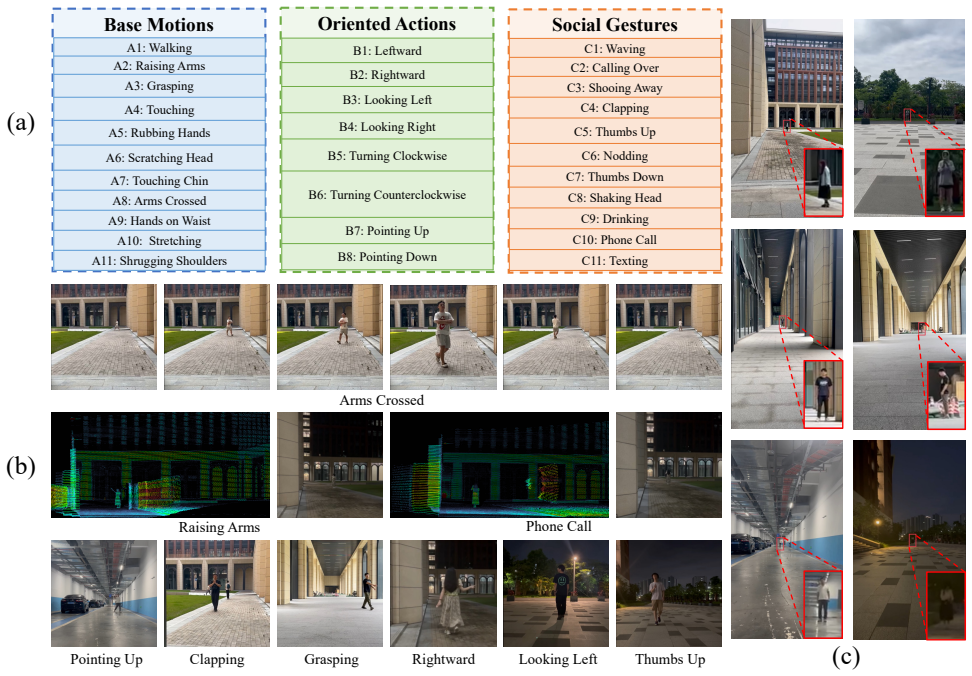
The paper's central claim is that Natural Human-Robot Interaction requires its own action recognition benchmark because conventional datasets assume fixed, close-range, static-camera views. ACTIVE fills that gap with 30 composite action classes, 80 subjects, and 46,868 video instances in RGB and LiDAR point cloud modalities, captured at 3–50 meters across six environments, day and night, with a moving and vibrating capture platform. On this benchmark, ACTIVE-PC reaches 60.10% top-1 accuracy in the point cloud modality, surpassing the strongest baseline (PST-Transformer at 46.76%) by 13.34 percentage points; on NTU RGB+D it remains competitive (91.7% cross-subject, 96.8% cross-view), and the RGB variant ACTIVE-RGB outperforms InternVideo2 by 2.68% on ACTIVE. The intended reading is that the proposed components, Multilevel Neighborhood Sampling, Layered Recognizers, and Elastic Ellipse Query, are what make the gain possible rather than a larger backbone or more data.
Load-bearing premise
The point cloud results assume that the TransFusion detector reliably finds every human subject in every frame across the full 3–50 m range before frames are resampled to 768 points (Section 5.1), and the paper does not report detection accuracy or failure cases by distance.
Editorial extensions
If this is right
- General point cloud action methods transfer poorly to robotic views: the best prior baseline reaches only 46.76% on ACTIVE, so the dataset provides a way to measure the gap between clean, close-range action recognition and N-HRI conditions.
- The decoupling of kinematic state from human action appears to matter: removing Layered Recognizers or EEQ each costs roughly five accuracy points on ACTIVE.
- EEQ makes performance less sensitive to the neighborhood radius hyperparameter, with accuracy variance dropping from 0.456 to 0.100 across radius settings.
- The RGB modality also benefits from the robotic-view design: ACTIVE-RGB (57.56% at $12\times224$) outperforms InternVideo2 (54.88%) on ACTIVE.
- With 46,868 instances carrying action and attribute labels, the benchmark supports joint action and attribute recognition, and pose annotations are planned as a later release.
Reading between the lines
- Extension: the learned anisotropic metric of EEQ could transfer to other egocentric or robot-view point cloud tasks, such as pedestrian intent prediction or mobile-robot navigation safety, where ego-motion dominates the point distribution.
- Extension: because the dataset includes both action labels and kinematic disturbance from platform motion, future work could report a separate robustness score that isolates ego-motion invariance from raw accuracy, which the current benchmark does not define.
- Extension: a testable follow-up is to train the detector and ACTIVE-PC jointly; if long-range detection is the bottleneck the paper does not quantify, end-to-end training could improve the 60.10% anchor more than any action-recognition module change.
- Extension: the 3–50 m distance range invites distance-stratified evaluation, for example reporting accuracy separately for short, medium, and long ranges; the paper reports only aggregate top-1 accuracy.
Editorial analysis
A structured set of objections, weighed in public.
Referee Report
Summary. The paper introduces ACTIVE, a large-scale multimodal (RGB + LiDAR point cloud) action recognition dataset for Natural Human-Robot Interaction, comprising 46,868 annotated instances, 80 subjects, 30 composite action categories, six environments, and capture distances from 3 to 50 meters from a mobile platform. The authors also propose ACTIVE-PC, a point cloud action recognition method built on Multilevel Neighborhood Sampling (MNS), Layered Recognizers (LR), and Elastic Ellipse Query (EEQ). They report 60.10% Top-1 accuracy on ACTIVE point clouds, outperforming PST-Transformer by 13.34 points, and 91.7% CS / 96.8% CV on NTU RGB+D. An RGB variant, ACTIVE-RGB, is also evaluated on ACTIVE, reaching 57.56% Top-1 accuracy.
Significance. If the benchmark and method claims hold, ACTIVE would fill a real gap: existing action recognition datasets do not combine long capture distances, platform motion, multimodal sensing, and N-HRI-oriented composite actions at this scale. ACTIVE-PC's gains on ACTIVE and its consistent performance on the external NTU RGB+D benchmark suggest the implementation is not broken and the architecture is worth studying. The authors also provide a code release, which supports reproducibility. However, the central quantitative claims currently rest on an unquantified person-detection preprocessing stage and single-run evaluations, so the evidence as presented is not yet sufficient to establish the benchmark's validity or the method's state-of-the-art status.
major comments (4)
- [§5.1, Table 2] The point cloud evaluation pipeline begins with TransFusion person detection, as stated in §5.1: "we first apply the TransFusion [1] method to detect human subjects within the scene." No detection accuracy, precision/recall, or distance-stratified analysis is reported. Because ACTIVE spans 3 to 50 meters and each frame is resampled to 768 points, distance-dependent detector failures would inject background points into the input, making the 60.10% accuracy in Table 2 a joint detection-plus-recognition score rather than a measure of ACTIVE-PC's action understanding. Please report TransFusion detection performance stratified by distance, provide failure-case analysis, or evaluate using ground-truth human crops, and re-present Table 2 accordingly.
- [§5.1, Tables 2 and 4] All accuracy numbers in Tables 2, 4, 5, and 6 are single-run point estimates on a single cross-subject split (53 training / 27 test subjects). Without error bars or significance tests, the 13.34-point improvement over PST-Transformer and the ablation differences in Table 5 could be influenced by seed variability. Please report mean and standard deviation over at least three independent runs and, if possible, additional subject splits or a statistical comparison.
- [§3, Table 1] The dataset characterization is incomplete for a benchmark paper. Section 3 reports totals (46,868 instances, 80 subjects, 30 classes, 6 sites) but does not provide per-class instance counts, distance distribution, day/night and environment breakdowns, or an annotation protocol with inter-annotator agreement. These details are necessary to assess class balance, task difficulty, and annotation reliability. Additionally, the claim of being "the first large-scale action recognition dataset specifically focused on N-HRI" should be supported by a more explicit comparison with the closest existing datasets, such as HOMAGE and SMG, rather than only by the summary row in Table 1.
- [§4.4, Eq. (1)] The abstract claims that ACTIVE-PC achieves "precise decoupling of kinematic interference from human actions," but the fusion mechanism in Eq. (1) is a simple average of Yhuman and Ykinematic. There is no explicit mechanism that subtracts or orthogonalizes kinematic components from action features, and no experiment demonstrates that the Kinematic Interpreter actually isolates platform motion. Please either soften the decoupling claim or provide evidence, such as kinematic label prediction accuracy, feature visualizations, or a controlled experiment varying platform motion.
minor comments (5)
- [Figure 3] The figure caption or figure itself contains the leftover artifact "1.png2.png3.png4.png"; this should be removed.
- [Eq. (1)] Equation (1) has an unmatched parenthesis: it reads "Y = (Yhuman + Ykinematic)) / 2" with one extra closing parenthesis.
- [References] Reference [18] is cited as "I Loshchilov. Decoupled weight decay regularization" without a venue or year; please provide the full citation.
- [§5.2] The text states that "Transformer-based models outperform CNN-based models," but Table 2 does not include any CNN-based baseline; either add a CNN baseline or revise the sentence to match the reported comparisons.
- [Figure 4] The t-SNE visualization covers only the 11 Base Motions categories, not all 30 action classes; the caption should state this limitation so that the claim about separating similar actions is not overgeneralized.
Circularity Check
No circularity found: ACTIVE-PC is evaluated on held-out subjects and on external benchmarks, and the learned EEQ scaling parameters are not presented as independent predictions.
full rationale
The paper's central derivation chain—introducing the ACTIVE dataset and the ACTIVE-PC method—does not reduce to its own inputs. The dataset is a new collection benchmark, and the method's quantitative claims (Table 2, 60.10% Top-1 on ACTIVE point clouds) are obtained under a Cross-Subject protocol that separates training and test subjects (Sec. 3.2). The EEQ scaling parameters α, β, γ are explicitly described as trainable ('Ω = {α, β, γ} are trainable scaling parameters') and the reported final values are post-training observations, not fitted inputs used to define a prediction. Ablations in Table 5 compare model variants under the same evaluation protocol, so they do not constitute fitted-input-called-prediction. The strongest empirical anchor is further supported by external evaluation on NTU RGB+D (Table 3: CS 91.7, CV 96.8), which is independent of ACTIVE's fitted parameters. There are no load-bearing self-citations: the cited works are standard external references, and the paper does not invoke any 'uniqueness theorem' from its own authors. The reviewer-flagged concern about TransFusion person detection and distance-stratified accuracy is a methodological validation gap, not a circularity: an unquantified preprocessing stage may condition the reported numbers, but it does not make the action-recognition result equal to its inputs by construction. Accordingly, no circularity step meets the evidentiary bar, and the correct finding is no significant circularity.
Assumptions & free parameters
free parameters (3)
- EEQ axis scaling parameters α, β, γ =
(3.5632, 3.6789, 2.8038)
- Spatial neighborhood radius r =
swept 0.1-2 in Table 6; final value not stated
- Sampled points per frame =
768 in main setting; 512 in ablations
assumptions (4)
- domain assumption The 53/27 cross-subject split prevents identity leakage between training and test clips.
- domain assumption TransFusion detects human subjects reliably across 3-50m before action recognition.
- domain assumption Point geometry without color is sufficient for the reported action recognition.
- domain assumption The composite action labels reflect consistent ground truth across subjects and distances.
Cite this review
Pith. "Pith review of Recognizing Actions from Robotic View for Natural Human-Robot Interaction." pith.science (2026). https://pith.science/paper/XYVF7WBS
@misc{pith2026250722522,
  author       = {Pith},
  title        = {Pith review of: Recognizing Actions from Robotic View for Natural Human-Robot Interaction},
  year         = {2026},
  howpublished = {\url{https://pith.science/paper/XYVF7WBS}},
  note         = {Machine review of arXiv:2507.22522}
}
read the original abstract
Natural Human-Robot Interaction (N-HRI) requires robots to recognize human actions at varying distances and states, regardless of whether the robot itself is in motion or stationary. This setup is more flexible and practical than conventional human action recognition tasks. However, existing benchmarks designed for traditional action recognition fail to address the unique complexities in N-HRI due to limited data, modalities, task categories, and diversity of subjects and environments. To address these challenges, we introduce ACTIVE (Action from Robotic View), a large-scale dataset tailored specifically for perception-centric robotic views prevalent in mobile service robots. ACTIVE comprises 30 composite action categories, 80 participants, and 46,868 annotated video instances, covering both RGB and point cloud modalities. Participants performed various human actions in diverse environments at distances ranging from 3m to 50m, while the camera platform was also mobile, simulating real-world scenarios of robot perception with varying camera heights due to uneven ground. This comprehensive and challenging benchmark aims to advance action and attribute recognition research in N-HRI. Furthermore, we propose ACTIVE-PC, a method that accurately perceives human actions at long distances using Multilevel Neighborhood Sampling, Layered Recognizers, Elastic Ellipse Query, and precise decoupling of kinematic interference from human actions. Experimental results demonstrate the effectiveness of ACTIVE-PC. Our code is available at: https://github.com/wangzy01/ACTIVE-Action-from-Robotic-View.
Figures


Figures from the paper (1 more)

Reference graph
Works this paper leans on
-
[1]
Transfusion: Robust lidar-camera fusion for 3d object detection with transform- ers
Xuyang Bai, Zeyu Hu, Xinge Zhu, Qingqiu Huang, Yilun Chen, Hongbo Fu, and Chiew-Lan Tai. Transfusion: Robust lidar-camera fusion for 3d object detection with transform- ers. In Proceedings of the IEEE/CVF conference on com- puter vision and pattern recognition, 2022. 7
work page 2022
-
[2]
3di- naction: Understanding human actions in 3d point clouds
Yizhak Ben-Shabat, Oren Shrout, and Stephen Gould. 3di- naction: Understanding human actions in 3d point clouds. In Proceedings of the IEEE/CVF Conference on Computer Vision and Pattern Recognition (CVPR), 2024. 7
work page 2024
-
[3]
Intelligent human activity recognition for healthcare digital twin
Elif Bozkaya-Aras, Tolga Onel, Levent Eriskin, and Mumtaz Karatas. Intelligent human activity recognition for healthcare digital twin. Internet of Things, 2025. 1
work page 2025
-
[4]
Smg: A micro-gesture dataset towards spontaneous body gestures for emotional stress state analysis
Haoyu Chen, Henglin Shi, Xin Liu, Xiaobai Li, and Guoying Zhao. Smg: A micro-gesture dataset towards spontaneous body gestures for emotional stress state analysis. Interna- tional Journal of Computer Vision, 2023. 3
work page 2023
-
[5]
An image is worth 16x16 words: Transformers for image recognition at scale
Alexey Dosovitskiy, Lucas Beyer, Alexander Kolesnikov, Dirk Weissenborn, Xiaohua Zhai, Thomas Unterthiner, Mostafa Dehghani, Matthias Minderer, Georg Heigold, Syl- vain Gelly, Jakob Uszkoreit, and Neil Houlsby. An image is worth 16x16 words: Transformers for image recognition at scale. ArXiv, 2020. 8
work page 2020
-
[6]
Point 4d trans- former networks for spatio-temporal modeling in point cloud videos
Hehe Fan, Yi Yang, and Mohan Kankanhalli. Point 4d trans- former networks for spatio-temporal modeling in point cloud videos. In 2021 IEEE/CVF Conference on Computer Vision and Pattern Recognition (CVPR), 2021. 3, 7, 8
work page 2021
-
[7]
Hehe Fan, Xin Yu, Yuhang Ding, Yi Yang, and MohanS. Kankanhalli. Pstnet: Point spatio-temporal convolution on point cloud sequences. Cornell University - arXiv,Cornell University - arXiv, 2022. 7
work page 2022
-
[8]
Deep hierarchical representation of point cloud videos via spatio- temporal decomposition
Hehe Fan, Xin Yu, Yi Yang, and Mohan Kankanhalli. Deep hierarchical representation of point cloud videos via spatio- temporal decomposition. IEEE Transactions on Pattern Analysis and Machine Intelligence, 2022. 7
work page 2022
Show all 34 references
-
[9]
Point spatio- temporal transformer networks for point cloud video mod- eling
Hehe Fan, Yi Yang, and Mohan Kankanhalli. Point spatio- temporal transformer networks for point cloud video mod- eling. IEEE Transactions on Pattern Analysis and Machine Intelligence, 2023. 3, 7
2023
-
[10]
Detecting masked faces in the wild with lle-cnns
Shiming Ge, Jia Li, Qiting Ye, and Zhao Luo. Detecting masked faces in the wild with lle-cnns. In2017 IEEE Confer- ence on Computer Vision and Pattern Recognition (CVPR) ,
-
[11]
Uniformer: Unifying convolution and self-attention for visual recogni- tion
Kunchang Li, Yali Wang, Junhao Zhang, Peng Gao, Guanglu Song, Yu Liu, Hongsheng Li, and Yu Jiao Qiao. Uniformer: Unifying convolution and self-attention for visual recogni- tion. IEEE Transactions on Pattern Analysis and Machine Intelligence, 2022. 3, 7
2022
-
[12]
Uniformerv2: Unlocking the po- tential of image vits for video understanding
Kunchang Li, Yali Wang, Yinan He, Yizhuo Li, Yi Wang, Limin Wang, and Yu Qiao. Uniformerv2: Unlocking the po- tential of image vits for video understanding. InProceedings of the IEEE/CVF International Conference on Computer Vi- sion (ICCV), 2023. 7
2023
-
[13]
Action recognition based on a bag of 3d points
Wanqing Li, Zhengyou Zhang, and Zicheng Liu. Action recognition based on a bag of 3d points. In 2010 IEEE computer society conference on computer vision and pattern recognition-workshops, 2010. 2, 3
2010
-
[14]
Mvitv2: Improved multiscale vision transform- ers for classification and detection
Yanghao Li, Chao-Yuan Wu, Haoqi Fan, Karttikeya Man- galam, Bo Xiong, Jitendra Malik, and Christoph Feicht- enhofer. Mvitv2: Improved multiscale vision transform- ers for classification and detection. In Proceedings of the IEEE/CVF conference on computer vision and pattern rec...
2022
-
[15]
imigue: An identity-free video dataset for micro-gesture understanding and emotion analysis
Xin Liu, Henglin Shi, Haoyu Chen, Zitong Yu, Xiaobai Li, and Guoying Zhao. imigue: An identity-free video dataset for micro-gesture understanding and emotion analysis. In Proceedings of the IEEE/CVF conference on computer vi- sion and pattern recognition, 2021. 3
2021
-
[16]
Leaf: Learning frames for 4d point cloud sequence un- derstanding
Yunze Liu, Junyu Chen, Zekai Zhang, Jingwei Huang, and Li Yi. Leaf: Learning frames for 4d point cloud sequence un- derstanding. In Proceedings of the IEEE/CVF International Conference on Computer Vision, 2023. 3
2023
-
[17]
Video swin transformer
Ze Liu, Jia Ning, Yue Cao, Yixuan Wei, Zheng Zhang, Stephen Lin, and Han Hu. Video swin transformer. In Pro- ceedings of the IEEE/CVF conference on computer vision and pattern recognition, 2022. 7
2022
-
[18]
Decoupled weight decay regularization
I Loshchilov. Decoupled weight decay regularization. 2017. 8
2017
-
[19]
Design of the human-robot interaction for a semi-autonomous service robot to assist el- derly people
Marcus Mast, Michael Burmester, Birgit Graf, Florian Weis- shardt, Georg Arbeiter, Michal Spanel, Zden ˇek Materna, Pavel Smrz, and Gernot Kronreif. Design of the human-robot interaction for a semi-autonomous service robot to assist el- derly people. 2015. 1
2015
-
[20]
Recognizing micro actions in videos: learning motion details via segment-level temporal pyramid
Yang Mi and Song Wang. Recognizing micro actions in videos: learning motion details via segment-level temporal pyramid. In 2019 IEEE International Conference on Multi- media and Expo (ICME), 2019. 3
2019
-
[21]
Ntu rgb+ d: A large scale dataset for 3d human activity anal- ysis
Amir Shahroudy, Jun Liu, Tian-Tsong Ng, and Gang Wang. Ntu rgb+ d: A large scale dataset for 3d human activity anal- ysis. In Proceedings of the IEEE/CVF conference on com- puter vision and pattern recognition, 2016. 2, 3
2016
-
[22]
Pointcmp: Contrastive mask prediction for self-supervised learning on point cloud videos
Zhiqiang Shen, Xiaoxiao Sheng, Longguang Wang, Yulan Guo, Qiong Liu, and Xi Zhou. Pointcmp: Contrastive mask prediction for self-supervised learning on point cloud videos. In 2023 IEEE/CVF Conference on Computer Vision and Pat- tern Recognition (CVPR), 2023. 3, 7
2023
-
[23]
Point contrastive pre- diction with semantic clustering for self-supervised learning on point cloud videos
Xiaoxiao Sheng, Zhiqiang Shen, Gang Xiao, Longguang Wang, Yu Kuen Guo, and Hehe Fan. Point contrastive pre- diction with semantic clustering for self-supervised learning on point cloud videos. 2023 IEEE/CVF International Con- ference on Computer Vision (ICCV), 2023. 7
2023
-
[24]
Videomae: Masked autoencoders are data-efficient learners for self-supervised video pre-training
Zhan Tong, Yibing Song, Jue Wang, and Limin Wang. Videomae: Masked autoencoders are data-efficient learners for self-supervised video pre-training. Advances in neural information processing systems, 2022. 3, 7
2022
-
[25]
Visualiz- ing data using t-sne
Laurens Van der Maaten and Geoffrey Hinton. Visualiz- ing data using t-sne. Journal of machine learning research,
-
[26]
Yolov10: Real-time end- to-end object detection
Ao Wang, Hui Chen, Lihao Liu, Kai Chen, Zijia Lin, Jun- gong Han, and Guiguang Ding. Yolov10: Real-time end- to-end object detection. arXiv preprint arXiv:2405.14458 ,
-
[27]
Temporal segment networks for action recognition in videos.IEEE transactions on pattern analysis and machine intelligence, 2018
Limin Wang, Yuanjun Xiong, Zhe Wang, Yu Qiao, Dahua Lin, Xiaoou Tang, and Luc Van Gool. Temporal segment networks for action recognition in videos.IEEE transactions on pattern analysis and machine intelligence, 2018. 3
2018
-
[28]
Videomae v2: Scaling video masked autoencoders with dual masking
Limin Wang, Bingkun Huang, Zhiyu Zhao, Zhan Tong, Yi- nan He, Yi Wang, Yali Wang, and Yu Qiao. Videomae v2: Scaling video masked autoencoders with dual masking. In Proceedings of the IEEE/CVF Conference on Computer Vi- sion and Pattern Recognition, 2023. 7
2023
-
[29]
Internvideo: General video foundation models via generative and discriminative learning
Yi Wang, Kunchang Li, Yizhuo Li, Yinan He, Bingkun Huang, Zhiyu Zhao, Hongjie Zhang, Jilan Xu, Yi Liu, Zun Wang, Sen Xing, Guo Chen, Junting Pan, Jiashuo Yu, Yali Wang, Limin Wang, and Yu Qiao. Internvideo: General video foundation models via generative and discriminative lear...
2022
-
[30]
Internvideo2: Scaling foundation models for mul- timodal video understanding
Yi Wang, Kunchang Li, Xinhao Li, Jiashuo Yu, Yinan He, Guo Chen, Baoqi Pei, Rongkun Zheng, Zun Wang, Yansong Shi, et al. Internvideo2: Scaling foundation models for mul- timodal video understanding. In European Conference on Computer Vision, 2024. 7
2024
-
[31]
Modeling 4d human-object interactions for event and object recognition
Ping Wei, Yibiao Zhao, Nanning Zheng, and Song-Chun Zhu. Modeling 4d human-object interactions for event and object recognition. In Proceedings of the IEEE/CVF Inter- national Conference on Computer Vision, 2013. 3
2013
-
[32]
Fine-grained action recognition using dy- namic kernels
Sravani Yenduri, Nazil Perveen, Vishnu Chalavadi, and C KrishnaMohan. Fine-grained action recognition using dy- namic kernels. Pattern Recognit., 2022. 1
2022
-
[33]
Recognizing micro-actions and reactions from paired egocentric videos
Ryo Yonetani, Kris M Kitani, and Yoichi Sato. Recognizing micro-actions and reactions from paired egocentric videos. In Proceedings of the IEEE Conference on Computer Vision and Pattern Recognition, 2016. 3
2016
-
[34]
Jianqi Zhong, Kaichen Zhou, Qingyong Hu, Bing Wang, Niki Trigoni, and A. Markham. No pain, big gain: Classify dynamic point cloud sequences with static models by fitting feature-level space-time surfaces. 2022 IEEE/CVF Confer- ence on Computer Vision and Pattern Recognition (CVPR) ,
2022
Reviewed August 6, 2026 · model on record in the stance chip above.
Discussion (0). Sign in to comment.