aLLoyM: A large language model for alloy phase diagram prediction
Pith reviewed 2026-05-19 03:06 UTC · model grok-4.3
The pith
A fine-tuned large language model generates phase diagrams for new alloy systems.
A machine-rendered reading of the paper's core claim, the machinery that carries it, and where it could break.
Core claim
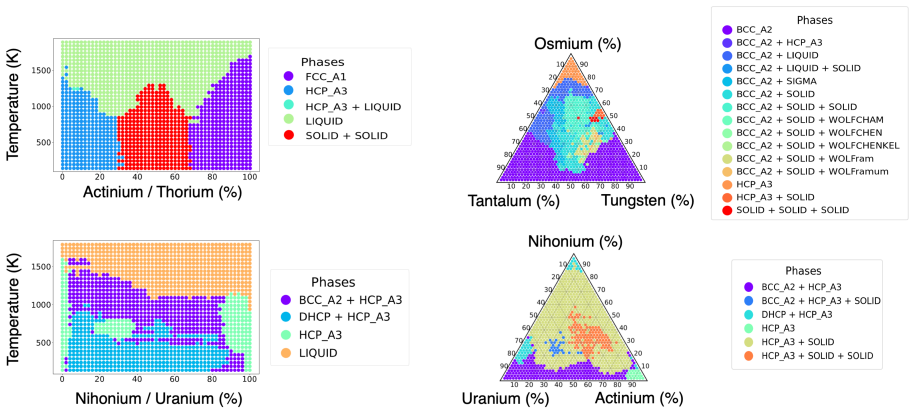
By curating Q&A pairs on alloy compositions, temperatures, and phases from existing sources and fine-tuning Mistral on both multiple-choice and short-answer formats, the resulting aLLoyM model shows improved accuracy on benchmark questions and the short-answer version can produce phase diagrams for novel alloy systems based solely on their components.
What carries the argument
Fine-tuned Mistral LLM using Q&A pairs from phase diagram databases to predict or generate phase information.
If this is right
- Performance on multiple-choice phase diagram questions improves substantially after fine-tuning.
- The short-answer model generates phase diagrams for alloy systems not present in the training data.
- Public release of the model and dataset supports further development in this area.
- This method offers a way to accelerate exploration of unexplored materials systems.
Where Pith is reading between the lines
- Such models might eventually handle quaternary or higher-order alloys if more data is incorporated.
- Integration with experimental validation loops could refine the predictions iteratively.
- The approach could complement existing computational tools like CALPHAD by providing rapid initial guesses.
Load-bearing premise
The curated set of Q&A pairs from known phase diagrams supplies enough varied examples for the model to learn general rules that apply accurately to entirely new alloy compositions.
What would settle it
Compare the phase diagrams generated by the short-answer model for a selection of unseen ternary alloys against independent experimental measurements or detailed CALPHAD calculations to check for agreement in phase fields and transition temperatures.
Figures


read the original abstract
Large Language Models (LLMs) are general-purpose tools with wide-ranging applications, including in materials science. In this work, we introduce aLLoyM, a fine-tuned LLM specifically trained on alloy compositions, temperatures, and their corresponding phase information. To develop aLLoyM, we curated question-and-answer (Q&A) pairs for binary and ternary phase diagrams using the open-source Computational Phase Diagram Database (CPDDB) and assessments based on CALPHAD (CALculation of PHAse Diagrams). We fine-tuned Mistral, an open-source pre-trained LLM, for two distinct Q&A formats: multiple-choice and short-answer. Benchmark evaluations demonstrate that fine-tuning substantially enhances performance on multiple-choice phase diagram questions. Moreover, the short-answer model of aLLoyM exhibits the ability to generate novel phase diagrams from its components alone, underscoring its potential to accelerate the discovery of previously unexplored materials systems. To promote further research and adoption, we have publicly released the short-answer fine-tuned version of aLLoyM, along with the complete benchmarking Q&A dataset, on Hugging Face.
Editorial analysis
A structured set of objections, weighed in public.
Referee Report
Summary. The manuscript introduces aLLoyM, a fine-tuned Mistral LLM for alloy phase diagram prediction. It curates Q&A pairs from CPDDB and CALPHAD assessments for binary and ternary systems, fine-tunes the model on multiple-choice and short-answer formats, reports improved benchmark performance on multiple-choice questions, and claims that the short-answer version can generate novel phase diagrams from alloy components alone. The short-answer model and Q&A dataset are released on Hugging Face.
Significance. If the short-answer generation capability were quantitatively validated on unseen systems, aLLoyM could offer a new route to rapid phase-diagram exploration that complements traditional CALPHAD workflows. At present the significance is limited by the absence of error metrics or held-out tests for the generative outputs.
major comments (2)
- [Abstract] Abstract: the claim that the short-answer model 'exhibits the ability to generate novel phase diagrams from its components alone' is unsupported by any quantitative metrics (e.g., MAE on invariant temperatures or phase-boundary compositions), error analysis, or comparison to independent CALPHAD/experimental references for alloy systems absent from the CPDDB/CALPHAD Q&A corpus.
- [Results] Results / evaluation section: no held-out test set of truly unseen binaries or ternaries is described, nor are systematic comparisons provided against established baselines (standard CALPHAD assessments or other ML models) for the short-answer extrapolation task; this leaves open the possibility that outputs are interpolations or hallucinations rather than reliable predictions.
minor comments (2)
- [Methods] The manuscript should specify the total number of Q&A pairs, the train/validation/test split ratios, and the exact fine-tuning hyperparameters used for both formats.
- [Figures] Figure or table captions for any example generated diagrams should include the source of the reference data against which the output is compared.
Simulated Author's Rebuttal
We thank the referee for their constructive comments, which correctly highlight the need for stronger quantitative support behind the generative claims for the short-answer model. We have revised the manuscript to temper the language in the abstract, clarify the scope of the evaluation, and add explicit discussion of limitations. These changes preserve the core contribution on fine-tuning and multiple-choice benchmarking while addressing the identified gaps.
read point-by-point responses
-
Referee: [Abstract] Abstract: the claim that the short-answer model 'exhibits the ability to generate novel phase diagrams from its components alone' is unsupported by any quantitative metrics (e.g., MAE on invariant temperatures or phase-boundary compositions), error analysis, or comparison to independent CALPHAD/experimental references for alloy systems absent from the CPDDB/CALPHAD Q&A corpus.
Authors: We agree that the original abstract phrasing overstated the strength of evidence for the generative capability. The examples in the manuscript are qualitative demonstrations rather than quantitatively validated predictions on held-out systems. In the revised manuscript we have updated the abstract to state that the short-answer model 'can generate phase diagram descriptions for alloy systems from component inputs, as shown in illustrative examples.' We have also inserted a dedicated limitations paragraph that notes the lack of MAE or similar metrics, the absence of comparisons to independent references for systems outside the training corpus, and the exploratory nature of the generation results. These revisions align the claims with the presented evidence. revision: yes
-
Referee: [Results] Results / evaluation section: no held-out test set of truly unseen binaries or ternaries is described, nor are systematic comparisons provided against established baselines (standard CALPHAD assessments or other ML models) for the short-answer extrapolation task; this leaves open the possibility that outputs are interpolations or hallucinations rather than reliable predictions.
Authors: The quantitative evaluation reported in the manuscript is confined to the multiple-choice benchmark, which does employ held-out questions. For the short-answer model the outputs are presented as illustrative generations on component combinations not directly copied from training Q&A pairs. We acknowledge that this does not constitute a rigorous held-out extrapolation test and that no baseline comparisons to other ML approaches or full CALPHAD assessments are provided for the generative task. In the revision we have added clarifying text in the results section describing the selection of generation examples, a short discussion of possible hallucinations, and a statement that systematic quantitative validation on truly novel systems is an important avenue for future work. We maintain that the primary contribution remains the fine-tuning and benchmarking results, with generation shown as a promising direction rather than a fully validated capability. revision: partial
Circularity Check
No significant circularity in fine-tuning pipeline or claims
full rationale
The paper's core process is curating Q&A pairs from external sources (CPDDB and independent CALPHAD assessments) followed by standard supervised fine-tuning of a pre-trained Mistral model. The claim that the short-answer model can generate novel phase diagrams rests on this conventional ML training against an independent database rather than any self-referential derivation, parameter fitting that is then re-used as a prediction, or load-bearing self-citation chains. No equations, uniqueness theorems, or ansatzes are invoked that reduce to the paper's own inputs by construction. The derivation chain is self-contained against external benchmarks and follows ordinary supervised learning practices.
Axiom & Free-Parameter Ledger
free parameters (1)
- fine-tuning hyperparameters
axioms (1)
- domain assumption The curated Q&A pairs derived from CPDDB and CALPHAD assessments accurately represent thermodynamic phase equilibria for the binary and ternary systems considered.
Lean theorems connected to this paper
-
IndisputableMonolith.Foundation.RealityFromDistinctionreality_from_one_distinction unclear?
unclearRelation between the paper passage and the cited Recognition theorem.
We fine-tuned Mistral... on Q&As... short-answer model... generate novel phase diagrams from its components alone
-
IndisputableMonolith.Cost.FunctionalEquationwashburn_uniqueness_aczel unclear?
unclearRelation between the paper passage and the cited Recognition theorem.
Benchmark evaluations... extrapolation split: Systems in the test set were completely excluded
What do these tags mean?
- matches
- The paper's claim is directly supported by a theorem in the formal canon.
- supports
- The theorem supports part of the paper's argument, but the paper may add assumptions or extra steps.
- extends
- The paper goes beyond the formal theorem; the theorem is a base layer rather than the whole result.
- uses
- The paper appears to rely on the theorem as machinery.
- contradicts
- The paper's claim conflicts with a theorem or certificate in the canon.
- unclear
- Pith found a possible connection, but the passage is too broad, indirect, or ambiguous to say the theorem truly supports the claim.
Reference graph
Works this paper leans on
-
[1]
Schlesinger, M. E. & Mueller, E. M. (eds) ASM handbook, volume 3 ASM Handbook (ASM International, Materials Park, OH, 1983)
work page 1983
-
[2]
Massalski, T. B. & Okamoto, H. (eds) Binary alloy phase diagrams (ASM International, 1990)
work page 1990
-
[3]
Villars, P., Prince, A. & Okamoto, H. Handbook of ternary alloy phase diagrams (ASM International, 1995)
work page 1995
-
[4]
Okamoto, H. Desk handbook 2 edn. ASM Handbooks (ASM International, 2010)
work page 2010
-
[5]
Computational phase diagram database (CPDDB). URL https://cpddb.nims.go. jp/
-
[6]
Jung, I.-H. & Van Ende, M.-A. Computational thermodynamic calculations: FactSage from CALPHAD thermodynamic database to virtual process simulation. Metallurgical and Materials Transactions B 51, 1851-1874 (2020). URL http://dx.doi.org/10. 1007/s11663-020-01908-7
work page 2020
-
[7]
Hallstedt, B., Noori, M., Kies, F., Oppermann, F. & Haase, C. Thermodynamic database for multi-principal element alloys within the system Al-Co-Cr-Fe-Mn-Ni-C. 20 Calphad 83, 102644 (2023). URL http://dx.doi.org/10.1016/j.calphad.2023. 102644
-
[8]
Terayama, K. et al. Efficient construction method for phase diagrams using uncertainty sampling. Physical Review Materials 3 (2019). URL http://dx.doi.org/10.1103/ PhysRevMaterials.3.033802
work page 2019
-
[9]
Aghaaminiha, M., Ghanadian, S. A., Ahmadi, E. & Farnoud, A. M. A machine learn- ing approach to estimation of phase diagrams for three-component lipid mixtures. Biochimica et Biophysica Acta (BBA) - Biomembranes 1862, 183350 (2020). URL http://dx.doi.org/10.1016/j.bbamem.2020.183350
-
[10]
Dai, C. & Glotzer, S. C. Efficient phase diagram sampling by active learning. The Journal of Physical Chemistry B 124, 1275-1284 (2020). URL http://dx.doi.org/ 10.1021/acs.jpcb.9b09202
-
[11]
Lund, J., Wang, H., Braatz, R. D. & Garc ˜Aa, R. E. Machine learning of phase dia- grams. Materials Advances 3, 8485-8497 (2022). URL http://dx.doi.org/10.1039/ D2MA00524G
work page 2022
-
[12]
Zipoli, F., Viterbo, V., Schilter, O., Kahle, L. & Laino, T. Prediction of phase dia- grams and associated phase structural properties. Industrial & Engineering Chemistry Research 61, 8378-389 (2022). URL http://dx.doi.org/10.1021/acs.iecr.2c00355
-
[13]
Tamura, R. et al. Machine-learning-based phase diagram construction for high- throughput batch experiments. Science and Technology of Advanced Materials: Methods 2, 153-161 (2022). URL http://dx.doi.org/10.1080/27660400.2022.2076548
-
[14]
Deffrennes, G., Terayama, K., Abe, T. & Tamura, R. A machine learning-based classifi- cation approach for phase diagram prediction. Materials & Design 215, 110497 (2022). URL http://dx.doi.org/10.1016/j.matdes.2022.110497. 21
-
[15]
Tamura, R. et al. AIPHAD, an active learning web application for visual understanding of phase diagrams. Communications Materials 5, 139 (2024). URL http://dx.doi. org/10.1038/s43246-024-00580-7
-
[16]
Jablonka, K. M. et al. 14 examples of how LLMs can transform materials science and chemistry: a reflection on a large language model hackathon. Digital Discovery 2, 1233-1250 (2023). URL http://dx.doi.org/10.1039/D3DD00113J
-
[17]
Liu, Y. et al. Generative artificial intelligence and its applications in materials science: Current situation and future perspectives. Journal of Materiomics 9, 798-816 (2023). URL http://dx.doi.org/10.1016/j.jmat.2023.05.001
-
[18]
Lei, G., Docherty, R. & Cooper, S. J. Materials science in the era of large language models: a perspective. Digital Discovery 3, 1257-1272 (2024). URL http://dx.doi. org/10.1039/D4DD00074A
-
[19]
Deb, J., Saikia, L., Dihingia, K. D. & Sastry, G. N. ChatGPT in the material design: Selected case studies to assess the potential of ChatGPT. Journal of Chemical Informa- tion and Modeling 64, 799-811 (2024). URL http://dx.doi.org/10.1021/acs.jcim. 3c01702
-
[20]
Jiang, X. et al. Applications of natural language processing and large language models in materials discovery. npj Computational Materials 11, 79 (2025). URL http://dx. doi.org/10.1038/s41524-025-01554-0
-
[21]
Yan, Z. et al. PDGPT: A large language model for acquiring phase diagram information in magnesium alloys. Materials Genome Engineering Advances 2, e77 (2024). URL http://dx.doi.org/10.1002/mgea.77. 22
-
[22]
Zha, Y., Li, Y. & Lu, X.-G. Enhancing large language model comprehension of material phase diagrams through prompt engineering and benchmark datasets. Mathematics 12, 3141 (2024). URL http://dx.doi.org/10.3390/math12193141
- [23]
-
[24]
URL https://huggingface.co/ unsloth/Mistral-Nemo-Instruct-2407-bnb-4bit
Hugging face, mistral-nemo-instruct-2407-bnb-4bit. URL https://huggingface.co/ unsloth/Mistral-Nemo-Instruct-2407-bnb-4bit
-
[25]
URL https://periodic-table.rsc.org/element/89/ actinium
Periodic table, actinium. URL https://periodic-table.rsc.org/element/89/ actinium
-
[26]
Farr, J., Giorgi, A., Bowman, M. & Money, R. The crystal structure of actinium metal and actinium hydride. Journal of Inorganic and Nuclear Chemistry 18, 42-47 (1961). URL http://dx.doi.org/10.1016/0022-1902(61)80369-2
-
[27]
URL https://periodic-table.rsc.org/element/92/ uranium
Periodic table, uranium. URL https://periodic-table.rsc.org/element/92/ uranium
-
[28]
Grenthe, I. et al. Uranium , 253-298 (Springer Netherlands). URL http://dx.doi.org/ 10.1007/1-4020-3598-5_5 . Acknowledgements The authors would like to thank Etsuko Ogamino for data collection. This study was sup- ported by a project subsidized by JSPS KAKENHI (25K01492 and 25KJ0870), JST-CREST (JPMJCR21O2), and MEXT Program: Data Creation and Utilizatio...
discussion (0)
Sign in with ORCID, Apple, or X to comment. Anyone can read and Pith papers without signing in.