REVIEW 3 major objections 4 minor 31 references
Matrix product states as thin torus limits of conformal correlators
T0 review · 3 major / 4 minor · reviewed 2026-08-06 · deepseek-v4-flash
Pith's one-line read In the thin torus limit, torus conformal blocks become finite-dimensional matrix product states: for SU(2)_1 and SU(2)_2, exactly the Majumdar-Ghosh and AKLT ground states.
desk verdict Fresh one-parameter bridge from idMPS to finite-bond-dimension MPS with MG and AKLT endpoints; the unproven thin-torus projection is the real gap, but the construction holds together and deserves review. read the letter →
The pith
A machine-rendered reading of the paper's core claim, the machinery that carries it, and where it could break.
The reading
What carries the argument
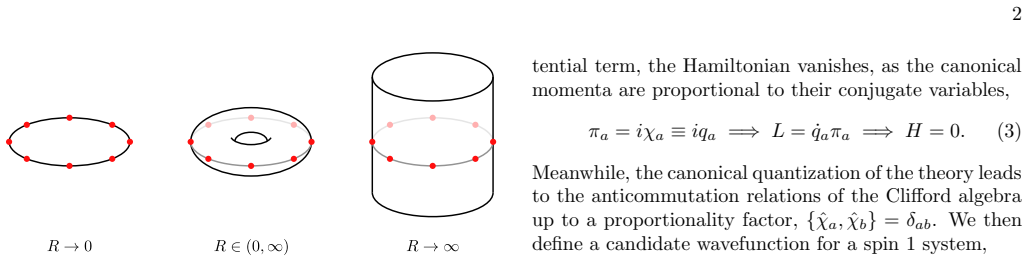
The central mechanism is the sewn-torus representation of a conformal block: a trace of $n$ chiral vertex operators interleaved with powers of $q^{L_0}$, with $q=e^{-2\pi/(nR)}$, so that $q\to0$ as the torus radius $R\to0$. Because $q^{L_0}$ weights states by conformal dimension, the small-$q$ limit projects each Verma module onto its primary (lowest-weight) subspace; replacing each vertex operator by its restriction to that finite-dimensional subspace turns the trace into the contraction of a chain of three-legged tensors, i.e. an MPS amplitude. For the models treated here, the restricted tensors are exactly the $\mathrm{SU}(2)$ Clebsch-Gordan coefficients (Eqs. 41--45), and the $S$ modular transformation maps this 'perpendicular' MPS basis into the 'parallel' basis in which the wavefunctions $\psi_k$ are written; this is why the two Majumdar-Ghosh states appear as $\pm$ linear combinations of the two dimer coverings.
What would settle it
Take an explicit $\mathrm{SU}(2)_1$ conformal block for a small even $N$, compute the normalized wavefunction at small nonzero $R$, and measure its overlap with the Majumdar-Ghosh state as $R\to0$: if the per-site fidelity does not approach 1, the limit is not the claimed MPS. A sharper check is the $q$-expansion around $q=0$: the first term from a Virasoro descendant entering the trace of Eq. (39) contributes at order $q^{\Delta+1}$, and unless its coefficient vanishes after normalization, the limit state contains a component orthogonal to the MPS.
Extended reading notes
Core claim
The central discovery is the exact thin-torus limit: as $R\to0$ (equivalently $\tau\to0$), the one-parameter family of spin-chain wavefunctions $\psi_k(s|\tau)$ obtained from chiral conformal blocks on a torus of modular parameter $\tau=iR$ converges, after normalization, to a finite-bond-dimension MPS. In the $\mathrm{SU}(2)_1$ WZW model, $\psi_0$ and $\psi_{1/2}$ converge to the two Majumdar-Ghosh ground states $|\mathrm{MG}\rangle_\pm$ of the spin-$\frac12$ chain, while at the opposite end $R\to\infty$, $\psi_0$ converges to the Haldane-Shastry ground state and $\psi_{1/2}$ to its first singlet excited state. In the $\mathrm{SU}(2)_2$ WZW model, $\psi_4$ converges to the AKLT state, $\psi_2$ and $\psi_3$ converge to superpositions of triplet-dimer coverings, and the cylinder limit merges $\psi_3$ and $\psi_4$ into the states $|\tan\rangle$ and $|\sin\rangle$. The mechanism is a projection: writing the torus conformal block as a trace of chiral vertex operators separated by $q^{L_0}$ factors with $q=e^{-2\pi/(nR)}$, the limit $q\to0$ selects the lowest conformal-weight subspace of each module, and the restricted vertex operators have exactly the matrix elements of an MPS -- the leading OPE coefficients (Clebsch-Gordan coefficients) of the virtual CFT. The paper presents this as a derivation, but explicitly states that a mathematical proof, bounding the error of the projection, is not given; numerical checks on the explicit conformal blocks support the identification.
Load-bearing premise
The load-bearing premise is that, as the torus radius shrinks to zero, the exponentially suppressed contributions of all higher-energy virtual states vanish quickly enough that the normalized wavefunction converges exactly to the finite-dimensional MPS built from the lowest-energy states; the paper explicitly refrains from proving the needed error bound.
Editorial extensions
If this is right
- For $\mathrm{SU}(2)_1$, the thin torus limits of $\psi_0$ and $\psi_{1/2}$ are exactly the two Majumdar-Ghosh ground states of the spin-$\frac12$ chain, superpositions of the two dimer coverings by spin singlets.
- For $\mathrm{SU}(2)_2$, $\psi_4$ becomes the AKLT state, while $\psi_2$ and $\psi_3$ become superpositions of triplet-dimer coverings; a local unitary $u$ relates the circular-polarization basis to the standard Pauli-matrix presentation.
- At the opposite end $\tau\to i\infty$, the same families recover the infinite-dimensional MPS: $\psi_0$ gives the Haldane-Shastry ground state and $\psi_{1/2}$ its first singlet excited state, while $\psi_3$ and $\psi_4$ merge into the $|\tan\rangle$ and $|\sin\rangle$ states.
- The family therefore interpolates between finite-correlation-length MPS and infinite-correlation-length idMPS, and optimizing $R$ gives accurate variational ground states for the $J_1$--$J_2$ model near the Majumdar-Ghosh point and for the bilinear-biquadratic model near the AKLT point.
Reading between the lines
- Editorial inference: the projection argument is not tied to levels 1 and 2, so the same construction should produce finite-bond-dimension MPS from any rational CFT; the natural open problem is to characterize which chiral-vertex-operator matrix elements yield normalizable translation-invariant MPS.
- Editorial inference: because the thin-torus geometry is the standard dimensional-reduction tool in fractional quantum Hall theory, the construction suggests a variational bridge between lattice fractional-Chern-insulator model wavefunctions and their MPS descendants, with $\tau$ as the interpolation parameter.
- Editorial inference: the missing error bound is directly testable: expanding the normalized conformal block in powers of $q$ around the primary contribution, the first descendant correction should vanish at $q=0$; if it does not, the limit state differs from the pure MPS.
Editorial analysis
A structured set of objections, weighed in public.
Referee Report
Summary. The paper introduces one-parameter families of spin-chain wavefunctions defined by chiral conformal block amplitudes on a torus with modular parameter τ = iR. For the SU(2)_1 and SU(2)_2 WZW models, explicit formulas are given for the amplitudes (Eqs. (8) and (16)). The cylinder limit R → ∞ reproduces the known infinite-dimensional MPS (Haldane-Shastry and related states), while the thin-torus limit R → 0 is claimed to produce finite-bond-dimension MPS: the two SU(2)_1 blocks converge to the two Majumdar-Ghosh ground states |MG>±, and the SU(2)_2 block ψ4 converges to the AKLT state. The argument is based on a sewing construction in which q^{L0} factors with q = exp(-2π/(nR)) project onto lowest conformal-weight subspaces, after which the trace of restricted chiral vertex operators becomes an MPS amplitude. The authors explicitly refrain from proving this projection and instead rely on numerical checks.
Significance. If the thin-torus identification is correct, the paper establishes a concrete bridge between CFT correlators and finite-bond-dimension tensor networks, placing well-known MPS at one end of a one-parameter family that interpolates to infinite-correlation-length states. The construction is attractive because it is parameter-free apart from R, the endpoint states are exactly known MPS, and the intermediate states are shown numerically to be good variational ansätze for the J1-J2 and quadratic-biquadratic chains (Figs. 3, 5, 7). The explicit formulas (8) and (16), the sewing picture, and the modular S-matrix relations are concrete and reproducible. However, the central limiting statement is not proved and the numerical support currently displayed does not directly test the endpoint convergence.
major comments (3)
- [Supplement, 'Thin torus limit argument'] The central identification of the R→0 limit with finite-bond-dimension MPS rests on replacing q^{L0}V_{I_m} by V^0_{I_m} in Eqs. (39)-(40), and the authors explicitly state that they do not prove this projection ('We refrain in the present work from making this argument into a mathematical proof...'). The sentence 'up to global factors absorbed in the normalization' is not sufficient, because the normalization factors can differ between the conformal blocks that are later superposed through the S-matrix relations (30)-(31) and (32)-(34). If the leading q-powers of the perpendicular-basis blocks in those relations differ, the normalized limits of ψ0 and ψ1/2 (or ψ2, ψ3, ψ4) could collapse onto a single dimer state rather than the claimed |MG>± and AKLT states. Please provide either an analytic leading-order expansion of the normalized states obtained from Eqs. (8) and (16) as R→0 using the modular transformations (26)-(29), or a direct numerical study of the fidelity to the target MPS as a function of R for fixed N.
- [Supplement, 'Thin torus limit argument'; main text, 'Thin torus limit'] The paper states that the thin-torus limits of known conformal blocks are checked numerically, but the numerical results actually displayed (Figs. 3, 5, 7 and the corresponding text) are variational optimizations over R for the J1-J2 and quadratic-biquadratic Hamiltonians; they do not directly plot the fidelity of the normalized τ→0 states against |MG>± or the AKLT state. Thus the central endpoint claim lacks the advertised numerical support. A small set of direct fidelity-versus-R curves for representative N, or an explicit statement that such curves were used to verify the limits, would make the claim concrete and testable.
- [Supplement, 'Choice of basis of conformal blocks and modular transformations'] The derivation of the S-matrix action (30)-(31) is summarized with 'it can be shown' after quoting the special-function identities (26)-(29). Because the wavefunctions (8) contain the configuration-dependent Marshall sign η_s, the product of prime forms, and the fixed positions z_j = j/N, the transformation of the entire amplitude may acquire s-dependent phases beyond the quoted constant coefficients. These phases determine which linear combination of dimer coverings (|MG>+ or |MG>−, and the analogous SU(2)_2 superpositions) is obtained. Please spell out the transformation of the full wavefunction, not just the theta functions, or explicitly state that all extra factors cancel and show the cancellation.
minor comments (4)
- [Main text, paragraph before Eq. (9)] Typo: 'the resulting conformal blocks will are singlets under SU(2)' should read 'will be singlets under SU(2)'.
- [Supplement, 'Free field representations'] Typo: 'Let's know look at the specific examples' should read 'Let us now look at the specific examples'.
- [Main text, Eq. (8)] The notation θ[k/0] is used before the theta-function convention is defined; please define θ[a/b] explicitly or refer to Eq. (20) at the first use in the main text.
- [Supplement, Eq. (59)] The notation ⟨sgl|0,N+1|ψ0⟩ is ambiguous; it would be clearer to state explicitly that the spins at positions 0 and N+1 are projected onto the singlet state |sgl⟩.
Circularity Check
No circular reduction found: the thin-torus MPS limits are computed from free-field conformal blocks and modular covariance, then checked against externally known Majumdar-Ghosh and AKLT states; the admitted unproven projection step is a rigor gap, not a circularity.
full rationale
The central claim—that the R→0 thin-torus limit of torus conformal-block wavefunctions equals finite-bond-dimension MPS with Clebsch-Gordan tensors—is a genuine derivation, not a circular one. The SU(2)_1 blocks (Eq. 8) are computed from the free-boson representation via external formulas [16,17]; the SU(2)_2 blocks (Eq. 16) via Wick's theorem Pfaffians. The thin-torus argument (Supplement Eqs. 35–45) replaces the q^{L0} sewing factors by a projection onto lowest conformal weight, giving a finite trace of restricted chiral vertex operators whose matrix elements are OPE coefficients. Those coefficients are fixed by SU(2) representation theory (Eqs. 41–45 are the standard Clebsch-Gordan/valence-bond tensors), not fitted. The 1/√2 superpositions in Eqs. (30)–(31) and (32)–(34) are fixed by modular covariance via Poisson resummation (Eqs. 26–29), not by targeting |MG⟩± or |AKLT⟩. The endpoint states are externally defined benchmarks—the Majumdar-Ghosh Hamiltonian (Eq. 11) and the Pauli-matrix AKLT tensor—so the identification is falsifiable and is numerically checked; no parameter is fitted to force the endpoints (R is a geometric modulus, Eq. 35). Self-citations ([1] for the cylinder/idMPS context, [11] for the parent-Hamiltonian formalism in the peripheral |sin⟩ and ψ1/2 checks, [30] for a ψ1/2 representation) are background or auxiliary and remain externally verifiable; they do not carry the thin-torus claim, which rests on the paper's own supplement and independent benchmarks. The weakest step is explicitly admitted: 'We refrain in the present work from making this argument into a mathematical proof, which would require bounding the error incurred when projecting onto the low conformal weight subspaces.' An unproven convergence/normalization step (e.g., relative q-powers of different fusion sectors after normalization) is a correctness gap, not a circular reduction: no equation in the paper is its own input by construction, and no fitted parameter is renamed as a prediction. The honest finding is no significant circularity.
Assumptions & free parameters
free parameters (1)
- R (modular parameter, tau = iR) =
N-dependent optimum, Figs. 3(a) and 5(a)
assumptions (4)
- domain assumption Free field representations reproduce the SU(2)_1 and SU(2)_2 WZW conformal blocks: a chiral boson at radius sqrt(2) with the Marshall sign for SU(2)_1 (Eqs. 6-9), and three Majorana fermions for SU(2)_2 (Eqs. 13-16).
- domain assumption The sewing construction of the N-punctured torus from n pairs of pants with equal sewing parameter q = exp(-2*pi/(nR)) (Eq. 35) matches the torus conformal block (Eq. 39), with the trace taken over the representation closing the perpendicular cycle.
- ad hoc to paper As q -> 0 (R -> 0), the q^{L0} projections restrict to the lowest conformal weight subspaces, so the wavefunction converges to the MPS built from the leading OPE coefficients, the Clebsch-Gordan coefficients (Eqs. 41-45).
- domain assumption The parent Hamiltonian formalism of Ref. [11] correctly yields a positive semidefinite Hamiltonian annihilated by the idMPS, used for the Haldane-Shastry excited state proof (Supplement, Eqs. 60-67) and for the |sin> parent Hamiltonian.
Cite this review
Pith. "Pith review of Matrix product states as thin torus limits of conformal correlators." pith.science (2026). https://pith.science/paper/2OBQIU4A
@misc{pith2026250722735,
  author       = {Pith},
  title        = {Pith review of: Matrix product states as thin torus limits of conformal correlators},
  year         = {2026},
  howpublished = {\url{https://pith.science/paper/2OBQIU4A}},
  note         = {Machine review of arXiv:2507.22735}
}
abstract
We introduce one-parameter families of spin chain ansatz wavefunctions constructed from chiral conformal field theory correlators on a torus, with the modular parameter $\tau$ serving as the deformation parameter. In the cylinder limit $\tau\to\infty$, these wavefunctions reduce to infinite dimensional matrix product states. In contrast, in the thin torus limit $\tau\to0$, they become finite bond dimension matrix product states (MPS). Focusing on families derived from the SU(2)$_1$ and SU(2)$_2$ Wess-Zumino-Witten models, we show that in the thin torus limit they reproduce known MPS ground states, such as those of the Majumdar-Ghosh and AKLT spin chains.
Figures


Figures from the paper (4 more)


Reference graph
Works this paper leans on
-
[1]
J. I. Cirac and G. Sierra, Infinite matrix product states, conformal field theory, and the Haldane-Shastry model, Phys. Rev. B 81, 104431 (2010)
work page 2010
-
[2]
J. I. Cirac, D. P´ erez-Garc ´ ıa, N. Schuch, and F. Ver- straete, Matrix product states and projected entangled pair states: Concepts, symmetries, theorems, Rev. Mod. Phys. 93, 045003 (2021)
work page 2021
-
[3]
R. B. Laughlin, Anomalous quantum Hall effect: An in- compressible quantum fluid with fractionally charged ex- citations, Phys. Rev. Lett. 50, 1395 (1983)
work page 1983
-
[4]
V. Kalmeyer and R. B. Laughlin, Equivalence of the resonating-valence-bond and fractional quantum Hall states, Phys. Rev. Lett. 59, 2095 (1987)
work page 1987
-
[5]
G. Moore and N. Read, Nonabelions in the fractional quantum Hall effect, Nuclear Physics B 360, 362 (1991)
work page 1991
-
[6]
In [1] and many subsequent publications, this ansatz was called infinite MPS (iMPS). To avoid confusion with the 6 unrelated ansatz of finite dimensional MPS on an infinite chain, we slightly modify the nomenclature, following a proposal by H.-H. Tu
-
[7]
A. E. B. Nielsen, B. Herwerth, J. I. Cirac, and G. Sierra, Field tensor network states, Physical Review B 103, 10.1103/physrevb.103.155130 (2021)
-
[8]
E. J. Bergholtz and A. Karlhede, Half-filled lowest Lan- dau level on a thin torus, Phys. Rev. Lett. 94, 026802 (2005)
work page 2005
Show all 31 references
-
[9]
B. A. Bernevig and N. Regnault, Thin-torus limit of fractional topological insulators (2012), arXiv:1204.5682 [cond-mat.str-el]
2012 arXiv
-
[10]
di Francesco, P
P. di Francesco, P. Mathieu, and D. S´ en´ echal,Conformal Field Theory (Springer New York, NY, 1996)
1996
-
[11]
A. E. B. Nielsen, J. I. Cirac, and G. Sierra, Quantum spin hamiltonians for the SU(2)k WZW model, Journal of Statistical Mechanics: Theory and Experiment 2011, P11014 (2011)
2011
-
[12]
Affleck, T
I. Affleck, T. Kennedy, E. H. Lieb, and H. Tasaki, Rig- orous results on valence-bond ground states in antiferro- magnets, Phys. Rev. Lett. 59, 799 (1987)
1987
-
[13]
Topo- logical
G. V. Dunne, R. Jackiw, and C. A. Trugenberger, “Topo- logical” (Chern-Simons) quantum mechanics, Phys. Rev. D 41, 661 (1990)
1990
-
[14]
This completely parameterizes the moduli space of complex structures on the torus
A torus of modular parameter τ can be seen as arising from quotienting the complex plane by the relations z ∼ z + 1 and z ∼ z + τ . This completely parameterizes the moduli space of complex structures on the torus
-
[15]
See Supplementary Material
-
[16]
Dijkgraaf, E
R. Dijkgraaf, E. P. Verlinde, and H. L. Verlinde, c = 1 Conformal Field Theories on Riemann Surfaces, Com- mun. Math. Phys. 115, 649 (1988)
1988
-
[17]
A. E. B. Nielsen and G. Sierra, Bosonic fractional quan- tum Hall states on the torus from conformal field the- ory, Journal of Statistical Mechanics: Theory and Ex- periment 2014, P04007 (2014)
2014
-
[18]
F. D. M. Haldane, Exact Jastrow-Gutzwiller resonating- valence-bond ground state of the spin- 1 2 antiferromag- netic Heisenberg chain with 1/r 2 exchange, Phys. Rev. Lett. 60, 635 (1988)
1988
-
[19]
B. S. Shastry, Exact solution of an s=1/2 Heisenberg antiferromagnetic chain with long-ranged interactions, Phys. Rev. Lett. 60, 639 (1988)
1988
-
[20]
P. H. Ginsparg, Applied Conformal Field Theory, in Les Houches Summer School in Theoretical Physics: Fields, Strings, Critical Phenomena (1988) arXiv:hep- th/9108028
1988
-
[21]
S´ olyom, Competing bilinear and biquadratic exchange couplings in spin-1 Heisenberg chains, Phys
J. S´ olyom, Competing bilinear and biquadratic exchange couplings in spin-1 Heisenberg chains, Phys. Rev. B 36, 8642 (1987)
1987
-
[22]
Schadschneider and J
A. Schadschneider and J. Zittartz, Variational study of isotropic spin-1 chains using matrix-product states, An- nalen der Physik 507, 157 (1995)
1995
-
[23]
Or´ us, T.-C
R. Or´ us, T.-C. Wei, and H.-H. Tu, Phase diagram of the SO(n) bilinear-biquadratic chain from many-body entan- glement, Phys. Rev. B 84, 064409 (2011)
2011
-
[24]
Tu, G.-M
H.-H. Tu, G.-M. Zhang, and T. Xiang, String order and hidden topological symmetry in the SO(2n + 1) symmet- ric matrix product states, Journal of Physics A: Mathe- matical and Theoretical 41, 415201 (2008)
2008
-
[25]
Tu, G.-M
H.-H. Tu, G.-M. Zhang, and T. Xiang, Class of exactly solvable SO(n) symmetric spin chains with matrix prod- uct ground states, Phys. Rev. B 78, 094404 (2008)
2008
-
[26]
Gasull, A
A. Gasull, A. Tilloy, J. I. Cirac, and G. Sierra, Symme- tries and field tensor network states, Physical Review B 107, 10.1103/physrevb.107.155102 (2023)
2023 doi
-
[27]
Tsuchiya and Y
A. Tsuchiya and Y. Kanie, Vertex Operators in the Con- formal Field Theory on p1 and Monodromy Represen- tations of the Braid Group, Lett. Math. Phys. 13, 303 (1987)
1987
-
[28]
Moore and N
G. Moore and N. Seiberg, Polynomial equations for ratio- nal conformal field theories, Physics Letters B 212, 451 (1988)
1988
-
[29]
Recknagel and V
A. Recknagel and V. Schomerus, Boundary Conformal Field Theory and the Worldsheet Approach to D-Branes , Cambridge Monographs on Mathematical Physics (Cam- bridge University Press, 2013)
2013
-
[30]
Herwerth, G
B. Herwerth, G. Sierra, H.-H. Tu, J. I. Cirac, and A. E. B. Nielsen, Edge states for the Kalmeyer-Laughlin wave function, Phys. Rev. B 92, 245111 (2015)
2015
-
[31]
pairs of pants
Note that in [11] the expressions are given in terms of complex plane coordinates, related to the cylinder co- ordinates as usual by an exponential map, x + it → e−2πi(x+it). 7 Supplemental Material Special functions We introduce here the special functions that appear in the m...
Reviewed August 6, 2026 · model on record in the stance chip above.
Discussion (0). Continue with ORCID to comment.