REVIEW 3 major objections 3 minor 1 cited by
Ambiguity-Aware Segmented Estimation of Mutual Coupling in Large RIS: Algorithm and Experimental Validation
T0 review · 3 major / 3 minor · reviewed 2026-08-06 · deepseek-v4-flash
Pith's one-line read Mutual coupling in a 100-element RIS is estimated at 40.5 dB accuracy by stitching ambiguity-aware segments.
desk verdict A genuinely useful segmented calibration method backed by a strong 100-element experiment, with a real but addressable robustness gap around per-element load tolerances. read the letter →
The pith
A machine-rendered reading of the paper's core claim, the machinery that carries it, and where it could break.
The reading
What carries the argument
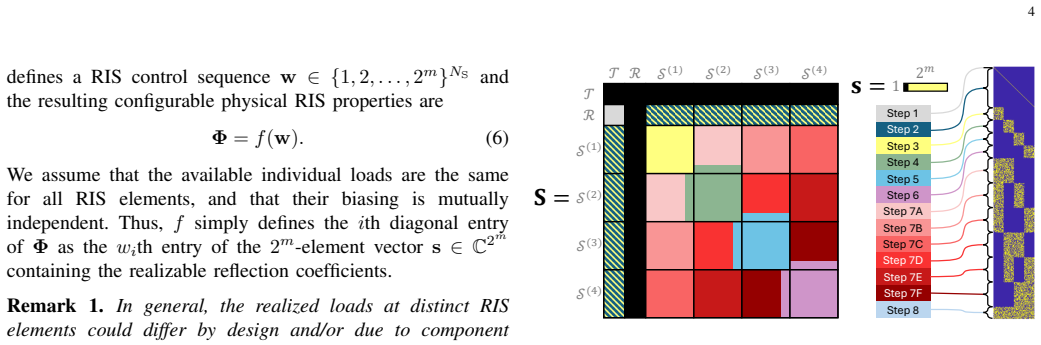
The load-bearing object is the multiport-network channel equation $H = S_{RT} + S_{RS}(\Phi^{-1}-S_{SS})^{-1}S_{ST}$, where $\Phi$ is the diagonal matrix of tunable load reflection coefficients and $S_{SS}$ is the RIS mutual-coupling matrix. The paper's machinery is an ambiguity-aware segmentation of the estimation of $S_{SS}$: after singular-value-decomposition (SVD) based rank-one updates fix the transmission vectors up to row-wise scaling factors, Phase 1 estimates the first diagonal block plus the shared load coefficient vector $s$, Phase 2 estimates each remaining diagonal block together with its scaling factors using $v$ overlapping elements from an already characterized group, and Phase 3 estimates every off-diagonal block between two groups, initialized from a linear-regression truncation of the series expansion of the channel equation. The overlap, the fixed $s$, and the sequentially fixed scaling factors are what make independent segment estimates stitchable.
What would settle it
Generate synthetic channel matrices from a known multiport-network model whose true load vectors differ per element, run the paper's algorithm on them, and compare the recovered $S_{SS}$ with the ground truth; if the overlap alignment still recovers $S_{SS}$ despite element-dependent loads, the shared-$s$ assumption is not load-bearing, whereas a misaligned $S_{SS}$ confirms it is. Experimentally, one can swap a single RIS element for a deliberately mismatched element after calibration and re-run Steps 3–7; a visible drop from the 40.5 dB out-of-sample accuracy would confirm that the shared-load assumption is required.
Extended reading notes
Core claim
The paper's central claim is that the full mutual-coupling matrix $S_{SS}$ of a large reconfigurable intelligent surface can be estimated remotely—without knowing the RIS design or the scattering environment—by partitioning the elements into groups and solving three sets of smaller problems in sequence: first the diagonal block of one group together with the load reflection coefficients and per-element scaling factors; then each remaining diagonal block together with its scaling factors, using a small overlap with an already characterized group to lock the ambiguity; finally each off-diagonal group-pair block independently, initialized by an affine low-fidelity estimate. The stitched result is shown experimentally to reproduce the measured 4×4 MIMO channel over 30 unseen RIS configurations at 40.5 dB accuracy (5867 complex parameters, 100 RIS elements), versus 17.0 dB for a first-order mutual-coupling model and 13.8 dB for the coupling-unaware cascaded model. Used in coordinate-descent optimization for five key performance indicators, the calibrated model predicts the experimentally measured KPIs accurately, while the low-fidelity models significantly overestimate them; in achieved KPI values, the MC-aware and first-order-MC models perform similarly and outperform the MC-unaware models.
Load-bearing premise
The load-bearing premise is that every RIS element offers the same two or few load reflection coefficients, summarized by one vector $s$, and that these loads are mutually independent; the paper itself flags in Remark 1 that component tolerances could make the realized loads element-dependent, in which case $s$ is only an average and the overlap-based stitching can align the wrong scaling factors.
Editorial extensions
If this is right
- The quadratic scaling of mutual-coupling unknowns no longer forces one giant global optimization; the estimation can be distributed over independent subproblems, so computational memory and measurement pipelines can be handled block by block.
- A calibrated multiport-network model can predict the full channel matrix for any RIS control word without new measurements, and the 40.5 dB out-of-sample accuracy makes those predictions trustworthy for link-level decisions.
- Practitioners can choose the fidelity tier—full MC, first-order MC, or cascaded—according to whether they need accurate performance prediction or only good optimized configurations.
- The data-reduction experiment shows that roughly 2.8 measurements per unknown parameter suffice under low noise, and that the segmented problem becomes ill-posed below a fraction $p = 0.2$ of the nominal data.
- The same ambiguity-aware segmentation is expected to transfer to other massively parametrized wave systems such as dynamic metasurface antennas and wave-domain physical neural networks.
Reading between the lines
- Beyond the paper: if load tolerances are large, the algorithm could be extended to estimate per-element load variations in Phase 1 or to replace overlap stitching with a gauge fix based on measured symmetries; the paper leaves this as a hardware-side open question.
- Beyond the paper: since accuracy drops sharply below $p = 0.2$ and scales linearly with SNR (in dB), the measurement budget could be made adaptive—stop collecting data for a segment once its held-out prediction error stops improving—rather than fixing $n_1, n_2, n_3$ in advance.
- Beyond the paper: the near-tie in achieved KPIs between MC-aware and first-order-MC models suggests a cost-benefit rule: use the cheap model to search configurations and reserve the MC-calibrated model for prediction tasks such as resource allocation, where trustworthy KPI estimates matter.
Signed reviews
Editorial analysis
A structured set of objections, weighed in public.
Referee Report
Summary. The paper proposes an ambiguity-aware segmented estimation algorithm for the mutual-coupling (MC) matrix of a large reconfigurable intelligent surface (RIS) in a multiport-network-theory (MNT) model. The full estimation problem is split into three sequential phases: first estimating one diagonal block together with the load reflection coefficients, then estimating the remaining diagonal blocks with overlapping group boundaries to align scaling ambiguities, and finally estimating all off-diagonal blocks via gradient descent initialized from a low-fidelity affine regression. The algorithm is validated experimentally on a 100-element, 1-bit RIS in a reverberation chamber with a 4x4 MIMO channel. The calibrated 5867-parameter MNT model achieves 40.5 dB held-out prediction accuracy on 30 unseen random configurations, compared with 17.0 dB for a first-order MC-aware model (LFMNT) and 13.8 dB for an MC-unaware cascaded model (CASC). The calibrated models are then used to optimize five wireless KPIs, with experimental measurements showing that MC-aware models give moderate KPI gains but substantially more reliable model-based KPI predictions.
Significance. If the central claims hold, this is a significant experimental and algorithmic contribution: it is the first experimental MC characterization for a large RIS, it offers a scalable segmentation with parallelizable subproblems, and it provides an extensive experimental performance evaluation of MC-aware versus MC-unaware models. The paper has real strengths: the validation is genuinely out-of-sample (unseen RIS configurations), the optimized configurations are also experimentally measured, and the manuscript is transparent about its assumptions and remaining open questions, including Remark 1 on load tolerances and the lack of systematic hyperparameter guidelines. The 40.5 dB figure on a 5867-parameter model is an impressive empirical result. However, two load-bearing issues need attention before the claims as stated can be fully accepted: the CASC benchmark is not independently calibrated, and the stitching procedure's robustness to per-element load deviations is not analyzed.
major comments (3)
- [Sec. III-E.2 and Sec. IV-B] The CASC benchmark model is not independently calibrated: it is obtained by taking the MNT-estimated parameters and setting all entries of \tilde{S}_{SS} to zero. Because the MNT parameters are identifiable only up to the ambiguities discussed in Sec. III, this derived CASC model is not necessarily the best CASC fit to the measured data. Since H_CASC is affine in the binary RIS configuration vector (after absorbing the unknown load coefficients into the per-element matrices), an independent least-squares calibration is straightforward and should be reported. Without it, the 13.8 dB accuracy figure and the claimed accuracy gap between MNT and CASC are not established.
- [Sec. III-A, Remark 1, and Steps 1-7 of Sec. III-C] The algorithm's stitching procedure relies critically on the assumption that all RIS elements realize the same two load reflection coefficients, summarized by the single vector s. Remark 1 explicitly acknowledges that component tolerances can make realized loads element-dependent, but the paper provides no analysis of the resulting bias. Under per-element load deviations, Step 1's global gauge \tilde{s}_1=0 and the overlap-based alignment of scaling factors in Steps 4-7 can absorb the deviations into different effective blocks, biasing the stitched off-diagonal entries of \tilde{S}_{SS}. A sensitivity study with synthetic data and known ground-truth S, or a rigorous identifiability analysis, is needed to support the claim of generally accurate stitchable estimates.
- [Sec. III-B and Sec. III-C] The central algorithmic claim is that the overlap procedure resolves the inherent ambiguities so that independently estimated segments can be stitched into a globally consistent MC matrix. The paper gives no formal proof or identifiability analysis of this claim; Remarks 4 and 5 offer only heuristic guidance on choosing v. The experimental validation is for a single prototype and therefore does not by itself establish the conditions under which stitching succeeds. A formal statement of the ambiguity structure and a proof that the overlap size v suffices, or at least a synthetic numerical study with random ground-truth S matrices, would substantially strengthen the paper.
minor comments (3)
- [Sec. III-C, Step 4] The condition 'e ≫ v ≥ 1' should read 'e ≥ v ≥ 1' (or 'e > v ≥ 1'); as written, 'e ≫ v' is too strong and is not what the subsequent text suggests.
- [Sec. IV-B] The choice n1 = n2 = e(e+1)/2 and n3 = e^2 is stated without a derivation; it would help readers if the number of unknowns in each subproblem were spelled out and compared with the number of measurements per subproblem.
- [General] No data or code availability statement is provided. Given the experimental nature of the work, making the measured channel matrices and the calibration code available would materially improve reproducibility and would allow other groups to test the segmentation procedure on their own prototypes.
Circularity Check
No circularity: the segmentation is independently validated on unseen RIS configurations; self-citations are method reuse, not load-bearing.
full rationale
The paper's central claim is an algorithm for segmented estimation of mutual-coupling parameters from measured channel matrices, experimentally validated on out-of-sample RIS configurations. The derivation chain is self-contained: the MNT model in Eq. (1) is used to derive the rank-one property of single-flip updates (Step 2), which is experimentally verified; the subsequent phases estimate independent parameter blocks with overlapping constraints and are stitched into a full model. The reported 40.5 dB accuracy is computed from n5 = 30 previously unseen random RIS configurations, so it is a genuine out-of-sample prediction rather than a fitted value. The self-citations to [18], [21], [22], [24], and [25] are used to justify the rank-one property, the ambiguity conditions, and the gradient-descent approach, but the central contribution does not rest on those citations for its truth: the full algorithm is tested against measured data, and the comparison to CASC and LFMNT benchmarks shows that the high-fidelity off-diagonal blocks contribute real predictive power. The only notable caveat is the assumption of identical load reflection coefficients across all elements, explicitly acknowledged in Remark 1 as potentially violated by component tolerances; this is a modeling assumption and a limitation, not a circular step. No equation is defined in terms of the target result, and no fitted parameter is re-labeled as a prediction. The paper therefore exhibits no significant circularity.
Assumptions & free parameters
free parameters (5)
- Second load reflection coefficient s_2 =
not reported
- MNT scattering-matrix parameters (S_RT, S_RS, S_ST, S_SS) =
5867 complex scalars, not disclosed
- Number of groups g and group size e =
g=4, e=25
- Overlap size v =
4
- Measurement budgets n1, n2, n3, n4 =
325, 325, 625, 300
assumptions (5)
- domain assumption The end-to-end channel follows H = S_RT + S_RS (Phi^-1 - S_SS)^-1 S_ST (Eq. 1)
- domain assumption The static scattering structure is linear, passive, reciprocal, and time-invariant over all measurements
- domain assumption All tunable loads are identical, mutually independent, and described by one shared 2^m-entry reflection-coefficient vector s
- domain assumption The PIN diode in each RIS element is small enough to be a lumped port, with the rest of the element treated as a static scatterer
- domain assumption A single-element load change gives a rank-one channel update Delta_i = H(w_i) - H(w_0)
Cite this review
Pith. "Pith review of Ambiguity-Aware Segmented Estimation of Mutual Coupling in Large RIS: Algorithm and Experimental Validation." pith.science (2026). https://pith.science/paper/QMAPJIUE
@misc{pith2026250722750,
  author       = {Pith},
  title        = {Pith review of: Ambiguity-Aware Segmented Estimation of Mutual Coupling in Large RIS: Algorithm and Experimental Validation},
  year         = {2026},
  howpublished = {\url{https://pith.science/paper/QMAPJIUE}},
  note         = {Machine review of arXiv:2507.22750}
}
read the original abstract
Optimizing a real-life RIS-parametrized wireless channel with a physics-consistent multiport-network model necessitates prior remote estimation of the mutual coupling (MC) between RIS elements. The number of MC parameters grows quadratically with the number of RIS elements, posing scalability challenges. Because of inevitable ambiguities, independently estimated segments of the MC matrix cannot be easily stitched together. Here, by carefully handling the ambiguities, we achieve a separation of the full estimation problem into three sequentially treated sets of smaller problems. We partition the RIS elements into groups. First, we estimate the MC for one group as well as the characteristics of the available loads. Second, we separately estimate the MC for each of the remaining groups, in each case with partial overlap with an already characterized group. Third, we separately estimate the MC between each distinct pair of groups. Full parallelization is feasible within the second and third sets of problems, and the third set of problems can furthermore benefit from efficient initialization. We experimentally validate our algorithm for a 4x4 MIMO channel parametrized by a 100-element RIS inside a rich-scattering environment. Our experimentally calibrated 5867-parameter multiport-network model achieves an accuracy of 40.5 dB, whereas benchmark models with limited or no MC awareness only reach 17.0 dB and 13.8 dB, respectively. Based on the experimentally calibrated models, we optimize the RIS for five wireless performance indicators. Experimental measurements with the optimized RIS configurations demonstrate only moderate benefits of MC awareness in RIS optimization in terms of the achieved performance. However, we observe that limited or no MC awareness markedly erodes the reliability of model-based predictions of the expected performance.
Figures


Figures from the paper (1 more)

Forward citations
Cited by 1 Pith paper
-
Frozen differential scattering in reconfigurable complex media
A localized perturbation makes the differential scattering matrix rank one, so the change in the output wavefront is always the same shape regardless of the input wavefront.
Reference graph
Works this paper leans on
-
[18]
Experimental Multiport-Network Parameter Estimation and Optimization for Multi-Bit RIS
P. del Hougne, “Experimental multiport-network parameter estimation and optimization for multi-bit RIS,” arXiv:2507.02168, 2025
work page Pith review arXiv 2025
-
[24]
J. Sol et al., “Experimentally realized physical-model-based frugal wave control in metasurface-programmable complex media,” Nat. Commun. , vol. 15, no. 1, p. 2841, 2024
work page 2024
-
[1]
G. Gradoni and M. Di Renzo, “End-to-end mutual coupling aware communication model for reconfigurable intelligent surfaces: An electromagnetic-compliant approach based on mutual impedances,” IEEE Wirel. Commun. Lett. , vol. 10, no. 5, pp. 938–942, 2021
work page 2021
-
[2]
A universal framework for multiport network analysis of reconfigurable intelligent surfaces,
M. Nerini et al., “A universal framework for multiport network analysis of reconfigurable intelligent surfaces,” IEEE Trans. Wirel. Commun. , vol. 23, no. 10, pp. 14 575–14 590, 2024
work page 2024
-
[3]
Mutual coupling and unit cell aware optimization for reconfigurable intelligent surfaces,
X. Qian and M. Di Renzo, “Mutual coupling and unit cell aware optimization for reconfigurable intelligent surfaces,” IEEE Wirel. Commun. Lett., vol. 10, no. 6, pp. 1183–1187, 2021
work page 2021
-
[4]
A. Abrardo et al. , “MIMO interference channels assisted by reconfigurable intelligent surfaces: Mutual coupling aware sum-rate optimization based on a mutual impedance channel model,” IEEE Wirel. Commun. Lett., vol. 10, no. 12, pp. 2624–2628, 2021
work page 2021
-
[5]
R. Ma et al. , “RIS-assisted SWIPT network for internet of everything under the electromagnetics-based communication model,” IEEE Internet Things J., vol. 11, no. 9, pp. 15 402–15 415, 2024
work page 2024
-
[6]
Optimization of RIS-aided MIMO—a mutually coupled loaded wire dipole model,
H. El Hassani et al. , “Optimization of RIS-aided MIMO—a mutually coupled loaded wire dipole model,” IEEE Wireless Commun. Lett. , vol. 13, no. 3, pp. 726–730, 2023
work page 2023
Show all 33 references
-
[7]
Beyond diagonal reconfigurable intelligent surfaces with mutual coupling: Modeling and optimization,
H. Li et al. , “Beyond diagonal reconfigurable intelligent surfaces with mutual coupling: Modeling and optimization,” IEEE Commun. Lett. , vol. 28, no. 4, pp. 937–941, 2024
2024
-
[8]
Design of reconfigurable intelligent surfaces by using S-parameter multiport network theory—optimization and full- wave validation,
A. Abrardo et al. , “Design of reconfigurable intelligent surfaces by using S-parameter multiport network theory—optimization and full- wave validation,” IEEE Trans. Wireless Commun. , vol. 23, no. 11, pp. 17 084––17 102, 2024
2024
-
[9]
Phase shifter optimization in RIS-aided MIMO systems under multiple reflections,
D. Wijekoon et al. , “Phase shifter optimization in RIS-aided MIMO systems under multiple reflections,” IEEE Trans. Wirel. Commun. , vol. 23, no. 8, pp. 8969–8983, 2024
2024
-
[10]
Global optimal closed-form solutions for intelligent surfaces with mutual coupling: Is mutual coupling detrimental or beneficial?
M. Nerini et al. , “Global optimal closed-form solutions for intelligent surfaces with mutual coupling: Is mutual coupling detrimental or beneficial?” arXiv:2411.04949, 2024
2024
-
[11]
Performance analysis of systems with coupled and decoupled RISs,
D. Semmler et al., “Performance analysis of systems with coupled and decoupled RISs,” Proc. ISWCS, pp. 1–6, 2024
2024
-
[12]
RISnet: A domain-knowledge driven neural network architecture for RIS optimization with mutual coupling and partial CSI,
B. Peng et al. , “RISnet: A domain-knowledge driven neural network architecture for RIS optimization with mutual coupling and partial CSI,” Trans. Wireless. Comm., vol. 24, no. 5, p. 4469–4482, Feb. 2025
2025
-
[13]
Macromodeling of reconfigurable intelligent surface based on microwave network theory,
Z. Zhang et al. , “Macromodeling of reconfigurable intelligent surface based on microwave network theory,” IEEE Trans. Antennas Propag. , vol. 70, no. 10, pp. 8707–8717, 2022
2022
-
[14]
Systematic physics-compliant analysis of over-the-air channel equalization in RIS-parametrized wireless networks-on-chip,
J. Tapie et al. , “Systematic physics-compliant analysis of over-the-air channel equalization in RIS-parametrized wireless networks-on-chip,” IEEE J. Sel. Areas Commun. , vol. 42, no. 8, pp. 2026–2038, 2024
2026
-
[15]
Mutual coupling in RIS-aided communication: Model training and experimental validation,
P. Zheng et al., “Mutual coupling in RIS-aided communication: Model training and experimental validation,” IEEE Trans. Wirel. Commun. , vol. 23, no. 11, pp. 17 174–17 188, 2024
2024
-
[16]
A hybrid transmitting and reflecting beyond diagonal reconfigurable intelligent surface with independent beam control and power splitting,
Z. Ming et al. , “A hybrid transmitting and reflecting beyond diagonal reconfigurable intelligent surface with independent beam control and power splitting,” arXiv:2504.09618, 2025
2025 arXiv
-
[17]
Beyond-diagonal RIS prototype and performance evaluation,
J. Tapie et al. , “Beyond-diagonal RIS prototype and performance evaluation,” arXiv:2505.13392, 2025
2025 arXiv
-
[19]
Smart sensing metasurface with self-defined functions in dual polarizations,
Q. Ma et al. , “Smart sensing metasurface with self-defined functions in dual polarizations,” Nanophotonics, vol. 9, no. 10, pp. 3271–3278, 2020
2020
-
[20]
Hybrid reconfigurable intelligent metasurfaces: Enabling simultaneous tunable reflections and sensing for 6g wireless communications,
G. C. Alexandropoulos et al. , “Hybrid reconfigurable intelligent metasurfaces: Enabling simultaneous tunable reflections and sensing for 6g wireless communications,” IEEE Veh. Technol. Mag., vol. 19, no. 1, pp. 75–84, 2023
2023
-
[21]
Virtual VNA: Minimal-ambiguity scattering matrix estimation with a fixed set of “virtual
P. del Hougne, “Virtual VNA: Minimal-ambiguity scattering matrix estimation with a fixed set of “virtual” load-tunable ports,” IEEE Trans. Instrum. Meas., vol. 74, pp. 1–19, 2025
2025
-
[22]
Virtual VNA 2.0: Ambiguity-free scattering matrix estimation by terminating not-directly-accessible ports with tunable and coupled loads,
P. del Hougne, “Virtual VNA 2.0: Ambiguity-free scattering matrix estimation by terminating not-directly-accessible ports with tunable and coupled loads,” IEEE Trans. Antennas Propag., vol. 73, no. 7, pp. 4903– 4908, 2025
2025
-
[23]
Wireless multi-port sensing: Virtual-VNA-enabled de- embedding of an over-the-air fixture,
P. del Hougne, “Wireless multi-port sensing: Virtual-VNA-enabled de- embedding of an over-the-air fixture,” arXiv:2507.12909, 2025
2025 arXiv
-
[25]
A physics-compliant diagonal representation for wireless channels parametrized by beyond-diagonal reconfigurable intelligent surfaces,
P. del Hougne, “A physics-compliant diagonal representation for wireless channels parametrized by beyond-diagonal reconfigurable intelligent surfaces,” IEEE Trans. Wirel. Commun., vol. 24, no. 7, pp. 5871–5884, 2025
2025
-
[26]
Reconfigurable intelligent surface (RIS): Eigenvalue decomposition-based separate channel estimation,
S. E. Zegrar et al., “Reconfigurable intelligent surface (RIS): Eigenvalue decomposition-based separate channel estimation,” Proc. PIMRC, pp. 1– 6, 2021
2021
-
[27]
Keyholes, correlations, and capacities of multielement transmit and receive antennas,
D. Chizhik et al., “Keyholes, correlations, and capacities of multielement transmit and receive antennas,” IEEE Trans. Wirel. Commun. , vol. 1, no. 2, pp. 361–368, 2002
2002
-
[28]
Scalable multiport antenna array characterization with PCB-realized tunable load network providing additional “virtual
J. Tapie and P. del Hougne, “Scalable multiport antenna array characterization with PCB-realized tunable load network providing additional “virtual” VNA ports,” IEEE Antennas Wirel. Propag. Lett. , 2025
2025
-
[29]
Over-the-air emulation of electronically adjustable Rician MIMO channels in a programmable-metasurface-stirred reverberation chamber,
I. Ahmed et al. , “Over-the-air emulation of electronically adjustable Rician MIMO channels in a programmable-metasurface-stirred reverberation chamber,” IEEE Trans. Antennas Propag. , vol. 73, no. 4, pp. 2104–2119, 2025. 12
2025
-
[30]
Efficient computation of physics- compliant channel realizations for (rich-scattering) RIS-parametrized radio environments,
H. Prod’homme and P. del Hougne, “Efficient computation of physics- compliant channel realizations for (rich-scattering) RIS-parametrized radio environments,” IEEE Commun. Lett. , vol. 27, no. 12, pp. 3375– 3379, 2023
2023
-
[31]
Optimal blind focusing on perturbation-inducing targets in sub-unitary complex media,
J. Sol et al., “Optimal blind focusing on perturbation-inducing targets in sub-unitary complex media,” Laser Photonics Rev., p. 2400619, 2024
2024
-
[32]
Optimally diverse communication channels in disordered environments with tuned randomness,
P. del Hougne et al. , “Optimally diverse communication channels in disordered environments with tuned randomness,” Nat. Electron., vol. 2, no. 1, pp. 36–41, 2019
2019
-
[33]
Statistical multiport-network modeling and efficient discrete optimization of RIS,
C. Hammami et al., “Statistical multiport-network modeling and efficient discrete optimization of RIS,” to appear on arXiv , 2025
2025
Reviewed August 6, 2026 · model on record in the stance chip above.
Discussion (0). Continue with ORCID to comment.