REVIEW 4 major objections 6 minor 26 references
MASCA: LLM based-Multi Agents System for Credit Assessment
T0 review · 4 major / 6 minor · reviewed 2026-08-06 · deepseek-v4-flash
Pith's one-line read The paper claims that a hierarchical, role-specialized team of LLM agents—feature engineer, risk and reward analysts, and a final orchestrator—outperforms zero-shot, chain-of-thought, and single-agent prompting for credit assessment…
desk verdict A promising multi-agent setup for credit scoring, but the Feature Engineer can't actually compute the required ratios from the German Credit attributes, so the headline results aren't attributable to the architecture. read the letter →
The pith
A machine-rendered reading of the paper's core claim, the machinery that carries it, and where it could break.
The reading
What carries the argument
The load-bearing object is the four-layer MASCA architecture. The Data Ingestion and Contextualization Layer uses a Data Analyst, a Contextualizer, and a Feature Engineer to clean the application and compute financial ratios such as debt-to-income, debt-to-asset, debt-service-coverage, credit utilization, savings-to-income, and employment-stability indices. The Multidimensional Assessment Layer splits into a Risk Team (Risk Modeler, Income and Stability Analyst, Debt Analyst) and a Reward Modeler, whose opposing objectives are described as a contrastive-learning-inspired balance. The Strategic Optimization Layer derives a risk-reward ratio and runs scenario simulations, and the Decision Orchestrator issues the final approval. A signaling-game perspective, in which higher-level agents send signals and lower-level agents update beliefs toward a Perfect Bayesian Equilibrium, is offered as a theoretical reading of the hierarchy, while the performance claim itself rests on the empirical comparisons in Tables 1 and 2.
What would settle it
Open the 200 test samples and check whether the 20 attributes include total assets, available credit limit, disposable income, and employment duration; if any are missing, the claimed ratios are not computable and the pipeline is implicitly fabricating values. A direct experiment is to rerun the heterogeneous MAS without the Feature Engineer, or to give the same enriched data to a single o3-mini, and compare accuracy with the reported 60%.
Extended reading notes
Core claim
The central claim is that credit assessment improves when a single LLM call is replaced by a hierarchical committee of role-specialized LLM agents. MASCA decomposes the task into data aggregation and normalization, persona construction, financial-ratio computation, separate risk and reward evaluations, risk-reward optimization, and a final approval decision. On the benchmark used, the heterogeneous MAS—GPT-4o handling the sub-agents and o3-mini making the final decision—achieves 60% accuracy, 83.33% recall, and 73.33% F1, compared with 45.5% accuracy for zero-shot GPT-4o, 36% for chain-of-thought GPT-4o, and 45.5% for the best single-agent multitasking baseline. The ablations report that a two-level architecture reaches 53.77% accuracy and 66.91% F1, outperforming a flat multi-agent version at 46% accuracy and 58.46% F1, which the paper reads as evidence that layered separation of duties lets later layers correct earlier assessments.
Load-bearing premise
The load-bearing premise is that the Feature Engineer can compute its named financial ratios from the 20 attributes in the dataset; if required fields such as total assets, available credit limit, disposable income, or employment duration are absent, the agent must violate the prompt's 'do not make assumptions' rule and every downstream decision inherits that error.
Editorial extensions
If this is right
- If the results hold, replacing a single LLM prompt with a role-specialized agent committee is a viable strategy for tabular financial classification, not just conversational or trading tasks.
- Hierarchical layering appears to matter: the two-level ablation beats the flat one, implying that later-stage agents can correct or validate earlier-stage outputs.
- Mixing models—a capable generalist for sub-tasks and a reasoning-focused model for the final decision—can produce a better precision-recall balance than either model alone.
- Because every agent emits a score and an explanation, the architecture generates an audit trail linking each final decision to specific sub-analyses, which is directly relevant to lending transparency and compliance.
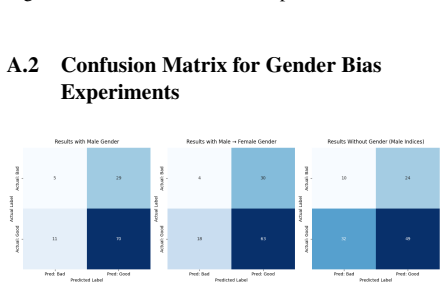
- The measured gender and ethnicity disparities imply that LLM-based credit assessment needs explicit fairness checks before any real-world deployment.
Reading between the lines
- Our inference: if the Feature Engineer's required inputs (total assets, available credit limit, disposable income, employment duration) are not actually present among the 20 dataset attributes, the reported ratio-based features cannot be computed from the data, and part of the accuracy gain may be an artifact of prompt structure rather than genuine financial feature engineering.
- Our inference: the signaling-game account is interpretive rather than tested; a natural experiment would vary the amount of information passed between layers and check whether accuracy follows the predicted direction of belief updating.
- Our inference: the single-dataset, 200-sample evaluation makes the +15.5 percentage-point accuracy margin sensitive to sampling variation; replicating on additional credit datasets or with open-weight models would clarify how much of the gain is architecture versus benchmark-specific.
- Our inference: a direct ablation that removes the Feature Engineer, or feeds the same enriched features to a single o3-mini, would isolate whether the hierarchy or the derived ratios carry the performance gain.
Editorial analysis
A structured set of objections, weighed in public.
Referee Report
Summary. MASCA proposes a hierarchical, role-specialized multi-agent LLM system for consumer credit assessment, combining a data ingestion layer (Data Analyst, Contextualizer, Feature Engineer), a multidimensional assessment layer (Risk Modeler, Income & Stability Analyst, Debt Analyst, Reward Modeler), a strategic optimization layer, and a Decision Orchestrator. The authors evaluate the framework on a 200-sample subset of the German Credit dataset using GPT-4o and o3-mini, reporting that the heterogeneous MAS reaches 60% accuracy, 83.33% recall, and 73.33% F1, outperforming zero-shot, chain-of-thought, and single-agent baselines. They also present an ablation study and a bias analysis for gender and ethnicity.
Significance. If the claimed results are valid, the paper would provide a useful demonstration that hierarchical, task-specialized LLM agents can improve a structured financial decision task, and its appendix of prompts and fairness analysis would be a helpful starting point for further research. The strengths are the explicit agent prompts (Appendix A.4-A.6), the inclusion of multiple baseline types, an ablation comparing flat vs. hierarchical structures, and a gender/ethnicity bias investigation with the 4/5th rule. These are concrete and partially falsifiable. However, as detailed below, the evidence currently does not establish that the described mechanism—especially the Feature Engineer's computation of financial ratios—has been faithfully executed on the actual dataset.
major comments (4)
- [§3.1.3 and Appendix A.4] The Feature Engineer prompt requires computation of DTI, DAR, DSCR, Credit Utilization, Savings-to-Income Ratio, Employment Stability Index, and Dependents Burden Ratio. The German Credit dataset, whose attribute list the paper never provides, does not contain total assets, available credit limit, disposable income, exact savings account value, or continuous employment duration; its employment and savings fields are coarse categorical ranges. Since the prompt explicitly instructs 'Do not make assumptions for data that is not provided,' the agent must either omit most of the required metrics or fabricate/proxy-impute the missing inputs. The paper does not release the attribute list, prompt logs, or code, so the reported 60% accuracy, 83.33% recall, and 73.33% F1 cannot be attributed to the described architecture. Please provide the exact mapping from the dataset's 20 attributes to each required ratio, and ideally show sampled Feature Engineer outputs demonstrating that each ratio is grounded in the actual input features.
- [Section 5, Table 1] Table 1 contains an unexplained row 'MultiAgent(OURS) (gpt-4o)' with 72.2% accuracy, 74.12% precision, 89.67% recall, and 80.8% F1, which is not discussed in the text and conflicts with the earlier homogeneous gpt-4o MAS row (51% accuracy, 65.18% precision, 55.3% recall, 59.84% F1). The caption and surrounding discussion do not identify what configuration this row represents (e.g., with or without contrastive learning, with or without the strategic optimizer), which makes the headline comparison ambiguous. Please clarify or remove this row.
- [Section 4.2 and Section 5] All results come from a single run on 200 test samples, with no error bars, repeated seeds, or statistical significance tests. The observed gaps, such as +9.5% accuracy for the o3-mini MAS over the single-agent o3-mini, may be within sampling noise. Please report variances, confidence intervals, or multiple runs; at a minimum, state explicitly that the results are single-run estimates.
- [Section 6] The bias analysis is not reproducible as reported. The paper does not specify whether the original dataset contains gender, how the authors modified gender, how ethnicity was 'probed' into the data, whether all other attributes were held constant, or how many samples per group were used. Without this methodology, the reported gender and ethnicity accuracy differences cannot be evaluated. Please provide the exact modification procedure and the group-wise sample sizes.
minor comments (6)
- [Table 1 caption] There are typos in the caption ('Methos inlcude') and the table appears to have a misaligned row boundary with Table 2; please proofread and reformat.
- [Section 6 title] The title 'Biasness Perspective' should be 'Bias Perspective'.
- [Abstract and Section 3.2] The abstract claims 'incorporate contrastive learning for risk and reward assessment,' but the methodology only draws inspiration from contrastive learning principles; no contrastive loss, training objective, or learning procedure is defined. Please either specify an actual contrastive component or soften the claim.
- [Section 3.5] The signaling game theory discussion is qualitative and does not define utility functions, signal spaces, or an equilibrium concept. If it is intended as a framing device, please state that explicitly and avoid unsubstantiated uses of 'Perfect Bayesian Equilibrium'.
- [Section 7] The conclusion mentions tools like web search for regulatory compliance, but no such tool use appears in the experimental setup. Please remove this or describe how it was used.
- [References] There are formatting errors in the references (e.g., 'V oudouris' and 'W ALTHER'), and some author names (e.g., 'tse Huang') appear without proper capitalization.
Circularity Check
No circular derivation: MASCA's reported gains are empirical comparisons against external baselines, with no fitted parameters, no load-bearing self-citations, and no prediction that reduces to its inputs by construction.
full rationale
I walked the paper's derivation chain. The central claim is in Section 5 and Table 1: the multi-agent system reaches 60% accuracy, 83.33% recall, and 73.33% F1, outperforming zero-shot, CoT, and single-agent baselines. These numbers are outputs of a prompted LLM pipeline evaluated on 200 test samples; nothing in the paper fits a parameter to the test labels, tunes on the benchmark, or defines one reported quantity as another by construction. The Feature Engineer calculations in Section 3.1.3 and Appendix A.4 are specified as formulas over input attributes, while the German Credit dataset may lack some required inputs such as total assets, disposable income, and available credit limit; this is a data-grounding and reproducibility risk, not a circularity reduction, because the downstream scores are not algebraically equal to the inputs and no output is defined in terms of the test labels. I checked the remaining circularity patterns: there are no author self-citations invoked as load-bearing premises, no imported uniqueness theorem from the authors' prior work, no ansatz smuggled in via citation, and no known result renamed as a prediction. The signaling-game and contrastive-learning passages (Sections 3.2 and 3.5) are interpretive framing rather than the mechanism claimed to derive the Table 1 numbers. Hence no circular step can be exhibited, and the honest finding is no significant circularity.
Assumptions & free parameters
free parameters (1)
- Risk-reward approval threshold =
not reported
assumptions (4)
- domain assumption The 200 labeled test samples from the flare-german dataset are a valid ground truth for creditworthiness.
- domain assumption A single LLM run per configuration is representative of system performance.
- domain assumption The Feature Engineer can compute the prescribed ratios (DTI, DAR, DSCR, credit utilization, savings-to-income, employment stability, dependents burden) from the 20 dataset attributes.
- domain assumption Modifying gender and adding a race attribute to otherwise unchanged samples is a valid protocol for measuring LLM bias.
Cite this review
Pith. "Pith review of MASCA: LLM based-Multi Agents System for Credit Assessment." pith.science (2026). https://pith.science/paper/DFU6VE2Z
@misc{pith2026250722758,
  author       = {Pith},
  title        = {Pith review of: MASCA: LLM based-Multi Agents System for Credit Assessment},
  year         = {2026},
  howpublished = {\url{https://pith.science/paper/DFU6VE2Z}},
  note         = {Machine review of arXiv:2507.22758}
}
read the original abstract
Recent advancements in financial problem-solving have leveraged LLMs and agent-based systems, with a primary focus on trading and financial modeling. However, credit assessment remains an underexplored challenge, traditionally dependent on rule-based methods and statistical models. In this paper, we introduce MASCA, an LLM-driven multi-agent system designed to enhance credit evaluation by mirroring real-world decision-making processes. The framework employs a layered architecture where specialized LLM-based agents collaboratively tackle sub-tasks. Additionally, we integrate contrastive learning for risk and reward assessment to optimize decision-making. We further present a signaling game theory perspective on hierarchical multi-agent systems, offering theoretical insights into their structure and interactions. Our paper also includes a detailed bias analysis in credit assessment, addressing fairness concerns. Experimental results demonstrate that MASCA outperforms baseline approaches, highlighting the effectiveness of hierarchical LLM-based multi-agent systems in financial applications, particularly in credit scoring.
Figures


Figures from the paper (3 more)


Reference graph
Works this paper leans on
-
[1]
Data Aggregation: - Collect and consolidate both structured data (numerical and categorical values) and unstructured data (textual information) from the input data. - Ensure that the data collection process covers all relevant fields such as financial metrics, credit scores, personal information, and narrative descriptions provided in the loan applications
-
[2]
Alympics: Llm agents meet game theory – exploring strategic decision-making with ai agents. Preprint, arXiv:2311.03220. Yuqi Nie, Yaxuan Kong, Xiaowen Dong, John M. Mul- vey, H. Vincent Poor, Qingsong Wen, and Stefan Zohren. 2024. A survey of large language models for financial applications: Progress, prospects and challenges. Preprint, arXiv:2406.11903. ...
arXiv 2024
-
[3]
Output Format: Your output should be a clean, structured dataset in the following format: { "structured_data": [ { "attribute": "X1", "name": "Status of existing checking account (qualitative)", "value": "A11", "description": "smaller than 0 DM" }, // ... repeat for all attributes ] } Note: Ensure each attribute’s description matches exactly with the prov...
-
[4]
- For numerical attributes: Present the value with appropriate units
Data Formatting Rules: - For qualitative attributes: Include both the code (e.g., A11) and its meaning. - For numerical attributes: Present the value with appropriate units. - Maintain consistent formatting across all entries. - Do not make assumptions about missing values. Your output should be a clean, normalized, and standardized dataset that is free o...
-
[6]
Data Analysis and Extraction: - Identify key characteristics that define the user’s financial behavior, personal background, and creditworthiness
-
[7]
Persona Development: - Synthesize the extracted information to build a detailed, coherent persona for the applicant. - Include relevant aspects such as financial stability, spending habits, risk tolerance, and any contextual nuances derived from the input data. - Highlight any patterns or indicators that may influence their loan eligibility
-
[8]
Contextual Enrichment: - Incorporate behavioral insights to add depth to the persona, ensuring that the resulting profile reflects both quantitative metrics and qualitative subtleties
-
[9]
Output Requirements: - Generate a user persona report that includes a summary profile, key financial indicators, behavioral insights, and potential reward and risk flags. - Ensure the persona is clear, comprehensive, and directly supports downstream reward and risk assessment and decision-making processes. Output Format: Provide your analysis in JSON form...
Show all 26 references
-
[10]
Identify and Derive Additional Features - Analyze Data: Examine the preprocessed dataset to identify opportunities for creating new features that provide deeper insights into an applicant’s risk profile. - Calculate Key Financial Metrics: Derive essential financial ratios and ...
-
[11]
derived_features and their respective values
Calculate and Validate the Metrics - Accurate Calculations: Utilize appropriate mathematical and statistical techniques to compute each metric accurately. - Ensure Data Robustness: Address data anomalies, handle missing values, and manage outliers to ensure that all calculatio...
-
[12]
Analyze Credit History - Pattern Recognition: Identify trends or anomalies in credit behavior
-
[13]
- Risk Indicators: Highlight specific behaviors or events that could serve as red flags, including multiple late payments, high credit utilization, or frequent account closures
Detect Inconsistencies and Red Flags - Inconsistency Identification: Flag any discrepancies or irregularities in the credit data. - Risk Indicators: Highlight specific behaviors or events that could serve as red flags, including multiple late payments, high credit utilization,...
-
[14]
pattern_analysis
Generate Credit Risk Profile - Profile Synthesis: Combine the insights from the analysis to create a detailed risk profile for the applicant. - Documentation: Clearly document the patterns identified, the significance of any anomalies, and the resulting risk assessments. - Rep...
-
[15]
- Income Stability Metrics: Calculate metrics such as income growth rate, variance, and consis- tency to determine the reliability of the applicant’s earnings
Analyze Income Data - Income Verification: Examine structured data such as salary figures, bonus information, and other income streams provided in the application. - Income Stability Metrics: Calculate metrics such as income growth rate, variance, and consis- tency to determin...
-
[16]
- Financial Statements Review: Inspect available financial statements, including bank statements and tax returns, to assess cash flow, savings, and debt obligations
Assess Financial Health - Employment History: Analyze employment records, duration of current and past jobs, and stability in the applicant’s career. - Financial Statements Review: Inspect available financial statements, including bank statements and tax returns, to assess cas...
-
[17]
income_analysis
Risk Evaluation - Identify Red Flags: Detect any sudden changes in income or employment status that may indicate financial instability. - Stress Testing: Simulate scenarios (e.g., economic downturns) to understand how the applicant’s income might be affected under different co...
-
[18]
- Repayment Structure: Understand the proposed repayment plan, such as installment frequency and amortization schedules
Analyze Loan Details - Loan Specifications: Review the details of the requested loan, including the amount, interest rate, term, and any special conditions. - Repayment Structure: Understand the proposed repayment plan, such as installment frequency and amortization schedules....
-
[19]
- Debt Metrics: Calculate key metrics such as the debt-to-income ratio, total outstanding debt, and average interest rates on existing debts
Evaluate Existing Debt Obligations - Debt Inventory: Compile a comprehensive list of the applicant’s current debts, including credit cards, mortgages, personal loans, and other liabilities. - Debt Metrics: Calculate key metrics such as the debt-to-income ratio, total outstandi...
-
[20]
debt_analysis
Risk Assessment and Analysis - Financial Burden Analysis: Evaluate the cumulative impact of the new loan alongside existing debts on the applicant’s cash flow and financial stability. - Scenario Simulation: Model different repayment scenarios to assess potential stress under v...
-
[21]
- Interest Income Calculation: Estimate the interest income that could be generated from the loan over its term, considering the interest rate and repayment schedule
Analyze Financial Benefits - Profitability Assessment: Evaluate the potential profitability of the loan based on the applicant’s financial profile, including income, credit history, and repayment capacity. - Interest Income Calculation: Estimate the interest income that could ...
-
[22]
- Risk Mitigation Factors: Highlight any risk mitigation factors that could reduce the likelihood of default, such as collateral or guarantees
Assess Positive Indicators - Creditworthiness Evaluation: Identify factors that enhance the applicant’s creditworthiness, such as a strong credit history, stable income, and low existing debt levels. - Risk Mitigation Factors: Highlight any risk mitigation factors that could r...
-
[23]
profitability_assessment
Generate Reward Profile - Profile Synthesis: Combine the insights from the analysis to create a detailed reward profile for the applicant. - Documentation: Clearly document the potential rewards identified, including financial benefits and any strategic advantages for the lend...
-
[24]
Aggregation of Risk Inputs - Consolidate Metrics: Combine quantitative risk scores (e.g., debt-to-income ratio, credit risk scores) with qualitative insights (e.g., behavioral flags, compliance exceptions) into a unified risk dataset
-
[25]
- Benefit Assessment: Quantify the potential reward by considering the applicant’s ability to repay, potential profitability, and positive risk mitigators
Reward Analysis - Identify Positive Indicators: Evaluate factors that enhance the applicant’s creditworthiness, such as stable income, strong credit history, and compliance with stringent policies. - Benefit Assessment: Quantify the potential reward by considering the applican...
-
[26]
risk_reward_ratio
Risk-Reward Optimization - Calculate Risk-Reward Ratio: Derive a risk-reward ratio or a similar metric that balances the identified risks against the expected rewards. Utilize weighted scoring if necessary. - Scenario Simulation: Conduct scenario analyses to simulate various e...
-
[2024]
Preprint, arXiv:2408.06361
Large language model agent in financial trad- ing: A survey. Preprint, arXiv:2408.06361. George Fatouros, Kostas Metaxas, John Soldatos, and Dimosthenis Kyriazis. 2024. Can large language models beat wall street? evaluating gpt-4’s impact on financial decision-making with mark...
2024
Reviewed August 6, 2026 · model on record in the stance chip above.
Discussion (0). Continue with ORCID to comment.