REVIEW 3 major objections 4 minor 30 references
Fast and Accurate Contextual Knowledge Extraction Using Cascading Language Model Chains and Candidate Answers
T0 review · 3 major / 4 minor · reviewed 2026-08-06 · deepseek-v4-flash
Pith's one-line read A cascade of small language models that only accept answers found in the text extracts patient dates of birth faster and more accurately than any single model, while reducing hallucinations.
desk verdict A practical cascade idea for CPU-only extraction, but the chain selection on the same test set undermines the headline numbers until a held-out split is done. read the letter →
The pith
A machine-rendered reading of the paper's core claim, the machinery that carries it, and where it could break.
The reading
What carries the argument
The load-bearing object is the Language Model Chain (LMC) algorithm, a particular instance of multi-stage cascade classification. A stack of language models is popped in order; the popped model is prompted on the text; the answer is accepted only if it belongs to a candidate set built by regular expressions from that same text; and every document whose answer fails this membership check is passed to the next model. The candidate set is what turns generation into selection: the fast first model handles easy documents, slower models see only the residual difficult ones, and a hallucinated date that is not in the text can never be accepted.
What would settle it
Measure the recall of the candidate-date regular expressions on the 2,327 expert-labelled documents. If the regexes fail to capture the true DOB in any document, the chain cannot answer it regardless of the models, so the chain's recall can never exceed the regex recall. A concrete check: if the regex recall is close to the chain's 91.8% target-DOB recall, then the language models contribute little beyond selecting among candidates; if the regex recall is higher than 91.8%, the shortfall is attributable to model selection errors, and improving the final model should raise accuracy. A direct experiment would insert a DOB written in a non-captured format, such as 'born in early 1998' or a handwritten date, and observe that no chain configuration can recover it.
Extended reading notes
Core claim
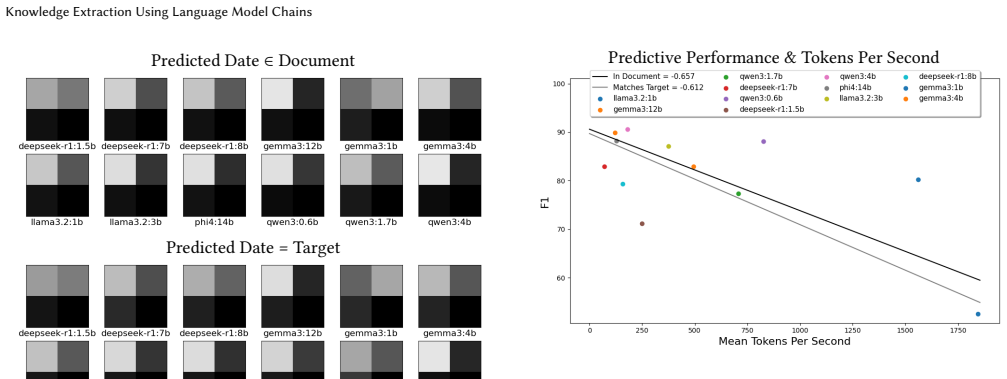
The central discovery is that restricting a language model's answer to a precomputed candidate set, and cascading through progressively slower models, converts a hard open-ended extraction task into a series of cheap verification tasks. Incorrect responses are not discarded as sunk costs; they route the corresponding text to a more predictive model. On the DOB task, the combined chain beat every component: chain_2 (llama3.2:1b then qwen3:0.6b then qwen3:4b) achieved 96.0% F1 for a date appearing in the document and 91.8% F1 for the target DOB, while also running faster than the individual models. The author interprets this as evidence that 'good enough' models plus candidate validation can exceed the accuracy of any single component, and that later models in a chain are more likely to hallucinate than earlier ones.
Load-bearing premise
The entire chain is capped by the regular expressions that build the candidate set: if a patient's date of birth is not written in a format the regexes recognise, no language model in the chain can ever output it.
Editorial extensions
If this is right
- A CPU-only laptop can run a cascade of small open-source models and beat the best single model it contains, so GPU-free deployments remain viable for constrained private-data tasks.
- Hallucinations are suppressed by construction: since only dates present in the document are accepted, a fabricated date cannot count as a correct prediction.
- The order of models in a chain affects speed but not accuracy: chain_3 and chain_4 contain the same two models in opposite order and produce identical predictions, so chains can be reordered to optimise latency without changing output.
- The negative correlation between LM speed and predictive performance can be used to pick chain components: faster, weaker models go first and the strongest model acts as the final arbiter.
- Larger parameter counts do not guarantee better extraction accuracy, so model choice for a specific task should be empirical rather than based on benchmark reputation.
Reading between the lines
- An extension the paper does not test: measure the candidate regex recall on the expert-labelled documents; the chain's recall cannot exceed that number, so subtracting it would separate the models' contribution from the candidate filter's contribution.
- If the method transfers, any extraction task whose answers form a closed set (IDs, codes, medication names) should get the same speed and hallucination-reduction benefits from a cascade plus validation.
- The identical outputs of chain_3 and chain_4 suggest the ordering of models has little effect on which documents are answered correctly; a chain that places the strongest selector first may be strictly better, which is a testable ordering heuristic.
- A clinical deployment would want a fallback for 'no candidate matches the context': the current design can only return a candidate or 'I do not know', so when the regexes miss the true DOB the failure is invisible.
Editorial analysis
A structured set of objections, weighed in public.
Referee Report
Summary. The paper proposes the Language Model Chain (LMC) algorithm, in which a stack of language models processes a document, a model's output is accepted only if it appears in a regex-extracted candidate set of dates, and documents whose outputs are not accepted are passed to the next model. The method is applied to a private corpus of 2,327 medical documents to extract patient dates of birth. The authors report that four hand-assembled chains outperform all twelve component models in F1 and in tokens per second, and that the best chain (chain_2) reaches 96.0% F1 for 'predicted date in document' and 91.8% F1 for matching the expert-assigned DOB, versus 90.6% and 89.7% for the best single model (qwen3:4b). The paper also reports speed advantages and a negative correlation between LM speed and predictive performance. The central claim is that multi-stage cascades with candidate validation increase speed and accuracy while reducing hallucinations.
Significance. If the result holds, the LMC is a practically useful low-resource method for a real extraction task: it uses small open-source models on a GPU-less laptop, provides a clear pseudocode and a full prompt and model list, and directly addresses a recognized weakness of language models. The paper is honest about several limitations, including the regex-based candidate ceiling and the limited exploration of model combinations. However, the empirical support for the central claim is currently incomplete: the chain compositions are selected on the same documents used for reporting, there is no uncertainty quantification, and the headline 'hallucination reduction' is to a substantial degree built into the algorithm rather than measured. The target-DOB F1 margins over the best single model are modest (about 2 F1 points), so the selection issue is not a formality.
major comments (3)
- [Sec. 5 (Fig. 4; Tables 3–4)] The four chain compositions are selected from Fig. 4, which plots F1 and mean tokens per second for the twelve LMs computed on exactly the same 2,327 documents that are later used to report the chain results in Table 4. Because chain_2 is explicitly chosen as the three LMs 'furthest above the correlation line' on this same evaluation set, and because no train/validation/test split, cross-validation, or pre-registration is described, the reported improvements (96.0 vs 90.6 and 91.8 vs 89.7 F1) are optimistic estimates rather than unbiased measurements. The manuscript should either evaluate the chains on a held-out document set or use a nested validation scheme, and should report confidence intervals or a significance test, especially since the main margins are only 2–5 F1 points.
- [Alg. 1 (lines 4–5); Sec. 3.4] The claimed reduction in hallucinations is largely by construction: the LMC reroutes or rejects any response that is not in the regex candidate set, so the 'prediction in document' precision is constrained by the candidate-set mechanism rather than being an emergent property of the language models. To support the abstract's hallucination claim, the paper should compare against a constrained baseline (e.g., the same candidate-answer post-filter applied to each single LM, or a rule-based baseline that always returns a candidate date) and should emphasize the target-DOB F1 (prediction equals expert-assigned DOB) as the substantive error metric, since that metric is not determined by the candidate filter alone.
- [Sec. 3.3; Table 4] The recall of the regex candidate extractor is not reported, even though it is the upper bound on any LMC's target recall: if the true DOB is not among the candidate dates, no LM in the chain can produce it. The manuscript acknowledges the regex limitation in Sec. 2 but does not quantify it. The observed target recall of 88.5% for chain_2 cannot be interpreted without knowing how close it is to that ceiling, so the authors should report the proportion of documents in which the true DOB is captured by the candidate extractor, and characterize which formats are missed.
minor comments (4)
- [Sec. 3.4, Eqs. (1)–(3)] The text states that TP, FP, and FN 'exist in the set of positive natural numbers (Z+)', but zero must be allowed (e.g., FN = 0 when all positives are found) and the F1 formula is undefined when all three are zero; the notation should be non-negative integers, with the zero-denominator case handled explicitly.
- [Sec. 6.2 and Table 4] The observation that chain_3 and chain_4 produce the same predictive results is presented as suggesting commutativity, but this is an overgeneralization from a single pair of chains; because the two LMs see different failure sets depending on order, order independence is not established and should be stated as a tentative observation.
- [Fig. 4] The legend indicates slopes for the correlation lines, but the correlation coefficients and their p-values are not reported; these numbers should be given so that the claimed negative correlation can be assessed.
- [Sec. 5, text near Table 3] There are small typographical errors in the chain descriptions, such as a missing closing quote around 'llama3.2:1b' and an inconsistent comma in the chain_4 description; these should be cleaned up.
Circularity Check
The reduction in 'prediction not in document' hallucinations is entailed by the algorithm's candidate-membership acceptance rule, while the LMC composition is selected on the same 2327 documents used to report its performance; the target-DOB accuracy is not itself forced.
-
self definitional
[Abstract; Sec. 2, Alg. 1 lines 3-7; Sec. 3.4; Sec. 6.1]
"In this, a language model's response to a given prompt about given text is only correct if it exists in the collection of possible (i.e., candidate) answers... If not, then precision indicates how likely an LM or LMC is to predict a date, and recall indicates whether these actually exist in the text (i.e., hallucination rate)."
The paper defines hallucination as producing a date not in the candidate set, which is exactly the membership test used in Algorithm 1 (get_incorrectly_predicted_data) to decide whether to accept a prediction or escalate to the next LM. For the 'prediction in document' metric, the LMC's final answer is correct iff at least one component LM produced a candidate date, because the first candidate-producing model is accepted and later models are only consulted if earlier outputs fail the same test. The reported improvement on this metric (e.g., chain_2 precision 99.0% vs qwen3:4b 94.7%) is therefore a logical OR of the components' scores under the very criterion the algorithm enforces, not an independent empirical discovery.
-
fitted input called prediction
[Sec. 5, Fig. 4 and Table 4; Sec. 3.1]
"We then used this to produce 4 LMCs. ... The second LMC (chain_2) was composed of 3 LMs that were furthest above the correlation line, and these (in order) were 'llama3.2:1b', 'qwen3:0.6b', and 'qwen3:4b'. ... Fig. 5 shows the predictive performance of each LMC and each of its respective LMs when these were prompted about the DOB in each medical document using the same prompt from before, and a summarised perspective of these results is shown in Tab. 4."
The chain compositions are chosen by looking at each LM's F1/TPS on the full 2327-document corpus in Fig. 4 (Experiment 1), and the same corpus is then used to report the chains' results in Table 4. No train/validation/test split, cross-validation, or pre-registration is described. The only tunable components of the method are which LMs form each chain and their order; selecting them on the evaluation set and then reporting that evaluation set as the chain's performance makes the reported margins (e.g., 96.0 vs 90.6 F1) in-sample selection results rather than independent predictions. This does not force the target-DOB result, but it inflates the empirical support for the headline claim.
full rationale
The central target-DOB extraction is not fitted to the expert labels: no LM is trained on the labels, and the final DOB must be chosen from regex candidates by the language models. However, two aspects of the paper's argument are circular or selection-driven. First, the 'prediction in document' / hallucination metric is the same candidate-membership predicate used by Algorithm 1 to accept or escalate predictions; the cascade's score on that metric is the OR of its components' scores by construction, so the claimed hallucination reduction is an algorithmic identity, not an empirical result. Second, the four LMC compositions are selected from Fig. 4, which plots the same 2327 documents' results, and Table 4 reports those same documents' chain results; this is in-sample model selection being reported as measured performance. The target-DOB F1 (91.8% for chain_2) is not forced by either mechanism, and the paper's speed claims are legitimate measurements, so the circularity is partial. The self-citation [12] is not load-bearing, and the LMC is explicitly positioned as an instance of cascade classification, so no additional circularity is present. The lack of a held-out split and unreported regex recall are real methodological limitations but are secondary to the circularity analysis.
Assumptions & free parameters
free parameters (4)
- LMC chain compositions (chain_1 to chain_4) =
four chains as in Tab. 3, e.g., chain_2 = llama3.2:1b, qwen3:0.6b, qwen3:4b
- Choice of the 12 candidate language models =
deepseek-r1 1.5b/7b/8b, gemma3 1b/4b/12b, llama3.2 1b/3b, phi4 14b, qwen3 0.6b/1.7b/4b
- Date regex extraction rules =
described in prose, not given verbatim
- Prompt template =
the single DOB prompt in Sec. 4
assumptions (4)
- domain assumption The regex-extracted candidate date set contains the true DOB for every document.
- domain assumption A slower, larger LM is more predictive on the examples that the faster LM fails, so escalating improves accuracy.
- domain assumption The expert-assigned DOBs are correct ground truth.
- standard math Standard definitions of precision, recall, and F1 and basic arithmetic are used.
Cite this review
Pith. "Pith review of Fast and Accurate Contextual Knowledge Extraction Using Cascading Language Model Chains and Candidate Answers." pith.science (2026). https://pith.science/paper/POWJ3WUF
@misc{pith2026250722921,
  author       = {Pith},
  title        = {Pith review of: Fast and Accurate Contextual Knowledge Extraction Using Cascading Language Model Chains and Candidate Answers},
  year         = {2026},
  howpublished = {\url{https://pith.science/paper/POWJ3WUF}},
  note         = {Machine review of arXiv:2507.22921}
}
read the original abstract
Language models can capture complex relationships in given text, but these are notorious for being costly and for producing information that does not exist (i.e., hallucinations). Furthermore, the resources invested into producing this information would be wasted if it were incorrect. We address these issues by proposing, implementing, and applying the Language Model Chain (LMC) algorithm. In this, a language model's response to a given prompt about given text is only correct if it exists in the collection of possible (i.e., candidate) answers, and text corresponding to incorrect responses is fed into a more predictive (but slower) language model. This process is repeated for a collection of language models, or until all predictions about the text are correct. We used the LMC algorithm to extract patient dates of birth from medical documents, and combining a collection of language models in a multi-stage cascade significantly increased prediction speed and accuracy over individual language models, while greatly reducing the number of corresponding hallucinations. We believe that the novel LMC algorithm significantly contributes to the knowledge extraction field, and that this should be explored much further in the future.
Figures


Figures from the paper (2 more)


Reference graph
Works this paper leans on
-
[1]
Ethem Alpaydin and Cenk Kaynak. 1998. Cascading classifiers. Kybernetika 34, 4 (1998), 369–374
work page 1998
-
[2]
Peter Belcak, Greg Heinrich, Shizhe Diao, Yonggan Fu, Xin Dong, Saurav Mu- ralidharan, Yingyan Celine Lin, and Pavlo Molchanov. 2025. Small Language Models are the Future of Agentic AI. arXiv preprint arXiv:2506.02153 (2025)
arXiv 2025
-
[3]
Leo Breiman. 2001. Random forests. Machine learning 45 (2001), 5–32
2001
-
[4]
Erik Brynjolfsson. 2022. The turing trap: the promise & peril of human-like artificial intelligence. Daedalus 151, 2 (2022), 272–287
work page 2022
-
[5]
Ebubekir Buber and DIRI Banu. 2018. Performance analysis and CPU vs GPU comparison for deep learning. In 2018 6th International Conference on Control Engineering & Information Technology). IEEE, 1–6
work page 2018
-
[6]
Zhaowei Cai and Nuno Vasconcelos. 2019. Cascade R-CNN: High quality object detection and instance segmentation. IEEE transactions on pattern analysis and machine intelligence 43, 5 (2019), 1483–1498
work page 2019
-
[7]
Yupeng Chang, Xu Wang, Jindong Wang, Yuan Wu, Linyi Yang, Kaijie Zhu, Hao Chen, Xiaoyuan Yi, Cunxiang Wang, Yidong Wang, et al . 2024. A survey on evaluation of large language models. ACM transactions on intelligent systems and technology 15, 3 (2024), 1–45
2024
-
[8]
Wenqi Fan, Yujuan Ding, Liangbo Ning, Shijie Wang, Hengyun Li, Dawei Yin, Tat-Seng Chua, and Qing Li. 2024. A survey on RAG meeting LLMs: towards retrieval-augmented large language models. In Proceedings of the 30th ACM SIGKDD Conference on Knowledge Discovery and Data Mining . 6491–6501
work page 2024
Show all 30 references
-
[9]
Sebastian Farquhar, Jannik Kossen, Lorenz Kuhn, and Yarin Gal. 2024. Detecting hallucinations in large language models using semantic entropy. Nature 630, 8017 (2024), 625–630
2024
-
[10]
Aaron Grattafiori, Abhimanyu Dubey, Abhinav Jauhri, Abhinav Pandey, Ab- hishek Kadian, Ahmad Al-Dahle, Aiesha Letman, Akhil Mathur, Alan Schel- ten, Alex Vaughan, et al . 2024. The llama 3 herd of models. arXiv preprint arXiv:2407.21783 (2024)
2024 arXiv
-
[11]
Xiaojie Guo, Amir Alipour-Fanid, Lingfei Wu, Hemant Purohit, Xiang Chen, Kai Zeng, and Liang Zhao. 2019. Multi-stage Deep Classifier Cascades for Open World Recognition. CoRR abs/1908.09931 (2019). arXiv:1908.09931 http://arxiv. org/abs/1908.09931
2019 arXiv
-
[12]
Lee Harris. 2025. Extracting Explainable Dates From Medical Images By Reverse- Engineering UNIX Timestamps. arXiv preprint arXiv:2505.11451 (2025)
2025 arXiv
-
[13]
Michael Kuchnik, Virginia Smith, and George Amvrosiadis. 2023. Validating large language models with relm. Proceedings of Machine Learning and Systems 5 (2023), 457–476
2023
-
[14]
Yong-Hwan Lee and Heung-Jun Kim. 2024. Comparative Analysis of YOLO Series (from V1 to V11) and Their Application in Computer Vision. Journal of the Semiconductor & Display Technology 23, 4 (2024), 190–198
2024
-
[15]
Jing Li, Aixin Sun, Jianglei Han, and Chenliang Li. 2020. A survey on deep learning for named entity recognition. IEEE transactions on knowledge and data engineering 34, 1 (2020), 50–70
2020
-
[16]
Sasha Luccioni, Yacine Jernite, and Emma Strubell. 2024. Power hungry process- ing: Watts driving the cost of AI deployment?. In Proceedings of the 2024 ACM conference on fairness, accountability, and transparency . 85–99
2024
-
[17]
Meghana Rajeev, Rajkumar Ramamurthy, Prapti Trivedi, Vikas Yadav, Oluwani- femi Bamgbose, Sathwik Tejaswi Madhusudan, James Zou, and Nazneen Rajani
-
[18]
Joseph Redmon, Santosh Divvala, Ross Girshick, and Ali Farhadi. 2016. You only look once: unified, real-time object detection. In Proceedings of the IEEE conference on computer vision and pattern recognition . 779–788
2016
-
[19]
Noam Shazeer, Azalia Mirhoseini, Krzysztof Maziarz, Andy Davis, Quoc Le, Geoffrey Hinton, and Jeff Dean. 2017. Outrageously large neural networks: The sparsely-gated mixture-of-experts layer. arXiv preprint arXiv:1701.06538 (2017)
2017 arXiv
-
[20]
Parshin Shojaee, Iman Mirzadeh, Keivan Alizadeh, Maxwell Horton, Samy Bengio, and Mehrdad Farajtabar. 2025. The illusion of thinking: understanding the strengths and limitations of reasoning models via the lens of problem complexity. arXiv preprint arXiv:2506.06941 (2025)
2025 arXiv
-
[21]
Ray Smith. 2007. An overview of the Tesseract OCR engine. InNinth international conference on document analysis and recognition (ICDAR 2007) , Vol. 2. IEEE, 629– 633
2007
-
[22]
Paul Viola and Michael Jones. 2001. Rapid object detection using a boosted cascade of simple features. In Proceedings of the 2001 IEEE computer society conference on computer vision and pattern recognition. CVPR 2001 , Vol. 1. Ieee, I–I
2001
-
[23]
Kushala VM, Harikrishna Warrier, Yogesh Gupta, et al . 2024. Fine tuning LLM for enterprise: practical guidelines and recommendations. arXiv preprint arXiv:2404.10779 (2024)
2024 arXiv
-
[24]
Liya Wang, David Yi, Damien Jose, John Passarelli, James Gao, Jordan Leventis, and Kang Li. 2025. Enterprise Large Language Model Evaluation Benchmark. arXiv preprint arXiv:2506.20274 (2025)
2025 arXiv
-
[25]
Carole-Jean Wu, Ramya Raghavendra, Udit Gupta, Bilge Acun, Newsha Ardalani, Kiwan Maeng, Gloria Chang, Fiona Aga, Jinshi Huang, Charles Bai, et al. 2022. Sustainable AI: environmental implications, challenges and opportunities. Pro- ceedings of Machine Learning and Systems 4 (...
2022
-
[26]
Zhiheng Xi, Wenxiang Chen, Xin Guo, Wei He, Yiwen Ding, Boyang Hong, Ming Zhang, Junzhe Wang, Senjie Jin, Enyu Zhou, et al. 2025. The rise and potential of large language model based agents: a survey. Science China Information Sciences Lee Harris 68, 2 (2025), 121101
2025
-
[27]
Hongbin Ye, Ningyu Zhang, Hui Chen, and Huajun Chen. 2022. Generative knowledge graph construction: a review. arXiv preprint arXiv:2210.12714 (2022)
2022 arXiv
-
[28]
Guangwei Zhang. 2025. Knowledge Protocol Engineering: A New Paradigm for AI in Domain-Specific Knowledge Work. arXiv preprint arXiv:2507.02760 (2025)
2025 arXiv
-
[29]
Yue Zhao, Meng Li, Liangzhen Lai, Naveen Suda, Damon Civin, and Vikas Chan- dra. 2018. Federated learning with non-IID data. arXiv preprint arXiv:1806.00582 (2018)
2018 arXiv
-
[2025]
arXiv preprint arXiv:2503.01781 (2025)
Cats confuse reasoning LLM: query agnostic adversarial triggers for rea- soning models. arXiv preprint arXiv:2503.01781 (2025)
2025 arXiv
Reviewed August 6, 2026 · model on record in the stance chip above.
Discussion (0). Sign in to comment.