REVIEW 1 major objections 5 minor 59 references
A Perturbative Approach to Symmetric Mass Generation
T0 review · 1 major / 5 minor · reviewed 2026-08-06 · deepseek-v4-flash
Pith's one-line read The paper identifies a new renormalization-group fixed point with a single relevant direction and conjectures that it describes the symmetric mass generation critical point in two models.
desk verdict A careful epsilon-expansion study of SMG with an original fixed point, but the central result rests on a hybrid scheme whose SMG-specific step is not independently validated. read the letter →
The pith
A machine-rendered reading of the paper's core claim, the machinery that carries it, and where it could break.
The reading
What carries the argument
The machinery is an $\epsilon$-expansion around the critical dimension where the SMG interaction becomes marginal, namely $D=2$ for the relativistic theory and $d=2$ spatial dimensions for the non-relativistic theory, using dimensional regularization and minimal subtraction. For the relativistic model the calculation employs a hybrid scheme: momentum integrals are performed in $D=2+\epsilon$ dimensions, but the spinor structure (gamma matrices) is taken from the target dimension $D=3$, so there is no chirality and no $\gamma_5$. The scheme is validated by reproducing known Gross-Neveu and Gross-Neveu-Heisenberg exponents, including the fermion anomalous dimension up to $O(1/N_f^3)$ in a large-$N_f$ expansion; the same tool then uncovers the new SMG fixed point.
What would settle it
A sign-problem-free quantum Monte Carlo simulation of the honeycomb-lattice SMG transition could falsify the identification: the $\epsilon$-expansion predicts $\nu^{-1}=1$ and $\eta\approx 0.047$ at $\epsilon=1$, so a measured correlation-length exponent clearly different from 1, or a fermion anomalous dimension far from about 0.05, would rule out this fixed point as the correct critical theory.
Extended reading notes
Core claim
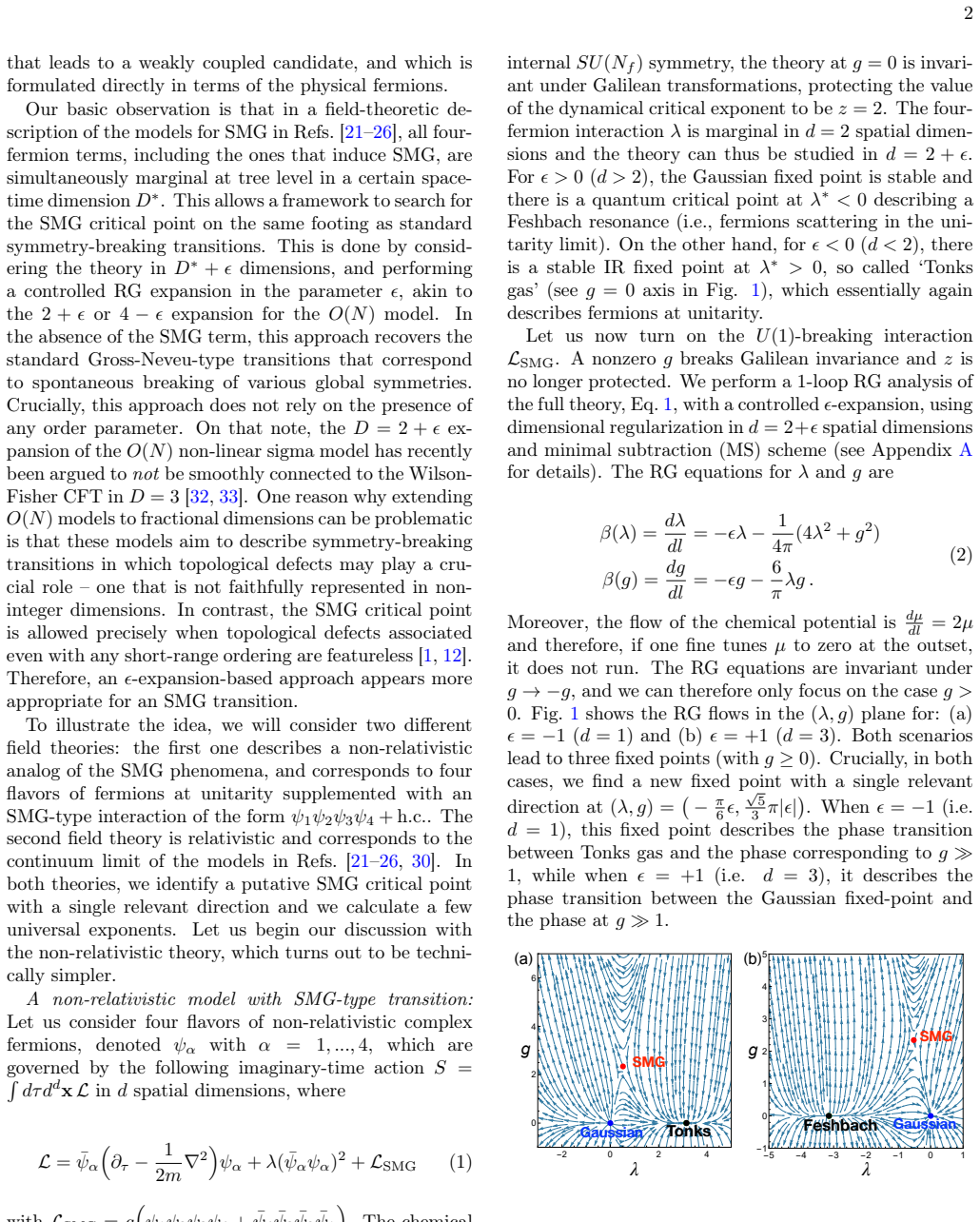
The central discovery is the identification of a fixed point, with a single relevant direction, produced by an SMG-inducing four-fermion interaction when the theory is studied in $D=2+\epsilon$ dimensions where that interaction is marginal at tree level. In the non-relativistic theory the fixed point sits at $(\lambda,g)=(-\pi\epsilon/6,\sqrt{5}\,\pi|\epsilon|/3)$ and separates a gapless phase from a gapped symmetric phase. In the relativistic theory with SU(2)$\times$SU(4) symmetry, a unique fixed point with nonzero SMG coupling and one relevant direction appears, and the SMG coupling is relevant at the previously known Gross-Neveu-Heisenberg fixed point, reshaping the phase diagram. The paper computes universal quantities at this fixed point: $\nu^{-1}=\epsilon$ at one loop, and fermion anomalous dimension $\eta_{\psi}^{\rm SMG}\approx 0.04650\,\epsilon^2$; for the non-relativistic model it also finds $z=2+\frac{10}{81}\epsilon^2$.
Load-bearing premise
The load-bearing assumption is that computing momentum integrals in $2+\epsilon$ spacetime dimensions while treating the Dirac spinors as three-dimensional gives the correct universal exponents of the true $D=3$ transition; if this mixed scheme is not valid, the new fixed point and its exponents would not describe the physical SMG transition.
Editorial extensions
If this is right
- If the SMG fixed point describes the transition, the inverse correlation length exponent is $\nu^{-1}=\epsilon$, so at $\epsilon=1$ the correlation length exponent is approximately unity, matching numerical estimates.
- The fermion anomalous dimension at the SMG fixed point is small, $\eta_{\psi}^{\rm SMG}\approx 0.04650\,\epsilon^2$, so fermion operators scale almost canonically at this transition.
- In the relativistic theory, turning on the SMG interaction makes the Gross-Neveu-Heisenberg fixed point a multicritical point with two relevant directions, so the phase diagram must contain a surface where the Dirac, SMG, and Gross-Neveu-Heisenberg phases meet.
- In the non-relativistic model, the SMG interaction breaks Galilean invariance and shifts the dynamical critical exponent from $z=2$ to $z=2+\frac{10}{81}\epsilon^2$.
- The leading-order approach is oblivious to the $\mathbb{Z}_{16}$ anomaly: a two-flavor version also has a similar fixed point even though it cannot host an SMG phase, leaving the nature of the large-coupling phase open.
Reading between the lines
- Editorial inference: the hybrid scheme's success in reproducing known Gross-Neveu and Gross-Neveu-Heisenberg exponents suggests that the same mixed-dimensional regulator could be applied to other non-Landau or deconfined quantum critical points where no order parameter exists.
- Editorial inference: the quantitative predictions at $\epsilon=1$ ($\nu\approx 1$, $\eta_\psi\approx 0.05$) give a direct target for numerical simulation of the honeycomb-lattice transition; a clearly larger fermion anomalous dimension would indicate that higher-order $\epsilon$ corrections or a different fixed point are needed.
- Editorial inference: if the analogous fixed point in the two-flavor model is physical despite the absence of any symmetric gapped phase, the phase beyond the Dirac semimetal must be something other than SMG, which would make that fixed point worth studying independently of mass generation.
- Editorial inference: the paper's rationale that $\epsilon$-expansion is safer for SMG than for symmetry-breaking transitions, because topological defects are featureless, points toward applying the same approach to other anomaly-free fermion mass generation problems in higher dimensions.
Editorial analysis
A structured set of objections, weighed in public.
Referee Report
Summary. The paper develops an epsilon-expansion approach to symmetric mass generation (SMG) transitions, in which the SMG-inducing four-fermion interaction becomes marginal at a critical spacetime dimension. The authors study two models: a non-relativistic four-flavor fermion theory where the SMG term is ψ1ψ2ψ3ψ4 + h.c., and a relativistic Dirac fermion model with SU(2)×SU(4) symmetry motivated by honeycomb lattice SMG models. In both cases they compute beta functions at one loop, identify a fixed point with a single relevant direction, compute the correlation length exponent ν^{-1} = ε, and obtain two-loop fermion anomalous dimensions and (for the non-relativistic model) the dynamic critical exponent. They conjecture that this fixed point describes the SMG critical point in the lattice models. The relativistic calculation uses a 'hybrid' scheme with momentum integrals in D = 2 + ε but gamma matrices from D = 3, which is validated against known Gross-Neveu and Gross-Neveu-Heisenberg results.
Significance. If the central conjecture is correct, this work provides the first controlled perturbative description of SMG criticality, including universal exponents, for a class of models that have so far been studied mainly numerically. The paper is technically detailed: the RG derivations in Appendices A and B are explicit, the GN and GNH fixed points are reproduced (including a large-Nf match up to O(1/Nf^3)), and the beta functions are internally consistent. The identification of a new fixed point is a concrete, falsifiable prediction that can be tested by quantum Monte Carlo simulations. However, the significance of the result depends on the validity of the hybrid scheme and on whether the new fixed point is a genuine SMG critical point rather than a regulator artifact; these issues are the main subjects of the major comments.
major comments (1)
- [Main text, Sec. 'A relativistic model' and Fig. 2(d)] The identification of the new fixed point with the lattice SMG transition requires setting ε = 1, and the paper gives no resummation or error estimate for this extrapolation. The inverse correlation length exponent is ν^{-1} = ε at one loop, giving ν = 1 at ε = 1, which is close to numerical results, but the fermion anomalous dimension η_ψ ≈ 0.0465 at ε = 1 is much smaller than numerical estimates, and the authors acknowledge this discrepancy. Given the recent concerns about the O(N) 2 + ε expansion not connecting smoothly to D = 3, the paper should at least discuss the reliability of setting ε = 1 for this particular fixed point, for example by computing the next-order correction or by comparing with a 4 − ε expansion if one exists. Without such an assessment, the statement that the fixed point describes the lattice SMG transition remains a conjecture whose empirical content is limited.
minor comments (5)
- [Appendix B, Eq. (B31)] The relation in Eq. (B31) is called an 'SU(2) completeness relation,' but it is the completeness relation for Pauli matrices; the text should clarify that the SU(2) refers to the spinor space, not the valley SU(2), to avoid confusion with the SU(2) valley symmetry used elsewhere.
- [Main text, Fig. 2(d)] The phase diagram in Fig. 2(d) uses labels A–H that are not defined in the caption or text; the reader cannot follow which regions correspond to which phases without referring back to panel (c) and the description in the text.
- [Main text, footnote [40]] Footnote [40] is placed after reference [40] in the reference list and appears as a parenthetical comment in the text; it would be clearer to place it as a regular footnote near the sentence it supports.
- [Appendix A, Eq. (A8)] The approximation γ_i ≈ ε Σ_j (dZ_i/dg_j) g_j is used without stating its order in ε; since Z_i is needed only to 1/ε order, this is valid, but the text should state that this is the leading-order expression to avoid confusion when the same symbol γ_i is later used at two-loop order.
- [References] Reference [11] appears with an incomplete author list and a transliterated title; it should be updated to provide the full citation.
Circularity Check
No significant circularity: the RG derivation is self-contained and the SMG identification is an explicit conjecture, not a fitted or definitionally forced result.
full rationale
The paper's central derivation is a direct one-loop (and two-loop for anomalous dimensions) RG computation from a specified fermionic action. The beta functions in Eqs. (2), (A36), and (B91)-(B95) are obtained by evaluating Feynman diagrams with dimensional regularization; the fixed points, including the G≠0 fixed point, are solutions of those beta functions, and the number of relevant directions is read from the stability matrix. No parameter is fitted to the target critical behavior, and no exponent is defined in terms of the result it is said to predict. The identification of the fixed point with the SMG transition is explicitly conjectural ('we conjecture that this fixed point describes...'), so the relation to the lattice SMG models is an interpretation rather than a circular derivation. The hybrid D=2+epsilon spinor scheme is an assumption, but it is justified on physical grounds (no gamma5 in D=3) and cross-checked against the independent GN and GNH results of Refs. [38,39]; the self-citation to Ref. [37] for a D=4-epsilon analog is only a pointer and is not load-bearing. Appendix C's two-flavor fixed point is an acknowledged limitation of the interpretation, not evidence that the beta-function result was assumed. Overall, the derivation chain does not reduce to its inputs.
Assumptions & free parameters
assumptions (4)
- standard math Standard perturbative RG with dimensional regularization and minimal subtraction applies to the four-fermion theories considered.
- domain assumption The low-energy theory of the honeycomb lattice model (Eq. 3) is relativistic with an emergent SU(2) valley symmetry.
- ad hoc to paper The hybrid scheme (D=2+epsilon loop integrals, D=3 spinor structure) correctly captures the universal critical exponents of the D=3 theory.
- domain assumption The phase at large SMG coupling is gapped and symmetric, so the fixed point indeed separates a gapless and a gapped symmetric phase.
Cite this review
Pith. "Pith review of A Perturbative Approach to Symmetric Mass Generation." pith.science (2026). https://pith.science/paper/VFUE2WP5
@misc{pith2026250723032,
  author       = {Pith},
  title        = {Pith review of: A Perturbative Approach to Symmetric Mass Generation},
  year         = {2026},
  howpublished = {\url{https://pith.science/paper/VFUE2WP5}},
  note         = {Machine review of arXiv:2507.23032}
}
abstract
The Landau paradigm has been a powerful framework for understanding phase transitions involving spontaneous symmetry breaking. In contrast, phase transitions between two symmetric phases, where neither phase breaks any symmetry, remain less explored. One intriguing class of such transitions involves "symmetric mass generation" (SMG), where interactions drive a transition from a gapless symmetric phase to a gapped symmetric phase. In this work, we develop a controlled perturbative approach to study a class of such transitions, based on an $\epsilon$-expansion around the critical dimension where the SMG-inducing-interaction becomes marginal. Applying this method to two distinct models, we identify a single-parameter-tuned transition in each case, which we conjecture captures the universal critical behavior of the SMG transition in these models. We compute universal quantities associated with these transitions.
Figures


Figures from the paper (5 more)


Reference graph
Works this paper leans on
-
[1]
1 shows the RG flows in the(λ, g)plane for: (a) ϵ=−1(d= 1) and (b)ϵ= +1(d= 3)
Fig. 1 shows the RG flows in the(λ, g)plane for: (a) ϵ=−1(d= 1) and (b)ϵ= +1(d= 3). Both scenarios lead to three fixed points (withg≥0). Crucially, in both cases, we find a new fixed point with a single relevant direction at(λ, g) = − π 6 ϵ, √ 5 3 π|ϵ| . Whenϵ=−1(i.e. d= 1), this fixed point describes the phase transition between Tonks gas and the phase c...
-
[2]
Wang and Y.-Z
J. Wang and Y.-Z. You, Symmetric mass generation, Symmetry14, 1475 (2022)
2022
-
[3]
Fidkowski and A
L. Fidkowski and A. Kitaev, Effects of interactions on the topological classification of free fermion systems, Phys. Rev. B81, 134509 (2010)
2010
-
[4]
L. Fidkowski, X. Chen, and A. Vishwanath, Non-abelian topological order on the surface of a 3d topological su- perconductor from an exactly solved model, Phys. Rev. X3, 041016 (2013)
work page 2013
-
[5]
C.WangandT.Senthil,Interactingfermionictopological insulators/superconductors in three dimensions, Physical Review B89, 10.1103/PhysRevB.89.195124 (2014)
-
[6]
M. A. Metlitski, L. Fidkowski, X. Chen, and A. Vish- wanath, Interaction effects on 3d topological supercon- ductors: surface topological order from vortex conden- sation, the 16 fold way and fermionic kramers doublets, arXiv preprint arXiv:1406.3032 (2014)
arXiv 2014
-
[7]
S. Ryu and S.-C. Zhang, Interacting topological phases and modular invariance, Phys. Rev. B85, 245132 (2012)
work page 2012
-
[8]
X.-L. Qi, A new class of (2+1)-dimensional topological superconductors withZ 8 topological classification, New Journal of Physics15, 065002 (2013)
work page 2013
Show all 59 references
-
[9]
Yao and S
H. Yao and S. Ryu, Interaction effect on topological clas- sification of superconductors in two dimensions, Phys. Rev. B88, 064507 (2013)
2013
-
[10]
Gu and M
Z.-C. Gu and M. Levin, Effect of interactions on two- dimensional fermionic symmetry-protected topological phases withZ 2 symmetry, Phys. Rev. B89, 201113 (2014)
2014
-
[11]
Eichten and J
E. Eichten and J. Preskill, Chiral gauge theories on the lattice, Nuclear Physics B268, 179 (1986)
1986
-
[12]
A lattice non-perturbative definition of an so(10) chiral gauge theory and its induced standard model, Chinese Physics Letters30, 111101 (2013)
2013
-
[13]
Y.-Z. You, Y. BenTov, and C. Xu, Interacting topo- logical superconductors and possible origin of16nchi- ral fermions in the standard model, arXiv preprint arXiv:1402.4151 (2014). 6
2014 arXiv
-
[14]
BenTov and A
Y. BenTov and A. Zee, Origin of families andso(18) grand unification, Phys. Rev. D93, 065036 (2016)
2016
-
[15]
Wang and X.-G
J. Wang and X.-G. Wen, Nonperturbative regularization of (1 + 1)-dimensional anomaly-free chiral fermions and bosons: On the equivalence of anomaly matching con- ditions and boundary gapping rules, Phys. Rev. B107, 014311 (2023)
2023
-
[16]
Tong, Comments on symmetric mass generation in 2d and 4d, Journal of High Energy Physics2022, 1 (2022)
D. Tong, Comments on symmetric mass generation in 2d and 4d, Journal of High Energy Physics2022, 1 (2022)
2022
-
[17]
S. S. Razamat and D. Tong, Gapped chiral fermions, Phys. Rev. X11, 011063 (2021)
2021
-
[18]
Wang and X.-G
J. Wang and X.-G. Wen, Solution to the1+1dimensional gauged chiral fermion problem, Phys. Rev. D99, 111501 (2019)
2019
-
[19]
M. Zeng, Z. Zhu, J. Wang, and Y.-Z. You, Symmetric mass generation in the1 + 1dimensional chiral fermion 3-4-5-0 model, Phys. Rev. Lett.128, 185301 (2022)
2022
-
[20]
Catterall, Chiral lattice fermions from staggered fields, Phys
S. Catterall, Chiral lattice fermions from staggered fields, Phys. Rev. D104, 014503 (2021)
2021
-
[21]
N.Butt, S.Catterall,andA.Hasenfratz,Symmetricmass generation with four su(2) doublet fermions, Phys. Rev. Lett.134, 031602 (2025)
2025
-
[22]
Slagle, Y.-Z
K. Slagle, Y.-Z. You, and C. Xu, Exotic quantum phase transitions of strongly interacting topological insulators, Phys. Rev. B91, 115121 (2015)
2015
-
[23]
Ayyar and S
V. Ayyar and S. Chandrasekharan, Massive fermions without fermion bilinear condensates, Phys. Rev. D91, 065035 (2015)
2015
-
[24]
Ayyar and S
V. Ayyar and S. Chandrasekharan, Origin of fermion masses without spontaneous symmetry breaking, Phys. Rev. D93, 081701 (2016)
2016
-
[25]
Catterall, Fermion mass without symmetry breaking, Journal of High Energy Physics2016, 121 (2016)
S. Catterall, Fermion mass without symmetry breaking, Journal of High Energy Physics2016, 121 (2016)
2016
-
[26]
He, H.-Q
Y.-Y. He, H.-Q. Wu, Y.-Z. You, C. Xu, Z. Y. Meng, and Z.-Y. Lu, Quantum critical point of dirac fermion mass generation without spontaneous symmetry break- ing, Phys. Rev. B94, 241111 (2016)
2016
-
[27]
Hou and Y.-Z
W. Hou and Y.-Z. You, Variational monte carlo study of symmetric mass generation in a bilayer honeycomb lattice model, Phys. Rev. B108, 125130 (2023)
2023
-
[28]
Z. H. Liu, Y. Da Liao, G. Pan, M. Song, J. Zhao, W. Jiang, C.-M. Jian, Y.-Z. You, F. F. Assaad, Z. Y. Meng, and C. Xu, Disorder operator and rényi entangle- ment entropy of symmetric mass generation, Phys. Rev. Lett.132, 156503 (2024)
2024
-
[29]
Catterall and D
S. Catterall and D. Schaich, Novel phases in strongly coupled four-fermion theories, Phys. Rev. D96, 034506 (2017)
2017
-
[30]
Kapustin, R
A. Kapustin, R. Thorngren, A. Turzillo, and Z. Wang, Fermionic symmetry protected topological phases and cobordisms, Journal of High Energy Physics2015, 1 (2015)
2015
-
[31]
You, Y.-C
Y.-Z. You, Y.-C. He, C. Xu, and A. Vishwanath, Sym- metric fermion mass generation as deconfined quantum criticality, Phys. Rev. X8, 011026 (2018)
2018
-
[32]
You, Y.-C
Y.-Z. You, Y.-C. He, A. Vishwanath, and C. Xu, From bosonic topological transition to symmetric fermion mass generation, Phys. Rev. B97, 125112 (2018)
2018
-
[33]
R. A. Jones,Explorations in two dimensional strongly correlated quantum matter: from exactly solvable models to conformal bootstrap, Ph.D. thesis, MIT (2024)
2024
-
[34]
De Cesare and S
F. De Cesare and S. Rychkov, Disturbing news about the epsilon-expansion, arXiv preprint arXiv:2505.21611 (2025)
2025 arXiv
-
[35]
Nishida and D
Y. Nishida and D. T. Son, Fermi gas near unitarity around four and two spatial dimensions, Phys. Rev. A 75, 063617 (2007)
2007
-
[36]
Nikolić and S
P. Nikolić and S. Sachdev, Renormalization-group fixed points, universal phase diagram, and1/nexpansion for quantum liquids with interactions near the unitarity limit, Phys. Rev. A75, 033608 (2007)
2007
-
[37]
Nishida and D
Y. Nishida and D. T. Son, Nonrelativistic conformal field theories, Phys. Rev. D76, 086004 (2007)
2007
-
[38]
Grover, D
T. Grover, D. Sheng, and A. Vishwanath, Emergent space-time supersymmetry at the boundary of a topo- logical phase, Science344, 280 (2014)
2014
-
[39]
J. A. Gracey, Largencritical exponents for the chiral heisenberg gross-neveu universality class, Phys. Rev. D 97, 105009 (2018)
2018
-
[40]
Ladovrechis, S
K. Ladovrechis, S. Ray, T. Meng, and L. Janssen, Gross- neveu-heisenberg criticality from2 +ϵexpansion, Phys. Rev. B107, 035151 (2023)
2023
-
[41]
Therefore, only the SMG fixed point (red) truly lies in the two planes, while the other dots correspond to the projection of other fixed points in these planes, result- ing in a slight misalignment between the position of the markers and the apparent position of the fixed poin...
-
[42]
For the GNH fixed point, this exponentνis calculated for the theory in theU(1)-preserving subspace
-
[43]
Yerzhakov and J
H. Yerzhakov and J. Maciejko, Disordered fermionic quantum critical points, Phys. Rev. B98, 195142 (2018)
2018
-
[44]
Yerzhakov and J
H. Yerzhakov and J. Maciejko, Random-mass disorder in the critical gross-neveu-yukawa models, Nuclear Physics B962, 115241 (2021)
2021
-
[45]
Dey and J
S. Dey and J. Maciejko, Quantum-critical electrodynam- ics of luttinger fermions, Phys. Rev. B106, 035140 (2022)
2022
-
[46]
Thomson and S
A. Thomson and S. Sachdev, Quantum electrodynam- ics in 2+1 dimensions with quenched disorder: Quantum critical states with interactions and disorder, Phys. Rev. B95, 235146 (2017)
2017
-
[47]
Bondi, G
A. Bondi, G. Curci, G. Paffuti, and P. Rossi, Metric and central charge in the perturbative approach to two di- mensional fermionic models, Annals of Physics199, 268 (1990). 7 Appendix A: RG Analysis of Model 1: F ermions at Unitarity
1990
-
[48]
The SMG interaction has been written in a manifestlySU(4)-invariant form
Setting up the RG calculation This appendix presents details of the RG analysis for the theory of fermions at unitarity, with the imaginary-time action S= Z dτ ddx ¯ψα ∂τ − 1 2m ∇2 ψα +λ Z dτ ddx( ¯ψαψα)2 + g 4! ϵαβγδ Z dτ ddx ψαψβψγψδ + ¯ψα ¯ψβ ¯ψγ ¯ψδ =S 0[ψ] +S λ[ψ] +S g[ψ]...
-
[49]
, (A18) where ellipsis denote vanishing or constant contributions
Quadratic order in cumulant expansion We now move to the second order term in the cumulant expansion S(2) int [c, f] +S(3) int [c, f] +S(4) int [f] 2 c f = S(2) int [c, f] 2 c f + S(3) int [c, f] 2 c f + 2 D S(2) int [c, f]S(4) int [f] Ec f +... , (A18) where ellipsis denote v...
-
[50]
(A34) Using Eq
Calculation of RG functions The effective action at quadratic order is thus Γ[c] = Z x ¯cα Z1∂τ − Z2 2 ∇2 cα +Z 3µ−ϵλ Z x (¯cαcα)2 +Z 4µ−ϵ g 4! ϵαβγδ Z x cαcβcγcδ + ¯cα¯cβ ¯cγ ¯cδ + 1 2 µ−ϵ 2π (4λ2 +g 2) 1 ϵ Z x (¯cαcα)2 + 1 2 µ−ϵ 2π λg 1 ϵ ϵαβγδ Z x cαcβcγcδ + ¯cα¯cβ ¯cγ ¯cδ ...
-
[51]
Fixed point analysis Solving the two RG equations for fixed points gives four solutions. Two of them correspond to theU(1)-symmetric fixed points, that is the Gaussian fixed point(λ, g) = (0,0)and the non-trivial fixed point(λ, g) = (−πϵ,0), which is either the Feshbach resona...
-
[52]
single-site
Existence of the SMG phase One way to build intuition for the phase diagram in the vicinity of the aforementioned fixed point with non-zerog is to consider a “single-site” Hamiltonian that is proportional to the relevant scaling operator at this fixed-point. This Hamiltonian t...
-
[53]
The RG equations for the couplings are obtained at 1-loop, while the renormalization of the propagator is done at 2-loop (so as to obtain the anomalous exponent for the fermion)
Setting up the RG calculation This appendix presents details of the RG calculation for the theory of Dirac fermions withSU(2)×SU(4)global symmetry. The RG equations for the couplings are obtained at 1-loop, while the renormalization of the propagator is done at 2-loop (so as t...
-
[54]
− 5 4 Z x O1(c) + Nf 2 Z x O2(c) + (Nf + 4Nv) 4 Z x O3(c)− 1 2 Z x O4(c) # , T (2) 4 =−µ −ϵ g2 4 π 1 ϵ
1-loop corrections to the interaction vertices Expanding the first expectation value of Eq. B18 yields the following 15 terms S(2) int [c, f] 2 c f = S(2) int,1 +S (2) int,2 +S (2) int,3 +S (2) int,4 +S (2) int,SMG 2 c f = S(2) int,1 2 c f + S(2) int,2 2 c f + S(2) int,3 2 c f...
-
[55]
D 2 Γ 1− D 2 ∆ D 2 −1 1 −x(1−x)(q−k) 2Γ 2− D 2 ∆ D 2 −2 1 # =− D (4π)D/2 Z 1 0 dx
2-loop correction to the propagator We now move on to the evaluation of the second expectation value in Eq. B18, which renormalizes the propagator. Expanding yields the following 11 terms S(3) int [c, f] 2 c f = S(3) int,1 +S (3) int,2 +S (3) int,3 +S (3) int,4 +S (3) int,SMG ...
-
[56]
+ 4(2Nf −N v)(g1g2 +g 3g4) + 4(2Nv −N f )(g1g3 +g 2g4) + 4(2−N vNf )(g1g4 +g 2g3) + 45g2 # 1 ϵ Z x ¯ciα /∂ciα ≡ 1 (4π)2 C (2) ψ 1 ϵ Z x ¯ciα /∂ciα , (B79) whereC (2) ψ denotes the bracket in the previous line. 29
-
[57]
B49 and B79
Calculation of RG functions The effective action at quadratic order in the cumulant expansion is then Γ[c] =Z ψ Z x ¯ciα /∂ciα −Z 1µ−ϵ g1 2 Z x O1(c)−Z 2µ−ϵ g2 2 Z x O2(c)−Z 3µ−ϵ g3 2 Z x O3(c) −Z 4µ−ϵ g4 2 Z x O4(c) +Z gµ−ϵ g 8 Z x OSMG(c)− 1 2 S(2) int [c, f] 2 c f − 1 2 S(3...
-
[58]
(Nv + 4Nf ) 4 g2 2 + Nf 2 g2 3 −g 1g2 −N f g2g3 +g 2g4 − 3 2 g3g4 + 7g2 # ,(B84) β(g3) =−ϵg 3 + 1 π
+ 4(2Nf −N v)(g1g2 +g 3g4) + 4(2Nv −N f )(g1g3 +g 2g4) + 4(2−N vNf )(g1g4 +g 2g3) + 45g2 i . (B82) For theβfunctions, the other anomalous dimensions are first computed and we then use Eq. B8. Sinceγψ is quadratic in the couplings, it only contributes to theβfunctions at 2-loop...
-
[59]
G2 1 −3G 1Gσ + 3G2 σ − 1 2 G2 # ,(C2) β(Gσ) =−ϵG σ + 1 π
Analysis of the RG equations a. RG flow and fixed points To analyze the RG flow, we first solve the above RG equations for fixed points. Given the complexity of the equations, we will proceed numerically, and first considerNv = 2andN f = 4, the case our of main interest. This ...
Reviewed August 6, 2026 · model on record in the stance chip above.
Discussion (0). Sign in to comment.