REVIEW 5 major objections 6 minor 23 references
In-between Motion Generation Based Multi-Style Quadruped Robot Locomotion
T0 review · 5 major / 6 minor · reviewed 2026-08-06 · deepseek-v4-flash
Pith's one-line read By filling in frames between arbitrary poses, this framework turns sparse motion-capture data into reference trajectories that train a quadruped controller to gallop, tripod, trot, and pace.
desk verdict Plausible integration with a real-robot demo, but arbitrary-velocity claim is unsupported and the baseline citation is wrong. read the letter →
The pith
A machine-rendered reading of the paper's core claim, the machinery that carries it, and where it could break.
The reading
What carries the argument
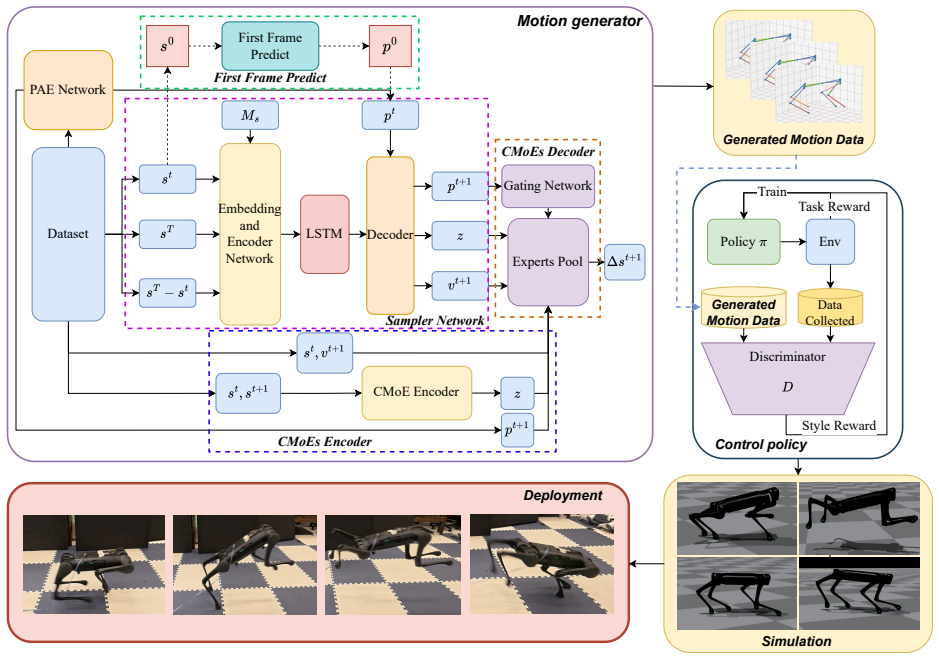
The load-bearing mechanism is a three-part motion generator. A periodic autoencoder (PAE) learns a low-dimensional phase manifold from joint-angular-velocity data, encoding where each gait is in its cycle. A conditional mixture-of-experts (CMoEs) decoder, gated by the phase value and conditioned on the current state, target velocity, and a latent style variable, predicts the next state delta $\Delta s_{t+1}$. A sampler network with an LSTM predictor converts the target state, the current phase, and the difference to the target into the latent, phase, and velocity inputs that let the decoder aim at the destination. The training loss stacks foot-skating, KL, position, rotation, orientation, root-position, and joint-limit terms, so each synthesized frame respects both the task and the robot's hardware limits. A first-frame phase-prediction network supplies the initial phase vector at deployment, where no future frames are available yet.
What would settle it
Run the generator with a start and target state that require a velocity outside the training set's range, say twice the maximum recorded speed in the sparse capture, and measure the L2 norm of the global position of the final predicted frame, the metric reported in the paper's comparison table. If the error at that out-of-range velocity reaches or exceeds the baseline's error, the phase-manifold generalization premise is not holding, and a policy trained on such data should also fail to track a velocity command at that speed.
Extended reading notes
Core claim
The central claim is that an in-between motion generator can turn a sparse motion-capture dataset into dense reference trajectories at essentially arbitrary velocities, and that these synthesized references are good enough to train an adversarial imitation policy that transfers to hardware. The generator's inputs and outputs are the robot's root state and joint poses rather than global skeletal positions, which keeps the synthesized motion compatible with the robot's joint limits and control interface. The paper reports that the generated motions preserve each gait's defining features—aerial phases in gallop, triangular support in tripod, diagonal coordination in trot, same-side coordination in pace—and that the trained policy tracks commanded velocities in simulation and on a real quadruped. In comparison against the baseline in-betweening model, the paper reports lower terminal-frame and whole-clip position error across most gaits.
Load-bearing premise
The load-bearing premise is that the periodic phase manifold learned from the original sparse motion-capture clips stays meaningful for start and end states, and velocities, that never appear in the training data, so the sampler and decoder can fabricate intermediate frames the imitation policy can trust.
Editorial extensions
If this is right
- A single trained policy can execute gallop, tripod, trotting, and pacing, with the reference motions for all four gaits generated from sparse capture data rather than collected separately.
- Because the generator outputs root state and joint poses directly, the synthesized motion transfers to the robot's control interface without retargeting or kinematic preprocessing.
- Velocity-tracking accuracy against commanded references improves relative to training on sparse data alone, supporting the claim that generated in-between data is load-bearing for controller stability.
- The first-frame phase predictor lets the controller start from a single observed frame at runtime, without requiring a history of preceding frames.
- Joint-limit and foot-skating penalties in the generator's loss keep the synthesized reference motions inside the robot's hardware capabilities, which the authors report as the reason no kinematic filtering was needed before policy training.
Reading between the lines
- Not claimed in the paper: the same phase-manifold generator could synthesize continuous velocity ramps or gait-to-gait transitions by setting target states outside the recorded clips; the paper demonstrates fixed-gait execution only.
- Not claimed in the paper: the data-formatting choice of root state plus joint poses should transfer to other legged morphologies, such as bipeds or hexapods, after re-tuning the phase dimension and joint-limit losses; only a quadruped is tested.
- Not claimed in the paper: an ablation that replaces the learned phase manifold with a fixed periodic clock while holding data volume constant would isolate how much of the velocity-tracking gain comes from phase continuity versus simply having more reference frames; the paper does not run this ablation.
Editorial analysis
A structured set of objections, weighed in public.
Referee Report
Summary. This paper proposes a framework for quadruped robot locomotion that combines a CVAE-based in-between motion generator with a periodic autoencoder (PAE) phase manifold and a mixture-of-experts decoder to synthesize multi-gait motions (gallop, tripod, trot, pace) from sparse motion capture data. The generated motions are used as reference data to train an adversarial-motion-prior (AMP) policy in simulation, which is then deployed on a Unitree AlienGo. The paper claims arbitrary-velocity motion generation and improved velocity tracking, supported by simulation results and qualitative real-robot demonstrations of gallop and tripod.
Significance. The proposed approach addresses a real problem—mocap data scarcity for quadruped imitation learning—and the real-robot deployment of gallop and tripod is a notable positive result. If the arbitrary-velocity generalization claim were rigorously validated, the framework could be useful for expanding reference motion datasets. However, the evidence presented is incomplete: the extrapolation claim is not tested, the quantitative comparison is weakened by a citation error and missing statistics, and the contribution of the generated data is not isolated by ablation. The paper does not provide code or data, but the physical-constraint design and phase-manifold idea are interesting.
major comments (5)
- [Section V and Section IV-A] The central claim that the framework 'is capable of generating motions at arbitrary velocities' is not substantiated. The PAE phase manifold (Section III-A) and the CMoEs/sampler networks are trained exclusively on the original motion capture clips; Eqs. (2)-(5) contain no term that encourages extrapolation beyond the training velocity distribution. Table III reports L2 errors on a test set but does not state the velocity distribution or include any experiment at velocities outside the training range. Please add a quantitative velocity-extrapolation experiment (e.g., generate and track reference motions at velocities above and below the training range) and report the resulting errors.
- [Section IV-A and Reference [14]] The comparison baseline and the claimed architectural inspiration are attributed to [14], which is 'RSMT: A remote sensing image-to-map translation model' (Remote Sensing, 2022), a paper unrelated to motion in-betweening. The method described in Section III-A appears to build on DeepPhase [15] and Tang et al. [13] instead. This citation error makes the method's provenance and the baseline comparison unverifiable. Please correct the citation and re-run the benchmark against the actual intended baseline.
- [Section IV-B and Section V] The abstract and conclusions credit the generated motion data with 'enhancing controller stability and improving velocity tracking performance,' but no controlled ablation is reported. There is no comparison of an AMP policy trained on the original mocap data alone versus one trained on the original plus generated data. Without this ablation, the improvements cannot be attributed to the motion generator. Please add a baseline policy trained only on the original mocap trajectories and report quantitative velocity-tracking error and stability metrics.
- [Section IV-B, Figs. 5-6] The real-world validation is qualitative (foot contact patterns, joint angles, torques) and covers only gallop and tripod. No numerical velocity-tracking error, stride frequency accuracy, or success rate is reported for hardware, so the conclusion of 'accurate velocity tracking performance through ... deployment on real-world robots' is not quantitatively supported. Please report quantitative metrics from the real-robot trials, ideally with commanded versus measured velocities.
- [Section III-A, 'First Frame Predict'] The initial phase vector is predicted from a sequence constructed by repeatedly replicating the starting frame. Because the PAE manifold is trained on joint angular velocities (Section III-A1), a static replicated sequence has zero velocity and may fall outside the manifold's valid input distribution. The paper does not describe how this prediction network is trained or validated for such inputs. Since an incorrect initial phase would propagate through the whole generated motion, this is load-bearing for deployment. Please provide training and validation details, and show that the predicted initial phase is consistent with the subsequent generated motion.
minor comments (6)
- [Fig. 1 and Fig. 3 captions] The captions contain typos: 'T ripod' and 'T rotting' should be 'Tripod' and 'Trotting'.
- [Section IV-A, text near Table III] The text says 'matching baseline terminal accuracy during trotting,' but Table III shows the proposed method is better (0.344 vs 0.444 for the last-frame L2 norm); please correct this inconsistency.
- [Table III] Table III lacks error bars, sample counts, and units; the reader cannot assess the statistical significance of the reported differences.
- [Table II] The regularization reward rows are not clearly formatted; the scale for each term should be listed separately to avoid ambiguity between the term values and their weights.
- [Section III-A, Data Formatting] The state definition s = {proot, Rroot, q} is not fully specified; a table of state dimensions and the ranges of q would improve reproducibility.
- [General] The paper does not include a limitations section; given the open extrapolation concerns, a discussion of the velocity range and generalization limits would be helpful to the reader.
Circularity Check
Partial self-reference in the style-reward loop; velocity-tracking and hardware claims are externally grounded, so no strong circularity.
-
other
[Fig. 2 caption / Sec. III-B, Table II style reward]
"Motion trajectories generated by the Motion Generator serve as reference motions for Imitation Learning."
The style reward rs_t used in Table II is the output of a discriminator whose positive reference class is the same generated motion data (Fig. 2: Generated Motion Data -> Style Reward Discriminator). The policy is therefore trained, by construction, to match the generator's own output; the imitation visualizations in Fig. 4 cannot independently certify that the generated data are natural or multi-style, because the notion of style is defined by those very data. This loop affects the style-quality assessment only. The central claims of accurate velocity tracking and real-robot deployment rest on the task reward (vcmd-vxy tracking) and external hardware telemetry, which are independent of the generator and of the style discriminator.
full rationale
The paper contains no self-citations used as load-bearing premises; its architectural anchors (PAE/DeepPhase, CVAE in-betweening, AMP) are external prior work, and the motion-generation evaluation (Table III) is a held-out test against a retrained baseline. The 'arbitrary velocities' claim is not demonstrated -- no experiment specifies a velocity range or tests outside the training distribution -- but that is an unsupported extrapolation/validity concern, not a circularity: the PAE, sampler, and CMoEs losses (Eqs. 2-5) do not reduce the test metric to a fitted parameter. The only genuine self-reference is the style-reward loop described above, which makes the multi-style quality assessment partly tautological but does not drive the external velocity-tracking or deployment results. Overall score 2 reflects this minor, non-load-bearing circularity; the principal empirical claims are independently grounded.
Assumptions & free parameters
free parameters (6)
- Latent dimension I of PAE latent space =
5 (stated)
- Phase dimension =
PhaseDim (not specified)
- Foot loss threshold delta =
unspecified
- Reward weights in Table II =
task 0.2, style 0.8, regularization 0.5
- Regularization coefficients =
-1e-5, -0.01, -2.5e-7, -5e-5, 1.0
- First-frame predictor architecture sizes =
1024 channels, kernel 5/3, dropout 0.4
assumptions (5)
- domain assumption Original motion capture data is rich enough to learn periodic phase manifolds for all four gaits.
- domain assumption Generated joint-space motions that satisfy kinematic and joint-limit constraints are dynamically feasible and transferable to real hardware.
- ad hoc to paper The learned phase manifold generalizes to arbitrary start/end states and arbitrary velocities.
- ad hoc to paper First-frame phase can be estimated from a replicated start frame through a CNN.
- standard math Standard RL and adversarial imitation learning assumptions (MDP, policy gradient, discriminator training) hold.
Cite this review
Pith. "Pith review of In-between Motion Generation Based Multi-Style Quadruped Robot Locomotion." pith.science (2026). https://pith.science/paper/JGQ7RIUA
@misc{pith2026250723053,
  author       = {Pith},
  title        = {Pith review of: In-between Motion Generation Based Multi-Style Quadruped Robot Locomotion},
  year         = {2026},
  howpublished = {\url{https://pith.science/paper/JGQ7RIUA}},
  note         = {Machine review of arXiv:2507.23053}
}
read the original abstract
Quadruped robots face persistent challenges in achieving versatile locomotion due to limitations in reference motion data diversity. To address these challenges, we introduce an in-between motion generation based multi-style quadruped robot locomotion framework. We propose a CVAE based motion generator, synthesizing multi-style dynamically feasible locomotion sequences between arbitrary start and end states. By embedding physical constraints and leveraging joint poses based phase manifold continuity, this component produces physically plausible motions spanning multiple gait modalities while ensuring kinematic compatibility with robotic morphologies. We train the imitation policy based on generated data, which validates the effectiveness of generated motion data in enhancing controller stability and improving velocity tracking performance. The proposed framework demonstrates significant improvements in velocity tracking and deployment stability. We successfully deploy the framework on a real-world quadruped robot, and the experimental validation confirms the framework's capability to generate and execute complex motion profiles, including gallop, tripod, trotting and pacing.
Figures


Figures from the paper (2 more)


Reference graph
Works this paper leans on
-
[14]
Rsmt: A remote sensing image-to- map translation model via adversarial deep transfer learning,
J. Song, J. Li, H. Chen, and J. Wu, “Rsmt: A remote sensing image-to- map translation model via adversarial deep transfer learning,” Remote Sensing, vol. 14, no. 4, p. 919, 2022
work page 2022
-
[15]
Deepphase: Periodic autoen- coders for learning motion phase manifolds,
S. Starke, I. Mason, and T. Komura, “Deepphase: Periodic autoen- coders for learning motion phase manifolds,” ACM Transactions on Graphics (TOG), vol. 41, no. 4, pp. 1–13, 2022
work page 2022
-
[13]
Real- time controllable motion transition for characters,
X. Tang, H. Wang, B. Hu, X. Gong, R. Yi, Q. Kou, and X. Jin, “Real- time controllable motion transition for characters,” ACM Transactions on Graphics (TOG) , vol. 41, no. 4, pp. 1–10, 2022
work page 2022
-
[1]
Computational approaches to motor learning by imitation,
S. Schaal, A. Ijspeert, and A. Billard, “Computational approaches to motor learning by imitation,” Philosophical Transactions of the Royal Society of London. Series B: Biological Sciences , vol. 358, no. 1431, pp. 537–547, 2003
work page 2003
-
[2]
Imitation and reinforcement learning,
J. Kober and J. Peters, “Imitation and reinforcement learning,” IEEE Robotics & Automation Magazine , vol. 17, no. 2, pp. 55–62, 2010
work page 2010
-
[3]
Learning agile robotic locomotion skills by imitating animals,
X. Bin Peng, E. Coumans, T. Zhang, T.-W. Lee, J. Tan, and S. Levine, “Learning agile robotic locomotion skills by imitating animals,” Robotics: Science and Systems (RSS), Virtual Event/Corvalis, July , pp. 12–16, 2020
work page 2020
-
[4]
Learning for a robot: Deep reinforcement learning, imitation learning, transfer learning,
J. Hua, L. Zeng, G. Li, and Z. Ju, “Learning for a robot: Deep reinforcement learning, imitation learning, transfer learning,” Sensors, vol. 21, no. 4, p. 1278, 2021
2021
-
[5]
Fld: Fourier latent dynamics for structured motion representation and learning,
C. Li, E. Stanger-Jones, S. Heim, and S. Kim, “Fld: Fourier latent dynamics for structured motion representation and learning,” arXiv preprint arXiv:2402.13820, 2024
arXiv 2024
Show all 23 references
-
[6]
Amp: Adversarial motion priors for stylized physics-based character con- trol,
X. B. Peng, Z. Ma, P. Abbeel, S. Levine, and A. Kanazawa, “Amp: Adversarial motion priors for stylized physics-based character con- trol,” ACM Transactions on Graphics (ToG) , vol. 40, no. 4, pp. 1–20, 2021
2021
-
[7]
Adversarial motion priors make good substitutes for complex reward functions,
A. Escontrela, X. B. Peng, W. Yu, T. Zhang, A. Iscen, K. Goldberg, and P. Abbeel, “Adversarial motion priors make good substitutes for complex reward functions,” in 2022 IEEE/RSJ International Confer- ence on Intelligent Robots and Systems (IROS) . IEEE, 2022, pp. 25–32
2022
-
[8]
Interactive motion generation from examples,
O. Arikan and D. A. Forsyth, “Interactive motion generation from examples,” ACM Transactions on Graphics (TOG) , vol. 21, no. 3, pp. 483–490, 2002
2002
-
[9]
Motion-motif graphs,
P. Beaudoin, S. Coros, M. Van de Panne, and P. Poulin, “Motion-motif graphs,” in Proceedings of the 2008 ACM SIGGRAPH/Eurographics symposium on computer animation , 2008, pp. 117–126
2008
-
[10]
Constraint-based motion optimization using a statistical dynamic model,
J. Chai and J. K. Hodgins, “Constraint-based motion optimization using a statistical dynamic model,” in ACM SIGGRAPH 2007 papers , 2007, pp. 8–es
2007
-
[11]
Construction and optimal search of interpolated motion graphs,
A. Safonova and J. K. Hodgins, “Construction and optimal search of interpolated motion graphs,” in ACM SIGGRAPH 2007 papers , 2007, pp. 106–es
2007
-
[12]
Robust mo- tion in-betweening,
F. G. Harvey, M. Yurick, D. Nowrouzezahrai, and C. Pal, “Robust mo- tion in-betweening,” ACM Transactions on Graphics (TOG) , vol. 39, no. 4, pp. 60–1, 2020
2020
-
[16]
Conditional motion in-betweening,
J. Kim, T. Byun, S. Shin, J. Won, and S. Choi, “Conditional motion in-betweening,” Pattern Recognition , vol. 132, p. 108894, 2022. [Online]. Available: https://www.sciencedirect.com/science/article/pii/ S0031320322003752
2022
-
[17]
Flexible motion in-betweening with diffusion models,
S. Cohan, G. Tevet, D. Reda, X. B. Peng, and M. van de Panne, “Flexible motion in-betweening with diffusion models,” in ACM SIGGRAPH 2024 Conference Papers , ser. SIGGRAPH ’24. New York, NY , USA: Association for Computing Machinery, 2024. [Online]. Available: https://doi.org/...
2024
-
[18]
Anymole: Any character mo- tion in-betweening leveraging video diffusion models,
K. Yun, S. Hong, C. Kim, and J. Noh, “Anymole: Any character mo- tion in-betweening leveraging video diffusion models,” in Proceedings of the Computer Vision and Pattern Recognition Conference (CVPR) , June 2025, pp. 27 838–27 848
2025
-
[19]
Sim-to-real learning of all common bipedal gaits via periodic reward composition,
J. Siekmann, Y . Godse, A. Fern, and J. Hurst, “Sim-to-real learning of all common bipedal gaits via periodic reward composition,” in 2021 IEEE International Conference on Robotics and Automation (ICRA) . IEEE, 2021, pp. 7309–7315
2021
-
[20]
Learning free gait transition for quadruped robots via phase-guided controller,
Y . Shao, Y . Jin, X. Liu, W. He, H. Wang, and W. Yang, “Learning free gait transition for quadruped robots via phase-guided controller,” IEEE Robotics and Automation Letters , vol. 7, no. 2, pp. 1230–1237, 2021
2021
-
[21]
Ai-cpg: Adaptive imitated central pattern generators for bipedal locomotion learned through reinforced reflex neural networks,
G. Li, A. Ijspeert, and M. Hayashibe, “Ai-cpg: Adaptive imitated central pattern generators for bipedal locomotion learned through reinforced reflex neural networks,” IEEE Robotics and Automation Letters, vol. 9, no. 6, pp. 5190–5197, 2024
2024
-
[22]
Exbody2: Advanced expressive humanoid whole-body control,
M. Ji, X. Peng, F. Liu, J. Li, G. Yang, X. Cheng, and X. Wang, “Exbody2: Advanced expressive humanoid whole-body control,”arXiv preprint arXiv:2412.13196, 2024
2024 arXiv
-
[23]
Asap: Aligning simulation and real-world physics for learning agile humanoid whole-body skills,
T. He, J. Gao, W. Xiao, Y . Zhang, Z. Wang, J. Wang, Z. Luo, G. He, N. Sobanbabu, C. Pan, Z. Yi, G. Qu, K. Kitani, J. Hodgins, L. J. Fan, Y . Zhu, C. Liu, and G. Shi, “Asap: Aligning simulation and real-world physics for learning agile humanoid whole-body skills,” arXiv prepri...
2025 arXiv
Reviewed August 6, 2026 · model on record in the stance chip above.
Discussion (0). Sign in to comment.