REVIEW 4 major objections 4 minor 62 references
Observational Restrictions and Slow-Roll D-brane Inflation in the Special $F(\phi,T)$ Gravity
T0 review · 4 major / 4 minor · reviewed 2026-08-06 · deepseek-v4-flash
Pith's one-line read The paper claims that a D-brane inflation model in F(φ,T) modified gravity, with a specific non-minimal coupling and potential, produces scalar spectral index and tensor-to-scalar ratio values that fall inside the Planck 2018 1σ and 2σ…
desk verdict Routine F(φ,T) extension with hand-tuned parameters; algebra errors and an unverified η_V make the quoted ns/r values unreliable. read the letter →
The pith
A machine-rendered reading of the paper's core claim, the machinery that carries it, and where it could break.
The reading
What carries the argument
The central object is the non-minimal coupling term $\beta F(\phi)T$ in the action (2.1), where $T=g^{\mu\nu}T_{\mu\nu}$ is the trace of the energy-momentum tensor; with $F(\phi)=\phi^5/\mu\,(1-m^4/\phi^4)$ and $V(\phi)=V_0(1-m^4/\phi^4)$, this coupling reshapes the Friedmann equations and the scalar-field equation of motion (2.12)–(2.15). From those equations the paper builds the slow-roll parameters $\epsilon_V$ and $\eta_V$, then maps them to observables through $n_s\simeq1+2\eta_V-6\epsilon_V$ and $r\simeq16\epsilon_V$, and finally uses the e-fold integral (2.20) to determine the field value at horizon crossing for $N=50$ or $60$. The same modified Friedmann equation drives the reheating calculation, relating the decay rate $\Gamma_\phi$ to the reheating temperature $T_{reh}$ and the number of reheating e-folds $N_{reh}$.
What would settle it
Recompute $n_s$ and $r$ using the directly varied field equation (2.9) in place of (2.15) and check whether the resulting points remain inside the Planck 2018 1$\sigma$–2$\sigma$ contours; until the two routes to the equation of motion are reconciled, the fit is not uniquely determined.
Extended reading notes
Core claim
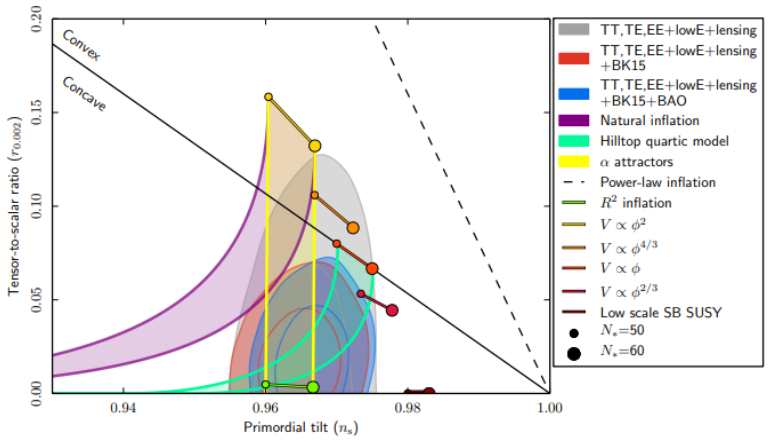
The paper's central claim, stated on its own terms, is that the action (2.1), namely Einstein gravity plus $\beta F(\phi)T$ with the D-brane-inspired functions $F(\phi)=\phi^5\mu^{-1}(1-m^4\phi^{-4})$ and $V(\phi)=V_0(1-m^4\phi^{-4})$, yields an inflationary dynamics whose observables $n_s$ and $r$ agree with the Planck 2018 data and specifically populate the left-hand (low-$r$) side of the $(n_s,r)$ plane. The paper derives the slow-roll parameters $\epsilon_V$ and $\eta_V$, the e-fold number $N$, and the resulting observables for $N=50$–$60$, reporting $n_s$ roughly in $0.95$–$0.97$ and $r$ from $10^{-6}$ to about $2\times10^{-4}$, all consistent with the BICEP/Keck 2021 bound $r<0.036$. In the limit $\beta\to0$, these predictions reduce to the standard simplest D-brane inflation in Einstein gravity, and for other parameter choices the same model can also cover the right-hand side of the Planck contours.
Load-bearing premise
The computed $n_s$ and $r$ values rest on equation (2.15) being the correct equation of motion for the scalar field in this action; every numerical comparison with the Planck contours depends on that one dynamical input.
Editorial extensions
If this is right
- For the parameter sets in Tables 1 and 2 with $N=50$–$60$, the predicted $(n_s,r)$ points lie inside the Planck 2018 1$\sigma$–2$\sigma$ regions, giving a modified-gravity realization of D-brane inflation that is consistent with current CMB data.
- The predicted tensor-to-scalar ratio is very small, $r\sim10^{-6}$–$10^{-4}$, far below the BICEP/Keck 2021 bound $r<0.036$, so future $B$-mode searches could test the model.
- At $\beta=0$ the model reduces continuously to the simplest D-brane inflation in Einstein gravity, so the modified gravity is an extension of the known Einstein-gravity result.
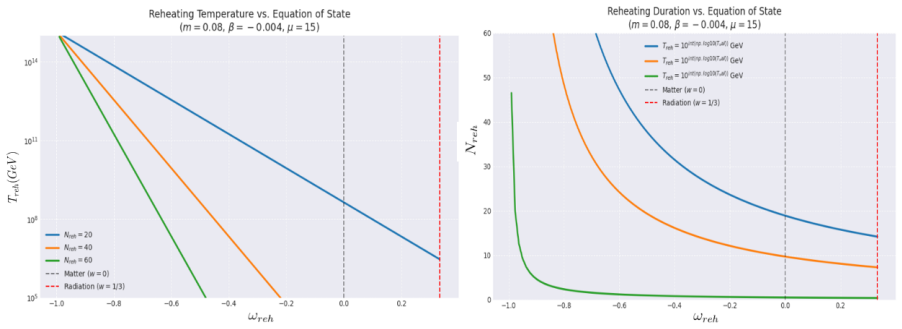
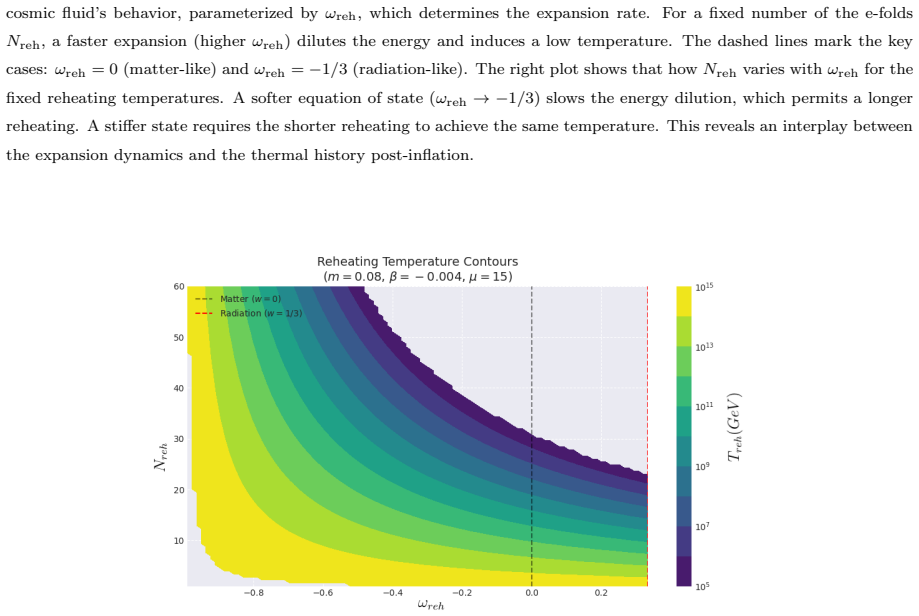
- The reheating analysis gives $T_{reh}$ between $10^5$ and $10^{15}\,\mathrm{GeV}$ and $N_{reh}$ between 1 and 60, consistent with the big-bang nucleosynthesis lower bound of roughly 1 MeV.
- With other parameter choices the same model can also cover the right-hand side of the Planck data, so the paper claims the $F(\phi,T)$ coupling can populate the whole currently allowed $(n_s,r)$ plane.
Reading between the lines
- A direct consistency check a reader can perform is to compare the scalar-field equation of motion obtained from varying the action (2.9) with the one obtained from the continuity equation (2.11) and with equation (2.15); the three routes are not identical, so the reported $(n_s,r)$ values are conditional on which equation is the correct dynamics.
- The same $F(\phi)T$ construction could be applied to other brane-inspired potentials, such as the KKLT form (3.2) or $\alpha$-attractor potentials, to see whether the low-$r$ coverage is generic to the coupling rather than a special feature of the chosen $F(\phi)$.
- The reheating temperature range invites a consistency check against gravitino or modulus constraints from the underlying string compactification; the paper does not specify the inflaton decay channels or the matter-sector couplings, so an explicit particle-physics model would complete the argument.
- If the slow-roll equation is corrected, the reported parameter ranges for $\beta$, $\mu$, and $m$ would need to be retuned; a systematic scan of this parameter space would show which regions of the Planck contours are genuinely accessible.
Editorial analysis
A structured set of objections, weighed in public.
Referee Report
Summary. The manuscript studies single-field slow-roll inflation in the F(φ,T) modified-gravity framework, using a D-brane-inspired potential V(φ)=V0(1−m^4/φ^4) and a coupling F(φ)=(φ^5/μ)(1−m^4/φ^4). It derives Friedman equations and slow-roll parameters, computes the scalar spectral index n_s and the tensor-to-scalar ratio r for grids of β, μ, m and N, compares the results with Planck 2018 and BICEP/Keck contours, and includes a reheating analysis. The central claim is that this specific model accurately covers the left-hand side of the Planck n_s–r region.
Significance. If the derivation were secure and the comparison restrictive, the model could be a useful string-motivated example of F(φ,T) inflation, and the reheating analysis would add value. The paper presents explicit analytical forms for the slow-roll parameters and reports numerical scans over the parameter space. However, the central claim is not currently established: the field equations contain internal inconsistencies, the key slow-roll parameter η_V is asserted without derivation, and the parameter comparison is explicitly described as capable of producing any desirable values of n_s and r. These issues undermine the claimed agreement with the Planck data.
major comments (4)
- [Section 2, Eqs. (2.9), (2.11), (2.15)] The scalar field equation is stated in three mutually inconsistent forms. Direct variation of the action (2.1) with respect to φ gives Eq. (2.11), which contains a term βF_{,φ} φdot^2 and a factor (1+2βF) multiplying (φddot+3Hφdot). Eq. (2.9) instead has a coefficient 2βF_{,φ} φdot^2, and Eq. (2.15) drops the factor (1+2βF) from the φddot term. The terms that differ are dropped in the slow-roll limit, so the three forms reduce to the same Eq. (2.17), but the presence of algebra errors in two of the three versions means that the derivation of the slow-roll system was not checked and must be repaired.
- [Section 2, Eq. (2.19)] The formula for η_V is load-bearing because Eq. (2.26) gives n_s = 1 + 2η_V − 6ε_V, and all entries in Tables 1 and 2 and Figure 3 follow from it. Yet Eq. (2.19) is presented without derivation, and it is algebraically complex enough that an error would directly change all reported n_s values. Since the same derivation path produced the incorrect Eqs. (2.9) and (2.15), the authors should derive Eq. (2.19) step by step from the full scalar equation and verify the substituted form (3.7), for example by numerically integrating the background equations and comparing with the slow-roll approximation.
- [Section 3, paragraph after Eq. (3.9)] The sentence 'By adjusting appropriate values for the parameters, it is feasible to receive any desirable values for n_s and r' concedes that the five free parameters β, μ, m, V0 and N are tuned to reproduce the observed pair. No likelihood, chi-squared statistic, or parameter constraints are reported, and no physical priors are imposed. The agreement with the Planck contours is therefore an exercise in curve-fitting rather than an observational restriction on the model.
- [Section 2, Eqs. (2.21)–(2.28)] The scalar and tensor power spectra are obtained by inserting the modified Hubble parameter and potential into the standard single-field general-relativity formulas for A_s, n_s, r and n_t. The action (2.1) contains a non-minimal coupling of φ to the trace T, which can modify the quadratic action for curvature perturbations beyond the background replacement. Without a derivation of the perturbation equations in F(φ,T) gravity, the numerical values in Tables 1–2 and Figure 3 are not grounded in the theory.
minor comments (4)
- [Section 2, Eq. (2.20)] The e-fold integral appears to be an expansion to first order in β; the order of the approximation should be stated explicitly, and the smallness of βF in the parameter ranges used in the tables should be verified.
- [Section 3, Tables 1–2] The dimensions of the parameters β, μ, m and V0 are not specified; the authors should state whether these are measured in Planck units so that the numerical ranges are meaningful.
- [Section 3, Figure 3] The blue and pink curves in Figure 3 are not identified with their parameter ranges in the caption; a legend or explicit reference to Tables 1 and 2 would improve readability.
- [Section 3, Eqs. (3.10)–(3.19)] The notation ω_φ in Eq. (3.10) and ω_reh in Eq. (3.19) should be distinguished; as written, ω_reh is an effective equation-of-state parameter for the reheating epoch and should not be confused with the constant ω_φ used in Eq. (3.17).
Circularity Check
The Planck-coverage claim is a post-hoc parameter fit: the paper states that any desired (ns, r) can be obtained by adjusting free parameters, so the agreement is not an independent prediction.
-
fitted input called prediction
[Sec. 3, paragraph between Eq. (3.9) and Table 1]
"By adjusting appropriate values for the parameters, it is feasible to receive any desirable values for “ ns” and “ r”."
After computing ns and r from the slow-roll formulas, the paper explicitly states that any desired values of ns and r can be obtained by adjusting the free parameters β, μ, m, and N. Consequently, the subsequent claim that the model “covers the left-hand side of the Planck data” does not test the model: the parameter values in Tables 1–2 and Figure 3 are chosen so that the output lands in the target region. The agreement is therefore a restatement of the fitting procedure, not an independent prediction derived from first principles. The same procedure appears in the Conclusions: “By choosing suitable numerical values for ‘β’ and ‘μ’ we can also cover the entire Planck data surface,” confirming that the comparison is a parameter fit rather than a falsifiable prediction.
full rationale
The derivation of ns and r from the action is algebraically substantive: Eqs. (2.18)–(2.26) produce slow-roll expressions modified by F(φ) and β, and those formulas do not reduce at the equation level to the Planck contours. However, the paper's own operational test is a fit, not a prediction. After presenting r and ns, it states that any desirable values can be achieved by adjusting the parameters, and the chosen potentials are described as guaranteeing Planck-data compatibility. The tables and Figure 3 are therefore demonstrations of model flexibility with free parameters, not independent outcomes that could confirm or rule out the model. This is the fitted-input-called-prediction pattern. No load-bearing self-citation was found: references to the authors' earlier works are contextual and do not support the central claim. The inconsistency among Eqs. (2.9), (2.11), and (2.15), and the unproved ηV expression (2.19), are correctness risks that should be independently checked, but they are not circularity because they concern the internal validity of the derivation rather than the reduction of outputs to inputs. Overall, the central claim of Planck coverage reduces to a post-hoc fit, so a partial-circularity score of 6 is appropriate.
Assumptions & free parameters
free parameters (5)
- β (coupling constant) =
-0.004, -0.001, -0.0001
- µ (cut-off scale) =
1 to 200
- m (mass parameter) =
0.02, 0.08, 0.1, 0.3
- V0 (potential amplitude) =
not fixed
- N (number of e-folds) =
50 to 60
assumptions (4)
- domain assumption The action S = ∫√-g[R/(2κ) + βF(ϕ)T + L_m] is a valid starting point for inflation.
- standard math The slow-roll approximation φdot^2 << V, |φddot| << |3Hφdot|, and F,ϕ φdot^2 << Hφdot holds during inflation.
- ad hoc to paper The specific forms V(ϕ)=V0(1-m^4/ϕ^4) and F(ϕ)=(ϕ^5/µ)(1-m^4/ϕ^4) capture the D-brane dynamics.
- ad hoc to paper The modified Klein-Gordon equation (2.15) is correct despite conflicting with Eq. (2.9) and (2.11).
Cite this review
Pith. "Pith review of Observational Restrictions and Slow-Roll D-brane Inflation in the Special $F(\phi,T)$ Gravity." pith.science (2026). https://pith.science/paper/2AAECBQH
@misc{pith2026250723321,
  author       = {Pith},
  title        = {Pith review of: Observational Restrictions and Slow-Roll D-brane Inflation in the Special $F(\phi,T)$ Gravity},
  year         = {2026},
  howpublished = {\url{https://pith.science/paper/2AAECBQH}},
  note         = {Machine review of arXiv:2507.23321}
}
abstract
We shall investigate the inflation for the D-brane model, motivated by the modified gravity $F(\phi,T)$. This gravity has been recently introduced in the literature. The feasibility of the D-brane inflation theory in the $F(\phi,T)$-gravity has been studied in conjunction with the most recent Planck data. We shall analyze the slow-roll inflation in the context of the $F(\phi)T$-gravity, via the D-brane model. Then, we shall calculate the inflation dynamics to obtain the scalar spectral index ``$n_s$'' and the tensor-to-scalar ratio ``$r$''. Besides, we investigate the dynamics of the reheating for this model. Our model accurately covers the left-hand side of the Planck data and the D-brane inflation.
Figures


Figures from the paper (4 more)


Reference graph
Works this paper leans on
-
[1]
A. H. Guth, Phys. Rev. D 23 (1981) 347
1981
-
[2]
Linde, Inflationary Cosmology, Phys
A.D. Linde, Inflationary Cosmology, Phys. Lett. B 108 (1982) 389
work page 1982
- [4]
-
[5]
D. H. Lyth and A. Riotto, Phys. Rept. 314 (1999) 1
work page 1999
-
[6]
Cosmological inflation and large-scale structure
A. R. Liddle and D. H. Lyth, “ Cosmological inflation and large-scale structure ”, Cambridge University Press, UK (2000)
work page 2000
-
[7]
BICEP, Keck collaboration, Phys. Rev. Lett. 127 (2021) 151301
work page 2021
-
[8]
Planck 2018 results. VI. Cosmological parameters
Planck Collaboration, “ Planck 2018 results. VI. Cosmological parameters ”, A&A 641, A6 (2020), [arXiv:1807.06209 [astro-ph.CO]]
arXiv 2020
-
[9]
Planck 2013 results. XVI. Cosmological parameters
Planck Collaboration, “ Planck 2013 results. XVI. Cosmological parameters ”, A&A 571, A16 (2014), [arXiv:1303.5076 [astro-ph.CO]]
arXiv 2014
Show all 62 references
-
[10]
Boubekeur and D
L. Boubekeur and D. Lyth, JCAP 07 (2005) 010
2005
-
[11]
Kallosh, A
R. Kallosh, A. D. Linde, JCAP 09 (2019) 030
2019
-
[12]
C. M. Lin, JCAP 06 (2020) 015
2020
-
[13]
Kohri, C
K. Kohri, C. M. Lin and D. H. Lyth, JCAP 12 (2007) 004
2007
-
[14]
Dimopoulos, Phys
K. Dimopoulos, Phys. Lett. B 809 (2020) 135688
2020
-
[15]
German, JCAP 02 (2021) 034
G. German, JCAP 02 (2021) 034
2021
-
[17]
Hoffmann, D
J. Hoffmann, D. Sloan, Phys. Rev. D 104 (2021) 123542
2021
-
[18]
K. A. Olive, Phys. Rept. 190 (1990) 307-403. 24
1990
-
[19]
Tegmark et al
M. Tegmark et al. [SDSS Collaboration], “ Cosmological parameters from SDSS and WMAP, Phys. Rev. D 69 (2004) 103501 [astro-ph/0310723]
2004 arXiv
-
[20]
Polchinski, Phys
J. Polchinski, Phys. Rev. Lett. 75 (1995) 4727
1995
-
[21]
Kachru, R
S. Kachru, R. Kallosh, A. D. Linde, et al. JCAP 0310 (2003) 013; G. Dvali, Q. Shafi and S. Solganik, Phys. Lett. B 450 (2001) 72-82
2003
-
[22]
C. P. Burgess, M. Majumdar, D. Nolte, F. Quevedo, G. Rajesh and R. J. Zhang, JHEP 07 (2001) 047
2001
-
[23]
Garcia-Bellido, R
J. Garcia-Bellido, R. Rabadan and F. Zamora, JHEP 01 (2002) 036
2002
-
[24]
Martin, C
J. Martin, C. Ringeval and V. Vennin, Phys. Dark Univ. 5-6 (2014) 75-235
2014
-
[25]
Kallosh, A
R. Kallosh, A. Linde and Y. Yamada, JHEP 01 (2019) 008
2019
-
[26]
Kallosh, A
R. Kallosh, A. D. Linde, and A. Roest, JHEP 198 (2013)1311
2013
-
[27]
J. J. M. Carrasco, R. Kallosh and A. Linde, JHEP 10 (2015) 147
2015
-
[28]
Kallosh and A
R. Kallosh and A. Linde, Phys. Rev. D 91 (2015) 083528
2015
-
[29]
Kallosh and A
R. Kallosh and A. Linde, Phys. Lett. B 798 (2019) 134970
2019
-
[30]
Galante, R
M. Galante, R. Kallosh, A. Linde and D. Roest, Phys. Rev. Lett. 114 (2015) 141302
2015
-
[31]
Planck 2018 results. X. Constraints on inflation
Planck Collaboration, “ Planck 2018 results. X. Constraints on inflation ”, A&A 641, A10 (2020), [arXiv:1807.06211 [astro-ph.CO]]
2020 arXiv
-
[32]
A. D. Linde, Phys. Lett. B 129 (1983) 177
1983
-
[33]
Freese, J
K. Freese, J. A. Frieman and A. V. Olinto, Phys. Rev. Lett. 65 (1990) 3233
1990
-
[34]
F. C. Adams, J. R. Bond, K. Freese, J. A. Frieman and A. V. Olinto, Phys. Rev. D 47 (1993) 426
1993
-
[35]
A. A. Starobinsky, Phys. Lett. B 91 (1980) 99
1980
-
[36]
V. R. Ivanov, S. V. Ketov, E. O. Pozdeeva and S. Yu. Vernov, JCAP 03 (2022) 058. 25
2022
-
[37]
Goncharov and A
A. Goncharov and A. D. Linde, Sov. Phys. JETP 59 (1984) 930; G. Dvali and S.H. Tye, Phys. Lett. B 450 (1999) 72-82
1984
-
[38]
E. E. Flanagan, Phys. Rev. Lett 92 (2004) 07110
2004
-
[39]
Ferraris, M
M. Ferraris, M. Francaviglia and I. Volovich. Class. Quant. Grav. 11 (1994) 1505- 1517
1994
-
[40]
G. R. Bengochea and R. Ferraro, Phys. Rev. D 79 (2009) 124019; S. Teymourtashlou and D. Kamani, Eur. Phys. J. C 81 (2021) 761, arXiv:2108.10164 [hep-th]
2009 arXiv
-
[41]
Nojiri and S
S. Nojiri and S. D. Odintsov, Phys. Lett. B 631 (2005) 1-6
2005
-
[42]
Harko, F
T. Harko, F. S. N. Lobo, S. Nojiri and S. D. Odintsov, Phys. Rev. D 84 (2011) 024020
2011
-
[43]
Ferraro and F
R. Ferraro and F. Fiorini, Phys. Rev. D 75 (2007) 084031
2007
-
[44]
Nojiri and S
S. Nojiri and S. D. Odintsov, Phys. Lett. B 599 (2004) 173
2004
-
[45]
Allemandi, A
G. Allemandi, A. Borowiec, M. Francaviglia and S.D. Odintsov, Phys. Rev. D 72 (2005) 063505; H. Daniali and D. Kamani, Nucl. Phys. B 975 (2022) 115683, arXiv:2202.09347 [hep-th]
2005 arXiv
-
[46]
Bertolami, C
O. Bertolami, C. G. Boehmer, T. Harko and F.S.N. Lobo, Phys. Rev. D 75 (2007) 104016
2007
-
[47]
Rudra, K
P. Rudra, K. Giri. Nucl. Phys. B 967 (2021) 115428; D. Kamani, Phys. Lett. B 564 (2003) 123-131, arXiv:hep-th/0304236
2021 arXiv
-
[48]
Zhang, C
X. Zhang, C. Y. Chen and Y. Reyimuaji. Phys. Rev. D 105 (2022) 043514
2022
-
[49]
Dzhunushaliev, V
V. Dzhunushaliev, V. Folomeev, B. Kleihaus, and J. Kunz. Eur. Phys. J. C 74 (2014) 1
2014
-
[50]
C. Y. Chen and Y. H. Kung. Phys. Dark Univ. 35 (2022) 100956
2022
-
[51]
X. Liu, T. Harko, and S. D. Liang. Eur. Phys. J. C 76 (2016) 1. 26
2016
-
[52]
Rubio and C
J. Rubio and C. Wetterich. Phys. Rev. D 96 (2017) 063509
2017
-
[53]
Belhaj, M
A. Belhaj, M. Benali, Y. Hassouni, and M. Lamaaoune. Int. J. Mod. Phys. A 38 (2023) 2350043
2023
-
[54]
M. Gamonal. Phys. Dark Univ. 31 (2021) 100768
2021
-
[55]
P. A. R. Ade et al. [Planck], Astron. Astrophys. 571 (2014) A22
2014
-
[56]
Improved constraints on primordial gravitational waves using Planck, WMAP, and BICEP/Keck observations through the 2018 observing season
Ade, Peter AR, et al. “ Improved constraints on primordial gravitational waves using Planck, WMAP, and BICEP/Keck observations through the 2018 observing season ”, Phys. Rev. Lett. 127. 15 (2021), 151301
2021
-
[57]
D. S. Salopek, J. R. Bond and J. M. Bardeen. Phys. Rev. D 40 (1989) 1753
1989
-
[58]
Cicoli, C
M. Cicoli, C. P. Burgess and F. Quevedo. JCAP 0903 (2009) 013
2009
-
[59]
Kachru and J
S.B Giddings, S. Kachru and J. Polchinski, Phys. Rev. D 66 (2002) 106006
2002
-
[60]
Silverstein and D
E. Silverstein and D. Tong, Phys. Rev. D 70 (2004) 103505
2004
-
[61]
P Burgess, JHEP 07 (2007) 047
C. P Burgess, JHEP 07 (2007) 047
2007
-
[62]
Kachru et al
S. Kachru et al. Phys. Rev. D 68 (2003) 046005
2003
-
[63]
I. R. Klebanov and M. J. Strassler, JHEP 08 (2000) 052
2000
-
[64]
Kofman et al. Phys. Rev. D 56 (1997) 3258. 27
1997
Reviewed August 6, 2026 · model on record in the stance chip above.
Discussion (0). Continue with ORCID to comment.