REVIEW 3 major objections 6 minor 35 references
Fuss--Catalan algebras on generalized Dyck paths via non-crossing partitions
T0 review · 3 major / 6 minor · reviewed 2026-08-06 · deepseek-v4-flash
Pith's one-line read The paper claims the Fuss–Catalan algebra, the r-color Temperley–Lieb generalization, is realized on increasing r-chains of non-crossing partitions and is isomorphic to its chord-diagram action, yielding a new r=2 reflection solution.
desk verdict Useful new framework for Fuss-Catalan algebras via non-crossing partitions, but the central bijection rests on an unproved stacking step; worth refereeing, not desk-rejecting. read the letter →
The pith
A machine-rendered reading of the paper's core claim, the machinery that carries it, and where it could break.
The reading
What carries the argument
The central object is the bijection $\Psi$ between non-crossing partitions of $[n]$ and chord diagrams on $2n$ points, defined by turning each block $(b_1,\dots,b_p)$ into arches joining $b_i$ to $(b_{i+1}-1)'$ modulo $n$; under $\Psi$ the Kreweras endomorphism $\rho$ (the standard rotation on non-crossing partitions) becomes chord-diagram rotation, and the block-merging operators $F_i$ become the Temperley–Lieb generators $e_i$. For the $r$-color setting the machinery is the extended bijection $\Psi^{(r)}$ from increasing $r$-chains to generalized chord diagrams on $2rn$ points obeying the parity condition $i+j-1\equiv 0 \pmod{2r}$, together with the generators $F^{(s)}_i = \rho^{i-1} F^{(s)}_1 \rho^{-(i-1)}$ built from the extended Kreweras endomorphism $\rho(\pi_1,\dots,\pi_r)=(\rho(\pi_r),\dots,\rho(\pi_1))$. The superposition principle of Proposition 4.8 — chords coming from comparable partitions do not cross — is what lets one generalized chord diagram carry $r$ independent Temperley–Lieb actions, and it is what the isomorphism of Proposition 5.5 rests on; a second bijection $\Phi$ described through cover-exclusive Dyck tilings is shown to differ from $\Psi^{(r)}$ by a rotation.
What would settle it
Draw $\Psi(1/2/3/4)$, $\Psi(1/23/4)$, and $\Psi(1234)$ by the rule of Section 3.3, place them on one set of $2\cdot3\cdot4$ points, and check whether the superposition is non-crossing and satisfies $i+j-1\equiv 0 \pmod{6}$; a crossing or a failed parity condition would refute Proposition 4.8 and break the isomorphism of Proposition 5.5. The same style of substitution settles the second claim: insert formulas (9.4)–(9.9) into the reflection equation (9.2) with explicit small diagrams and generic spectral parameters $w,z$.
Extended reading notes
Core claim
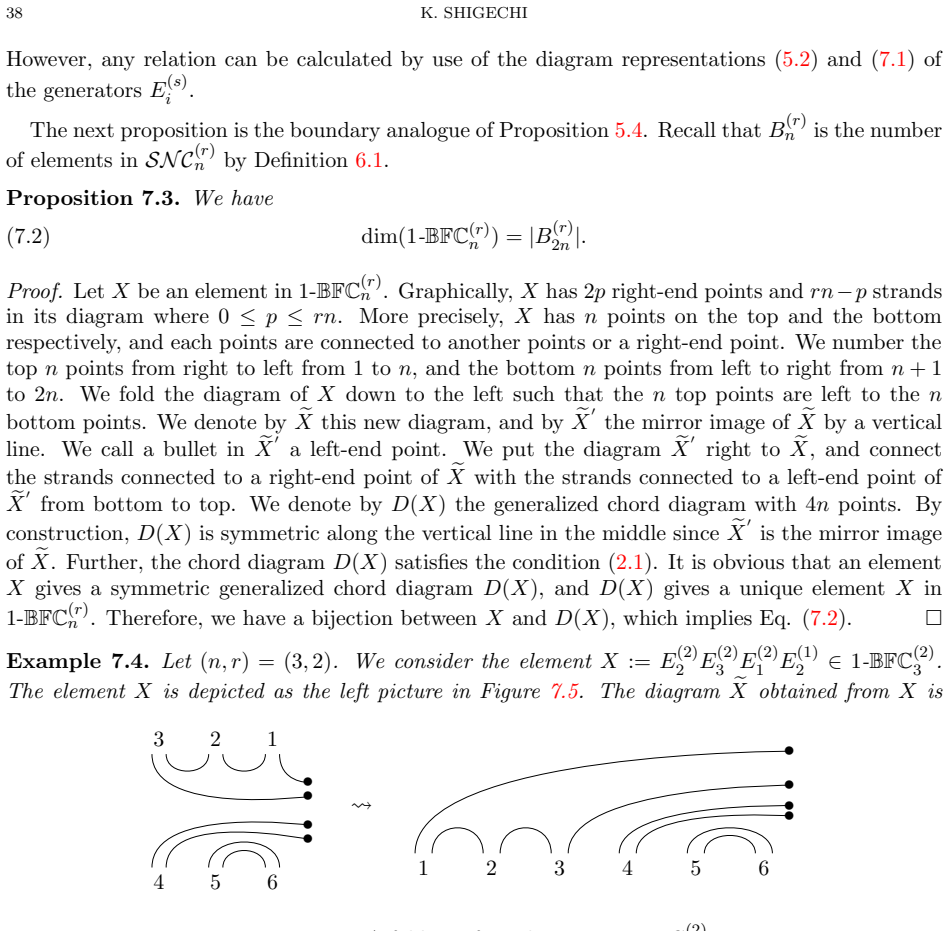
The central claim is Proposition 5.5: the Fuss–Catalan algebra $NC^{(r)}_n$ on increasing $r$-chains of non-crossing partitions, generated by operators $F^{(s)}_i$ formed from a block-merging map conjugated by the Kreweras endomorphism, is isomorphic to the diagrammatic Fuss–Catalan algebra $TL^{(r)}_n$ acting on generalized chord diagrams, by the correspondence $F^{(s)}_i \mapsto E^{(s)}_i$. The fact underneath it is the superposition statement of Proposition 4.8: whenever $\pi_1 \leq \pi_2 \leq \cdots \leq \pi_r$, the chord diagrams $\Psi(\pi_1),\dots,\Psi(\pi_r)$ obtained entrywise from the bijection between non-crossing partitions and chord diagrams never intersect, so they stack into a single generalized chord diagram and the $r$ colors act independently. The paper also claims that the Kreweras endomorphism is conjugate, under the bijection, to rotation of chord diagrams (Proposition 3.11), that the cover relation of the non-crossing partition lattice records exactly when one chord diagram is obtained from another by a generator (Proposition 3.14), and that the one- and two-boundary Fuss–Catalan algebras act on symmetric non-crossing partitions, with primed integers marking the symmetric chords that encode the second boundary (Theorems 7.9, 7.10, 8.8, 8.12). Finally, Proposition 9.1 claims an explicit $r=2$ solution of the reflection equation, formulas (9.7)–(9.9), valid under the stated non-degeneracy conditions on $\tau, \tau_e, \tau_o$, with the degenerate cases handled separately.
Load-bearing premise
The construction rests on the claim that the chord diagrams belonging to the entries of an increasing chain always stack without crossings; the proof works out a single block-merging step in two configurations and extends to arbitrary chains by repeating the argument, so if any longer chain failed to stack, the central bijection and every isomorphism built on it would need repair.
Editorial extensions
If this is right
- The Fuss–Catalan algebra acquires a purely combinatorial model — chains in the lattice of non-crossing partitions — so its elements and actions can be studied with partition combinatorics, in the same way the Temperley–Lieb algebra is studied with Dyck paths and chord diagrams.
- Cover relations in the non-crossing partition lattice encode generator actions: $C_2 = e_i C_1$ holds exactly when the corresponding partitions cover one another in the appropriate direction, giving a poset-theoretic reading of the whole Temperley–Lieb action.
- The dimension formulas $\dim TL^{(r)}_n = |P^{(r)}_{n+1}|$, $\dim 1\text{-}BFC^{(r)}_n = B^{(r)}_{2n}$, and $\dim 2\text{-}BFC^{(r)}_n = K^{(r)}_n$ follow directly from the bijections, so counting chains, Dyck tilings, and folded diagrams yields the same numbers.
- The boundary algebras act on symmetric non-crossing partitions, and the two-boundary case is carried by primed integers whose allowed positions obey the linear order (6.10) on symmetric chords — the second boundary is extra data on the same partitions.
- The explicit $r=2$ solution (9.6)–(9.9) of the reflection equation furnishes concrete boundary weights, the ingredient needed to build an integrable lattice model with boundaries from the one-boundary Fuss–Catalan algebra.
Reading between the lines
- Editorial: if the isomorphism of Proposition 5.5 holds, known facts about the diagrammatic Fuss–Catalan algebra — its relations in Theorem 5.3, its dimensions, and its Yang–Baxter solution — transfer to the chain model; a check the paper leaves implicit is whether the chain representation is faithful for all $r$ and $n$.
- Editorial: the construction uses only a lattice with a Kreweras-type rotation and comparable objects whose chord diagrams stay non-crossing, so the same recipe is likely to yield Fuss–Catalan-type algebras for other non-crossing families, such as non-crossing partitions of other Coxeter types.
- Editorial: the $r=2$ reflection solution invites the same ansatz $K(w) = 1 + \sum_s k_s(w) E^{(s)}_n$ for $r\ge 3$; whether the functional equations admit solutions in the larger algebra is left open by the paper.
Editorial analysis
A structured set of objections, weighed in public.
Referee Report
Summary. The paper develops a combinatorial framework for Fuss–Catalan algebras using increasing r-chains of non-crossing partitions. It defines a bijection between such chains and generalized Dyck paths, a second bijection to generalized chord diagrams, and uses these to compare an algebra generated by operators on chains with the diagrammatic Fuss–Catalan algebra of Bisch–Jones and Di Francesco. Boundary analogues are introduced via symmetric non-crossing partitions and primed integers, and a solution of the reflection equation for r = 2 is proposed. The central claim is that the chain algebra is isomorphic to the diagrammatic algebra, with the boundary versions isomorphic to the one- and two-boundary diagrammatic algebras.
Significance. If the missing verifications are supplied, the paper would give a useful and explicit dictionary between increasing chains of non-crossing partitions, generalized Dyck paths, and generalized chord diagrams, extending the classical Temperley–Lieb/non-crossing partition correspondence. The paper is constructive: the bijections are described algorithmically, several examples are worked out, and the r = 1 case is checked against the known Temperley–Lieb action. The proposed r = 2 reflection matrix is an explicit, falsifiable formula. However, several load-bearing assertions are supported only by sketches or by 'repeating a similar argument', so the announced isomorphisms are not yet fully established.
major comments (3)
- [§4.4, Proposition 4.8] The proof of Proposition 4.8 establishes only the single-cover case π1 ⋖ π2 and then extends to arbitrary chains by 'repeating a similar argument' along the composition sequence (4.2). This requires a transitivity statement that is not proved: if the pairs (Ψ(π1), Ψ(ν)) and (Ψ(ν), Ψ(π2)) are non-crossing, it does not follow automatically that (Ψ(π1), Ψ(π2)) is non-crossing, since each cover operation reconnects endpoints and can create new chords that were not present in the earlier diagram. The inverse direction of Ψ(r) is also only sketched: after reading off the chord diagrams Cs from C, the partitions πs = Ψ^{-1}(Cs) are asserted to form an increasing chain without proof. Since Proposition 5.5 and the boundary analogues in Theorems 7.10 and 8.12 all pass through Ψ(r), this gap is load-bearing.
- [§5, Proposition 5.5] Even granting Proposition 4.8, the proof of Proposition 5.5 asserts that F_i^(s) = Ψ(r)^{-1} E_i^(s) Ψ(r) 'by the construction of the bijection Ψ(r)'. The reader is not shown why applying f1 to the suffix π_{r-s+1},...,π_r of an r-chain corresponds, under the superposition Ψ(r), to the action of E_i^(s) on exactly the s inner strands of the generalized chord diagram. This requires a diagrammatic comparison that is not supplied, and the same gap propagates to Theorem 7.10 and Theorem 8.12, whose proofs reduce to the r = 1 case plus a superposition assertion.
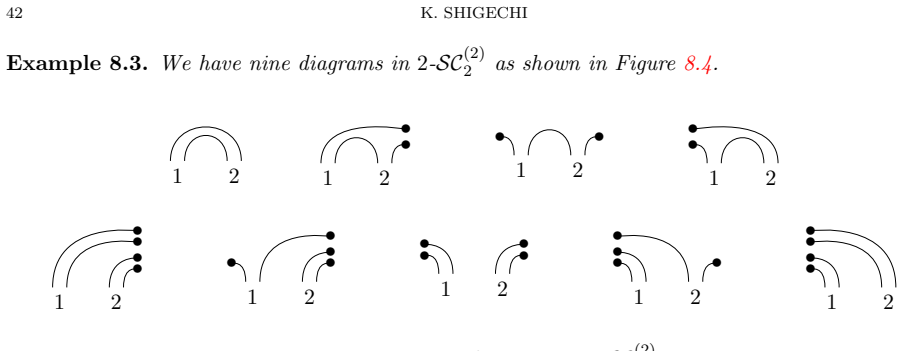
- [§8, Lemma 8.13 and Definition 8.10] The bijection SN C'^{(r)}_n ≅ SC'^{(r)}_n is asserted by comparing Definition 6.23 with Definition 8.10, but the constraints in Definition 6.23(a)–(b) and the admissibility condition in Definition 8.10 involve both the chain order and the nesting order of symmetric chords. No proof is given that these constraints correspond under the bijection of Proposition 6.7, nor that the generators G_i^(s) preserve the set SN C'^{(r)}_n. This is load-bearing for the two-boundary isomorphism Theorem 8.12.
minor comments (6)
- [Title and running header] The title header contains the typo 'FUSS–CA T ALAN'; the introduction also has 'Temperely' for 'Temperley'.
- [Example 4.6] Example 4.6 says 'an increase 3-chain' where 'an increasing 3-chain' is meant, and the phrase 'the positions of U in P_{j1∪...∪jm} is given by' should agree in number with 'set'.
- [§4.2, construction of κ(r)] In the merging step, the text writes 'a := {q ∈ B^{(i-1)}_{j1} : q < min B^{(i-1)}_{j2}}' and then uses 'a(r+1)' as a position; it should specify that the cardinality |a| is intended.
- [Proposition 4.7] The chain of equalities ξ^{r+1} = eσ^{r+1} = ρ^2 mixes maps on three different sets; the statement should be clarified by explicitly naming the identifications under which the equality is asserted.
- [Theorem 5.3] The proof says the relations are 'routine to check' and lists only relations of order up to three; since the paper later uses higher-order diagram identities, it would be helpful to state explicitly that all relations are determined by the diagrammatic representation and to give one worked higher-order example.
- [References] Reference [27] contains the typo 'J. Pure Appl. Alegebra' and should be corrected.
Circularity Check
No significant circularity: the central isomorphisms are verified by explicit bijections, and the only self-citation is auxiliary.
full rationale
The derivation chain is self-contained against independently defined objects. The bijection Ψ(r) is an explicit set map, Proposition 4.8 attempts to prove admissibility of the superposition from the chain condition, and Proposition 3.11 verifies F_i = Ψ^{-1} e_i Ψ directly. Proposition 5.5 then compares generator actions strand-by-strand rather than defining NC^(r)_n in terms of TL^(r)_n; the proof has a gap in the stacking argument for chains of length greater than two, but that is an incompleteness or correctness concern, not circularity. The boundary isomorphisms (Theorems 7.9, 7.10, 8.8, and 8.12) similarly reduce to checking local generator actions against explicit bijections. The only self-citation, reference [27] for cover-exclusive Dyck tilings, supports an auxiliary alternative description (Proposition 4.22 and Corollary 4.23) and is not load-bearing for the central isomorphism claims. The reflection-equation solution is obtained by solving the coefficient equations (9.10)-(9.14) derived from the algebra relations, so it is not a fitted input renamed as a prediction. No equation or conclusion reduces by construction to its own input.
Assumptions & free parameters
assumptions (3)
- standard math The lattice of non-crossing partitions is graded with rank n minus the number of blocks, and the Kreweras endomorphism reverses covers (rk(rho(pi)) + rk(pi) = n - 1).
- domain assumption The diagrammatic presentations of the Fuss-Catalan algebra TL(r)_n and the boundary algebras 1-BFC(r)_n and 2-BFC(r)_n (relations in Theorem 5.3 and Sections 7-8) are the correct defining relations of these algebras.
- ad hoc to paper The parity conditions in Definition 6.23(b) and the admissibility condition in Definition 8.10 exactly characterize the primed-integer r-chains that correspond to two-boundary diagrams.
invented entities (1)
-
Primed integers on symmetric non-crossing partitions (SN C'_n)
Cite this review
Pith. "Pith review of Fuss--Catalan algebras on generalized Dyck paths via non-crossing partitions." pith.science (2026). https://pith.science/paper/FVPCCKVM
@misc{pith2026250723460,
  author       = {Pith},
  title        = {Pith review of: Fuss--Catalan algebras on generalized Dyck paths via non-crossing partitions},
  year         = {2026},
  howpublished = {\url{https://pith.science/paper/FVPCCKVM}},
  note         = {Machine review of arXiv:2507.23460}
}
abstract
We study the Fuss--Catalan algebras, which are generalizations of the Temperley--Lieb algebra and act on generalized Dyck paths, through non-crossing partitions. First, the Temperley--Lieb algebra is defined on non-crossing partitions, and a bijection between a Dyck path and a non-crossing partition is shown to be compatible with the Temperley--Lieb algebra on Dyck paths, or equivalently chord diagrams. We show that the Kreweras endomorphism on non-crossing partitions is equivalent to the rotation of chord diagrams under the bijection. Secondly, by considering an increasing $r$-chain in the graded lattice of non-crossing partitions, we define the Fuss--Catalan algebras on increasing $r$-chains. Through a bijection between an increasing $r$-chain and a generalized Dyck path, one naturally obtains the Fuss--Catalan algebra on generalized Dyck paths. As generalizations of the Fuss--Catalan algebra, we introduce the one- and two-boundary Fuss--Catalan algebras. Increasing $r$-chains of symmetric non-crossing partitions give symmetric generalized Dyck paths by the bijection, and the boundary Fuss--Catalan algebras naturally act on them. We show that these representations are compatible with the diagrammatic representations of the algebras by use of generalized chord diagrams. Thirdly, we discuss the integrability of the Fuss--Catalan algebras. For the Fuss--Catalan algebras with boundaries, we obtain a new solution of the reflection equation in the case of $r=2$.
Figures


Figures from the paper (9 more)



Reference graph
Works this paper leans on
-
[1]
Armstrong, Generalized noncrossing partitions and combinatorics of Coxeter groups , vol
D. Armstrong, Generalized noncrossing partitions and combinatorics of Coxeter groups , vol. 202, Memoirs of the American Mathematical Society, 2009
work page 2009
-
[2]
Multicolored Temperley-Lieb lattice models. The ground state
A. Babichenko and D. Gepner, Multicoloured Temperley–Lieb lattice models. The ground state, J. Phys. A: Math. Theor. 40 (2007), 203–216, arXiv:cond-mat/0605447
work page Pith review arXiv 2007
-
[3]
R. J. Baxter, Exactly Solved Models in Statistical Mechanics , Academic Press, London, 1982
work page 1982
-
[4]
Biane, Some properties of crossings and partitions , Discrete Math
P. Biane, Some properties of crossings and partitions , Discrete Math. 175 (1997), no. 1, 41–53, doi
work page 1997
-
[5]
D. Bisch and V. Jones, Algebras associated to intermediate subfactors , Invent. Math. 128 (1997), no. 1, 89–157
work page 1997
-
[6]
184, Dekker, New York, 1997, pp
, A note on free composition of subfactors , Geometry and physics (Jørgen Ellegaard Andersen, Johan Dupont, Henrik Pedersen, and Andrew Swann, eds.), Lecture Notes in Pure and Applied Mathematics, no. 184, Dekker, New York, 1997, pp. 339–361
work page 1997
-
[7]
Brenti, Kazhdan—Lusztig and R-polynomials, Young’s lattice, and Dyck partitions , Pacific J
F. Brenti, Kazhdan—Lusztig and R-polynomials, Young’s lattice, and Dyck partitions , Pacific J. Math. 207 (2002), 257–286
work page 2002
-
[8]
The two-boundary Temperley-Lieb algebra
J. de Gier and A. Nichols, The two-boundary Temperley–Lieb algebra, J. Algebra 321 (2009), 1132–1167, arXiv: math/0703338
work page Pith review arXiv 2009
Show all 35 references
-
[9]
de Gier, A
J. de Gier, A. Nichols, P. Pyatov, and V. Rittenberg, Magic in the spectra of the XXZ quantum chain with boundaries ∆ = 0 and ∆ = −1/2, Nucl. Phys. B 729 (2005), 387–418, arXiv:hep-th/0505062
2005 arXiv
-
[10]
de Gier and P
J. de Gier and P. Pyatov, Bethe ansatz for the Temperley–Lieb loop model with open boundaries , J. Stat. Mech. (2004), P03002, arXiv:hep-th/0312235
2004 arXiv
-
[11]
P. H. Edelman, Chain enumeration and non-crossing partitions , Discrete Math. 31 (1980), no. 2, 171–180, doi
1980
-
[12]
40 (1982), no
, Multichains, non-crossing partitions and trees , Discrete Math. 40 (1982), no. 2, 171–179, doi
1982
-
[13]
P. H. Edelman and R. Simion, Chains in the lattice of noncrossing partitions , Discrete Math. 126 (1994), no. 1, 107–119, doi
1994
-
[14]
Di Francesco, New integrable lattice models from Fuss–Catalan algebras , Nucl
P. Di Francesco, New integrable lattice models from Fuss–Catalan algebras , Nucl. Phys. B 532 (1998), 609–634, arXiv:hep-th/9807074
1998 arXiv
-
[15]
A. B. Hussein, On representations of Fuss–Catalan algebras , J. Algebra 519 (2019), 398–423
2019
-
[16]
L. H. Kauffman, State models and the Jones polynomial , Topology 26 (1987), 395–407
1987
-
[17]
Kreweras, Sur les partitions non croisees d’un cycle , Discrete Math
G. Kreweras, Sur les partitions non croisees d’un cycle , Discrete Math. 1 (1972), no. 4, 333–350, doi
1972
-
[18]
Z. A. Landau, Fuss–Catalan algebras and chains of intermediate subfactors , Pacific J. Math. 197 (2001), no. 2, 325–368. FUSS–CATALAN ALGEBRAS ON GENERALIZED DYCK PATHS VIA NON-CROSSING PARTITIONS 51
2001
-
[19]
P. P. Martin and H. Saleur, On an algebraic approach to higher-dimensional statistical mechanics , Commun. Math. Phys. 158 (1993), 155–190, arXiv:hep-th/9208061
1993 arXiv
-
[20]
, The blob algebra and the periodic Temperley–Lieb algebra, Lett. Math. Phys. 30 (1994), 189–206, arXiv: hep-th/9302094
1994 arXiv
-
[21]
P. P. Martin and D. Woodcock, On the structure of the blob algebra , J. Algebra 225 (2000), 957–988
2000
-
[22]
, Generalized blob algebra and alcove geometry , LMS J. Comput. Math. 6 (2003), 249–296, arXiv:math. RT/0205263
2003
-
[23]
Poupard, Etude et denombrement paralleles des partitions non-croisees d’un cycle et des decoupages d’un polygone convexe, Discrete Math
Y. Poupard, Etude et denombrement paralleles des partitions non-croisees d’un cycle et des decoupages d’un polygone convexe, Discrete Math. 2 (1972), no. 3, 279–288, doi
1972
-
[24]
Sch¨ utzenberger,Promotion des morphismes d’en sembles ordonn´ es, Discrete Math
M.-P. Sch¨ utzenberger,Promotion des morphismes d’en sembles ordonn´ es, Discrete Math. 2 (1972), 73–94
1972
-
[25]
17, Accad
, Evacuations, Colloquio Internazionale sulle Teorie Combinatorie (Rome, 1973), Tomo I, Atti dei Con- vegni Lincei, No. 17, Accad. Naz. Lincei, 1976, pp. 257–264
1973
-
[26]
Louis-Pasteur Strasbourg, Strasbourg, 1976, Springer, coll
, La correspondance de Robinson , Combinatoire et repre´ esentationi du groupe sym´ etrique: Actes Table Ronde CNRS, Univ. Louis-Pasteur Strasbourg, Strasbourg, 1976, Springer, coll. (D. Foata, ed.), Lecture Notes in Math., no. 579, Springer-Verlag, Berlin/New York, 1977, pp. 59–113
1976
-
[27]
Shigechi and P
K. Shigechi and P. Zinn-Justin, Path representation of maximal parabolic Kazhdan–Lusztig polynomials , J. Pure Appl. Alegebra 216 (2012), no. 11, 2533–2548, arXiv:1001.1080
2012 arXiv
-
[28]
Simion, Combinatorial statistics on non-crossing partitions , Journal of Combinatorial Theory, Series A 66 (1994), no
R. Simion, Combinatorial statistics on non-crossing partitions , Journal of Combinatorial Theory, Series A 66 (1994), no. 2, 270–301, doi
1994
-
[29]
217 (2000), no
, Noncrossing partitions, Discrete Math. 217 (2000), no. 1, 367–409, doi
2000
-
[30]
Simion and D
R. Simion and D. Ullman, On the structure of the lattice of noncrossing partitions , Discrete Math. 98 (1991), no. 3, 193–206, doi
1991
-
[31]
E. K. Sklyanin, Boundary conditions for integrable quantum systems , J. Phys. A: Math. Gen. 21 (1988), no. 10, 2375–2389
1988
-
[32]
R. P. Stanley, Parking Functions and Noncrossing Partitions , Electron. J. Comb. 4 (1997), no. 2, R20, doi
1997
-
[33]
, Catalan Numbers, Cambridge University Press, New York, 2015
2015
-
[34]
Stump, More bijective Catalan combinatorics on permutations and on signed permutations, J
C. Stump, More bijective Catalan combinatorics on permutations and on signed permutations, J. Comb. 4 (2013), no. 4, 419–447, arXiv:0808.2822
2013 arXiv
-
[35]
H. N. V. Temperley and E. H. Lieb, Relations between the ‘percolation ’ and ‘coloring’ problem and other graph- theoretical problems associated with regular planar lattices: some exact results for the ‘percolation problem’, Proc. Roy. Soc. Lond. A 322 (1971), 251–280. Email ad...
1971
Reviewed August 6, 2026 · model on record in the stance chip above.
Discussion (0). Continue with ORCID to comment.