REVIEW 4 major objections 5 minor 35 references
User Experience Estimation in Human-Robot Interaction Via Multi-Instance Learning of Multimodal Social Signals
T0 review · 4 major / 5 minor · reviewed 2026-08-06 · deepseek-v4-flash
Pith's one-line read This paper claims that a Transformer-based model can estimate a user's experience with a robot from facial expressions and voice, and that it outperforms third-party human evaluators in this task.
desk verdict Useful new UX dataset and a sensible modeling framework, but the headline claim of beating human evaluators is unestablished because the humans got far less training data than the model. read the letter →
The pith
A machine-rendered reading of the paper's core claim, the machinery that carries it, and where it could break.
The reading
What carries the argument
The core mechanism is a two-stage multi-instance learning architecture built from shared CNNs and Transformer encoders. The user's video is split into short clips; each clip's frames pass through a CNN and a first Transformer to produce a clip-level vector, and a second Transformer aggregates these vectors to capture long-term interaction patterns. The audio track is converted to a mel-spectrogram, divided into patches, and encoded by a CNN plus Transformer in the same patchwise fashion. The resulting global audio and vision representations are concatenated and fed to an MLP that predicts one of seven UX scores, and a CLS token in each Transformer is what aggregates the sequence into a single representation. Attention rollout is applied to inspect which clips and audio patches the model relies on, showing that expressive episodes and tonal changes receive high attention.
What would settle it
Conduct the same comparison with human evaluators trained on videos from the same twenty participants used to train the model, then measure Acc.7 and Acc.3 on held-out participants; if human accuracy then equals or exceeds the model's, the reported advantage is an artifact of unequal training exposure.
Extended reading notes
Core claim
The central discovery is that a two-stage multi-instance Transformer, fed with cropped face images and mel-spectrogram patches of the user's voice, can predict self-reported UX questionnaire responses more accurately than third-party human evaluators. On the seven-level scale the proposed model averages about 33% accuracy versus about 23% for human raters, and on the three-level scale it averages about 70% versus 64%, while both substantially exceed chance. The paper also finds that the multimodal model beats each unimodal variant on most questionnaire items, and that attention is spread over multiple video clips, concentrating on moments of expressive change rather than uniformly across the interaction. The authors interpret this as evidence that UX, being a multi-faceted construct, is better estimated by modeling temporal dynamics of social signals than by momentary observations.
Load-bearing premise
The finding that the model outperforms human evaluators depends on the assumption that human raters who trained on only two participants' videos are a fair human benchmark; if a person given the same amount of training data as the model were equally or more accurate, the central claim would no longer hold.
Editorial extensions
If this is right
- Robots could estimate a user's experience continuously during an interaction and adapt their behavior in real time, reducing reliance on post-interaction questionnaires.
- A single camera and microphone provide sufficient sensing for the multimodal UX estimator, making deployment feasible for service robots.
- The same system can predict scores for all 15 questionnaire items spanning attractiveness, stimulation, interactivity, and satisfaction, covering a broader construct than engagement or sentiment alone.
- The multi-instance design shows that preserving temporal structure matters: momentary snapshot-based predictors would be weaker, so interaction-aware architectures are preferable for UX estimation.
Reading between the lines
- A natural extension not pursued in the paper is to use the predicted UX as a reward signal for reinforcement learning, letting a robot learn behaviors that optimize estimated user satisfaction without human labels.
- The human baseline was given far less training data than the model, so a symmetric human experiment would likely narrow the gap; this is a limitation to address before claiming general superiority over human judgment.
- The attention findings suggest a testable hypothesis: UX-relevant moments are localized in time, so an estimator that crops interactions to the most expressive segments might match full-video accuracy at a much lower computational cost.
- If the approach replicates across different robot platforms, interaction types, and user demographics, it would support a broader claim that self-reported experience leaves measurable traces in brief expressive behavior, worth testing in multi-party or long-duration conversations.
Editorial analysis
A structured set of objections, weighed in public.
Referee Report
Summary. The paper proposes a Transformer-based multi-instance learning model that estimates seven-point questionnaire UX ratings from facial-expression videos and voice in human-robot interaction. The authors introduce a new dataset of 220 interactions from 22 participants with two robots, evaluate unimodal and multimodal variants under subject-independent 4-fold cross-validation, and compare the best model against seven third-party human evaluators. They report that the model outperforms the human evaluators and provide attention analyses to interpret the model's focus.
Significance. If the reported results were robust, the paper would make a useful contribution: a new HRI UX dataset, a sensible weakly supervised temporal architecture, and an explicit human-baseline comparison are all valuable for affective HRI. The subject-independent evaluation protocol and the attention analysis are strengths. However, the central claim, that the method outperforms third-party human evaluators, depends on a severely unmatched baseline and is not supported by the reported statistics; the multimodal advantage is also numerically tiny and untested. With those load-bearing issues unresolved, the contribution is not yet established.
major comments (4)
- [V-B, Figs. 7-8] The central claim that the model 'outperforms third-party human evaluators' is not supported because the human and model baselines are not matched in training data. The text states that 'each evaluator watched videos of two participants as training data,' while the model was trained under subject-independent 4-fold cross-validation on the full dataset; for the comparison, the paper reports only that the model's performance was averaged over 12 participants and does not specify how many participants' labels the model saw. This conflates model quality with a substantial training-data advantage and makes the reported 10-point Acc.7 gap uninterpretable. The comparison also lacks significance tests or confidence intervals for the model, and the human error bars show only the best and worst evaluator rather than the uncertainty of the mean.
- [III] The participant counts are internally inconsistent. The text says 'The experiment was conducted with 22 participants' and then 'Among the participants, 22 were male, and one was female,' which cannot both be true. Section V-B then states that 'This experiment used data from 12 of the 22 participants,' but the main dataset description reports 220 data points (22 participants x 10 scenarios). The paper must clarify the actual total sample size, the gender breakdown, and which analyses use the full 22 participants versus the 12-participant subset; this directly affects the validity of the reported cross-validation and human-comparison results.
- [V-A, Figs. 5-6] The claimed benefit of multimodality is not statistically demonstrated. The average Acc.7 values are 34.5% for the vision-only model, 33.6% for the audio-only model, and 35.1% for the multimodal model, a difference of roughly 0.6 percentage points. No error bars, confidence intervals, or significance tests are reported for any model, and the statement that 'each model performed significantly better than chance' is made without a statistical test. Similarly, the Acc.3 differences among models are small and could easily be noise. The authors should report per-fold variability or permutation tests before claiming that the multimodal approach is effective.
- [V-B] The human-evaluation reporting is insufficient for a fair baseline comparison. The paper states that error bars in the third-party evaluation graph represent the maximum and minimum accuracy values, i.e., the best and worst evaluator, which is not a measure of the uncertainty of the mean human performance. No inter-rater reliability statistic (e.g., Cohen's kappa or Krippendorff's alpha) is reported, so it is unclear whether the human ratings are reliable enough to serve as a meaningful benchmark. This matters because the headline claim rests entirely on this comparison.
minor comments (5)
- [IV, Eq. (4)] The notation in Eq. (4) is self-referential: it defines Fvi = Transformer([Fvi, CLSi]), but the intended input is the frame-level feature vectors Ci, so it should be Fvi = Transformer([Ci, CLSi]).
- [IV, Section on Vision Encoder] There is a grammatical and typographical issue: 'The feature vectors Ci extracted from individual frames are processed by the Transformer encoder The feature vectors Ci are processed along with a CLS token...' The sentence is broken and should be rewritten.
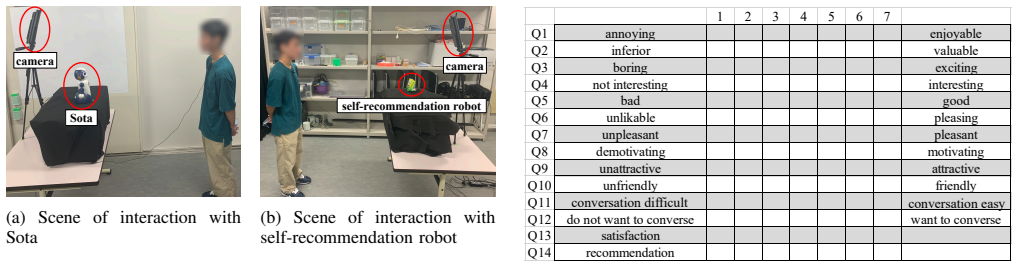
- [Fig. 3] The questionnaire in Fig. 3 contains typos: 'want to use agein' should be 'want to use again', and the label 'conversation difficultconversation easy' is missing a separator.
- [V-A, Experimental Settings] The key hyperparameters (16 video clips, 16 frames per clip, 16 patch images) are presented without any sensitivity analysis or justification, leaving open how dependent the results are on these choices.
- [V-A] The statement that the proposed model outperforms the other models on most questionnaire items is not fully supported by Fig. 6, where the multimodal model is not the best on every item; the text should acknowledge the item-level variability.
Circularity Check
No significant circularity; the UX-estimation claim is an empirical supervised-learning result, with the human-comparison asymmetry being a validity concern rather than a circular step.
full rationale
Walked the paper's derivation chain: the UX dataset (Sec. III) is independently collected from self-reported questionnaires; the proposed model (Sec. IV) is a standard Transformer/MIL supervised architecture trained with cross-entropy loss (Eq. 7); Acc.7 and Acc.3 are conventional accuracy metrics computed on held-out participants via subject-independent 4-fold cross-validation. No fitted parameter is renamed as a prediction: the model's output is the questionnaire score itself, and the input features (facial images, mel-spectrograms) are not defined in terms of the target UX labels. The comparison with third-party human evaluators (Sec. V-B) is empirical and, while it raises a real protocol-fairness concern because evaluators watched only two participants' training videos whereas the model was trained on substantially more data, that is an experimental-validity limitation rather than a circularity. Self-citations such as [3], [4], and [22] are used only to describe prior robot behaviors and context, and none is load-bearing for the UX-estimation performance claim. The central claim therefore does not reduce to its own inputs by construction.
Assumptions & free parameters
free parameters (3)
- Number of video clips and frames per clip =
16 clips, 16 frames each
- Acc.3 quantization thresholds =
1-2 negative, 3-5 neutral, 6-7 positive
- Questionnaire item subset =
15 items from UEQ
assumptions (4)
- domain assumption Self-reported answers to the selected 15 items constitute a valid measure of UX in HRI.
- domain assumption Facial expression and voice contain sufficient information to predict UX; posture, gaze, and head movement are negligible.
- domain assumption The 10 scripted robot behaviors elicit the intended positive/negative UX.
- domain assumption Subject-independent 4-fold cross-validation with 22 participants yields stable accuracy estimates.
Cite this review
Pith. "Pith review of User Experience Estimation in Human-Robot Interaction Via Multi-Instance Learning of Multimodal Social Signals." pith.science (2026). https://pith.science/paper/2YS4IXKL
@misc{pith2026250723544,
  author       = {Pith},
  title        = {Pith review of: User Experience Estimation in Human-Robot Interaction Via Multi-Instance Learning of Multimodal Social Signals},
  year         = {2026},
  howpublished = {\url{https://pith.science/paper/2YS4IXKL}},
  note         = {Machine review of arXiv:2507.23544}
}
read the original abstract
In recent years, the demand for social robots has grown, requiring them to adapt their behaviors based on users' states. Accurately assessing user experience (UX) in human-robot interaction (HRI) is crucial for achieving this adaptability. UX is a multi-faceted measure encompassing aspects such as sentiment and engagement, yet existing methods often focus on these individually. This study proposes a UX estimation method for HRI by leveraging multimodal social signals. We construct a UX dataset and develop a Transformer-based model that utilizes facial expressions and voice for estimation. Unlike conventional models that rely on momentary observations, our approach captures both short- and long-term interaction patterns using a multi-instance learning framework. This enables the model to capture temporal dynamics in UX, providing a more holistic representation. Experimental results demonstrate that our method outperforms third-party human evaluators in UX estimation.
Figures


Figures from the paper (6 more)


Reference graph
Works this paper leans on
-
[1]
Home-assistant robot for an aging society,
K. Yamazaki, R. Ueda, S. Nozawa, M. Kojima, K. Okada, K. Mat- sumoto, M. Ishikawa, I. Shimoyama, and M. Inaba, “Home-assistant robot for an aging society,” Proceedings of the IEEE , vol. 100, no. 8, pp. 2429–2441, 2012
work page 2012
-
[2]
Robots serve humans in pub- lic places—kejia robot as a shopping assistant,
Y . Chen, F. Wu, W. Shuai, and X. Chen, “Robots serve humans in pub- lic places—kejia robot as a shopping assistant,” International Journal of Advanced Robotic Systems , vol. 14, no. 3, p. 1729881417703569, 2017
work page 2017
-
[3]
Teleoperated robot acting autonomous for better customer satisfaction,
J. Baba, S. Sichao, J. Nakanishi, I. Kuramoto, K. Ogawa, Y . Yoshikawa, and H. Ishiguro, “Teleoperated robot acting autonomous for better customer satisfaction,” in Extended Abstracts of the 2020 CHI Conference on Human Factors in Computing Systems , 2020, pp. 1–8
work page 2020
-
[4]
T. Iwamoto, J. Baba, J. Nakanishi, K. Hyodo, Y . Yoshikawa, and H. Ishiguro, “Playful recommendation: Sales promotion that robots stimulate pleasant feelings instead of product explanation,” IEEE Robotics and Automation Letters , vol. 7, no. 4, pp. 11 815–11 822, 2022
work page 2022
-
[5]
Service robots in a bakery shop: A field study,
S. Song, B. Jun, J. Nakanishi, Y . Yoshikawa, and H. Ishiguro, “Service robots in a bakery shop: A field study,” in2022 IEEE/RSJ International Conference on Intelligent Robots and Systems (IROS) . IEEE, 2022, pp. 134–140
work page 2022
-
[6]
Recognizing users feedback from non-verbal communicative acts in conversational recommender systems,
B. De Carolis, M. de Gemmis, P. Lops, and G. Palestra, “Recognizing users feedback from non-verbal communicative acts in conversational recommender systems,” Pattern Recognition Letters, vol. 99, pp. 87– 95, 2017
work page 2017
-
[7]
Nonverbal communication in humans,
F. B. Mandal, “Nonverbal communication in humans,” Journal of human behavior in the social environment, vol. 24, no. 4, pp. 417–421, 2014
work page 2014
-
[8]
Social signal processing: Survey of an emerging domain,
A. Vinciarelli, M. Pantic, and H. Bourlard, “Social signal processing: Survey of an emerging domain,” Image and vision computing, vol. 27, no. 12, pp. 1743–1759, 2009
work page 2009
Show all 35 references
-
[9]
Engagement in human-agent interaction: An overview,
C. Oertel, G. Castellano, M. Chetouani, J. Nasir, M. Obaid, C. Pelachaud, and C. Peters, “Engagement in human-agent interaction: An overview,” Frontiers in Robotics and AI , vol. 7, p. 92, 2020
2020
-
[10]
Eval- uating the engagement with social robots,
S. M. Anzalone, S. Boucenna, S. Ivaldi, and M. Chetouani, “Eval- uating the engagement with social robots,” International Journal of Social Robotics, vol. 7, pp. 465–478, 2015
2015
-
[11]
Personalized estimation of engagement from videos using active learning with deep reinforcement learning,
O. (Oggi) Rudovic, H. Won Park, J. Busche, B. Schuller, C. Breazeal, and R. W. Picard, “Personalized estimation of engagement from videos using active learning with deep reinforcement learning,” in Proceedings of the IEEE/CVF Conference on Computer Vision and Pattern Recogniti...
2019
-
[12]
Are you still with me? continuous engagement assessment from a robot’s point of view,
F. Del Duchetto, P. Baxter, and M. Hanheide, “Are you still with me? continuous engagement assessment from a robot’s point of view,” Frontiers in Robotics and AI , vol. 7, p. 116, 2020
2020
-
[13]
Learning on the job: Long-term behavioural adaptation in human-robot interactions,
F. Del Duchetto and M. Hanheide, “Learning on the job: Long-term behavioural adaptation in human-robot interactions,” IEEE Robotics and Automation Letters , vol. 7, no. 3, pp. 6934–6941, 2022
2022
-
[14]
A survey of multimodal sentiment analysis,
M. Soleymani, D. Garcia, B. Jou, B. Schuller, S.-F. Chang, and M. Pantic, “A survey of multimodal sentiment analysis,” Image and Vision Computing, vol. 65, pp. 3–14, 2017
2017
-
[15]
Sentiment analysis: from opinion mining to human-agent interaction,
C. Clavel and Z. Callejas, “Sentiment analysis: from opinion mining to human-agent interaction,” IEEE Transactions on affective computing , vol. 7, no. 1, pp. 74–93, 2015
2015
-
[16]
Assessment of users’ interests in multi- modal dialog based on exchange unit,
S. Tomimasu and M. Araki, “Assessment of users’ interests in multi- modal dialog based on exchange unit,” in Proceedings of the Workshop on Multimodal Analyses enabling Artificial Agents in Human-Machine Interaction, 2016, pp. 33–37
2016
-
[17]
Multimodal learning for identifying opportunities for em- pathetic responses,
L. Tavabi, K. Stefanov, S. Nasihati Gilani, D. Traum, and M. So- leymani, “Multimodal learning for identifying opportunities for em- pathetic responses,” in 2019 International Conference on Multimodal Interaction, 2019, pp. 95–104
2019
-
[18]
Morse: Multimodal sentiment analysis for real-life settings,
Y . Yao, V . P ´erez-Rosas, M. Abouelenien, and M. Burzo, “Morse: Multimodal sentiment analysis for real-life settings,” in Proceedings of the 2020 International Conference on Multimodal Interaction , 2020, pp. 387–396
2020
-
[19]
Effects of physiological signals in different types of multimodal sentiment estimation,
S. Katada, S. Okada, and K. Komatani, “Effects of physiological signals in different types of multimodal sentiment estimation,” IEEE Transactions on Affective Computing , 2022
2022
-
[20]
P. S. P. Rex Hartson, The UX Book: Agile UX Design for a Quality User Experience. Morgan Kaufmann, Cambridge, 2018
2018
-
[21]
User experience questionnaire handbook,
M. Schrepp, “User experience questionnaire handbook,” All you need to know to apply the UEQ successfully in your project , 2015
2015
-
[22]
Behavioral assessment of a humanoid robot when at- tracting pedestrians in a mall,
Y . Okafuji, Y . Ozaki, J. Baba, J. Nakanishi, K. Ogawa, Y . Yoshikawa, and H. Ishiguro, “Behavioral assessment of a humanoid robot when at- tracting pedestrians in a mall,” International journal of social robotics, vol. 14, no. 7, pp. 1731–1747, 2022
2022
-
[23]
User experience in social robots,
E. S. Shourmasti, R. Colomo-Palacios, H. Holone, and S. Demi, “User experience in social robots,” Sensors, vol. 21, no. 15, p. 5052, 2021
2021
-
[24]
Does the personality of consumers influence the assessment of the experience of interaction with social robots?
S. Forgas-Coll, R. Huertas-Garcia, A. Andriella, and G. Aleny `a, “Does the personality of consumers influence the assessment of the experience of interaction with social robots?” International Journal of Social Robotics, pp. 1–21, 2022
2022
-
[25]
Speech-based recognition of self-reported and observed emotion in a dimensional space,
K. P. Truong, D. A. Van Leeuwen, and F. M. De Jong, “Speech-based recognition of self-reported and observed emotion in a dimensional space,” Speech communication, vol. 54, no. 9, pp. 1049–1063, 2012
2012
-
[26]
Fser: Deep convolutional neural networks for speech emotion recognition,
B. F. P. Dossou and Y . K. S. Gbenou, “Fser: Deep convolutional neural networks for speech emotion recognition,” in Proceedings of the IEEE/CVF International Conference on Computer Vision (ICCV) Workshops, October 2021, pp. 3533–3538
2021
-
[27]
AST: Audio Spectrogram Transformer,
Y . Gong, Y .-A. Chung, and J. Glass, “AST: Audio Spectrogram Transformer,” in Proc. Interspeech 2021 , 2021, pp. 571–575
2021
-
[28]
Imagenet: A large-scale hierarchical image database,
J. Deng, W. Dong, R. Socher, L.-J. Li, K. Li, and L. Fei-Fei, “Imagenet: A large-scale hierarchical image database,” in 2009 IEEE conference on computer vision and pattern recognition . Ieee, 2009, pp. 248–255
2009
-
[29]
Ex- pression snippet transformer for robust video-based facial expression recognition,
Y . Liu, W. Wang, C. Feng, H. Zhang, Z. Chen, and Y . Zhan, “Ex- pression snippet transformer for robust video-based facial expression recognition,” Pattern Recognition, vol. 138, p. 109368, 2023
2023
-
[30]
Former-dfer: Dynamic facial expression recog- nition transformer,
Z. Zhao and Q. Liu, “Former-dfer: Dynamic facial expression recog- nition transformer,” in Proceedings of the 29th ACM International Conference on Multimedia , 2021, pp. 1553–1561
2021
-
[31]
Logo-former: Local-global spatio-temporal transformer for dynamic facial expression recognition,
F. Ma, B. Sun, and S. Li, “Logo-former: Local-global spatio-temporal transformer for dynamic facial expression recognition,” in ICASSP 2023-2023 IEEE International Conference on Acoustics, Speech and Signal Processing (ICASSP) . IEEE, 2023, pp. 1–5
2023
-
[32]
Training deep networks for facial expression recognition with crowd-sourced label distribution,
E. Barsoum, C. Zhang, C. C. Ferrer, and Z. Zhang, “Training deep networks for facial expression recognition with crowd-sourced label distribution,” in Proceedings of the 18th ACM international conference on multimodal interaction , 2016, pp. 279–283
2016
-
[33]
Openface 2.0: Facial behavior analysis toolkit,
T. Baltrusaitis, A. Zadeh, Y . C. Lim, and L.-P. Morency, “Openface 2.0: Facial behavior analysis toolkit,” in 2018 13th IEEE international conference on automatic face & gesture recognition (FG 2018). IEEE, 2018, pp. 59–66
2018
-
[34]
Human vs. computer in scene and object recognition,
A. Borji and L. Itti, “Human vs. computer in scene and object recognition,” in Proceedings of the IEEE conference on computer vision and pattern recognition , 2014, pp. 113–120
2014
-
[35]
Quantifying attention flow in transform- ers,
S. Abnar and W. Zuidema, “Quantifying attention flow in transform- ers,” arXiv preprint arXiv:2005.00928 , 2020
2005 arXiv
Reviewed August 6, 2026 · model on record in the stance chip above.
Discussion (0). Sign in to comment.